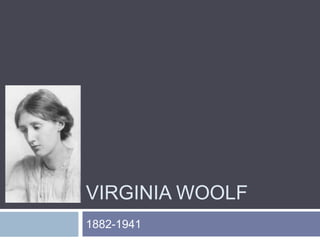
Virginia Woolf1882-1941
BiographyBorn:  Adeline Virginia Stephen in London, brought up and educated at home. 1895,she had the first of numerous nervous breakdowns. following the death of her mother later claimed to have been frequently molested by Gerald Duckworth, her half-brother, suffered psychologically from the experience. in 1904, she moved with her sister, Vanessa, and two brothers to a house in Bloomsbury. Following the death of her father (Sir Leslie Stephen, an editor and literary critic)
Bio - continued1905: began writing professionally initially for the Times Literary Supplement. In 1912 she married Leonard Woolf, a civil servant and political theorist. 1915: first novel, The Voyage Out, was published. Her novels are considered revolutionary and  pioneered literary modernism. Late 1920’s Began an affair with  writer Vita Sackville-West
Bio – part 3considered a leading modernistone of the greatest innovators in the English language. experimented with:stream-of-consciousness, underlying psychological /emotional motives of charactersfractured narrative and chronology. Impact is still felt today.
Bio – part 41941: committed suicide, by drowning herself near her home in Rodmell. She filled her pockets with stonesjumped into the Ouse River. left a suicide note: "I have a feeling I shall go mad. I cannot go on longer in these terrible times. I shan't recover this time. I hear voices and cannot concentrate on my work. I have fought against it but cannot fight any longer."
Part II:Literary Style
Literary Style“Examine for a moment an ordinary mind on an ordinary day. The mind receives a myriad impressions—trivial, fantastic, evanescent, or engraved with the sharpness of steel. . . . Let us record the atoms as they fall upon the mind in the order in which they fall, let us trace the pattern, however disconnected and incoherent in appearance, which each sight or incident scores upon the consciousness,”  - Virginia Woolf in “Modern Fiction” .
Depict Life as “Actually Experienced”
Woolf’s writing attempts to capture the fragmented, spontaneous richness of life as perceived through the human mind.Conventional narrative form:could not do justice to the tumultuous randomness of modern existence,Woolf experimented with methods that would convey: momentary sensations discontinuities of human consciousness. The self: was not something circumscribed by objects and linear narratives, perceived only in flashes. By allowing the boundaries of the self to crumble, by leaving oneself open to “exceptional moments” or “sudden shocks” of insight, one may experience “a peculiar horror and a physical collapse” as the self dissolves, but also “ecstasy” and “rapture”.
Part III:Room of One’s own
IntroForm: Extended essay (developed from two lectures).Summary: Woolf reflects on the situation of women writers over the centuries, explores the effect of material conditions and patriarchal attitudes on their intellectual and imaginative work.Themes: Women writers and intellectuals have not had the money, independence, or material comforts necessary to create their best work; women have served as supportive props to the male ego rather than developing their own abilitiesanger toward men and oppressive social conditions have tarnished the writing of some womenan androgynous mind is necessary to the creation of great literature.
Key Passages“It is strange what a difference a tail makes” “Why was one sex so prosperous and the other so poor? What effect has poverty on fiction?” “if Shakespeare had had an “extraordinarily gifted sister,” she would not have been able to realize her potential” “Anger had snatched my pencil while I dreamt. But what was anger doing there?” 000; “What is meant by ‘reality’?”  “Some collaboration has to take place in the mind between the woman and the man before the act of creation can be accomplished,”.
FeminismA Room of One’s Own has become a feminist classic. it has generated debate among both feminist and nonfeminist scholars and criticsstill influential today because it addresses fundamental issues relating to women writers and the material and social conditions under which they produced (and perhaps still produce) their work.
Shakespeare’s Sisterwhat would have happened if Shakespeare had had an “extraordinarily gifted sister” “Judith” Shakespeare, Woolf speculates, would never have been able to realize her potential, instead would have “found herself with child . . . and . . . killed herself one winter’s night”
Women’s writing and female povertycentral issue: “Why was one sex so prosperous and the other so poor? What conditions are necessary for the creation of works of art?” Woolf develops this theme through various examples:very different meals men and women are served in their respective colleges. After a skimpy meal at a woman’s college, the narrator comments, “Indeed, conversation for a moment flagged. The human frame being what it is, heart, body and brain all mixed together, . . . a good dinner is of great importance to good talk. One cannot think well, love well, sleep well if one has not dined well”
Does this also hold true for the Working Classes?Woolf muses: “Yet genius of a sort must have existed among women as it must have existed among the working classes” Woolf has sometimes been criticized for being elitist:how does Woolf’s class position affects her views.?Are her theories about writing and poverty—for both men and women—valid today?
Charlotte Brontecontroversial sectionso f the essay :described as possessing a type of “genius” that will never be “expressed whole and entire” because of the writer’s anger over women’s position in the world “Her books will be deformed and twisted. She will write in a rage where she should write calmly While this passage appears in chapter 4, the question of the relationship of anger to the creation of art is developed at length in chapter 2. Adopting the persona of a formerly poor woman who comes into some money, she explains, “by degrees fear and bitterness modified themselves into pity and toleration;  and then in a year or two pity and toleration went, and the greatest release of all came, which is freedom to think of things in themselves” In Woolf’s view, the ability “to think of things in themselves” requires a sufficient extent of economic securitysomething that Bronte did not have. many critics do not agree that indignation and rage marred Bronte’s work or that these topics are not suitable for literary contemplation.

Virginia Woolf

  • 1.
  • 2.
    BiographyBorn: AdelineVirginia Stephen in London, brought up and educated at home. 1895,she had the first of numerous nervous breakdowns. following the death of her mother later claimed to have been frequently molested by Gerald Duckworth, her half-brother, suffered psychologically from the experience. in 1904, she moved with her sister, Vanessa, and two brothers to a house in Bloomsbury. Following the death of her father (Sir Leslie Stephen, an editor and literary critic)
  • 3.
    Bio - continued1905:began writing professionally initially for the Times Literary Supplement. In 1912 she married Leonard Woolf, a civil servant and political theorist. 1915: first novel, The Voyage Out, was published. Her novels are considered revolutionary and pioneered literary modernism. Late 1920’s Began an affair with writer Vita Sackville-West
  • 4.
    Bio – part3considered a leading modernistone of the greatest innovators in the English language. experimented with:stream-of-consciousness, underlying psychological /emotional motives of charactersfractured narrative and chronology. Impact is still felt today.
  • 5.
    Bio – part41941: committed suicide, by drowning herself near her home in Rodmell. She filled her pockets with stonesjumped into the Ouse River. left a suicide note: "I have a feeling I shall go mad. I cannot go on longer in these terrible times. I shan't recover this time. I hear voices and cannot concentrate on my work. I have fought against it but cannot fight any longer."
  • 6.
  • 7.
    Literary Style“Examine fora moment an ordinary mind on an ordinary day. The mind receives a myriad impressions—trivial, fantastic, evanescent, or engraved with the sharpness of steel. . . . Let us record the atoms as they fall upon the mind in the order in which they fall, let us trace the pattern, however disconnected and incoherent in appearance, which each sight or incident scores upon the consciousness,” - Virginia Woolf in “Modern Fiction” .
  • 8.
    Depict Life as“Actually Experienced”
  • 9.
    Woolf’s writing attemptsto capture the fragmented, spontaneous richness of life as perceived through the human mind.Conventional narrative form:could not do justice to the tumultuous randomness of modern existence,Woolf experimented with methods that would convey: momentary sensations discontinuities of human consciousness. The self: was not something circumscribed by objects and linear narratives, perceived only in flashes. By allowing the boundaries of the self to crumble, by leaving oneself open to “exceptional moments” or “sudden shocks” of insight, one may experience “a peculiar horror and a physical collapse” as the self dissolves, but also “ecstasy” and “rapture”.
  • 10.
    Part III:Room ofOne’s own
  • 11.
    IntroForm: Extended essay(developed from two lectures).Summary: Woolf reflects on the situation of women writers over the centuries, explores the effect of material conditions and patriarchal attitudes on their intellectual and imaginative work.Themes: Women writers and intellectuals have not had the money, independence, or material comforts necessary to create their best work; women have served as supportive props to the male ego rather than developing their own abilitiesanger toward men and oppressive social conditions have tarnished the writing of some womenan androgynous mind is necessary to the creation of great literature.
  • 12.
    Key Passages“It isstrange what a difference a tail makes” “Why was one sex so prosperous and the other so poor? What effect has poverty on fiction?” “if Shakespeare had had an “extraordinarily gifted sister,” she would not have been able to realize her potential” “Anger had snatched my pencil while I dreamt. But what was anger doing there?” 000; “What is meant by ‘reality’?” “Some collaboration has to take place in the mind between the woman and the man before the act of creation can be accomplished,”.
  • 13.
    FeminismA Room ofOne’s Own has become a feminist classic. it has generated debate among both feminist and nonfeminist scholars and criticsstill influential today because it addresses fundamental issues relating to women writers and the material and social conditions under which they produced (and perhaps still produce) their work.
  • 14.
    Shakespeare’s Sisterwhat wouldhave happened if Shakespeare had had an “extraordinarily gifted sister” “Judith” Shakespeare, Woolf speculates, would never have been able to realize her potential, instead would have “found herself with child . . . and . . . killed herself one winter’s night”
  • 15.
    Women’s writing andfemale povertycentral issue: “Why was one sex so prosperous and the other so poor? What conditions are necessary for the creation of works of art?” Woolf develops this theme through various examples:very different meals men and women are served in their respective colleges. After a skimpy meal at a woman’s college, the narrator comments, “Indeed, conversation for a moment flagged. The human frame being what it is, heart, body and brain all mixed together, . . . a good dinner is of great importance to good talk. One cannot think well, love well, sleep well if one has not dined well”
  • 16.
    Does this alsohold true for the Working Classes?Woolf muses: “Yet genius of a sort must have existed among women as it must have existed among the working classes” Woolf has sometimes been criticized for being elitist:how does Woolf’s class position affects her views.?Are her theories about writing and poverty—for both men and women—valid today?
  • 17.
    Charlotte Brontecontroversial sectionsof the essay :described as possessing a type of “genius” that will never be “expressed whole and entire” because of the writer’s anger over women’s position in the world “Her books will be deformed and twisted. She will write in a rage where she should write calmly While this passage appears in chapter 4, the question of the relationship of anger to the creation of art is developed at length in chapter 2. Adopting the persona of a formerly poor woman who comes into some money, she explains, “by degrees fear and bitterness modified themselves into pity and toleration; and then in a year or two pity and toleration went, and the greatest release of all came, which is freedom to think of things in themselves” In Woolf’s view, the ability “to think of things in themselves” requires a sufficient extent of economic securitysomething that Bronte did not have. many critics do not agree that indignation and rage marred Bronte’s work or that these topics are not suitable for literary contemplation.