The Victorian Era Part I – Overview of an Era
"We are of the time of chivalry....We are of the age of steam."  - William Makepeace Thackery
An “Age of Transition” The Quest for Self-Definition
Never since the beginning of Time was there, that we hear or read of, so intensely self-conscious a Society. Our whole relations to the Universe and to our fellow-man have become an Inquiry, a Doubt.  — Thomas Carlyle, 1831        
Rule Britannia? Between 1800 & 1850: population doubled from nine to eighteen million  Britain became the richest country on earth first urban, industrial society in history  By 1890: 1 in 4 people on the earth were under British rule
General Characteristics: The Victorian Era was marked by: Momentous and intimidating social changes Mind-blowing inventions extraordinary energies
Industrialization Land owning aristocracy lost power The insecure, “ever expanding” urban middle class gained power Businessmen Professionals Millions of rural workers forced into poverty
Best of Times/Worst of Times… the rapidity of events produced: wild prosperity vs. unthinkable poverty  humane reforms vs. flagrant exploitation immense ambitions vs. devastating doubts An age of great achievement, deep faith, indisputable progress  AND  destruction, religious collapse, vicious profiteering
Reform and Revolutionary Fears Every social sector fought for privileges and feared the unchecked rights of the others : Campaigns to extend voting rights Men Middle class Working class Brought on fears of an armed insurrection Feared class warfare Arguments for and against trade unions Women’s equality Socialism Separation of church and state
“ Multitudinousness"  The complexity of British culture: Thwarted all attempts to define a collective identity or a clear sense of purpose  Victorians suffered from both “future shock” and information overload: steam-powered printing presses  Railways & Telegraphs Journalism and junk mail
Self-Consciously Modern: people were sure only of their differences from previous generations  traditional ways of life transforming: Life was now perilously unstable The world was now astonishingly new
We Are Not Amused… Victoria and the Victorians
"Few of us, perhaps, have realized till now how large a part she had in the life of everyone of us; how the thread of her life [bound] the warp of the nation's progress."  - A newspaper quote on the Death of the Queen in 1901
“…  the head of our morality” During the tumultuous time, The Queen ultimately came to represent: England & Empire  Stability & Continuity Duty, Family, & Propriety A stern, conservative, durable symbol of her dynamic, aggressively businesslike realm.
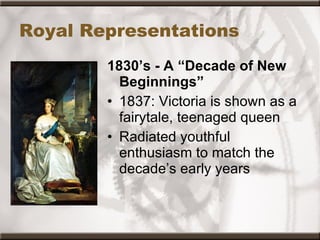
Royal Representations 1830’s - A “Decade of New Beginnings” 1837: Victoria is shown as a fairytale, teenaged queen Radiated youthful enthusiasm to match the decade’s early years
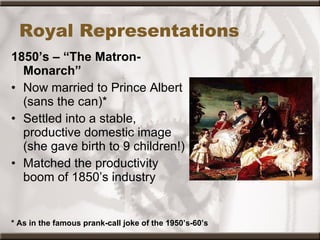
Royal Representations 1850’s – “The Matron-Monarch” Now married to Prince Albert (sans the can)* Settled into a stable, productive domestic image (she gave birth to 9 children!) Matched the productivity boom of 1850’s industry * As in the famous prank-call joke of the 1950’s-60’s
Royal Representations 1870’s - “The Widow of Windsor” Reclusive after Albert’s early death in 1861 Projected a world-weary gloominess Her aging was reflected in Britain’s own sense of maturation as an Imperial world power
An Exception to Her own Rule: Victoria herself was study in contradiction; a publicly projected image that held a privately unfulfilled ideal : World’s most powerful woman, but did not support the “mad, wicked folly of Women’s Rights”. Her face was known around the world, but she lived in constant seclusion Held as an icon of motherhood, but hated pregnancy, childbirth and babies
What is a Victorian? The adjective "Victorian" was first used in 1851 to celebrate the nation's mounting pride in its institutions and commercial success.  This historical/literary period is defined by the duration of a monarch’s rule, rather than any one unifying idea as was the case with the Romantics.
Victorian Behavior Stereotypically, “Victorian” social conduct is governed by: Strict rules Formal manners Rigidly defined gender roles Relations hampered by sexual prudery Intense obsession with a  public  appearance of propriety ( private  facts were often the compete opposite!)
Contradictory Behaviors Perceived Image: Energetic Phenomenal work ethic Sense of duty towards the “Public Good” Self-confident A Society of “over-achievers”
Contradictory Behaviors Their contemporary literature hints that: Work obsession = deliberate distraction Public responsibility = an excuse to ease doubts: Religious faith Gender roles Class privilege and Imperial rule Conservatism =  FEAR OF CHANGE Dominate the moment to keep the future (which was uncertain) at bay Great discoveries = unexpected, often distressing repercussions

The Victorian Era

  • 1.
    The Victorian EraPart I – Overview of an Era
  • 2.
    "We are ofthe time of chivalry....We are of the age of steam." - William Makepeace Thackery
  • 3.
    An “Age ofTransition” The Quest for Self-Definition
  • 4.
    Never since thebeginning of Time was there, that we hear or read of, so intensely self-conscious a Society. Our whole relations to the Universe and to our fellow-man have become an Inquiry, a Doubt. — Thomas Carlyle, 1831        
  • 5.
    Rule Britannia? Between1800 & 1850: population doubled from nine to eighteen million Britain became the richest country on earth first urban, industrial society in history By 1890: 1 in 4 people on the earth were under British rule
  • 6.
    General Characteristics: TheVictorian Era was marked by: Momentous and intimidating social changes Mind-blowing inventions extraordinary energies
  • 7.
    Industrialization Land owningaristocracy lost power The insecure, “ever expanding” urban middle class gained power Businessmen Professionals Millions of rural workers forced into poverty
  • 8.
    Best of Times/Worstof Times… the rapidity of events produced: wild prosperity vs. unthinkable poverty humane reforms vs. flagrant exploitation immense ambitions vs. devastating doubts An age of great achievement, deep faith, indisputable progress AND destruction, religious collapse, vicious profiteering
  • 9.
    Reform and RevolutionaryFears Every social sector fought for privileges and feared the unchecked rights of the others : Campaigns to extend voting rights Men Middle class Working class Brought on fears of an armed insurrection Feared class warfare Arguments for and against trade unions Women’s equality Socialism Separation of church and state
  • 10.
    “ Multitudinousness" The complexity of British culture: Thwarted all attempts to define a collective identity or a clear sense of purpose Victorians suffered from both “future shock” and information overload: steam-powered printing presses Railways & Telegraphs Journalism and junk mail
  • 11.
    Self-Consciously Modern: peoplewere sure only of their differences from previous generations traditional ways of life transforming: Life was now perilously unstable The world was now astonishingly new
  • 12.
    We Are NotAmused… Victoria and the Victorians
  • 13.
    "Few of us,perhaps, have realized till now how large a part she had in the life of everyone of us; how the thread of her life [bound] the warp of the nation's progress." - A newspaper quote on the Death of the Queen in 1901
  • 14.
    “… thehead of our morality” During the tumultuous time, The Queen ultimately came to represent: England & Empire Stability & Continuity Duty, Family, & Propriety A stern, conservative, durable symbol of her dynamic, aggressively businesslike realm.
  • 15.
    Royal Representations 1830’s- A “Decade of New Beginnings” 1837: Victoria is shown as a fairytale, teenaged queen Radiated youthful enthusiasm to match the decade’s early years
  • 16.
    Royal Representations 1850’s– “The Matron-Monarch” Now married to Prince Albert (sans the can)* Settled into a stable, productive domestic image (she gave birth to 9 children!) Matched the productivity boom of 1850’s industry * As in the famous prank-call joke of the 1950’s-60’s
  • 17.
    Royal Representations 1870’s- “The Widow of Windsor” Reclusive after Albert’s early death in 1861 Projected a world-weary gloominess Her aging was reflected in Britain’s own sense of maturation as an Imperial world power
  • 18.
    An Exception toHer own Rule: Victoria herself was study in contradiction; a publicly projected image that held a privately unfulfilled ideal : World’s most powerful woman, but did not support the “mad, wicked folly of Women’s Rights”. Her face was known around the world, but she lived in constant seclusion Held as an icon of motherhood, but hated pregnancy, childbirth and babies
  • 19.
    What is aVictorian? The adjective "Victorian" was first used in 1851 to celebrate the nation's mounting pride in its institutions and commercial success. This historical/literary period is defined by the duration of a monarch’s rule, rather than any one unifying idea as was the case with the Romantics.
  • 20.
    Victorian Behavior Stereotypically,“Victorian” social conduct is governed by: Strict rules Formal manners Rigidly defined gender roles Relations hampered by sexual prudery Intense obsession with a public appearance of propriety ( private facts were often the compete opposite!)
  • 21.
    Contradictory Behaviors PerceivedImage: Energetic Phenomenal work ethic Sense of duty towards the “Public Good” Self-confident A Society of “over-achievers”
  • 22.
    Contradictory Behaviors Theircontemporary literature hints that: Work obsession = deliberate distraction Public responsibility = an excuse to ease doubts: Religious faith Gender roles Class privilege and Imperial rule Conservatism = FEAR OF CHANGE Dominate the moment to keep the future (which was uncertain) at bay Great discoveries = unexpected, often distressing repercussions