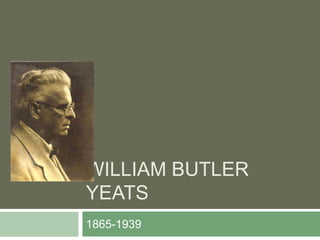
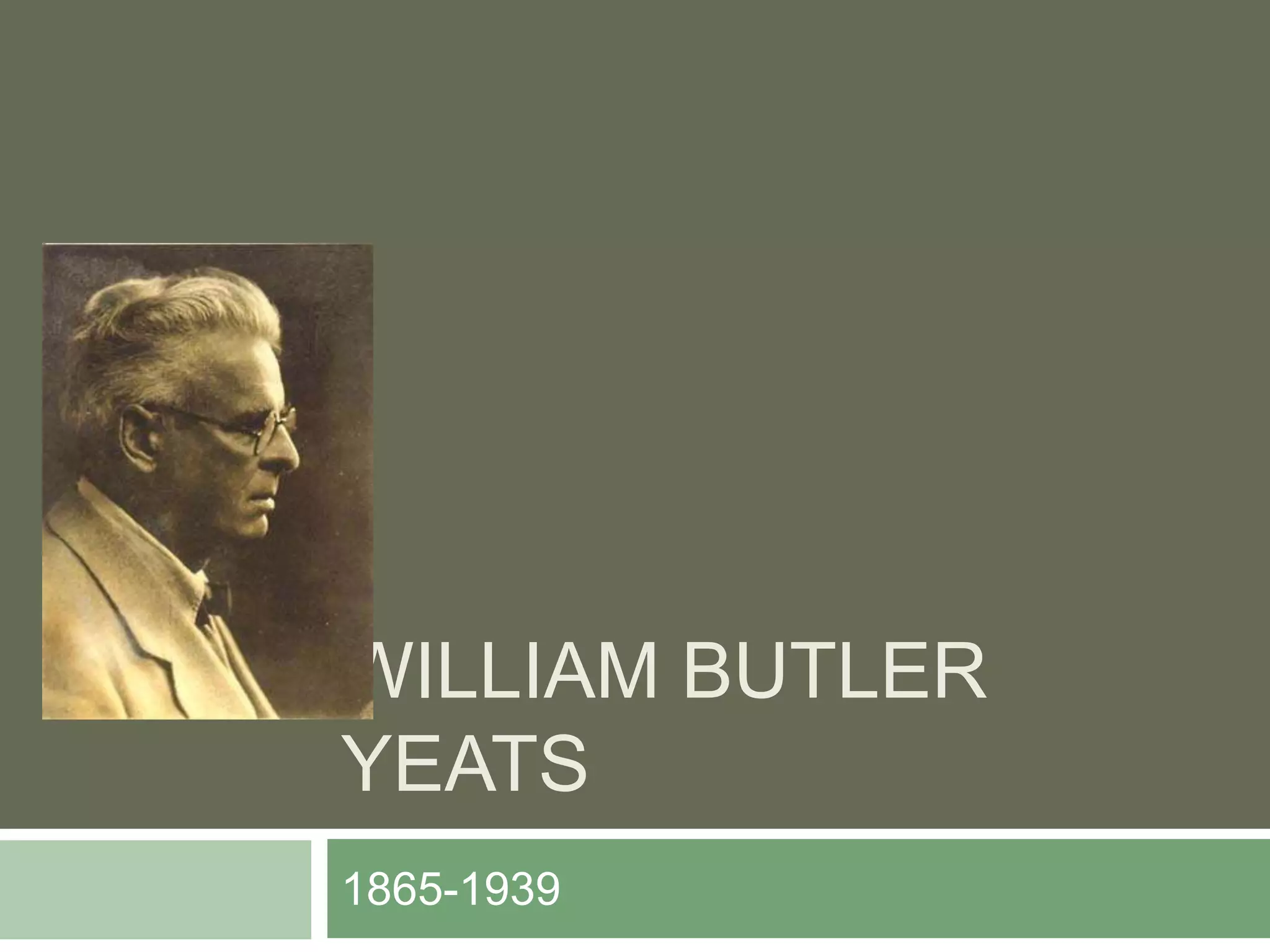
William Butler Yeats1865-1939
BiographyBorn in Dublin, Anglo-Irish familyFascinated by Irish mythology and the occultSpiritual by nature, but couldn’t accept Christian dogmaCaught up in the rise of the “Fenians”, 1890’s nationalism and the demand for Irish home rule1889 met Maud Gonneheiress and nationalistBecame infatuated with herProposed several times, but was refusedShe married another revolutionary 1908 began an affair with her
Bio - continued1916 finally marries at age 51Met wife in his occult clubsShe was an “spirit” or “automatic” writerMarriage was successful2 children1922-1928 a senator in the Irish Free State
IntroAdopts many “masks” and approachesradical nationalistclassical liberalreactionary conservative and millenarian nihilistThe gyre:Two opposing wheels set in motionGoverning creationCyclical theory of existence:All this has happened before, all this will happen againhis work is varied, contradictoryPost-colonial writereffects of British empire/colonization on literary production.Nationalism, anti-nationalism, the creation of a national identityRebellion, revolution, resistance to colonizationvacillating  and ambivalent attitudes towards the colonizerhybridity
Art/PoliticsYeats proposesA connection between art and politics that his writing brings to mindIn “Man and the Echo,” for example, Yeats asks: “Did that play of mine send out / Certain men the English shot?” (lines 11-12). The play, Cathleen niHoulihan, co-authored by Yeats with Lady Gregory, may have helped mobilize the revolutionaries who participated in the Easter Rising of 1916. draws attention to the political power of his own writing  also brings up questions about the effect of art on politics in general.
Art/PoliticsLiterature in this sense is not merely decorative or confined to rarefied academic circles, something with the potential to touch and influence events in the real world. helped to shape attitudes, however, also tells us much about existing attitudes, offers significant insights into Irish culture and history. conflicted literary responses to this history
“The Lake Isle of Innisfree”Themes: Longing for an idealized pastoral Ireland; imagining rural self-reliance and escape from urban desolationmythologizing and constructing an independent, non-British Ireland.
“The Lake Isle of Innisfree”Gives some sense of his early Romantic influencesreveals Yeats as Irish nation-builder and myth-makerHow does he imagine a free Ireland here?parallels between the speaker’s intention to “live alone” (line 4) and plant his “Nine bean-rows” (line 3), and a self-sufficient Ireland.
InnisfreeThe island’s name notions of hybridity and nationalism?Contradictory?Innisfree is literally a “free island,” real location in the west of Irelandfree from British rulealso a hybrid word, combining English with Gaelic, How the two cultures are intertwined. Yeats made a conscious decision not to use the Gaelic spelling. mythologizing an idyllic Ireland, this is the “real” Ireland, not the streets of Dublin or elsewhere. represents the life (the heart), the center, of Ireland, and as such becomes a national symbol.constructing a national identity separate from British identity.
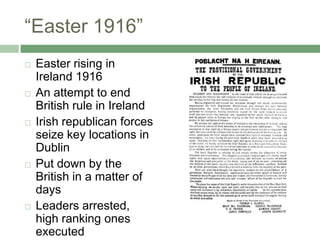
“Easter 1916”Easter rising in Ireland 1916An attempt to end British rule in IrelandIrish republican forces seize key locations in DublinPut down by the British in a matter of daysLeaders arrested, high ranking ones executed
“Easter 1916”Ambivalent toneDid not please some of his friendsfluctuating view of the Irish revolutionaries who carried out the rebellion.Look for indication of class distinctionsincere respectalso some disparaging remarkscannot be entirely erased by recognition of the rebels’ martyrdom
“Easter 1916”Too long a sacrifice / Can make a stone of the heart” admires the commitment of the revolutionariesquestions their tactics and their judgment. Believes that the English government may eventually grant the Irish their independenceasks: “Was it needless death after all? For England may keep faith” (lines 67-68).Moreover, he wonders: “what if excess of love / Bewildered [the slain nationalists] till they died?” (lines 72-73). By the final lines, the refrain: all “changed, changed utterly: / A terrible beauty is born” (lines 79-80)What is “born” here? What does Yeats think of Ireland’s future and why?
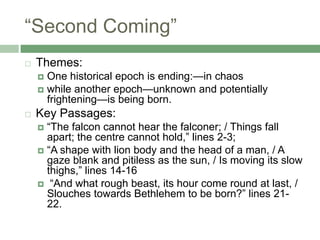
“Second Coming”Themes:One historical epoch is ending:—in chaoswhile another epoch—unknown and potentially frightening—is being born.Key Passages:“The falcon cannot hear the falconer; / Things fall apart; the centre cannot hold,” lines 2-3; “A shape with lion body and the head of a man, / A gaze blank and pitiless as the sun, / Is moving its slow thighs,” lines 14-16 “And what rough beast, its hour come round at last, / Slouches towards Bethlehem to be born?” lines 21-22.
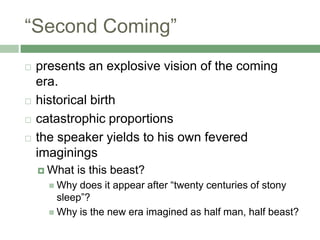
“Second Coming”presents an explosive vision of the coming era.historical birth catastrophic proportions the speaker yields to his own fevered imaginingsWhat is this beast? Why does it appear after “twenty centuries of stony sleep”?Why is the new era imagined as half man, half beast?
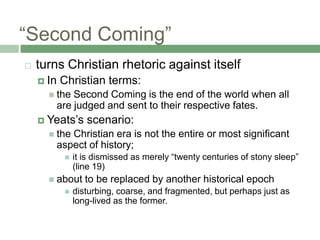
“Second Coming”turns Christian rhetoric against itselfIn Christian terms:the Second Coming is the end of the world when all are judged and sent to their respective fates.Yeats’s scenario:the Christian era is not the entire or most significant aspect of history;it is dismissed as merely “twenty centuries of stony sleep” (line 19)about to be replaced by another historical epochdisturbing, coarse, and fragmented, but perhaps just as long-lived as the former.
“Second Coming”the falcon and the falconer relationship to the disintegrating center :“The falcon cannot hear the falconer; / Things fall apart the centre cannot hold” [lines 2-3]). What do the “falcon” and “falconer” represent? Christ and the modern era? A more generalized concept of a strong leader and his public? something more abstract?Yeats’s  politics were ambivalent at this point:anti-democratic/pro-fascist tendenciesspeaker is worried about the loss of order in the worlddisorder growing out of the disturbances of war and revolution

William Butler Yeats

  • 1.
  • 2.
    BiographyBorn in Dublin,Anglo-Irish familyFascinated by Irish mythology and the occultSpiritual by nature, but couldn’t accept Christian dogmaCaught up in the rise of the “Fenians”, 1890’s nationalism and the demand for Irish home rule1889 met Maud Gonneheiress and nationalistBecame infatuated with herProposed several times, but was refusedShe married another revolutionary 1908 began an affair with her
  • 3.
    Bio - continued1916finally marries at age 51Met wife in his occult clubsShe was an “spirit” or “automatic” writerMarriage was successful2 children1922-1928 a senator in the Irish Free State
  • 4.
    IntroAdopts many “masks”and approachesradical nationalistclassical liberalreactionary conservative and millenarian nihilistThe gyre:Two opposing wheels set in motionGoverning creationCyclical theory of existence:All this has happened before, all this will happen againhis work is varied, contradictoryPost-colonial writereffects of British empire/colonization on literary production.Nationalism, anti-nationalism, the creation of a national identityRebellion, revolution, resistance to colonizationvacillating and ambivalent attitudes towards the colonizerhybridity
  • 5.
    Art/PoliticsYeats proposesA connectionbetween art and politics that his writing brings to mindIn “Man and the Echo,” for example, Yeats asks: “Did that play of mine send out / Certain men the English shot?” (lines 11-12). The play, Cathleen niHoulihan, co-authored by Yeats with Lady Gregory, may have helped mobilize the revolutionaries who participated in the Easter Rising of 1916. draws attention to the political power of his own writing also brings up questions about the effect of art on politics in general.
  • 6.
    Art/PoliticsLiterature in thissense is not merely decorative or confined to rarefied academic circles, something with the potential to touch and influence events in the real world. helped to shape attitudes, however, also tells us much about existing attitudes, offers significant insights into Irish culture and history. conflicted literary responses to this history
  • 7.
    “The Lake Isleof Innisfree”Themes: Longing for an idealized pastoral Ireland; imagining rural self-reliance and escape from urban desolationmythologizing and constructing an independent, non-British Ireland.
  • 8.
    “The Lake Isleof Innisfree”Gives some sense of his early Romantic influencesreveals Yeats as Irish nation-builder and myth-makerHow does he imagine a free Ireland here?parallels between the speaker’s intention to “live alone” (line 4) and plant his “Nine bean-rows” (line 3), and a self-sufficient Ireland.
  • 9.
    InnisfreeThe island’s namenotions of hybridity and nationalism?Contradictory?Innisfree is literally a “free island,” real location in the west of Irelandfree from British rulealso a hybrid word, combining English with Gaelic, How the two cultures are intertwined. Yeats made a conscious decision not to use the Gaelic spelling. mythologizing an idyllic Ireland, this is the “real” Ireland, not the streets of Dublin or elsewhere. represents the life (the heart), the center, of Ireland, and as such becomes a national symbol.constructing a national identity separate from British identity.
  • 10.
    “Easter 1916”Easter risingin Ireland 1916An attempt to end British rule in IrelandIrish republican forces seize key locations in DublinPut down by the British in a matter of daysLeaders arrested, high ranking ones executed
  • 11.
    “Easter 1916”Ambivalent toneDidnot please some of his friendsfluctuating view of the Irish revolutionaries who carried out the rebellion.Look for indication of class distinctionsincere respectalso some disparaging remarkscannot be entirely erased by recognition of the rebels’ martyrdom
  • 12.
    “Easter 1916”Too longa sacrifice / Can make a stone of the heart” admires the commitment of the revolutionariesquestions their tactics and their judgment. Believes that the English government may eventually grant the Irish their independenceasks: “Was it needless death after all? For England may keep faith” (lines 67-68).Moreover, he wonders: “what if excess of love / Bewildered [the slain nationalists] till they died?” (lines 72-73). By the final lines, the refrain: all “changed, changed utterly: / A terrible beauty is born” (lines 79-80)What is “born” here? What does Yeats think of Ireland’s future and why?
  • 13.
    “Second Coming”Themes:One historicalepoch is ending:—in chaoswhile another epoch—unknown and potentially frightening—is being born.Key Passages:“The falcon cannot hear the falconer; / Things fall apart; the centre cannot hold,” lines 2-3; “A shape with lion body and the head of a man, / A gaze blank and pitiless as the sun, / Is moving its slow thighs,” lines 14-16 “And what rough beast, its hour come round at last, / Slouches towards Bethlehem to be born?” lines 21-22.
  • 14.
    “Second Coming”presents anexplosive vision of the coming era.historical birth catastrophic proportions the speaker yields to his own fevered imaginingsWhat is this beast? Why does it appear after “twenty centuries of stony sleep”?Why is the new era imagined as half man, half beast?
  • 15.
    “Second Coming”turns Christianrhetoric against itselfIn Christian terms:the Second Coming is the end of the world when all are judged and sent to their respective fates.Yeats’s scenario:the Christian era is not the entire or most significant aspect of history;it is dismissed as merely “twenty centuries of stony sleep” (line 19)about to be replaced by another historical epochdisturbing, coarse, and fragmented, but perhaps just as long-lived as the former.
  • 16.
    “Second Coming”the falconand the falconer relationship to the disintegrating center :“The falcon cannot hear the falconer; / Things fall apart the centre cannot hold” [lines 2-3]). What do the “falcon” and “falconer” represent? Christ and the modern era? A more generalized concept of a strong leader and his public? something more abstract?Yeats’s politics were ambivalent at this point:anti-democratic/pro-fascist tendenciesspeaker is worried about the loss of order in the worlddisorder growing out of the disturbances of war and revolution