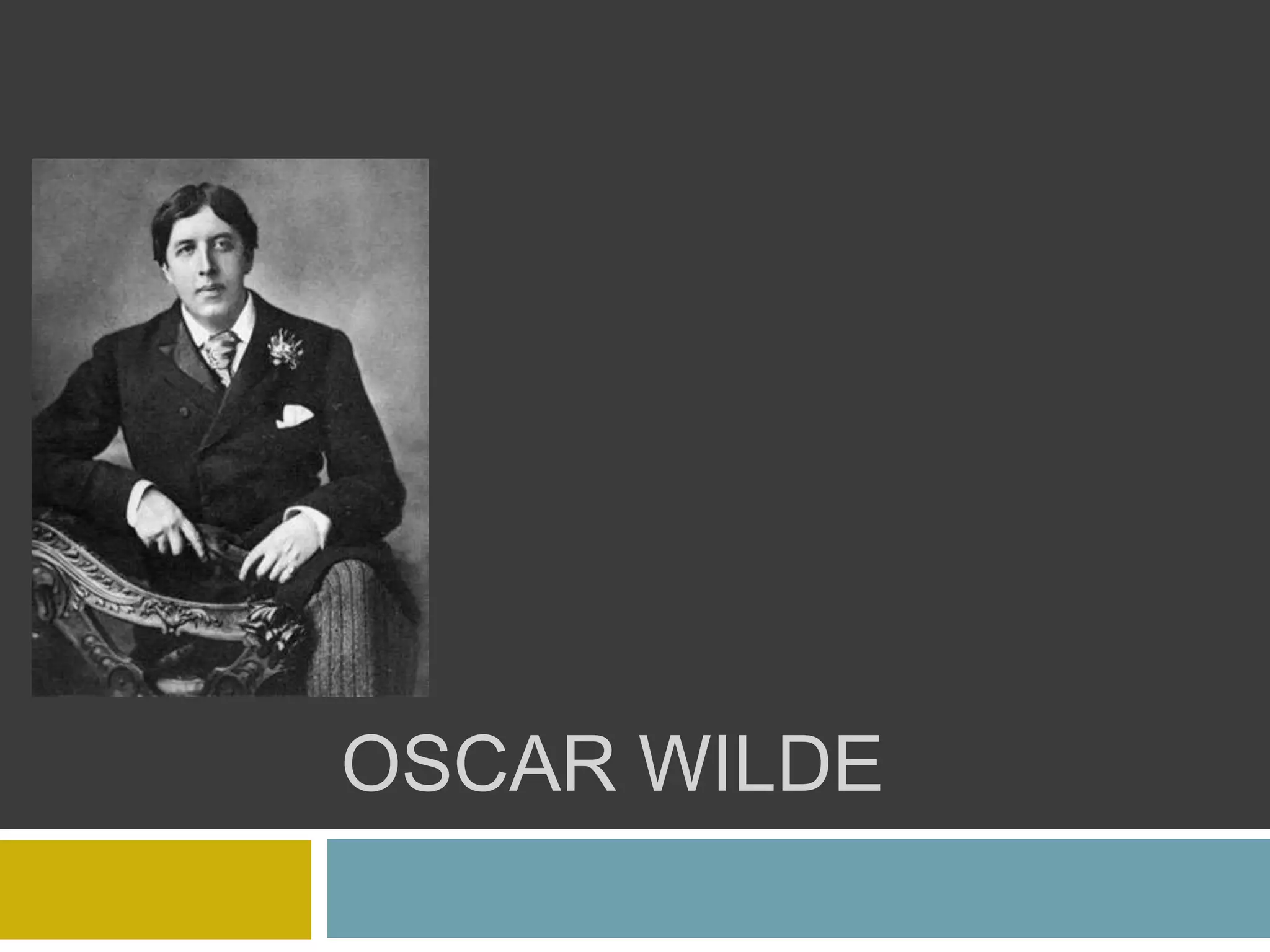
Oscar Wilde
BiographyBorn in Dublinfather physicianmother writer (poetry/prominent figure in Dublin literary society)Excelled in classical literature (Trinity C.)Scholarship to Magdalen College (Oxford)Famous for:brilliant conversation – barbed and clever wit flamboyant manner of dress & behavior“Dandy” figure based himself
Bio - contiunedStudent of “aesthetic movement” – which rejected older Victorian insistence on moral purposed of art Celebrated value of “art for art’s sakeSettled in LondonMocked Victorian notions about moral seriousness of great artTreated art as the “supreme reality” and treated life as “fiction”
Witicisms:“I have nothing to declare except my genius.”“Experience is simply the name we give our mistakes.”“A man can be happy with any woman as long as he does not love her.”
ScandalWas married with 2 childrenStill didn’t hide his relations with men1891 began a relationship with Lord Alfred DouglasAccused by the man’s father of being a homosexualWilde sued for libel, lost and was arrested.1895 famous trial, he suffered a dramatic downfall imprisoned after being convicted of "gross indecency" for homosexual acts.
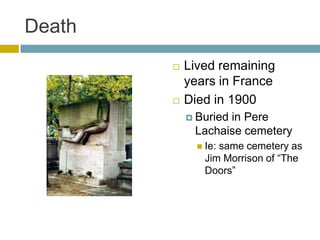
DeathLived remaining years in FranceDied in 1900Buried in Pere Lachaise cemeteryIe: same cemetery as Jim Morrison of “The Doors”
“Importance of Being Earnest”Form: Play; farce.Summary: Two young dandies seek marriages with two young women. Identity, character, personality, and ideals are tenuous and ephemeral.Themes: Appearance is more important than substancelies are more real than truthVictorian society is based on false appearances Ideals such as honesty, morality, and sincerity are meaningless.
Key passages“Nothing will induce me to part with Bunbury, and if you ever get married, which seems to me extremely problematic, you will be very glad to know Bunbury. A man who marries without knowing Bunbury has a very tedious time of it”“To be born, or at any rate, bred in a handbag, whether it had handles or not, seems to me to display a contempt for the ordinary decencies of family life that reminds one of the worst excesses of the French Revolution. And I presume you know what that unfortunate movement led to?”“I hope you have not been leading a double life, pretending to be wicked and being really good all the time. That would be hypocrisy”“The home seems to me to be the proper sphere for the man. And certainly once a man begins to neglect his domestic duties he becomes painfully effeminate, does he not?”“We live, I regret to say, in an age of surfaces”; “He has nothing, but he looks everything. What more can one desire?”“It is a terrible thing for a man to find out suddenly that all his life he has been speaking nothing but the truth,” .
Other Notes…What is the meaning of the title?Multiple meanings concerning identity and concepts such as sincerity can be wrung out of Earnest/Ernest social truths such as the “importance of a name” in high society can be inferredThe Victorian middle class was known for its earnestness and for its elevation of qualities such as duty, honesty, and hard work. The play dismantles these revered conceptsa topsy-turvy universe in which lies have a fundamental truth to them and the truth has no value at allcharacters are perfectly happy to reside in a realm of false appearances. How does humor undermine Victorian social convention?Lady Bracknell, the play’s strongest representative of upper-class sham propriety. “Algernon is an extremely, I may almost say an ostentatiously, eligible man. He has nothing, but he looks everything. What more can one desire?” Lady Bracknell’s comments here parody Victorian society by their overt concern with style over substance.
More notesGwendolyn’s speech to Jack similarly lampoons the idealism of the age: “We live, as I hope you know, Mr. Worthing, in an age of ideals . . . and my ideal has always been to love someone of the name of Ernest.” In order to emphasize the arbitrariness of social values, Wilde gives us characters whose values are always relative, changeable, and self-servingespecially those connected with the central Victorian institutions of marriage and the family. Jack and Algernon, find ways to escape from identities imposed on them by a rule-bound society:anarchic self-invention facility with a liberating, epigrammatic language that seems to spontaneously create a world of its own albeit one based just as much on appearances as the one it overturns.

Oscar Wilde

  • 1.
  • 2.
    BiographyBorn in Dublinfatherphysicianmother writer (poetry/prominent figure in Dublin literary society)Excelled in classical literature (Trinity C.)Scholarship to Magdalen College (Oxford)Famous for:brilliant conversation – barbed and clever wit flamboyant manner of dress & behavior“Dandy” figure based himself
  • 3.
    Bio - contiunedStudentof “aesthetic movement” – which rejected older Victorian insistence on moral purposed of art Celebrated value of “art for art’s sakeSettled in LondonMocked Victorian notions about moral seriousness of great artTreated art as the “supreme reality” and treated life as “fiction”
  • 4.
    Witicisms:“I have nothingto declare except my genius.”“Experience is simply the name we give our mistakes.”“A man can be happy with any woman as long as he does not love her.”
  • 5.
    ScandalWas married with2 childrenStill didn’t hide his relations with men1891 began a relationship with Lord Alfred DouglasAccused by the man’s father of being a homosexualWilde sued for libel, lost and was arrested.1895 famous trial, he suffered a dramatic downfall imprisoned after being convicted of "gross indecency" for homosexual acts.
  • 6.
    DeathLived remaining yearsin FranceDied in 1900Buried in Pere Lachaise cemeteryIe: same cemetery as Jim Morrison of “The Doors”
  • 7.
    “Importance of BeingEarnest”Form: Play; farce.Summary: Two young dandies seek marriages with two young women. Identity, character, personality, and ideals are tenuous and ephemeral.Themes: Appearance is more important than substancelies are more real than truthVictorian society is based on false appearances Ideals such as honesty, morality, and sincerity are meaningless.
  • 8.
    Key passages“Nothing willinduce me to part with Bunbury, and if you ever get married, which seems to me extremely problematic, you will be very glad to know Bunbury. A man who marries without knowing Bunbury has a very tedious time of it”“To be born, or at any rate, bred in a handbag, whether it had handles or not, seems to me to display a contempt for the ordinary decencies of family life that reminds one of the worst excesses of the French Revolution. And I presume you know what that unfortunate movement led to?”“I hope you have not been leading a double life, pretending to be wicked and being really good all the time. That would be hypocrisy”“The home seems to me to be the proper sphere for the man. And certainly once a man begins to neglect his domestic duties he becomes painfully effeminate, does he not?”“We live, I regret to say, in an age of surfaces”; “He has nothing, but he looks everything. What more can one desire?”“It is a terrible thing for a man to find out suddenly that all his life he has been speaking nothing but the truth,” .
  • 9.
    Other Notes…What isthe meaning of the title?Multiple meanings concerning identity and concepts such as sincerity can be wrung out of Earnest/Ernest social truths such as the “importance of a name” in high society can be inferredThe Victorian middle class was known for its earnestness and for its elevation of qualities such as duty, honesty, and hard work. The play dismantles these revered conceptsa topsy-turvy universe in which lies have a fundamental truth to them and the truth has no value at allcharacters are perfectly happy to reside in a realm of false appearances. How does humor undermine Victorian social convention?Lady Bracknell, the play’s strongest representative of upper-class sham propriety. “Algernon is an extremely, I may almost say an ostentatiously, eligible man. He has nothing, but he looks everything. What more can one desire?” Lady Bracknell’s comments here parody Victorian society by their overt concern with style over substance.
  • 10.
    More notesGwendolyn’s speechto Jack similarly lampoons the idealism of the age: “We live, as I hope you know, Mr. Worthing, in an age of ideals . . . and my ideal has always been to love someone of the name of Ernest.” In order to emphasize the arbitrariness of social values, Wilde gives us characters whose values are always relative, changeable, and self-servingespecially those connected with the central Victorian institutions of marriage and the family. Jack and Algernon, find ways to escape from identities imposed on them by a rule-bound society:anarchic self-invention facility with a liberating, epigrammatic language that seems to spontaneously create a world of its own albeit one based just as much on appearances as the one it overturns.