Maureen Ong
Objectives
At the end of the report:
 The students will be able to know the meaning of the
Expectancy Theory
 The student will be able to recall the three
components of the Expectancy Theory
 The students will be able to discuss the relevance of
the Expectancy Theory in the Organizational
Behavior.
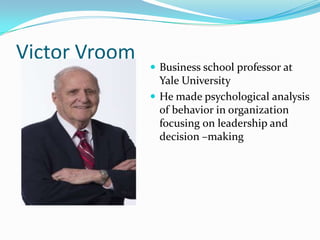
Victor Vroom

 Business school professor at

Yale University
 He made psychological analysis
of behavior in organization
focusing on leadership and
decision –making
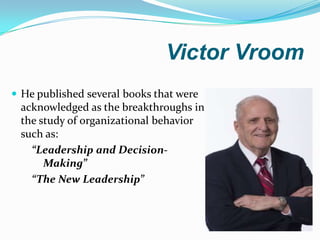
Victor Vroom
 He published several books that were

acknowledged as the breakthroughs in
the study of organizational behavior
such as:
“Leadership and DecisionMaking”
“The New Leadership”
WHAT IS
EXPECTANCY
THEORY?
The basic idea behind the theory
is that people will be motivated
because they believe that their
decision will lead to their desired
outcome" (Redmond, 2009)

"
Expectancy Theory
Proposes that a person will decide to
act in a certain way because they are
motivated to select a behavior over
other behaviors due to what they
expect the result to be.
Expectancy Theory
The theory states that individuals have different sets of
goals and can be motivated if they believe that:
There is a positive correlation between efforts and
performance.
2. Favorable performance will result in a desirable reward.
3. The reward will satisfy an important need
1.
Expectancy Theory is Based on four
assumptions:
A person join an organization with expectations
about their needs, motivation and past experiences
2. An individual’s behavior is a result of conscious
choice
3. A person want different things from the organization
(good salary, promotion, fulfillment etc)
4. A person will chooses among alternatives to be able
to optimize outcomes for them personally.
1.
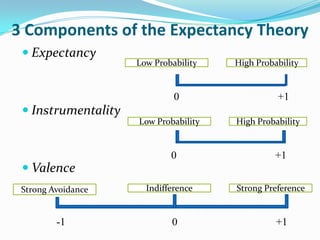
3 Components of the Expectancy Theory
 Expectancy

Low Probability

0

 Instrumentality

Low Probability

0

High Probability

+1
High Probability

+1

 Valence
Strong Avoidance

-1

Indifference

0

Strong Preference

+1
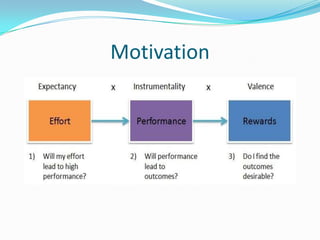
Motivation
Expectancy
The belief that higher or increased

work effort will result to better
performance or completion of a task.
Instrumentality
The perception of the person that if
he or she person performs well, a
desired outcome will result from it.
Valence
 This refers to the person’s emotional orientation to the

value of the outcome or rewards that were brought
about by the person’s effort to the performance shown.
Intrinsic Factors are those that are driven by internal
rewards such as satisfaction and pleasure felt when a
task is accomplished.
Extrinsic Factors are those that are external rewards
such as promotion, increase in salary etc.
What the management should do?
 The management must know what supervision,

trainings or resources the employees needs
 The management must ensure that promises of
rewards are fulfilled and that the employees are made
aware of that
 The management must know the employees value.
Reference
 Newstrom,John (2007).Organizational Behavior: Human Behavior at

work (12th ed.). Boston, Mass:McGrawHill

 Lunenburg, Fred(2011).Expectancy Theory of Motivation: Motivating

by Altering Expectations. International Journal of Management
,Business ,and Administration,Vol.15 No.15.
http://www.nationalforum.com/Electronic%20Journal%20Volumes/Lu
neneburg,%20Fred%20C%20Expectancy%20Theory%20%20Altering%
20E

 https://www.boundless.com/management/organizational-

behavior/process-and-motivation/expectancy-theory--2/
 http://som.yale.edu/victor-h-vroom
 https://wikispaces.psu.edu/display/PSYCH484/4.+Expectancy+Theory

expectancy theory

  • 1.
  • 2.
    Objectives At the endof the report:  The students will be able to know the meaning of the Expectancy Theory  The student will be able to recall the three components of the Expectancy Theory  The students will be able to discuss the relevance of the Expectancy Theory in the Organizational Behavior.
  • 3.
    Victor Vroom  Businessschool professor at Yale University  He made psychological analysis of behavior in organization focusing on leadership and decision –making
  • 4.
    Victor Vroom  Hepublished several books that were acknowledged as the breakthroughs in the study of organizational behavior such as: “Leadership and DecisionMaking” “The New Leadership”
  • 5.
  • 6.
    The basic ideabehind the theory is that people will be motivated because they believe that their decision will lead to their desired outcome" (Redmond, 2009) "
  • 7.
    Expectancy Theory Proposes thata person will decide to act in a certain way because they are motivated to select a behavior over other behaviors due to what they expect the result to be.
  • 8.
    Expectancy Theory The theorystates that individuals have different sets of goals and can be motivated if they believe that: There is a positive correlation between efforts and performance. 2. Favorable performance will result in a desirable reward. 3. The reward will satisfy an important need 1.
  • 9.
    Expectancy Theory isBased on four assumptions: A person join an organization with expectations about their needs, motivation and past experiences 2. An individual’s behavior is a result of conscious choice 3. A person want different things from the organization (good salary, promotion, fulfillment etc) 4. A person will chooses among alternatives to be able to optimize outcomes for them personally. 1.
  • 10.
    3 Components ofthe Expectancy Theory  Expectancy Low Probability 0  Instrumentality Low Probability 0 High Probability +1 High Probability +1  Valence Strong Avoidance -1 Indifference 0 Strong Preference +1
  • 11.
  • 12.
    Expectancy The belief thathigher or increased work effort will result to better performance or completion of a task.
  • 13.
    Instrumentality The perception ofthe person that if he or she person performs well, a desired outcome will result from it.
  • 14.
    Valence  This refersto the person’s emotional orientation to the value of the outcome or rewards that were brought about by the person’s effort to the performance shown. Intrinsic Factors are those that are driven by internal rewards such as satisfaction and pleasure felt when a task is accomplished. Extrinsic Factors are those that are external rewards such as promotion, increase in salary etc.
  • 15.
    What the managementshould do?  The management must know what supervision, trainings or resources the employees needs  The management must ensure that promises of rewards are fulfilled and that the employees are made aware of that  The management must know the employees value.
  • 17.
    Reference  Newstrom,John (2007).OrganizationalBehavior: Human Behavior at work (12th ed.). Boston, Mass:McGrawHill  Lunenburg, Fred(2011).Expectancy Theory of Motivation: Motivating by Altering Expectations. International Journal of Management ,Business ,and Administration,Vol.15 No.15. http://www.nationalforum.com/Electronic%20Journal%20Volumes/Lu neneburg,%20Fred%20C%20Expectancy%20Theory%20%20Altering% 20E  https://www.boundless.com/management/organizational- behavior/process-and-motivation/expectancy-theory--2/  http://som.yale.edu/victor-h-vroom  https://wikispaces.psu.edu/display/PSYCH484/4.+Expectancy+Theory