Expectancy Theory
• It is one of the motivation theory

• It says that individuals have different sets of goals
  and can be motivated if they have certain
  expectations

• It is about choice, it explains the processes that an
  individual undergoes to make choices

• First proposed by Victor Vroom of the Yale School of
  Management
• This theory emphasizes the needs for organizations
  to relate rewards directly to performance and to
  ensure that the rewards provided are deserved and
  wanted by the recipients.

• A number of factors can contribute to an employee’s
  expectancy perceptions:
   – the level of confidence in the skills required for the
     task
   – the amount of support that may be expected from
     superiors and subordinates
   – the quality of the materials and equipment
   – the availability of pertinent information
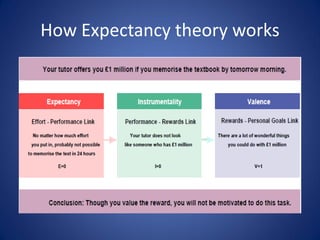
• Vroom introduces three variables within the
  expectancy theory which are
   – Expectancy (E)
   – Instrumentality (I)
   – Valence (V)
Expectancy
• Expectancy refers to the strength of a person’s
  belief about whether or not a particular job
  performance is attainable.

• This expectancy of performance may be thought
  of in terms of probabilities ranging from zero to
  1.0

• Management must discover what resources,
  training, or supervision the employees need.
  Probability or strength of belief that a particular
  action will lead to a particular first level outcome.
Instrumentality
• It is the belief that if you perform well that a
  valued outcome will be received

• This reward may come in the form of a pay
  increase, promotion, recognition or sense of
  accomplishment

• Instrumentality is low when the reward is
  given for all performances given.
Valence
• It refers to the emotional orientations which people
  hold with respect to rewards.

• The depth of the want of an employee for extrinsic
  [money, promotion, free time, benefits] or intrinsic
  [satisfaction] rewards.

• Management must discover what employees
  appreciate. For the valence to be positive, the person
  must prefer attaining the outcome to not attaining it.
• Vroom says the product of these variables is
  the motivation and suggests that an
  employee’s     beliefs  about    Expectancy,
  Instrumentality,    and   Valence   interact
  psychologically.

• In this way they create a motivational force,
  such that the employee will act in a way that
  brings pleasure and avoids pain.
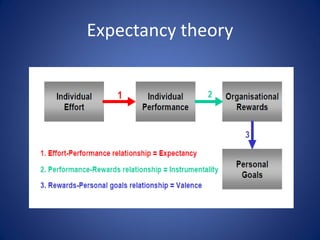
Expectancy theory
How Expectancy theory works
References
• Motivation and it’s theories
   – http://managementconsultingcourses.com/Lesson20Motivation&ItsTh
     eories.pdf
• Expectancy theory, wikipedia accessed on 29th of june 2012
   – http://en.wikipedia.org/wiki/Expectancy_theory
• Expectancy theory
   – http://www.lacpa.org.lb/Includes/Images/Docs/TC/TC341.pdf
Thank You

Expectancy theory

  • 1.
  • 2.
    • It isone of the motivation theory • It says that individuals have different sets of goals and can be motivated if they have certain expectations • It is about choice, it explains the processes that an individual undergoes to make choices • First proposed by Victor Vroom of the Yale School of Management
  • 3.
    • This theoryemphasizes the needs for organizations to relate rewards directly to performance and to ensure that the rewards provided are deserved and wanted by the recipients. • A number of factors can contribute to an employee’s expectancy perceptions: – the level of confidence in the skills required for the task – the amount of support that may be expected from superiors and subordinates – the quality of the materials and equipment – the availability of pertinent information
  • 4.
    • Vroom introducesthree variables within the expectancy theory which are – Expectancy (E) – Instrumentality (I) – Valence (V)
  • 5.
    Expectancy • Expectancy refersto the strength of a person’s belief about whether or not a particular job performance is attainable. • This expectancy of performance may be thought of in terms of probabilities ranging from zero to 1.0 • Management must discover what resources, training, or supervision the employees need. Probability or strength of belief that a particular action will lead to a particular first level outcome.
  • 6.
    Instrumentality • It isthe belief that if you perform well that a valued outcome will be received • This reward may come in the form of a pay increase, promotion, recognition or sense of accomplishment • Instrumentality is low when the reward is given for all performances given.
  • 7.
    Valence • It refersto the emotional orientations which people hold with respect to rewards. • The depth of the want of an employee for extrinsic [money, promotion, free time, benefits] or intrinsic [satisfaction] rewards. • Management must discover what employees appreciate. For the valence to be positive, the person must prefer attaining the outcome to not attaining it.
  • 8.
    • Vroom saysthe product of these variables is the motivation and suggests that an employee’s beliefs about Expectancy, Instrumentality, and Valence interact psychologically. • In this way they create a motivational force, such that the employee will act in a way that brings pleasure and avoids pain.
  • 9.
  • 10.
  • 11.
    References • Motivation andit’s theories – http://managementconsultingcourses.com/Lesson20Motivation&ItsTh eories.pdf • Expectancy theory, wikipedia accessed on 29th of june 2012 – http://en.wikipedia.org/wiki/Expectancy_theory • Expectancy theory – http://www.lacpa.org.lb/Includes/Images/Docs/TC/TC341.pdf
  • 12.