By- Himani Panwar
MBA II Sem
On-the-Job Training
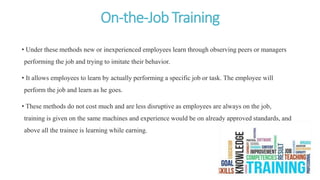
• Under these methods new or inexperienced employees learn through observing peers or managers
performing the job and trying to imitate their behavior.
• It allows employees to learn by actually performing a specific job or task. The employee will
perform the job and learn as he goes.
• These methods do not cost much and are less disruptive as employees are always on the job,
training is given on the same machines and experience would be on already approved standards, and
above all the trainee is learning while earning.
Example
Madhuri hired a new candy wrapper named Jacqueline.
 Jacqueline had no experience working in a candy factory. In fact, Jacqueline had no experience
working on an assembly line either.
As the candies move along the assembly line, Jacqueline learned how to wrap each candy while
working alongside a more experienced candy wrapper Madhuri.
The more experienced candy wrapper showed Jacqueline exactly how to wrap candies, how to time
the assembly line and how to detect irregularly shaped candies.
If Jacqueline made a mistake, Madhuri would be able to correct it immediately.
Advantages
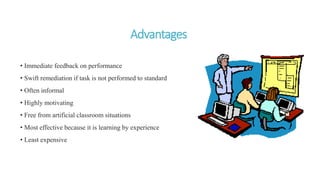
• Immediate feedback on performance
• Swift remediation if task is not performed to standard
• Often informal
• Highly motivating
• Free from artificial classroom situations
• Most effective because it is learning by experience
• Least expensive
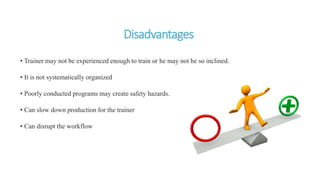
Disadvantages
• Trainer may not be experienced enough to train or he may not be so inclined.
• It is not systematically organized
• Poorly conducted programs may create safety hazards.
• Can slow down production for the trainer
• Can disrupt the workflow
Methods
Job Rotation
Coaching
Job Instruction
Committee Assignments
Apprenticeship
Mentoring
Understudy
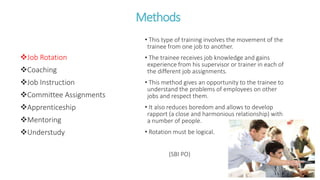
• This type of training involves the movement of the
trainee from one job to another.
• The trainee receives job knowledge and gains
experience from his supervisor or trainer in each of
the different job assignments.
• This method gives an opportunity to the trainee to
understand the problems of employees on other
jobs and respect them.
• It also reduces boredom and allows to develop
rapport (a close and harmonious relationship) with
a number of people.
• Rotation must be logical.
(SBI PO)
Methods
Job Rotation
Coaching
Job Instruction
Committee Assignments
Apprenticeship
Mentoring
Understudy
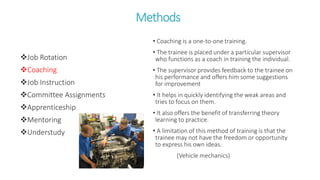
• Coaching is a one-to-one training.
• The trainee is placed under a particular supervisor
who functions as a coach in training the individual.
• The supervisor provides feedback to the trainee on
his performance and offers him some suggestions
for improvement
• It helps in quickly identifying the weak areas and
tries to focus on them.
• It also offers the benefit of transferring theory
learning to practice.
• A limitation of this method of training is that the
trainee may not have the freedom or opportunity
to express his own ideas.
(Vehicle mechanics)
Methods
Job Rotation
Coaching
Job Instruction
Committee Assignments
Apprenticeship
Mentoring
Understudy
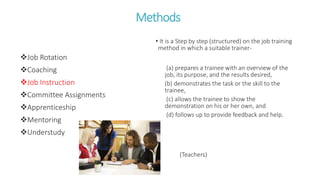
• It is a Step by step (structured) on the job training
method in which a suitable trainer-
(a) prepares a trainee with an overview of the
job, its purpose, and the results desired,
(b) demonstrates the task or the skill to the
trainee,
(c) allows the trainee to show the
demonstration on his or her own, and
(d) follows up to provide feedback and help.
(Teachers)
Methods
Job Rotation
Coaching
Job Instruction
Committee Assignments
Apprenticeship
Mentoring
Understudy
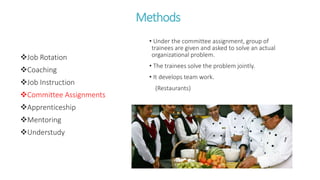
• Under the committee assignment, group of
trainees are given and asked to solve an actual
organizational problem.
• The trainees solve the problem jointly.
• It develops team work.
(Restaurants)
Methods
Job Rotation
Coaching
Job Instruction
Committee Assignments
Apprenticeship
Mentoring
Understudy
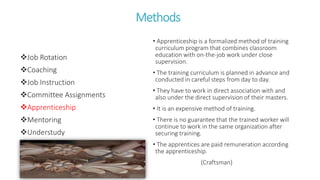
• Apprenticeship is a formalized method of training
curriculum program that combines classroom
education with on-the-job work under close
supervision.
• The training curriculum is planned in advance and
conducted in careful steps from day to day.
• They have to work in direct association with and
also under the direct supervision of their masters.
• It is an expensive method of training.
• There is no guarantee that the trained worker will
continue to work in the same organization after
securing training.
• The apprentices are paid remuneration according
the apprenticeship.
(Craftsman)
Methods
Job Rotation
Coaching
Job Instruction
Committee Assignments
Apprenticeship
Mentoring
Understudy
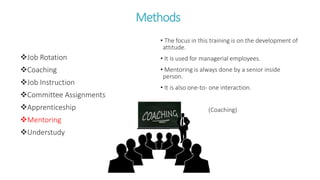
• The focus in this training is on the development of
attitude.
• It is used for managerial employees.
• Mentoring is always done by a senior inside
person.
• It is also one-to- one interaction.
(Coaching)
Methods
Job Rotation
Coaching
Job Instruction
Committee Assignments
Apprenticeship
Mentoring
Understudy
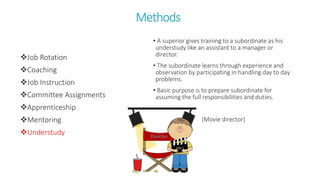
• A superior gives training to a subordinate as his
understudy like an assistant to a manager or
director.
• The subordinate learns through experience and
observation by participating in handling day to day
problems.
• Basic purpose is to prepare subordinate for
assuming the full responsibilities and duties.
(Movie director)
On the Job Training

On the Job Training

  • 1.
  • 2.
    On-the-Job Training • Underthese methods new or inexperienced employees learn through observing peers or managers performing the job and trying to imitate their behavior. • It allows employees to learn by actually performing a specific job or task. The employee will perform the job and learn as he goes. • These methods do not cost much and are less disruptive as employees are always on the job, training is given on the same machines and experience would be on already approved standards, and above all the trainee is learning while earning.
  • 3.
    Example Madhuri hired anew candy wrapper named Jacqueline.  Jacqueline had no experience working in a candy factory. In fact, Jacqueline had no experience working on an assembly line either. As the candies move along the assembly line, Jacqueline learned how to wrap each candy while working alongside a more experienced candy wrapper Madhuri. The more experienced candy wrapper showed Jacqueline exactly how to wrap candies, how to time the assembly line and how to detect irregularly shaped candies. If Jacqueline made a mistake, Madhuri would be able to correct it immediately.
  • 4.
    Advantages • Immediate feedbackon performance • Swift remediation if task is not performed to standard • Often informal • Highly motivating • Free from artificial classroom situations • Most effective because it is learning by experience • Least expensive
  • 5.
    Disadvantages • Trainer maynot be experienced enough to train or he may not be so inclined. • It is not systematically organized • Poorly conducted programs may create safety hazards. • Can slow down production for the trainer • Can disrupt the workflow
  • 6.
    Methods Job Rotation Coaching Job Instruction CommitteeAssignments Apprenticeship Mentoring Understudy • This type of training involves the movement of the trainee from one job to another. • The trainee receives job knowledge and gains experience from his supervisor or trainer in each of the different job assignments. • This method gives an opportunity to the trainee to understand the problems of employees on other jobs and respect them. • It also reduces boredom and allows to develop rapport (a close and harmonious relationship) with a number of people. • Rotation must be logical. (SBI PO)
  • 7.
    Methods Job Rotation Coaching Job Instruction CommitteeAssignments Apprenticeship Mentoring Understudy • Coaching is a one-to-one training. • The trainee is placed under a particular supervisor who functions as a coach in training the individual. • The supervisor provides feedback to the trainee on his performance and offers him some suggestions for improvement • It helps in quickly identifying the weak areas and tries to focus on them. • It also offers the benefit of transferring theory learning to practice. • A limitation of this method of training is that the trainee may not have the freedom or opportunity to express his own ideas. (Vehicle mechanics)
  • 8.
    Methods Job Rotation Coaching Job Instruction CommitteeAssignments Apprenticeship Mentoring Understudy • It is a Step by step (structured) on the job training method in which a suitable trainer- (a) prepares a trainee with an overview of the job, its purpose, and the results desired, (b) demonstrates the task or the skill to the trainee, (c) allows the trainee to show the demonstration on his or her own, and (d) follows up to provide feedback and help. (Teachers)
  • 9.
    Methods Job Rotation Coaching Job Instruction CommitteeAssignments Apprenticeship Mentoring Understudy • Under the committee assignment, group of trainees are given and asked to solve an actual organizational problem. • The trainees solve the problem jointly. • It develops team work. (Restaurants)
  • 10.
    Methods Job Rotation Coaching Job Instruction CommitteeAssignments Apprenticeship Mentoring Understudy • Apprenticeship is a formalized method of training curriculum program that combines classroom education with on-the-job work under close supervision. • The training curriculum is planned in advance and conducted in careful steps from day to day. • They have to work in direct association with and also under the direct supervision of their masters. • It is an expensive method of training. • There is no guarantee that the trained worker will continue to work in the same organization after securing training. • The apprentices are paid remuneration according the apprenticeship. (Craftsman)
  • 11.
    Methods Job Rotation Coaching Job Instruction CommitteeAssignments Apprenticeship Mentoring Understudy • The focus in this training is on the development of attitude. • It is used for managerial employees. • Mentoring is always done by a senior inside person. • It is also one-to- one interaction. (Coaching)
  • 12.
    Methods Job Rotation Coaching Job Instruction CommitteeAssignments Apprenticeship Mentoring Understudy • A superior gives training to a subordinate as his understudy like an assistant to a manager or director. • The subordinate learns through experience and observation by participating in handling day to day problems. • Basic purpose is to prepare subordinate for assuming the full responsibilities and duties. (Movie director)