This theory is about choice, it explains
the processes that an individual
undergoes to make choices. In
organizational behavior study,
expectancy theory is a motivation
theory first proposed by Victor Vroom
of the Yale School of Management.
The expectancy theory says that
individuals have different sets of goals
and can be motivated if they have certain
expectations..
As we are constantly predicting likely
futures, we create expectations about
future events. If things seem reasonably
likely and attractive, we know how to get
there and we believe we can make the
difference then this will motivate us to act
to make this future come true.
In other words, if people expect a
positive and desirable outcome,
they will usually work hard to
perform at the level expected of
them.
The expectancy theory of motivation
suggested by Vroom, unlike Maslow and
Herzberg, does not concentrate on needs,
but rather focuses on outcomes.
Whereas Maslow and Herzberg look at
the relationship between internal needs
and the resulting effort expended to
fulfill them, Vroom separates effort,
which arises from motivation,
performance, and outcomes.
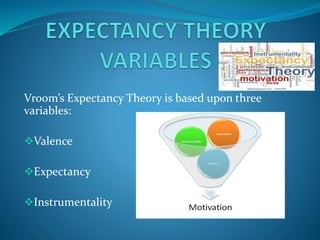
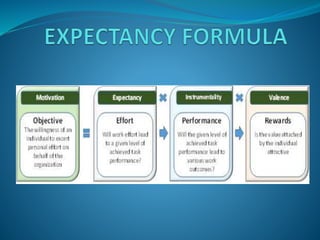
Vroom’s Expectancy Theory is based upon three
variables:
Valence
Expectancy
Instrumentality
“Is the outcome I get of any value to me?”.
 It refers to the emotional orientations
which people hold with respect to outcomes
[rewards]. The depth of the want of an
employee for extrinsic [money, promotion,
free time, benefits] or intrinsic [satisfaction]
rewards.
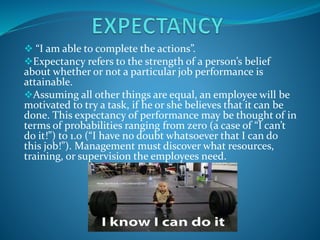
 “I am able to complete the actions”.
Expectancy refers to the strength of a person’s belief
about whether or not a particular job performance is
attainable.
Assuming all other things are equal, an employee will be
motivated to try a task, if he or she believes that it can be
done. This expectancy of performance may be thought of in
terms of probabilities ranging from zero (a case of “I can’t
do it!”) to 1.0 (“I have no doubt whatsoever that I can do
this job!”). Management must discover what resources,
training, or supervision the employees need.
The belief that “if I complete certain actions then I will achieve
the outcome”.
In other words, it is the belief that if you perform well that a
valued outcome will be received i.e. “if I do a good job, there is
something in it for me”.
Instrumentality may range from a probability of 1.0 (meaning
that the attainment of the second outcome, the reward, is certain
if the first outcome, excellent job performance, is attained)
through zero (meaning there is no likely relationship between
the first outcome and the second).
Expectancy  theory

Expectancy theory

  • 1.
    This theory isabout choice, it explains the processes that an individual undergoes to make choices. In organizational behavior study, expectancy theory is a motivation theory first proposed by Victor Vroom of the Yale School of Management.
  • 2.
    The expectancy theorysays that individuals have different sets of goals and can be motivated if they have certain expectations.. As we are constantly predicting likely futures, we create expectations about future events. If things seem reasonably likely and attractive, we know how to get there and we believe we can make the difference then this will motivate us to act to make this future come true.
  • 3.
    In other words,if people expect a positive and desirable outcome, they will usually work hard to perform at the level expected of them.
  • 4.
    The expectancy theoryof motivation suggested by Vroom, unlike Maslow and Herzberg, does not concentrate on needs, but rather focuses on outcomes. Whereas Maslow and Herzberg look at the relationship between internal needs and the resulting effort expended to fulfill them, Vroom separates effort, which arises from motivation, performance, and outcomes.
  • 5.
    Vroom’s Expectancy Theoryis based upon three variables: Valence Expectancy Instrumentality
  • 6.
    “Is the outcomeI get of any value to me?”.  It refers to the emotional orientations which people hold with respect to outcomes [rewards]. The depth of the want of an employee for extrinsic [money, promotion, free time, benefits] or intrinsic [satisfaction] rewards.
  • 7.
     “I amable to complete the actions”. Expectancy refers to the strength of a person’s belief about whether or not a particular job performance is attainable. Assuming all other things are equal, an employee will be motivated to try a task, if he or she believes that it can be done. This expectancy of performance may be thought of in terms of probabilities ranging from zero (a case of “I can’t do it!”) to 1.0 (“I have no doubt whatsoever that I can do this job!”). Management must discover what resources, training, or supervision the employees need.
  • 8.
    The belief that“if I complete certain actions then I will achieve the outcome”. In other words, it is the belief that if you perform well that a valued outcome will be received i.e. “if I do a good job, there is something in it for me”. Instrumentality may range from a probability of 1.0 (meaning that the attainment of the second outcome, the reward, is certain if the first outcome, excellent job performance, is attained) through zero (meaning there is no likely relationship between the first outcome and the second).