
Scope of
Leadership
Presented
by:
Pakhi Jain
LeadershipAcc. To the Business Dictionary- The activity of leading a group of
people or an organization or the ability to do this. Leadership involves
establishing a clear vision, sharing that vision with others so that they
will follow willingly,
providing the information, knowledge and methods to realize
that vision, and coordinating and balancing the conflicting
interests of all members and stakeholders.
Acc. To Forbes magazine Leadership is a process of social
influence, which maximizes the efforts of others, towards the
achievement of a goal.
Peter Ducker stated- “Management is doing the right things
and Leadership is doing the things right”
Self-
LeadershipBirth and birthright are natural boundaries of one’s
leadership scope. Your birth naturally ordains that You, Lead
you!
The eight variables that increase or limit your scope of
leadership in life are purpose, gifting, skill, responsibility,
respect, maturity, credibility and honour. Your degree of
or mastery of these elements determines the extent of your
scope of leadership or your authority to instruct and direct
others.
To increase your leadership scope, lead yourself well first.-
Pastor Joe Flores
1. Understanding and maintaining the Ethics related to
work
Leadership as a process includes the maintenance of ethical
behavior.
A study conducted by Frank Stantton Morris- A Descriptive
Quantitative survey with open ended questions on
36Aarizona police officers to answer two research questions,
“ How does a Police Chief demonstrates his/her personal
ethics based leadership standards?” and “ How does the
police chief maintains his/her ethical standards?”
It was found that police chiefs believed in more guidelines
laid by the organization and worked in the same direction
ethically rather than following personal preferences.
Ethical leadership: Ethical leadership is both visible and
invisible. The visible part is in the way the leader works with
and treats others, in his behavior in public, in his statements
and his actions. The invisible aspects of ethical leadership lie
in the leader’s character, in his decision-making process, in
his mindset, in the set of values and principles on which he
draws, and in his courage to make ethical decisions in tough
situations.
Ethical leaders are ethical all the time, not just when
someone’s looking; and they’re ethical over time, proving
again and again that ethics are an integral part of the
intellectual and philosophical framework they use to
understand and relate to the world.
2. Creating a healthy culture and climate of the
organization
A research conducted by Yafang Tsai, conducted in the year 2010, found
a relationship between Organizational culture, leadership behaviour and
Job satisfaction.
It was a cross-sectional study focused on hospital nurses in Taiwan. Data
was collected using a structured questionnaire.
Results indicated: Organizational cultures were significantly (positively)
correlated with leadership behavior and job satisfaction, and leadership
behavior was significantly (positively) correlated with job satisfaction.
The culture within an organization is very important, playing a large role
in whether it is a happy and healthy environment in which to work. In
communicating and promoting the organizational ethos to employees,
their acknowledgement and acceptance of it can influence their work
behavior and attitudes. When the interaction between the leadership and
employees is good, the latter will make a greater contribution to team
communication and collaboration, and will also be encouraged to
accomplish the mission and objectives assigned by the organization,
thereby enhancing job satisfaction.
3. Understanding the process of receptivity to change
and maintaining it
In a chapter written by John G. Bruhen, “ Leaders who
create change and manage it- How leaders Limit success. He
ahs specifically talked about the importance of leaders to
implement the change and manage it of the organizations
success. He states “leaders limit success of the organization
by the way they manage the change”
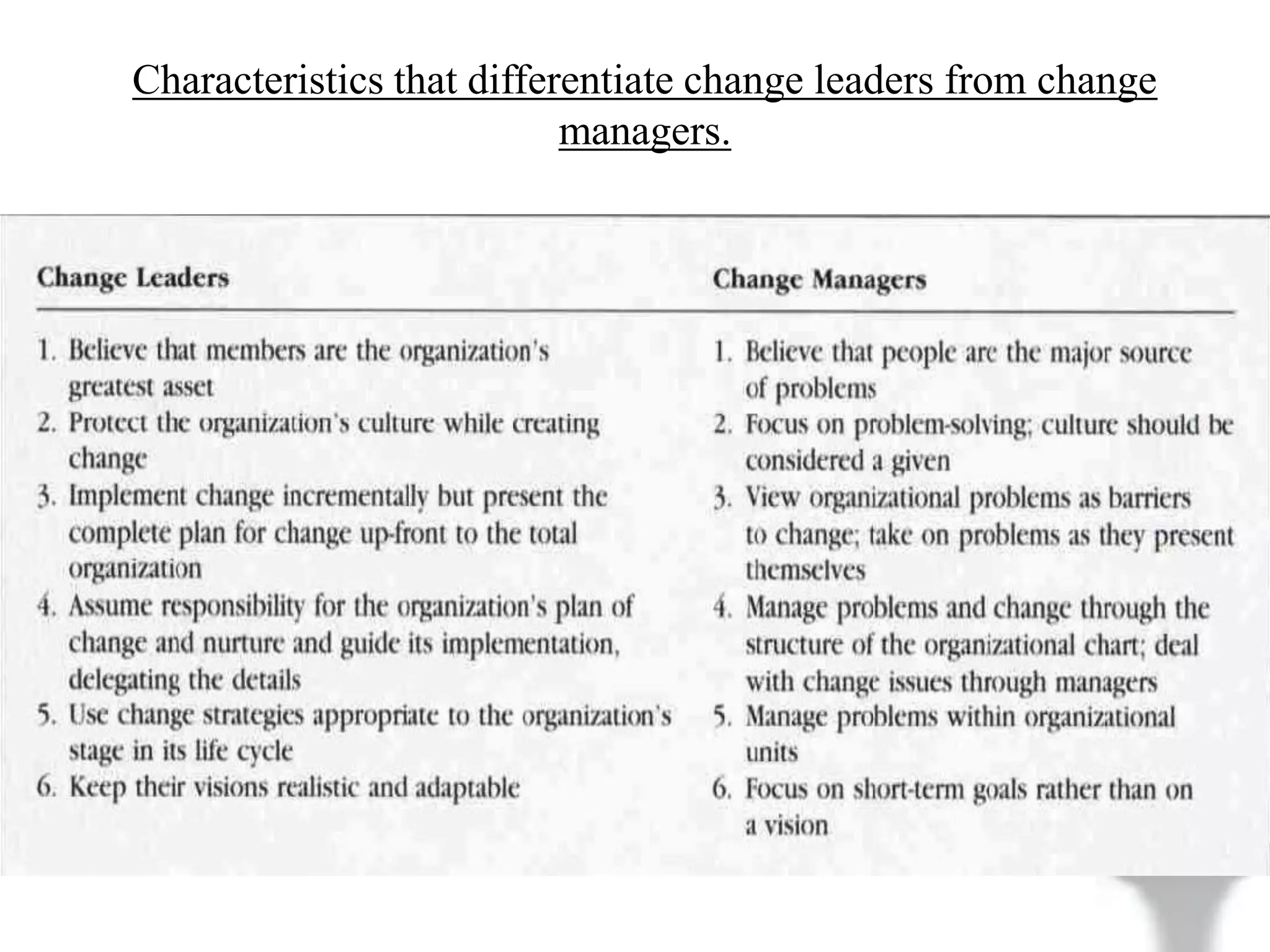
Characteristics that differentiate change leaders from change
managers.
Characteristics that differentiate change leaders from change
managers.
4. Understanding the process of Decision making and making
decisions accordingly.
In a paper on “ Leadership and Decision Making” by Victor H. Vroom
and Arthur Jago.
Vroom and Yetton worked exclusively with group problems and with an
experimental design which called for 30 cases. The results, obtained
from
investigations of eight distinct populations comprising over 500
managers.
• They found only 10 percent could be accounted for general tendencies
to be autocratic or participative. (as expressed in differences among
individuals)
• 30 percent was attributable to situational effects. (differences in
situations)
• 60 percent was attributed to other forms of individual differences
(difference in managers in tailoring their approach according to the
situation)
These are the differences in decision rules that the leaders employ
concerning when to encourage participation.
5. Understanding the process of Decision making and making
decisions accordingly.
An article printed in Forbes Magazine states- “A leader who is a strong
communicator has a chance to be successful through his or her
followers. A weak communicator has no chance at all.”
A dissertation done by Raymond J Dean, entails the topic Leadership
communication and Organization Change. This study explored the effect
of leadership communication on employee perceptions of an
organizational change at two nuclear power plants. The results of the
study demonstrated that a relationship exists between leadership
communications and employee perceptions of an organizational change.
The data collected indicates that the content and frequency of
communications can affect employee perceptions of organizational
justice and empowerment. In addition, the communication strategies
employed in the organizational change were seen as indicators of
leadership style by the individuals who received the communications.
References
•Dean J. R. (n.y.), Leadership communications and organizational change: A
case study of the effect of leadership communications in shaping employee
perceptions of change efforts at two nuclear power facilities [ HTML
Document]. Retrived [04.02.14]. From the World Wide Web,
http://udini.proquest.com/view/leadership-communications-and-
goid:304820342/
• Pastor Flores J. (May 27, 2013), America Preachers.Com, Increasing Your
Leadership Scope [HTML Document]. Retrieved [02.02.14] From the World
Wide Web, http://www.americapreachers.com/christian-news/increasing-
your-leadership-scope/
• Kruse K. (2013), On What is Leadership?. Forbes Magazine. 20-22
• Morris S. F. (n.y.), Demonstrating Leadership and Maintaining Ethical
Standards [HTML Document]. Retrieved [29.01.14]. From World Wide Web,
http://books.google.co.in/books?id=PghALP-
6KIwC&pg=PA2&lpg=PA2&dq=leadership+and+maintaining+guidelines&sourc
e=bl&ots=hUltsp9Bnn&sig=ZzruOfVhDyULQIq-
E7ATPgl4ry4&hl=en&sa=X&ei=psLvUuvvM8y-
rgfc3oHgCw&ved=0CCwQ6AEwAQ#v=onepage&q=leadership%20and%20mai
ntaining%20guidelines&f=false
References
• Vroom H.V. & Jago G.A. (1974), On Leadership and Decision Making.
Decision Sciences. Volume 5, pp. 743-755.
• Morgan N. (2013). On Is Leadership all about communication?. Leadership
[HTML Document]. Retrieved on [02.02.14]. From World Wide Web,
http://www.forbes.com/sites/nickmorgan/2013/01/29/is-leadership-all-
about-communications/
• Tsai Y. (2011), On Relationship between Organizational Culture, Leadership
Behavior and Job Satisfaction. BMC Health Services Research.
doi:10.1186/1472-6963-11-98
Thank You

Scope of leadership

  • 1.
  • 2.
    LeadershipAcc. To theBusiness Dictionary- The activity of leading a group of people or an organization or the ability to do this. Leadership involves establishing a clear vision, sharing that vision with others so that they will follow willingly, providing the information, knowledge and methods to realize that vision, and coordinating and balancing the conflicting interests of all members and stakeholders. Acc. To Forbes magazine Leadership is a process of social influence, which maximizes the efforts of others, towards the achievement of a goal. Peter Ducker stated- “Management is doing the right things and Leadership is doing the things right”
  • 4.
    Self- LeadershipBirth and birthrightare natural boundaries of one’s leadership scope. Your birth naturally ordains that You, Lead you! The eight variables that increase or limit your scope of leadership in life are purpose, gifting, skill, responsibility, respect, maturity, credibility and honour. Your degree of or mastery of these elements determines the extent of your scope of leadership or your authority to instruct and direct others. To increase your leadership scope, lead yourself well first.- Pastor Joe Flores
  • 5.
    1. Understanding andmaintaining the Ethics related to work Leadership as a process includes the maintenance of ethical behavior. A study conducted by Frank Stantton Morris- A Descriptive Quantitative survey with open ended questions on 36Aarizona police officers to answer two research questions, “ How does a Police Chief demonstrates his/her personal ethics based leadership standards?” and “ How does the police chief maintains his/her ethical standards?” It was found that police chiefs believed in more guidelines laid by the organization and worked in the same direction ethically rather than following personal preferences.
  • 6.
    Ethical leadership: Ethicalleadership is both visible and invisible. The visible part is in the way the leader works with and treats others, in his behavior in public, in his statements and his actions. The invisible aspects of ethical leadership lie in the leader’s character, in his decision-making process, in his mindset, in the set of values and principles on which he draws, and in his courage to make ethical decisions in tough situations. Ethical leaders are ethical all the time, not just when someone’s looking; and they’re ethical over time, proving again and again that ethics are an integral part of the intellectual and philosophical framework they use to understand and relate to the world.
  • 7.
    2. Creating ahealthy culture and climate of the organization A research conducted by Yafang Tsai, conducted in the year 2010, found a relationship between Organizational culture, leadership behaviour and Job satisfaction. It was a cross-sectional study focused on hospital nurses in Taiwan. Data was collected using a structured questionnaire. Results indicated: Organizational cultures were significantly (positively) correlated with leadership behavior and job satisfaction, and leadership behavior was significantly (positively) correlated with job satisfaction. The culture within an organization is very important, playing a large role in whether it is a happy and healthy environment in which to work. In communicating and promoting the organizational ethos to employees, their acknowledgement and acceptance of it can influence their work behavior and attitudes. When the interaction between the leadership and employees is good, the latter will make a greater contribution to team communication and collaboration, and will also be encouraged to accomplish the mission and objectives assigned by the organization, thereby enhancing job satisfaction.
  • 8.
    3. Understanding theprocess of receptivity to change and maintaining it In a chapter written by John G. Bruhen, “ Leaders who create change and manage it- How leaders Limit success. He ahs specifically talked about the importance of leaders to implement the change and manage it of the organizations success. He states “leaders limit success of the organization by the way they manage the change” Characteristics that differentiate change leaders from change managers.
  • 9.
    Characteristics that differentiatechange leaders from change managers.
  • 10.
    4. Understanding theprocess of Decision making and making decisions accordingly. In a paper on “ Leadership and Decision Making” by Victor H. Vroom and Arthur Jago. Vroom and Yetton worked exclusively with group problems and with an experimental design which called for 30 cases. The results, obtained from investigations of eight distinct populations comprising over 500 managers. • They found only 10 percent could be accounted for general tendencies to be autocratic or participative. (as expressed in differences among individuals) • 30 percent was attributable to situational effects. (differences in situations) • 60 percent was attributed to other forms of individual differences (difference in managers in tailoring their approach according to the situation) These are the differences in decision rules that the leaders employ concerning when to encourage participation.
  • 11.
    5. Understanding theprocess of Decision making and making decisions accordingly. An article printed in Forbes Magazine states- “A leader who is a strong communicator has a chance to be successful through his or her followers. A weak communicator has no chance at all.” A dissertation done by Raymond J Dean, entails the topic Leadership communication and Organization Change. This study explored the effect of leadership communication on employee perceptions of an organizational change at two nuclear power plants. The results of the study demonstrated that a relationship exists between leadership communications and employee perceptions of an organizational change. The data collected indicates that the content and frequency of communications can affect employee perceptions of organizational justice and empowerment. In addition, the communication strategies employed in the organizational change were seen as indicators of leadership style by the individuals who received the communications.
  • 13.
    References •Dean J. R.(n.y.), Leadership communications and organizational change: A case study of the effect of leadership communications in shaping employee perceptions of change efforts at two nuclear power facilities [ HTML Document]. Retrived [04.02.14]. From the World Wide Web, http://udini.proquest.com/view/leadership-communications-and- goid:304820342/ • Pastor Flores J. (May 27, 2013), America Preachers.Com, Increasing Your Leadership Scope [HTML Document]. Retrieved [02.02.14] From the World Wide Web, http://www.americapreachers.com/christian-news/increasing- your-leadership-scope/ • Kruse K. (2013), On What is Leadership?. Forbes Magazine. 20-22 • Morris S. F. (n.y.), Demonstrating Leadership and Maintaining Ethical Standards [HTML Document]. Retrieved [29.01.14]. From World Wide Web, http://books.google.co.in/books?id=PghALP- 6KIwC&pg=PA2&lpg=PA2&dq=leadership+and+maintaining+guidelines&sourc e=bl&ots=hUltsp9Bnn&sig=ZzruOfVhDyULQIq- E7ATPgl4ry4&hl=en&sa=X&ei=psLvUuvvM8y- rgfc3oHgCw&ved=0CCwQ6AEwAQ#v=onepage&q=leadership%20and%20mai ntaining%20guidelines&f=false
  • 14.
    References • Vroom H.V.& Jago G.A. (1974), On Leadership and Decision Making. Decision Sciences. Volume 5, pp. 743-755. • Morgan N. (2013). On Is Leadership all about communication?. Leadership [HTML Document]. Retrieved on [02.02.14]. From World Wide Web, http://www.forbes.com/sites/nickmorgan/2013/01/29/is-leadership-all- about-communications/ • Tsai Y. (2011), On Relationship between Organizational Culture, Leadership Behavior and Job Satisfaction. BMC Health Services Research. doi:10.1186/1472-6963-11-98
  • 15.