PHYSIOLOGY OF MICROORGANISMS
1. Methods of
laboratory diagnosis
2. Methods of the
bacterial cultivation
3. Identification of
bacteria
4. Bacterial metabolism
5. Media for bacterial
growth
6. Sterilization
Methods of laboratory diagnosis
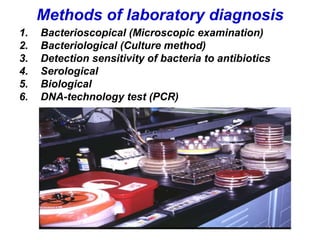
1. Bacterioscopical (Microscopic examination)
2. Bacteriological (Culture method)
3. Detection sensitivity of bacteria to antibiotics
4. Serological
5. Biological
6. DNA-technology test (PCR)
In the clinical laboratory it is necessary:
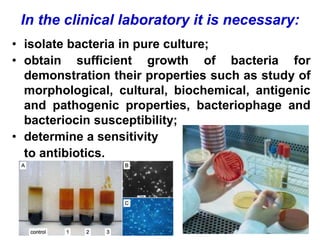
• isolate bacteria in pure culture;
• obtain sufficient growth of bacteria for
demonstration their properties such as study of
morphological, cultural, biochemical, antigenic
and pathogenic properties, bacteriophage and
bacteriocin susceptibility;
• determine a sensitivity
to antibiotics.
Methods of the cultivation
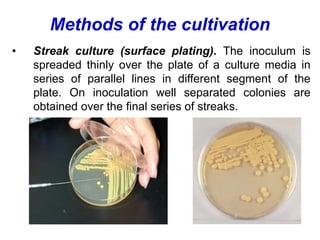
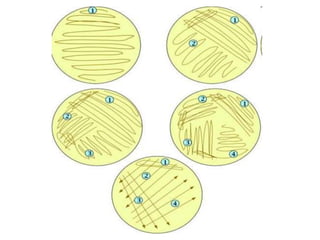
• Streak culture (surface plating). The inoculum is
spreaded thinly over the plate of a culture media in
series of parallel lines in different segment of the
plate. On inoculation well separated colonies are
obtained over the final series of streaks.
Methods of the cultivation
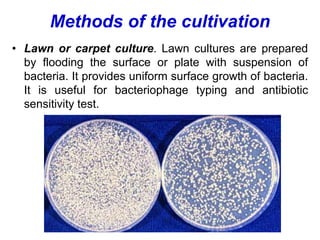
• Lawn or carpet culture. Lawn cultures are prepared
by flooding the surface or plate with suspension of
bacteria. It provides uniform surface growth of bacteria.
It is useful for bacteriophage typing and antibiotic
sensitivity test.
Methods of the cultivation
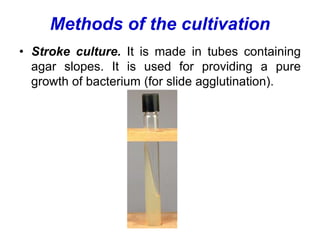
• Stroke culture. It is made in tubes containing
agar slopes. It is used for providing a pure
growth of bacterium (for slide agglutination).
Methods of the cultivation
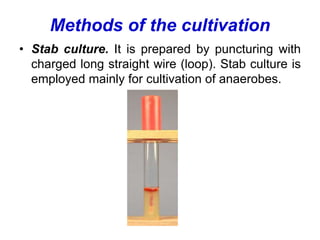
• Stab culture. It is prepared by puncturing with
charged long straight wire (loop). Stab culture is
employed mainly for cultivation of anaerobes.
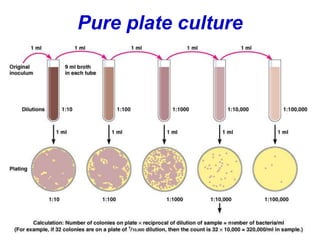
Pure plate culture
Methods of the cultivation
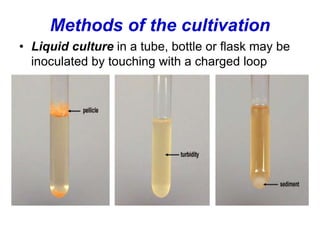
• Liquid culture in a tube, bottle or flask may be
inoculated by touching with a charged loop
Identification of bacteria
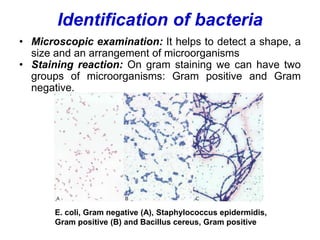
• Microscopic examination: It helps to detect a shape, a
size and an arrangement of microorganisms
• Staining reaction: On gram staining we can have two
groups of microorganisms: Gram positive and Gram
negative.
E. coli, Gram negative (A), Staphylococcus epidermidis,
Gram positive (B) and Bacillus cereus, Gram positive
Identification of bacteria
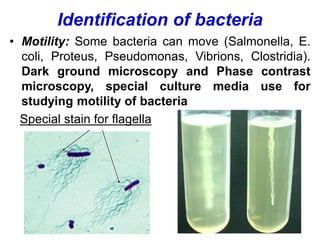
• Motility: Some bacteria can move (Salmonella, E.
coli, Proteus, Pseudomonas, Vibrions, Clostridia).
Dark ground microscopy and Phase contrast
microscopy, special culture media use for
studying motility of bacteria
Special stain for flagella
Identification of bacteria
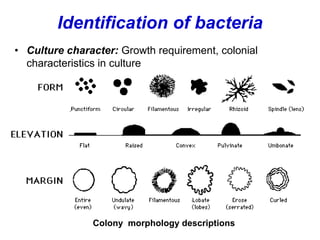
• Culture character: Growth requirement, colonial
characteristics in culture
Colony morphology descriptions
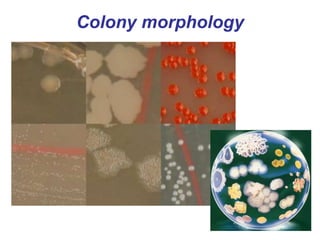
Colony morphology
Identification of bacteria
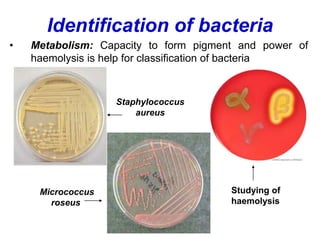
• Metabolism: Capacity to form pigment and power of
haemolysis is help for classification of bacteria
Staphylococcus
aureus
Micrococcus
roseus
Studying of
haemolysis
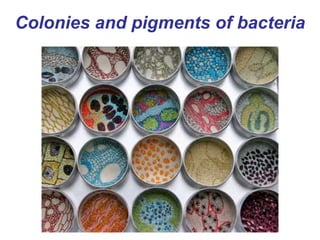
Colonies and pigments of bacteria
Identification of bacteria
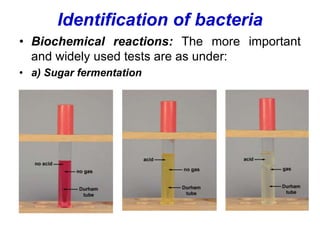
• Biochemical reactions: The more important
and widely used tests are as under:
• a) Sugar fermentation
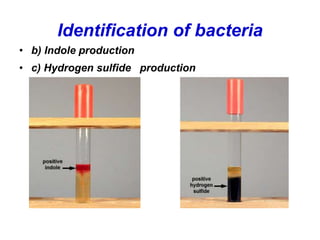
Identification of bacteria
• b) Indole production
• c) Hydrogen sulfide production
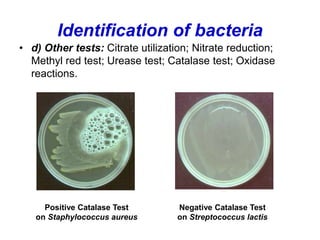
Identification of bacteria
• d) Other tests: Citrate utilization; Nitrate reduction;
Methyl red test; Urease test; Catalase test; Oxidase
reactions.
Positive Catalase Test
on Staphylococcus aureus
Negative Catalase Test
on Streptococcus lactis
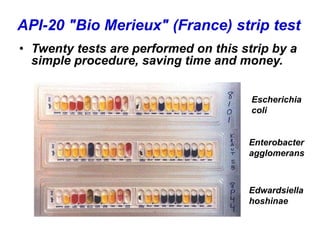
API-20 "Bio Merieux" (France) strip test
• Twenty tests are performed on this strip by a
simple procedure, saving time and money.
Escherichia
coli
Enterobacter
agglomerans
Edwardsiella
hoshinae
Identification of bacteria
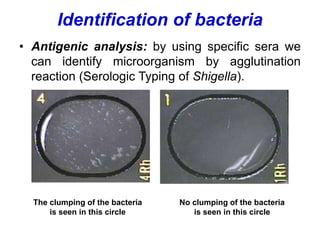
• Antigenic analysis: by using specific sera we
can identify microorganism by agglutination
reaction (Serologic Typing of Shigella).
No clumping of the bacteria
is seen in this circle
The clumping of the bacteria
is seen in this circle
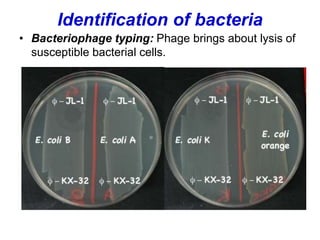
Identification of bacteria
• Bacteriophage typing: Phage brings about lysis of
susceptible bacterial cells.
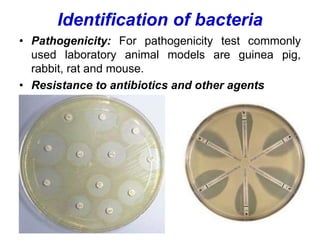
Identification of bacteria
• Pathogenicity: For pathogenicity test commonly
used laboratory animal models are guinea pig,
rabbit, rat and mouse.
• Resistance to antibiotics and other agents
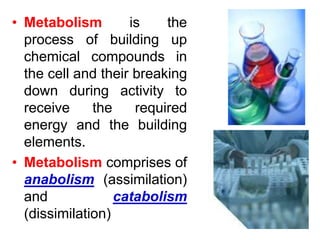
• Metabolism is the
process of building up
chemical compounds in
the cell and their breaking
down during activity to
receive the required
energy and the building
elements.
• Metabolism comprises of
anabolism (assimilation)
and catabolism
(dissimilation)
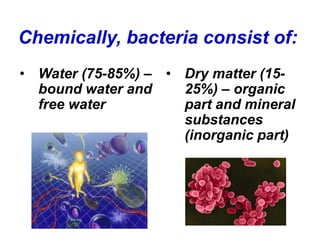
Chemically, bacteria consist of:
• Water (75-85%) –
bound water and
free water
• Dry matter (15-
25%) – organic
part and mineral
substances
(inorganic part)
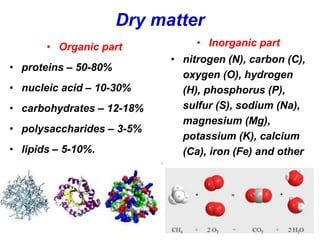
Dry matter
• Organic part
• proteins – 50-80%
• nucleic acid – 10-30%
• carbohydrates – 12-18%
• polysaccharides – 3-5%
• lipids – 5-10%.
• Inorganic part
• nitrogen (N), carbon (C),
oxygen (O), hydrogen
(H), phosphorus (P),
sulfur (S), sodium (Na),
magnesium (Mg),
potassium (K), calcium
(Ca), iron (Fe) and other
Classification of bacteria based
on nutritional requirements
• Autotrophs are free-living, most of which can
use carbon dioxide as their carbon source. The
energy can be obtained from:
• sunlight – protoautotrophs (get energy from
photochemical reactions)
• inorganic compounds, by oxidation –
chemoautotrophs (get energy from chemical
reactions)
• Heterotrophs are generally parasitic bacteria,
requiring more complex organic compounds
than carbon dioxide, e.g. sugars, as their source
of carbon and energy.
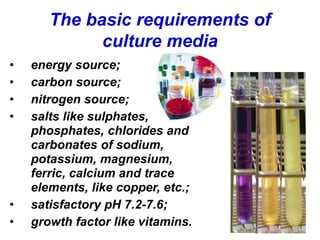
The basic requirements of
culture media
• energy source;
• carbon source;
• nitrogen source;
• salts like sulphates,
phosphates, chlorides and
carbonates of sodium,
potassium, magnesium,
ferric, calcium and trace
elements, like copper, etc.;
• satisfactory pH 7.2-7.6;
• growth factor like vitamins.
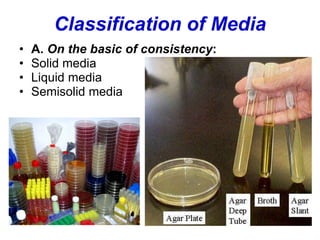
Classification of Media
• A. On the basic of consistency:
• Solid media
• Liquid media
• Semisolid media
Classification of Media
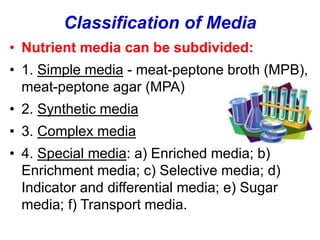
• Nutrient media can be subdivided:
• 1. Simple media - meat-peptone broth (MPB),
meat-peptone agar (MPA)
• 2. Synthetic media
• 3. Complex media
• 4. Special media: a) Enriched media; b)
Enrichment media; c) Selective media; d)
Indicator and differential media; e) Sugar
media; f) Transport media.
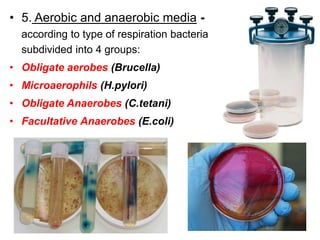
• 5. Aerobic and anaerobic media -
according to type of respiration bacteria
subdivided into 4 groups:
• Obligate aerobes (Brucella)
• Microaerophils (H.pylori)
• Obligate Anaerobes (C.tetani)
• Facultative Anaerobes (E.coli)
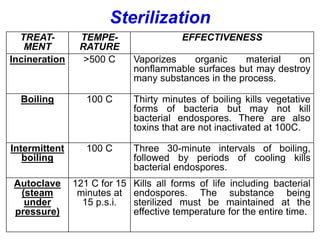
Sterilization
TREAT-
MENT
TEMPE-
RATURE
EFFECTIVENESS
Incineration >500 C Vaporizes organic material on
nonflammable surfaces but may destroy
many substances in the process.
Boiling 100 C Thirty minutes of boiling kills vegetative
forms of bacteria but may not kill
bacterial endospores. There are also
toxins that are not inactivated at 100C.
Intermittent
boiling
100 C Three 30-minute intervals of boiling,
followed by periods of cooling kills
bacterial endospores.
Autoclave
(steam
under
pressure)
121 C for 15
minutes at
15 p.s.i.
Kills all forms of life including bacterial
endospores. The substance being
sterilized must be maintained at the
effective temperature for the entire time.
Sterilization
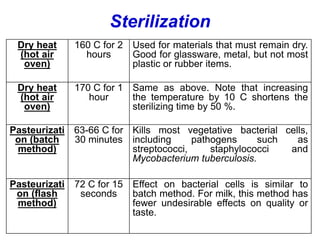
Dry heat
(hot air
oven)
160 C for 2
hours
Used for materials that must remain dry.
Good for glassware, metal, but not most
plastic or rubber items.
Dry heat
(hot air
oven)
170 C for 1
hour
Same as above. Note that increasing
the temperature by 10 C shortens the
sterilizing time by 50 %.
Pasteurizati
on (batch
method)
63-66 C for
30 minutes
Kills most vegetative bacterial cells,
including pathogens such as
streptococci, staphylococci and
Mycobacterium tuberculosis.
Pasteurizati
on (flash
method)
72 C for 15
seconds
Effect on bacterial cells is similar to
batch method. For milk, this method has
fewer undesirable effects on quality or
taste.
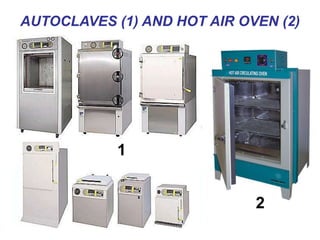
AUTOCLAVES (1) AND HOT AIR OVEN (2)
1
2

PHYSIOLOGY OF MICROORGANISMS-2012.ppt

  • 1.
    PHYSIOLOGY OF MICROORGANISMS 1.Methods of laboratory diagnosis 2. Methods of the bacterial cultivation 3. Identification of bacteria 4. Bacterial metabolism 5. Media for bacterial growth 6. Sterilization
  • 2.
    Methods of laboratorydiagnosis 1. Bacterioscopical (Microscopic examination) 2. Bacteriological (Culture method) 3. Detection sensitivity of bacteria to antibiotics 4. Serological 5. Biological 6. DNA-technology test (PCR)
  • 3.
    In the clinicallaboratory it is necessary: • isolate bacteria in pure culture; • obtain sufficient growth of bacteria for demonstration their properties such as study of morphological, cultural, biochemical, antigenic and pathogenic properties, bacteriophage and bacteriocin susceptibility; • determine a sensitivity to antibiotics.
  • 4.
    Methods of thecultivation • Streak culture (surface plating). The inoculum is spreaded thinly over the plate of a culture media in series of parallel lines in different segment of the plate. On inoculation well separated colonies are obtained over the final series of streaks.
  • 6.
    Methods of thecultivation • Lawn or carpet culture. Lawn cultures are prepared by flooding the surface or plate with suspension of bacteria. It provides uniform surface growth of bacteria. It is useful for bacteriophage typing and antibiotic sensitivity test.
  • 7.
    Methods of thecultivation • Stroke culture. It is made in tubes containing agar slopes. It is used for providing a pure growth of bacterium (for slide agglutination).
  • 8.
    Methods of thecultivation • Stab culture. It is prepared by puncturing with charged long straight wire (loop). Stab culture is employed mainly for cultivation of anaerobes.
  • 9.
  • 10.
    Methods of thecultivation • Liquid culture in a tube, bottle or flask may be inoculated by touching with a charged loop
  • 11.
    Identification of bacteria •Microscopic examination: It helps to detect a shape, a size and an arrangement of microorganisms • Staining reaction: On gram staining we can have two groups of microorganisms: Gram positive and Gram negative. E. coli, Gram negative (A), Staphylococcus epidermidis, Gram positive (B) and Bacillus cereus, Gram positive
  • 12.
    Identification of bacteria •Motility: Some bacteria can move (Salmonella, E. coli, Proteus, Pseudomonas, Vibrions, Clostridia). Dark ground microscopy and Phase contrast microscopy, special culture media use for studying motility of bacteria Special stain for flagella
  • 13.
    Identification of bacteria •Culture character: Growth requirement, colonial characteristics in culture Colony morphology descriptions
  • 14.
  • 15.
    Identification of bacteria •Metabolism: Capacity to form pigment and power of haemolysis is help for classification of bacteria Staphylococcus aureus Micrococcus roseus Studying of haemolysis
  • 16.
  • 17.
    Identification of bacteria •Biochemical reactions: The more important and widely used tests are as under: • a) Sugar fermentation
  • 18.
    Identification of bacteria •b) Indole production • c) Hydrogen sulfide production
  • 19.
    Identification of bacteria •d) Other tests: Citrate utilization; Nitrate reduction; Methyl red test; Urease test; Catalase test; Oxidase reactions. Positive Catalase Test on Staphylococcus aureus Negative Catalase Test on Streptococcus lactis
  • 20.
    API-20 "Bio Merieux"(France) strip test • Twenty tests are performed on this strip by a simple procedure, saving time and money. Escherichia coli Enterobacter agglomerans Edwardsiella hoshinae
  • 21.
    Identification of bacteria •Antigenic analysis: by using specific sera we can identify microorganism by agglutination reaction (Serologic Typing of Shigella). No clumping of the bacteria is seen in this circle The clumping of the bacteria is seen in this circle
  • 22.
    Identification of bacteria •Bacteriophage typing: Phage brings about lysis of susceptible bacterial cells.
  • 23.
    Identification of bacteria •Pathogenicity: For pathogenicity test commonly used laboratory animal models are guinea pig, rabbit, rat and mouse. • Resistance to antibiotics and other agents
  • 24.
    • Metabolism isthe process of building up chemical compounds in the cell and their breaking down during activity to receive the required energy and the building elements. • Metabolism comprises of anabolism (assimilation) and catabolism (dissimilation)
  • 25.
    Chemically, bacteria consistof: • Water (75-85%) – bound water and free water • Dry matter (15- 25%) – organic part and mineral substances (inorganic part)
  • 26.
    Dry matter • Organicpart • proteins – 50-80% • nucleic acid – 10-30% • carbohydrates – 12-18% • polysaccharides – 3-5% • lipids – 5-10%. • Inorganic part • nitrogen (N), carbon (C), oxygen (O), hydrogen (H), phosphorus (P), sulfur (S), sodium (Na), magnesium (Mg), potassium (K), calcium (Ca), iron (Fe) and other
  • 27.
    Classification of bacteriabased on nutritional requirements • Autotrophs are free-living, most of which can use carbon dioxide as their carbon source. The energy can be obtained from: • sunlight – protoautotrophs (get energy from photochemical reactions) • inorganic compounds, by oxidation – chemoautotrophs (get energy from chemical reactions) • Heterotrophs are generally parasitic bacteria, requiring more complex organic compounds than carbon dioxide, e.g. sugars, as their source of carbon and energy.
  • 28.
    The basic requirementsof culture media • energy source; • carbon source; • nitrogen source; • salts like sulphates, phosphates, chlorides and carbonates of sodium, potassium, magnesium, ferric, calcium and trace elements, like copper, etc.; • satisfactory pH 7.2-7.6; • growth factor like vitamins.
  • 29.
    Classification of Media •A. On the basic of consistency: • Solid media • Liquid media • Semisolid media
  • 30.
    Classification of Media •Nutrient media can be subdivided: • 1. Simple media - meat-peptone broth (MPB), meat-peptone agar (MPA) • 2. Synthetic media • 3. Complex media • 4. Special media: a) Enriched media; b) Enrichment media; c) Selective media; d) Indicator and differential media; e) Sugar media; f) Transport media.
  • 31.
    • 5. Aerobicand anaerobic media - according to type of respiration bacteria subdivided into 4 groups: • Obligate aerobes (Brucella) • Microaerophils (H.pylori) • Obligate Anaerobes (C.tetani) • Facultative Anaerobes (E.coli)
  • 32.
    Sterilization TREAT- MENT TEMPE- RATURE EFFECTIVENESS Incineration >500 CVaporizes organic material on nonflammable surfaces but may destroy many substances in the process. Boiling 100 C Thirty minutes of boiling kills vegetative forms of bacteria but may not kill bacterial endospores. There are also toxins that are not inactivated at 100C. Intermittent boiling 100 C Three 30-minute intervals of boiling, followed by periods of cooling kills bacterial endospores. Autoclave (steam under pressure) 121 C for 15 minutes at 15 p.s.i. Kills all forms of life including bacterial endospores. The substance being sterilized must be maintained at the effective temperature for the entire time.
  • 33.
    Sterilization Dry heat (hot air oven) 160C for 2 hours Used for materials that must remain dry. Good for glassware, metal, but not most plastic or rubber items. Dry heat (hot air oven) 170 C for 1 hour Same as above. Note that increasing the temperature by 10 C shortens the sterilizing time by 50 %. Pasteurizati on (batch method) 63-66 C for 30 minutes Kills most vegetative bacterial cells, including pathogens such as streptococci, staphylococci and Mycobacterium tuberculosis. Pasteurizati on (flash method) 72 C for 15 seconds Effect on bacterial cells is similar to batch method. For milk, this method has fewer undesirable effects on quality or taste.
  • 34.
    AUTOCLAVES (1) ANDHOT AIR OVEN (2) 1 2