SOLID WASTE
AND ITS
MANAGEMENT
K R MICRO NOTES
1
WASTE
 It is defined as:
Waste (also known as rubbish, trash, refuse,
garbage, junk) is any unwanted or useless materials.
OR
“Any materials unused and rejected as worthless
or unwanted” and “A useless or profitless activity;
using or expending or consuming thoughtlessly or
carelessly”
K R MICRO NOTES
2
K R MICRO NOTES
3
INTRODUCTION
 Since the beginning, Human kind has been
generating waste.
 It could be in the form of:
 Bones
 Other parts of animals they slaughter
 Wood
 With the progress of civilization the waste
generated became of a more complex nature.
K R MICRO NOTES
4
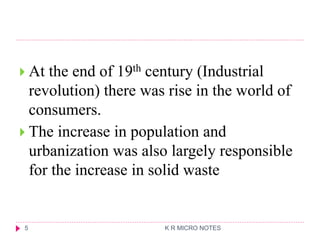
 At the end of 19th century (Industrial
revolution) there was rise in the world of
consumers.
 The increase in population and
urbanization was also largely responsible
for the increase in solid waste
K R MICRO NOTES
5
TYPES OF WASTE
 Solid Waste
 Liquid Waste
 Gaseous Wastes
 Animal by-products
 Biodegradable waste
 Biomedical waste
 Bulky waste
 Business waste
K R MICRO NOTES
6
 Chemical waste
 Clinical waste
 Coffee wastewater
 Commercial waste
 Construction and demolition waste (C&D
waste)
 Controlled waste
 Consumable waste
 Composite
K R MICRO NOTES
7
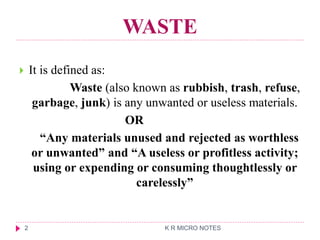
SOLID WASTE
 It is defined as:
“Non-liquid, non-soluble materials ranging
from municipal garbage to industrial wastes
that contain complex and sometimes
hazardous substances”
K R MICRO NOTES
8
 Solid wastes also include:
• Sewage sludge
• Agricultural refuse
• Demolition wastes
• Mining residues
K R MICRO NOTES
9
TYPES OF SOLID WASTE
 Broadly there are 3 types of waste which are as
follows:
1. Household waste is generally classified as
Municipal waste
2. Industrial waste as Hazardous waste
3. Biomedical waste or Hospital waste as
Infectious waste
K R MICRO NOTES
10
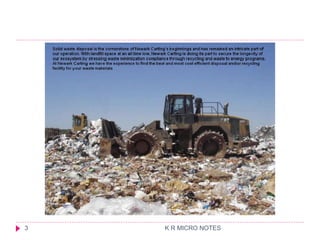
MUNICIPAL SOLID WASTE
 Municipal solid waste consists of:
Household waste
Construction and demolition debris
Sanitation residue
Waste from streets.
K R MICRO NOTES
11
K R MICRO NOTES
12
 With rising urbanization and change in lifestyle and
food habits, the amount of municipal solid waste has
been increasing rapidly and its composition changing.
 The existing landfills are neither well equipped or
well managed and are not lined properly to protect
against contamination of soil and groundwater.
K R MICRO NOTES
13
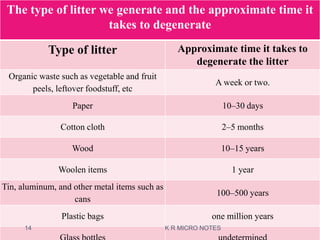
The type of litter we generate and the approximate time it
takes to degenerate
Type of litter Approximate time it takes to
degenerate the litter
Organic waste such as vegetable and fruit
peels, leftover foodstuff, etc
A week or two.
Paper 10–30 days
Cotton cloth 2–5 months
Wood 10–15 years
Woolen items 1 year
Tin, aluminum, and other metal items such as
cans
100–500 years
Plastic bags one million years
K R MICRO NOTES
14
HAZARDOUS WASTE
 Industrial and hospital waste is considered
hazardous as they may contain toxic
substances.
 Hazardous wastes could be highly toxic to
humans, animals, and plants. They are
 Corrosive
 Highly inflammable, or explosive
 React when exposed to certain things e.g. gases
K R MICRO NOTES
15
 Household wastes that can be categorized as
hazardous waste include:
old batteries
shoe polish
paint tins
old medicines
medicine bottles.
K R MICRO NOTES
16
 Hospital waste contaminated by chemicals
used in hospitals is considered hazardous.
 These chemicals include formaldehyde and
phenols, which are used as disinfectants.
K R MICRO NOTES
17
 In the industrial sector, the major generators of
hazardous waste are the metal, chemical, paper,
pesticide, dye, refining, and rubber goods
industries.
 Direct exposure to chemicals in hazardous
waste such as mercury and cyanide can be
fatal.
K R MICRO NOTES
18
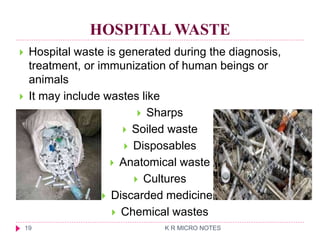
HOSPITAL WASTE
 Hospital waste is generated during the diagnosis,
treatment, or immunization of human beings or
animals
 It may include wastes like
 Sharps
 Soiled waste
 Disposables
 Anatomical waste
 Cultures
 Discarded medicines
 Chemical wastes
K R MICRO NOTES
19
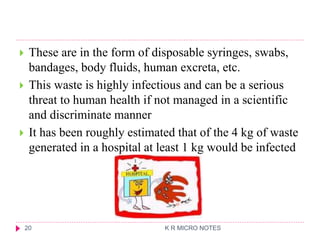
 These are in the form of disposable syringes, swabs,
bandages, body fluids, human excreta, etc.
 This waste is highly infectious and can be a serious
threat to human health if not managed in a scientific
and discriminate manner
 It has been roughly estimated that of the 4 kg of waste
generated in a hospital at least 1 kg would be infected
K R MICRO NOTES
20
SOURCES AND OTHER TYPES OF WASTE
Source Typical Waste
Generators
Types of solid wastes
1:Residential Single and multifamily
dwellings
 Food wastes
 Paper
 Cardboard
 Plastics
 Textiles
 Leather
 Yard wastes
 Wood
 Glass
 Metals
 Ashes
 Special wastes
(e.g bulky items, consumer
electronics, white goods,
batteries, oil, tires), and
household hazardous wastes.)
K R MICRO NOTES
21
2: Industrial Light and heavy
manufacturing, fabrication,
construction sites, power and
chemical plants.
 Housekeeping wastes
 Packaging
 Food wastes
 Construction and
demolition materials
 Hazardous wastes
 Ashes
 Special wastes.
3:Commercial Stores, hotels, restaurants,
markets, office buildings, etc.
 Paper
 cardboard
 plastics
 wood
 food wastes
 glass
 metals
 special wastes
 hazardous wastes
4: Institutional Schools, hospitals, prisons,
government centers.
Same as commercial.
K R MICRO NOTES
22
5:Construction and demolition New construction sites, road
repair, renovation sites,
demolition of buildings
 Wood
 steel
 concrete
 dirt etc.
6:Municipal services Street cleaning, landscaping,
parks, beaches, other
recreational areas, water and
wastewater treatment plants.
 Street sweepings
 landscape and tree
trimmings
 General wastes from parks
 Beaches
 Recreational areas; sludge.
7:Process (manufacturing etc.) Heavy and light manufacturing,
refineries, chemical plants,
power plants, mineral
extraction and processing.
 Industrial process wastes
 Scrap materials
 Off-specification products.
8:Agriculture Crops, orchards, vineyards,
dairies, feedlots, farms.
 Spoiled food wastes
 Agricultural wastes
 Hazardous wastes (e.g.,
K R MICRO NOTES
23
CAUSES OF SOLID WASTE
 The main sources for solid wastes are domestic,
commercial, industrial, municipal, and agricultural
wastes.
 The composition of a city waste is as follows:
 Paper, wood, cardboard 53 %
 Garbage 22 %
 Ceramics, glass, crockery 10 %
 Metals 8 %
 Rubber, plastics, discarded textiles 7 %
K R MICRO NOTES
24
Composition of City Waste
0%
10%
20%
30%
40%
50%
60%
Paper,
w ood,
cardboard
Garbage Ceramic,
glass
crokery
metals Rubber,
plastics,
discarded
textiles
Type of Wastes
Percentages
Series1
K R MICRO NOTES
25
 The increase in the quantity of solid waste is
due to
 Overpopulation,
Affluence (material comfort)
Technological advancement
K R MICRO NOTES
26
EFFECTS OF SOLID WASTE
a) Health Hazard
 If solid wastes are not collected and allowed to
accumulate, they may create unsanitary conditions.
 This may lead to epidemic outbreaks.
 Many diseases like cholera, diarrhea, dysentery,
plague, jaundice, or gastro-intestinal diseases may
spread and cause loss of human lives.
 In addition, improper handling of the solid wastes is a
health hazard for the workers who come in direct
contact with the waste
K R MICRO NOTES
27
b) Environmental Impact
 If the solid wastes are not treated properly,
decomposition and putrefaction (decay) may take
place.
 The organic solid waste during decomposition may
generate obnoxious (intolerable) odors.
K R MICRO NOTES
28
WASTE MANAGEMENT
4 R’s CONCEPT
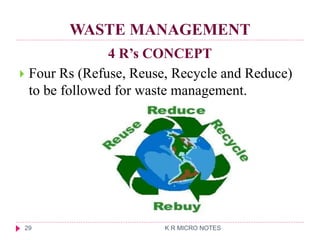
 Four Rs (Refuse, Reuse, Recycle and Reduce)
to be followed for waste management.
K R MICRO NOTES
29

Solid-waste-management .pptx

  • 1.
  • 2.
    WASTE  It isdefined as: Waste (also known as rubbish, trash, refuse, garbage, junk) is any unwanted or useless materials. OR “Any materials unused and rejected as worthless or unwanted” and “A useless or profitless activity; using or expending or consuming thoughtlessly or carelessly” K R MICRO NOTES 2
  • 3.
    K R MICRONOTES 3
  • 4.
    INTRODUCTION  Since thebeginning, Human kind has been generating waste.  It could be in the form of:  Bones  Other parts of animals they slaughter  Wood  With the progress of civilization the waste generated became of a more complex nature. K R MICRO NOTES 4
  • 5.
     At theend of 19th century (Industrial revolution) there was rise in the world of consumers.  The increase in population and urbanization was also largely responsible for the increase in solid waste K R MICRO NOTES 5
  • 6.
    TYPES OF WASTE Solid Waste  Liquid Waste  Gaseous Wastes  Animal by-products  Biodegradable waste  Biomedical waste  Bulky waste  Business waste K R MICRO NOTES 6
  • 7.
     Chemical waste Clinical waste  Coffee wastewater  Commercial waste  Construction and demolition waste (C&D waste)  Controlled waste  Consumable waste  Composite K R MICRO NOTES 7
  • 8.
    SOLID WASTE  Itis defined as: “Non-liquid, non-soluble materials ranging from municipal garbage to industrial wastes that contain complex and sometimes hazardous substances” K R MICRO NOTES 8
  • 9.
     Solid wastesalso include: • Sewage sludge • Agricultural refuse • Demolition wastes • Mining residues K R MICRO NOTES 9
  • 10.
    TYPES OF SOLIDWASTE  Broadly there are 3 types of waste which are as follows: 1. Household waste is generally classified as Municipal waste 2. Industrial waste as Hazardous waste 3. Biomedical waste or Hospital waste as Infectious waste K R MICRO NOTES 10
  • 11.
    MUNICIPAL SOLID WASTE Municipal solid waste consists of: Household waste Construction and demolition debris Sanitation residue Waste from streets. K R MICRO NOTES 11
  • 12.
    K R MICRONOTES 12
  • 13.
     With risingurbanization and change in lifestyle and food habits, the amount of municipal solid waste has been increasing rapidly and its composition changing.  The existing landfills are neither well equipped or well managed and are not lined properly to protect against contamination of soil and groundwater. K R MICRO NOTES 13
  • 14.
    The type oflitter we generate and the approximate time it takes to degenerate Type of litter Approximate time it takes to degenerate the litter Organic waste such as vegetable and fruit peels, leftover foodstuff, etc A week or two. Paper 10–30 days Cotton cloth 2–5 months Wood 10–15 years Woolen items 1 year Tin, aluminum, and other metal items such as cans 100–500 years Plastic bags one million years K R MICRO NOTES 14
  • 15.
    HAZARDOUS WASTE  Industrialand hospital waste is considered hazardous as they may contain toxic substances.  Hazardous wastes could be highly toxic to humans, animals, and plants. They are  Corrosive  Highly inflammable, or explosive  React when exposed to certain things e.g. gases K R MICRO NOTES 15
  • 16.
     Household wastesthat can be categorized as hazardous waste include: old batteries shoe polish paint tins old medicines medicine bottles. K R MICRO NOTES 16
  • 17.
     Hospital wastecontaminated by chemicals used in hospitals is considered hazardous.  These chemicals include formaldehyde and phenols, which are used as disinfectants. K R MICRO NOTES 17
  • 18.
     In theindustrial sector, the major generators of hazardous waste are the metal, chemical, paper, pesticide, dye, refining, and rubber goods industries.  Direct exposure to chemicals in hazardous waste such as mercury and cyanide can be fatal. K R MICRO NOTES 18
  • 19.
    HOSPITAL WASTE  Hospitalwaste is generated during the diagnosis, treatment, or immunization of human beings or animals  It may include wastes like  Sharps  Soiled waste  Disposables  Anatomical waste  Cultures  Discarded medicines  Chemical wastes K R MICRO NOTES 19
  • 20.
     These arein the form of disposable syringes, swabs, bandages, body fluids, human excreta, etc.  This waste is highly infectious and can be a serious threat to human health if not managed in a scientific and discriminate manner  It has been roughly estimated that of the 4 kg of waste generated in a hospital at least 1 kg would be infected K R MICRO NOTES 20
  • 21.
    SOURCES AND OTHERTYPES OF WASTE Source Typical Waste Generators Types of solid wastes 1:Residential Single and multifamily dwellings  Food wastes  Paper  Cardboard  Plastics  Textiles  Leather  Yard wastes  Wood  Glass  Metals  Ashes  Special wastes (e.g bulky items, consumer electronics, white goods, batteries, oil, tires), and household hazardous wastes.) K R MICRO NOTES 21
  • 22.
    2: Industrial Lightand heavy manufacturing, fabrication, construction sites, power and chemical plants.  Housekeeping wastes  Packaging  Food wastes  Construction and demolition materials  Hazardous wastes  Ashes  Special wastes. 3:Commercial Stores, hotels, restaurants, markets, office buildings, etc.  Paper  cardboard  plastics  wood  food wastes  glass  metals  special wastes  hazardous wastes 4: Institutional Schools, hospitals, prisons, government centers. Same as commercial. K R MICRO NOTES 22
  • 23.
    5:Construction and demolitionNew construction sites, road repair, renovation sites, demolition of buildings  Wood  steel  concrete  dirt etc. 6:Municipal services Street cleaning, landscaping, parks, beaches, other recreational areas, water and wastewater treatment plants.  Street sweepings  landscape and tree trimmings  General wastes from parks  Beaches  Recreational areas; sludge. 7:Process (manufacturing etc.) Heavy and light manufacturing, refineries, chemical plants, power plants, mineral extraction and processing.  Industrial process wastes  Scrap materials  Off-specification products. 8:Agriculture Crops, orchards, vineyards, dairies, feedlots, farms.  Spoiled food wastes  Agricultural wastes  Hazardous wastes (e.g., K R MICRO NOTES 23
  • 24.
    CAUSES OF SOLIDWASTE  The main sources for solid wastes are domestic, commercial, industrial, municipal, and agricultural wastes.  The composition of a city waste is as follows:  Paper, wood, cardboard 53 %  Garbage 22 %  Ceramics, glass, crockery 10 %  Metals 8 %  Rubber, plastics, discarded textiles 7 % K R MICRO NOTES 24
  • 25.
    Composition of CityWaste 0% 10% 20% 30% 40% 50% 60% Paper, w ood, cardboard Garbage Ceramic, glass crokery metals Rubber, plastics, discarded textiles Type of Wastes Percentages Series1 K R MICRO NOTES 25
  • 26.
     The increasein the quantity of solid waste is due to  Overpopulation, Affluence (material comfort) Technological advancement K R MICRO NOTES 26
  • 27.
    EFFECTS OF SOLIDWASTE a) Health Hazard  If solid wastes are not collected and allowed to accumulate, they may create unsanitary conditions.  This may lead to epidemic outbreaks.  Many diseases like cholera, diarrhea, dysentery, plague, jaundice, or gastro-intestinal diseases may spread and cause loss of human lives.  In addition, improper handling of the solid wastes is a health hazard for the workers who come in direct contact with the waste K R MICRO NOTES 27
  • 28.
    b) Environmental Impact If the solid wastes are not treated properly, decomposition and putrefaction (decay) may take place.  The organic solid waste during decomposition may generate obnoxious (intolerable) odors. K R MICRO NOTES 28
  • 29.
    WASTE MANAGEMENT 4 R’sCONCEPT  Four Rs (Refuse, Reuse, Recycle and Reduce) to be followed for waste management. K R MICRO NOTES 29