EVOLUTION AND FUNCTIONS OF MICROSOFT EXCEL
IMRAN WASTA
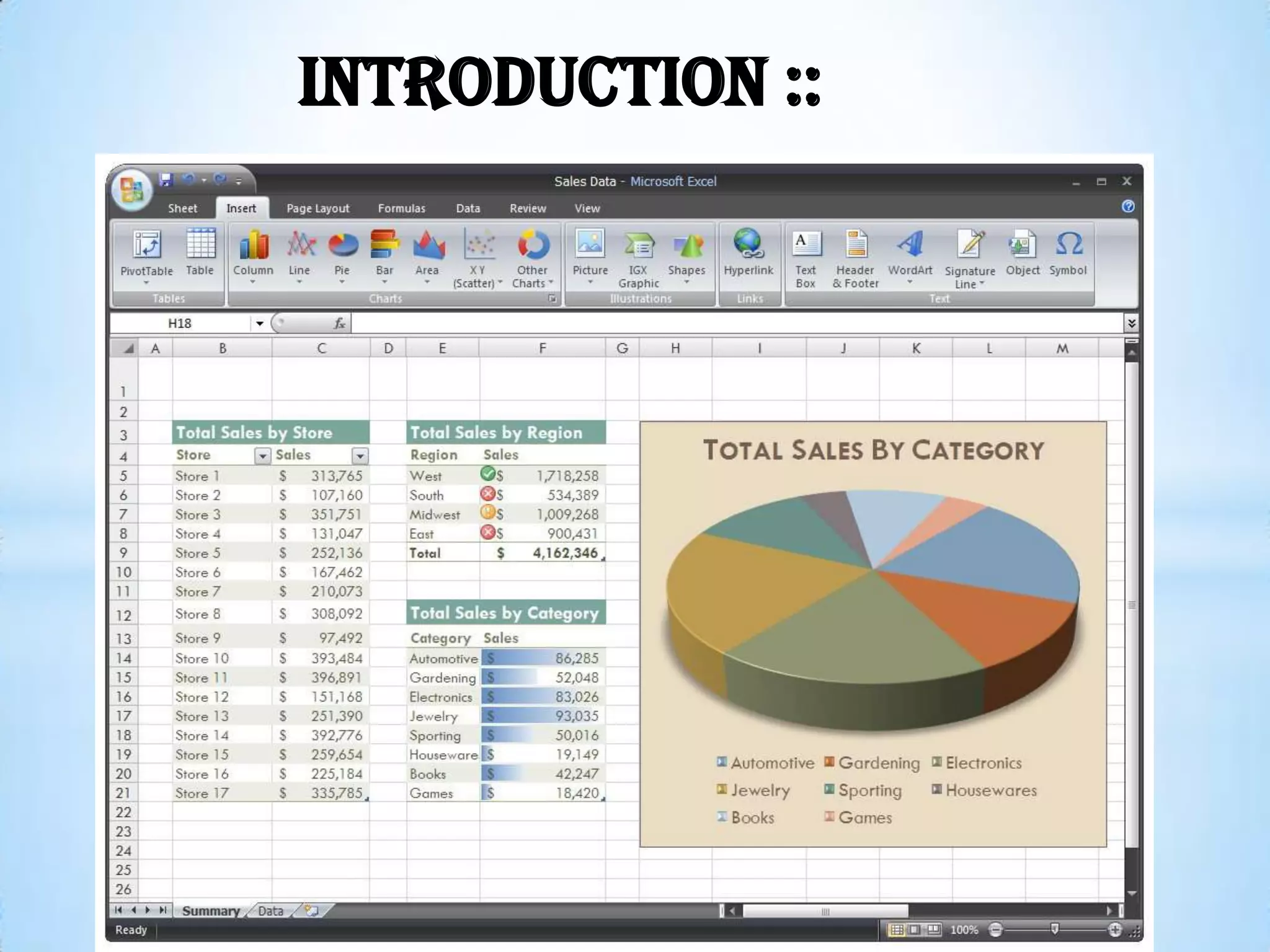
INTRODUCTION ::
 FIRST COMPUTERIZED SPREADSHEET - DEVELOPED BY DAN BRICKLIN
AND BOB FRANKSTON FOR THE APPLE II COMPUTER
 MARKETED AS VISICALC
 IN 1982 LOTUS DEVELOPMENT RELEASED 123 FOR DOS.
 SETUP AS THE FIRST BUSINESS TOOL
 IN 1982 MICROSOFT ORIGINALLY MARKETED A SPREADSHEET PROGRAM
CALLED MULTIPLAN.
 THE FIRST VERSION OF EXCEL WAS RELEASED FOR THE MAC IN 1985
AND THE FIRST WINDOWS VERSION WAS RELEASED IN NOVEMBER 1987.
 UPGRADES -TOOL BARS, OUTLINING, DRAWING, 3-D CHARTS,
NUMEROUS SHORTCUTS, AND MORE AUTOMATED FEATURES
EARLY SPREADSHEETS ::
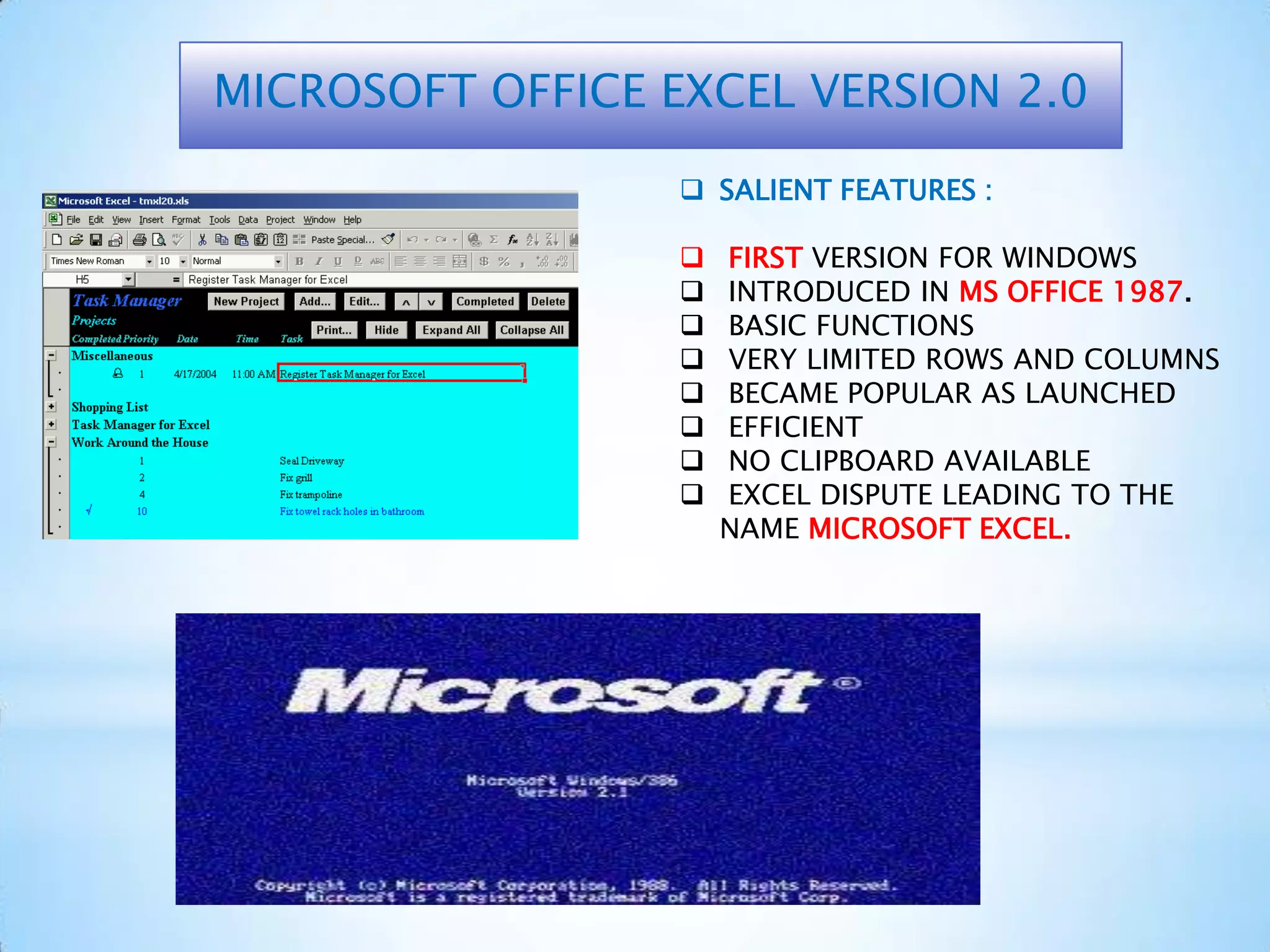
MICROSOFT OFFICE EXCEL VERSION 2.0
 SALIENT FEATURES :
 FIRST VERSION FOR WINDOWS
 INTRODUCED IN MS OFFICE 1987.
 BASIC FUNCTIONS
 VERY LIMITED ROWS AND COLUMNS
 BECAME POPULAR AS LAUNCHED
 EFFICIENT
 NO CLIPBOARD AVAILABLE
 EXCEL DISPUTE LEADING TO THE
NAME MICROSOFT EXCEL.
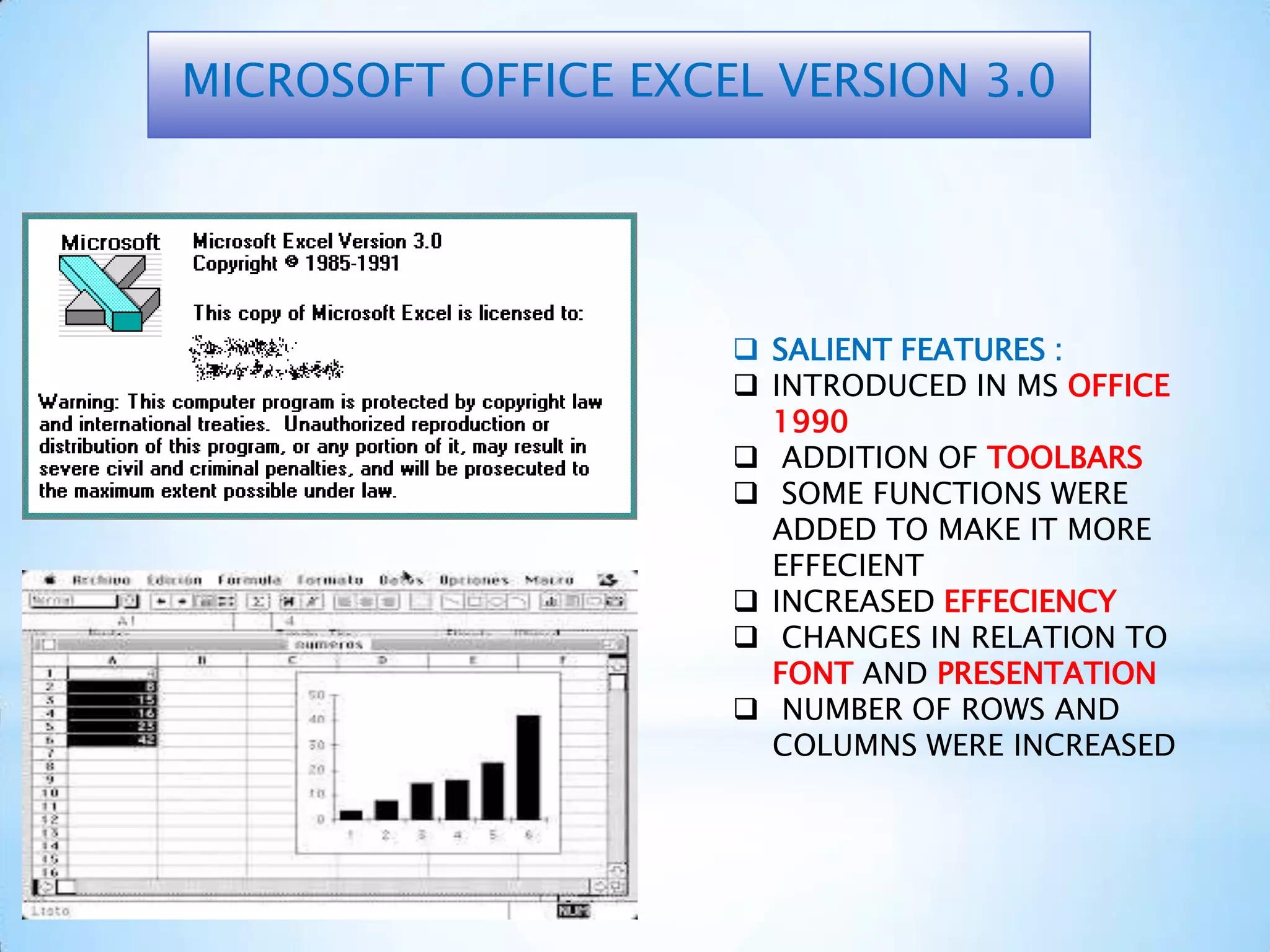
 SALIENT FEATURES :
 INTRODUCED IN MS OFFICE
1990
 ADDITION OF TOOLBARS
 SOME FUNCTIONS WERE
ADDED TO MAKE IT MORE
EFFECIENT
 INCREASED EFFECIENCY
 CHANGES IN RELATION TO
FONT AND PRESENTATION
 NUMBER OF ROWS AND
COLUMNS WERE INCREASED
MICROSOFT OFFICE EXCEL VERSION 3.0
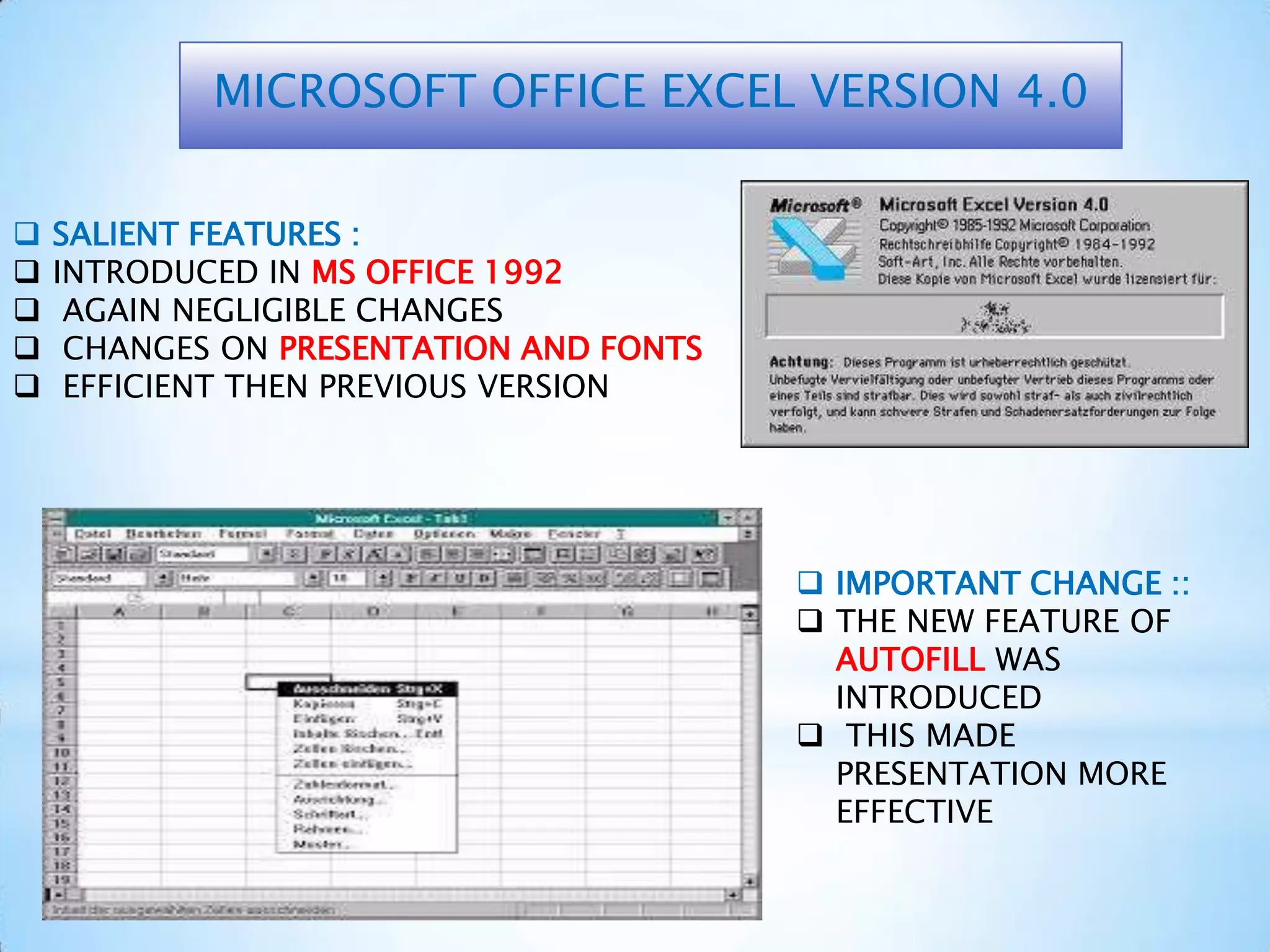
 SALIENT FEATURES :
 INTRODUCED IN MS OFFICE 1992
 AGAIN NEGLIGIBLE CHANGES
 CHANGES ON PRESENTATION AND FONTS
 EFFICIENT THEN PREVIOUS VERSION
MICROSOFT OFFICE EXCEL VERSION 4.0
 IMPORTANT CHANGE ::
 THE NEW FEATURE OF
AUTOFILL WAS
INTRODUCED
 THIS MADE
PRESENTATION MORE
EFFECTIVE
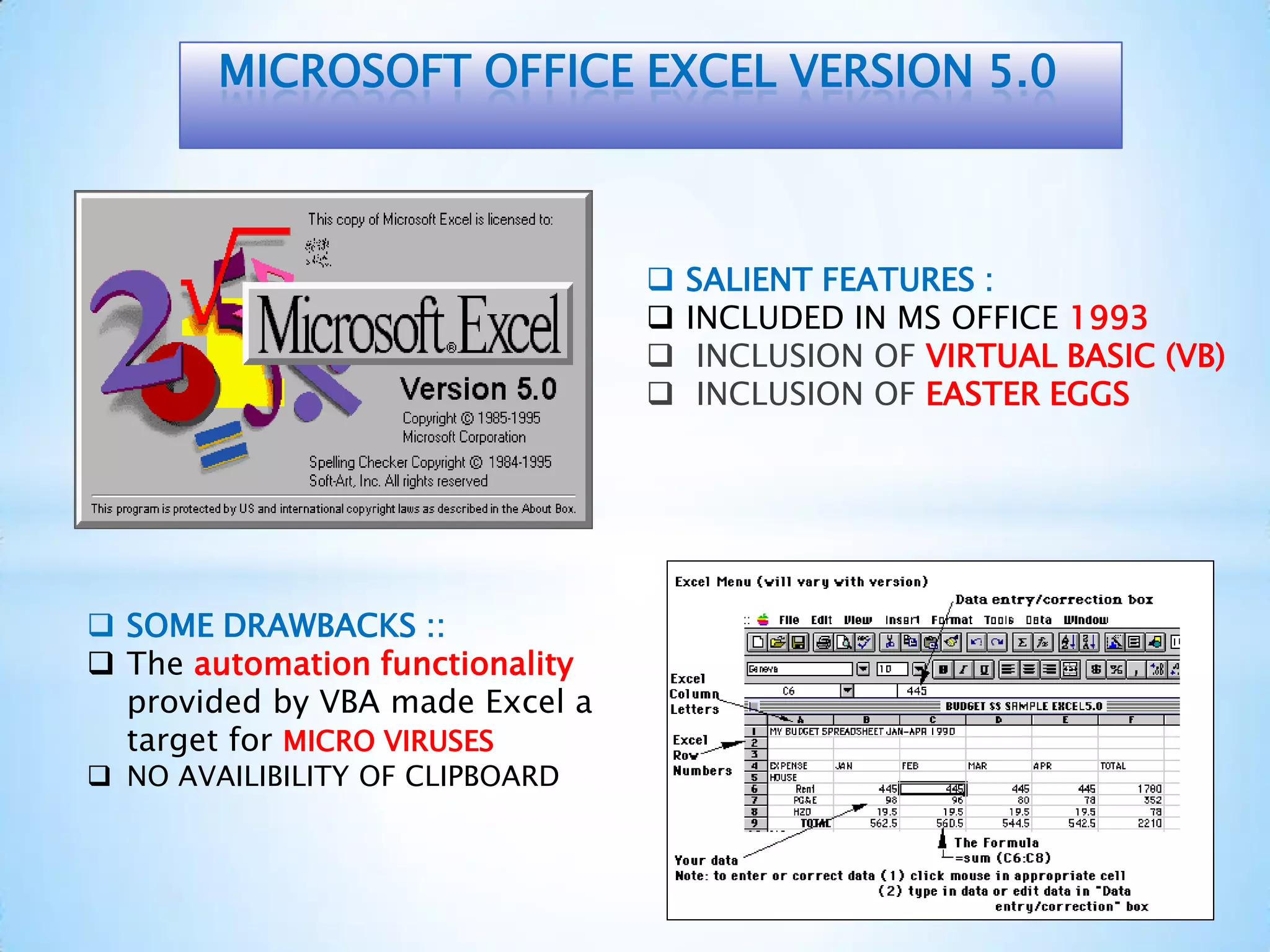
MICROSOFT OFFICE EXCEL VERSION 5.0
 SALIENT FEATURES :
 INCLUDED IN MS OFFICE 1993
 INCLUSION OF VIRTUAL BASIC (VB)
 INCLUSION OF EASTER EGGS
 SOME DRAWBACKS ::
 The automation functionality
provided by VBA made Excel a
target for MICRO VIRUSES
 NO AVAILIBILITY OF CLIPBOARD
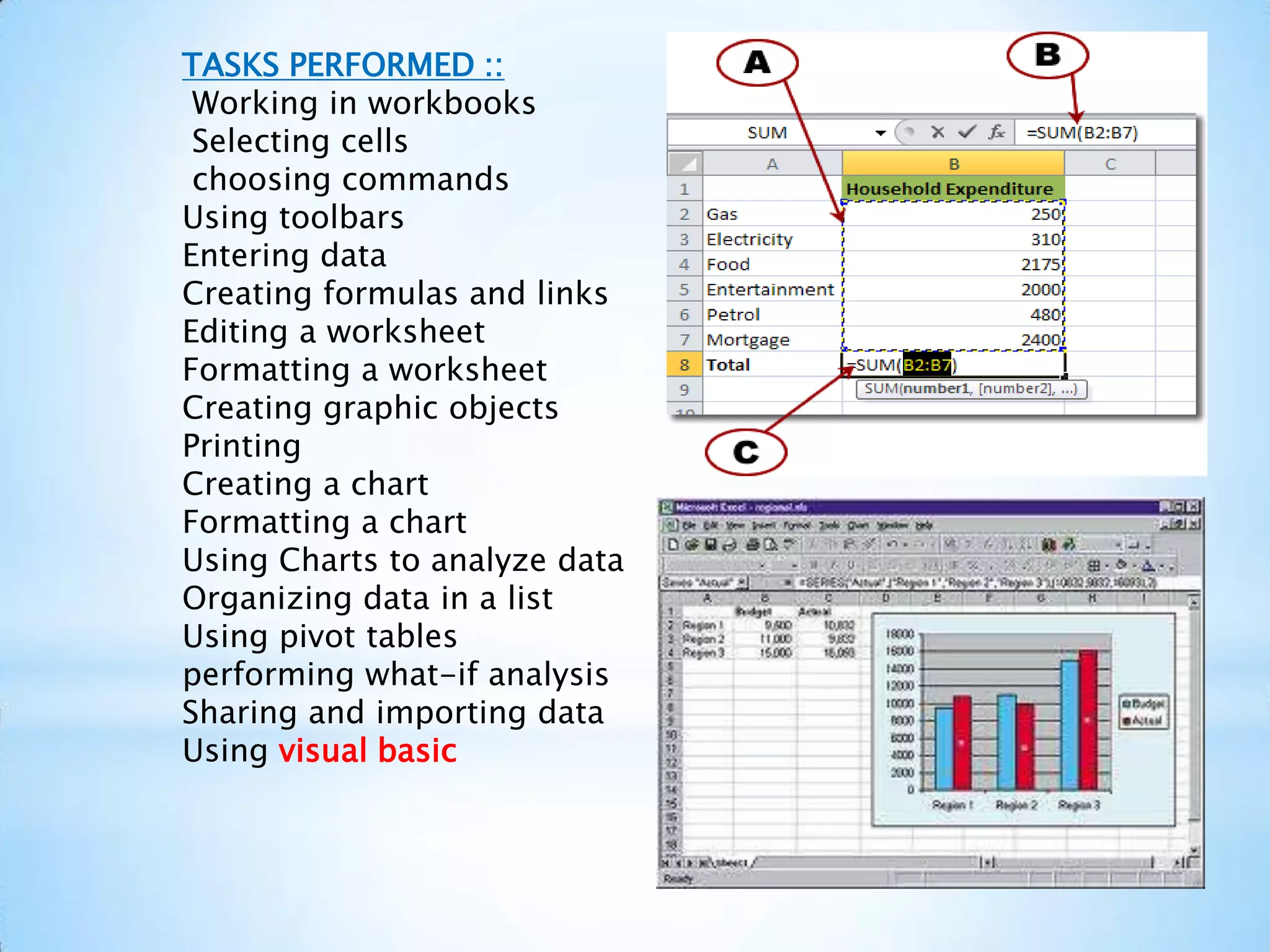
TASKS PERFORMED ::
Working in workbooks
Selecting cells
choosing commands
Using toolbars
Entering data
Creating formulas and links
Editing a worksheet
Formatting a worksheet
Creating graphic objects
Printing
Creating a chart
Formatting a chart
Using Charts to analyze data
Organizing data in a list
Using pivot tables
performing what-if analysis
Sharing and importing data
Using visual basic
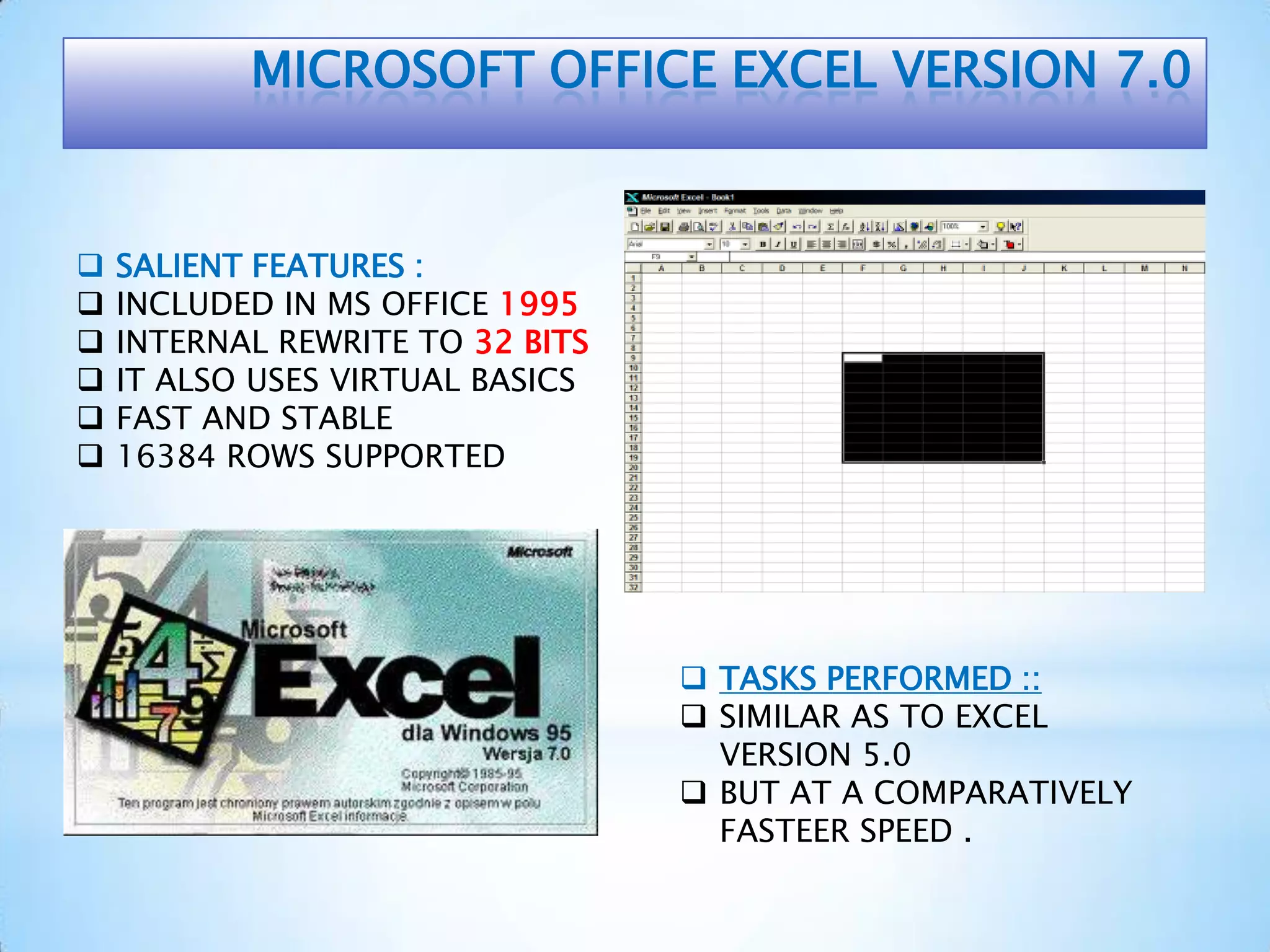
MICROSOFT OFFICE EXCEL VERSION 7.0
 SALIENT FEATURES :
 INCLUDED IN MS OFFICE 1995
 INTERNAL REWRITE TO 32 BITS
 IT ALSO USES VIRTUAL BASICS
 FAST AND STABLE
 16384 ROWS SUPPORTED
 TASKS PERFORMED ::
 SIMILAR AS TO EXCEL
VERSION 5.0
 BUT AT A COMPARATIVELY
FASTEER SPEED .
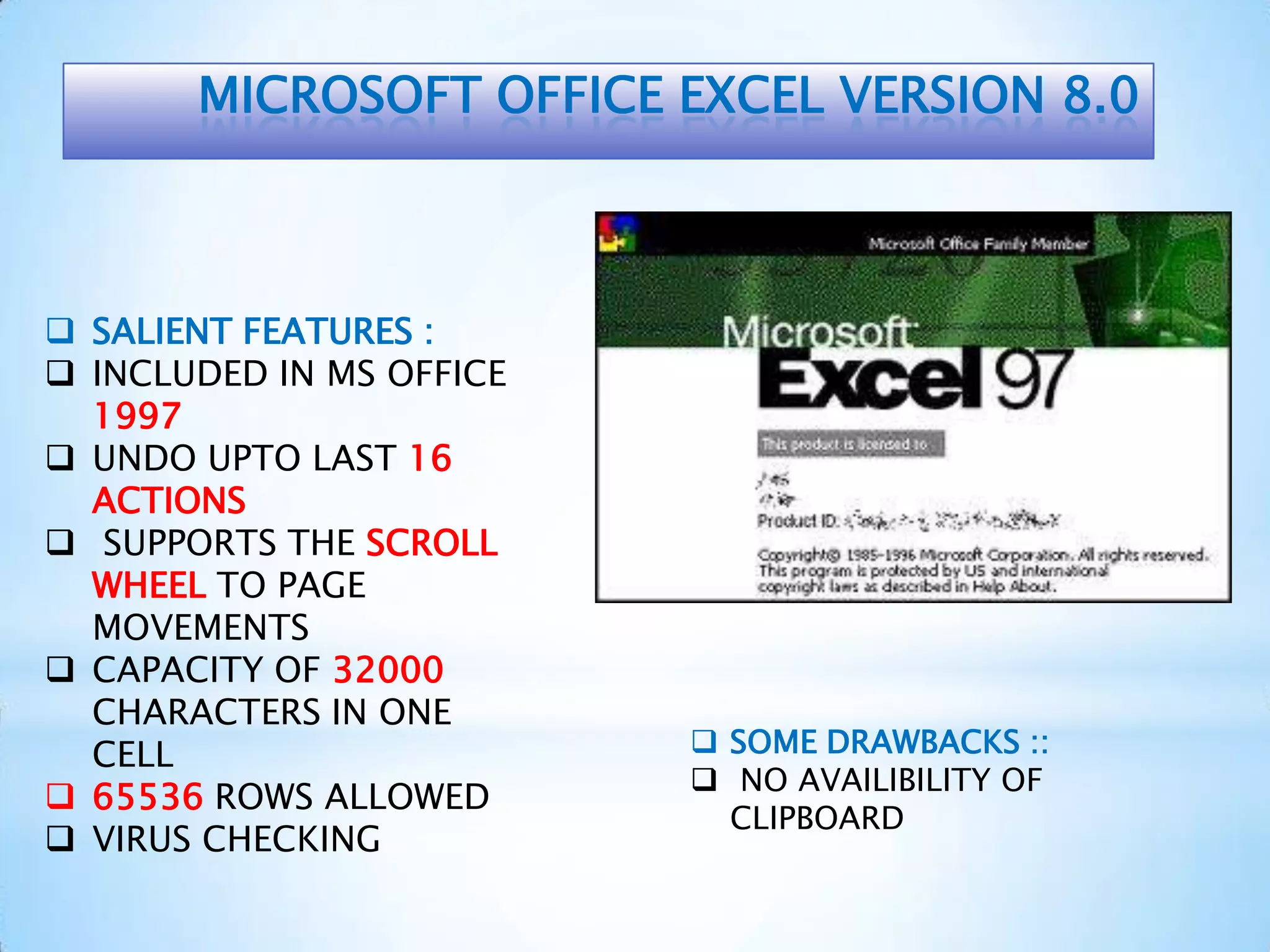
MICROSOFT OFFICE EXCEL VERSION 8.0
 SALIENT FEATURES :
 INCLUDED IN MS OFFICE
1997
 UNDO UPTO LAST 16
ACTIONS
 SUPPORTS THE SCROLL
WHEEL TO PAGE
MOVEMENTS
 CAPACITY OF 32000
CHARACTERS IN ONE
CELL
 65536 ROWS ALLOWED
 VIRUS CHECKING
 SOME DRAWBACKS ::
 NO AVAILIBILITY OF
CLIPBOARD
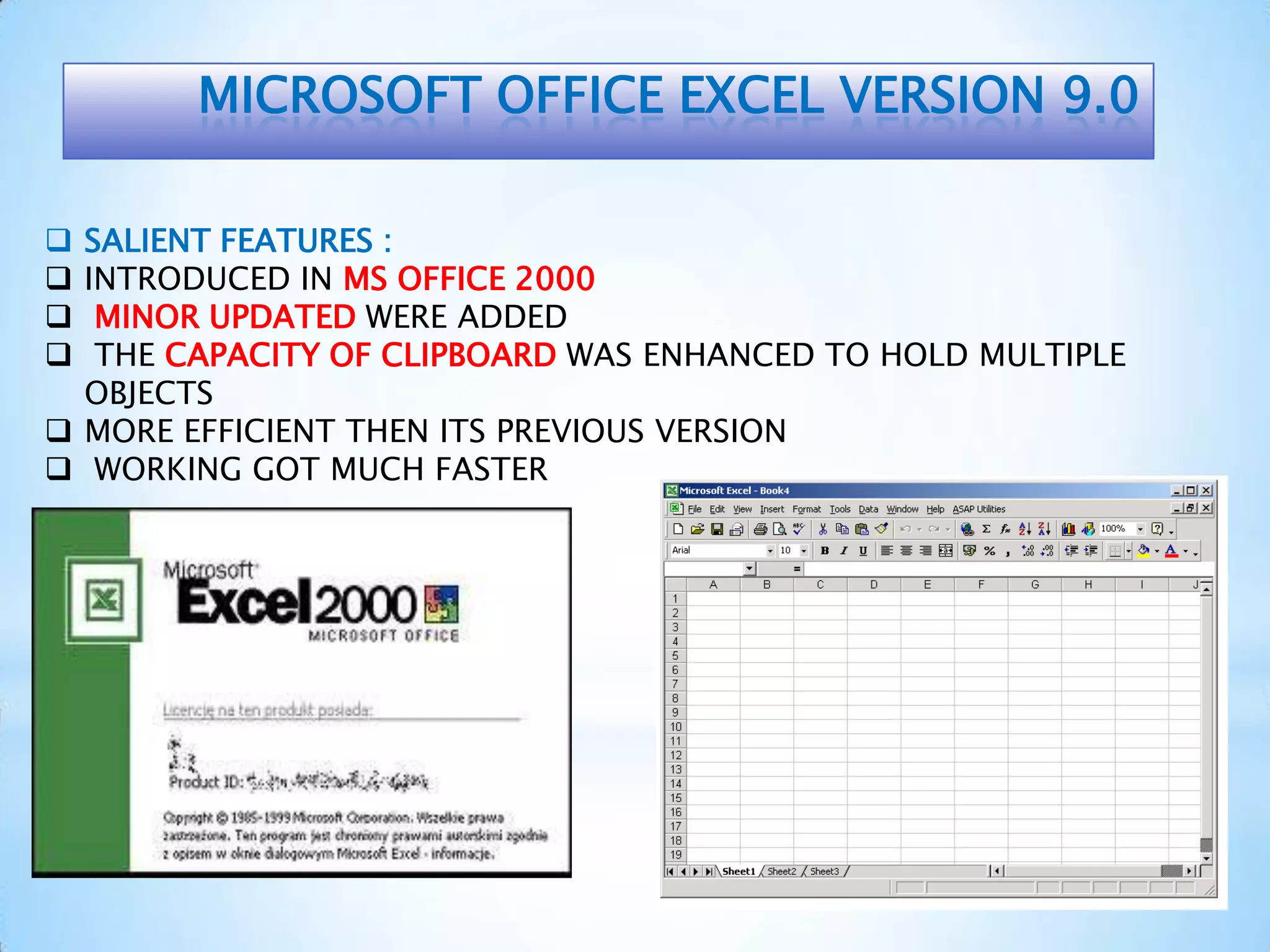
MICROSOFT OFFICE EXCEL VERSION 9.0
 SALIENT FEATURES :
 INTRODUCED IN MS OFFICE 2000
 MINOR UPDATED WERE ADDED
 THE CAPACITY OF CLIPBOARD WAS ENHANCED TO HOLD MULTIPLE
OBJECTS
 MORE EFFICIENT THEN ITS PREVIOUS VERSION
 WORKING GOT MUCH FASTER
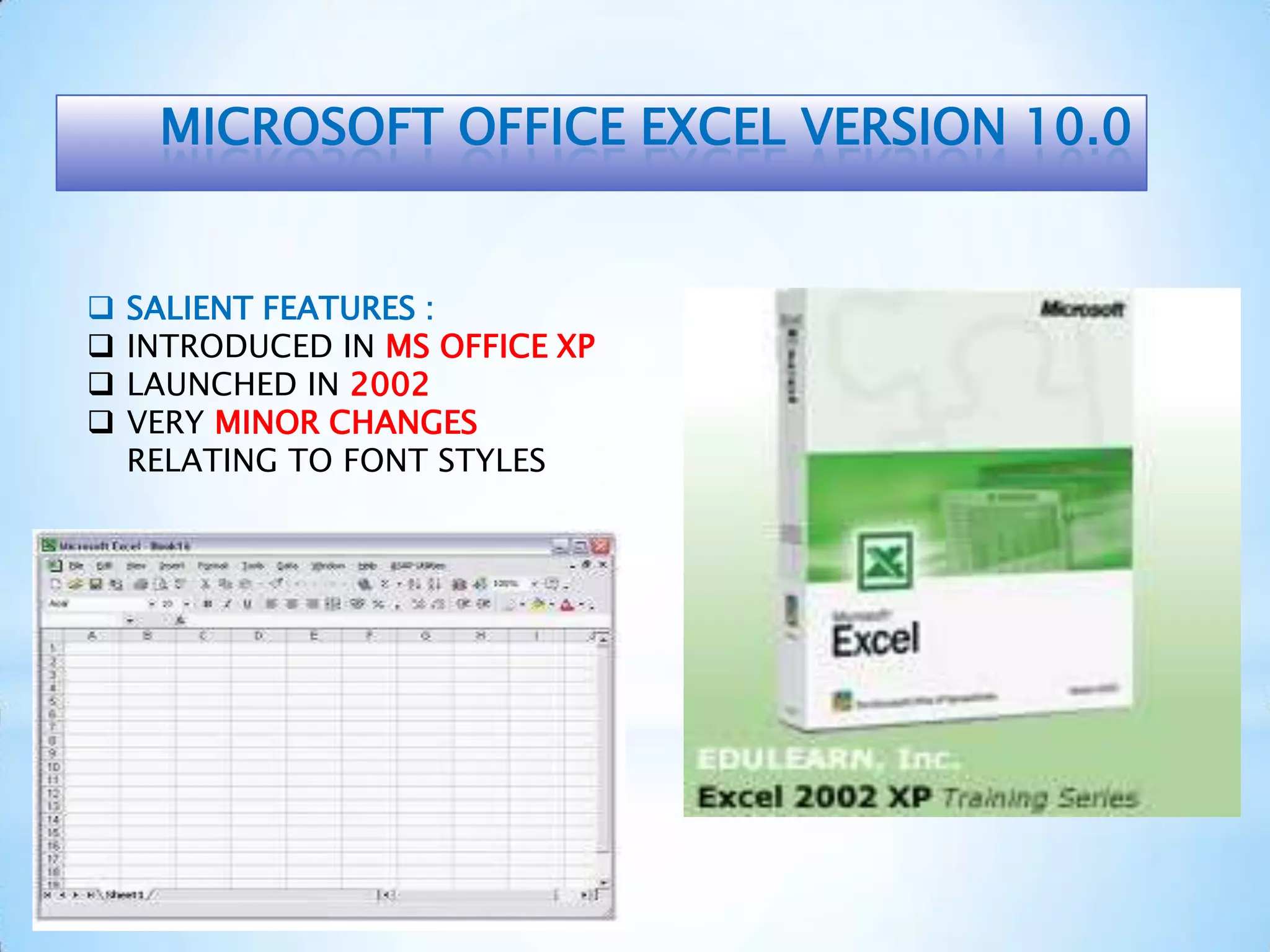
MICROSOFT OFFICE EXCEL VERSION 10.0
 SALIENT FEATURES :
 INTRODUCED IN MS OFFICE XP
 LAUNCHED IN 2002
 VERY MINOR CHANGES
RELATING TO FONT STYLES
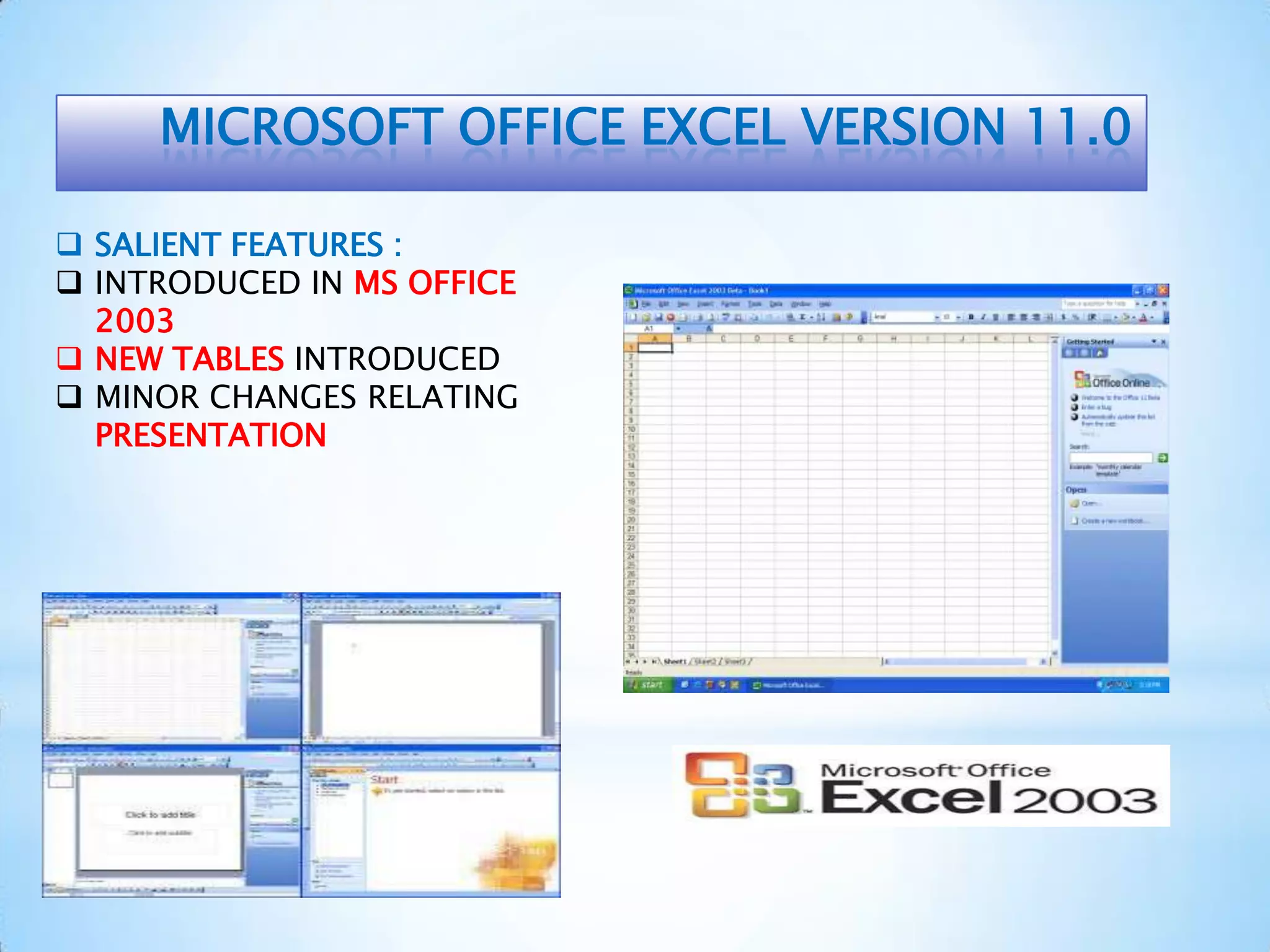
MICROSOFT OFFICE EXCEL VERSION 11.0
 SALIENT FEATURES :
 INTRODUCED IN MS OFFICE
2003
 NEW TABLES INTRODUCED
 MINOR CHANGES RELATING
PRESENTATION
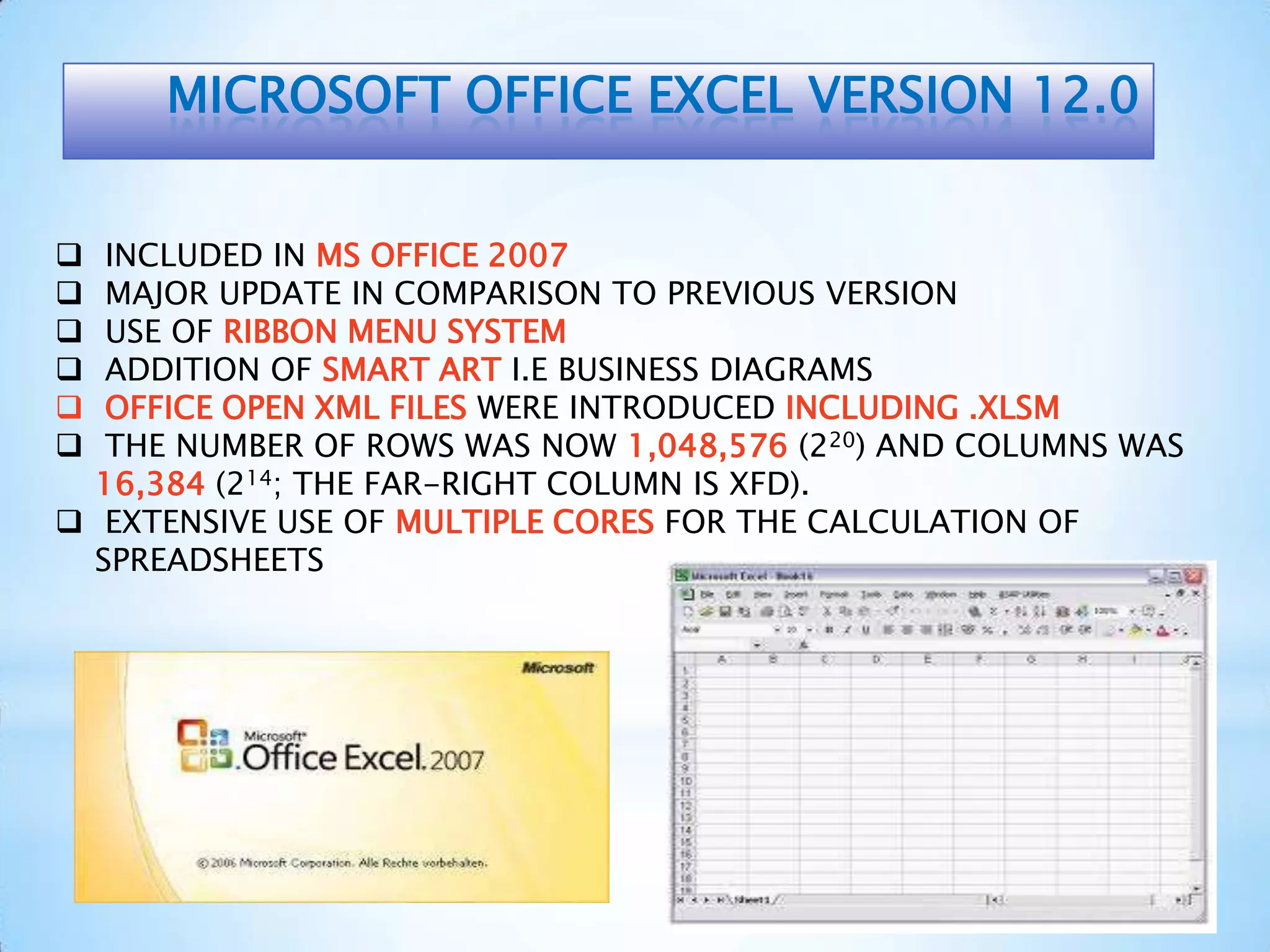
MICROSOFT OFFICE EXCEL VERSION 12.0
 INCLUDED IN MS OFFICE 2007
 MAJOR UPDATE IN COMPARISON TO PREVIOUS VERSION
 USE OF RIBBON MENU SYSTEM
 ADDITION OF SMART ART I.E BUSINESS DIAGRAMS
 OFFICE OPEN XML FILES WERE INTRODUCED INCLUDING .XLSM
 THE NUMBER OF ROWS WAS NOW 1,048,576 (220) AND COLUMNS WAS
16,384 (214; THE FAR-RIGHT COLUMN IS XFD).
 EXTENSIVE USE OF MULTIPLE CORES FOR THE CALCULATION OF
SPREADSHEETS
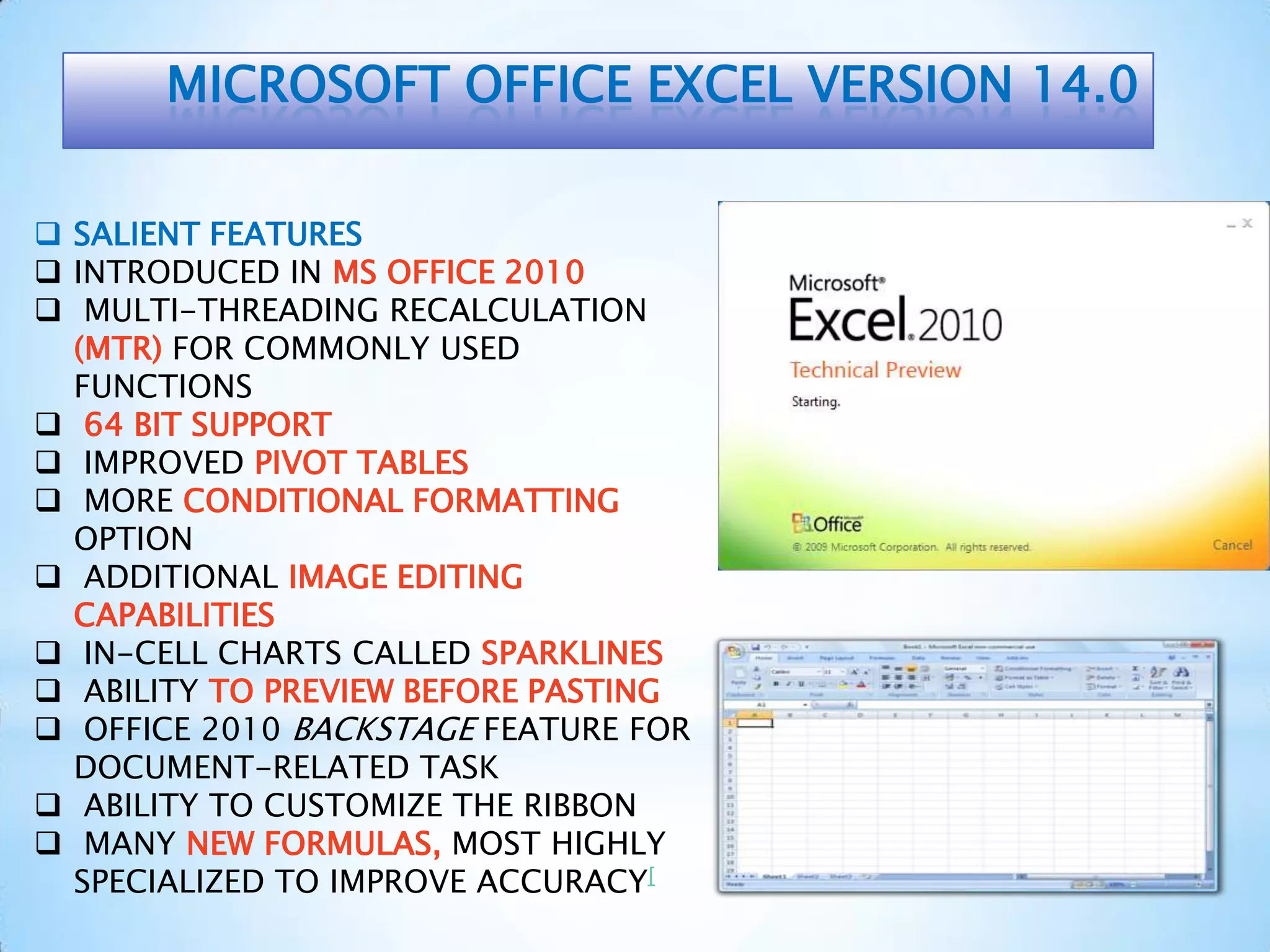
MICROSOFT OFFICE EXCEL VERSION 14.0
 SALIENT FEATURES
 INTRODUCED IN MS OFFICE 2010
 MULTI-THREADING RECALCULATION
(MTR) FOR COMMONLY USED
FUNCTIONS
 64 BIT SUPPORT
 IMPROVED PIVOT TABLES
 MORE CONDITIONAL FORMATTING
OPTION
 ADDITIONAL IMAGE EDITING
CAPABILITIES
 IN-CELL CHARTS CALLED SPARKLINES
 ABILITY TO PREVIEW BEFORE PASTING
 OFFICE 2010 BACKSTAGE FEATURE FOR
DOCUMENT-RELATED TASK
 ABILITY TO CUSTOMIZE THE RIBBON
 MANY NEW FORMULAS, MOST HIGHLY
SPECIALIZED TO IMPROVE ACCURACY[
MICROSOFT OFFICE EXCEL VERSION 15
 SALIENT FEATURES
 INCLUDED IN MS OFFICE
2013
 A LOT OF NEW TOOLS
HAVE BEEN INCLUDED IN
THIS RELEASE:
 IMPROVED MULTI-
THREADING AND MEMORY
CONTENTION
 FLASHFILL
 POWERVIEW
 POWERPIVOT
 TIMELINE SLICER
 WINDOWS APP
 INQUIRE
 50 NEW FUNCTIONS
1985 Excel 1.0
1988 Excel 1.5
1989 Excel 2.2
1990 Excel 3.0
1992 Excel 4.0
1993 Excel 5.0
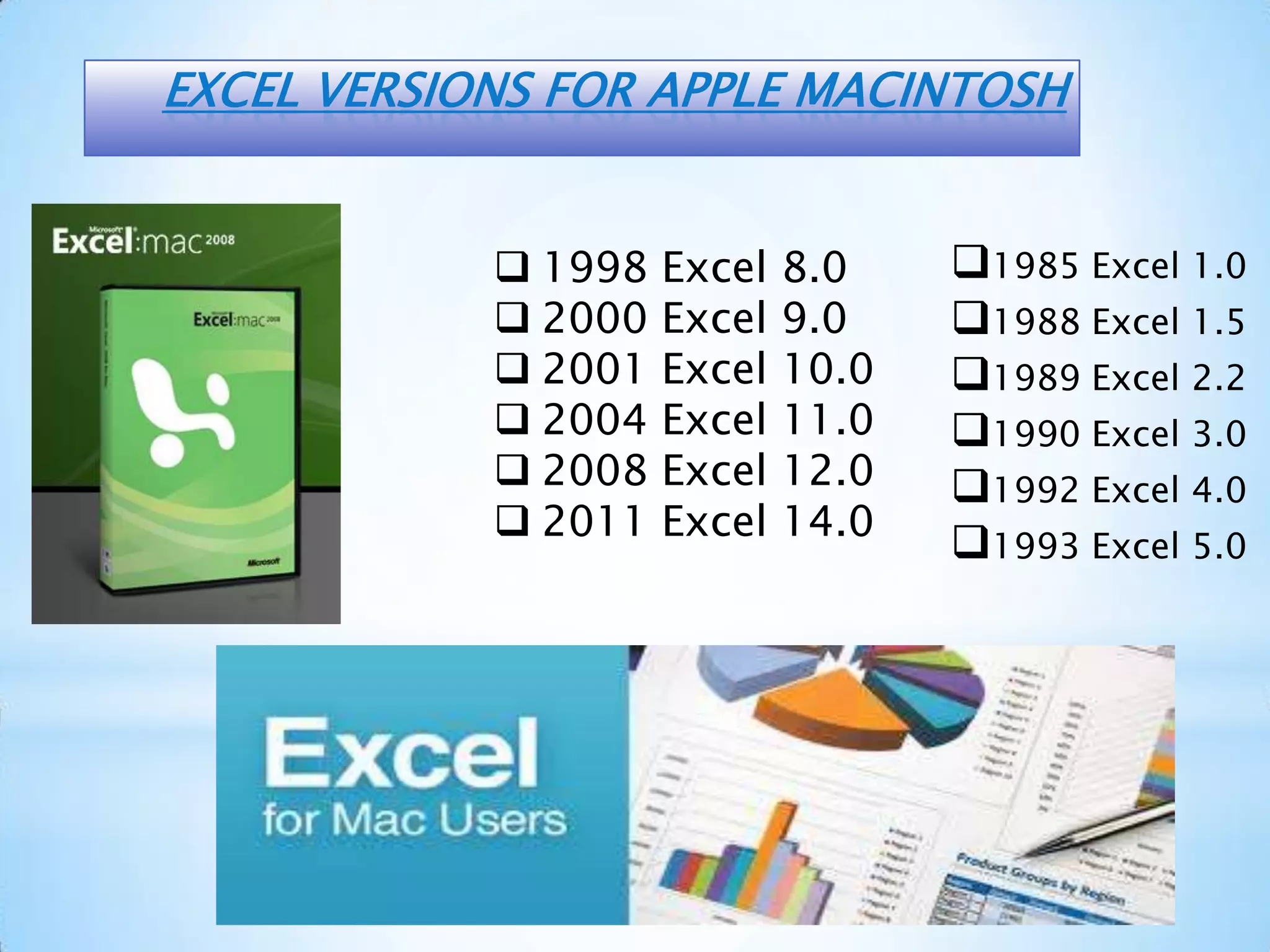
EXCEL VERSIONS FOR APPLE MACINTOSH
 1998 Excel 8.0
 2000 Excel 9.0
 2001 Excel 10.0
 2004 Excel 11.0
 2008 Excel 12.0
 2011 Excel 14.0
1. Financial
2. Date & Time
3. Maths & Trignometrical
4. Statistical
5. Lookup & Reference
6. Database
7. Text
8. Logical
9. Information
10.Engineering
11.Cube
12.Compatibility
PMT: Calculate payment for loan ,based on constant
payment and constant interest rates.
PPMT: Returns the payment on the principal for a
given period for an investment based on periodic
,constant payment and constant interest rates.
IPMT: Returns the interest payment for a given period
base on periodic ,constant payment and a constant
interest rate.
NPMT: It is used to find number of periods for an
investment based on periodic ,constant payment and
interest rate.
Financial function
RATE: It is used to find interest rate for an
investment based on periodic ,constant payments.
PV: Used for finding present value of investment.
FV: Used for finding future value of investment.
IRR: Used to find internal rate of return on
investment.
NPV: Calculate net present value of investment. If
NPV is positive that is favorable but negative is not
favorable.
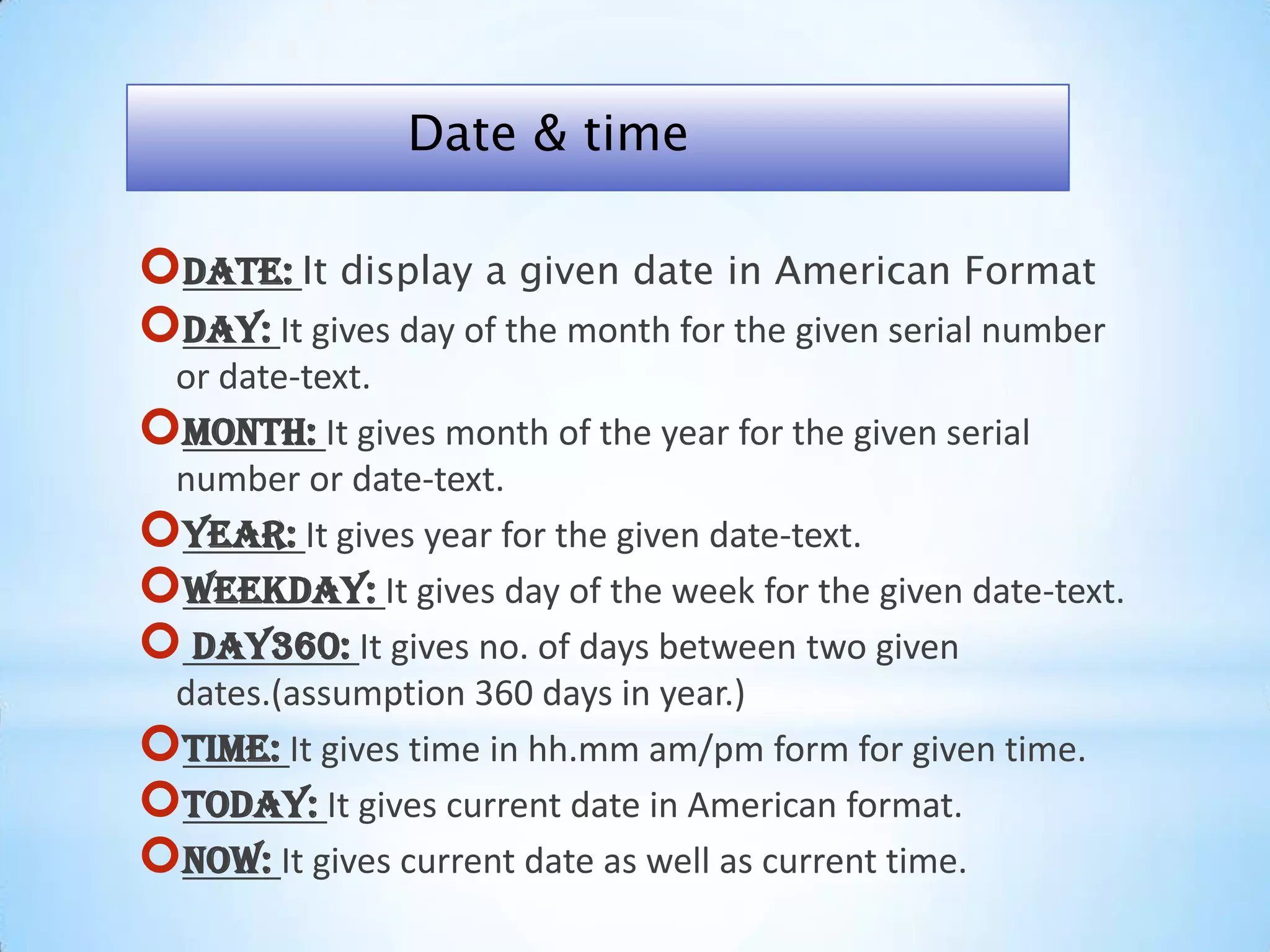
Date: It display a given date in American Format
Day: It gives day of the month for the given serial number
or date-text.
Month: It gives month of the year for the given serial
number or date-text.
Year: It gives year for the given date-text.
Weekday: It gives day of the week for the given date-text.
 day360: It gives no. of days between two given
dates.(assumption 360 days in year.)
Time: It gives time in hh.mm am/pm form for given time.
Today: It gives current date in American format.
Now: It gives current date as well as current time.
Date & time
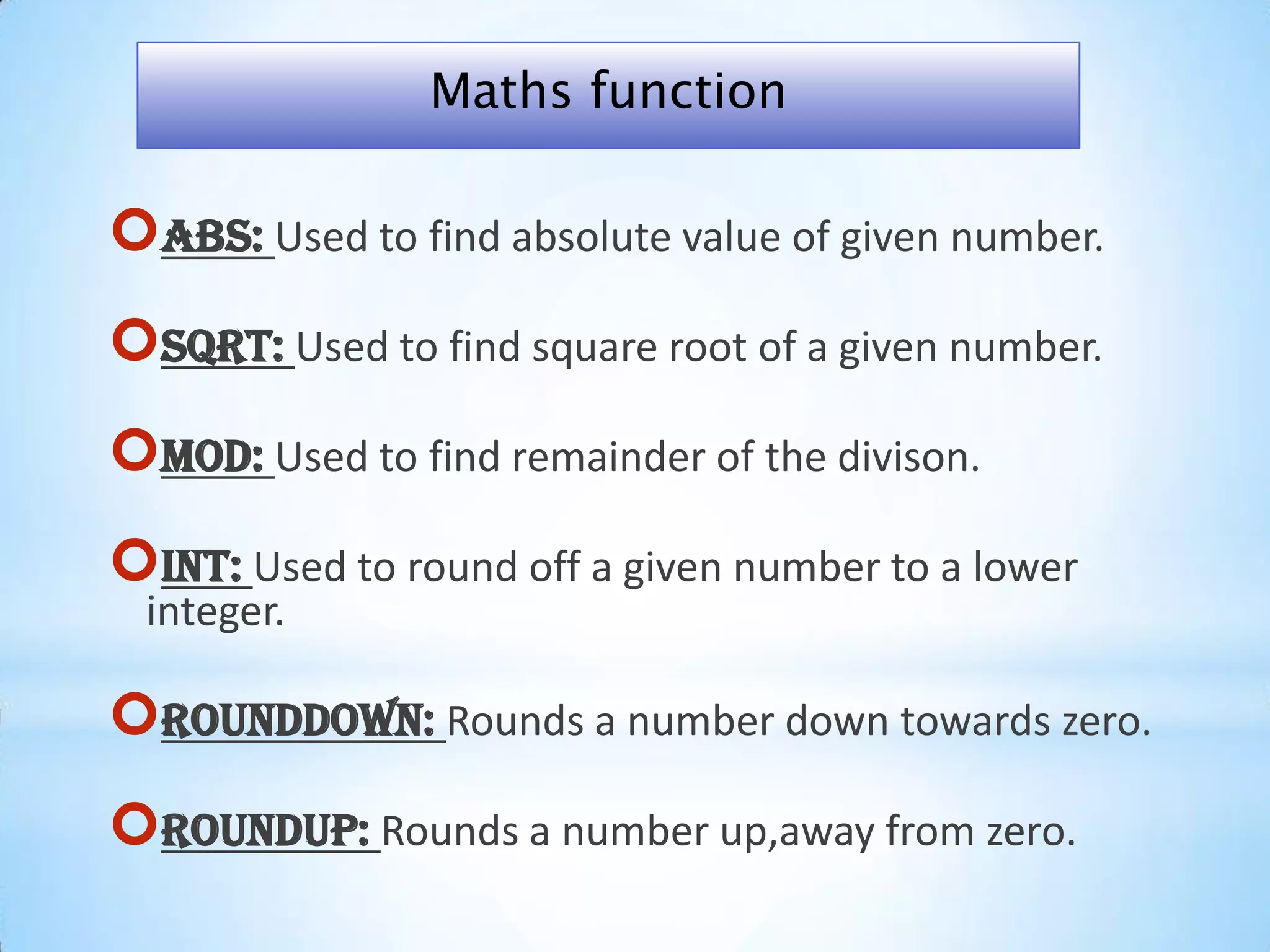
ABS: Used to find absolute value of given number.
SQRT: Used to find square root of a given number.
MOD: Used to find remainder of the divison.
INT: Used to round off a given number to a lower
integer.
ROUNDDOWN: Rounds a number down towards zero.
ROUNDUP: Rounds a number up,away from zero.
Maths function
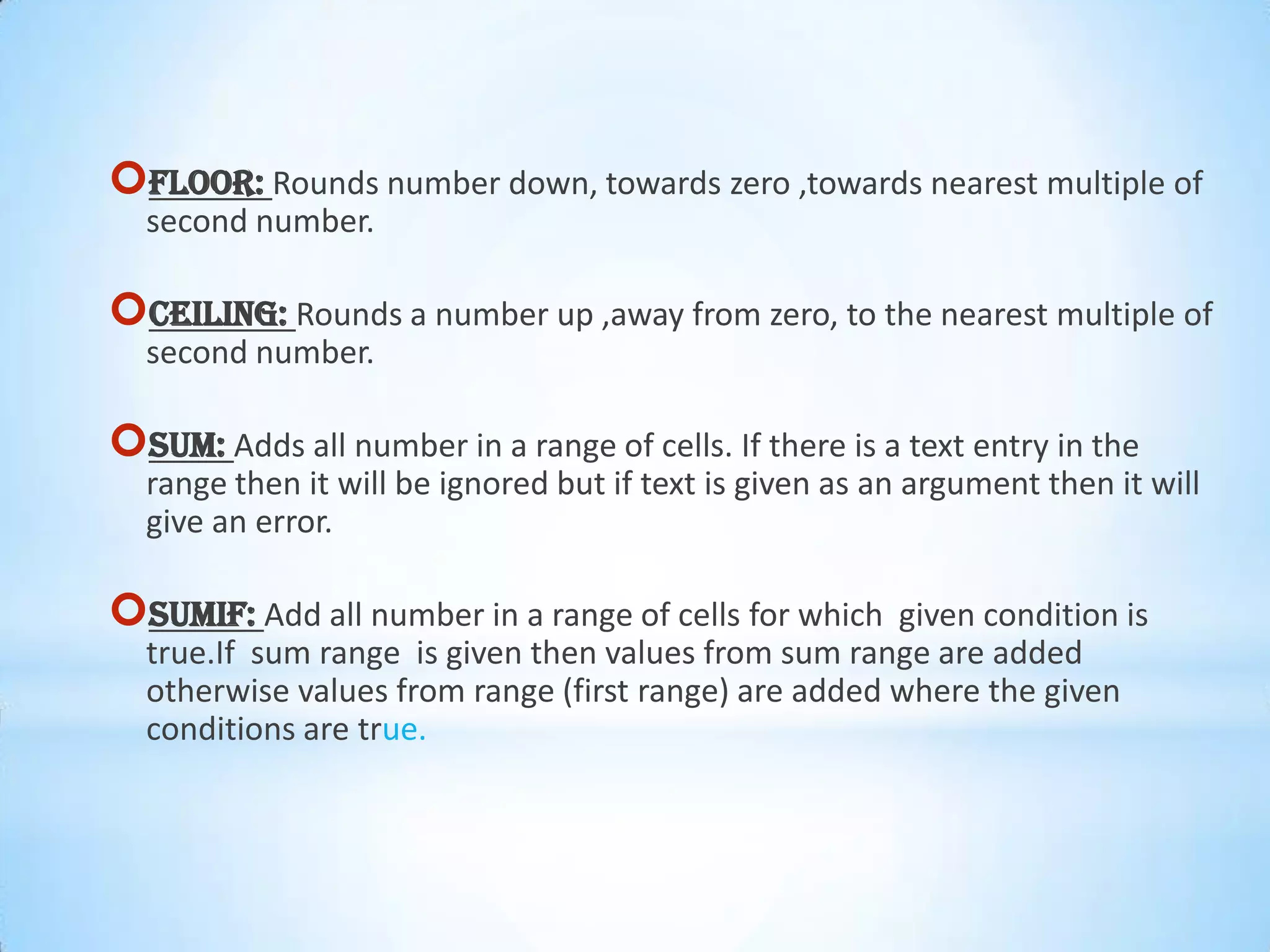
FLOOR: Rounds number down, towards zero ,towards nearest multiple of
second number.
CEILING: Rounds a number up ,away from zero, to the nearest multiple of
second number.
SUM: Adds all number in a range of cells. If there is a text entry in the
range then it will be ignored but if text is given as an argument then it will
give an error.
SUMIF: Add all number in a range of cells for which given condition is
true.If sum range is given then values from sum range are added
otherwise values from range (first range) are added where the given
conditions are true.
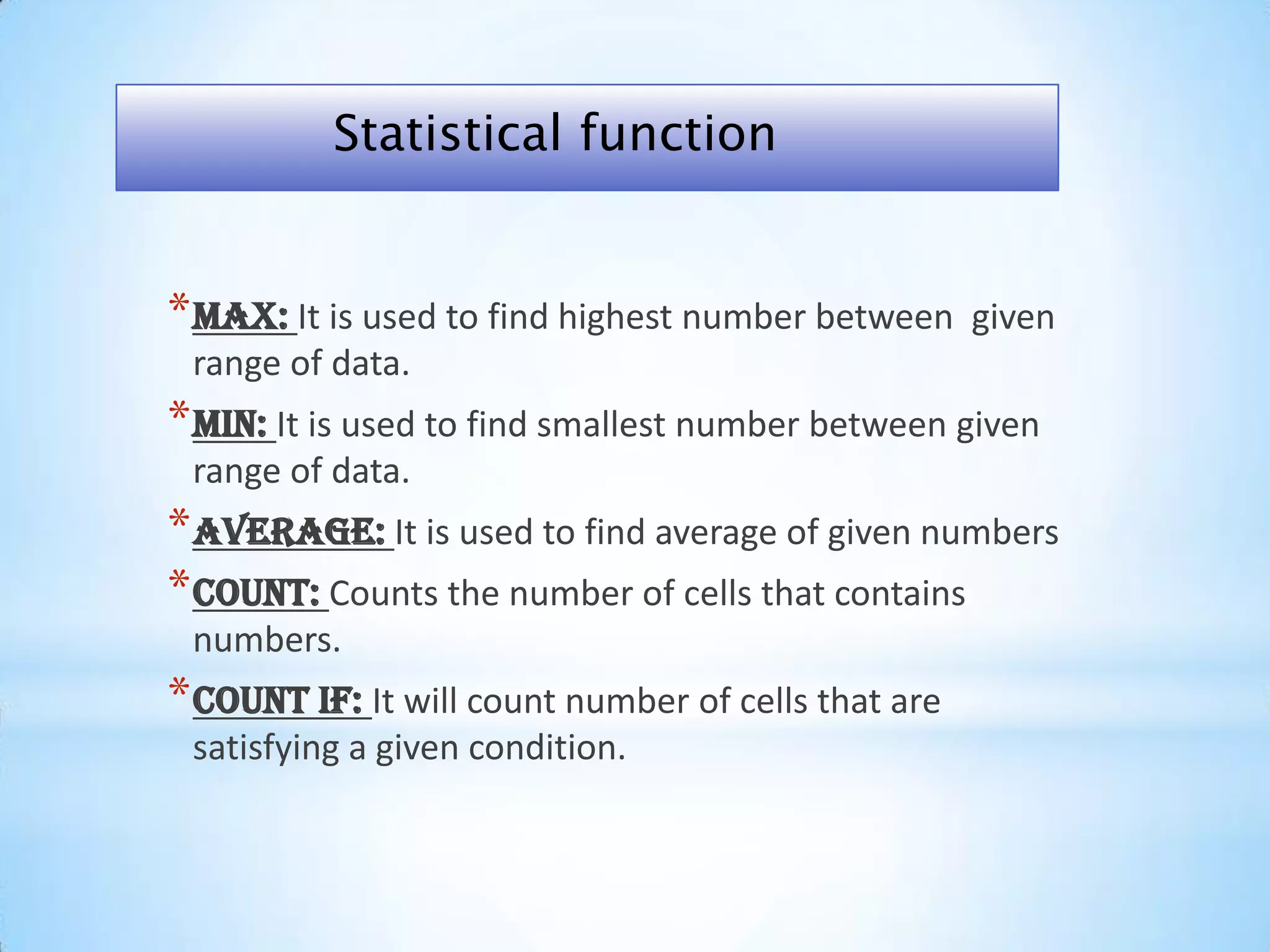
*Max: It is used to find highest number between given
range of data.
*Min: It is used to find smallest number between given
range of data.
*Average: It is used to find average of given numbers
*Count: Counts the number of cells that contains
numbers.
*Count if: It will count number of cells that are
satisfying a given condition.
Statistical function
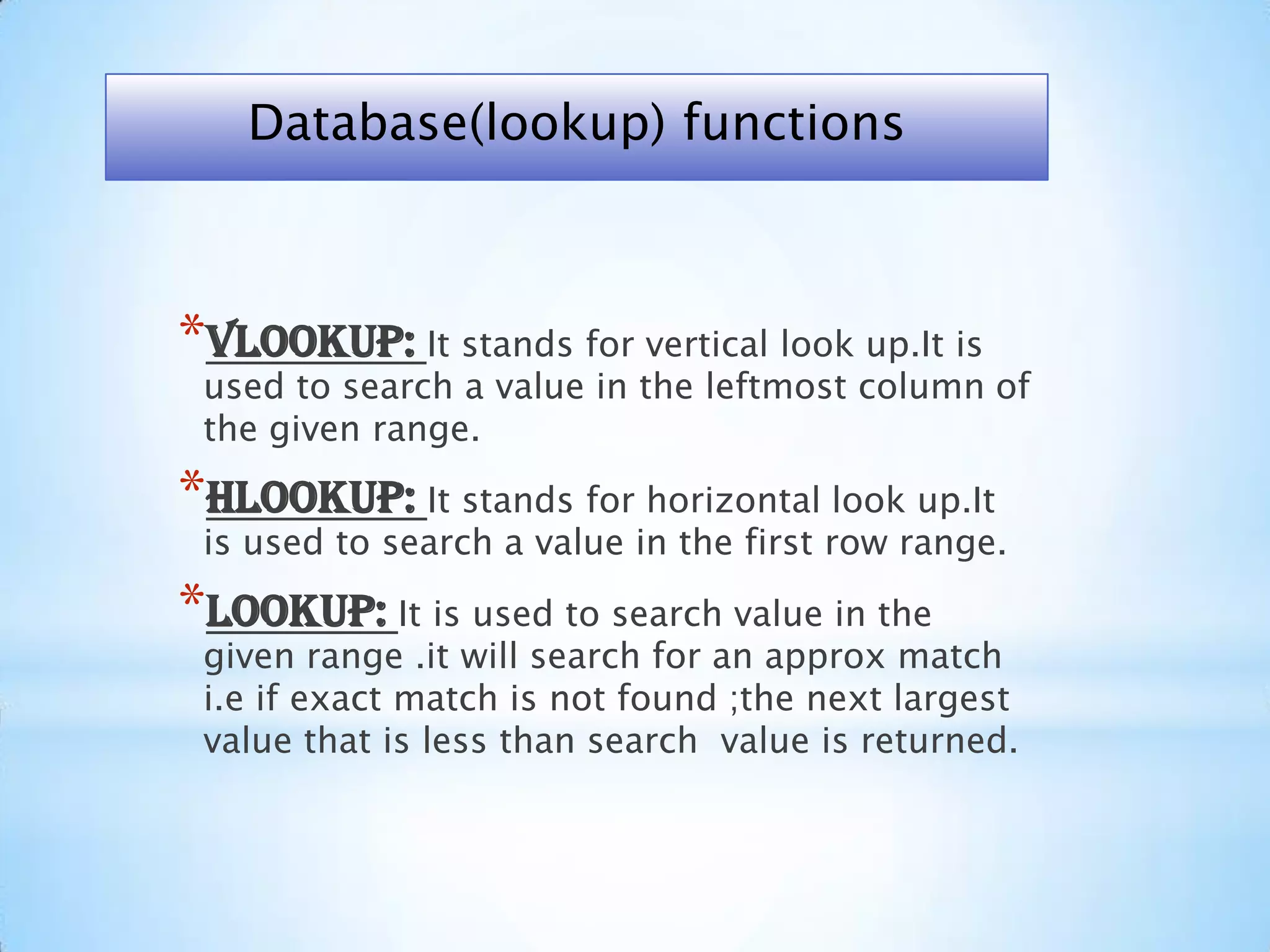
*VLOOKUP: It stands for vertical look up.It is
used to search a value in the leftmost column of
the given range.
*HLOOKUP: It stands for horizontal look up.It
is used to search a value in the first row range.
*LOOKUP: It is used to search value in the
given range .it will search for an approx match
i.e if exact match is not found ;the next largest
value that is less than search value is returned.
Database(lookup) functions
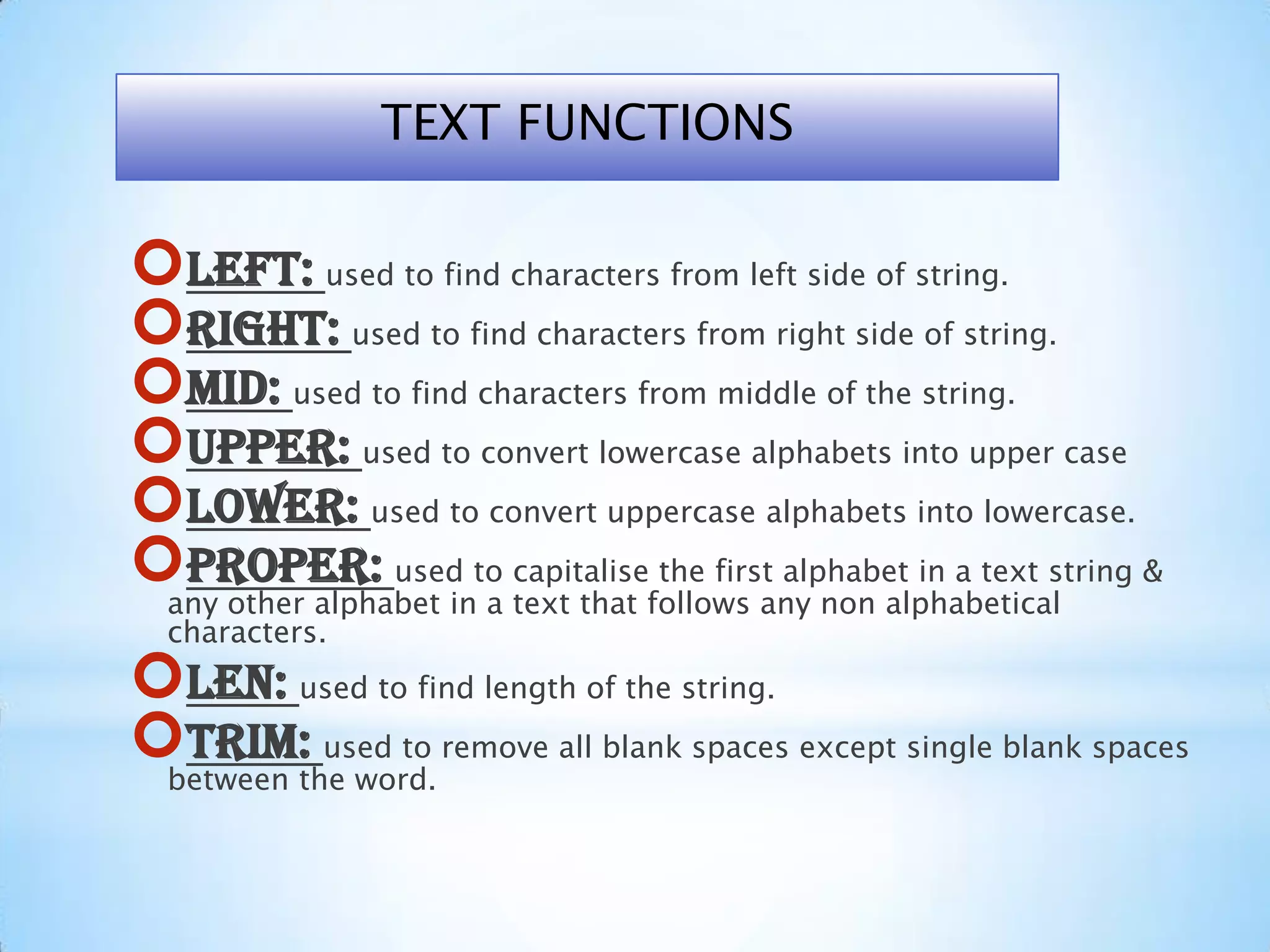
Left: used to find characters from left side of string.
Right: used to find characters from right side of string.
Mid: used to find characters from middle of the string.
Upper: used to convert lowercase alphabets into upper case
Lower: used to convert uppercase alphabets into lowercase.
Proper: used to capitalise the first alphabet in a text string &
any other alphabet in a text that follows any non alphabetical
characters.
Len: used to find length of the string.
Trim: used to remove all blank spaces except single blank spaces
between the word.
TEXT FUNCTIONS
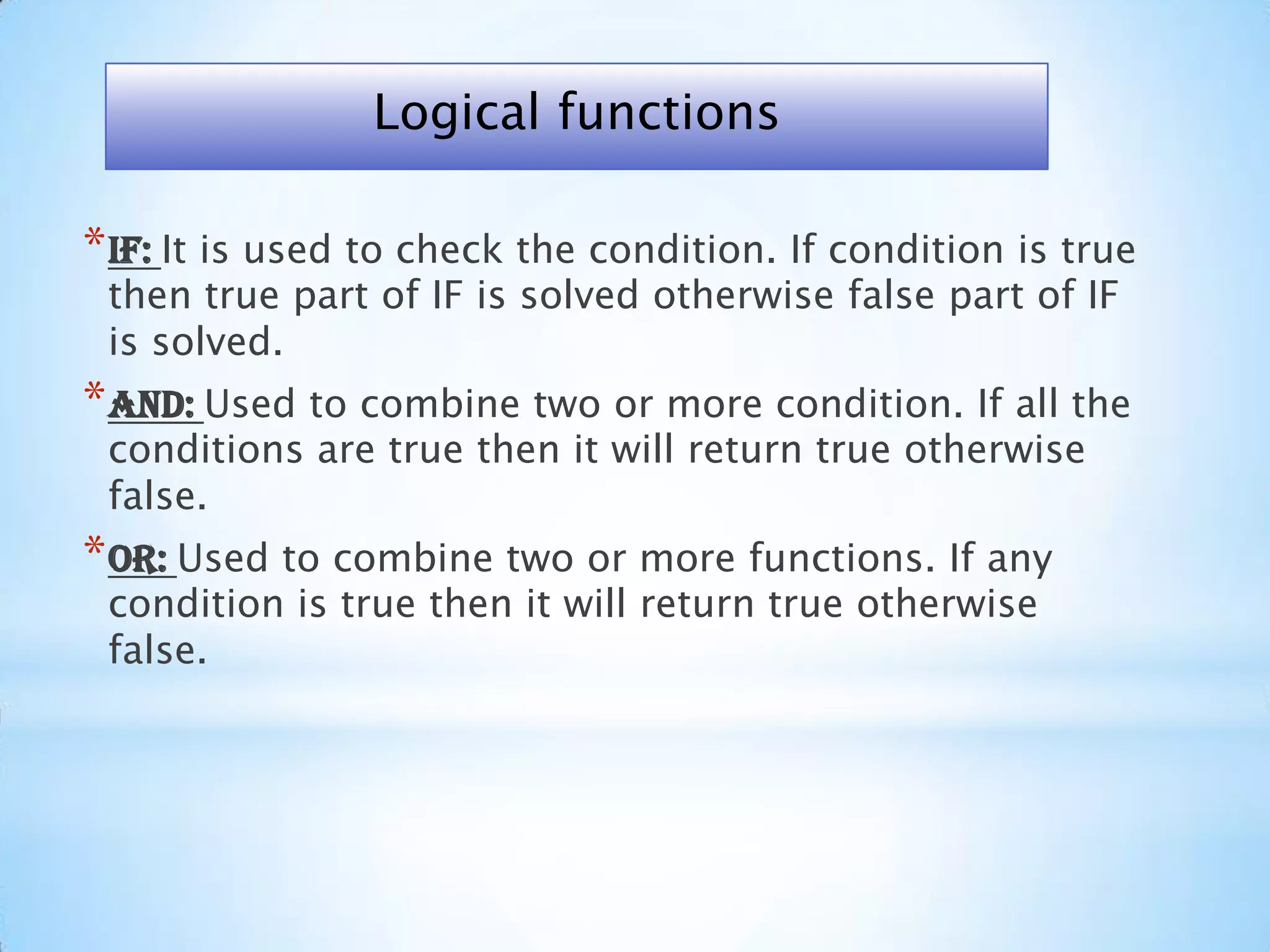
*IF: It is used to check the condition. If condition is true
then true part of IF is solved otherwise false part of IF
is solved.
*AND: Used to combine two or more condition. If all the
conditions are true then it will return true otherwise
false.
*OR: Used to combine two or more functions. If any
condition is true then it will return true otherwise
false.
Logical functions
*
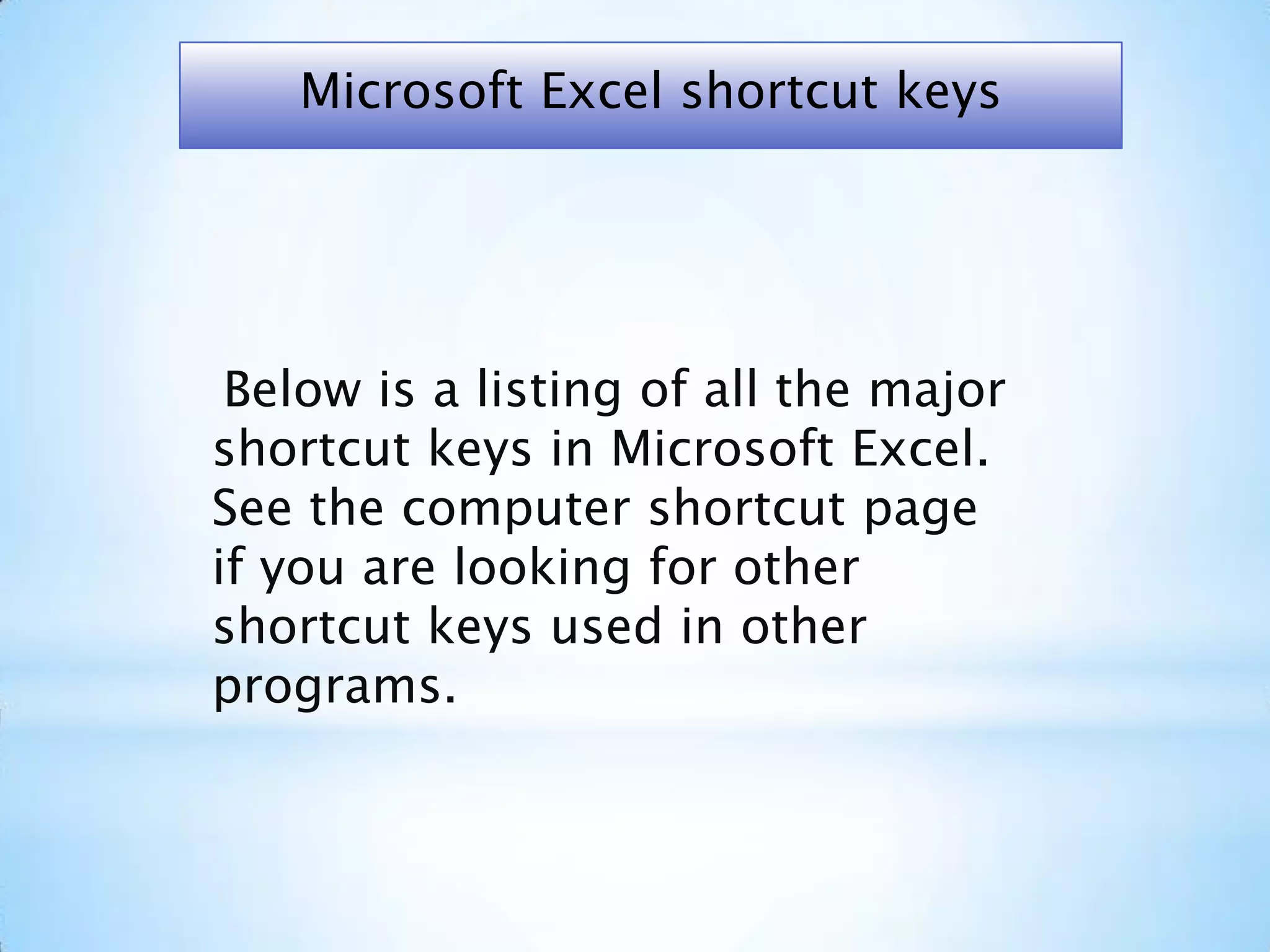
Below is a listing of all the major
shortcut keys in Microsoft Excel.
See the computer shortcut page
if you are looking for other
shortcut keys used in other
programs.
Microsoft Excel shortcut keys
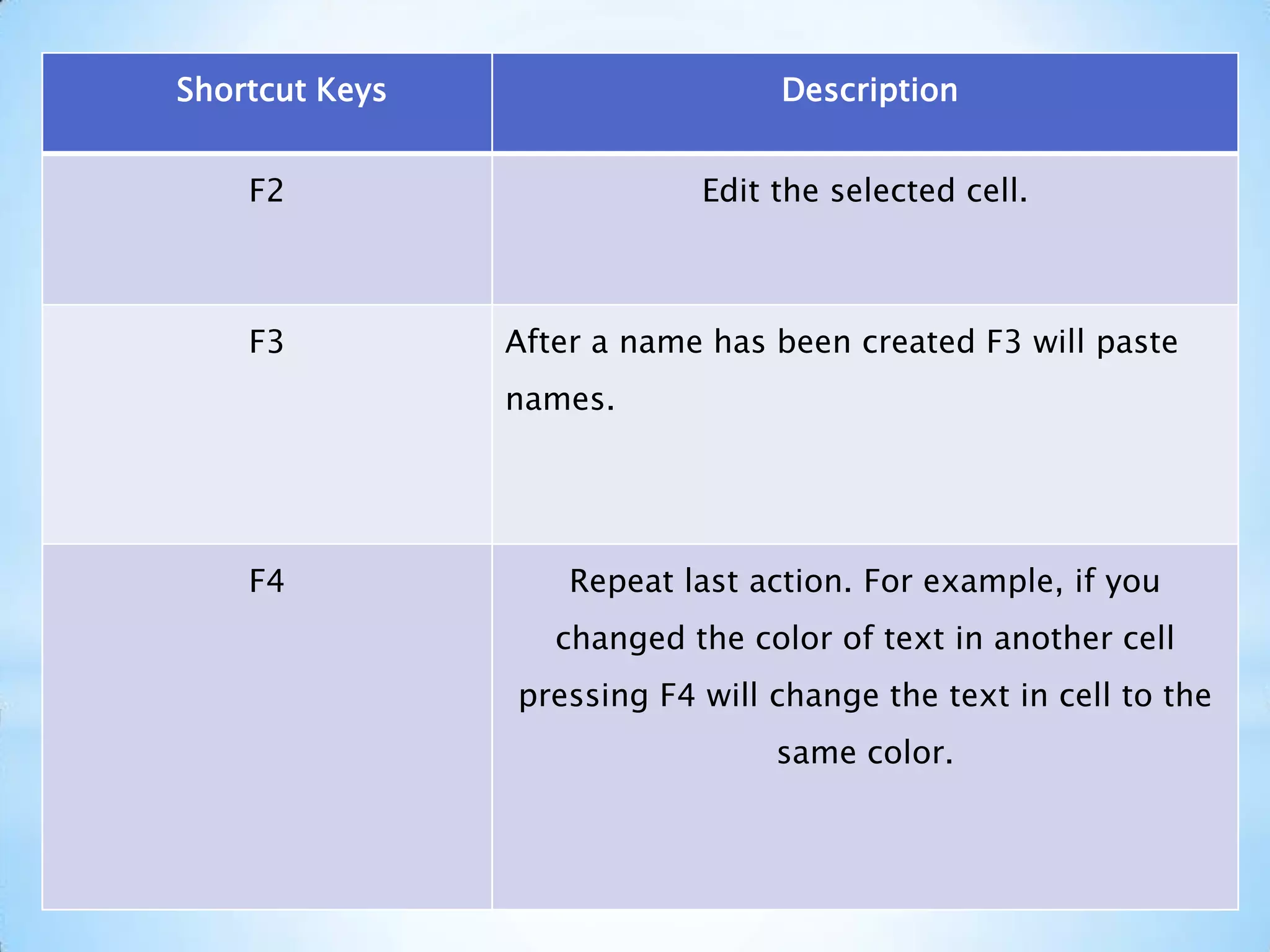
Shortcut Keys Description
F2 Edit the selected cell.
F3 After a name has been created F3 will paste
names.
F4 Repeat last action. For example, if you
changed the color of text in another cell
pressing F4 will change the text in cell to the
same color.
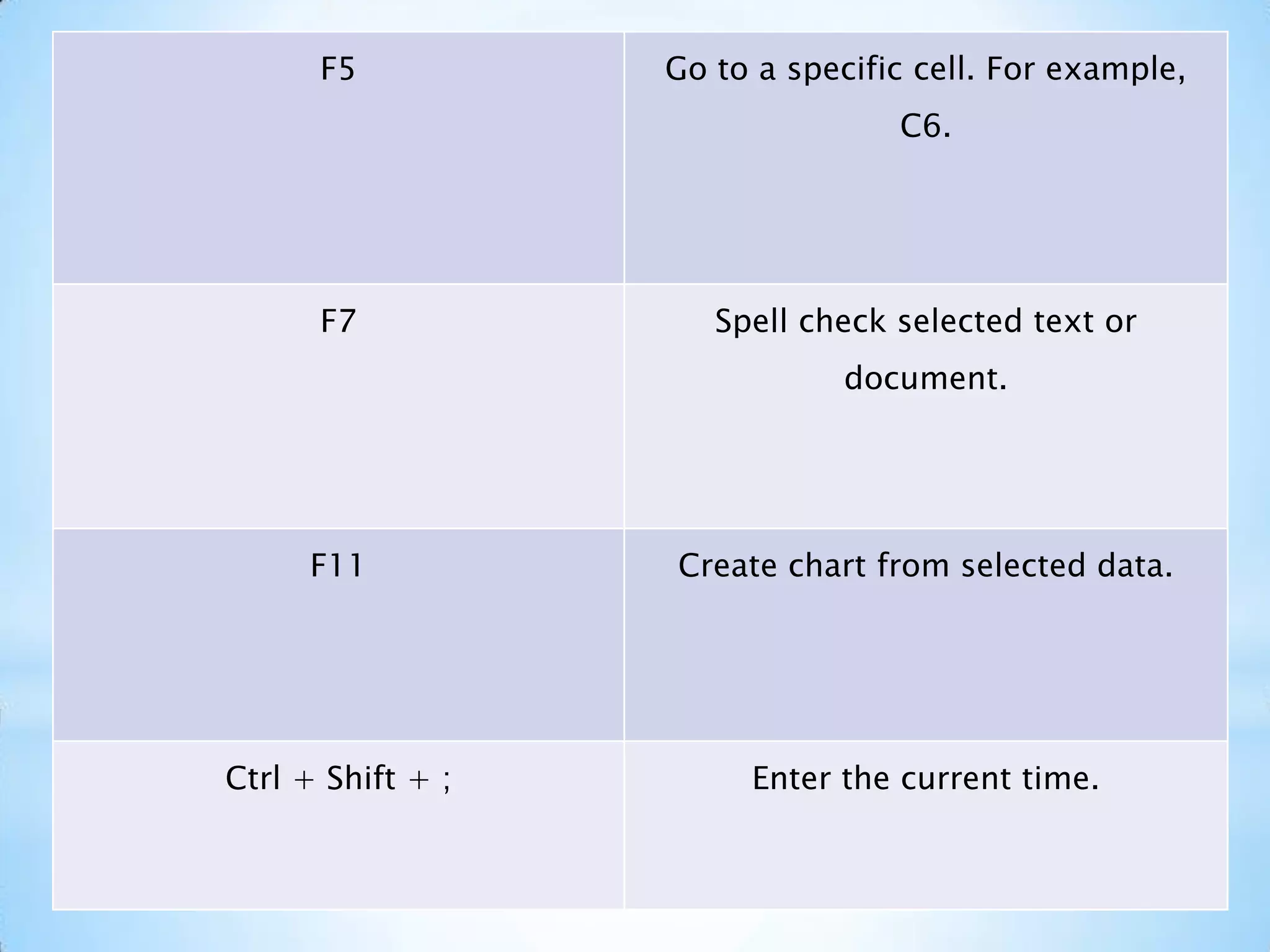
F5 Go to a specific cell. For example,
C6.
F7 Spell check selected text or
document.
F11 Create chart from selected data.
Ctrl + Shift + ; Enter the current time.
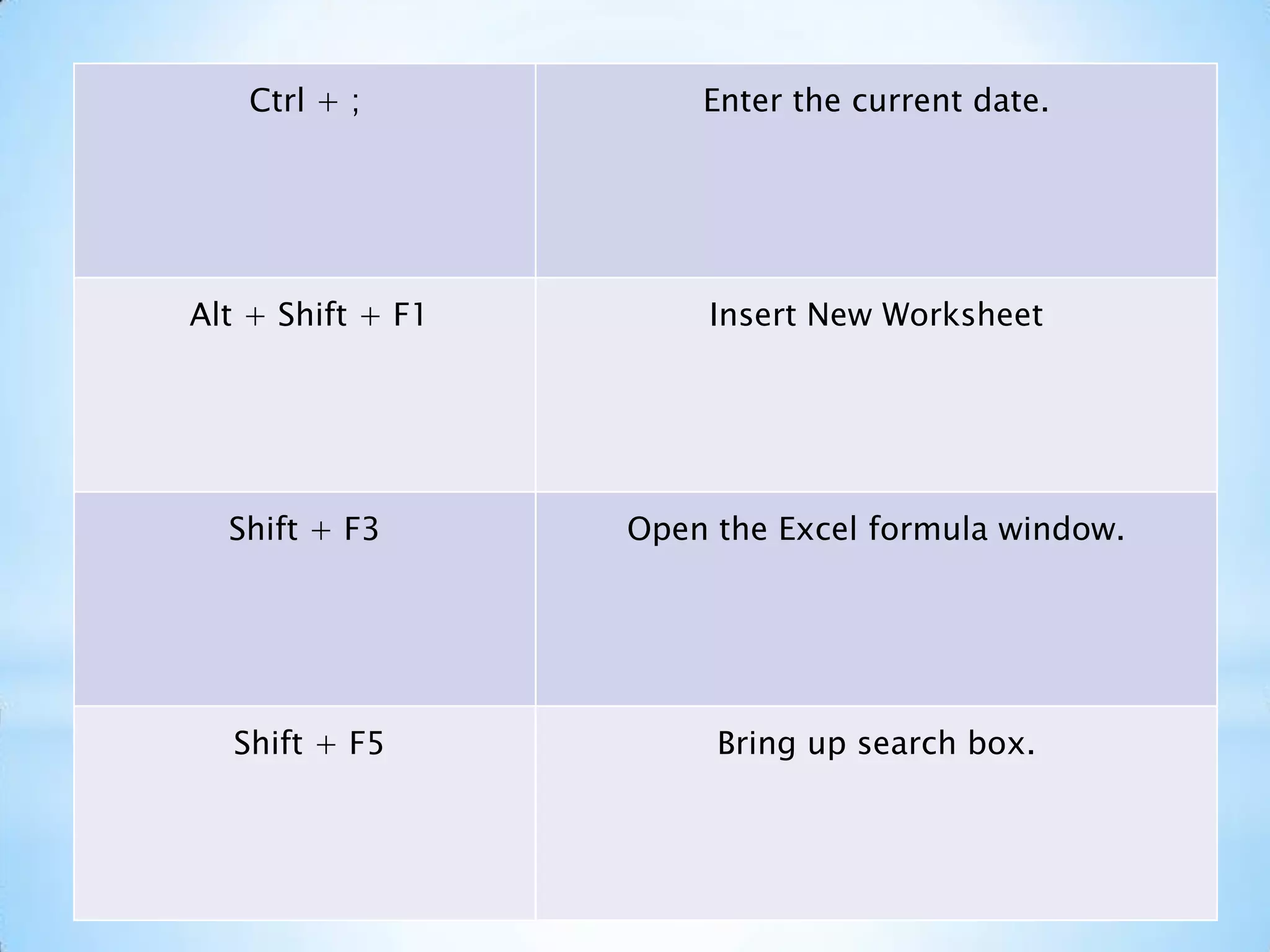
Ctrl + ; Enter the current date.
Alt + Shift + F1 Insert New Worksheet
Shift + F3 Open the Excel formula window.
Shift + F5 Bring up search box.
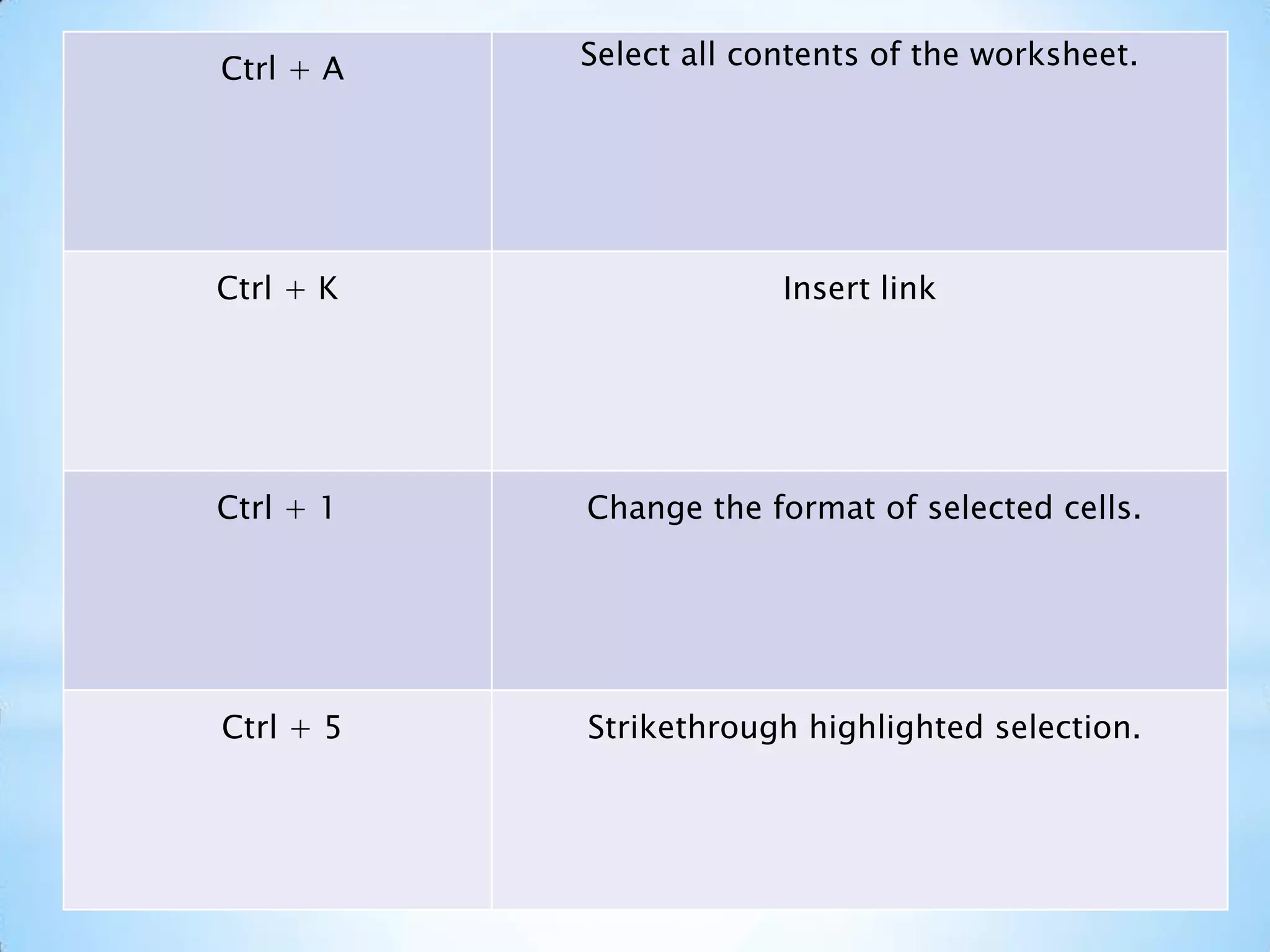
Ctrl + A Select all contents of the worksheet.
Ctrl + K Insert link
Ctrl + 1 Change the format of selected cells.
Ctrl + 5 Strikethrough highlighted selection.
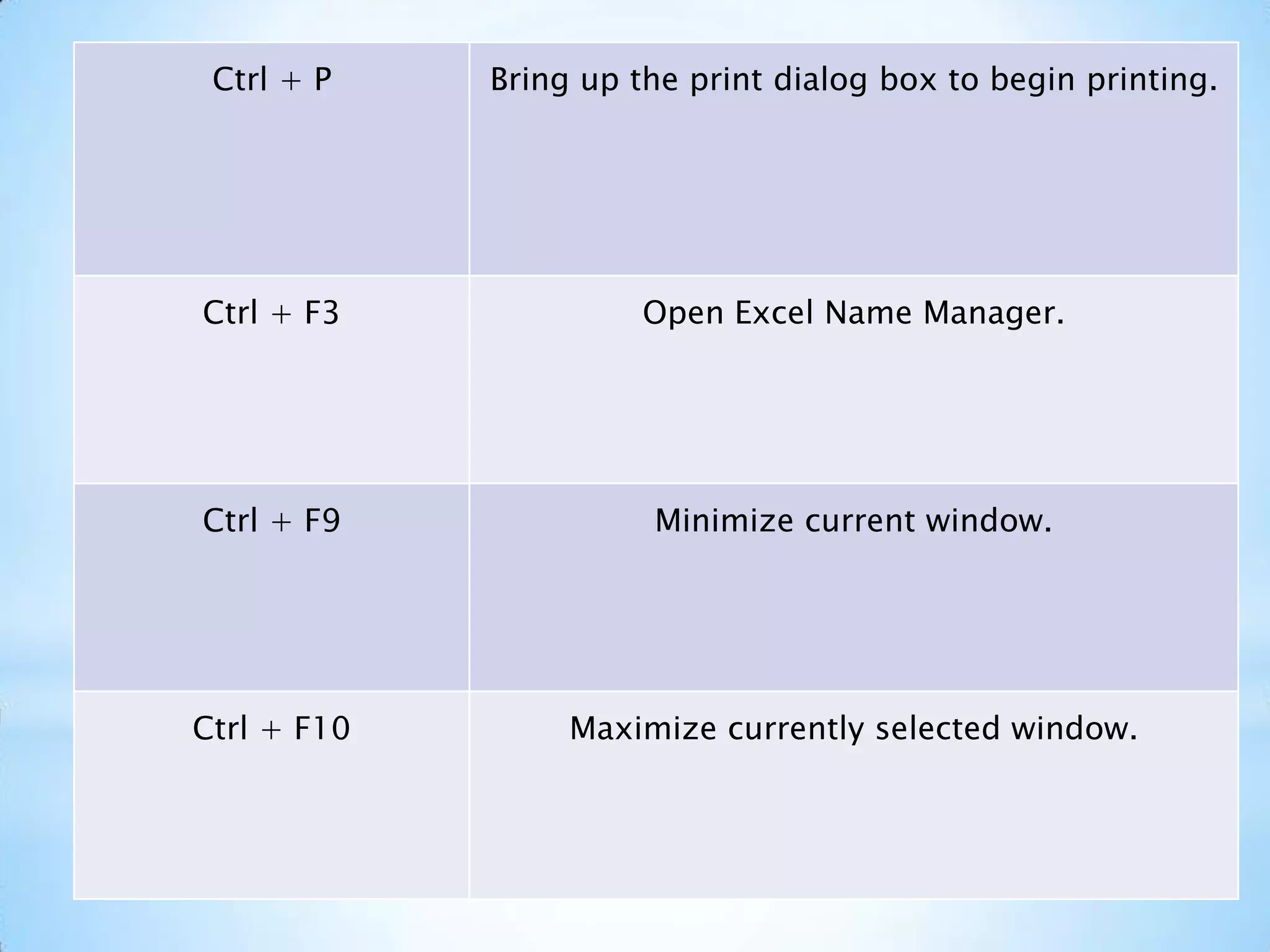
Ctrl + P Bring up the print dialog box to begin printing.
Ctrl + F3 Open Excel Name Manager.
Ctrl + F9 Minimize current window.
Ctrl + F10 Maximize currently selected window.
VERSIONS AND FUNCTIONS OF MS EXCEL

VERSIONS AND FUNCTIONS OF MS EXCEL

  • 1.
    EVOLUTION AND FUNCTIONSOF MICROSOFT EXCEL
  • 2.
  • 3.
  • 4.
     FIRST COMPUTERIZEDSPREADSHEET - DEVELOPED BY DAN BRICKLIN AND BOB FRANKSTON FOR THE APPLE II COMPUTER  MARKETED AS VISICALC  IN 1982 LOTUS DEVELOPMENT RELEASED 123 FOR DOS.  SETUP AS THE FIRST BUSINESS TOOL  IN 1982 MICROSOFT ORIGINALLY MARKETED A SPREADSHEET PROGRAM CALLED MULTIPLAN.  THE FIRST VERSION OF EXCEL WAS RELEASED FOR THE MAC IN 1985 AND THE FIRST WINDOWS VERSION WAS RELEASED IN NOVEMBER 1987.  UPGRADES -TOOL BARS, OUTLINING, DRAWING, 3-D CHARTS, NUMEROUS SHORTCUTS, AND MORE AUTOMATED FEATURES EARLY SPREADSHEETS ::
  • 5.
    MICROSOFT OFFICE EXCELVERSION 2.0  SALIENT FEATURES :  FIRST VERSION FOR WINDOWS  INTRODUCED IN MS OFFICE 1987.  BASIC FUNCTIONS  VERY LIMITED ROWS AND COLUMNS  BECAME POPULAR AS LAUNCHED  EFFICIENT  NO CLIPBOARD AVAILABLE  EXCEL DISPUTE LEADING TO THE NAME MICROSOFT EXCEL.
  • 6.
     SALIENT FEATURES:  INTRODUCED IN MS OFFICE 1990  ADDITION OF TOOLBARS  SOME FUNCTIONS WERE ADDED TO MAKE IT MORE EFFECIENT  INCREASED EFFECIENCY  CHANGES IN RELATION TO FONT AND PRESENTATION  NUMBER OF ROWS AND COLUMNS WERE INCREASED MICROSOFT OFFICE EXCEL VERSION 3.0
  • 7.
     SALIENT FEATURES:  INTRODUCED IN MS OFFICE 1992  AGAIN NEGLIGIBLE CHANGES  CHANGES ON PRESENTATION AND FONTS  EFFICIENT THEN PREVIOUS VERSION MICROSOFT OFFICE EXCEL VERSION 4.0  IMPORTANT CHANGE ::  THE NEW FEATURE OF AUTOFILL WAS INTRODUCED  THIS MADE PRESENTATION MORE EFFECTIVE
  • 8.
    MICROSOFT OFFICE EXCELVERSION 5.0  SALIENT FEATURES :  INCLUDED IN MS OFFICE 1993  INCLUSION OF VIRTUAL BASIC (VB)  INCLUSION OF EASTER EGGS  SOME DRAWBACKS ::  The automation functionality provided by VBA made Excel a target for MICRO VIRUSES  NO AVAILIBILITY OF CLIPBOARD
  • 9.
    TASKS PERFORMED :: Workingin workbooks Selecting cells choosing commands Using toolbars Entering data Creating formulas and links Editing a worksheet Formatting a worksheet Creating graphic objects Printing Creating a chart Formatting a chart Using Charts to analyze data Organizing data in a list Using pivot tables performing what-if analysis Sharing and importing data Using visual basic
  • 10.
    MICROSOFT OFFICE EXCELVERSION 7.0  SALIENT FEATURES :  INCLUDED IN MS OFFICE 1995  INTERNAL REWRITE TO 32 BITS  IT ALSO USES VIRTUAL BASICS  FAST AND STABLE  16384 ROWS SUPPORTED  TASKS PERFORMED ::  SIMILAR AS TO EXCEL VERSION 5.0  BUT AT A COMPARATIVELY FASTEER SPEED .
  • 11.
    MICROSOFT OFFICE EXCELVERSION 8.0  SALIENT FEATURES :  INCLUDED IN MS OFFICE 1997  UNDO UPTO LAST 16 ACTIONS  SUPPORTS THE SCROLL WHEEL TO PAGE MOVEMENTS  CAPACITY OF 32000 CHARACTERS IN ONE CELL  65536 ROWS ALLOWED  VIRUS CHECKING  SOME DRAWBACKS ::  NO AVAILIBILITY OF CLIPBOARD
  • 12.
    MICROSOFT OFFICE EXCELVERSION 9.0  SALIENT FEATURES :  INTRODUCED IN MS OFFICE 2000  MINOR UPDATED WERE ADDED  THE CAPACITY OF CLIPBOARD WAS ENHANCED TO HOLD MULTIPLE OBJECTS  MORE EFFICIENT THEN ITS PREVIOUS VERSION  WORKING GOT MUCH FASTER
  • 13.
    MICROSOFT OFFICE EXCELVERSION 10.0  SALIENT FEATURES :  INTRODUCED IN MS OFFICE XP  LAUNCHED IN 2002  VERY MINOR CHANGES RELATING TO FONT STYLES
  • 14.
    MICROSOFT OFFICE EXCELVERSION 11.0  SALIENT FEATURES :  INTRODUCED IN MS OFFICE 2003  NEW TABLES INTRODUCED  MINOR CHANGES RELATING PRESENTATION
  • 15.
    MICROSOFT OFFICE EXCELVERSION 12.0  INCLUDED IN MS OFFICE 2007  MAJOR UPDATE IN COMPARISON TO PREVIOUS VERSION  USE OF RIBBON MENU SYSTEM  ADDITION OF SMART ART I.E BUSINESS DIAGRAMS  OFFICE OPEN XML FILES WERE INTRODUCED INCLUDING .XLSM  THE NUMBER OF ROWS WAS NOW 1,048,576 (220) AND COLUMNS WAS 16,384 (214; THE FAR-RIGHT COLUMN IS XFD).  EXTENSIVE USE OF MULTIPLE CORES FOR THE CALCULATION OF SPREADSHEETS
  • 16.
    MICROSOFT OFFICE EXCELVERSION 14.0  SALIENT FEATURES  INTRODUCED IN MS OFFICE 2010  MULTI-THREADING RECALCULATION (MTR) FOR COMMONLY USED FUNCTIONS  64 BIT SUPPORT  IMPROVED PIVOT TABLES  MORE CONDITIONAL FORMATTING OPTION  ADDITIONAL IMAGE EDITING CAPABILITIES  IN-CELL CHARTS CALLED SPARKLINES  ABILITY TO PREVIEW BEFORE PASTING  OFFICE 2010 BACKSTAGE FEATURE FOR DOCUMENT-RELATED TASK  ABILITY TO CUSTOMIZE THE RIBBON  MANY NEW FORMULAS, MOST HIGHLY SPECIALIZED TO IMPROVE ACCURACY[
  • 17.
    MICROSOFT OFFICE EXCELVERSION 15  SALIENT FEATURES  INCLUDED IN MS OFFICE 2013  A LOT OF NEW TOOLS HAVE BEEN INCLUDED IN THIS RELEASE:  IMPROVED MULTI- THREADING AND MEMORY CONTENTION  FLASHFILL  POWERVIEW  POWERPIVOT  TIMELINE SLICER  WINDOWS APP  INQUIRE  50 NEW FUNCTIONS
  • 18.
    1985 Excel 1.0 1988Excel 1.5 1989 Excel 2.2 1990 Excel 3.0 1992 Excel 4.0 1993 Excel 5.0 EXCEL VERSIONS FOR APPLE MACINTOSH  1998 Excel 8.0  2000 Excel 9.0  2001 Excel 10.0  2004 Excel 11.0  2008 Excel 12.0  2011 Excel 14.0
  • 20.
    1. Financial 2. Date& Time 3. Maths & Trignometrical 4. Statistical 5. Lookup & Reference 6. Database 7. Text 8. Logical 9. Information 10.Engineering 11.Cube 12.Compatibility
  • 21.
    PMT: Calculate paymentfor loan ,based on constant payment and constant interest rates. PPMT: Returns the payment on the principal for a given period for an investment based on periodic ,constant payment and constant interest rates. IPMT: Returns the interest payment for a given period base on periodic ,constant payment and a constant interest rate. NPMT: It is used to find number of periods for an investment based on periodic ,constant payment and interest rate. Financial function
  • 22.
    RATE: It isused to find interest rate for an investment based on periodic ,constant payments. PV: Used for finding present value of investment. FV: Used for finding future value of investment. IRR: Used to find internal rate of return on investment. NPV: Calculate net present value of investment. If NPV is positive that is favorable but negative is not favorable.
  • 23.
    Date: It displaya given date in American Format Day: It gives day of the month for the given serial number or date-text. Month: It gives month of the year for the given serial number or date-text. Year: It gives year for the given date-text. Weekday: It gives day of the week for the given date-text.  day360: It gives no. of days between two given dates.(assumption 360 days in year.) Time: It gives time in hh.mm am/pm form for given time. Today: It gives current date in American format. Now: It gives current date as well as current time. Date & time
  • 24.
    ABS: Used tofind absolute value of given number. SQRT: Used to find square root of a given number. MOD: Used to find remainder of the divison. INT: Used to round off a given number to a lower integer. ROUNDDOWN: Rounds a number down towards zero. ROUNDUP: Rounds a number up,away from zero. Maths function
  • 25.
    FLOOR: Rounds numberdown, towards zero ,towards nearest multiple of second number. CEILING: Rounds a number up ,away from zero, to the nearest multiple of second number. SUM: Adds all number in a range of cells. If there is a text entry in the range then it will be ignored but if text is given as an argument then it will give an error. SUMIF: Add all number in a range of cells for which given condition is true.If sum range is given then values from sum range are added otherwise values from range (first range) are added where the given conditions are true.
  • 26.
    *Max: It isused to find highest number between given range of data. *Min: It is used to find smallest number between given range of data. *Average: It is used to find average of given numbers *Count: Counts the number of cells that contains numbers. *Count if: It will count number of cells that are satisfying a given condition. Statistical function
  • 27.
    *VLOOKUP: It standsfor vertical look up.It is used to search a value in the leftmost column of the given range. *HLOOKUP: It stands for horizontal look up.It is used to search a value in the first row range. *LOOKUP: It is used to search value in the given range .it will search for an approx match i.e if exact match is not found ;the next largest value that is less than search value is returned. Database(lookup) functions
  • 28.
    Left: used tofind characters from left side of string. Right: used to find characters from right side of string. Mid: used to find characters from middle of the string. Upper: used to convert lowercase alphabets into upper case Lower: used to convert uppercase alphabets into lowercase. Proper: used to capitalise the first alphabet in a text string & any other alphabet in a text that follows any non alphabetical characters. Len: used to find length of the string. Trim: used to remove all blank spaces except single blank spaces between the word. TEXT FUNCTIONS
  • 29.
    *IF: It isused to check the condition. If condition is true then true part of IF is solved otherwise false part of IF is solved. *AND: Used to combine two or more condition. If all the conditions are true then it will return true otherwise false. *OR: Used to combine two or more functions. If any condition is true then it will return true otherwise false. Logical functions
  • 30.
    * Below is alisting of all the major shortcut keys in Microsoft Excel. See the computer shortcut page if you are looking for other shortcut keys used in other programs. Microsoft Excel shortcut keys
  • 31.
    Shortcut Keys Description F2Edit the selected cell. F3 After a name has been created F3 will paste names. F4 Repeat last action. For example, if you changed the color of text in another cell pressing F4 will change the text in cell to the same color.
  • 32.
    F5 Go toa specific cell. For example, C6. F7 Spell check selected text or document. F11 Create chart from selected data. Ctrl + Shift + ; Enter the current time.
  • 33.
    Ctrl + ;Enter the current date. Alt + Shift + F1 Insert New Worksheet Shift + F3 Open the Excel formula window. Shift + F5 Bring up search box.
  • 34.
    Ctrl + ASelect all contents of the worksheet. Ctrl + K Insert link Ctrl + 1 Change the format of selected cells. Ctrl + 5 Strikethrough highlighted selection.
  • 35.
    Ctrl + PBring up the print dialog box to begin printing. Ctrl + F3 Open Excel Name Manager. Ctrl + F9 Minimize current window. Ctrl + F10 Maximize currently selected window.