Verbs: Unit 3
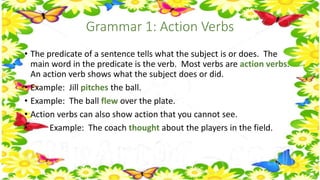
Grammar 1: Action Verbs 
• The predicate of a sentence tells what the subject is or does. The 
main word in the predicate is the verb. Most verbs are action verbs. 
An action verb shows what the subject does or did. 
• Example: Jill pitches the ball. 
• Example: The ball flew over the plate. 
• Action verbs can also show action that you cannot see. 
• Example: The coach thought about the players in the field.
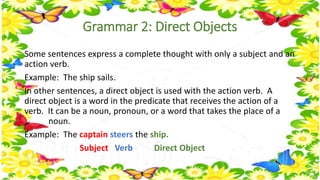
Grammar 2: Direct Objects 
Some sentences express a complete thought with only a subject and an 
action verb. 
Example: The ship sails. 
In other sentences, a direct object is used with the action verb. A 
direct object is a word in the predicate that receives the action of a 
verb. It can be a noun, pronoun, or a word that takes the place of a 
noun. 
Example: The captain steers the ship. 
Subject Verb Direct Object
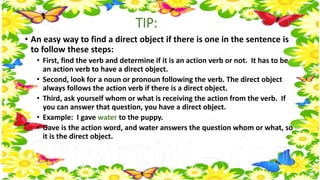
TIP: 
• An easy way to find a direct object if there is one in the sentence is 
to follow these steps: 
• First, find the verb and determine if it is an action verb or not. It has to be 
an action verb to have a direct object. 
• Second, look for a noun or pronoun following the verb. The direct object 
always follows the action verb if there is a direct object. 
• Third, ask yourself whom or what is receiving the action from the verb. If 
you can answer that question, you have a direct object. 
• Example: I gave water to the puppy. 
• Gave is the action word, and water answers the question whom or what, so 
it is the direct object.
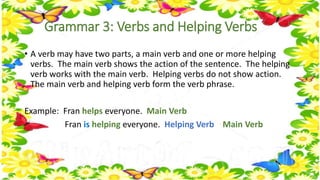
Grammar 3: Verbs and Helping Verbs 
• A verb may have two parts, a main verb and one or more helping 
verbs. The main verb shows the action of the sentence. The helping 
verb works with the main verb. Helping verbs do not show action. 
The main verb and helping verb form the verb phrase. 
Example: Fran helps everyone. Main Verb 
Fran is helping everyone. Helping Verb Main Verb
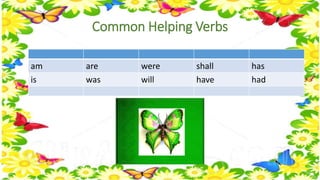
Common Helping Verbs 
am are were shall has 
is was will have had
Grammar 4: Linking Verbs 
• A linking verb links the subject of a sentence with a word or words in 
the predicate. Linking verbs do NOT show action, and it is NOT a 
helping verb. It is followed by a word in the predicate that names or 
describes the subject. 
• Example: Anna looks happy. (Happy describes Anna.) 
• Anna is a student. (Anna=student) 
• Some words can be either linking or action depending upon how they 
are used in the sentence. 
• Example: The crowd looked at the divers. Action 
• The crowd looked tired. Linking
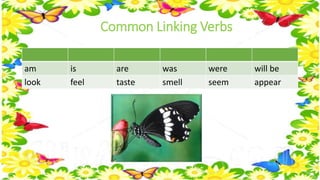
Common Linking Verbs 
am is are was were will be 
look feel taste smell seem appear
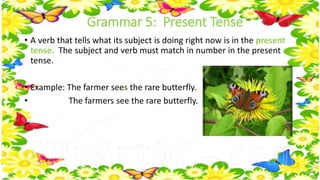
Grammar 5: Present Tense 
• A verb that tells what its subject is doing right now is in the present 
tense. The subject and verb must match in number in the present 
tense. 
• Example: The farmer sees the rare butterfly. 
• The farmers see the rare butterfly.
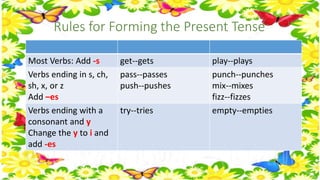
Rules for Forming the Present Tense 
Most Verbs: Add -s get--gets play--plays 
Verbs ending in s, ch, 
pass--passes 
sh, x, or z 
push--pushes 
Add –es 
punch--punches 
mix--mixes 
fizz--fizzes 
Verbs ending with a 
consonant and y 
Change the y to i and 
add -es 
try--tries empty--empties
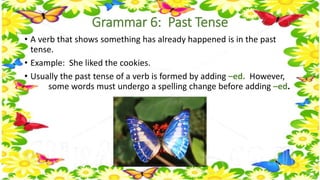
Grammar 6: Past Tense 
• A verb that shows something has already happened is in the past 
tense. 
• Example: She liked the cookies. 
• Usually the past tense of a verb is formed by adding –ed. However, 
some words must undergo a spelling change before adding –ed.
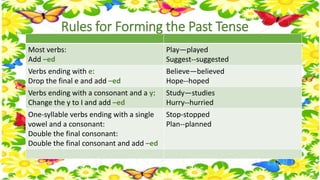
Rules for Forming the Past Tense 
Most verbs: 
Add –ed 
Play—played 
Suggest--suggested 
Verbs ending with e: 
Drop the final e and add –ed 
Believe—believed 
Hope--hoped 
Verbs ending with a consonant and a y: 
Change the y to I and add –ed 
Study—studies 
Hurry--hurried 
One-syllable verbs ending with a single 
vowel and a consonant: 
Double the final consonant: 
Double the final consonant and add –ed 
Stop-stopped 
Plan--planned
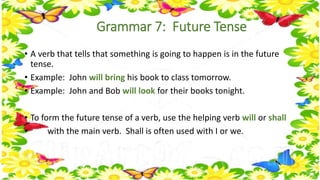
Grammar 7: Future Tense 
• A verb that tells that something is going to happen is in the future 
tense. 
• Example: John will bring his book to class tomorrow. 
• Example: John and Bob will look for their books tonight. 
• To form the future tense of a verb, use the helping verb will or shall 
• with the main verb. Shall is often used with I or we.
Grammar 8: Verb Agreement 
• A present tense verb and its subject must agree in number. If the 
subject is singular, then the verb must be singular. If the subject is 
plural, then the verb must be plural.
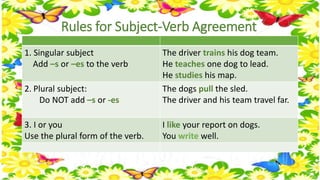
Rules for Subject-Verb Agreement 
1. Singular subject 
Add –s or –es to the verb 
The driver trains his dog team. 
He teaches one dog to lead. 
He studies his map. 
2. Plural subject: 
Do NOT add –s or -es 
The dogs pull the sled. 
The driver and his team travel far. 
3. I or you 
Use the plural form of the verb. 
I like your report on dogs. 
You write well.
Grammar 9: Agreement with Be and Have 
• You must change the forms of the verbs be and have in special ways 
to agree with their subjects.
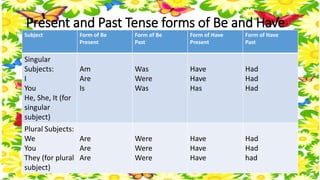
Present and Past Tense forms of Be and Have 
Subject Form of Be 
Present 
Form of Be 
Past 
Form of Have 
Present 
Form of Have 
Past 
Singular 
Subjects: 
I 
You 
He, She, It (for 
singular 
subject) 
Am 
Are 
Is 
Was 
Were 
Was 
Have 
Have 
Has 
Had 
Had 
Had 
Plural Subjects: 
We 
You 
They (for plural 
subject) 
Are 
Are 
Are 
Were 
Were 
Were 
Have 
Have 
Have 
Had 
Had 
had
Grammar 10: Contractions with NOT 
• You can combine some verbs with the word not to make contractions. 
A contraction is a word formed by joining two words, making one 
short word. An apostrophe (‘) takes the place of the letter or letters 
dropped to shorten the word.
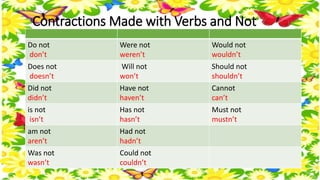
Contractions Made with Verbs and Not 
Do not 
don’t 
Were not 
weren’t 
Would not 
wouldn’t 
Does not 
doesn’t 
Will not 
won’t 
Should not 
shouldn’t 
Did not 
didn’t 
Have not 
haven’t 
Cannot 
can’t 
is not 
isn’t 
Has not 
hasn’t 
Must not 
mustn’t 
am not 
aren’t 
Had not 
hadn’t 
Was not 
wasn’t 
Could not 
couldn’t
Grammar 11: Regular and Irregular Verbs 
• Most verbs form their past tense by adding –ed to the verb. Verbs 
that follow this rule are called regular verbs. 
• Some verbs do not form their past tense by adding –ed to the verb. 
They are called irregular verbs, and they have special forms to show 
the past.
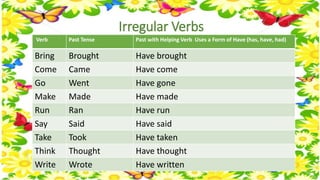
Irregular Verbs 
Verb Past Tense Past with Helping Verb Uses a Form of Have (has, have, had) 
Bring Brought Have brought 
Come Came Have come 
Go Went Have gone 
Make Made Have made 
Run Ran Have run 
Say Said Have said 
Take Took Have taken 
Think Thought Have thought 
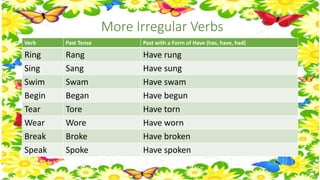
Write Wrote Have written
More Irregular Verbs 
Verb Past Tense Past with a Form of Have (has, have, had) 
Ring Rang Have rung 
Sing Sang Have sung 
Swim Swam Have swam 
Begin Began Have begun 
Tear Tore Have torn 
Wear Wore Have worn 
Break Broke Have broken 
Speak Spoke Have spoken
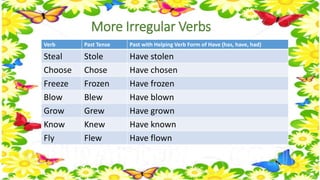
More Irregular Verbs 
Verb Past Tense Past with Helping Verb Form of Have (has, have, had) 
Steal Stole Have stolen 
Choose Chose Have chosen 
Freeze Frozen Have frozen 
Blow Blew Have blown 
Grow Grew Have grown 
Know Knew Have known 
Fly Flew Have flown
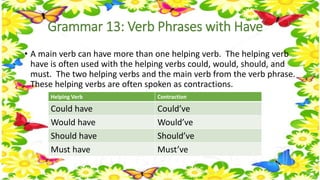
Grammar 13: Verb Phrases with Have 
• A main verb can have more than one helping verb. The helping verb 
have is often used with the helping verbs could, would, should, and 
must. The two helping verbs and the main verb from the verb phrase. 
These helping verbs are often spoken as contractions. 
Helping Verb Contraction 
Could have Could’ve 
Would have Would’ve 
Should have Should’ve 
Must have Must’ve
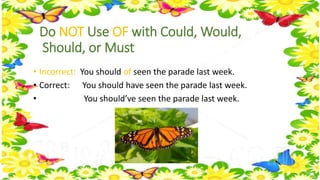
Do NOT Use OF with Could, Would, 
Should, or Must 
• Incorrect: You should of seen the parade last week. 
• Correct: You should have seen the parade last week. 
• You should’ve seen the parade last week.
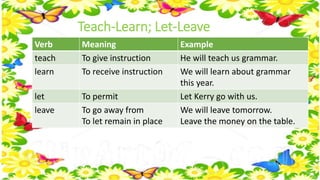
Teach-Learn; Let-Leave 
Verb Meaning Example 
teach To give instruction He will teach us grammar. 
learn To receive instruction We will learn about grammar 
this year. 
let To permit Let Kerry go with us. 
leave To go away from 
To let remain in place 
We will leave tomorrow. 
Leave the money on the table.
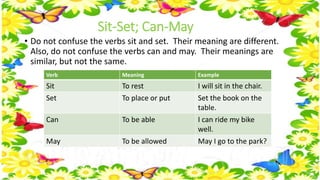
Sit-Set; Can-May 
• Do not confuse the verbs sit and set. Their meaning are different. 
Also, do not confuse the verbs can and may. Their meanings are 
similar, but not the same. 
Verb Meaning Example 
Sit To rest I will sit in the chair. 
Set To place or put Set the book on the 
table. 
Can To be able I can ride my bike 
well. 
May To be allowed May I go to the park?
The End

Verbs Unit 3

  • 1.
  • 2.
    Grammar 1: ActionVerbs • The predicate of a sentence tells what the subject is or does. The main word in the predicate is the verb. Most verbs are action verbs. An action verb shows what the subject does or did. • Example: Jill pitches the ball. • Example: The ball flew over the plate. • Action verbs can also show action that you cannot see. • Example: The coach thought about the players in the field.
  • 3.
    Grammar 2: DirectObjects Some sentences express a complete thought with only a subject and an action verb. Example: The ship sails. In other sentences, a direct object is used with the action verb. A direct object is a word in the predicate that receives the action of a verb. It can be a noun, pronoun, or a word that takes the place of a noun. Example: The captain steers the ship. Subject Verb Direct Object
  • 4.
    TIP: • Aneasy way to find a direct object if there is one in the sentence is to follow these steps: • First, find the verb and determine if it is an action verb or not. It has to be an action verb to have a direct object. • Second, look for a noun or pronoun following the verb. The direct object always follows the action verb if there is a direct object. • Third, ask yourself whom or what is receiving the action from the verb. If you can answer that question, you have a direct object. • Example: I gave water to the puppy. • Gave is the action word, and water answers the question whom or what, so it is the direct object.
  • 5.
    Grammar 3: Verbsand Helping Verbs • A verb may have two parts, a main verb and one or more helping verbs. The main verb shows the action of the sentence. The helping verb works with the main verb. Helping verbs do not show action. The main verb and helping verb form the verb phrase. Example: Fran helps everyone. Main Verb Fran is helping everyone. Helping Verb Main Verb
  • 6.
    Common Helping Verbs am are were shall has is was will have had
  • 7.
    Grammar 4: LinkingVerbs • A linking verb links the subject of a sentence with a word or words in the predicate. Linking verbs do NOT show action, and it is NOT a helping verb. It is followed by a word in the predicate that names or describes the subject. • Example: Anna looks happy. (Happy describes Anna.) • Anna is a student. (Anna=student) • Some words can be either linking or action depending upon how they are used in the sentence. • Example: The crowd looked at the divers. Action • The crowd looked tired. Linking
  • 8.
    Common Linking Verbs am is are was were will be look feel taste smell seem appear
  • 9.
    Grammar 5: PresentTense • A verb that tells what its subject is doing right now is in the present tense. The subject and verb must match in number in the present tense. • Example: The farmer sees the rare butterfly. • The farmers see the rare butterfly.
  • 10.
    Rules for Formingthe Present Tense Most Verbs: Add -s get--gets play--plays Verbs ending in s, ch, pass--passes sh, x, or z push--pushes Add –es punch--punches mix--mixes fizz--fizzes Verbs ending with a consonant and y Change the y to i and add -es try--tries empty--empties
  • 11.
    Grammar 6: PastTense • A verb that shows something has already happened is in the past tense. • Example: She liked the cookies. • Usually the past tense of a verb is formed by adding –ed. However, some words must undergo a spelling change before adding –ed.
  • 12.
    Rules for Formingthe Past Tense Most verbs: Add –ed Play—played Suggest--suggested Verbs ending with e: Drop the final e and add –ed Believe—believed Hope--hoped Verbs ending with a consonant and a y: Change the y to I and add –ed Study—studies Hurry--hurried One-syllable verbs ending with a single vowel and a consonant: Double the final consonant: Double the final consonant and add –ed Stop-stopped Plan--planned
  • 13.
    Grammar 7: FutureTense • A verb that tells that something is going to happen is in the future tense. • Example: John will bring his book to class tomorrow. • Example: John and Bob will look for their books tonight. • To form the future tense of a verb, use the helping verb will or shall • with the main verb. Shall is often used with I or we.
  • 14.
    Grammar 8: VerbAgreement • A present tense verb and its subject must agree in number. If the subject is singular, then the verb must be singular. If the subject is plural, then the verb must be plural.
  • 15.
    Rules for Subject-VerbAgreement 1. Singular subject Add –s or –es to the verb The driver trains his dog team. He teaches one dog to lead. He studies his map. 2. Plural subject: Do NOT add –s or -es The dogs pull the sled. The driver and his team travel far. 3. I or you Use the plural form of the verb. I like your report on dogs. You write well.
  • 16.
    Grammar 9: Agreementwith Be and Have • You must change the forms of the verbs be and have in special ways to agree with their subjects.
  • 17.
    Present and PastTense forms of Be and Have Subject Form of Be Present Form of Be Past Form of Have Present Form of Have Past Singular Subjects: I You He, She, It (for singular subject) Am Are Is Was Were Was Have Have Has Had Had Had Plural Subjects: We You They (for plural subject) Are Are Are Were Were Were Have Have Have Had Had had
  • 18.
    Grammar 10: Contractionswith NOT • You can combine some verbs with the word not to make contractions. A contraction is a word formed by joining two words, making one short word. An apostrophe (‘) takes the place of the letter or letters dropped to shorten the word.
  • 19.
    Contractions Made withVerbs and Not Do not don’t Were not weren’t Would not wouldn’t Does not doesn’t Will not won’t Should not shouldn’t Did not didn’t Have not haven’t Cannot can’t is not isn’t Has not hasn’t Must not mustn’t am not aren’t Had not hadn’t Was not wasn’t Could not couldn’t
  • 20.
    Grammar 11: Regularand Irregular Verbs • Most verbs form their past tense by adding –ed to the verb. Verbs that follow this rule are called regular verbs. • Some verbs do not form their past tense by adding –ed to the verb. They are called irregular verbs, and they have special forms to show the past.
  • 21.
    Irregular Verbs VerbPast Tense Past with Helping Verb Uses a Form of Have (has, have, had) Bring Brought Have brought Come Came Have come Go Went Have gone Make Made Have made Run Ran Have run Say Said Have said Take Took Have taken Think Thought Have thought Write Wrote Have written
  • 22.
    More Irregular Verbs Verb Past Tense Past with a Form of Have (has, have, had) Ring Rang Have rung Sing Sang Have sung Swim Swam Have swam Begin Began Have begun Tear Tore Have torn Wear Wore Have worn Break Broke Have broken Speak Spoke Have spoken
  • 23.
    More Irregular Verbs Verb Past Tense Past with Helping Verb Form of Have (has, have, had) Steal Stole Have stolen Choose Chose Have chosen Freeze Frozen Have frozen Blow Blew Have blown Grow Grew Have grown Know Knew Have known Fly Flew Have flown
  • 24.
    Grammar 13: VerbPhrases with Have • A main verb can have more than one helping verb. The helping verb have is often used with the helping verbs could, would, should, and must. The two helping verbs and the main verb from the verb phrase. These helping verbs are often spoken as contractions. Helping Verb Contraction Could have Could’ve Would have Would’ve Should have Should’ve Must have Must’ve
  • 25.
    Do NOT UseOF with Could, Would, Should, or Must • Incorrect: You should of seen the parade last week. • Correct: You should have seen the parade last week. • You should’ve seen the parade last week.
  • 26.
    Teach-Learn; Let-Leave VerbMeaning Example teach To give instruction He will teach us grammar. learn To receive instruction We will learn about grammar this year. let To permit Let Kerry go with us. leave To go away from To let remain in place We will leave tomorrow. Leave the money on the table.
  • 27.
    Sit-Set; Can-May •Do not confuse the verbs sit and set. Their meaning are different. Also, do not confuse the verbs can and may. Their meanings are similar, but not the same. Verb Meaning Example Sit To rest I will sit in the chair. Set To place or put Set the book on the table. Can To be able I can ride my bike well. May To be allowed May I go to the park?
  • 28.