The power
of nature
6
Holidays
7
Our
planet
8
Changes
9
You were
He was
She was
It was
We were
You were
They were
I was
watch
watch ing
watch ing
ed
watched ing
watch ing
watch ing
watch ing
watch ing
ed
AFFIRMATIVE
ed
ed
ed
ed
ed
ing
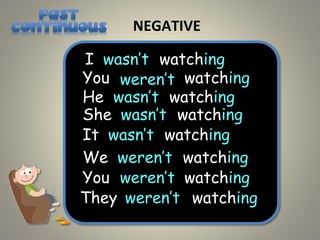
NEGATIVE
I was not watching
You were not watching
He was not watching
She was not watching
It was not watching
We were not watching
You were not watching
They were not watching
wasn’t
weren’t
wasn’t
wasn’t
wasn’t
weren’t
weren’t
weren’t
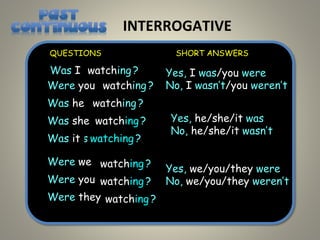
INTERROGATIVE
I was
Was I
You were
Were you
He was
Was he
She was
Was she
It was
Was it
We were
Were we
You were ?
Were you
They were
Were they
Yes, I was/you were
No, I wasn’t/you weren’t
Yes, we/you/they were
No, we/you/they weren’t
QUESTIONS SHORT ANSWERS
watching ?
watching ?
watching ?
watching ?
?
watching
?
watching
watching
?
watching
Yes, he/she/it was
No, he/she/it wasn’t
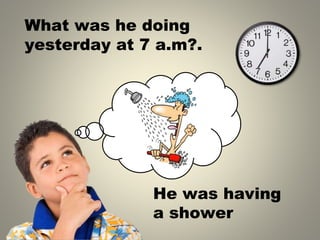
What was he doing
yesterday at 7 a.m .
?
He was having
a shower
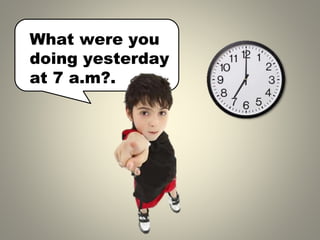
What were you
doing yesterday
at 7 a.m .
?
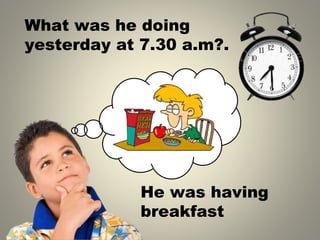
What was he doing
yesterday at 7.30 a.m .
?
He was having
breakfast
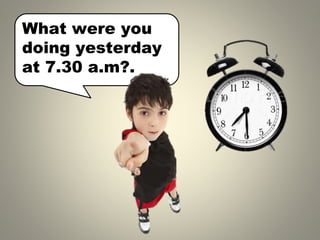
What were you
doing yesterday
at 7.30 a.m .
?
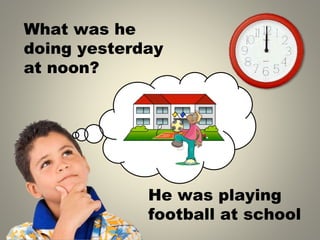
What was he
doing yesterday
at noon?
He was playing
football at school
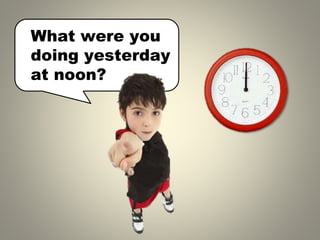
What were you
doing yesterday
at noon?
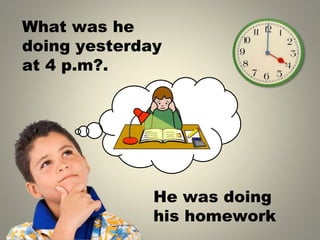
What was he
doing yesterday
at 4 p.m .
?
He was doing
his homework
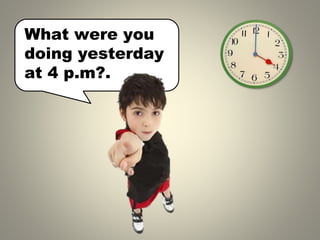
What were you
doing yesterday
at 4 p.m .
?
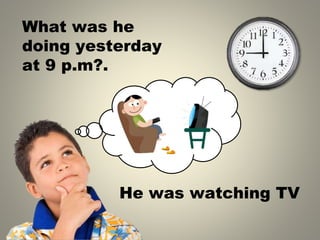
What was he
doing yesterday
at 9 p.m .
?
He was watching TV
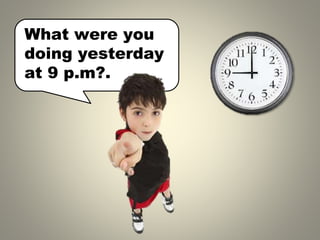
What were you
doing yesterday
at 9 p.m .
?
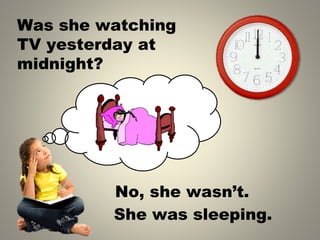
Was she watching
TV yesterday at
midnight?
No, she wasn’t.
She was sleeping.
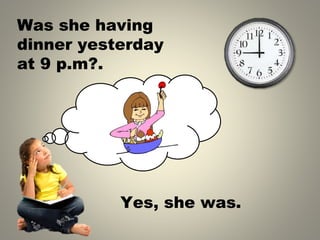
Was she having
dinner yesterday
at 9 p.m .
?
Yes, she was.
Were you having
a bath yesterday
at midnight?
What were you
reading last month?
What were you doing
before this class?
What were you doing
before you went to bed
yesterday?
What were you doing
last Sunday morning?
What were you doing
yesterday while your mother
or father was cooking?
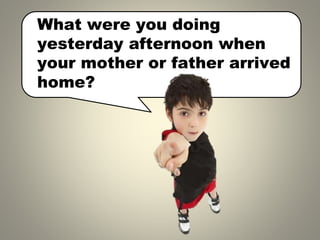
What were you doing
yesterday afternoon when
your mother or father arrived
home?
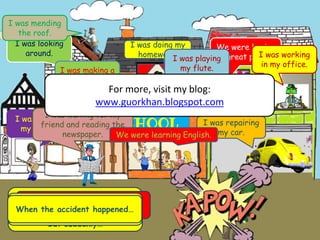
It was 9 o’clock in the
morning. Everybody in the town
was doing their own work .
But suddenly…
……a car crashed into a tree !
Everybody shared this news
with other people. They said:
When the accident happened…
I was doing my
homework.
I was playing
my guitar.
We were having
a great party.
SCHOOL
I was looking
around.
I was repairing
my car.
I was waiting for my
friend and reading the
newspaper.
I was working
in my office.
I was mending
the roof.
We were learning English.
I was playing
my flute.
I was making a
phone call.
For more, visit my blog:
www.guorkhan.blogspot.com
THE SIMPLE PAST TENSE
GRAMMAR
IDEA
● We use the Past simple tense to describe an
action that took place in the past .
● This action is Short and Finished.
WORDS
• These are some words and expressions that
usually appear with a verb in the Past Simple.
⮚Last ………
..
⮚ ……
.. ago
⮚Yesterday
⮚In 1986
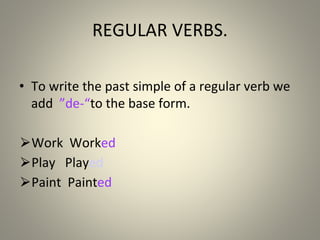
REGULAR VERBS.
• To write the past simple of a regular verb we
add “
-
de
” to the base form.
⮚Work Worked
⮚Play Played
⮚Paint Painted
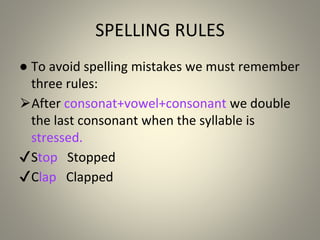
SPELLING RULES
● To avoid spelling mistakes we must remember
three rules:
⮚After consonat+vowel+consonant we double
the last consonant when the syllable is
stressed.
✔Stop Stopped
✔Clap Clapped
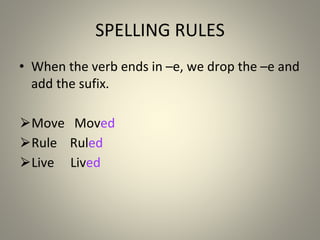
SPELLING RULES
• When the verb ends in –e, we drop the –e and
add the sufix.
⮚Move Moved
⮚Rule Ruled
⮚Live Lived
SPELLING RULES
• When the verb ends in consonant+y we drop
the “y ”and write “i+ed ”
.
⮚Cry Cried
⮚Try Tried
PRONOUNCIATION RULES
• There are 3 ways to pronounce “
– ed”
⮚/d/
⮚/t /
⮚/id /
PRONOUNCIATION RULES
● We pronounce /d/ after vowel or voiced
sound (b,g,l,m,v,).
⮚Play Played /d/
⮚Beg Begged /d/
⮚Live Lived /d/
PRONOUNCIATION RULES
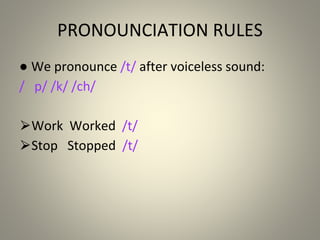
● We pronounce /t/ after voiceless sound:
/ p/ /k/ /ch/
⮚Work Worked /t/
⮚Stop Stopped /t/
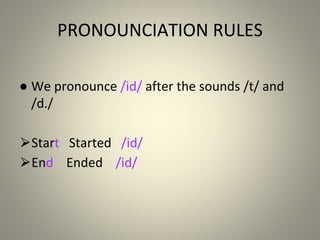
PRONOUNCIATION RULES
● We pronounce /id/ after the sounds /t/ and
/d./
⮚Start Started /id/
⮚End Ended /id/
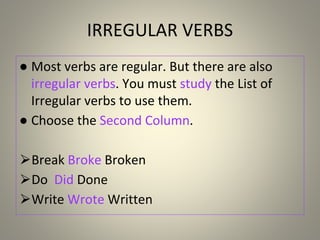
IRREGULAR VERBS
● Most verbs are regular. But there are also
irregular verbs. You must study the List of
Irregular verbs to use them.
● Choose the Second Column.
⮚Break Broke Broken
⮚Do Did Done
⮚Write Wrote Written
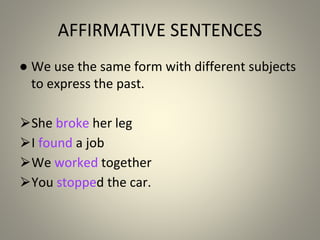
AFFIRMATIVE SENTENCES
● We use the same form with different subjects
to express the past.
⮚She broke her leg
⮚I found a job
⮚We worked together
⮚You stopped the car.
AUXILIARY VERB
• The auxiliary verb for the past simple is “DID ”
.
• When we use the auxiliary verb “did ”or
“didn´t ”the main verb is written in the
infinitive.
NEGATIVE SENTENCES
• We write didn´t in front of the verb.
Remember the verb in the infinitive.
⮚I didn´t study for my exams.
⮚They didn´t bring the flowers
⮚She didn´t stop the car.
⮚The programme didn´t begin one hour ago.
QUESTIONS IN THE PAST SIMPLE
• We write didn´t in front of the subject. The
main verb is written in the infinitive.
⮚Did you come yesterday?
⮚Did you hear the noise?
⮚Did she open the present?
SIMPLE PAST TENSE
(EXERCISE)
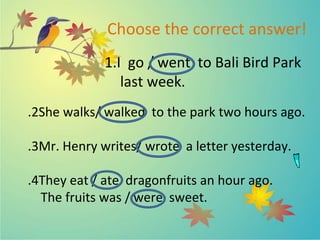
Choose the correct answer!
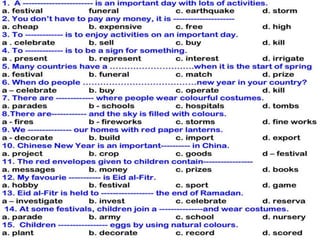
1.I go / went to Bali Bird Park
last week.
2
. She walks/ walked to the park two hours ago.
3
. Mr. Henry writes/ wrote a letter yesterday.
4
. They eat / ate dragonfruits an hour ago.
The fruits was / were sweet.
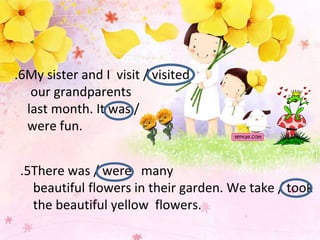
6
. My sister and I visit / visited
our grandparents
last month. It was /
were fun.
5
. There was / were many
beautiful flowers in their garden. We take / took
the beautiful yellow flowers.
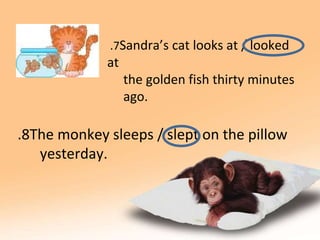
8
. The monkey sleeps / slept on the pillow
yesterday.
7
. Sandra’s cat looks at / looked
at
the golden fish thirty minutes
ago.
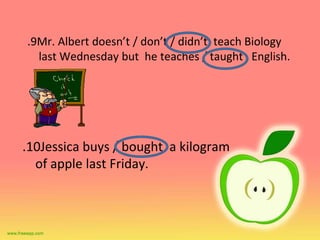
10
. Jessica buys / bought a kilogram
of apple last Friday.
9
. Mr. Albert doesn’t / don’t / didn’t teach Biology
last Wednesday but he teaches / taught English.
13
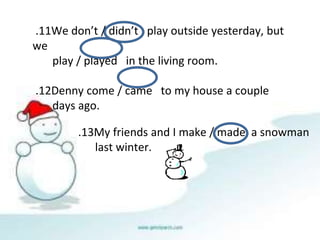
. My friends and I make / made a snowman
last winter.
11
. We don’t / didn’t play outside yesterday, but
we
play / played in the living room.
12
. Denny come / came to my house a couple
days ago.
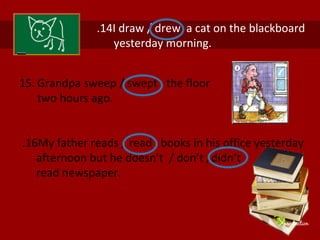
15. Grandpa sweep / swept the floor
two hours ago.
16
. My father reads / read books in his office yesterday
afternoon but he doesn’t / don’t /didn’t
read newspaper.
14
. I draw / drew a cat on the blackboard
yesterday morning.
17
. I celebrate / celebrated Christmas with
my family last December.
18
. They give / gave me a special gift.
19. I get / got a cute Teddy bear doll
from my parents.
19. I was / were so happy.
22
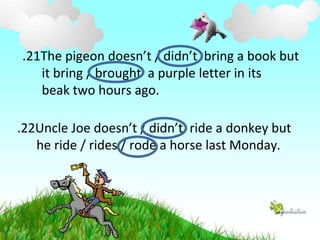
. Uncle Joe doesn’t / didn’t ride a donkey but
he ride / rides / rode a horse last Monday.
21
. The pigeon doesn’t / didn’t bring a book but
it bring / brought a purple letter in its
beak two hours ago.
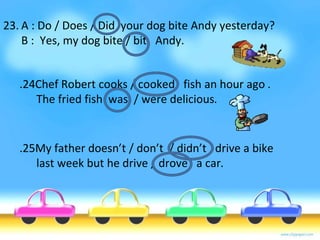
23. A : Do / Does / Did your dog bite Andy yesterday?
B : Yes, my dog bite / bit Andy.
24
. Chef Robert cooks / cooked fish an hour ago .
The fried fish was / were delicious.
25
. My father doesn’t / don’t / didn’t drive a bike
last week but he drive / drove a car.
How to express the
future then?
There are several ways to express the
future:
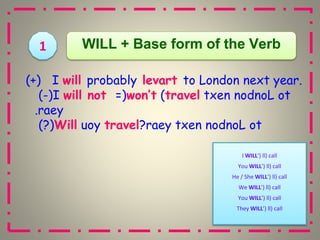
)+( I will probably levart to London next year.
(
-
) I will not =(won’t )travel txen nodnoL ot
raey
.
(
?
) Will uoy travel raey txen nodnoL ot
?
1 WILL + Base form of the Verb
I WILL (
’ ll) call
You WILL (
’ ll) call
He / She WILL (
’ ll) call
We WILL (
’ ll) call
You WILL (
’ ll) call
They WILL (
’ ll) call
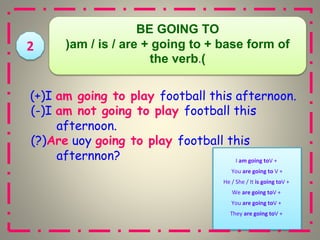
)+(I am going to play football this afternoon.
(
-
) I am not going to play football this
afternoon.
(
?
) Are uoy going to play football this
afternnon?
2
BE GOING TO
(am / is / are + going to + base form of
the verb )
.
I am going toV +
You are going to V +
He / She / It is going toV +
We are going toV +
You are going toV +
They are going toV +
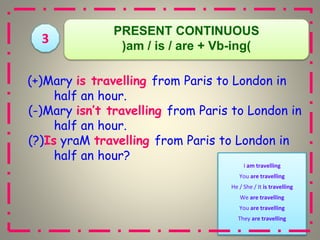
)+(Mary is travelling from Paris to London in
half an hour.
(
-
) Mary isn’t travelling from Paris to London in
half an hour.
(
?
) Is yraM travelling from Paris to London in
half an hour?
3
PRESENT CONTINUOUS
(am / is / are + Vb-ing)
I am travelling
You are travelling
He / She / It is travelling
We are travelling
You are travelling
They are travelling
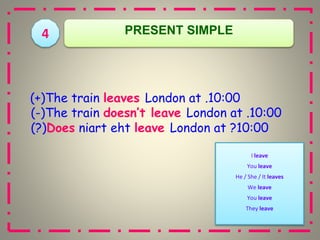
)+(The train leaves London at 10:00
.
(
-
) The train doesn’t leave London at 10:00
.
(
?
) Does niart eht leave London at 10:00
?
4 PRESENT SIMPLE
I leave
You leave
He / She / It leaves
We leave
You leave
They leave
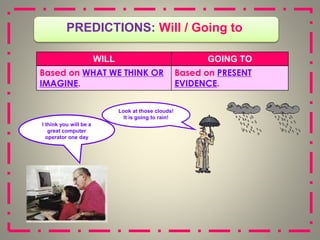
PREDICTIONS: Will / Going to
WILL GOING TO
Based on WHAT WE THINK OR
IMAGINE.
Based on PRESENT
EVIDENCE.
Look at those clouds!
It is going to rain!
I think you will be a
great computer
operator one day
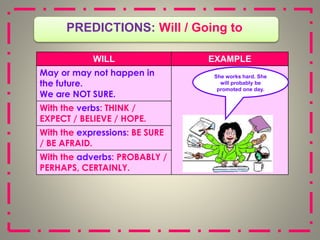
PREDICTIONS: Will / Going to
WILL EXAMPLE
May or may not happen in
the future.
We are NOT SURE.
With the verbs: THINK /
EXPECT / BELIEVE / HOPE.
With the expressions: BE SURE
/ BE AFRAID.
With the adverbs: PROBABLY /
PERHAPS, CERTAINLY.
She works hard. She
will probably be
promoted one day.
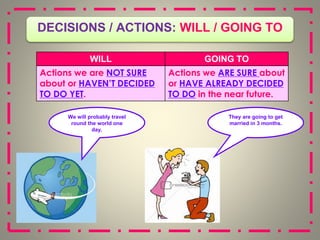
DECISIONS / ACTIONS: WILL / GOING TO
WILL GOING TO
Actions we are NOT SURE
about or HAVEN’T DECIDED
TO DO YET.
Actions we ARE SURE about
or HAVE ALREADY DECIDED
TO DO in the near future.
We will probably travel
round the world one
day.
They are going to get
married in 3 months.
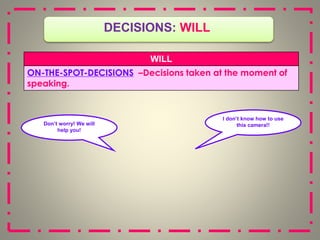
DECISIONS: WILL
WILL
ON-THE-SPOT-DECISIONS –Decisions taken at the moment of
speaking.
I don’t know how to use
this camera!!
Don’t worry! We will
help you!
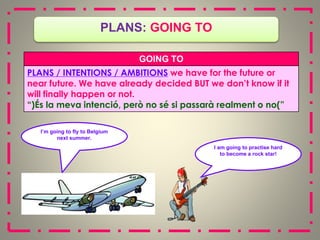
I am going to practise hard
to become a rock star!
PLANS: GOING TO
I’m going to fly to Belgium
next summer.
GOING TO
PLANS / INTENTIONS / AMBITIONS we have for the future or
near future. We have already decided BUT we don’t know if it
will finally happen or not.
(
“ És la meva intenció, però no sé si passarà realment o no ”
)
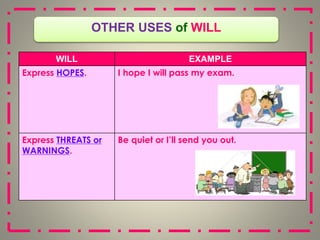
OTHER USES of WILL
WILL EXAMPLE
Express HOPES. I hope I will pass my exam.
Express THREATS or
WARNINGS.
Be quiet or I’ll send you out.
OTHER USES of WILL
WILL EXAMPLE
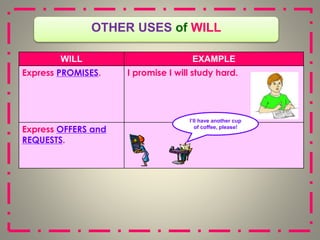
Express PROMISES. I promise I will study hard.
Express OFFERS and
REQUESTS.
I’ll have another cup
of coffee, please!
FIXED ARRANGEMENTS: PRESENT
CONTINUOUS
PRESENT CONTINUOUS EXAMPLE
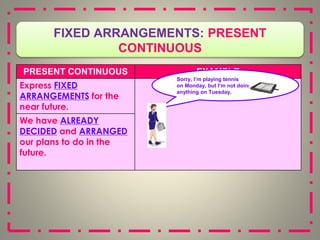
Express FIXED
ARRANGEMENTS for the
near future.
We have ALREADY
DECIDED and ARRANGED
our plans to do in the
future.
Sorry, I’m playing tennis
on Monday, but I’m not doing
anything on Tuesday.
TIMETABLES: PRESENT SIMPLE
WILL EXAMPLE
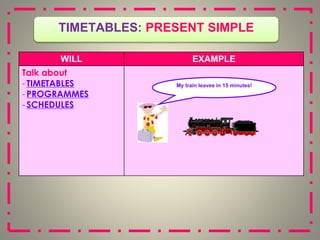
Talk about
- TIMETABLES
- PROGRAMMES
- SCHEDULES
My train leaves in 15 minutes!
• TOMORROW
• THE DAY AFTER TOMORROW
• NEXT WEEK / MONTH / YEAR
• SOON
• TONIGHT
• IN A WEEK / IN A MONTH / IN A YEAR cte ,
.
TIME EXPRESSIONS:
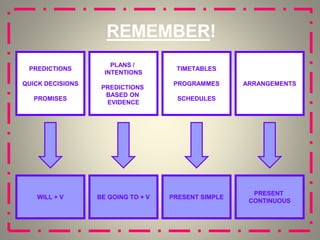
REMEMBER!
PREDICTIONS
QUICK DECISIONS
PROMISES
PLANS /
INTENTIONS
PREDICTIONS
BASED ON
EVIDENCE
TIMETABLES
PROGRAMMES
SCHEDULES
ARRANGEMENTS
WILL + V BE GOING TO + V PRESENT SIMPLE
PRESENT
CONTINUOUS
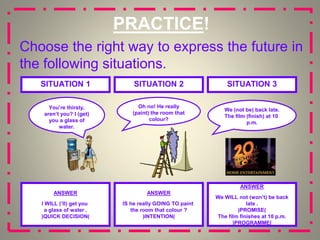
PRACTICE!
Choose the right way to express the future in
the following situations.
SITUATION 1 SITUATION 2 SITUATION 3
You’re thirsty,
aren’t you? I (get)
you a glass of
water.
Oh no! He really
(paint) the room that
colour?
ANSWER
I WILL (’ll) get you
a glass of water .
(QUICK DECISION)
ANSWER
IS he really GOING TO paint
the room that colour ?
(INTENTION)
ANSWER
We WILL not (won’t) be back
late .
(PROMISE)
The film finishes at 10 p.m.
(PROGRAMME)
We (not be) back late.
The film (finish) at 10
p.m.
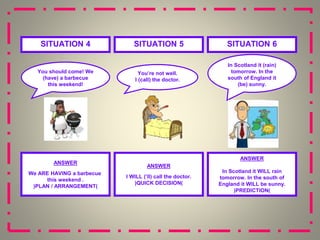
ANSWER
We ARE HAVING a barbecue
this weekend .
(PLAN / ARRANGEMENT)
ANSWER
In Scotland it WILL rain
tomorrow. In the south of
England it WILL be sunny.
(PREDICTION)
SITUATION 6
SITUATION 4 SITUATION 5
You should come! We
(have) a barbecue
this weekend!
ANSWER
I WILL (’ll) call the doctor.
(QUICK DECISION)
You’re not well.
I (call) the doctor.
In Scotland it (rain)
tomorrow. In the
south of England it
(be) sunny.
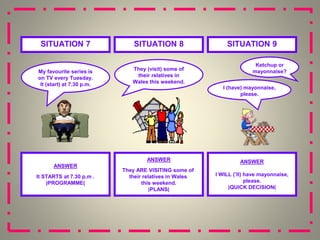
ANSWER
It STARTS at 7.30 p.m .
(PROGRAMME)
ANSWER
I WILL (’ll) have mayonnaise,
please.
(QUICK DECISION)
SITUATION 9
SITUATION 7 SITUATION 8
ANSWER
They ARE VISITING some of
their relatives in Wales
this weekend.
(PLANS)
My favourite series is
on TV every Tuesday.
It (start) at 7.30 p.m.
They (visit) some of
their relatives in
Wales this weekend.
Ketchup or
mayonnaise?
I (have) mayonnaise,
please.
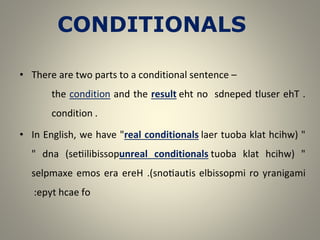
• There are two parts to a conditional sentence –
the condition and the result .
ehT
tluser
sdneped
no
eht
condition .
• In English, we have "real conditionals "
hcihw(
klat
tuoba
laer
)setiilibissop
dna
" unreal conditionals "
hcihw(
klat
tuoba
yranigami
ro
elbissopmi
)snotiautis
.
ereH
era
emos
selpmaxe
fo
hcae
epyt
:
CONDITIONALS
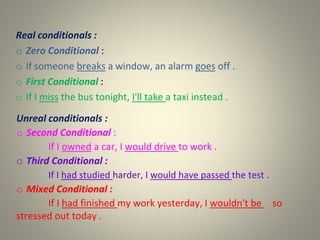
Real conditionals :
o Zero Conditional :
o If someone breaks a window, an alarm goes off .
o First Conditional :
o If I miss the bus tonight, I'll take a taxi instead .
Unreal conditionals :
o Second Conditional :
If I owned a car, I would drive to work .
o Third Conditional :
If I had studied harder, I would have passed the test .
o Mixed Conditional :
If I had finished my work yesterday, I wouldn't be so
stressed out today .
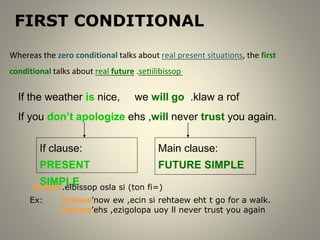
FIRST CONDITIONAL
If the weather is nice, we will go klaw a rof
.
If you don’t apologize ehs ,will never trust you again.
If clause:
PRESENT
SIMPLE
Main clause:
FUTURE SIMPLE
Unless elbissop osla si )ton fi=(
.
Ex: Unless now ew ,ecin si rehtaew eht
’ t go for a walk.
Unless ehs ,ezigolopa uoy
’ ll never trust you again
Whereas the zero conditional talks about real present situations, the first
conditional talks about real future setiilibissop
.
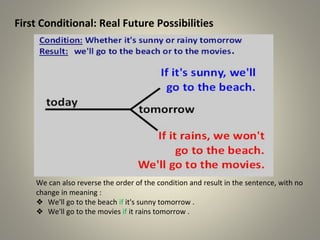
First Conditional: Real Future Possibilities
We can also reverse the order of the condition and result in the sentence, with no
change in meaning :
❖ We'll go to the beach if it's sunny tomorrow .
❖ We'll go to the movies if it rains tomorrow .
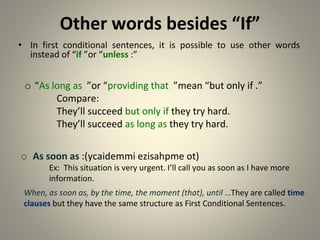
Other words besides “If”
• In first conditional sentences, it is possible to use other words
instead of “if ”or “unless ”
:
When, as soon as, by the time, the moment (that), until …They are called time
clauses but they have the same structure as First Conditional Sentences.
o As soon as )ycaidemmi ezisahpme ot(
:
Ex: This situation is very urgent. I’ll call you as soon as I have more
information.
o “As long as ”or “providing that ”mean “but only if ”
.
Compare:
They’ll succeed but only if they try hard.
They’ll succeed as long as they try hard.
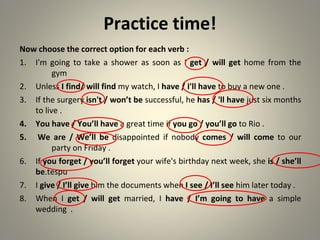
Practice time!
Now choose the correct option for each verb :
1. I'm going to take a shower as soon as I get / will get home from the
gym
2. Unless I find/ will find my watch, I have / I'll have to buy a new one .
3. If the surgery isn't / won’t be successful, he has / 'll have just six months
to live .
4. You have / You’ll have a great time if you go / you’ll go to Rio .
5. We are / We’ll be disappointed if nobody comes / will come to our
party on Friday .
6. If you forget / you’ll forget your wife's birthday next week, she is / she’ll
be tespu
.
7. I give / I’ll give him the documents when I see / I’ll see him later today .
8. When I get / will get married, I have / I’m going to have a simple
wedding .
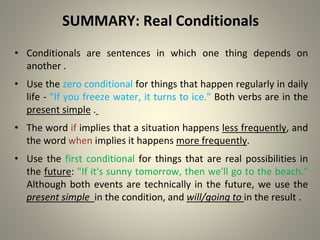
SUMMARY: Real Conditionals
• Conditionals are sentences in which one thing depends on
another .
• Use the zero conditional for things that happen regularly in daily
life - "If you freeze water, it turns to ice." Both verbs are in the
present simple .
• The word if implies that a situation happens less frequently, and
the word when implies it happens more frequently.
• Use the first conditional for things that are real possibilities in
the future: "If it's sunny tomorrow, then we'll go to the beach."
Although both events are technically in the future, we use the
present simple in the condition, and will/going to in the result .
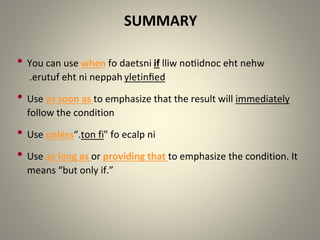
• You can use when fo daetsni if lliw notiidnoc eht nehw
yletinfied
erutuf eht ni neppah
.
• Use as soon as to emphasize that the result will immediately
follow the condition
• Use unless " fo ecalp ni
ton fi
.
“
• Use as long as or providing that to emphasize the condition. It
means “but only if ”
.
SUMMARY
PRESENT PERFECT SIMPLE
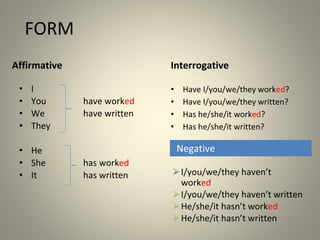
FORM
Affirmative Interrogative
• I
• You have worked
• We have written
• They
• He
• She has worked
• It has written
• Have I/you/we/they worked?
• Have I/you/we/they written?
• Has he/she/it worked?
• Has he/she/it written?
⮚I/you/we/they haven’t
worked
⮚I/you/we/they haven’t written
⮚He/she/it hasn’t worked
⮚He/she/it hasn’t written
Negative
USES
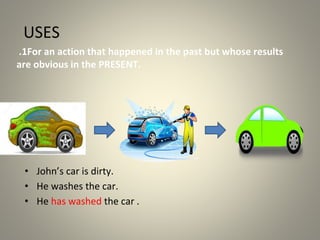
1
. For an action that happened in the past but whose results
are obvious in the PRESENT.
• John’s car is dirty.
• He washes the car.
• He has washed the car .
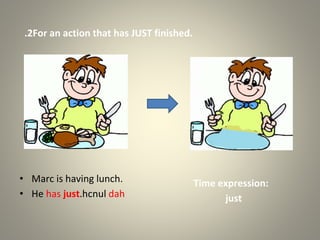
2
. For an action that has JUST finished.
Time expression:
just
• Marc is having lunch.
• He has just dah
hcnul
.
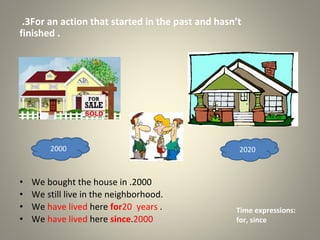
3
. For an action that started in the past and hasn’t
finished .
• We bought the house in 2000
.
• We still live in the neighborhood.
• We have lived here for20 years .
• We have lived here since 2000
.
2000 2020
Time expressions:
for, since
4
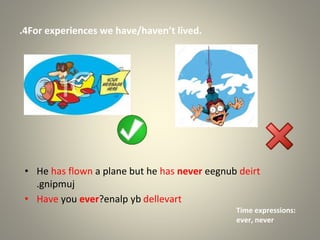
. For experiences we have/haven’t lived.
• He has flown a plane but he has never deirt
eegnub
gnipmuj
.
• Have you ever dellevart
enalp yb
?
Time expressions:
ever, never
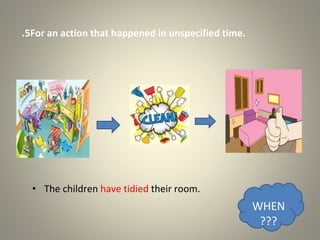
5
. For an action that happened in unspecified time.
• The children have tidied their room.
WHEN
???
Time expressions
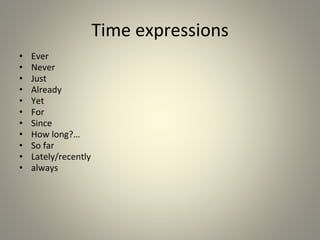
• Ever
• Never
• Just
• Already
• Yet
• For
• Since
• How long …
?
• So far
• Lately/recently
• always
ALREADY/YET
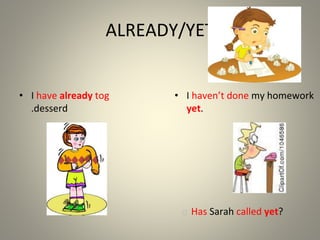
• I have already tog
desserd
.
• I haven’t done my homework
yet.
� Has Sarah called yet?
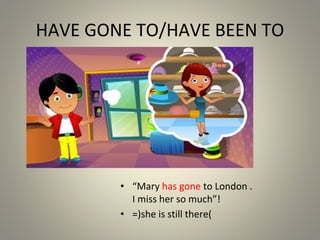
HAVE GONE TO/HAVE BEEN TO
• “Mary has gone to London .
I miss her so much !
”
• =(she is still there)
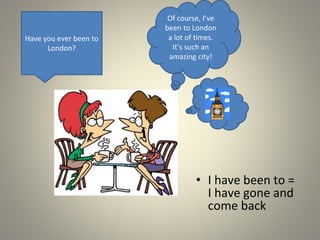
• I have been to =
I have gone and
come back
Have you ever been to
London?
Of course, I’ve
been to London
a lot of times.
It’s such an
amazing city!
THE END

3prep_term_1_exams new hello Egyptian.pptx

  • 8.
  • 10.
    You were He was Shewas It was We were You were They were I was watch watch ing watch ing ed watched ing watch ing watch ing watch ing watch ing ed AFFIRMATIVE ed ed ed ed ed ing
  • 11.
    NEGATIVE I was notwatching You were not watching He was not watching She was not watching It was not watching We were not watching You were not watching They were not watching wasn’t weren’t wasn’t wasn’t wasn’t weren’t weren’t weren’t
  • 12.
    INTERROGATIVE I was Was I Youwere Were you He was Was he She was Was she It was Was it We were Were we You were ? Were you They were Were they Yes, I was/you were No, I wasn’t/you weren’t Yes, we/you/they were No, we/you/they weren’t QUESTIONS SHORT ANSWERS watching ? watching ? watching ? watching ? ? watching ? watching watching ? watching Yes, he/she/it was No, he/she/it wasn’t
  • 13.
    What was hedoing yesterday at 7 a.m . ? He was having a shower
  • 14.
    What were you doingyesterday at 7 a.m . ?
  • 15.
    What was hedoing yesterday at 7.30 a.m . ? He was having breakfast
  • 16.
    What were you doingyesterday at 7.30 a.m . ?
  • 17.
    What was he doingyesterday at noon? He was playing football at school
  • 18.
    What were you doingyesterday at noon?
  • 19.
    What was he doingyesterday at 4 p.m . ? He was doing his homework
  • 20.
    What were you doingyesterday at 4 p.m . ?
  • 21.
    What was he doingyesterday at 9 p.m . ? He was watching TV
  • 22.
    What were you doingyesterday at 9 p.m . ?
  • 23.
    Was she watching TVyesterday at midnight? No, she wasn’t. She was sleeping.
  • 24.
    Was she having dinneryesterday at 9 p.m . ? Yes, she was.
  • 25.
    Were you having abath yesterday at midnight?
  • 26.
  • 27.
    What were youdoing before this class?
  • 28.
    What were youdoing before you went to bed yesterday?
  • 29.
    What were youdoing last Sunday morning?
  • 30.
    What were youdoing yesterday while your mother or father was cooking?
  • 31.
    What were youdoing yesterday afternoon when your mother or father arrived home?
  • 32.
    It was 9o’clock in the morning. Everybody in the town was doing their own work . But suddenly… ……a car crashed into a tree ! Everybody shared this news with other people. They said: When the accident happened… I was doing my homework. I was playing my guitar. We were having a great party. SCHOOL I was looking around. I was repairing my car. I was waiting for my friend and reading the newspaper. I was working in my office. I was mending the roof. We were learning English. I was playing my flute. I was making a phone call. For more, visit my blog: www.guorkhan.blogspot.com
  • 33.
    THE SIMPLE PASTTENSE GRAMMAR
  • 34.
    IDEA ● We usethe Past simple tense to describe an action that took place in the past . ● This action is Short and Finished.
  • 35.
    WORDS • These aresome words and expressions that usually appear with a verb in the Past Simple. ⮚Last ……… .. ⮚ …… .. ago ⮚Yesterday ⮚In 1986
  • 36.
    REGULAR VERBS. • Towrite the past simple of a regular verb we add “ - de ” to the base form. ⮚Work Worked ⮚Play Played ⮚Paint Painted
  • 37.
    SPELLING RULES ● Toavoid spelling mistakes we must remember three rules: ⮚After consonat+vowel+consonant we double the last consonant when the syllable is stressed. ✔Stop Stopped ✔Clap Clapped
  • 38.
    SPELLING RULES • Whenthe verb ends in –e, we drop the –e and add the sufix. ⮚Move Moved ⮚Rule Ruled ⮚Live Lived
  • 39.
    SPELLING RULES • Whenthe verb ends in consonant+y we drop the “y ”and write “i+ed ” . ⮚Cry Cried ⮚Try Tried
  • 40.
    PRONOUNCIATION RULES • Thereare 3 ways to pronounce “ – ed” ⮚/d/ ⮚/t / ⮚/id /
  • 41.
    PRONOUNCIATION RULES ● Wepronounce /d/ after vowel or voiced sound (b,g,l,m,v,). ⮚Play Played /d/ ⮚Beg Begged /d/ ⮚Live Lived /d/
  • 42.
    PRONOUNCIATION RULES ● Wepronounce /t/ after voiceless sound: / p/ /k/ /ch/ ⮚Work Worked /t/ ⮚Stop Stopped /t/
  • 43.
    PRONOUNCIATION RULES ● Wepronounce /id/ after the sounds /t/ and /d./ ⮚Start Started /id/ ⮚End Ended /id/
  • 44.
    IRREGULAR VERBS ● Mostverbs are regular. But there are also irregular verbs. You must study the List of Irregular verbs to use them. ● Choose the Second Column. ⮚Break Broke Broken ⮚Do Did Done ⮚Write Wrote Written
  • 45.
    AFFIRMATIVE SENTENCES ● Weuse the same form with different subjects to express the past. ⮚She broke her leg ⮚I found a job ⮚We worked together ⮚You stopped the car.
  • 46.
    AUXILIARY VERB • Theauxiliary verb for the past simple is “DID ” . • When we use the auxiliary verb “did ”or “didn´t ”the main verb is written in the infinitive.
  • 47.
    NEGATIVE SENTENCES • Wewrite didn´t in front of the verb. Remember the verb in the infinitive. ⮚I didn´t study for my exams. ⮚They didn´t bring the flowers ⮚She didn´t stop the car. ⮚The programme didn´t begin one hour ago.
  • 48.
    QUESTIONS IN THEPAST SIMPLE • We write didn´t in front of the subject. The main verb is written in the infinitive. ⮚Did you come yesterday? ⮚Did you hear the noise? ⮚Did she open the present?
  • 49.
  • 50.
    Choose the correctanswer! 1.I go / went to Bali Bird Park last week. 2 . She walks/ walked to the park two hours ago. 3 . Mr. Henry writes/ wrote a letter yesterday. 4 . They eat / ate dragonfruits an hour ago. The fruits was / were sweet.
  • 51.
    6 . My sisterand I visit / visited our grandparents last month. It was / were fun. 5 . There was / were many beautiful flowers in their garden. We take / took the beautiful yellow flowers.
  • 52.
    8 . The monkeysleeps / slept on the pillow yesterday. 7 . Sandra’s cat looks at / looked at the golden fish thirty minutes ago.
  • 53.
    10 . Jessica buys/ bought a kilogram of apple last Friday. 9 . Mr. Albert doesn’t / don’t / didn’t teach Biology last Wednesday but he teaches / taught English.
  • 54.
    13 . My friendsand I make / made a snowman last winter. 11 . We don’t / didn’t play outside yesterday, but we play / played in the living room. 12 . Denny come / came to my house a couple days ago.
  • 55.
    15. Grandpa sweep/ swept the floor two hours ago. 16 . My father reads / read books in his office yesterday afternoon but he doesn’t / don’t /didn’t read newspaper. 14 . I draw / drew a cat on the blackboard yesterday morning.
  • 56.
    17 . I celebrate/ celebrated Christmas with my family last December. 18 . They give / gave me a special gift. 19. I get / got a cute Teddy bear doll from my parents. 19. I was / were so happy.
  • 57.
    22 . Uncle Joedoesn’t / didn’t ride a donkey but he ride / rides / rode a horse last Monday. 21 . The pigeon doesn’t / didn’t bring a book but it bring / brought a purple letter in its beak two hours ago.
  • 58.
    23. A :Do / Does / Did your dog bite Andy yesterday? B : Yes, my dog bite / bit Andy. 24 . Chef Robert cooks / cooked fish an hour ago . The fried fish was / were delicious. 25 . My father doesn’t / don’t / didn’t drive a bike last week but he drive / drove a car.
  • 60.
    How to expressthe future then? There are several ways to express the future:
  • 61.
    )+( I willprobably levart to London next year. ( - ) I will not =(won’t )travel txen nodnoL ot raey . ( ? ) Will uoy travel raey txen nodnoL ot ? 1 WILL + Base form of the Verb I WILL ( ’ ll) call You WILL ( ’ ll) call He / She WILL ( ’ ll) call We WILL ( ’ ll) call You WILL ( ’ ll) call They WILL ( ’ ll) call
  • 62.
    )+(I am goingto play football this afternoon. ( - ) I am not going to play football this afternoon. ( ? ) Are uoy going to play football this afternnon? 2 BE GOING TO (am / is / are + going to + base form of the verb ) . I am going toV + You are going to V + He / She / It is going toV + We are going toV + You are going toV + They are going toV +
  • 63.
    )+(Mary is travellingfrom Paris to London in half an hour. ( - ) Mary isn’t travelling from Paris to London in half an hour. ( ? ) Is yraM travelling from Paris to London in half an hour? 3 PRESENT CONTINUOUS (am / is / are + Vb-ing) I am travelling You are travelling He / She / It is travelling We are travelling You are travelling They are travelling
  • 64.
    )+(The train leavesLondon at 10:00 . ( - ) The train doesn’t leave London at 10:00 . ( ? ) Does niart eht leave London at 10:00 ? 4 PRESENT SIMPLE I leave You leave He / She / It leaves We leave You leave They leave
  • 65.
    PREDICTIONS: Will /Going to WILL GOING TO Based on WHAT WE THINK OR IMAGINE. Based on PRESENT EVIDENCE. Look at those clouds! It is going to rain! I think you will be a great computer operator one day
  • 66.
    PREDICTIONS: Will /Going to WILL EXAMPLE May or may not happen in the future. We are NOT SURE. With the verbs: THINK / EXPECT / BELIEVE / HOPE. With the expressions: BE SURE / BE AFRAID. With the adverbs: PROBABLY / PERHAPS, CERTAINLY. She works hard. She will probably be promoted one day.
  • 67.
    DECISIONS / ACTIONS:WILL / GOING TO WILL GOING TO Actions we are NOT SURE about or HAVEN’T DECIDED TO DO YET. Actions we ARE SURE about or HAVE ALREADY DECIDED TO DO in the near future. We will probably travel round the world one day. They are going to get married in 3 months.
  • 68.
    DECISIONS: WILL WILL ON-THE-SPOT-DECISIONS –Decisionstaken at the moment of speaking. I don’t know how to use this camera!! Don’t worry! We will help you!
  • 69.
    I am goingto practise hard to become a rock star! PLANS: GOING TO I’m going to fly to Belgium next summer. GOING TO PLANS / INTENTIONS / AMBITIONS we have for the future or near future. We have already decided BUT we don’t know if it will finally happen or not. ( “ És la meva intenció, però no sé si passarà realment o no ” )
  • 70.
    OTHER USES ofWILL WILL EXAMPLE Express HOPES. I hope I will pass my exam. Express THREATS or WARNINGS. Be quiet or I’ll send you out.
  • 71.
    OTHER USES ofWILL WILL EXAMPLE Express PROMISES. I promise I will study hard. Express OFFERS and REQUESTS. I’ll have another cup of coffee, please!
  • 72.
    FIXED ARRANGEMENTS: PRESENT CONTINUOUS PRESENTCONTINUOUS EXAMPLE Express FIXED ARRANGEMENTS for the near future. We have ALREADY DECIDED and ARRANGED our plans to do in the future. Sorry, I’m playing tennis on Monday, but I’m not doing anything on Tuesday.
  • 73.
    TIMETABLES: PRESENT SIMPLE WILLEXAMPLE Talk about - TIMETABLES - PROGRAMMES - SCHEDULES My train leaves in 15 minutes!
  • 74.
    • TOMORROW • THEDAY AFTER TOMORROW • NEXT WEEK / MONTH / YEAR • SOON • TONIGHT • IN A WEEK / IN A MONTH / IN A YEAR cte , . TIME EXPRESSIONS:
  • 75.
    REMEMBER! PREDICTIONS QUICK DECISIONS PROMISES PLANS / INTENTIONS PREDICTIONS BASEDON EVIDENCE TIMETABLES PROGRAMMES SCHEDULES ARRANGEMENTS WILL + V BE GOING TO + V PRESENT SIMPLE PRESENT CONTINUOUS
  • 76.
    PRACTICE! Choose the rightway to express the future in the following situations. SITUATION 1 SITUATION 2 SITUATION 3 You’re thirsty, aren’t you? I (get) you a glass of water. Oh no! He really (paint) the room that colour? ANSWER I WILL (’ll) get you a glass of water . (QUICK DECISION) ANSWER IS he really GOING TO paint the room that colour ? (INTENTION) ANSWER We WILL not (won’t) be back late . (PROMISE) The film finishes at 10 p.m. (PROGRAMME) We (not be) back late. The film (finish) at 10 p.m.
  • 77.
    ANSWER We ARE HAVINGa barbecue this weekend . (PLAN / ARRANGEMENT) ANSWER In Scotland it WILL rain tomorrow. In the south of England it WILL be sunny. (PREDICTION) SITUATION 6 SITUATION 4 SITUATION 5 You should come! We (have) a barbecue this weekend! ANSWER I WILL (’ll) call the doctor. (QUICK DECISION) You’re not well. I (call) the doctor. In Scotland it (rain) tomorrow. In the south of England it (be) sunny.
  • 78.
    ANSWER It STARTS at7.30 p.m . (PROGRAMME) ANSWER I WILL (’ll) have mayonnaise, please. (QUICK DECISION) SITUATION 9 SITUATION 7 SITUATION 8 ANSWER They ARE VISITING some of their relatives in Wales this weekend. (PLANS) My favourite series is on TV every Tuesday. It (start) at 7.30 p.m. They (visit) some of their relatives in Wales this weekend. Ketchup or mayonnaise? I (have) mayonnaise, please.
  • 80.
    • There aretwo parts to a conditional sentence – the condition and the result . ehT tluser sdneped no eht condition . • In English, we have "real conditionals " hcihw( klat tuoba laer )setiilibissop dna " unreal conditionals " hcihw( klat tuoba yranigami ro elbissopmi )snotiautis . ereH era emos selpmaxe fo hcae epyt : CONDITIONALS
  • 81.
    Real conditionals : oZero Conditional : o If someone breaks a window, an alarm goes off . o First Conditional : o If I miss the bus tonight, I'll take a taxi instead . Unreal conditionals : o Second Conditional : If I owned a car, I would drive to work . o Third Conditional : If I had studied harder, I would have passed the test . o Mixed Conditional : If I had finished my work yesterday, I wouldn't be so stressed out today .
  • 82.
    FIRST CONDITIONAL If theweather is nice, we will go klaw a rof . If you don’t apologize ehs ,will never trust you again. If clause: PRESENT SIMPLE Main clause: FUTURE SIMPLE Unless elbissop osla si )ton fi=( . Ex: Unless now ew ,ecin si rehtaew eht ’ t go for a walk. Unless ehs ,ezigolopa uoy ’ ll never trust you again Whereas the zero conditional talks about real present situations, the first conditional talks about real future setiilibissop .
  • 83.
    First Conditional: RealFuture Possibilities We can also reverse the order of the condition and result in the sentence, with no change in meaning : ❖ We'll go to the beach if it's sunny tomorrow . ❖ We'll go to the movies if it rains tomorrow .
  • 84.
    Other words besides“If” • In first conditional sentences, it is possible to use other words instead of “if ”or “unless ” : When, as soon as, by the time, the moment (that), until …They are called time clauses but they have the same structure as First Conditional Sentences. o As soon as )ycaidemmi ezisahpme ot( : Ex: This situation is very urgent. I’ll call you as soon as I have more information. o “As long as ”or “providing that ”mean “but only if ” . Compare: They’ll succeed but only if they try hard. They’ll succeed as long as they try hard.
  • 85.
    Practice time! Now choosethe correct option for each verb : 1. I'm going to take a shower as soon as I get / will get home from the gym 2. Unless I find/ will find my watch, I have / I'll have to buy a new one . 3. If the surgery isn't / won’t be successful, he has / 'll have just six months to live . 4. You have / You’ll have a great time if you go / you’ll go to Rio . 5. We are / We’ll be disappointed if nobody comes / will come to our party on Friday . 6. If you forget / you’ll forget your wife's birthday next week, she is / she’ll be tespu . 7. I give / I’ll give him the documents when I see / I’ll see him later today . 8. When I get / will get married, I have / I’m going to have a simple wedding .
  • 86.
    SUMMARY: Real Conditionals •Conditionals are sentences in which one thing depends on another . • Use the zero conditional for things that happen regularly in daily life - "If you freeze water, it turns to ice." Both verbs are in the present simple . • The word if implies that a situation happens less frequently, and the word when implies it happens more frequently. • Use the first conditional for things that are real possibilities in the future: "If it's sunny tomorrow, then we'll go to the beach." Although both events are technically in the future, we use the present simple in the condition, and will/going to in the result .
  • 87.
    • You canuse when fo daetsni if lliw notiidnoc eht nehw yletinfied erutuf eht ni neppah . • Use as soon as to emphasize that the result will immediately follow the condition • Use unless " fo ecalp ni ton fi . “ • Use as long as or providing that to emphasize the condition. It means “but only if ” . SUMMARY
  • 89.
  • 90.
    FORM Affirmative Interrogative • I •You have worked • We have written • They • He • She has worked • It has written • Have I/you/we/they worked? • Have I/you/we/they written? • Has he/she/it worked? • Has he/she/it written? ⮚I/you/we/they haven’t worked ⮚I/you/we/they haven’t written ⮚He/she/it hasn’t worked ⮚He/she/it hasn’t written Negative
  • 91.
    USES 1 . For anaction that happened in the past but whose results are obvious in the PRESENT. • John’s car is dirty. • He washes the car. • He has washed the car .
  • 92.
    2 . For anaction that has JUST finished. Time expression: just • Marc is having lunch. • He has just dah hcnul .
  • 93.
    3 . For anaction that started in the past and hasn’t finished . • We bought the house in 2000 . • We still live in the neighborhood. • We have lived here for20 years . • We have lived here since 2000 . 2000 2020 Time expressions: for, since
  • 94.
    4 . For experienceswe have/haven’t lived. • He has flown a plane but he has never deirt eegnub gnipmuj . • Have you ever dellevart enalp yb ? Time expressions: ever, never
  • 95.
    5 . For anaction that happened in unspecified time. • The children have tidied their room. WHEN ???
  • 96.
    Time expressions • Ever •Never • Just • Already • Yet • For • Since • How long … ? • So far • Lately/recently • always
  • 97.
    ALREADY/YET • I havealready tog desserd . • I haven’t done my homework yet. � Has Sarah called yet?
  • 98.
    HAVE GONE TO/HAVEBEEN TO • “Mary has gone to London . I miss her so much ! ” • =(she is still there)
  • 99.
    • I havebeen to = I have gone and come back Have you ever been to London? Of course, I’ve been to London a lot of times. It’s such an amazing city!
  • 101.