The Verb Group
The Verb Group
• The verb group in a clause is used to say
  what is happening in an action or situation.
• You usually put the verb group immediately
  after the subject.
• The verb group always includes a main verb.
  I waited.
  They killed the elephants.
The Verb Group
• Regular verbs have four forms:
  – The base form
  – The third person singular form of the
    present simple
  – The ‘-ing’ form of the present participle
  – The ‘-ed’ form used for the past simple and
    the past participle
    ask > asks > asking > asked
    try > tries > trying > tried
The Verb Group
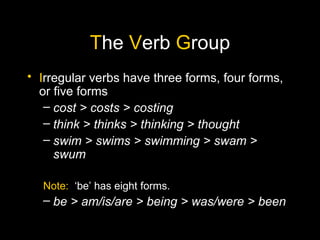
• Irregular verbs have three forms, four forms,
  or five forms
   – cost > costs > costing
   – think > thinks > thinking > thought
   – swim > swims > swimming > swam >
     swum

  Note: ‘be’ has eight forms.
  – be > am/is/are > being > was/were > been
The Verb Group
• The main verb can have one or two
  auxiliaries in front of it.

  I had met him in London.
  The car was being repaired.
The Verb Group
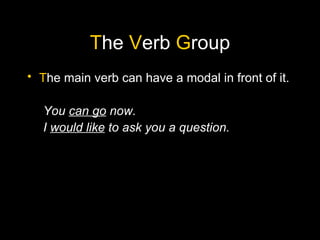
• The main verb can have a modal in front of it.

  You can go now.
  I would like to ask you a question.
The Verb Group
• The main verb can have a modal and one or
  two auxiliaries in front of it.

  I could have spent the whole year on it.
  She would have been delighted to see you.
The Verb Group
• In negative clauses, you have to use a modal
  or auxiliary and put ‘not’ after the first word of
  the verb group.

  He does not speak English very well.
  I was not smiling.
  It could not have been wrong.

  Note: You often use short forms rather than
  ‘not’. I didn’ t know that.
The Verb Group
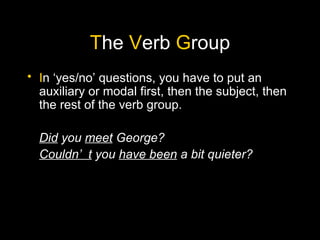
• In ‘yes/no’ questions, you have to put an
  auxiliary or modal first, then the subject, then
  the rest of the verb group.

  Did you meet George?
  Couldn’ t you have been a bit quieter?
The Verb Group
• In ‘wh’-questions, you have to put the verb
  group first. If the ‘wh’-word is the subject, you
  put the verb group next.

  Which came first?
  Who could have done it?
The Verb Group
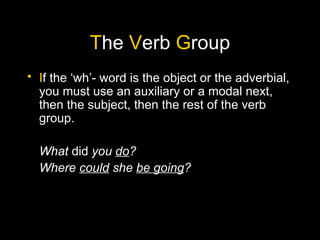
• If the ‘wh’- word is the object or the adverbial,
  you must use an auxiliary or a modal next,
  then the subject, then the rest of the verb
  group.

  What did you do?
  Where could she be going?
The Verb Group
• Some verb groups have an object or two
  objects after them.

  He closed the door.
  She sends you her love.
The Verb Group
• Verb groups invloving linking verbs, such as
  ‘be’ have a complement after them.

  They were sailors.
  She felt happy.
The Verb Group
• Some verb groups have an adverbial after
  them.

  We walked through the park.
  She put the letter on the table.
Questions?
For more slide presentations visit:

The Verb Group

  • 1.
  • 2.
    The Verb Group •The verb group in a clause is used to say what is happening in an action or situation. • You usually put the verb group immediately after the subject. • The verb group always includes a main verb. I waited. They killed the elephants.
  • 3.
    The Verb Group •Regular verbs have four forms: – The base form – The third person singular form of the present simple – The ‘-ing’ form of the present participle – The ‘-ed’ form used for the past simple and the past participle ask > asks > asking > asked try > tries > trying > tried
  • 4.
    The Verb Group •Irregular verbs have three forms, four forms, or five forms – cost > costs > costing – think > thinks > thinking > thought – swim > swims > swimming > swam > swum Note: ‘be’ has eight forms. – be > am/is/are > being > was/were > been
  • 5.
    The Verb Group •The main verb can have one or two auxiliaries in front of it. I had met him in London. The car was being repaired.
  • 6.
    The Verb Group •The main verb can have a modal in front of it. You can go now. I would like to ask you a question.
  • 7.
    The Verb Group •The main verb can have a modal and one or two auxiliaries in front of it. I could have spent the whole year on it. She would have been delighted to see you.
  • 8.
    The Verb Group •In negative clauses, you have to use a modal or auxiliary and put ‘not’ after the first word of the verb group. He does not speak English very well. I was not smiling. It could not have been wrong. Note: You often use short forms rather than ‘not’. I didn’ t know that.
  • 9.
    The Verb Group •In ‘yes/no’ questions, you have to put an auxiliary or modal first, then the subject, then the rest of the verb group. Did you meet George? Couldn’ t you have been a bit quieter?
  • 10.
    The Verb Group •In ‘wh’-questions, you have to put the verb group first. If the ‘wh’-word is the subject, you put the verb group next. Which came first? Who could have done it?
  • 11.
    The Verb Group •If the ‘wh’- word is the object or the adverbial, you must use an auxiliary or a modal next, then the subject, then the rest of the verb group. What did you do? Where could she be going?
  • 12.
    The Verb Group •Some verb groups have an object or two objects after them. He closed the door. She sends you her love.
  • 13.
    The Verb Group •Verb groups invloving linking verbs, such as ‘be’ have a complement after them. They were sailors. She felt happy.
  • 14.
    The Verb Group •Some verb groups have an adverbial after them. We walked through the park. She put the letter on the table.
  • 15.
    Questions? For more slidepresentations visit: