8 th  Grade Grammar Review Verb family
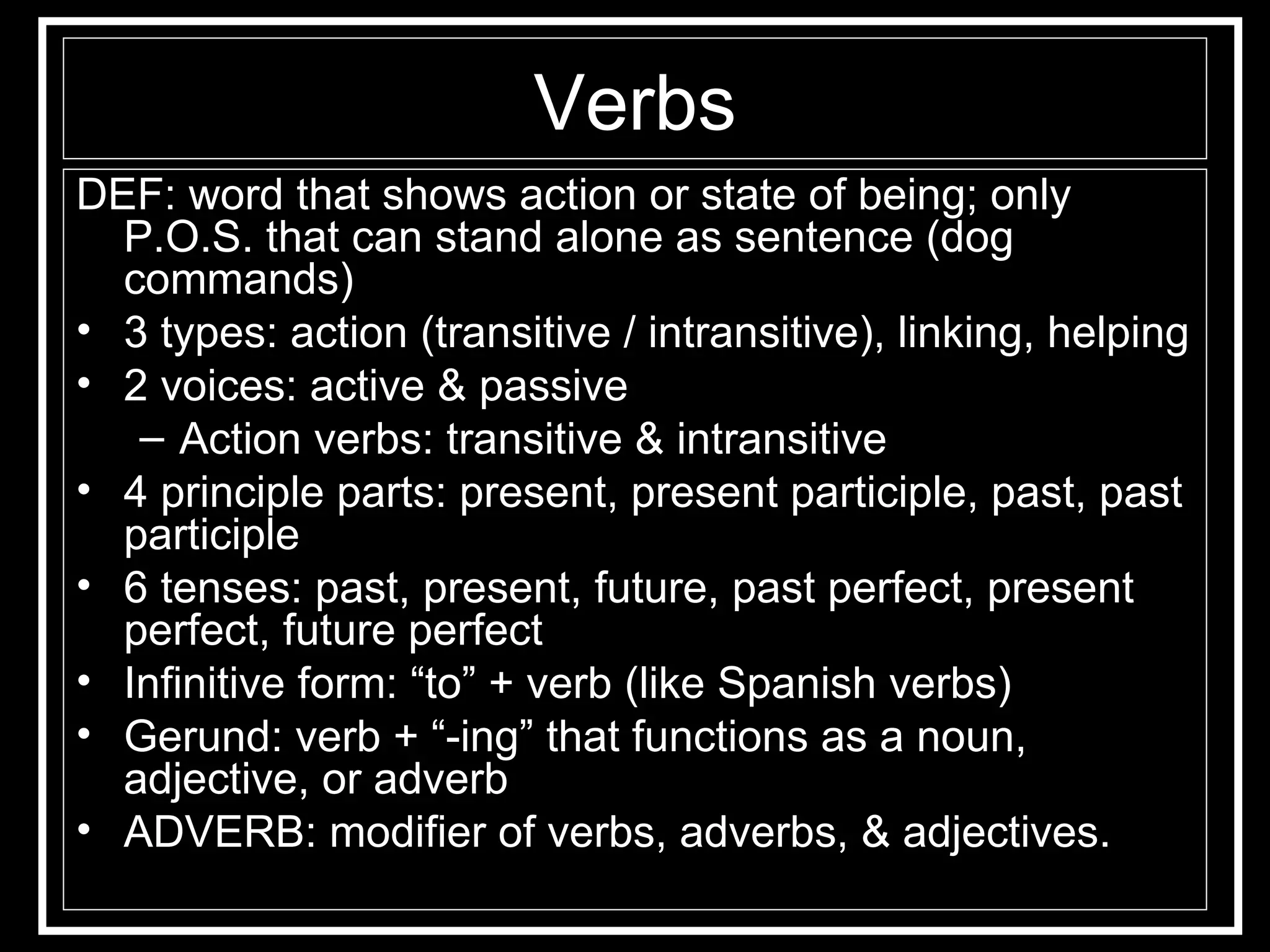
Verbs DEF: word that shows action or state of being; only P.O.S. that can stand alone as sentence (dog commands) 3 types: action (transitive / intransitive), linking, helping 2 voices: active & passive Action verbs: transitive & intransitive 4 principle parts: present, present participle, past, past participle 6 tenses: past, present, future, past perfect, present perfect, future perfect Infinitive form: “to” + verb (like Spanish verbs) Gerund: verb + “-ing” that functions as a noun, adjective, or adverb ADVERB: modifier of verbs, adverbs, & adjectives.
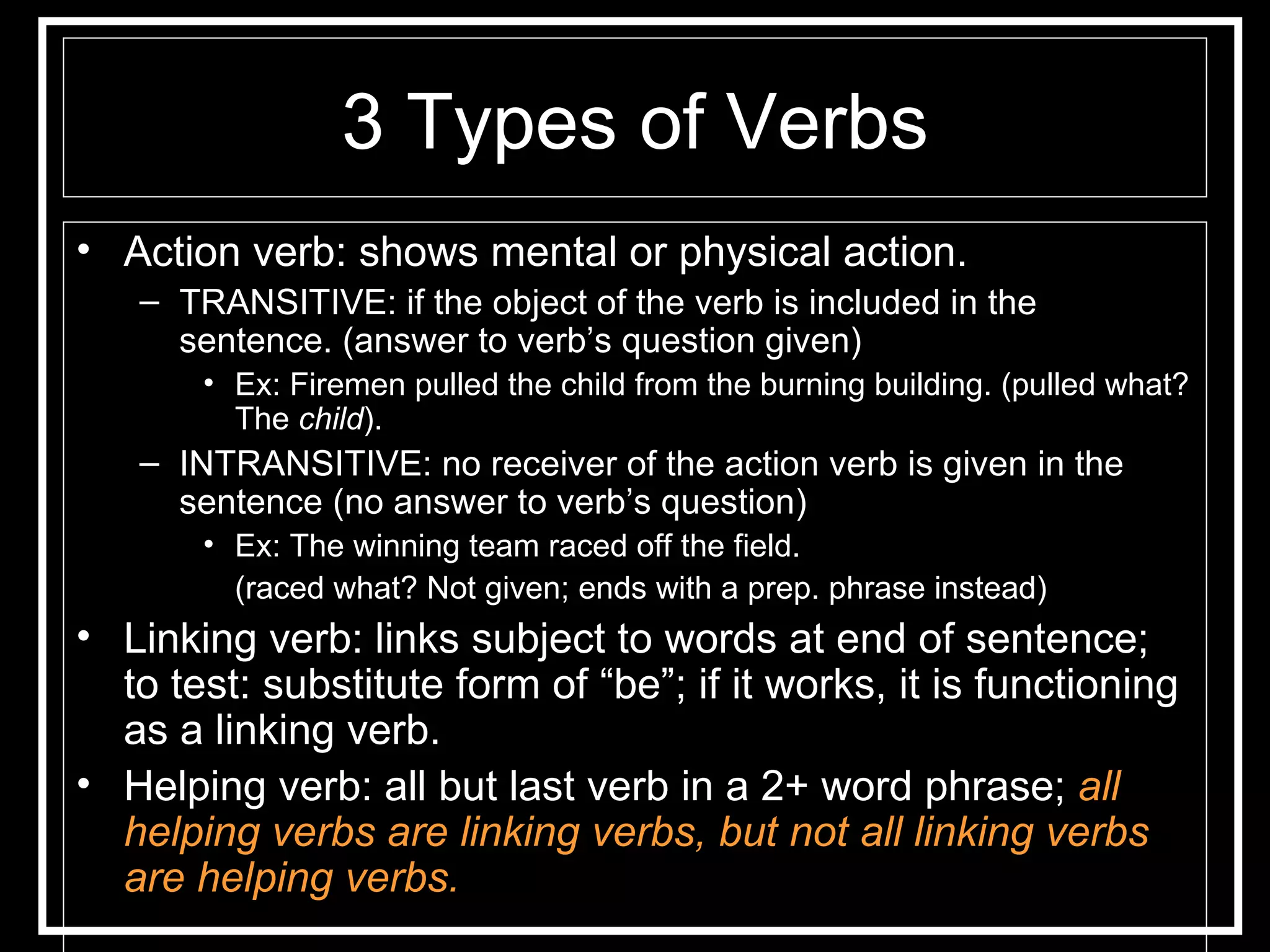
3 Types of Verbs Action verb: shows mental or physical action. TRANSITIVE: if the object of the verb is included in the sentence. (answer to verb’s question given) Ex: Firemen pulled the child from the burning building. (pulled what? The  child ). INTRANSITIVE: no receiver of the action verb is given in the sentence (no answer to verb’s question) Ex: The winning team raced off the field. (raced what? Not given; ends with a prep. phrase instead) Linking verb: links subject to words at end of sentence; to test: substitute form of “be”; if it works, it is functioning as a linking verb. Helping verb: all but last verb in a 2+ word phrase;  all helping verbs are linking verbs, but not all linking verbs are helping verbs.
List of helping verbs List of linking verbs fall seem lie feel appear get stay turn taste sound smell remain prove look *can be linking verbs helping verbs are linking  not all; verbs; linking are also right at the listed  run verbs grow helping turn the (all of   will   shall should did would does could do can been had being has were have was  might are must is may am
2 Voices ACTIVE VOICE: Subject performs the action;  BEST FORM TO USE IN WRITING: Eg: Anne Interviewed the actor. PASSIVE VOICE: Passive verb tenses: When the subject does not perform the action: Eg: The actor was interviewed by Anne. Forming Passive Verb Tenses: will have been  + past part. future perfect: had been  + past part. past perfect: has been  + past part. present perf: will be  + past part. future: was  + past part. past: is  + past part. present:
4 Principle Parts REGULAR VERBS: ( past and past participle are created adding “-ed”) Present Present part. Past Past part. look (am) looking looked   (have) looked move (am) moving moved  (have) moved IRREGULAR VERBS: (no adding “-ed” for past; must be memorized) Present Present part. Past Past part. be (am) being was   (have) been swim (am) swimming swam  (have) swum write (am) writing wrote   (have) written
6 Tenses The first 3 you’ve known forever: past, present & future. The perfect tenses use the past participle + the past, present, & future forms of “have” I will have eaten. future perf: I will have tasted future perf: I had eaten past perf: I had tasted past perf: I have eaten present perf: I have tasted present perf: I will eat. future: I will taste future: I ate. past: I tasted past: I eat. present: I taste present: BASIC FORMS OF  EAT TENSE BASIC FORMS OF  TASTE TENSE (Irregular   verb example) (Regular verb example)
Infinitive The infinitive form of the verb is the verb phrase “to +” verb and function as a noun, adjective, or adverb.  You need to determine what word the phrase is affecting: If it functions as the subject or object, it is a noun If it modifies a noun, it is an adjective if it modifies a verb, adjective, or adverb, it is an adverb. Most verb vocabulary in foreign languages is presented in the infinitive form Eg: Gail resolved  to jog  two miles every day. ( “to jog” is the infinitive used as a noun). DO NOT CONFUSE THE INFINITIVE WITH A PREPOSITIONAL PHRASE: Hugo decided  to walk   to school.   (“to walk” is the infinitive used as a noun. “to school” is a prepositional phrase).
Gerund Verbs ending in  –ing  that acts as a noun. Eg:  Practicing  basketball is all that Ja’Vonne does. ( Practicing  is used as part of the gerund phrase  “Practicing basketball.”  Both words function as one noun.) Eg. Craig was caught  cheating . ( Cheating  is the direct object of verb caught)
Adverbs Def: Modifies verbs, adjectives, & adverbs (free-love hippie); does NOT modify nouns or pronouns. (sister to adjective) Usually ends in  –ly  (exceptions: lovely, ugly, lonely, and only).   Also words  very, so, too, more, & less . Answers questions: Where?  When?  How?  To what extent?  Examples: She finished her homework quickly. ( quickly  modifies verb  finished) The notes were  extremely  helpful. ( extremely  modifies adjective  helpful) Frank thundered down the aisle  too  fiercely and was given a charging foul. ( Too  modifies adverb  fiercely)

8th Grade Grammar Review Verb Fam

  • 1.
    8 th Grade Grammar Review Verb family
  • 2.
    Verbs DEF: wordthat shows action or state of being; only P.O.S. that can stand alone as sentence (dog commands) 3 types: action (transitive / intransitive), linking, helping 2 voices: active & passive Action verbs: transitive & intransitive 4 principle parts: present, present participle, past, past participle 6 tenses: past, present, future, past perfect, present perfect, future perfect Infinitive form: “to” + verb (like Spanish verbs) Gerund: verb + “-ing” that functions as a noun, adjective, or adverb ADVERB: modifier of verbs, adverbs, & adjectives.
  • 3.
    3 Types ofVerbs Action verb: shows mental or physical action. TRANSITIVE: if the object of the verb is included in the sentence. (answer to verb’s question given) Ex: Firemen pulled the child from the burning building. (pulled what? The child ). INTRANSITIVE: no receiver of the action verb is given in the sentence (no answer to verb’s question) Ex: The winning team raced off the field. (raced what? Not given; ends with a prep. phrase instead) Linking verb: links subject to words at end of sentence; to test: substitute form of “be”; if it works, it is functioning as a linking verb. Helping verb: all but last verb in a 2+ word phrase; all helping verbs are linking verbs, but not all linking verbs are helping verbs.
  • 4.
    List of helpingverbs List of linking verbs fall seem lie feel appear get stay turn taste sound smell remain prove look *can be linking verbs helping verbs are linking not all; verbs; linking are also right at the listed run verbs grow helping turn the (all of   will   shall should did would does could do can been had being has were have was might are must is may am
  • 5.
    2 Voices ACTIVEVOICE: Subject performs the action; BEST FORM TO USE IN WRITING: Eg: Anne Interviewed the actor. PASSIVE VOICE: Passive verb tenses: When the subject does not perform the action: Eg: The actor was interviewed by Anne. Forming Passive Verb Tenses: will have been + past part. future perfect: had been + past part. past perfect: has been + past part. present perf: will be + past part. future: was + past part. past: is + past part. present:
  • 6.
    4 Principle PartsREGULAR VERBS: ( past and past participle are created adding “-ed”) Present Present part. Past Past part. look (am) looking looked (have) looked move (am) moving moved (have) moved IRREGULAR VERBS: (no adding “-ed” for past; must be memorized) Present Present part. Past Past part. be (am) being was (have) been swim (am) swimming swam (have) swum write (am) writing wrote (have) written
  • 7.
    6 Tenses Thefirst 3 you’ve known forever: past, present & future. The perfect tenses use the past participle + the past, present, & future forms of “have” I will have eaten. future perf: I will have tasted future perf: I had eaten past perf: I had tasted past perf: I have eaten present perf: I have tasted present perf: I will eat. future: I will taste future: I ate. past: I tasted past: I eat. present: I taste present: BASIC FORMS OF EAT TENSE BASIC FORMS OF TASTE TENSE (Irregular verb example) (Regular verb example)
  • 8.
    Infinitive The infinitiveform of the verb is the verb phrase “to +” verb and function as a noun, adjective, or adverb. You need to determine what word the phrase is affecting: If it functions as the subject or object, it is a noun If it modifies a noun, it is an adjective if it modifies a verb, adjective, or adverb, it is an adverb. Most verb vocabulary in foreign languages is presented in the infinitive form Eg: Gail resolved to jog two miles every day. ( “to jog” is the infinitive used as a noun). DO NOT CONFUSE THE INFINITIVE WITH A PREPOSITIONAL PHRASE: Hugo decided to walk to school. (“to walk” is the infinitive used as a noun. “to school” is a prepositional phrase).
  • 9.
    Gerund Verbs endingin –ing that acts as a noun. Eg: Practicing basketball is all that Ja’Vonne does. ( Practicing is used as part of the gerund phrase “Practicing basketball.” Both words function as one noun.) Eg. Craig was caught cheating . ( Cheating is the direct object of verb caught)
  • 10.
    Adverbs Def: Modifiesverbs, adjectives, & adverbs (free-love hippie); does NOT modify nouns or pronouns. (sister to adjective) Usually ends in –ly (exceptions: lovely, ugly, lonely, and only). Also words very, so, too, more, & less . Answers questions: Where? When? How? To what extent? Examples: She finished her homework quickly. ( quickly modifies verb finished) The notes were extremely helpful. ( extremely modifies adjective helpful) Frank thundered down the aisle too fiercely and was given a charging foul. ( Too modifies adverb fiercely)