VERBS
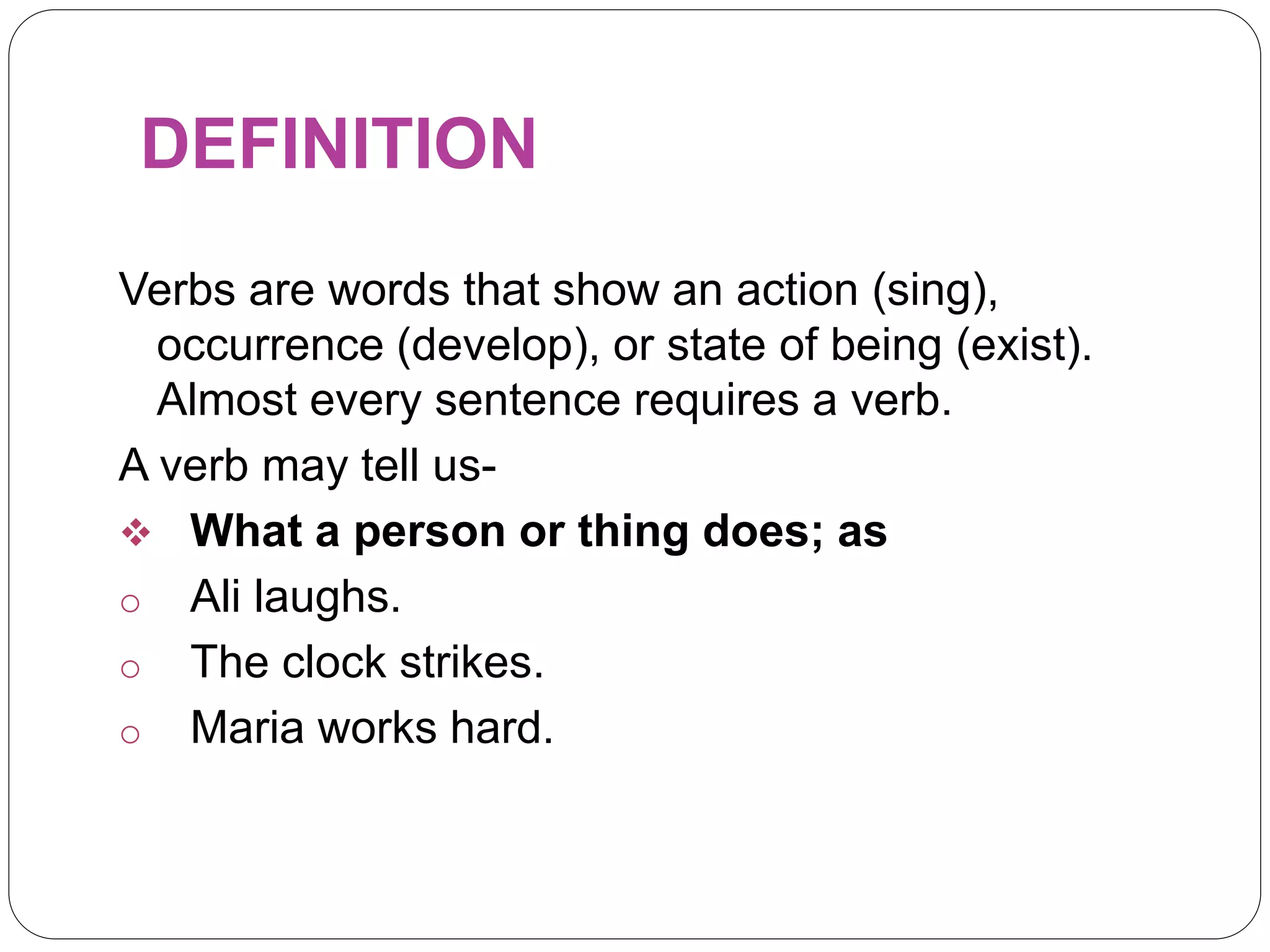
DEFINITION
Verbs are words that show an action (sing),
occurrence (develop), or state of being (exist).
Almost every sentence requires a verb.
A verb may tell us-
 What a person or thing does; as
o Ali laughs.
o The clock strikes.
o Maria works hard.
U
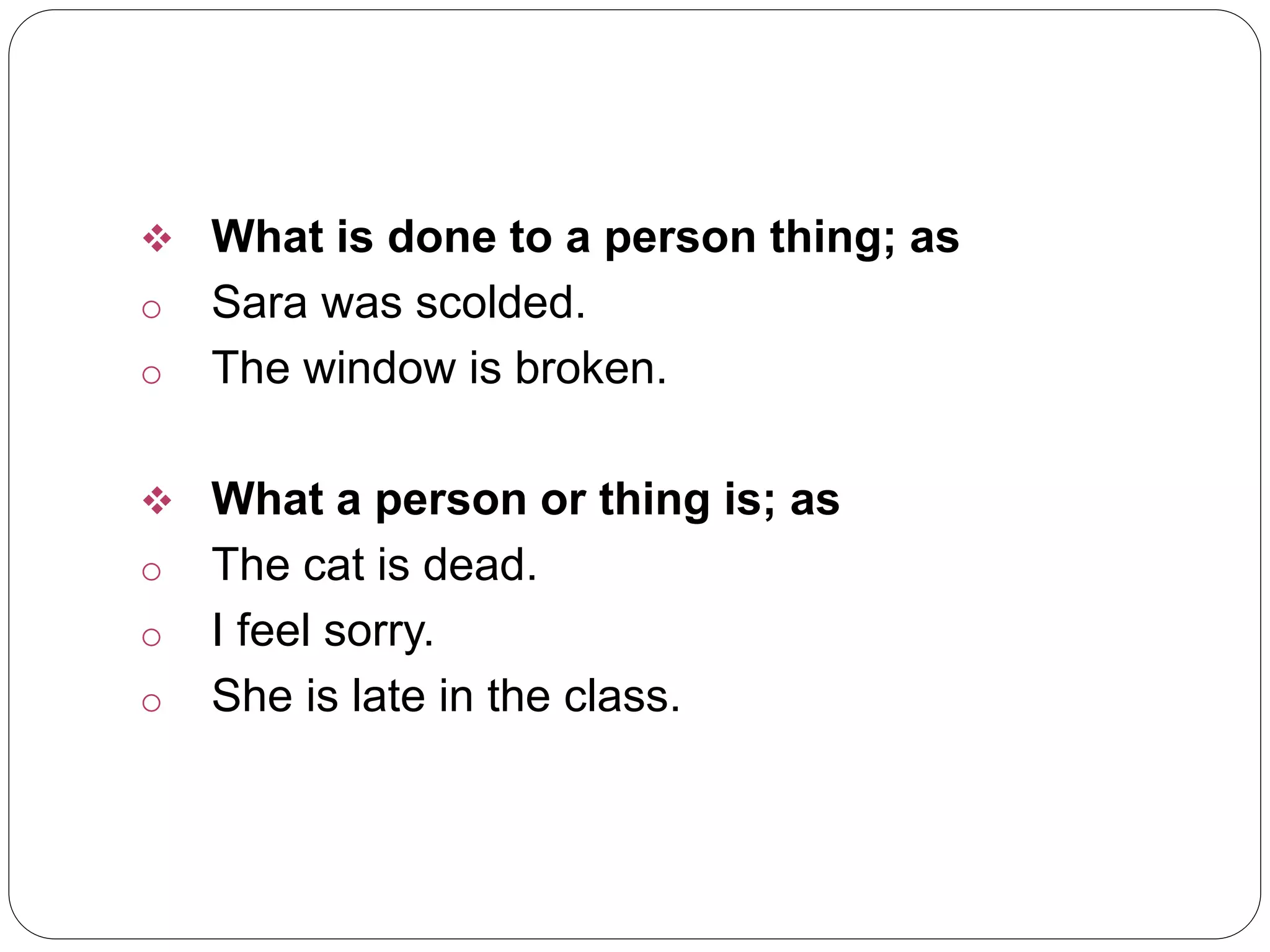
 What is done to a person thing; as
o Sara was scolded.
o The window is broken.
 What a person or thing is; as
o The cat is dead.
o I feel sorry.
o She is late in the class.
Types of verb
Action verb
o Transitive verb
o Intransitive verb
Finite and non finite verb
Compound verb
Regular and irregular verb
Modal verb
Linking verb
ACTION VERBS
Action verbs are the words that express action
(give, eat, walk, etc). or possession (have,
own)etc.
Action verbs can either be transitive or intransitive
verbs.
 Transitive verbs
Transitive verbs are actions verb that have an
object to receive that actions. Examples;
 I baked some cookies.
 I rode the bicycle.
 I moved the chair.
I
Intransitive verbs
Intransitive verbs are action verbs but unlike
transitive verbs, the do not having an object
receiving the action.
• I laughed
• I cried
• The book fell
• The sun set
• The horse galloped
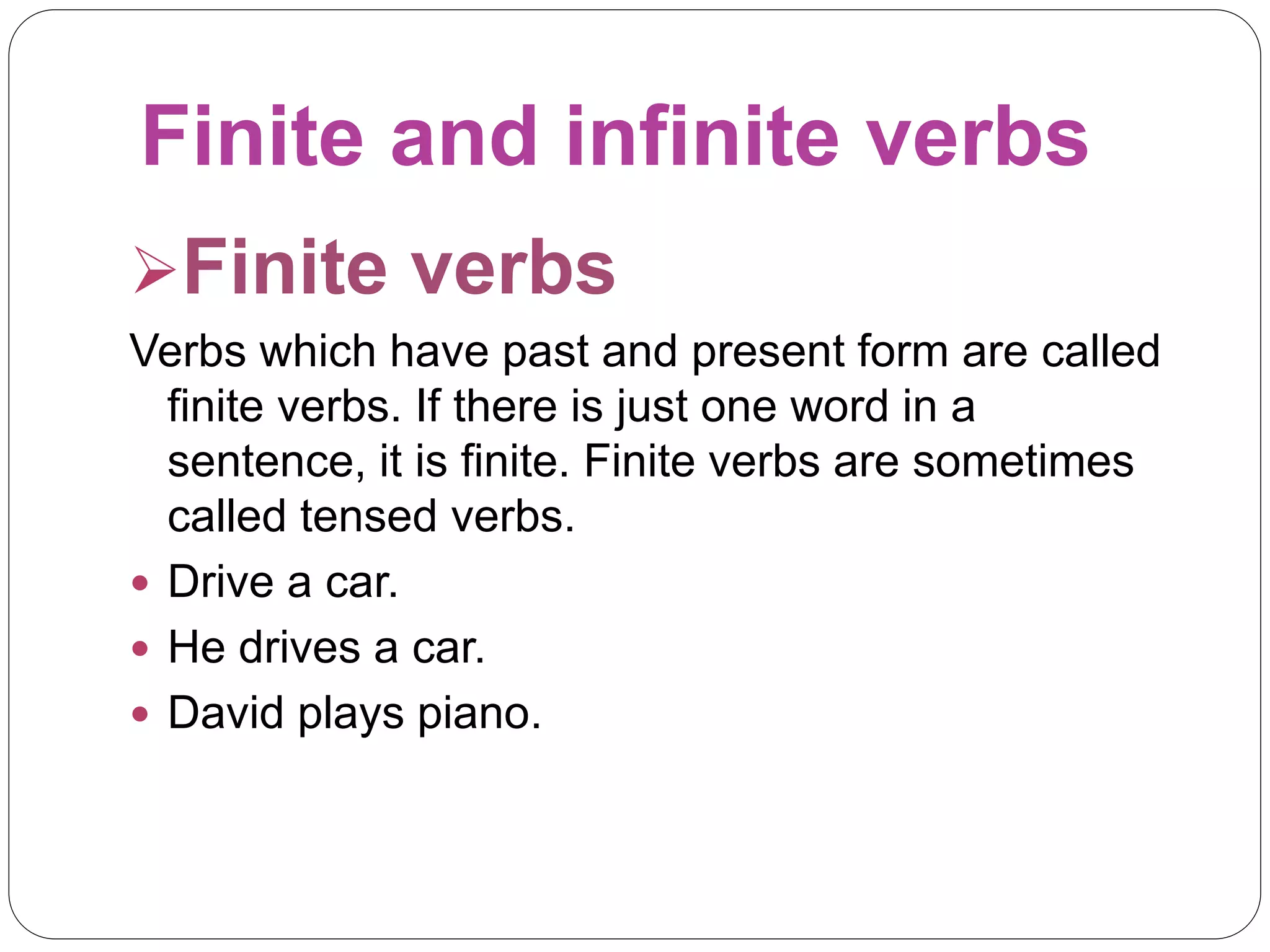
Finite and infinite verbs
Finite verbs
Verbs which have past and present form are called
finite verbs. If there is just one word in a
sentence, it is finite. Finite verbs are sometimes
called tensed verbs.
 Drive a car.
 He drives a car.
 David plays piano.
Infinite verbs
The infinitive form of a verb is the verb in its basic form.
It is the version of the verb which will appear in the
dictionary. The infinitive form of a verb is usually
preceded by "to“. Examples
 We decided not to go out.
 To learn is very important.
 I want to swim in the pool.
 To cruise in a car is not allowed here.
 The most important thing is not to give up.
 To be funny is the goal of comedians.
Compound verbs
If a subject of a sentence has a verb that is made
up of more than one word, that verb is called a
compound verb. There are several forms of
compound verbs including:
 A prepositional verb
 A phrasal verb
 A verb with auxiliaries
 A compound single-word verb
Prepositional verb
When a preposition combines with a verb to form a new verb, the
result is called a prepositional verb. Some examples include:
 I believe in respecting our elders.
 Why does Timmy always ask for more ice cream?
 The success of this campaign will rely upon increasing voter
turnout.
Phrasal Verb
When a verb combines with another type of word, such as an
adverb, the result is a phrasal verb. Some examples include:
 She should really tear up that contract.
 Can you take away the garbage?
 Most people take down their holiday decorations by January 1st.
 If he's going to work on fixing the car, he should wear gloves
Verb with auxiliaries
In this form, a verb combines with another verb
called a helping verb. The helping verb is typically
have, has, had, am, be, been, is, are, was or
were. For example, in the following sentences,
the first word in bold is the auxiliary verb. and the
second verb follows. Together they are a
compound verb. For example:
 Joe was walking down the street last night.
 The council will meet to discuss the issue
tomorrow.
 Jack and Jill are running up the hill.
Compound single-word verb
Sometimes a single verb is a combination of multiple
words. Both words might be verbs or one of the words
might be a descriptor word. The words may run
together as one word or they may be joined by a
hyphen. Regardless of the spelling, when used
together, the words function as a single verb.
 For example:
 The Smiths usually hire Jessica to babysit their son
on Saturday nights.
 Gerald really wants to water-proof the deck this
weekend.
 The easiest meal idea is just to stir-fry everything
together.
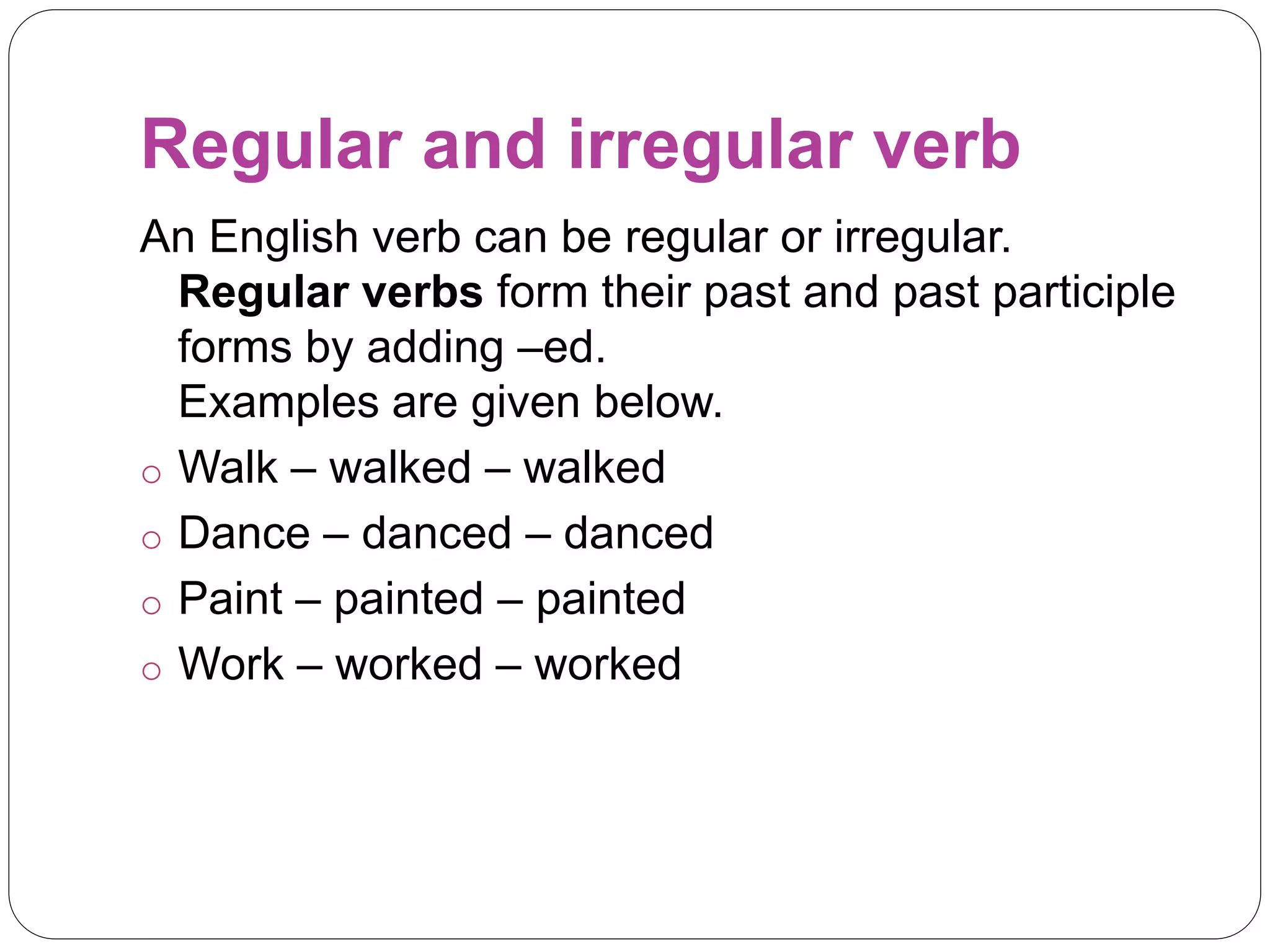
Regular and irregular verb
An English verb can be regular or irregular.
Regular verbs form their past and past participle
forms by adding –ed.
Examples are given below.
o Walk – walked – walked
o Dance – danced – danced
o Paint – painted – painted
o Work – worked – worked
JJ
Irregular verbs form their past and past participle
forms in different ways.
There are mainly three types of irregular verbs.
• Verbs in which all the three forms are the same (e.g. put –
put – put)
• Verbs in which two of the three forms are the same (e.g. sit
– sat – sat)
• Verbs in which all three forms are different (e.g. drink –
drank – drunk)
Some verbs can be both regular and irregular. Examples are:
 Burn – burnt – burnt (irregular)
Burn – burned – burned (regular)
 Dream – dreamt – dreamt (irregular)
Dream – dreamed – dreamed (regular)
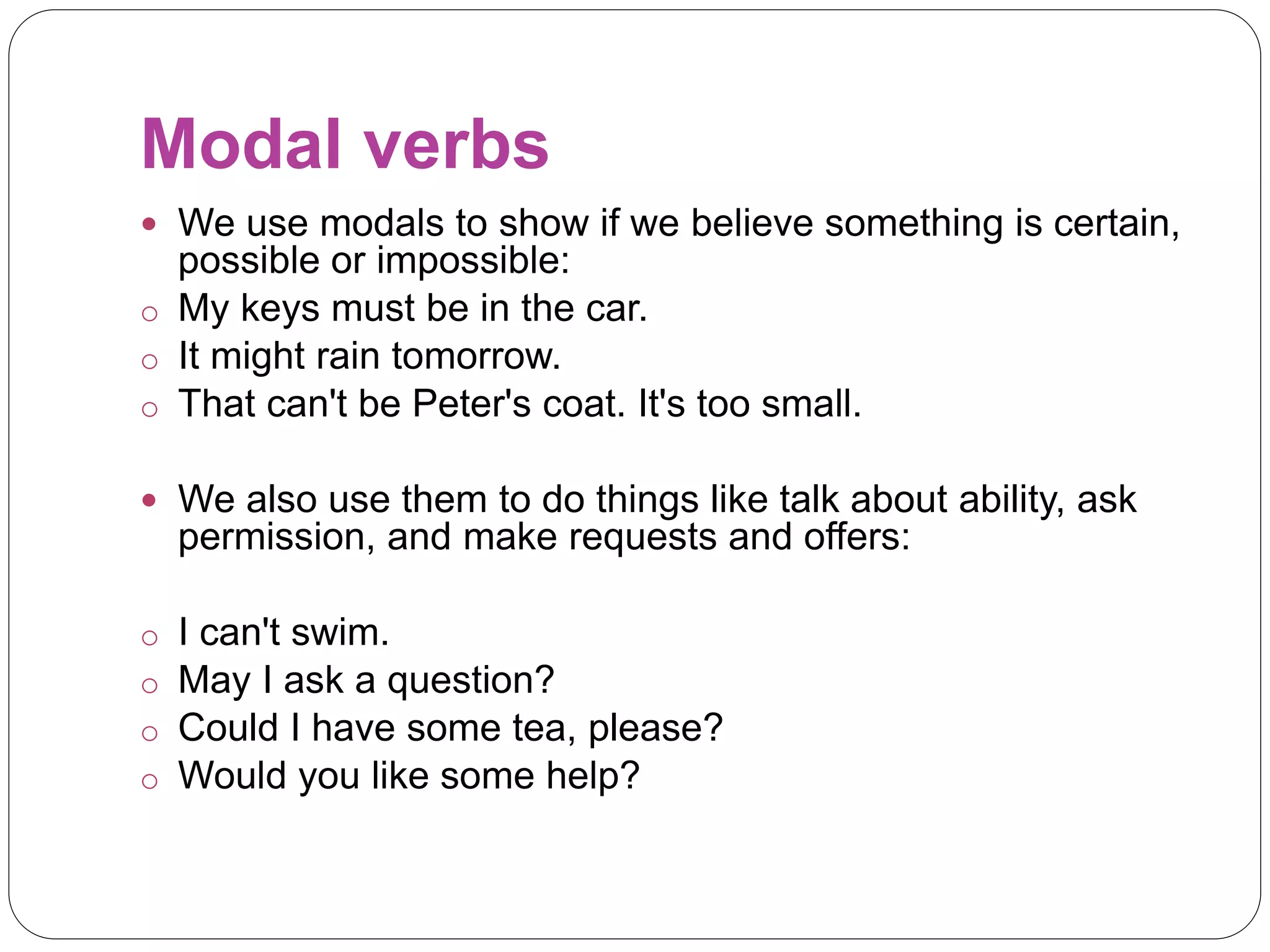
Modal verbs
 We use modals to show if we believe something is certain,
possible or impossible:
o My keys must be in the car.
o It might rain tomorrow.
o That can't be Peter's coat. It's too small.
 We also use them to do things like talk about ability, ask
permission, and make requests and offers:
o I can't swim.
o May I ask a question?
o Could I have some tea, please?
o Would you like some help?
Linking verbs
A linking verb connects the subject with a word that
gives information about the subject, such as a
condition or relationship. They do not show any
action; they simply link the subject with the rest of
the sentence. The most common linking verbs are
forms of the verb to be: am, is, are, was, were,
being, been.
 William is excited about his promotion.
 She appears upset about the announcement.
 The eggs smell rotten.
 He went red after tripping on the rug.
HAHA
THANKYOU

Verbs types briefly expl

  • 1.
  • 2.
    DEFINITION Verbs are wordsthat show an action (sing), occurrence (develop), or state of being (exist). Almost every sentence requires a verb. A verb may tell us-  What a person or thing does; as o Ali laughs. o The clock strikes. o Maria works hard.
  • 3.
    U  What isdone to a person thing; as o Sara was scolded. o The window is broken.  What a person or thing is; as o The cat is dead. o I feel sorry. o She is late in the class.
  • 4.
    Types of verb Actionverb o Transitive verb o Intransitive verb Finite and non finite verb Compound verb Regular and irregular verb Modal verb Linking verb
  • 5.
    ACTION VERBS Action verbsare the words that express action (give, eat, walk, etc). or possession (have, own)etc. Action verbs can either be transitive or intransitive verbs.  Transitive verbs Transitive verbs are actions verb that have an object to receive that actions. Examples;  I baked some cookies.  I rode the bicycle.  I moved the chair.
  • 6.
    I Intransitive verbs Intransitive verbsare action verbs but unlike transitive verbs, the do not having an object receiving the action. • I laughed • I cried • The book fell • The sun set • The horse galloped
  • 7.
    Finite and infiniteverbs Finite verbs Verbs which have past and present form are called finite verbs. If there is just one word in a sentence, it is finite. Finite verbs are sometimes called tensed verbs.  Drive a car.  He drives a car.  David plays piano.
  • 8.
    Infinite verbs The infinitiveform of a verb is the verb in its basic form. It is the version of the verb which will appear in the dictionary. The infinitive form of a verb is usually preceded by "to“. Examples  We decided not to go out.  To learn is very important.  I want to swim in the pool.  To cruise in a car is not allowed here.  The most important thing is not to give up.  To be funny is the goal of comedians.
  • 9.
    Compound verbs If asubject of a sentence has a verb that is made up of more than one word, that verb is called a compound verb. There are several forms of compound verbs including:  A prepositional verb  A phrasal verb  A verb with auxiliaries  A compound single-word verb
  • 10.
    Prepositional verb When apreposition combines with a verb to form a new verb, the result is called a prepositional verb. Some examples include:  I believe in respecting our elders.  Why does Timmy always ask for more ice cream?  The success of this campaign will rely upon increasing voter turnout. Phrasal Verb When a verb combines with another type of word, such as an adverb, the result is a phrasal verb. Some examples include:  She should really tear up that contract.  Can you take away the garbage?  Most people take down their holiday decorations by January 1st.  If he's going to work on fixing the car, he should wear gloves
  • 11.
    Verb with auxiliaries Inthis form, a verb combines with another verb called a helping verb. The helping verb is typically have, has, had, am, be, been, is, are, was or were. For example, in the following sentences, the first word in bold is the auxiliary verb. and the second verb follows. Together they are a compound verb. For example:  Joe was walking down the street last night.  The council will meet to discuss the issue tomorrow.  Jack and Jill are running up the hill.
  • 12.
    Compound single-word verb Sometimesa single verb is a combination of multiple words. Both words might be verbs or one of the words might be a descriptor word. The words may run together as one word or they may be joined by a hyphen. Regardless of the spelling, when used together, the words function as a single verb.  For example:  The Smiths usually hire Jessica to babysit their son on Saturday nights.  Gerald really wants to water-proof the deck this weekend.  The easiest meal idea is just to stir-fry everything together.
  • 13.
    Regular and irregularverb An English verb can be regular or irregular. Regular verbs form their past and past participle forms by adding –ed. Examples are given below. o Walk – walked – walked o Dance – danced – danced o Paint – painted – painted o Work – worked – worked
  • 14.
    JJ Irregular verbs formtheir past and past participle forms in different ways. There are mainly three types of irregular verbs. • Verbs in which all the three forms are the same (e.g. put – put – put) • Verbs in which two of the three forms are the same (e.g. sit – sat – sat) • Verbs in which all three forms are different (e.g. drink – drank – drunk) Some verbs can be both regular and irregular. Examples are:  Burn – burnt – burnt (irregular) Burn – burned – burned (regular)  Dream – dreamt – dreamt (irregular) Dream – dreamed – dreamed (regular)
  • 15.
    Modal verbs  Weuse modals to show if we believe something is certain, possible or impossible: o My keys must be in the car. o It might rain tomorrow. o That can't be Peter's coat. It's too small.  We also use them to do things like talk about ability, ask permission, and make requests and offers: o I can't swim. o May I ask a question? o Could I have some tea, please? o Would you like some help?
  • 16.
    Linking verbs A linkingverb connects the subject with a word that gives information about the subject, such as a condition or relationship. They do not show any action; they simply link the subject with the rest of the sentence. The most common linking verbs are forms of the verb to be: am, is, are, was, were, being, been.  William is excited about his promotion.  She appears upset about the announcement.  The eggs smell rotten.  He went red after tripping on the rug.
  • 17.