SUBJECT-VERB 
AGREEMENT 
Brushup Chap 3
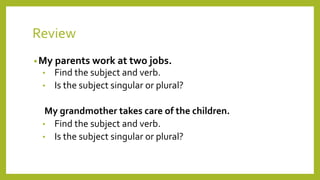
Review 
•My parents work at two jobs. 
• Find the subject and verb. 
• Is the subject singular or plural? 
My grandmother takes care of the children. 
• Find the subject and verb. 
• Is the subject singular or plural?
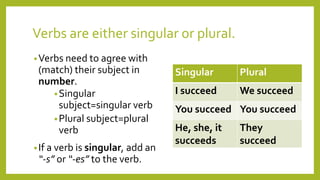
Verbs are either singular or plural. 
•Verbs need to agree with 
(match) their subject in 
number. 
•Singular 
subject=singular verb 
•Plural subject=plural 
verb 
• If a verb is singular, add an 
“-s” or “-es” to the verb. 
Singular Plural 
I succeed We succeed 
You succeed You succeed 
He, she, it 
They 
succeeds 
succeed
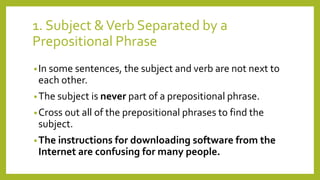
1. Subject & Verb Separated by a 
Prepositional Phrase 
• In some sentences, the subject and verb are not next to 
each other. 
•The subject is never part of a prepositional phrase. 
•Cross out all of the prepositional phrases to find the 
subject. 
•The instructions for downloading software from the 
Internet are confusing for many people.
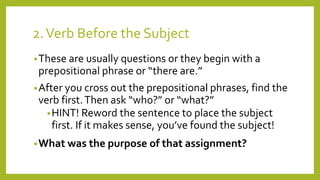
2. Verb Before the Subject 
•These are usually questions or they begin with a 
prepositional phrase or “there are.” 
•After you cross out the prepositional phrases, find the 
verb first. Then ask “who?” or “what?” 
•HINT! Reword the sentence to place the subject 
first. If it makes sense, you’ve found the subject! 
•What was the purpose of that assignment?
3. Indefinite Pronoun Subjects 
•Indefinite pronouns are pronouns that refer to one set 
of unspecified being or things. 
• Each, anyone, nothing, somebody, anything, etc. 
•Indefinite pronouns are always singular and always take 
a singular verb. 
• Remember, singular verbs end in “-s”! 
•Somebody was reading my mail.
4. Compound Subjects 
•A compound subject is made up of two or more 
subjects connected to each other by “and” (“and” is not 
part of the subject). 
•A compound subject is plural and requires a plural verb. 
•Rent and insurance were my biggest expenses for the 
month.
Rules You Need to Remember 
1. Subjects and verbs must match in number. 
2. Add an –s to a 3rd person singular verb, but do not add 
any endings to a plural verb. 
3. Subjects are never part of a prepositional phrase. 
4. Indefinite pronouns are always singular. 
5. Compound subjects always take a plural noun.

Subject-Verb Agreement

  • 1.
  • 2.
    Review •My parentswork at two jobs. • Find the subject and verb. • Is the subject singular or plural? My grandmother takes care of the children. • Find the subject and verb. • Is the subject singular or plural?
  • 3.
    Verbs are eithersingular or plural. •Verbs need to agree with (match) their subject in number. •Singular subject=singular verb •Plural subject=plural verb • If a verb is singular, add an “-s” or “-es” to the verb. Singular Plural I succeed We succeed You succeed You succeed He, she, it They succeeds succeed
  • 4.
    1. Subject &Verb Separated by a Prepositional Phrase • In some sentences, the subject and verb are not next to each other. •The subject is never part of a prepositional phrase. •Cross out all of the prepositional phrases to find the subject. •The instructions for downloading software from the Internet are confusing for many people.
  • 5.
    2. Verb Beforethe Subject •These are usually questions or they begin with a prepositional phrase or “there are.” •After you cross out the prepositional phrases, find the verb first. Then ask “who?” or “what?” •HINT! Reword the sentence to place the subject first. If it makes sense, you’ve found the subject! •What was the purpose of that assignment?
  • 6.
    3. Indefinite PronounSubjects •Indefinite pronouns are pronouns that refer to one set of unspecified being or things. • Each, anyone, nothing, somebody, anything, etc. •Indefinite pronouns are always singular and always take a singular verb. • Remember, singular verbs end in “-s”! •Somebody was reading my mail.
  • 7.
    4. Compound Subjects •A compound subject is made up of two or more subjects connected to each other by “and” (“and” is not part of the subject). •A compound subject is plural and requires a plural verb. •Rent and insurance were my biggest expenses for the month.
  • 8.
    Rules You Needto Remember 1. Subjects and verbs must match in number. 2. Add an –s to a 3rd person singular verb, but do not add any endings to a plural verb. 3. Subjects are never part of a prepositional phrase. 4. Indefinite pronouns are always singular. 5. Compound subjects always take a plural noun.