Verbs
Verbs A  verb  is a word the expresses an action, or a state of being.
Kinds of Verbs Action Verbs  –   show either a physical or mental action. The plane  landed  at the airport a while ago.  (physical action) Mother always  hopes  for the best.  (mental action)
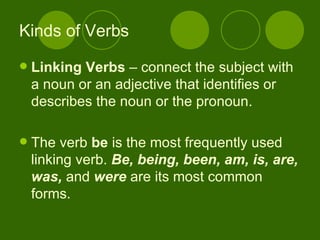
Kinds of Verbs Linking Verbs  –   connect the subject with a noun or an adjective that identifies or describes the noun or the pronoun.  The verb  be  is the most frequently used linking verb.  Be, being, been, am, is, are, was,  and  were   are its most common forms.
Kinds of Verbs Other linking verbs include: taste smell look feel stay seem grow become sound remain get appear
Kinds of Verbs Auxiliary Verbs  –   verbs used with main verbs to form verb phrases. The most common auxiliary verbs are forms of  be, have,  and  do. must shall, should may, might will, would can, could have, has, had do, does, did be, been, am, is, was, were
Characteristics of Verbs A verb is  transitive   when a person or thing directs the action toward someone or something. The receiver of the action is called the  object of the verb. He  wrote  a beautiful poem. (a what? – a poem) A verb is  intransitive  when the doer of the action does not direct the action toward someone or something. The sky  darkened .
Active and Passive Voice Voice  tells whether the subject of the sentence is the doer of the receiver of the  action.  The verb is in the  active voice  if the subject performs the action. Mother  gave   me a new dress. The verb is in the  passive voice  is the subject receives the action. I  was given  a new dress by Mother.
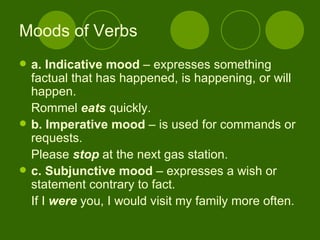
Moods of Verbs a. Indicative mood  – expresses something factual that has happened, is happening, or will happen. Rommel  eats  quickly. b. Imperative mood  – is used for commands or requests. Please  stop  at the next gas station. c. Subjunctive mood  – expresses a wish or statement contrary to fact. If I  were  you, I would visit my family more often.
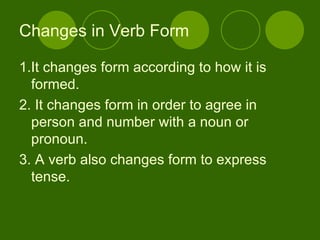
Changes in Verb Form 1.It changes form according to how it is formed. 2. It changes form in order to agree in person and number with a noun or pronoun. 3. A verb also changes form to express tense.
Verb Tenses Simple Tense Simple Present Tense Simple Past Tense Simple Future Tense Progressive Tense (Continuous) Present Progressive Past Progressive Future Progressive
Verb Tenses Perfect Tense Present Perfect Tense Past Perfect Tense Future Perfect Tense Perfect Progressive (Continuous) Tense Present Perfect Progressive Tense Past Perfect Progressive Tense Future Perfect Progressive Tense
Simple Tenses Simple Present Tense base form + -s/es expresses action happening at the present moment or action that happens habitually A strange noise  comes  from the basement.
Simple Tenses Simple Past Tense base form + -d/ed express action or a state of being that took place in the past The students  waited  for the guest for more than four hours. The president  signed  the peace treaty.
Simple Tenses Simple Future Tense will / shall + base form expresses an action that will take place sometime in the future; may also express a prediction or give an order The Zoom Master  will play  against the Gin- Makers on Sunday. The candidate  will  surely win the pageant.
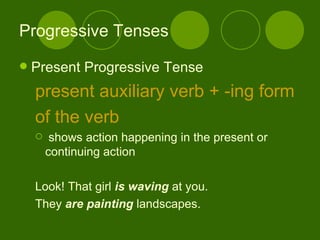
Progressive Tenses Present Progressive Tense present auxiliary verb + -ing form of the verb shows action happening in the present or continuing action  Look! That girl  is waving  at you. They  are painting  landscapes.
Progressive Tenses Present Progressive Tense past auxiliary verb + -ing form of the verb express action or a state of being that took place in the past  I  was writing  my report when you called. When the principal came, the students  were doing  their English projects.
Progressive Tenses Future Progressive Tense will / shall + be + -ing form of the verb indicates future action I  was writing  my report when you called. When the principal came, the students  were doing  their English projects.
Perfect Tenses Present Perfect Tense has / have + past participle of the  verb describe an action in the past and continues to the present;  also express an action that has been completed at some indefinite past  The basketball player  has had  a lot of trouble with his knee. We  have waited  long for this blessing.
Perfect Tenses Past Perfect Tense had + past participle of the  verb express an action that was completed in the past at some time before another action took place  Mariz  had worked  as a nanny before she graduated. I  had  already  left  by the time the school bus came to pick me up.
Perfect Tenses Future Perfect Tense will / shall + have + past participle of the verb used to express future action that will be completed before another future action  My brother  will have graduated  by 2005. In December, they  will have known  each other for a year.
Perfect Progressive Form Present Perfect Progressive Form has/have + been + -ing form of the verb indicates past action that continues to the present  I  have been hoping  you would call.
Perfect Progressive Form Past Perfect Progressive Form had + been + -ing form of the verb indicates past action that continues to the present  Nico  had been seeing  Nikki a lot until summer.
Perfect Progressive Form Future Perfect Progressive Form will / shall + have + been +-ing form of the verb indicates a continuous action that will be completed at some point in the future  In another five minutes, we  will have been driving  for five hours.
Non-Verb Forms - Participles A participle must be in a verb string in order to behave as a verb. Without an auxiliary, a participle plays a non-verb role in its sentence.  Arriving home late, Priscilla RUSHED into the kitchen. She WAS THINKING about the burnt potatoes.
Non-Verb Forms - Participles Remember that  participles  are  parts  of verb strings. They need auxiliaries to do a verb's work. If a participle has no auxiliary in front of it, look elsewhere for the sentence's verb.
Infinitives When the word  to  stands in front of the base form of a verb, it creates an  infinitive . An infinitive plays a non-verb role in its sentence.  To know him IS to love him. I WANT to bring him with me at Christmas.

Verbs

  • 1.
  • 2.
    Verbs A verb is a word the expresses an action, or a state of being.
  • 3.
    Kinds of VerbsAction Verbs – show either a physical or mental action. The plane landed at the airport a while ago. (physical action) Mother always hopes for the best. (mental action)
  • 4.
    Kinds of VerbsLinking Verbs – connect the subject with a noun or an adjective that identifies or describes the noun or the pronoun. The verb be is the most frequently used linking verb. Be, being, been, am, is, are, was, and were are its most common forms.
  • 5.
    Kinds of VerbsOther linking verbs include: taste smell look feel stay seem grow become sound remain get appear
  • 6.
    Kinds of VerbsAuxiliary Verbs – verbs used with main verbs to form verb phrases. The most common auxiliary verbs are forms of be, have, and do. must shall, should may, might will, would can, could have, has, had do, does, did be, been, am, is, was, were
  • 7.
    Characteristics of VerbsA verb is transitive when a person or thing directs the action toward someone or something. The receiver of the action is called the object of the verb. He wrote a beautiful poem. (a what? – a poem) A verb is intransitive when the doer of the action does not direct the action toward someone or something. The sky darkened .
  • 8.
    Active and PassiveVoice Voice tells whether the subject of the sentence is the doer of the receiver of the action. The verb is in the active voice if the subject performs the action. Mother gave me a new dress. The verb is in the passive voice is the subject receives the action. I was given a new dress by Mother.
  • 9.
    Moods of Verbsa. Indicative mood – expresses something factual that has happened, is happening, or will happen. Rommel eats quickly. b. Imperative mood – is used for commands or requests. Please stop at the next gas station. c. Subjunctive mood – expresses a wish or statement contrary to fact. If I were you, I would visit my family more often.
  • 10.
    Changes in VerbForm 1.It changes form according to how it is formed. 2. It changes form in order to agree in person and number with a noun or pronoun. 3. A verb also changes form to express tense.
  • 11.
    Verb Tenses SimpleTense Simple Present Tense Simple Past Tense Simple Future Tense Progressive Tense (Continuous) Present Progressive Past Progressive Future Progressive
  • 12.
    Verb Tenses PerfectTense Present Perfect Tense Past Perfect Tense Future Perfect Tense Perfect Progressive (Continuous) Tense Present Perfect Progressive Tense Past Perfect Progressive Tense Future Perfect Progressive Tense
  • 13.
    Simple Tenses SimplePresent Tense base form + -s/es expresses action happening at the present moment or action that happens habitually A strange noise comes from the basement.
  • 14.
    Simple Tenses SimplePast Tense base form + -d/ed express action or a state of being that took place in the past The students waited for the guest for more than four hours. The president signed the peace treaty.
  • 15.
    Simple Tenses SimpleFuture Tense will / shall + base form expresses an action that will take place sometime in the future; may also express a prediction or give an order The Zoom Master will play against the Gin- Makers on Sunday. The candidate will surely win the pageant.
  • 16.
    Progressive Tenses PresentProgressive Tense present auxiliary verb + -ing form of the verb shows action happening in the present or continuing action Look! That girl is waving at you. They are painting landscapes.
  • 17.
    Progressive Tenses PresentProgressive Tense past auxiliary verb + -ing form of the verb express action or a state of being that took place in the past I was writing my report when you called. When the principal came, the students were doing their English projects.
  • 18.
    Progressive Tenses FutureProgressive Tense will / shall + be + -ing form of the verb indicates future action I was writing my report when you called. When the principal came, the students were doing their English projects.
  • 19.
    Perfect Tenses PresentPerfect Tense has / have + past participle of the verb describe an action in the past and continues to the present; also express an action that has been completed at some indefinite past The basketball player has had a lot of trouble with his knee. We have waited long for this blessing.
  • 20.
    Perfect Tenses PastPerfect Tense had + past participle of the verb express an action that was completed in the past at some time before another action took place Mariz had worked as a nanny before she graduated. I had already left by the time the school bus came to pick me up.
  • 21.
    Perfect Tenses FuturePerfect Tense will / shall + have + past participle of the verb used to express future action that will be completed before another future action My brother will have graduated by 2005. In December, they will have known each other for a year.
  • 22.
    Perfect Progressive FormPresent Perfect Progressive Form has/have + been + -ing form of the verb indicates past action that continues to the present I have been hoping you would call.
  • 23.
    Perfect Progressive FormPast Perfect Progressive Form had + been + -ing form of the verb indicates past action that continues to the present Nico had been seeing Nikki a lot until summer.
  • 24.
    Perfect Progressive FormFuture Perfect Progressive Form will / shall + have + been +-ing form of the verb indicates a continuous action that will be completed at some point in the future In another five minutes, we will have been driving for five hours.
  • 25.
    Non-Verb Forms -Participles A participle must be in a verb string in order to behave as a verb. Without an auxiliary, a participle plays a non-verb role in its sentence. Arriving home late, Priscilla RUSHED into the kitchen. She WAS THINKING about the burnt potatoes.
  • 26.
    Non-Verb Forms -Participles Remember that participles are parts of verb strings. They need auxiliaries to do a verb's work. If a participle has no auxiliary in front of it, look elsewhere for the sentence's verb.
  • 27.
    Infinitives When theword to stands in front of the base form of a verb, it creates an infinitive . An infinitive plays a non-verb role in its sentence. To know him IS to love him. I WANT to bring him with me at Christmas.