Verbs & Tenses I
Objectives
By the end of this lesson, you will learn about:
• Verbs & Types of Verbs – Action, Linking, Helping
• Using verbs in a sentence
• The 3 Tenses- Past, Present and Future tense
• Correct usage of tenses in sentences
What is a Verb?
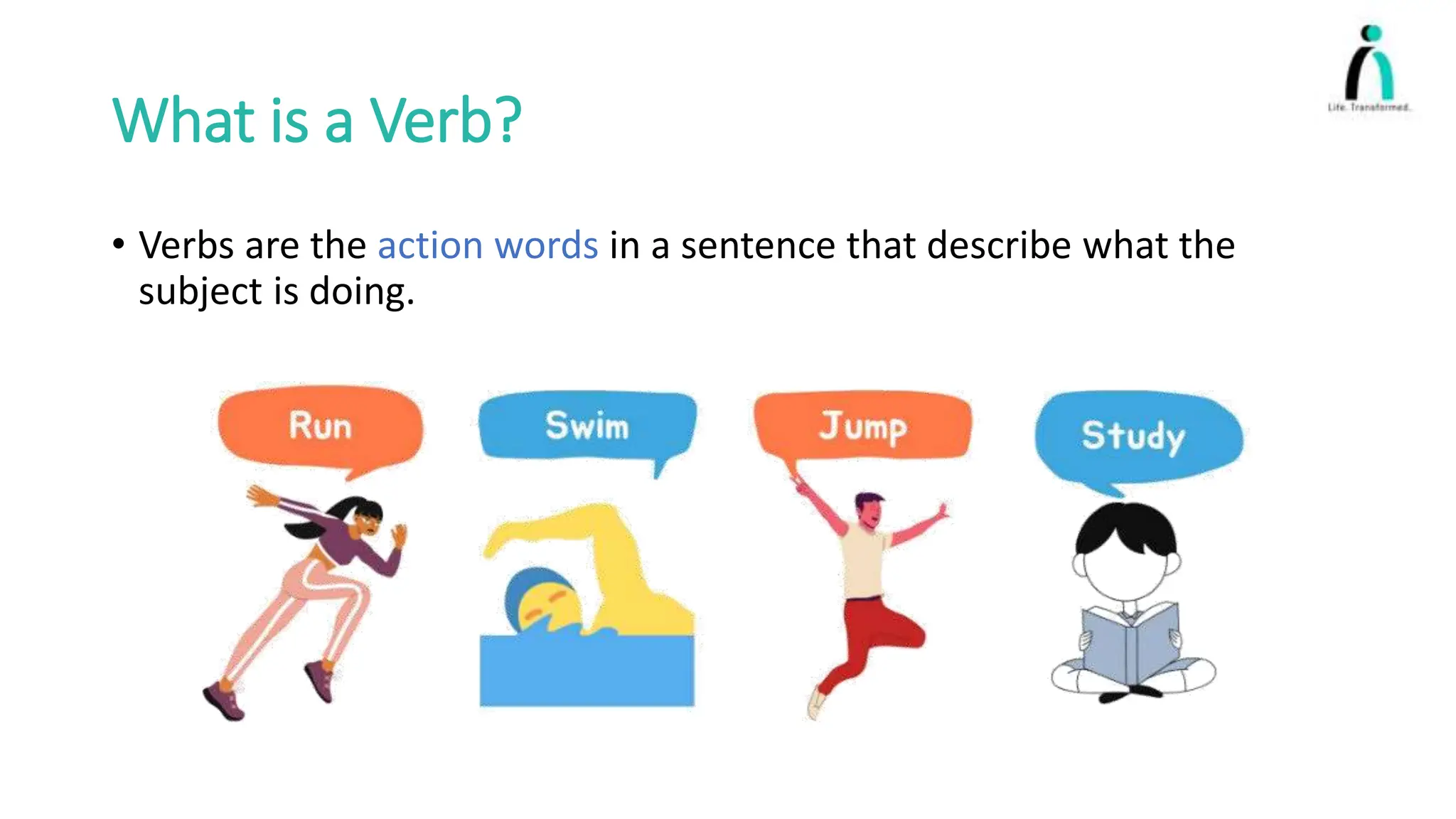
• Verbs are the action words in a sentence that describe what the
subject is doing.
Verb
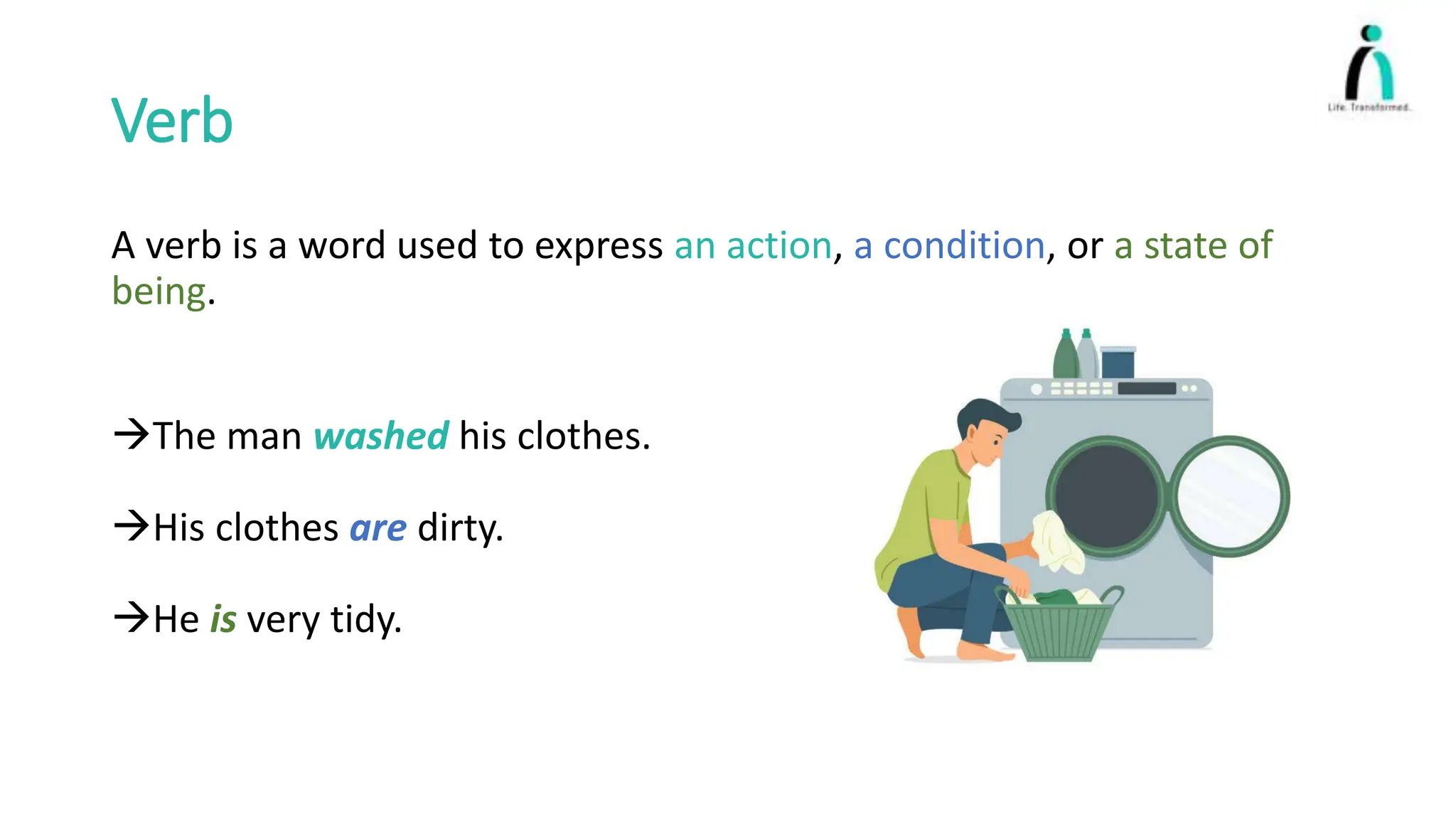
A verb is a word used to express an action, a condition, or a state of
being.
The man washed his clothes.
His clothes are dirty.
He is very tidy.
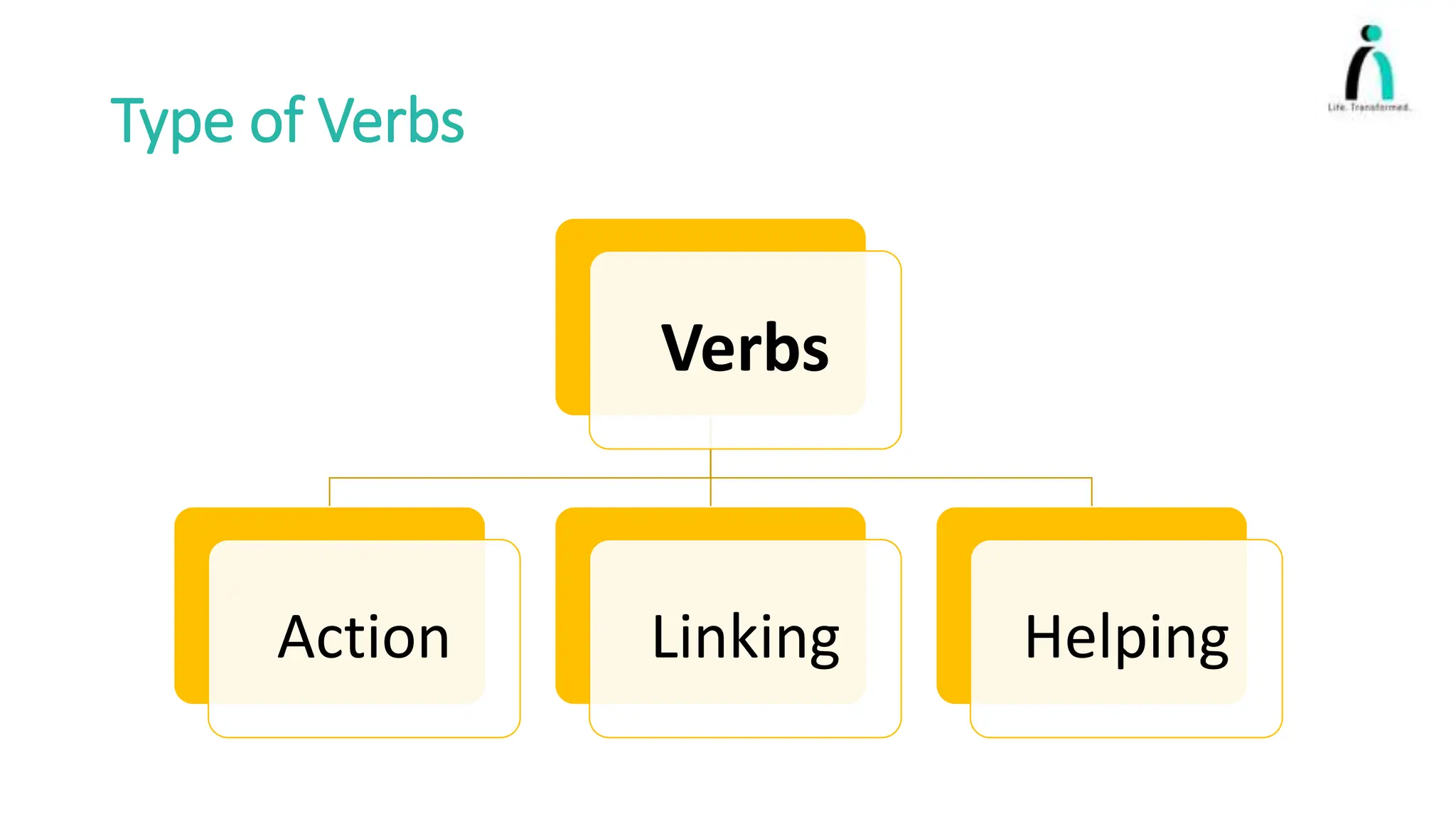
Type of Verbs
Verbs
Action Linking Helping
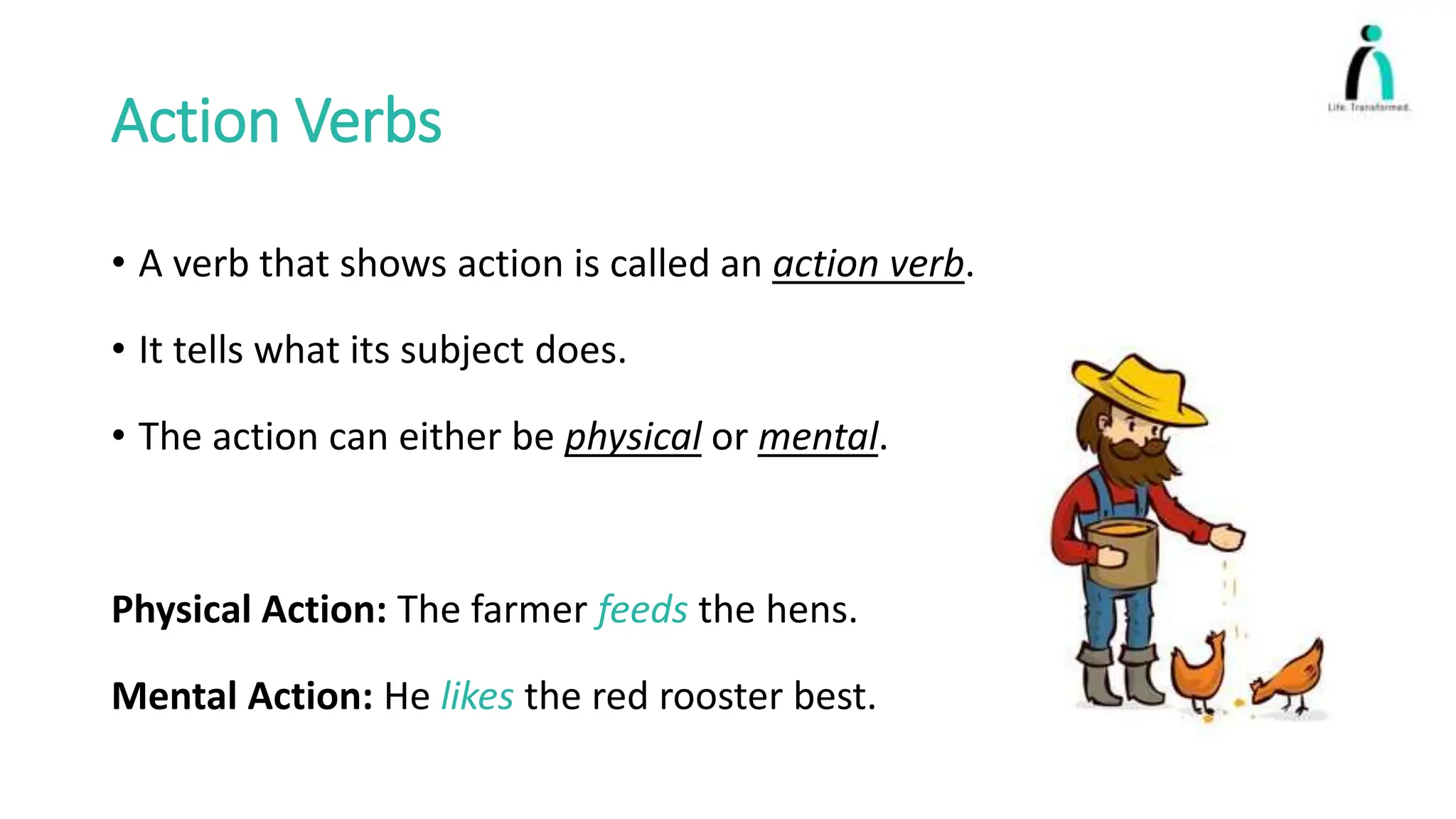
Action Verbs
• A verb that shows action is called an action verb.
• It tells what its subject does.
• The action can either be physical or mental.
Physical Action: The farmer feeds the hens.
Mental Action: He likes the red rooster best.
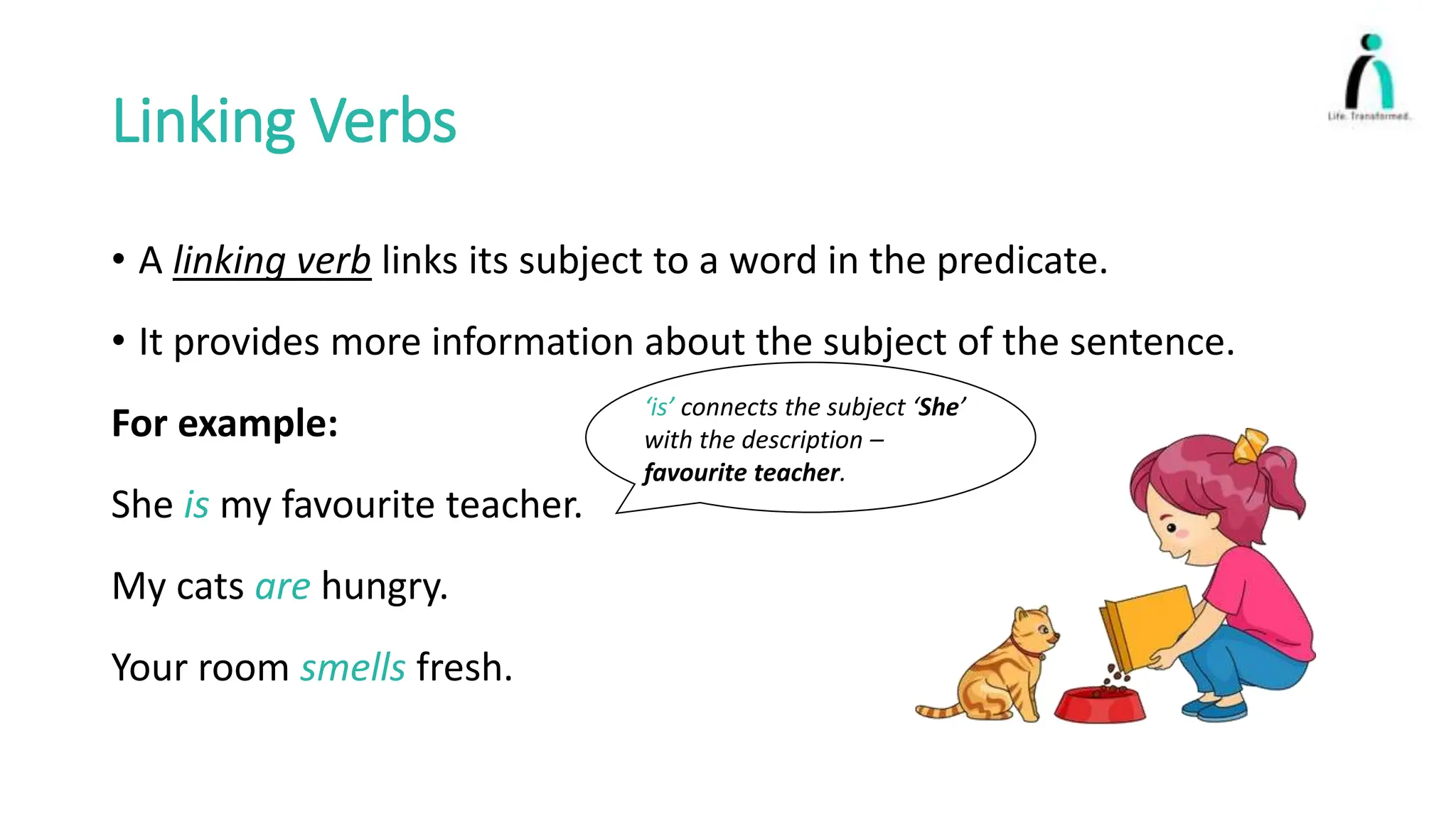
Linking Verbs
• A linking verb links its subject to a word in the predicate.
• It provides more information about the subject of the sentence.
For example:
She is my favourite teacher.
My cats are hungry.
Your room smells fresh.
‘is’ connects the subject ‘She’
with the description –
favourite teacher.
Linking Verbs
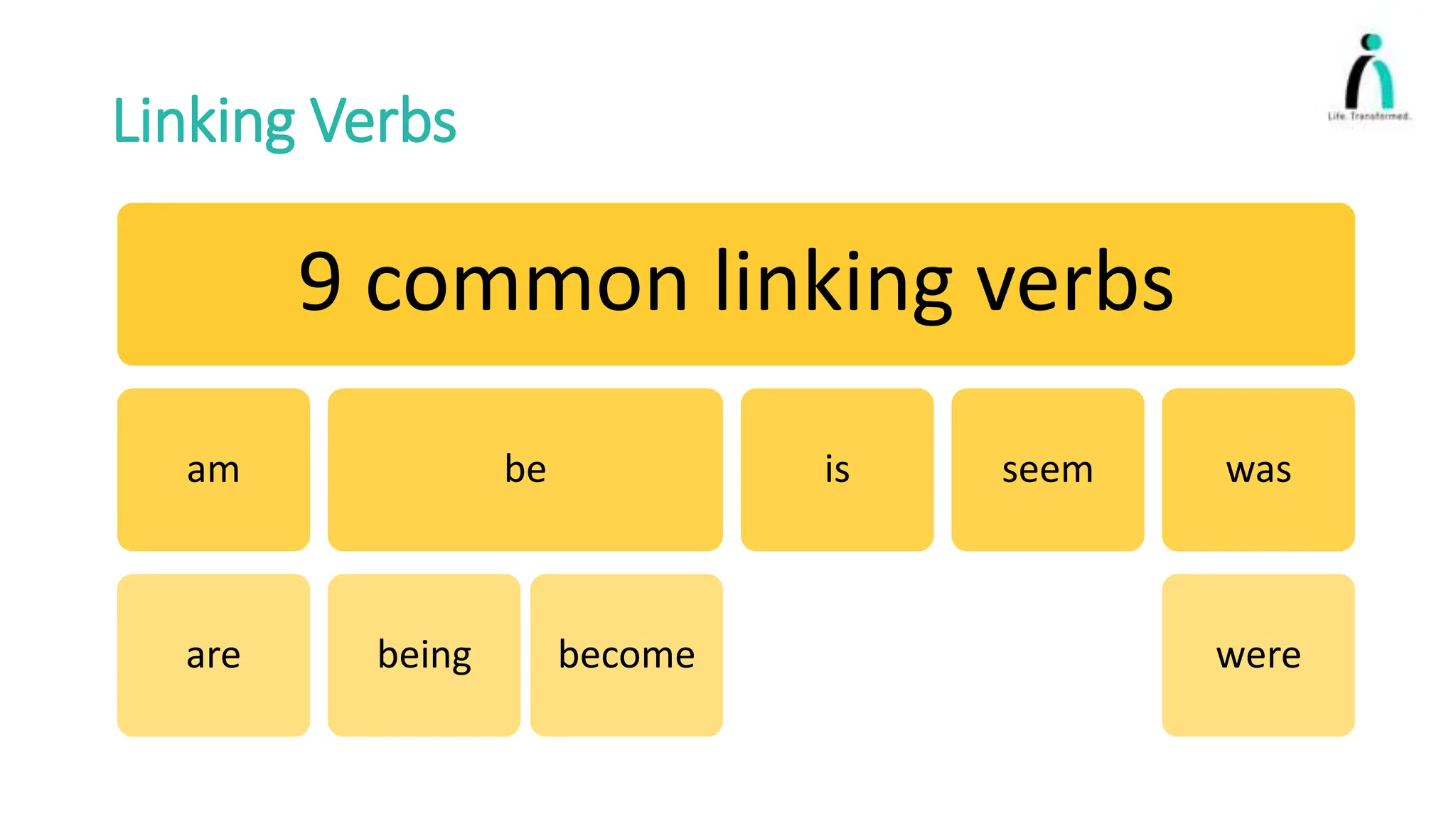
9 common linking verbs
am
are
be
being become
is seem was
were
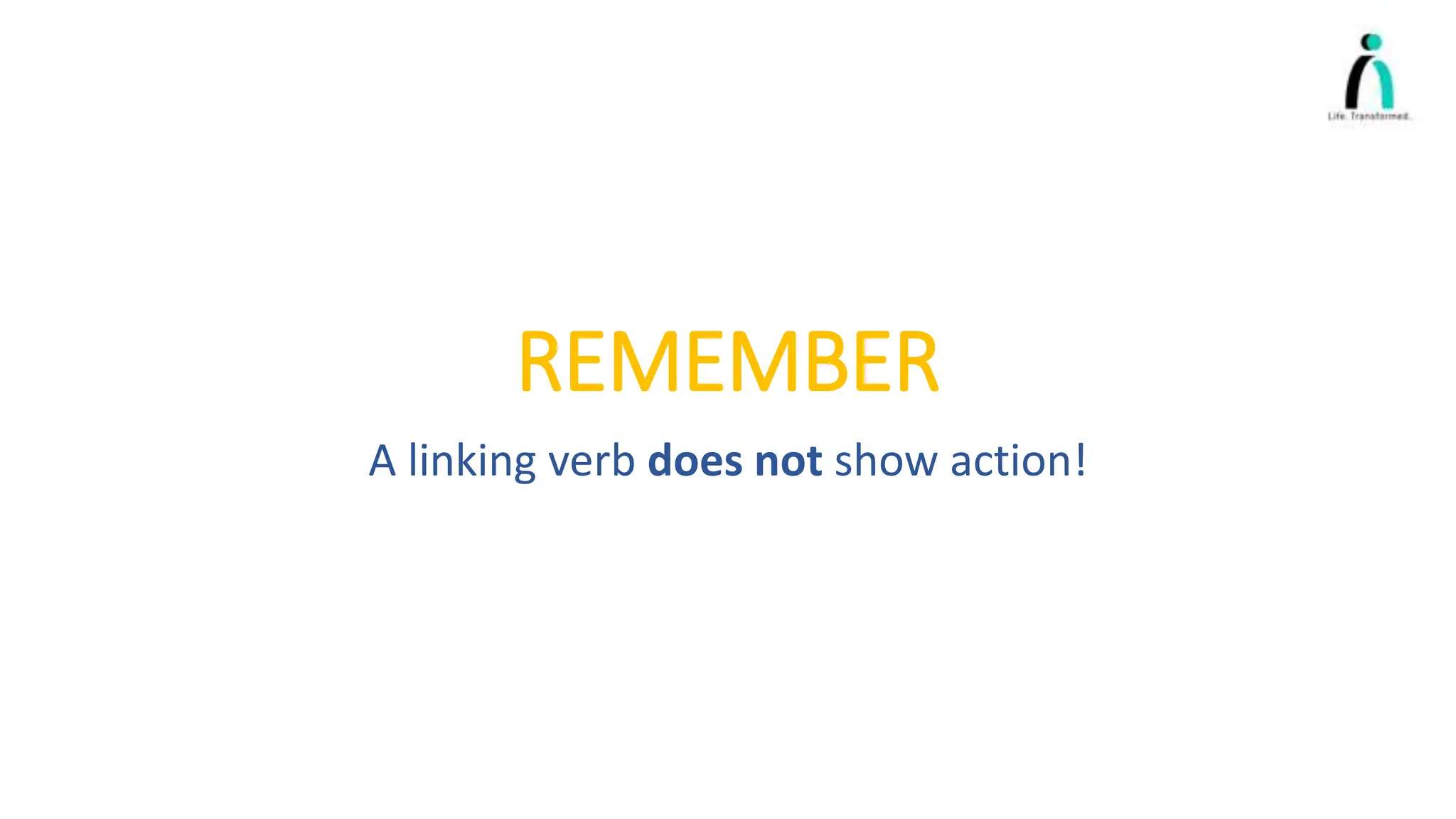
REMEMBER
A linking verb does not show action!
Helping Verbs
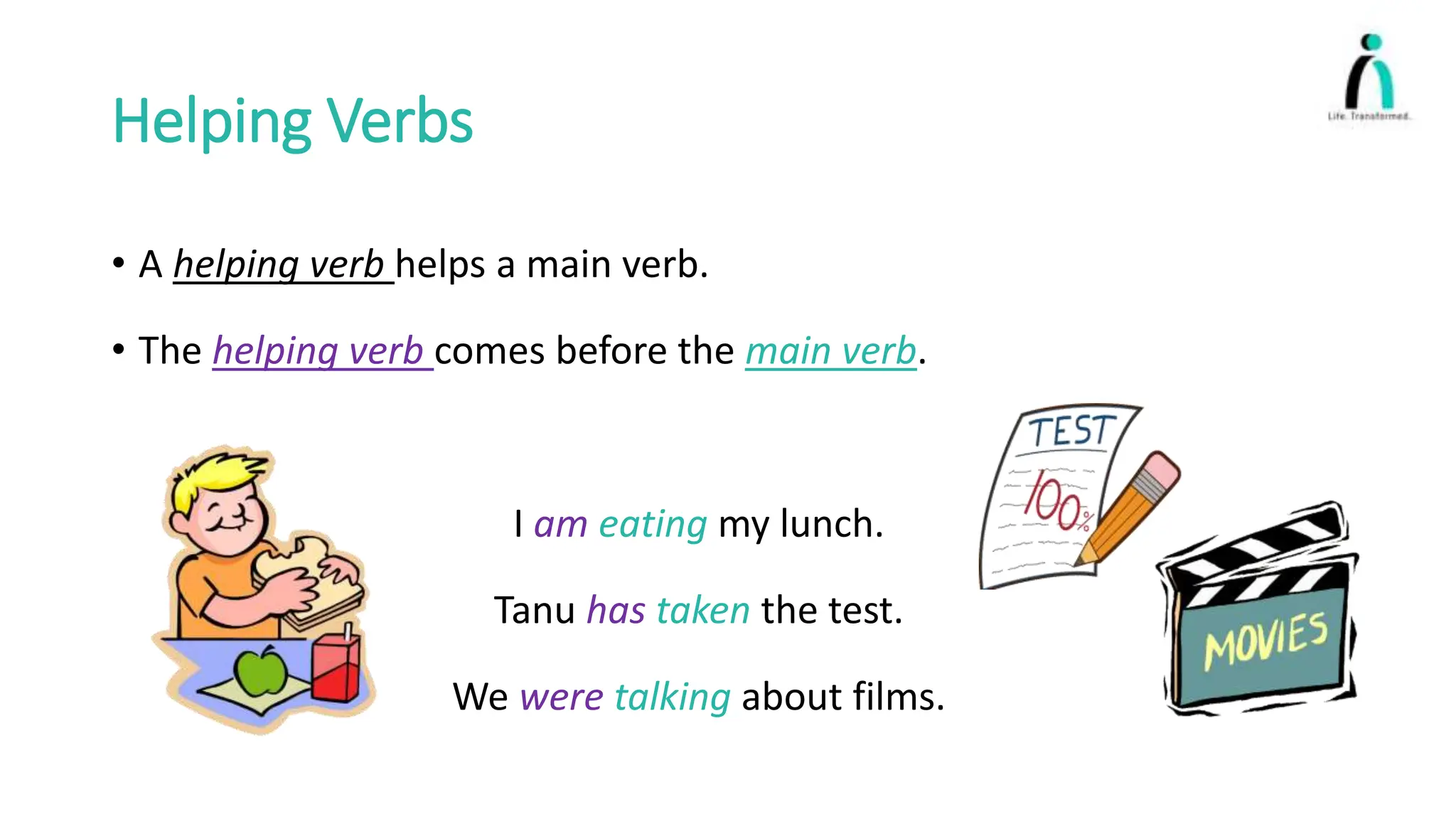
• A helping verb helps a main verb.
• The helping verb comes before the main verb.
I am eating my lunch.
Tanu has taken the test.
We were talking about films.
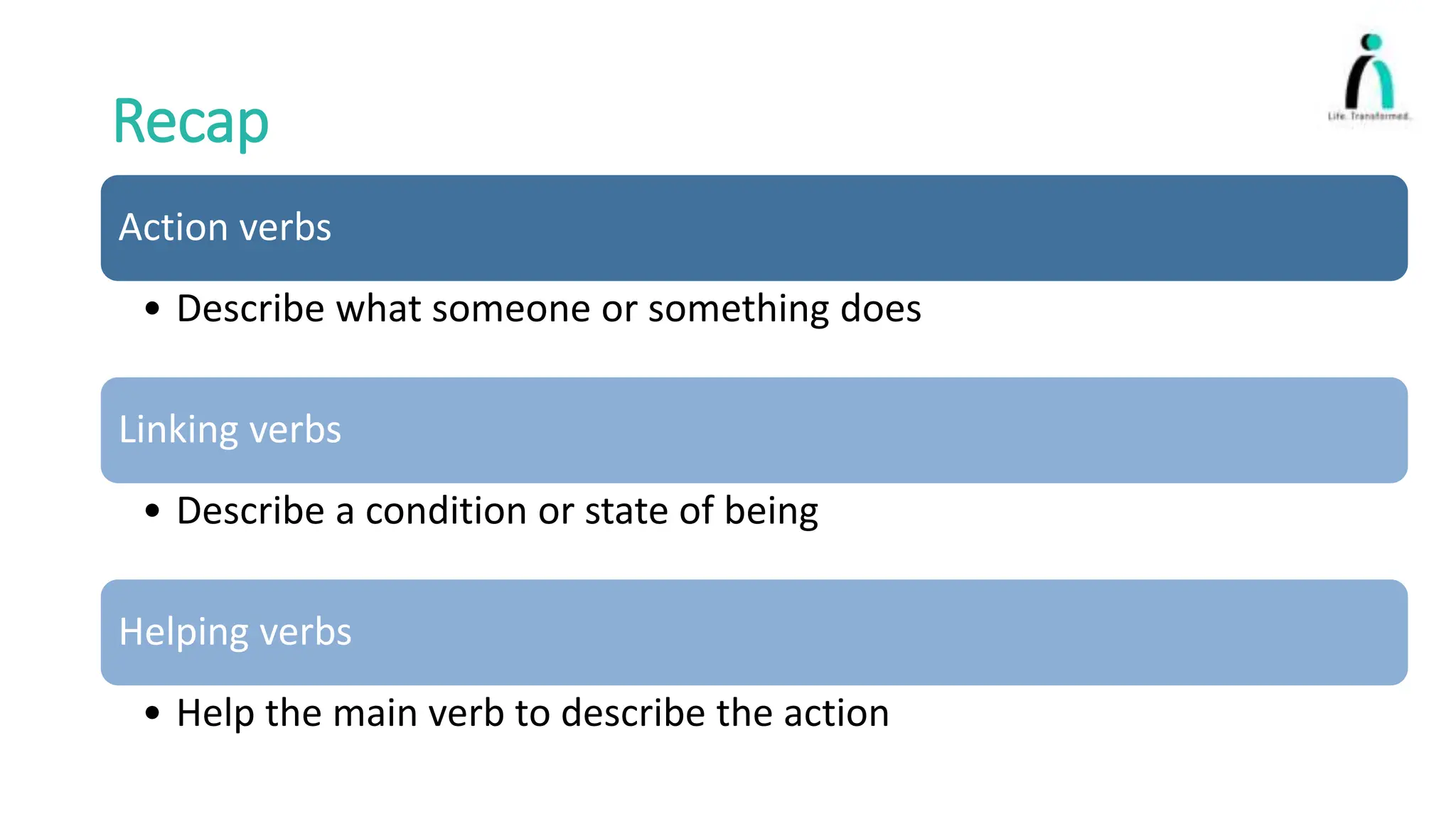
Recap
Action verbs
• Describe what someone or something does
Linking verbs
• Describe a condition or state of being
Helping verbs
• Help the main verb to describe the action
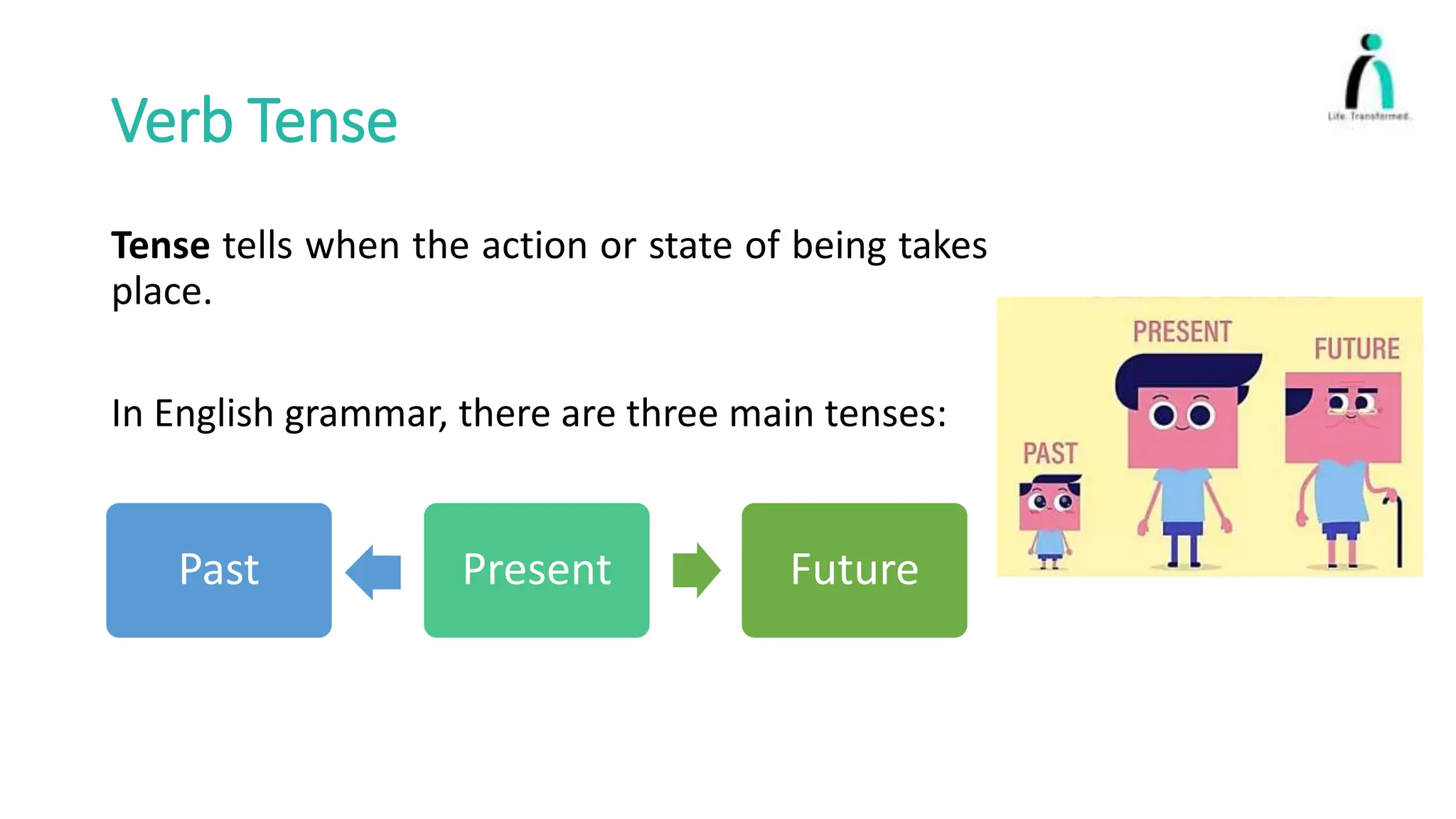
Verb Tense
Tense tells when the action or state of being takes
place.
In English grammar, there are three main tenses:
Past Present Future
Present Tense
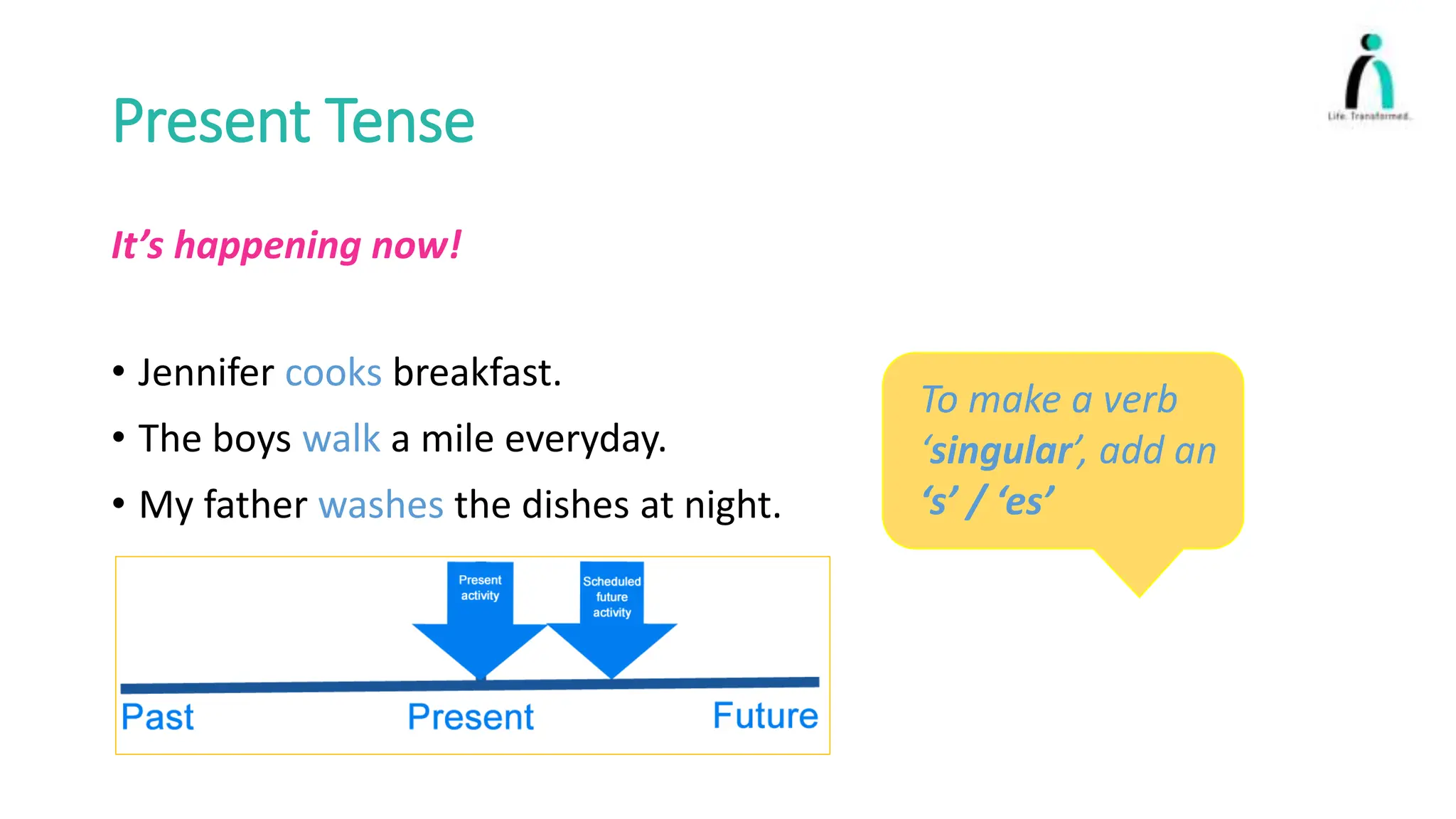
It’s happening now!
• Jennifer cooks breakfast.
• The boys walk a mile everyday.
• My father washes the dishes at night.
To make a verb
‘singular’, add an
‘s’ / ‘es’
Present Tense
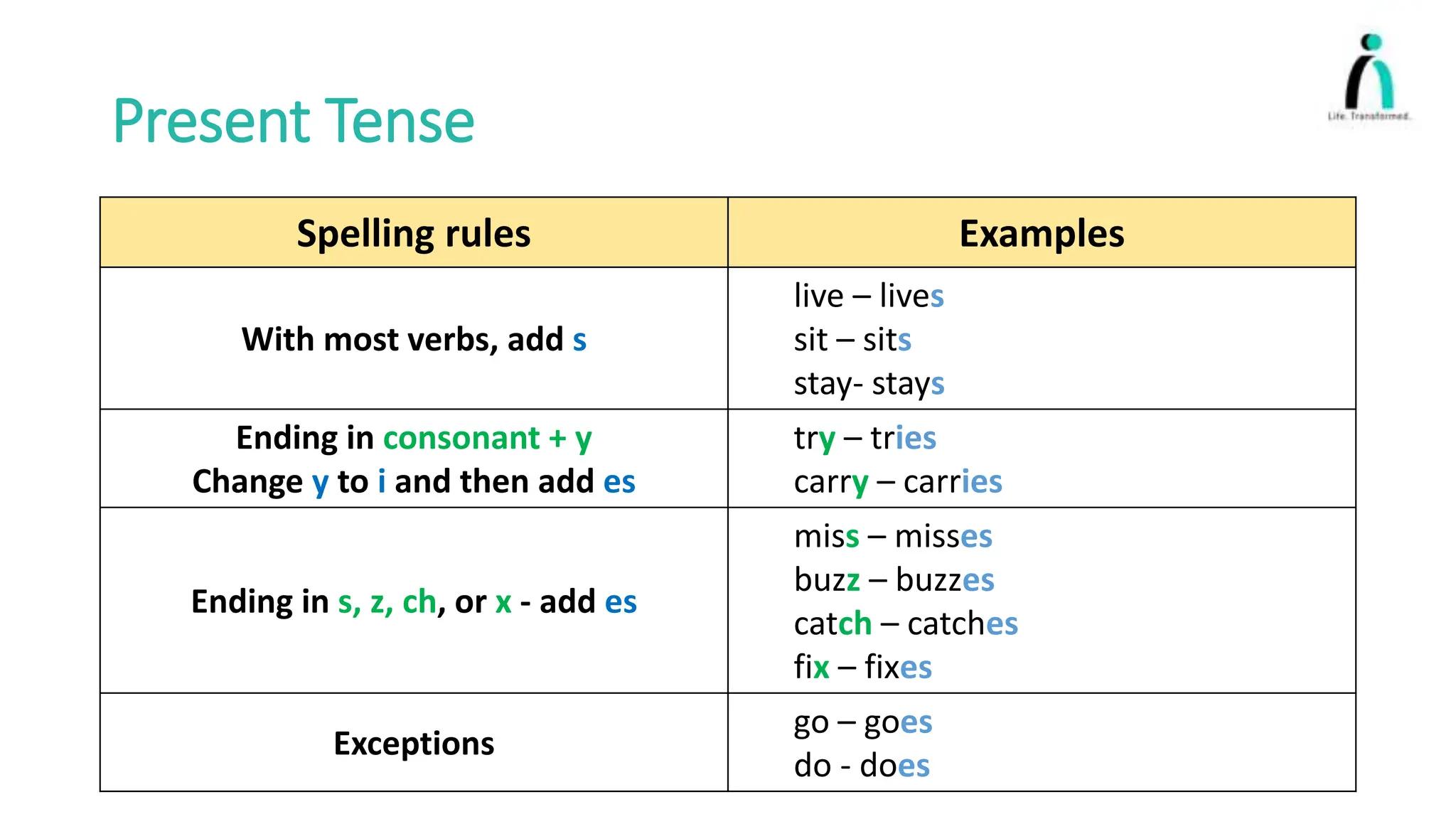
Spelling rules Examples
With most verbs, add s
live – lives
sit – sits
stay- stays
Ending in consonant + y
Change y to i and then add es
try – tries
carry – carries
Ending in s, z, ch, or x - add es
miss – misses
buzz – buzzes
catch – catches
fix – fixes
Exceptions
go – goes
do - does
Present Tense
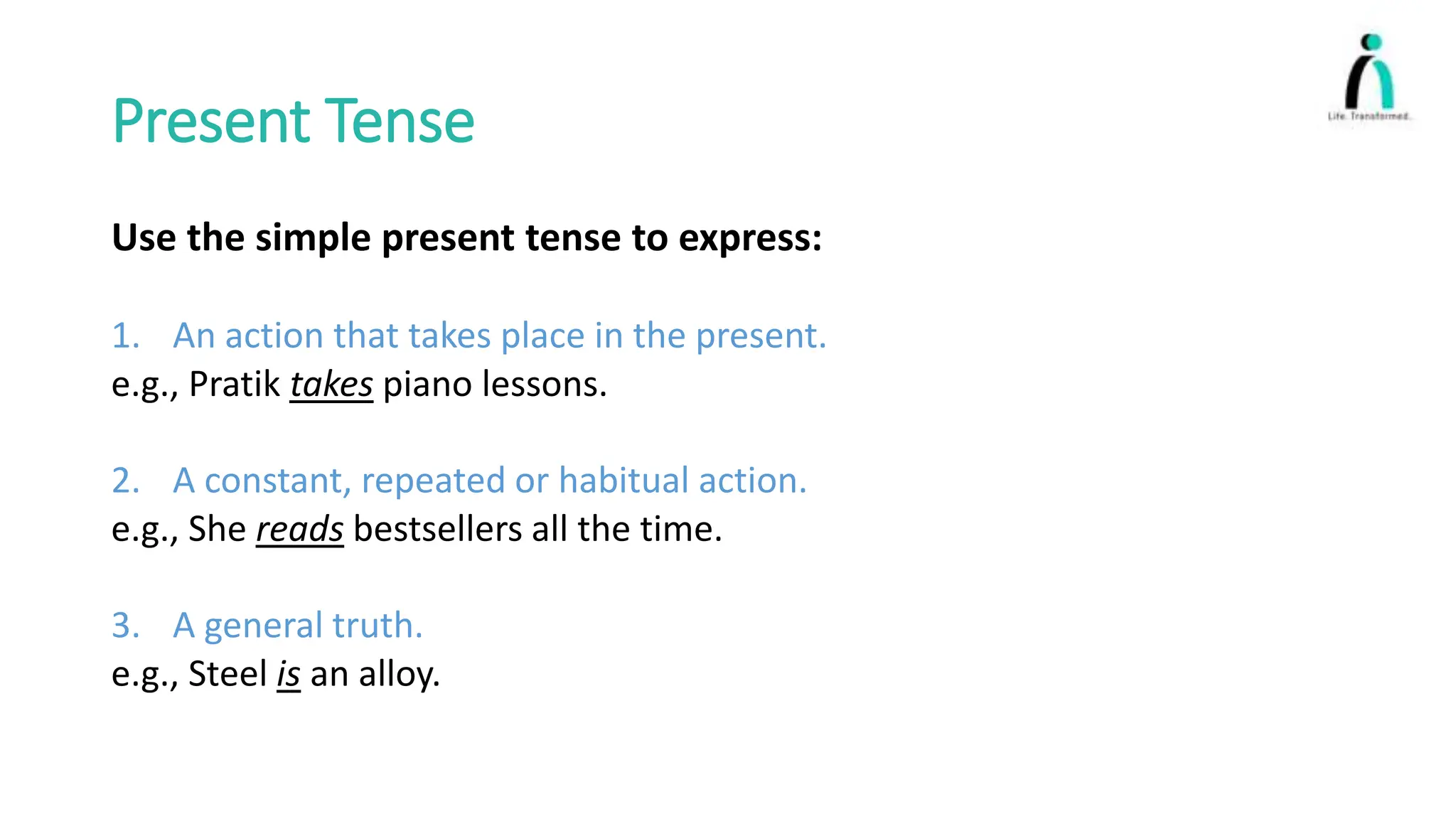
Use the simple present tense to express:
1. An action that takes place in the present.
e.g., Pratik takes piano lessons.
2. A constant, repeated or habitual action.
e.g., She reads bestsellers all the time.
3. A general truth.
e.g., Steel is an alloy.
Present Tense
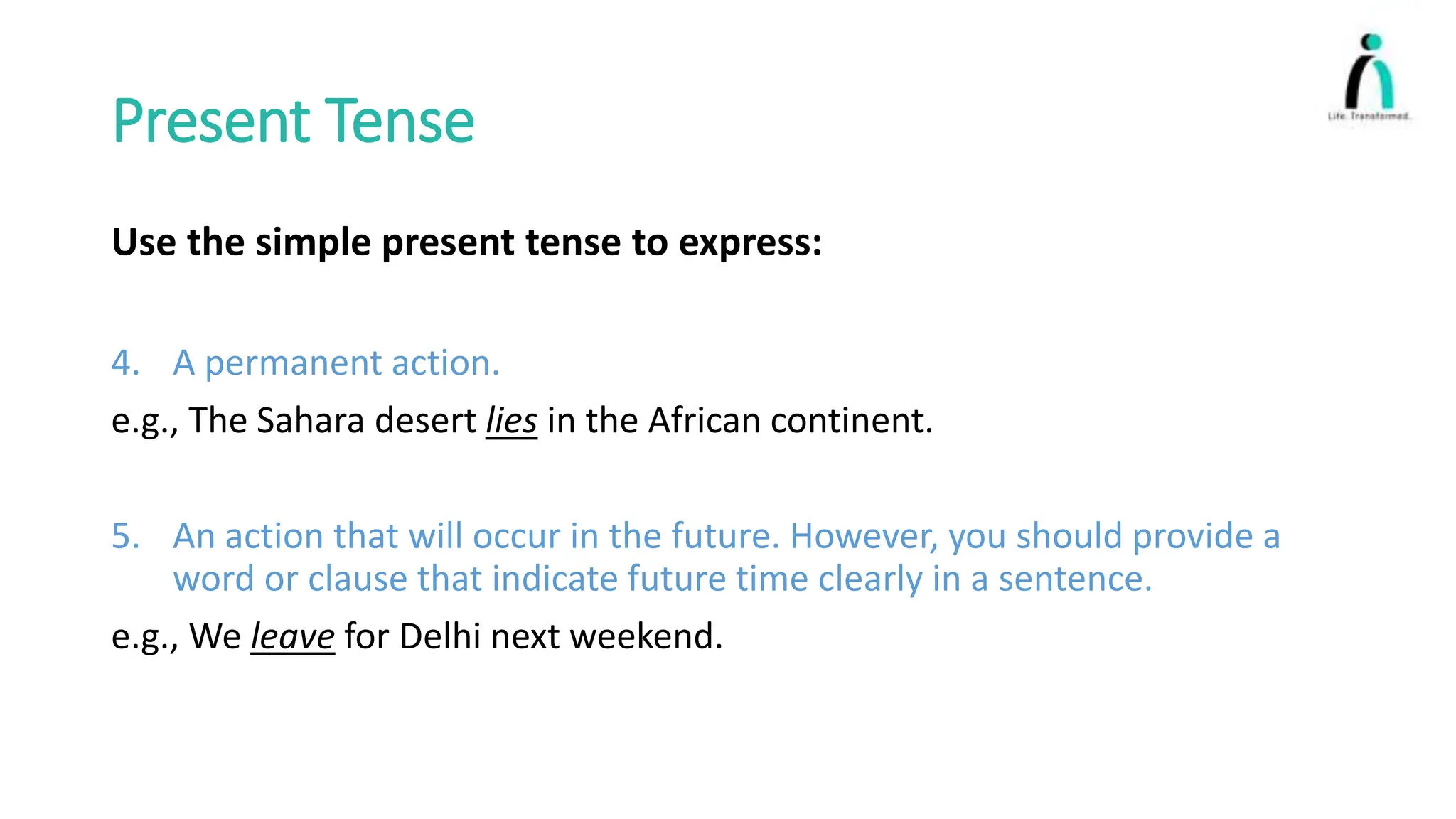
Use the simple present tense to express:
4. A permanent action.
e.g., The Sahara desert lies in the African continent.
5. An action that will occur in the future. However, you should provide a
word or clause that indicate future time clearly in a sentence.
e.g., We leave for Delhi next weekend.
Past Tense
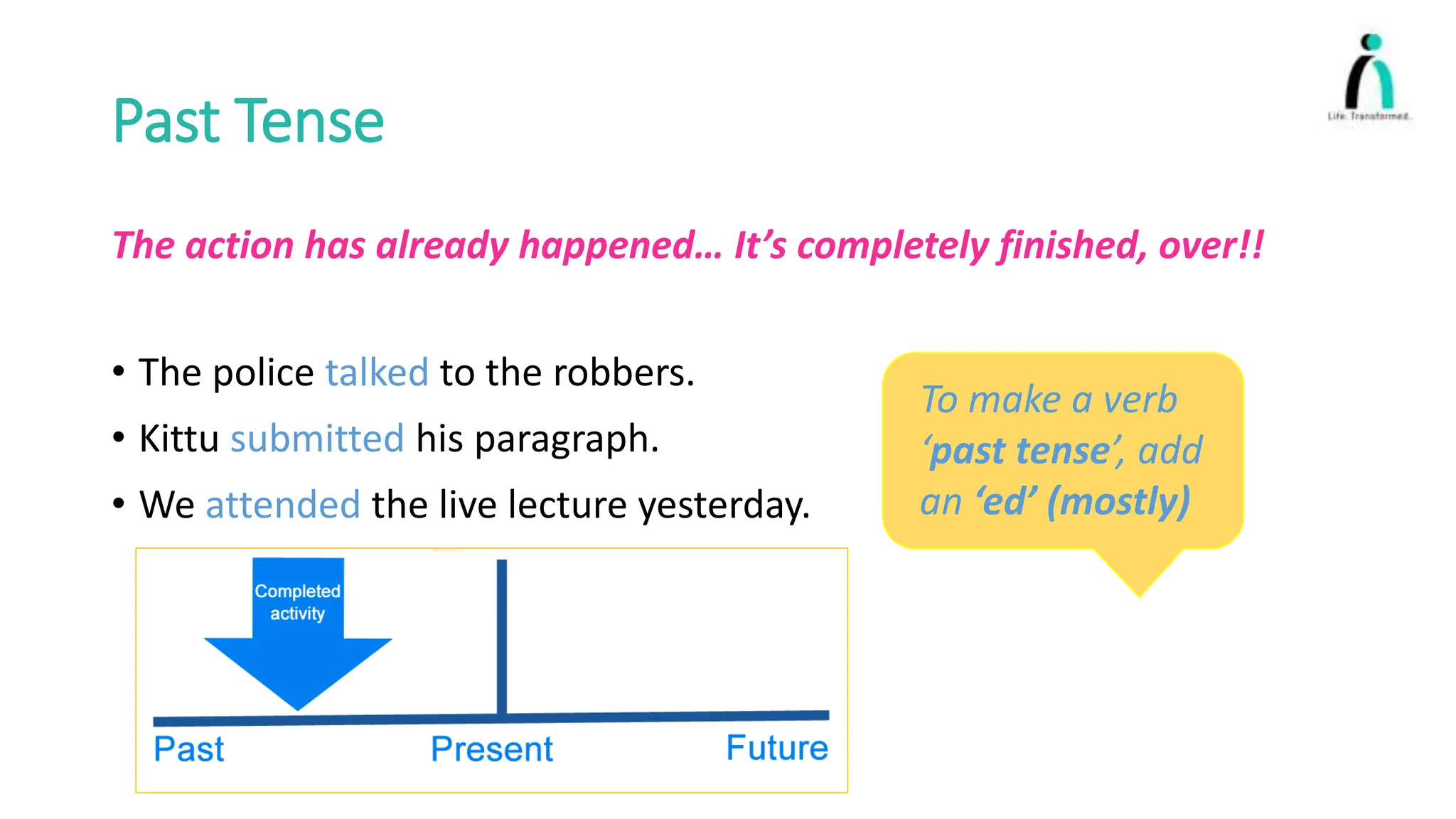
The action has already happened… It’s completely finished, over!!
• The police talked to the robbers.
• Kittu submitted his paragraph.
• We attended the live lecture yesterday.
To make a verb
‘past tense’, add
an ‘ed’ (mostly)
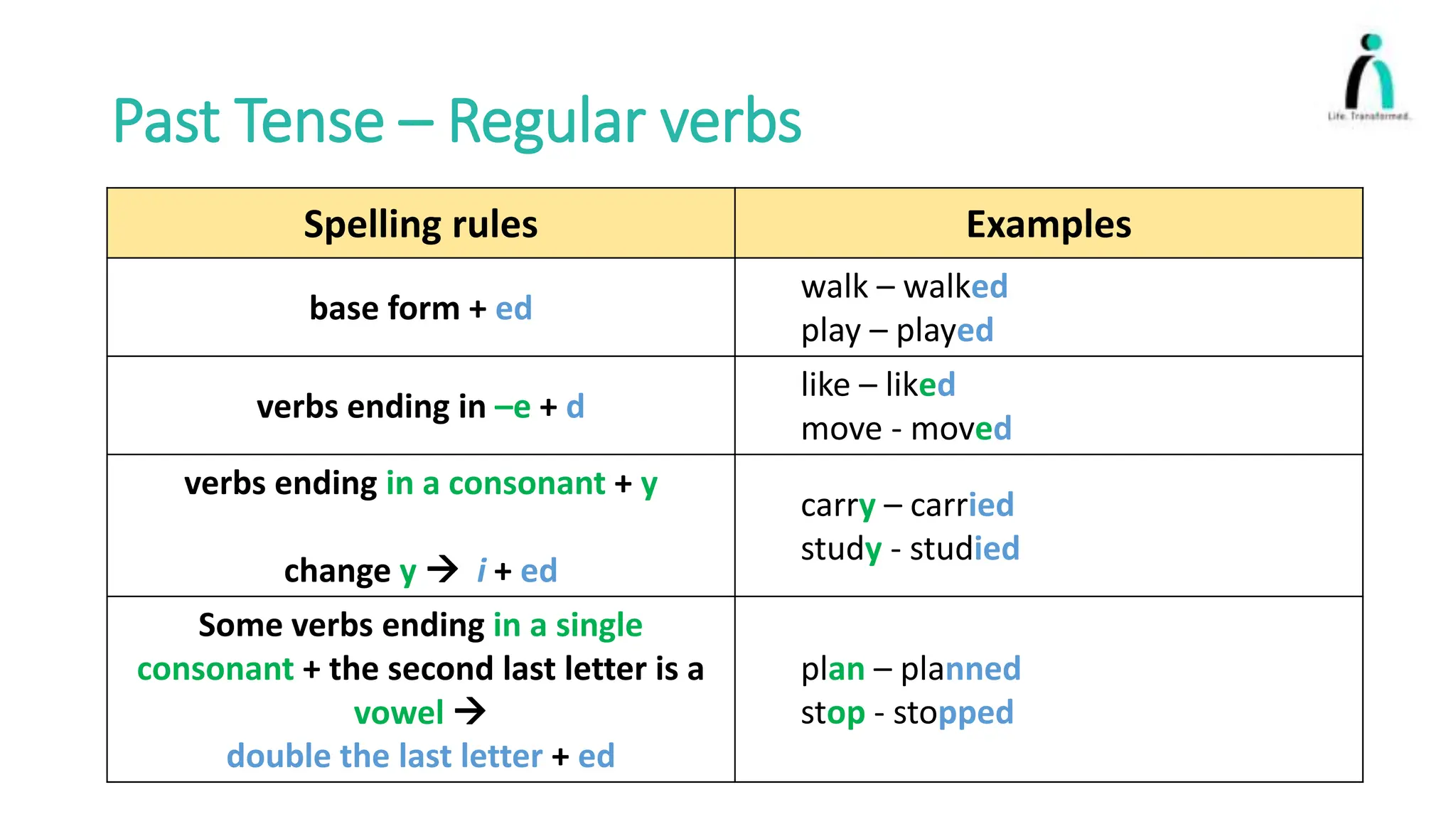
Past Tense – Regular verbs
Spelling rules Examples
base form + ed
walk – walked
play – played
verbs ending in –e + d
like – liked
move - moved
verbs ending in a consonant + y
change y  i + ed
carry – carried
study - studied
Some verbs ending in a single
consonant + the second last letter is a
vowel 
double the last letter + ed
plan – planned
stop - stopped
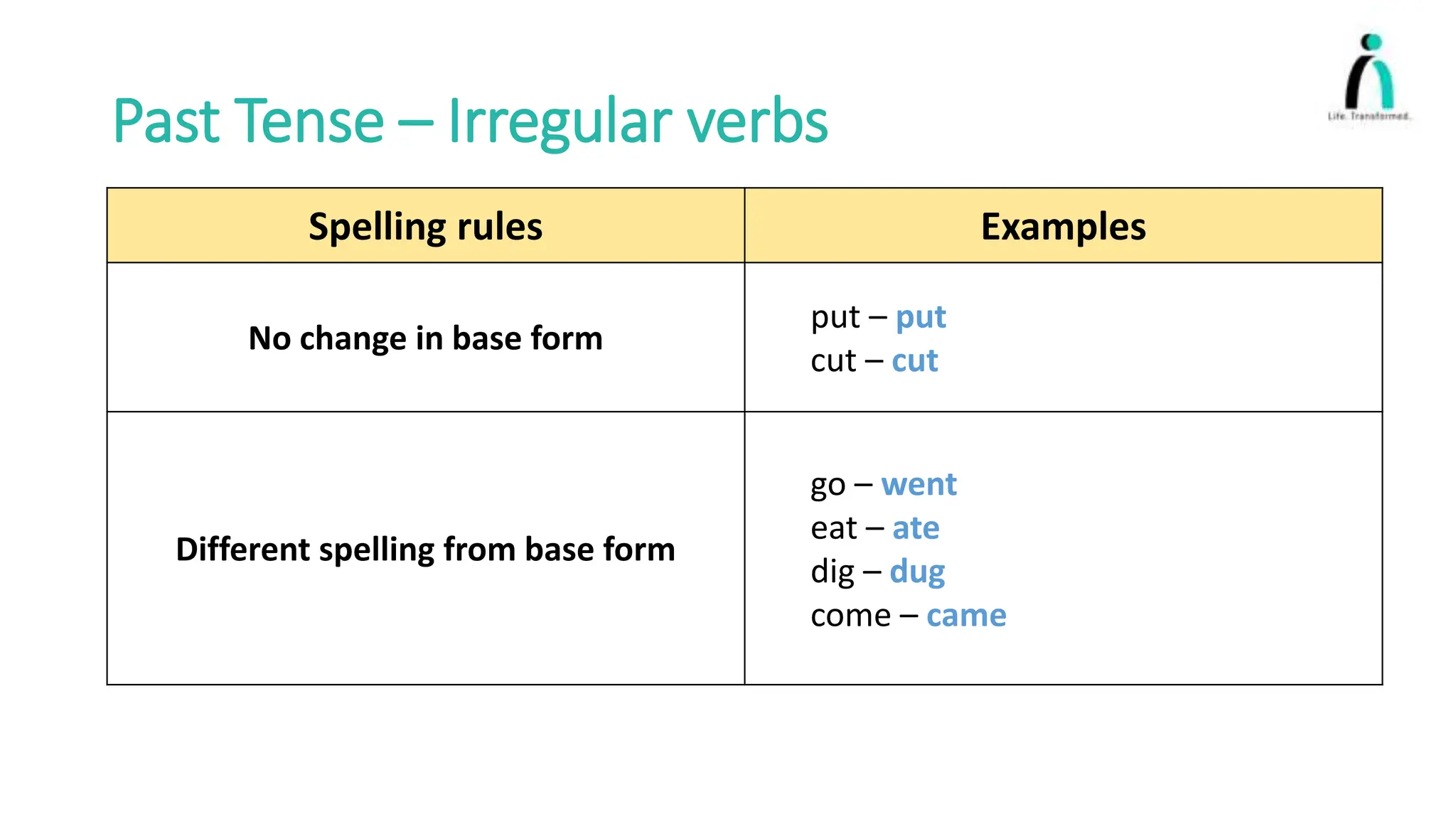
Past Tense – Irregular verbs
Spelling rules Examples
No change in base form
put – put
cut – cut
Different spelling from base form
go – went
eat – ate
dig – dug
come – came
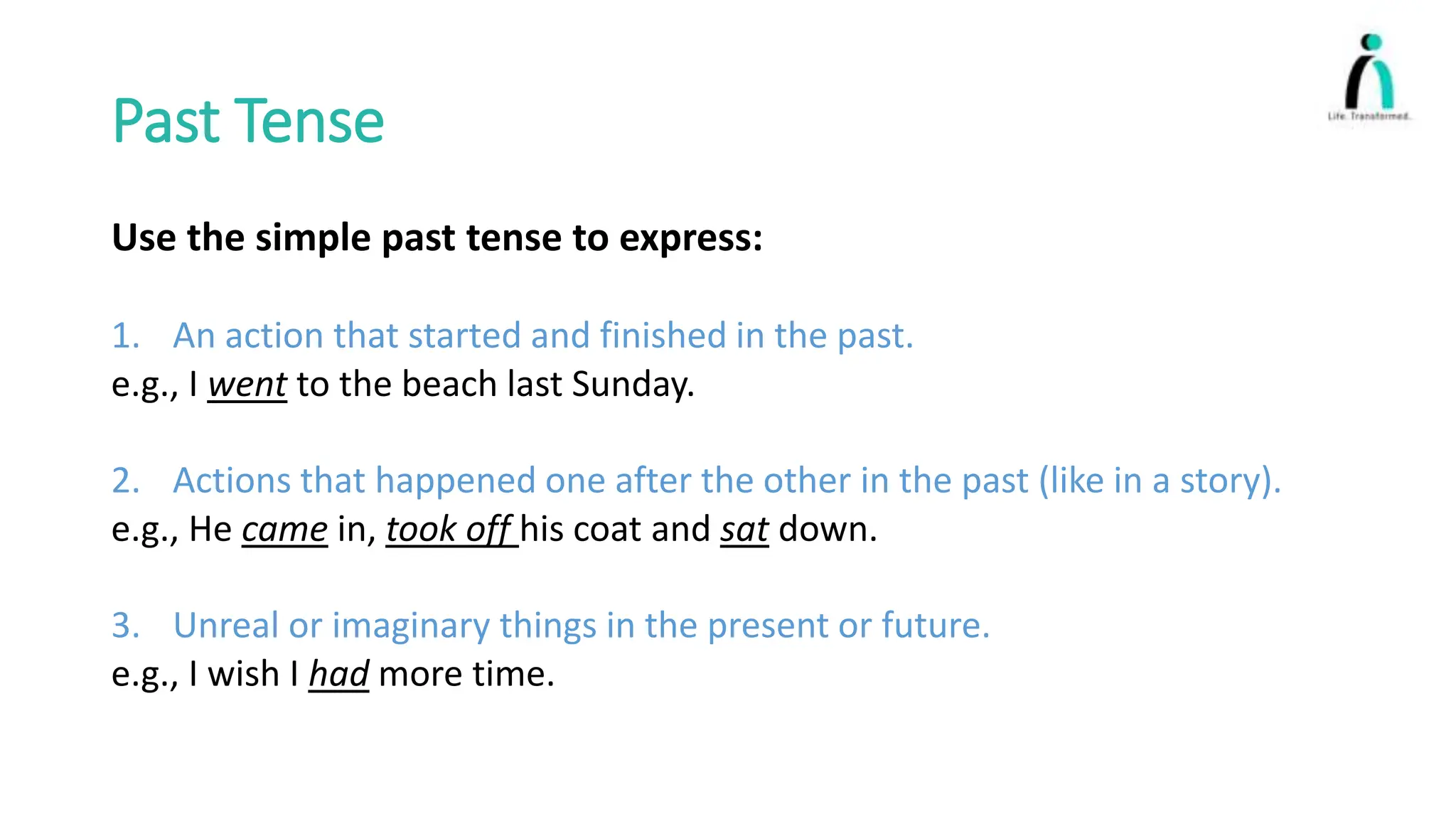
Past Tense
Use the simple past tense to express:
1. An action that started and finished in the past.
e.g., I went to the beach last Sunday.
2. Actions that happened one after the other in the past (like in a story).
e.g., He came in, took off his coat and sat down.
3. Unreal or imaginary things in the present or future.
e.g., I wish I had more time.
Future Tense
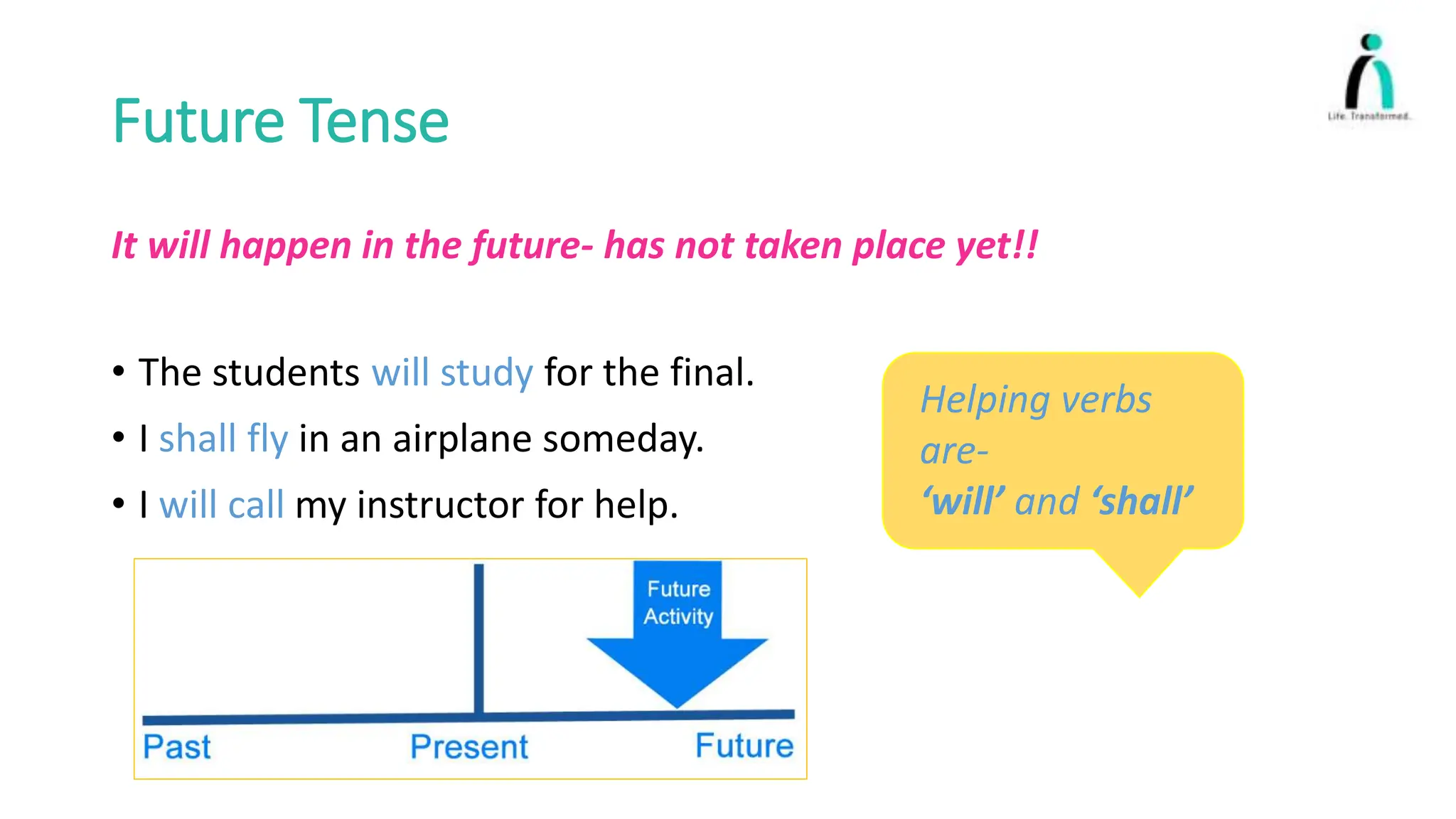
It will happen in the future- has not taken place yet!!
• The students will study for the final.
• I shall fly in an airplane someday.
• I will call my instructor for help.
Helping verbs
are-
‘will’ and ‘shall’
Future Tense
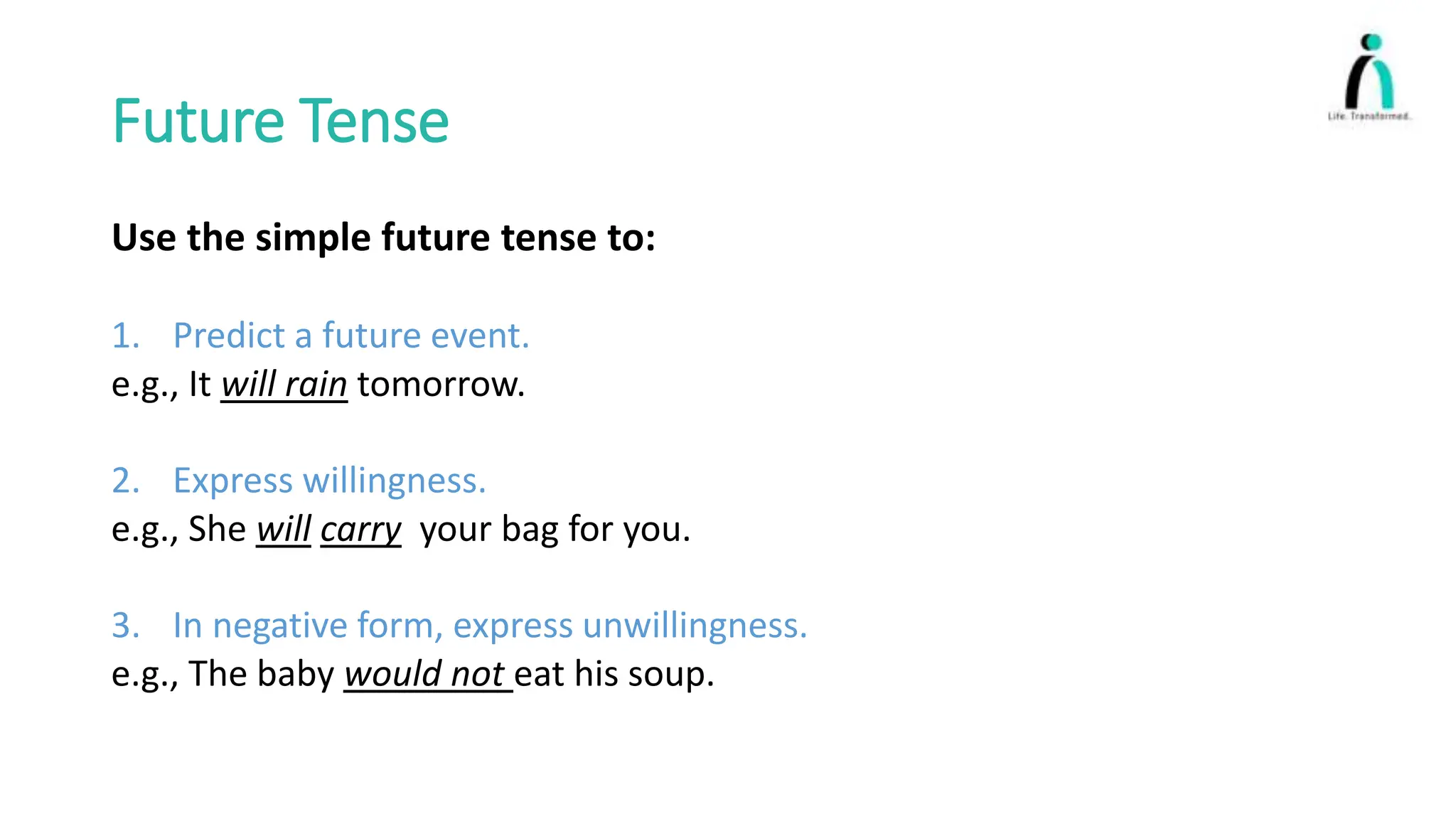
Use the simple future tense to:
1. Predict a future event.
e.g., It will rain tomorrow.
2. Express willingness.
e.g., She will carry your bag for you.
3. In negative form, express unwillingness.
e.g., The baby would not eat his soup.
Future Tense
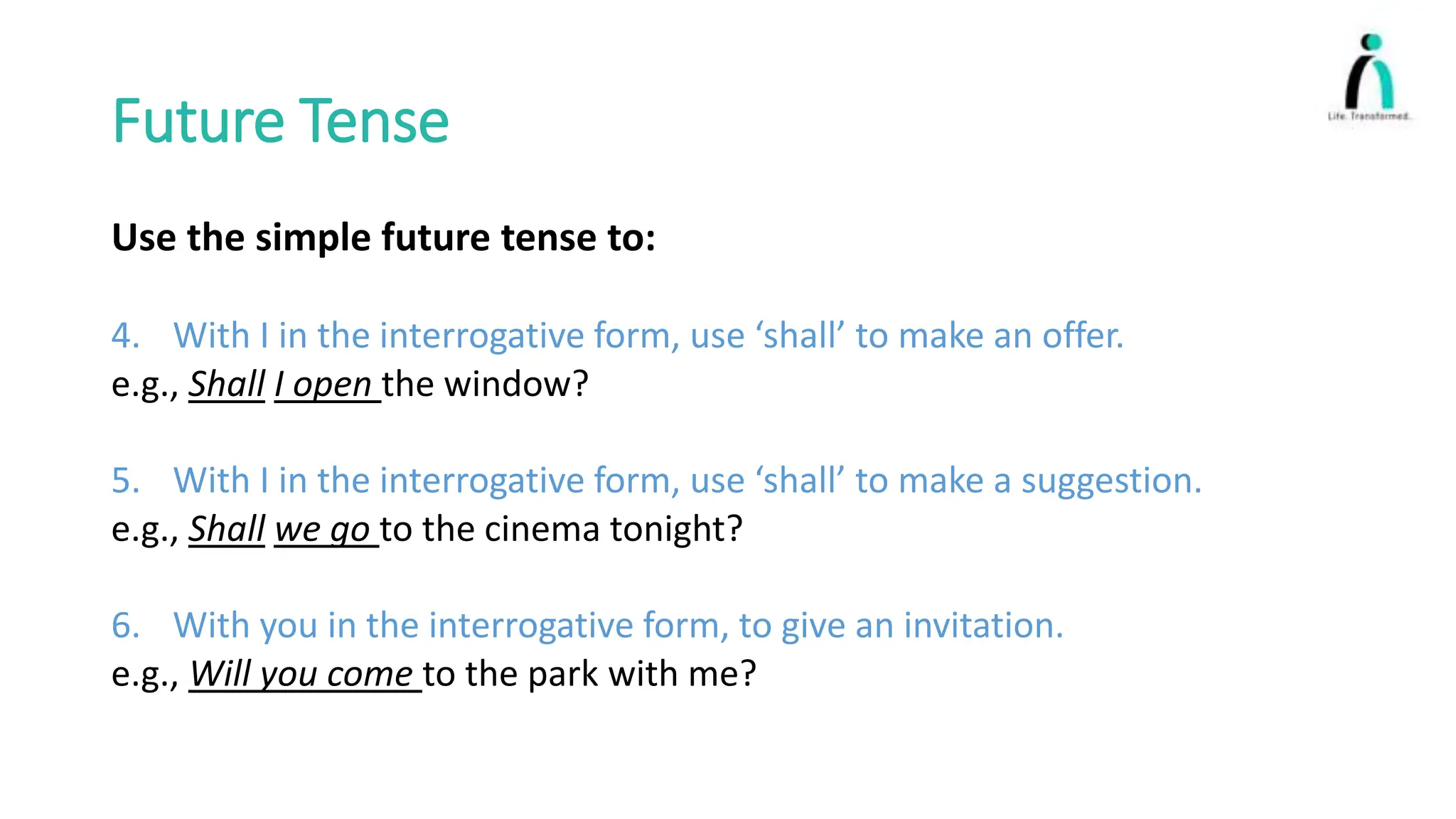
Use the simple future tense to:
4. With I in the interrogative form, use ‘shall’ to make an offer.
e.g., Shall I open the window?
5. With I in the interrogative form, use ‘shall’ to make a suggestion.
e.g., Shall we go to the cinema tonight?
6. With you in the interrogative form, to give an invitation.
e.g., Will you come to the park with me?
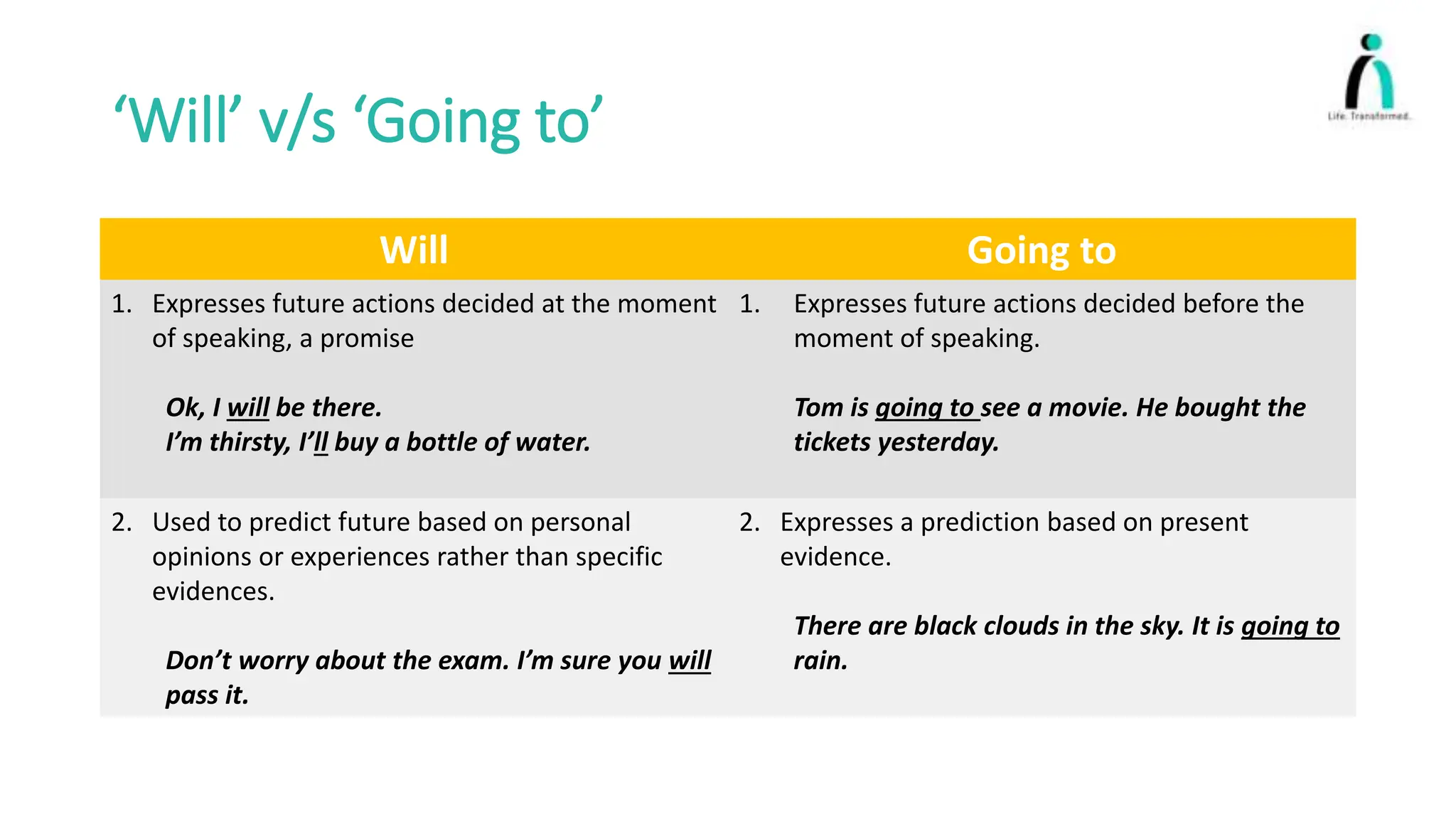
‘Will’ v/s ‘Going to’
Will Going to
1. Expresses future actions decided at the moment
of speaking, a promise
Ok, I will be there.
I’m thirsty, I’ll buy a bottle of water.
1. Expresses future actions decided before the
moment of speaking.
Tom is going to see a movie. He bought the
tickets yesterday.
2. Used to predict future based on personal
opinions or experiences rather than specific
evidences.
Don’t worry about the exam. I’m sure you will
pass it.
2. Expresses a prediction based on present
evidence.
There are black clouds in the sky. It is going to
rain.
Recap
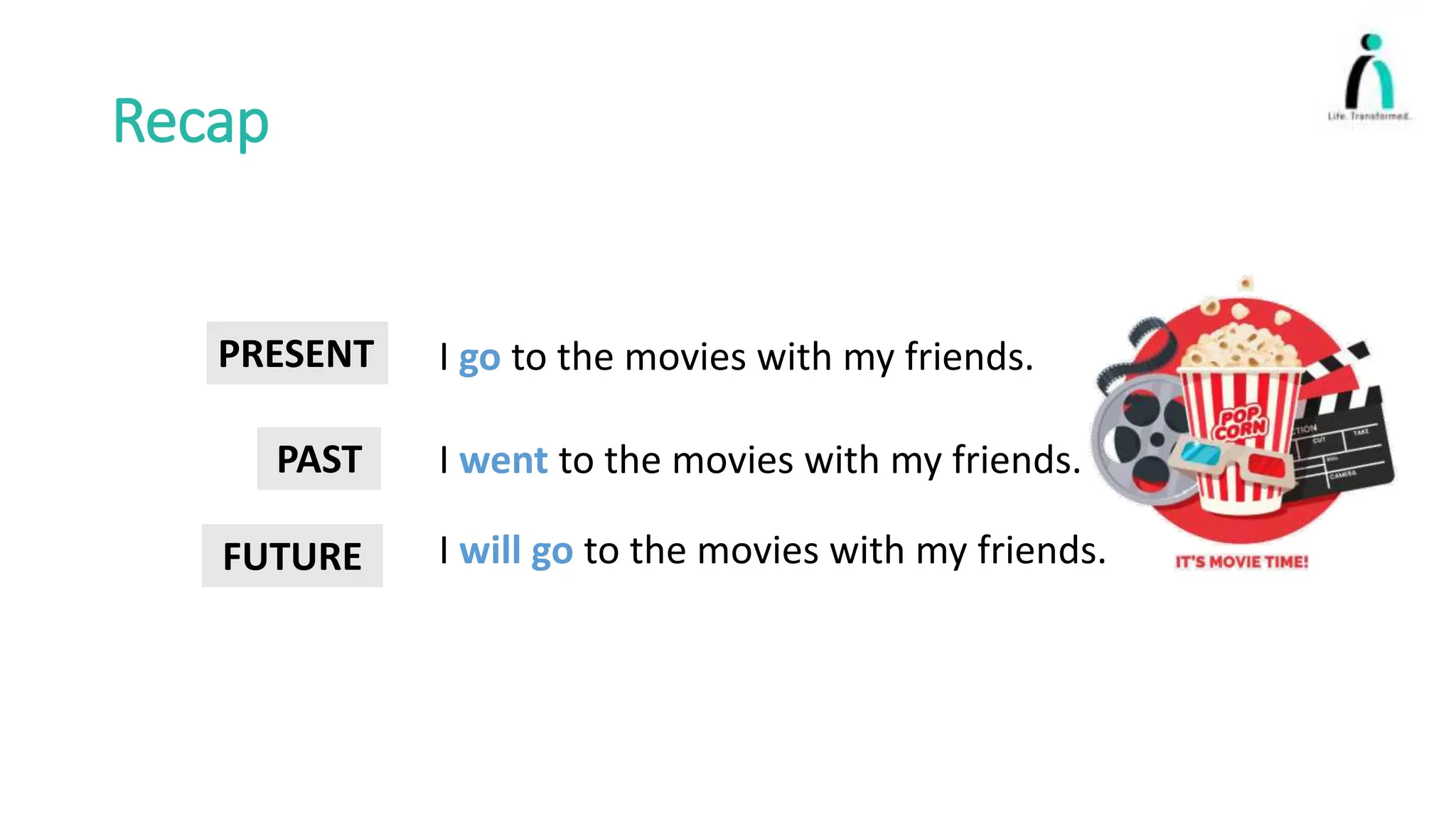
I go to the movies with my friends.
I went to the movies with my friends.
I will go to the movies with my friends.
PRESENT
PAST
FUTURE
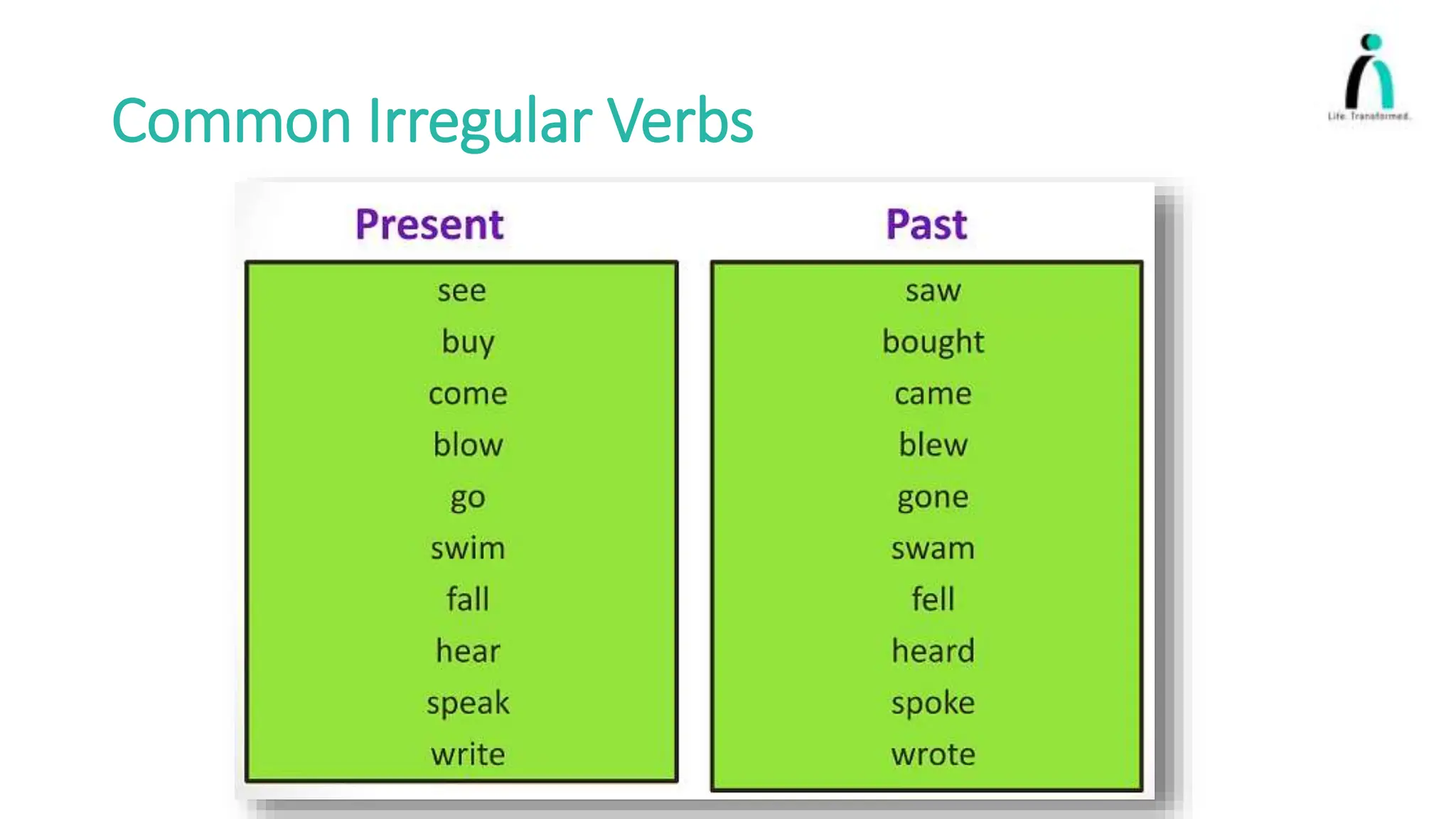
Common Irregular Verbs
Remember
When writing, stay in the same tense throughout the document.
Let’s Practice
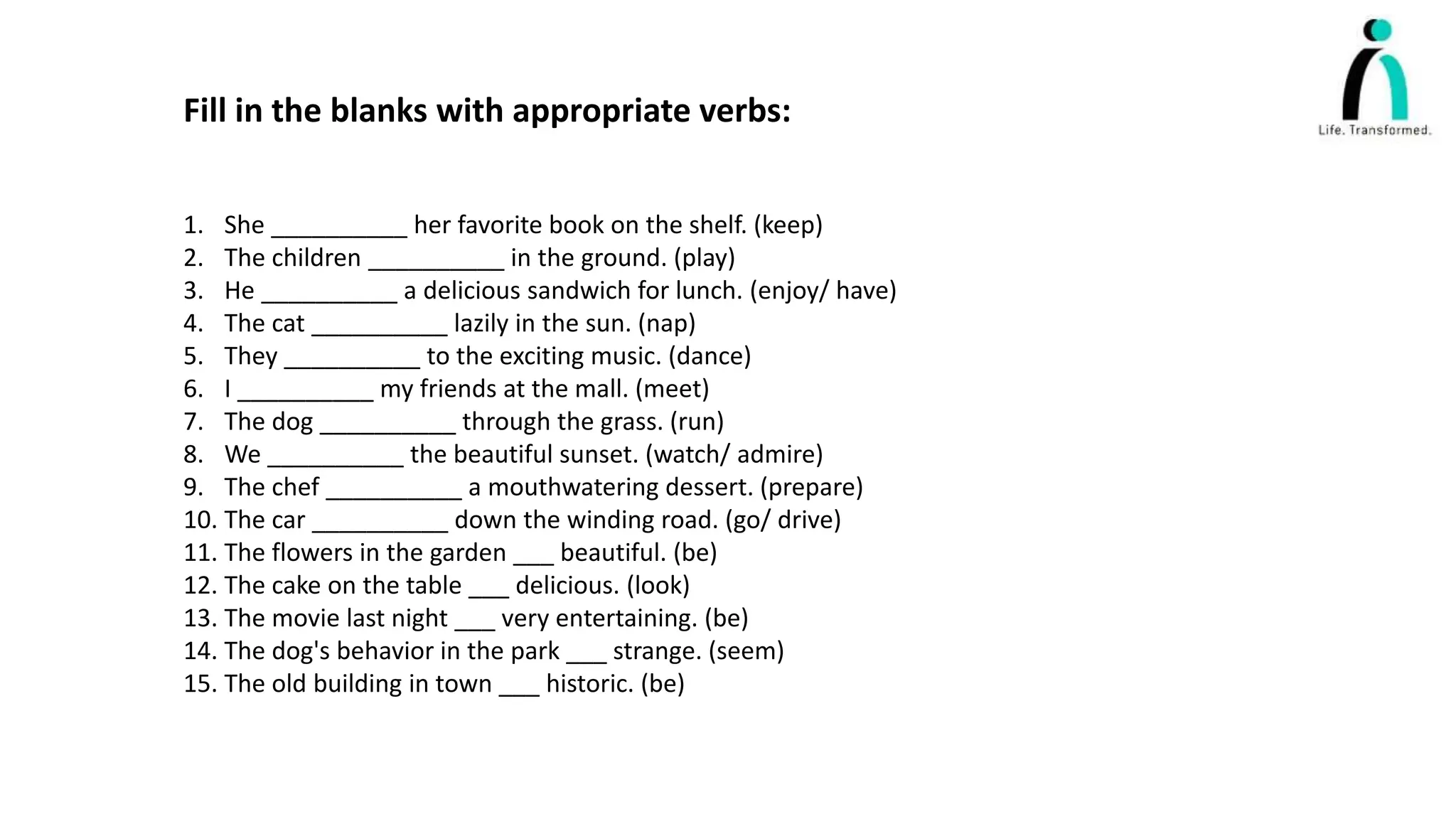
Fill in the blanks with appropriate verbs:
1. She __________ her favorite book on the shelf. (keep)
2. The children __________ in the ground. (play)
3. He __________ a delicious sandwich for lunch. (enjoy/ have)
4. The cat __________ lazily in the sun. (nap)
5. They __________ to the exciting music. (dance)
6. I __________ my friends at the mall. (meet)
7. The dog __________ through the grass. (run)
8. We __________ the beautiful sunset. (watch/ admire)
9. The chef __________ a mouthwatering dessert. (prepare)
10. The car __________ down the winding road. (go/ drive)
11. The flowers in the garden ___ beautiful. (be)
12. The cake on the table ___ delicious. (look)
13. The movie last night ___ very entertaining. (be)
14. The dog's behavior in the park ___ strange. (seem)
15. The old building in town ___ historic. (be)
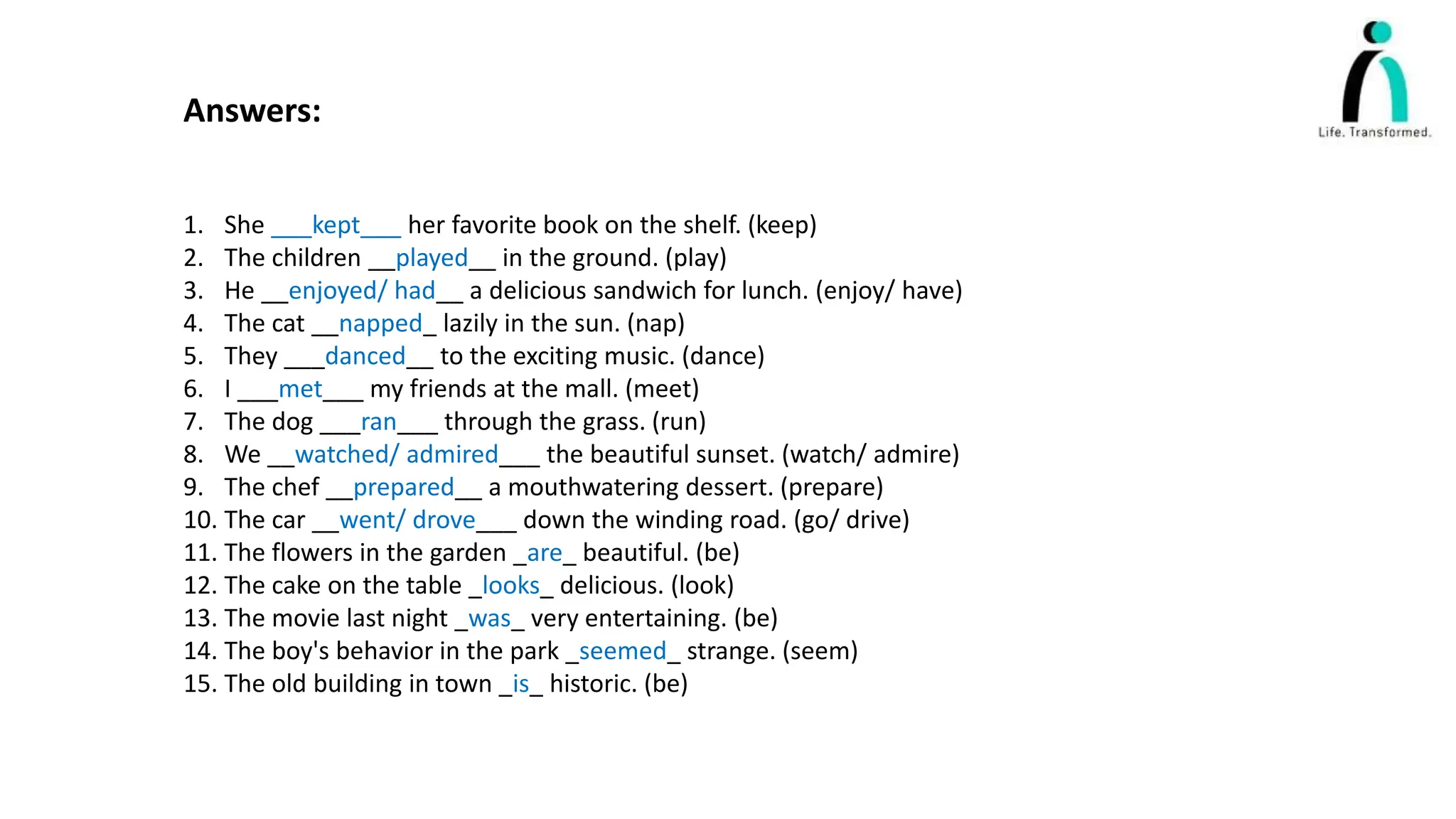
Answers:
1. She ___kept___ her favorite book on the shelf. (keep)
2. The children __played__ in the ground. (play)
3. He __enjoyed/ had__ a delicious sandwich for lunch. (enjoy/ have)
4. The cat __napped_ lazily in the sun. (nap)
5. They ___danced__ to the exciting music. (dance)
6. I ___met___ my friends at the mall. (meet)
7. The dog ___ran___ through the grass. (run)
8. We __watched/ admired___ the beautiful sunset. (watch/ admire)
9. The chef __prepared__ a mouthwatering dessert. (prepare)
10. The car __went/ drove___ down the winding road. (go/ drive)
11. The flowers in the garden _are_ beautiful. (be)
12. The cake on the table _looks_ delicious. (look)
13. The movie last night _was_ very entertaining. (be)
14. The boy's behavior in the park _seemed_ strange. (seem)
15. The old building in town _is_ historic. (be)
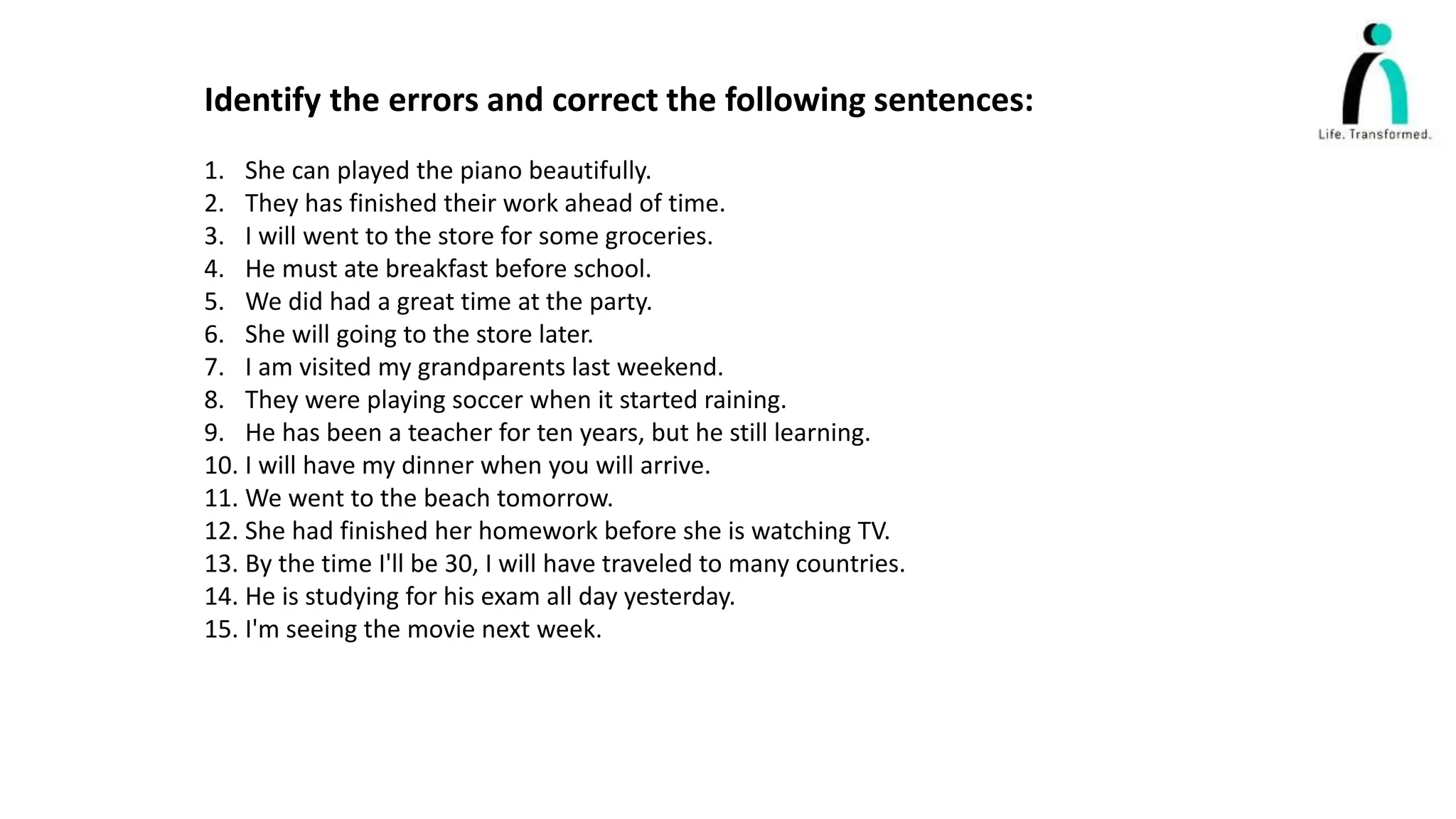
Identify the errors and correct the following sentences:
1. She can played the piano beautifully.
2. They has finished their work ahead of time.
3. I will went to the store for some groceries.
4. He must ate breakfast before school.
5. We did had a great time at the party.
6. She will going to the store later.
7. I am visited my grandparents last weekend.
8. They were playing soccer when it started raining.
9. He has been a teacher for ten years, but he still learning.
10. I will have my dinner when you will arrive.
11. We went to the beach tomorrow.
12. She had finished her homework before she is watching TV.
13. By the time I'll be 30, I will have traveled to many countries.
14. He is studying for his exam all day yesterday.
15. I'm seeing the movie next week.
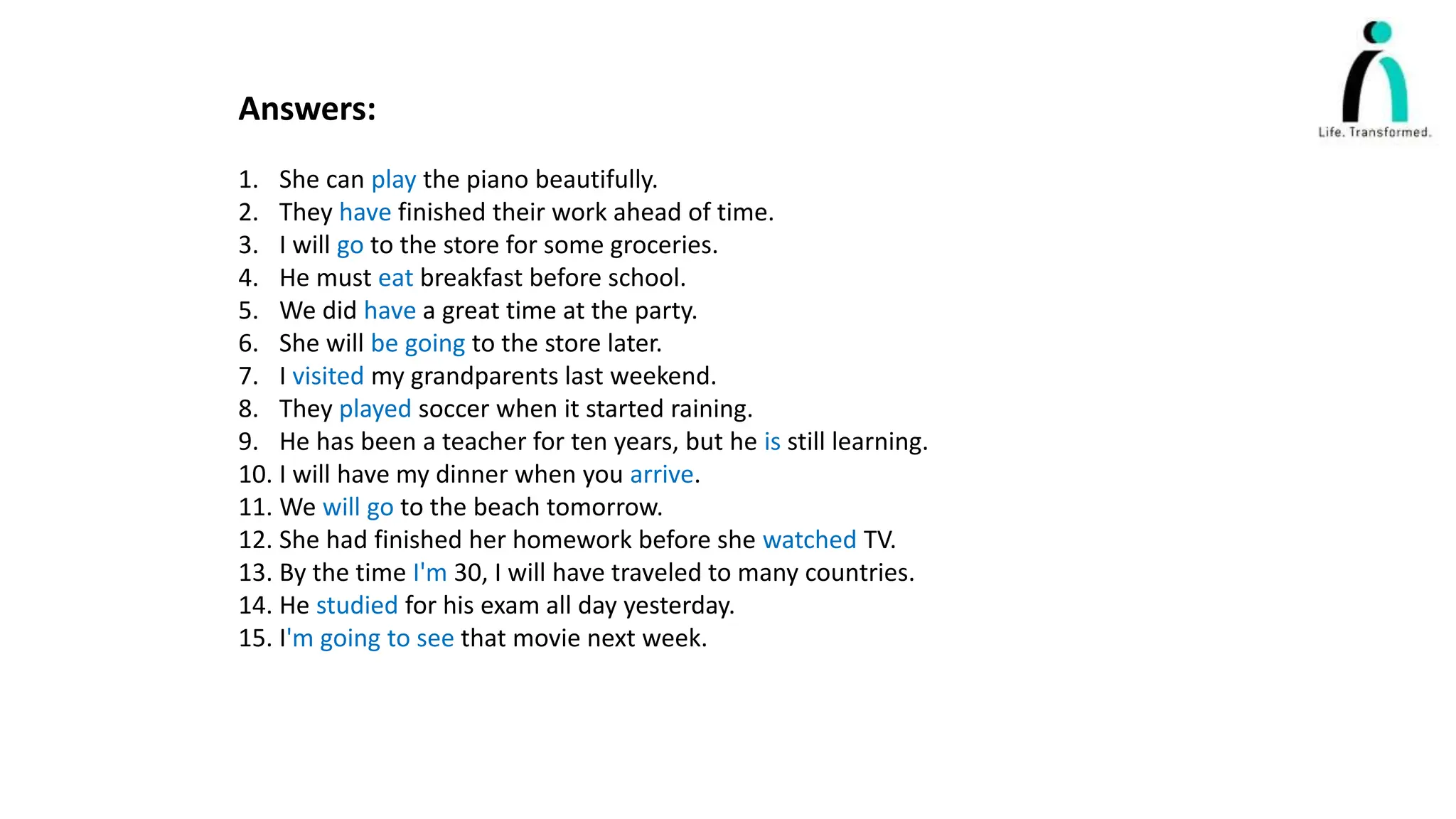
Answers:
1. She can play the piano beautifully.
2. They have finished their work ahead of time.
3. I will go to the store for some groceries.
4. He must eat breakfast before school.
5. We did have a great time at the party.
6. She will be going to the store later.
7. I visited my grandparents last weekend.
8. They played soccer when it started raining.
9. He has been a teacher for ten years, but he is still learning.
10. I will have my dinner when you arrive.
11. We will go to the beach tomorrow.
12. She had finished her homework before she watched TV.
13. By the time I'm 30, I will have traveled to many countries.
14. He studied for his exam all day yesterday.
15. I'm going to see that movie next week.
THANK YOU

A verb is a word that in syntax generally conveys an action, an occurrence, or a state of being.

  • 1.
  • 2.
    Objectives By the endof this lesson, you will learn about: • Verbs & Types of Verbs – Action, Linking, Helping • Using verbs in a sentence • The 3 Tenses- Past, Present and Future tense • Correct usage of tenses in sentences
  • 3.
    What is aVerb? • Verbs are the action words in a sentence that describe what the subject is doing.
  • 4.
    Verb A verb isa word used to express an action, a condition, or a state of being. The man washed his clothes. His clothes are dirty. He is very tidy.
  • 5.
  • 6.
    Action Verbs • Averb that shows action is called an action verb. • It tells what its subject does. • The action can either be physical or mental. Physical Action: The farmer feeds the hens. Mental Action: He likes the red rooster best.
  • 7.
    Linking Verbs • Alinking verb links its subject to a word in the predicate. • It provides more information about the subject of the sentence. For example: She is my favourite teacher. My cats are hungry. Your room smells fresh. ‘is’ connects the subject ‘She’ with the description – favourite teacher.
  • 8.
    Linking Verbs 9 commonlinking verbs am are be being become is seem was were
  • 9.
    REMEMBER A linking verbdoes not show action!
  • 10.
    Helping Verbs • Ahelping verb helps a main verb. • The helping verb comes before the main verb. I am eating my lunch. Tanu has taken the test. We were talking about films.
  • 11.
    Recap Action verbs • Describewhat someone or something does Linking verbs • Describe a condition or state of being Helping verbs • Help the main verb to describe the action
  • 12.
    Verb Tense Tense tellswhen the action or state of being takes place. In English grammar, there are three main tenses: Past Present Future
  • 13.
    Present Tense It’s happeningnow! • Jennifer cooks breakfast. • The boys walk a mile everyday. • My father washes the dishes at night. To make a verb ‘singular’, add an ‘s’ / ‘es’
  • 14.
    Present Tense Spelling rulesExamples With most verbs, add s live – lives sit – sits stay- stays Ending in consonant + y Change y to i and then add es try – tries carry – carries Ending in s, z, ch, or x - add es miss – misses buzz – buzzes catch – catches fix – fixes Exceptions go – goes do - does
  • 15.
    Present Tense Use thesimple present tense to express: 1. An action that takes place in the present. e.g., Pratik takes piano lessons. 2. A constant, repeated or habitual action. e.g., She reads bestsellers all the time. 3. A general truth. e.g., Steel is an alloy.
  • 16.
    Present Tense Use thesimple present tense to express: 4. A permanent action. e.g., The Sahara desert lies in the African continent. 5. An action that will occur in the future. However, you should provide a word or clause that indicate future time clearly in a sentence. e.g., We leave for Delhi next weekend.
  • 17.
    Past Tense The actionhas already happened… It’s completely finished, over!! • The police talked to the robbers. • Kittu submitted his paragraph. • We attended the live lecture yesterday. To make a verb ‘past tense’, add an ‘ed’ (mostly)
  • 18.
    Past Tense –Regular verbs Spelling rules Examples base form + ed walk – walked play – played verbs ending in –e + d like – liked move - moved verbs ending in a consonant + y change y  i + ed carry – carried study - studied Some verbs ending in a single consonant + the second last letter is a vowel  double the last letter + ed plan – planned stop - stopped
  • 19.
    Past Tense –Irregular verbs Spelling rules Examples No change in base form put – put cut – cut Different spelling from base form go – went eat – ate dig – dug come – came
  • 20.
    Past Tense Use thesimple past tense to express: 1. An action that started and finished in the past. e.g., I went to the beach last Sunday. 2. Actions that happened one after the other in the past (like in a story). e.g., He came in, took off his coat and sat down. 3. Unreal or imaginary things in the present or future. e.g., I wish I had more time.
  • 21.
    Future Tense It willhappen in the future- has not taken place yet!! • The students will study for the final. • I shall fly in an airplane someday. • I will call my instructor for help. Helping verbs are- ‘will’ and ‘shall’
  • 22.
    Future Tense Use thesimple future tense to: 1. Predict a future event. e.g., It will rain tomorrow. 2. Express willingness. e.g., She will carry your bag for you. 3. In negative form, express unwillingness. e.g., The baby would not eat his soup.
  • 23.
    Future Tense Use thesimple future tense to: 4. With I in the interrogative form, use ‘shall’ to make an offer. e.g., Shall I open the window? 5. With I in the interrogative form, use ‘shall’ to make a suggestion. e.g., Shall we go to the cinema tonight? 6. With you in the interrogative form, to give an invitation. e.g., Will you come to the park with me?
  • 24.
    ‘Will’ v/s ‘Goingto’ Will Going to 1. Expresses future actions decided at the moment of speaking, a promise Ok, I will be there. I’m thirsty, I’ll buy a bottle of water. 1. Expresses future actions decided before the moment of speaking. Tom is going to see a movie. He bought the tickets yesterday. 2. Used to predict future based on personal opinions or experiences rather than specific evidences. Don’t worry about the exam. I’m sure you will pass it. 2. Expresses a prediction based on present evidence. There are black clouds in the sky. It is going to rain.
  • 25.
    Recap I go tothe movies with my friends. I went to the movies with my friends. I will go to the movies with my friends. PRESENT PAST FUTURE
  • 26.
  • 27.
    Remember When writing, stayin the same tense throughout the document.
  • 28.
  • 29.
    Fill in theblanks with appropriate verbs: 1. She __________ her favorite book on the shelf. (keep) 2. The children __________ in the ground. (play) 3. He __________ a delicious sandwich for lunch. (enjoy/ have) 4. The cat __________ lazily in the sun. (nap) 5. They __________ to the exciting music. (dance) 6. I __________ my friends at the mall. (meet) 7. The dog __________ through the grass. (run) 8. We __________ the beautiful sunset. (watch/ admire) 9. The chef __________ a mouthwatering dessert. (prepare) 10. The car __________ down the winding road. (go/ drive) 11. The flowers in the garden ___ beautiful. (be) 12. The cake on the table ___ delicious. (look) 13. The movie last night ___ very entertaining. (be) 14. The dog's behavior in the park ___ strange. (seem) 15. The old building in town ___ historic. (be)
  • 30.
    Answers: 1. She ___kept___her favorite book on the shelf. (keep) 2. The children __played__ in the ground. (play) 3. He __enjoyed/ had__ a delicious sandwich for lunch. (enjoy/ have) 4. The cat __napped_ lazily in the sun. (nap) 5. They ___danced__ to the exciting music. (dance) 6. I ___met___ my friends at the mall. (meet) 7. The dog ___ran___ through the grass. (run) 8. We __watched/ admired___ the beautiful sunset. (watch/ admire) 9. The chef __prepared__ a mouthwatering dessert. (prepare) 10. The car __went/ drove___ down the winding road. (go/ drive) 11. The flowers in the garden _are_ beautiful. (be) 12. The cake on the table _looks_ delicious. (look) 13. The movie last night _was_ very entertaining. (be) 14. The boy's behavior in the park _seemed_ strange. (seem) 15. The old building in town _is_ historic. (be)
  • 31.
    Identify the errorsand correct the following sentences: 1. She can played the piano beautifully. 2. They has finished their work ahead of time. 3. I will went to the store for some groceries. 4. He must ate breakfast before school. 5. We did had a great time at the party. 6. She will going to the store later. 7. I am visited my grandparents last weekend. 8. They were playing soccer when it started raining. 9. He has been a teacher for ten years, but he still learning. 10. I will have my dinner when you will arrive. 11. We went to the beach tomorrow. 12. She had finished her homework before she is watching TV. 13. By the time I'll be 30, I will have traveled to many countries. 14. He is studying for his exam all day yesterday. 15. I'm seeing the movie next week.
  • 32.
    Answers: 1. She canplay the piano beautifully. 2. They have finished their work ahead of time. 3. I will go to the store for some groceries. 4. He must eat breakfast before school. 5. We did have a great time at the party. 6. She will be going to the store later. 7. I visited my grandparents last weekend. 8. They played soccer when it started raining. 9. He has been a teacher for ten years, but he is still learning. 10. I will have my dinner when you arrive. 11. We will go to the beach tomorrow. 12. She had finished her homework before she watched TV. 13. By the time I'm 30, I will have traveled to many countries. 14. He studied for his exam all day yesterday. 15. I'm going to see that movie next week.
  • 33.

Editor's Notes

  • #8 Tell the class: The most common linking verb is ‘be’ in all forms, such as, is, am, was and more…
  • #13 Teacher’s notes: In English grammar, there are three main tenses, and they are each further classified into four different forms, which sum up to twelve tenses in total. The three tenses in English are: Present Tense Past Tense Future Tense And, The four different forms are: Simple Tense Form Continuous Tense Form Perfect Tense Form Perfect Continuous Tense Form
  • #25 Teacher’s notes: A very confusing concept is when to use WILL and when to use BE GOING TO when we refer the future. Both refer to the future and there is a slight difference between the two though in most cases they can be used interchangeably.
  • #31 You can make the sentences in other tenses also.