GROUP
2
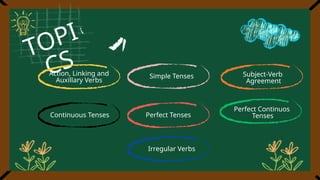
TOPI
CS
Action, Linking and
Auxillary Verbs
Simple Tenses Subject-Verb
Agreement
Continuous Tenses Perfect Tenses
Perfect Continuos
Tenses
Irregular Verbs
Action,
Lingking
and
Auxillary
Verbs
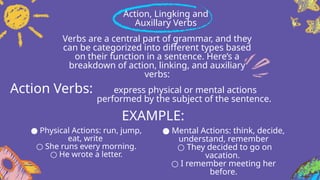
Action Verbs:
Action, Lingking and
Auxillary Verbs
Verbs are a central part of grammar, and they
can be categorized into different types based
on their function in a sentence. Here’s a
breakdown of action, linking, and auxiliary
verbs:
express physical or mental actions
performed by the subject of the sentence.
● Physical Actions: run, jump,
eat, write
○ She runs every morning.
○ He wrote a letter.
● Mental Actions: think, decide,
understand, remember
○ They decided to go on
vacation.

○ I remember meeting her
before.
EXAMPLE:
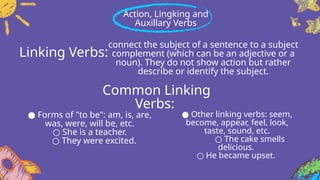
Linking Verbs:
connect the subject of a sentence to a subject
complement (which can be an adjective or a
noun). They do not show action but rather
describe or identify the subject.
● Forms of "to be": am, is, are,
was, were, will be, etc.
○ She is a teacher.
○ They were excited.
● Other linking verbs: seem,
become, appear, feel, look,
taste, sound, etc.
○ The cake smells
delicious.
○ He became upset.
Common Linking
Verbs:
Action, Lingking and
Auxillary Verbs
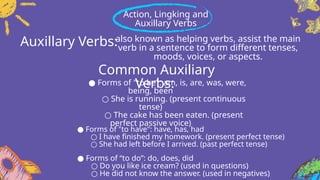
Auxillary Verbs:also known as helping verbs, assist the main
verb in a sentence to form different tenses,
moods, voices, or aspects.
● Forms of "to be": am, is, are, was, were,
being, been
○ She is running. (present continuous
tense)
○ The cake has been eaten. (present
perfect passive voice)
● Forms of "to have": have, has, had
○ I have finished my homework. (present perfect tense)
○ She had left before I arrived. (past perfect tense)
Common Auxiliary
Verbs:
● Forms of “to do”: do, does, did
○ Do you like ice cream? (used in questions)
○ He did not know the answer. (used in negatives)
Action, Lingking and
Auxillary Verbs
Simple
Tenses
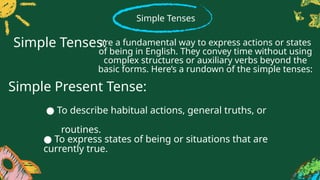
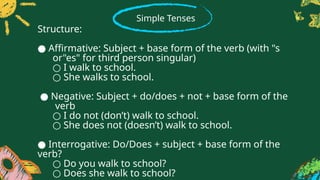
Simple Tenses:
Simple Tenses
are a fundamental way to express actions or states
of being in English. They convey time without using
complex structures or auxiliary verbs beyond the
basic forms. Here’s a rundown of the simple tenses:
● To describe habitual actions, general truths, or
routines.
● To express states of being or situations that are
currently true.
Simple Present Tense:
Simple Tenses
Structure:
● Affirmative: Subject + base form of the verb (with "s
or"es" for third person singular)
○ I walk to school.
○ She walks to school.
● Negative: Subject + do/does + not + base form of the
verb
○ I do not (don’t) walk to school.
○ She does not (doesn’t) walk to school.
● Interrogative: Do/Does + subject + base form of the
verb?
○ Do you walk to school?
○ Does she walk to school?
Simple Tenses
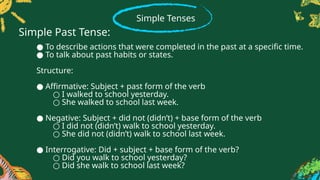
● To describe actions that were completed in the past at a specific time.
● To talk about past habits or states.
Structure:
● Affirmative: Subject + past form of the verb
○ I walked to school yesterday.
○ She walked to school last week.
● Negative: Subject + did not (didn’t) + base form of the verb
○ I did not (didn’t) walk to school yesterday.
○ She did not (didn’t) walk to school last week.
● Interrogative: Did + subject + base form of the verb?
○ Did you walk to school yesterday?
○ Did she walk to school last week?
Simple Past Tense:
Simple Tenses
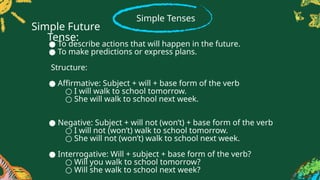
● To describe actions that will happen in the future.
● To make predictions or express plans.
Structure:
● Affirmative: Subject + will + base form of the verb
○ I will walk to school tomorrow.
○ She will walk to school next week.
● Negative: Subject + will not (won’t) + base form of the verb
○ I will not (won’t) walk to school tomorrow.
○ She will not (won’t) walk to school next week.
● Interrogative: Will + subject + base form of the verb?
○ Will you walk to school tomorrow?
○ Will she walk to school next week?
Simple Future
Tense:
Subject-
Verb
Agreeme
nt
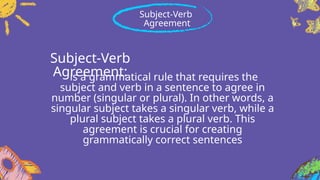
Subject-Verb
Agreement:
is a grammatical rule that requires the
subject and verb in a sentence to agree in
number (singular or plural). In other words, a
singular subject takes a singular verb, while a
plural subject takes a plural verb. This
agreement is crucial for creating
grammatically correct sentences
Subject-Verb
Agreement
Basic Rules of Subject-
Verb Agreement:
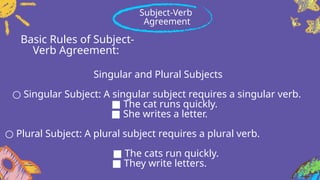
Singular and Plural Subjects
○ Singular Subject: A singular subject requires a singular verb.
■ The cat runs quickly.
■ She writes a letter.
○ Plural Subject: A plural subject requires a plural verb.
■ The cats run quickly.
■ They write letters.
Subject-Verb
Agreement
Basic Rules of Subject-
Verb Agreement:
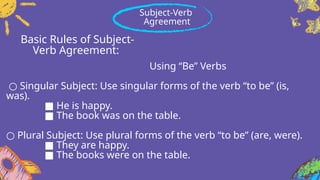
Using “Be” Verbs
○ Singular Subject: Use singular forms of the verb “to be” (is,
was).
■ He is happy.
■ The book was on the table.
○ Plural Subject: Use plural forms of the verb “to be” (are, were).
■ They are happy.
■ The books were on the table.
Subject-Verb
Agreement
Basic Rules of Subject-
Verb Agreement:
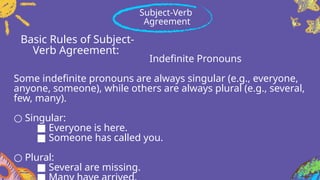
Indefinite Pronouns
Some indefinite pronouns are always singular (e.g., everyone,
anyone, someone), while others are always plural (e.g., several,
few, many).
○ Singular:
■ Everyone is here.
■ Someone has called you.
○ Plural:
■ Several are missing.
Subject-Verb
Agreement
Basic Rules of Subject-
Verb Agreement:
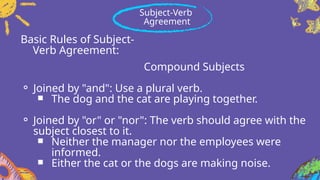
Compound Subjects
⚬ Joined by "and": Use a plural verb.
■ The dog and the cat are playing together.
⚬ Joined by "or" or "nor": The verb should agree with the
subject closest to it.
■ Neither the manager nor the employees were
informed.
■ Either the cat or the dogs are making noise.
Subject-Verb
Agreement
Basic Rules of Subject-
Verb Agreement:
Collective Nouns
Collective nouns (e.g., team, group, family) can take either
singular or plural verbs depending on whether the noun is acting
as a single unit or as individual members.
⚬ As a Single Unit (Singular):
■ The team is winning the game.
■ The family has moved to a new house.
⚬ As Individuals (Plural):
■ The team are arguing among themselves.
■ The family are all going to different colleges.
Subject-Verb
Agreement
Basic Rules of Subject-
Verb Agreement:
Amounts and Quantities
When referring to an amount of money, time, or distance, the
verb agrees with the amount rather than the individual items.
⚬ Five dollars is a reasonable price. (singular, because “five
dollars” is considered a single amount)
⚬ Ten miles are too far to walk. (plural, because “ten miles”
refers to multiple miles)
Subject-Verb
Agreement
Continu
ous
Tenses
Continuous Tenses
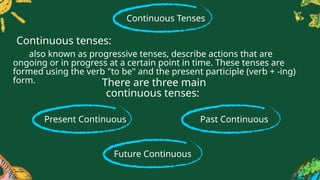
also known as progressive tenses, describe actions that are
ongoing or in progress at a certain point in time. These tenses are
formed using the verb "to be" and the present participle (verb + -ing)
form. There are three main
continuous tenses:
Future Continuous
Present Continuous Past Continuous
Continuous tenses:
Continuous Tenses
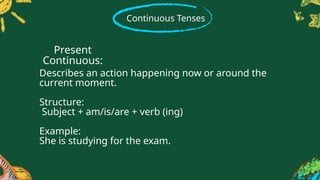
Describes an action happening now or around the
current moment.
Structure:
Subject + am/is/are + verb (ing)
Example:
She is studying for the exam.
Present
Continuous:
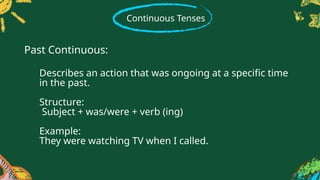
Continuous Tenses
Describes an action that was ongoing at a specific time
in the past.
Structure:
Subject + was/were + verb (ing)
Example:
They were watching TV when I called.
Past Continuous:
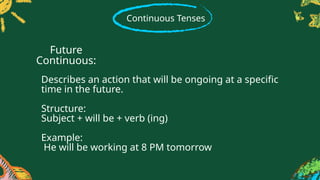
Continuous Tenses
Describes an action that will be ongoing at a specific
time in the future.
Structure:
Subject + will be + verb (ing)
Example:
He will be working at 8 PM tomorrow
Future
Continuous:
Perfect
Tenses
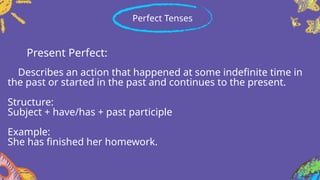
Present Perfect:
Describes an action that happened at some indefinite time in
the past or started in the past and continues to the present.
Structure:
Subject + have/has + past participle
Example:
She has finished her homework.
Perfect Tenses
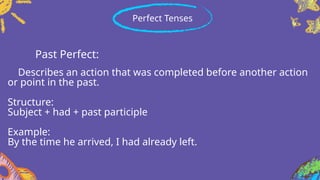
Past Perfect:
Describes an action that was completed before another action
or point in the past.
Structure:
Subject + had + past participle
Example:
By the time he arrived, I had already left.
Perfect Tenses
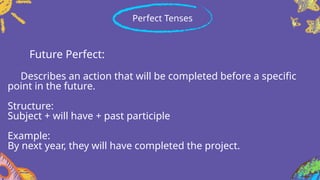
Future Perfect:
Describes an action that will be completed before a specific
point in the future.
Structure:
Subject + will have + past participle
Example:
By next year, they will have completed the project.
Perfect Tenses
Perfect
continuo
us
Perfect continuous
tenses
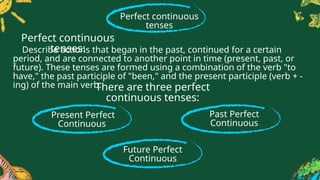
Describe actions that began in the past, continued for a certain
period, and are connected to another point in time (present, past, or
future). These tenses are formed using a combination of the verb "to
have," the past participle of "been," and the present participle (verb + -
ing) of the main verb.
There are three perfect
continuous tenses:
Future Perfect
Continuous
Present Perfect
Continuous
Past Perfect
Continuous
Perfect continuous
tenses:
Perfect continuous
tenses
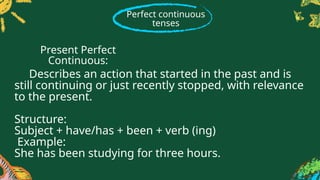
Describes an action that started in the past and is
still continuing or just recently stopped, with relevance
to the present.
Structure:
Subject + have/has + been + verb (ing)
Example:
She has been studying for three hours.
Present Perfect
Continuous:
Perfect continuous
tenses
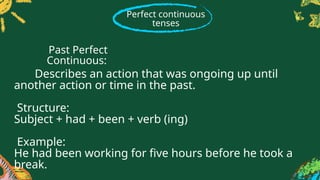
Describes an action that was ongoing up until
another action or time in the past.
Structure:
Subject + had + been + verb (ing)
Example:
He had been working for five hours before he took a
break.
Past Perfect
Continuous:
Perfect continuous
tenses
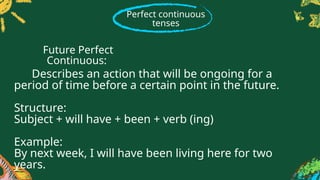
Describes an action that will be ongoing for a
period of time before a certain point in the future.
Structure:
Subject + will have + been + verb (ing)
Example:
By next week, I will have been living here for two
years.
Future Perfect
Continuous:
Irregula
r Verbs
is a verb that does not follow the standard pattern of adding
-ed to form its past tense and past participle. Instead, these verbs
undergo changes in their spelling or remain the same in their
different forms.
Examples:
Go went (past tense), gone (past participle)
→
Begin began (past tense), begun (past participle)
→
Take took (past tense), taken (past participle)
→
Cut cut (past tense), cut (past participle)
→
Irregular Verbs
Irregular Verbs:
Regular vs. Irregular Verbs:
Regular Verbs: Follow a predictable pattern by adding -ed for both
past tense and past participle.
Example: Walk walked (past tense and past participle)
→
Irregular Verbs: Do not follow a consistent pattern and must be
memorized.
Example: Eat ate (past tense), eaten (past participle)
→
Irregular verbs are common in English and are used frequently, so
learning them is important for mastering verb conjugations.
Irregular Verbs
Irregular Verbs:
Thanks for
Listening

Identifying Adjectives and adverbs .pptx

  • 1.
  • 2.
    TOPI CS Action, Linking and AuxillaryVerbs Simple Tenses Subject-Verb Agreement Continuous Tenses Perfect Tenses Perfect Continuos Tenses Irregular Verbs
  • 3.
  • 4.
    Action Verbs: Action, Lingkingand Auxillary Verbs Verbs are a central part of grammar, and they can be categorized into different types based on their function in a sentence. Here’s a breakdown of action, linking, and auxiliary verbs: express physical or mental actions performed by the subject of the sentence. ● Physical Actions: run, jump, eat, write ○ She runs every morning. ○ He wrote a letter. ● Mental Actions: think, decide, understand, remember ○ They decided to go on vacation. ○ I remember meeting her before. EXAMPLE:
  • 5.
    Linking Verbs: connect thesubject of a sentence to a subject complement (which can be an adjective or a noun). They do not show action but rather describe or identify the subject. ● Forms of "to be": am, is, are, was, were, will be, etc. ○ She is a teacher. ○ They were excited. ● Other linking verbs: seem, become, appear, feel, look, taste, sound, etc. ○ The cake smells delicious. ○ He became upset. Common Linking Verbs: Action, Lingking and Auxillary Verbs
  • 6.
    Auxillary Verbs:also knownas helping verbs, assist the main verb in a sentence to form different tenses, moods, voices, or aspects. ● Forms of "to be": am, is, are, was, were, being, been ○ She is running. (present continuous tense) ○ The cake has been eaten. (present perfect passive voice) ● Forms of "to have": have, has, had ○ I have finished my homework. (present perfect tense) ○ She had left before I arrived. (past perfect tense) Common Auxiliary Verbs: ● Forms of “to do”: do, does, did ○ Do you like ice cream? (used in questions) ○ He did not know the answer. (used in negatives) Action, Lingking and Auxillary Verbs

  • 7.
  • 8.
    Simple Tenses: Simple Tenses area fundamental way to express actions or states of being in English. They convey time without using complex structures or auxiliary verbs beyond the basic forms. Here’s a rundown of the simple tenses: ● To describe habitual actions, general truths, or routines. ● To express states of being or situations that are currently true. Simple Present Tense:
  • 9.
    Simple Tenses Structure: ● Affirmative:Subject + base form of the verb (with "s or"es" for third person singular) ○ I walk to school. ○ She walks to school. ● Negative: Subject + do/does + not + base form of the verb ○ I do not (don’t) walk to school. ○ She does not (doesn’t) walk to school. ● Interrogative: Do/Does + subject + base form of the verb? ○ Do you walk to school? ○ Does she walk to school?
  • 10.
    Simple Tenses ● Todescribe actions that were completed in the past at a specific time. ● To talk about past habits or states. Structure: ● Affirmative: Subject + past form of the verb ○ I walked to school yesterday. ○ She walked to school last week. ● Negative: Subject + did not (didn’t) + base form of the verb ○ I did not (didn’t) walk to school yesterday. ○ She did not (didn’t) walk to school last week. ● Interrogative: Did + subject + base form of the verb? ○ Did you walk to school yesterday? ○ Did she walk to school last week? Simple Past Tense:
  • 11.
    Simple Tenses ● Todescribe actions that will happen in the future. ● To make predictions or express plans. Structure: ● Affirmative: Subject + will + base form of the verb ○ I will walk to school tomorrow. ○ She will walk to school next week. ● Negative: Subject + will not (won’t) + base form of the verb ○ I will not (won’t) walk to school tomorrow. ○ She will not (won’t) walk to school next week. ● Interrogative: Will + subject + base form of the verb? ○ Will you walk to school tomorrow? ○ Will she walk to school next week? Simple Future Tense:
  • 12.
  • 13.
    Subject-Verb Agreement: is a grammaticalrule that requires the subject and verb in a sentence to agree in number (singular or plural). In other words, a singular subject takes a singular verb, while a plural subject takes a plural verb. This agreement is crucial for creating grammatically correct sentences Subject-Verb Agreement
  • 14.
    Basic Rules ofSubject- Verb Agreement: Singular and Plural Subjects ○ Singular Subject: A singular subject requires a singular verb. ■ The cat runs quickly. ■ She writes a letter. ○ Plural Subject: A plural subject requires a plural verb. ■ The cats run quickly. ■ They write letters. Subject-Verb Agreement
  • 15.
    Basic Rules ofSubject- Verb Agreement: Using “Be” Verbs ○ Singular Subject: Use singular forms of the verb “to be” (is, was). ■ He is happy. ■ The book was on the table. ○ Plural Subject: Use plural forms of the verb “to be” (are, were). ■ They are happy. ■ The books were on the table. Subject-Verb Agreement
  • 16.
    Basic Rules ofSubject- Verb Agreement: Indefinite Pronouns Some indefinite pronouns are always singular (e.g., everyone, anyone, someone), while others are always plural (e.g., several, few, many). ○ Singular: ■ Everyone is here. ■ Someone has called you. ○ Plural: ■ Several are missing. Subject-Verb Agreement
  • 17.
    Basic Rules ofSubject- Verb Agreement: Compound Subjects ⚬ Joined by "and": Use a plural verb. ■ The dog and the cat are playing together. ⚬ Joined by "or" or "nor": The verb should agree with the subject closest to it. ■ Neither the manager nor the employees were informed. ■ Either the cat or the dogs are making noise. Subject-Verb Agreement
  • 18.
    Basic Rules ofSubject- Verb Agreement: Collective Nouns Collective nouns (e.g., team, group, family) can take either singular or plural verbs depending on whether the noun is acting as a single unit or as individual members. ⚬ As a Single Unit (Singular): ■ The team is winning the game. ■ The family has moved to a new house. ⚬ As Individuals (Plural): ■ The team are arguing among themselves. ■ The family are all going to different colleges. Subject-Verb Agreement
  • 19.
    Basic Rules ofSubject- Verb Agreement: Amounts and Quantities When referring to an amount of money, time, or distance, the verb agrees with the amount rather than the individual items. ⚬ Five dollars is a reasonable price. (singular, because “five dollars” is considered a single amount) ⚬ Ten miles are too far to walk. (plural, because “ten miles” refers to multiple miles) Subject-Verb Agreement
  • 20.
  • 21.
    Continuous Tenses also knownas progressive tenses, describe actions that are ongoing or in progress at a certain point in time. These tenses are formed using the verb "to be" and the present participle (verb + -ing) form. There are three main continuous tenses: Future Continuous Present Continuous Past Continuous Continuous tenses:
  • 22.
    Continuous Tenses Describes anaction happening now or around the current moment. Structure: Subject + am/is/are + verb (ing) Example: She is studying for the exam. Present Continuous:
  • 23.
    Continuous Tenses Describes anaction that was ongoing at a specific time in the past. Structure: Subject + was/were + verb (ing) Example: They were watching TV when I called. Past Continuous:
  • 24.
    Continuous Tenses Describes anaction that will be ongoing at a specific time in the future. Structure: Subject + will be + verb (ing) Example: He will be working at 8 PM tomorrow Future Continuous:
  • 25.
  • 26.
    Present Perfect: Describes anaction that happened at some indefinite time in the past or started in the past and continues to the present. Structure: Subject + have/has + past participle Example: She has finished her homework. Perfect Tenses
  • 27.
    Past Perfect: Describes anaction that was completed before another action or point in the past. Structure: Subject + had + past participle Example: By the time he arrived, I had already left. Perfect Tenses
  • 28.
    Future Perfect: Describes anaction that will be completed before a specific point in the future. Structure: Subject + will have + past participle Example: By next year, they will have completed the project. Perfect Tenses
  • 29.
  • 30.
    Perfect continuous tenses Describe actionsthat began in the past, continued for a certain period, and are connected to another point in time (present, past, or future). These tenses are formed using a combination of the verb "to have," the past participle of "been," and the present participle (verb + - ing) of the main verb. There are three perfect continuous tenses: Future Perfect Continuous Present Perfect Continuous Past Perfect Continuous Perfect continuous tenses:
  • 31.
    Perfect continuous tenses Describes anaction that started in the past and is still continuing or just recently stopped, with relevance to the present. Structure: Subject + have/has + been + verb (ing) Example: She has been studying for three hours. Present Perfect Continuous:
  • 32.
    Perfect continuous tenses Describes anaction that was ongoing up until another action or time in the past. Structure: Subject + had + been + verb (ing) Example: He had been working for five hours before he took a break. Past Perfect Continuous:
  • 33.
    Perfect continuous tenses Describes anaction that will be ongoing for a period of time before a certain point in the future. Structure: Subject + will have + been + verb (ing) Example: By next week, I will have been living here for two years. Future Perfect Continuous:
  • 34.
  • 35.
    is a verbthat does not follow the standard pattern of adding -ed to form its past tense and past participle. Instead, these verbs undergo changes in their spelling or remain the same in their different forms. Examples: Go went (past tense), gone (past participle) → Begin began (past tense), begun (past participle) → Take took (past tense), taken (past participle) → Cut cut (past tense), cut (past participle) → Irregular Verbs Irregular Verbs:
  • 36.
    Regular vs. IrregularVerbs: Regular Verbs: Follow a predictable pattern by adding -ed for both past tense and past participle. Example: Walk walked (past tense and past participle) → Irregular Verbs: Do not follow a consistent pattern and must be memorized. Example: Eat ate (past tense), eaten (past participle) → Irregular verbs are common in English and are used frequently, so learning them is important for mastering verb conjugations. Irregular Verbs Irregular Verbs:
  • 37.