

The two pillars of communication
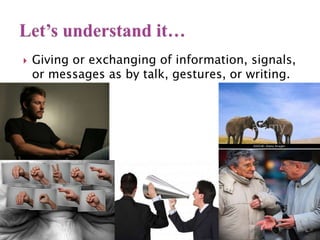
 Giving or exchanging of information, signals,
or messages as by talk, gestures, or writing.
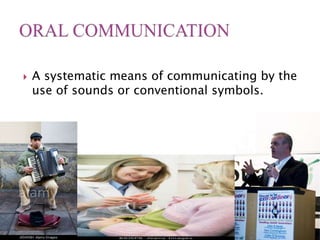
 A systematic means of communicating by the
use of sounds or conventional symbols.
 Verbal
 Non-Verbal
 Process of communication through sending
and receiving word messages
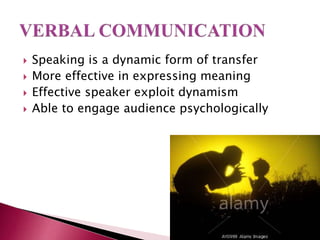
 Speaking is a dynamic form of transfer
 More effective in expressing meaning
 Effective speaker exploit dynamism
 Able to engage audience psychologically
 Pace of involvement controlled by writer and
reader.
 Writing and rewriting possible;
 Read- reading, quick, slow or stop to think-
understandability.
 Writer has less control over what the reader
read.
 More precise with preparation only
 Words cannot be withdrawn. Only apology
 Word for word reading- not speech making
and is monotonous, retain very little of the
information transmitted.
 Speaker – more control over listener
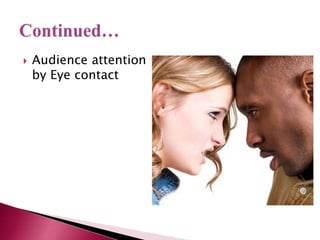
 Audience attention
by Eye contact
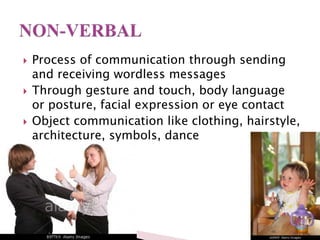
 Process of communication through sending
and receiving wordless messages
 Through gesture and touch, body language
or posture, facial expression or eye contact
 Object communication like clothing, hairstyle,
architecture, symbols, dance
 Writing is a static form of transfer.
 More precise.
 Words chosen deliberately and thoughtfully.
 Written argument- Extra ordinarily
sophisticated, intricate.
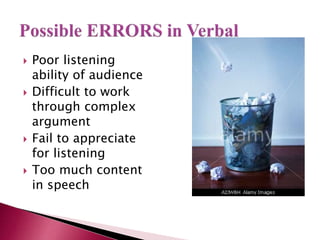
 Poor listening
ability of audience
 Difficult to work
through complex
argument
 Fail to appreciate
for listening
 Too much content
in speech
 http://www.alamy.com/search-
results.asp?qt=errors&submitsearch=Search&
st=0&go=1&a=-
1&archive=1&size=0xFF&CreativeOn=1&lic=
6&lic=1
Verbal written communication

Verbal written communication

  • 1.
    The two pillarsof communication
  • 2.
     Giving orexchanging of information, signals, or messages as by talk, gestures, or writing.
  • 3.
     A systematicmeans of communicating by the use of sounds or conventional symbols.
  • 4.
  • 5.
     Process ofcommunication through sending and receiving word messages
  • 6.
     Speaking isa dynamic form of transfer  More effective in expressing meaning  Effective speaker exploit dynamism  Able to engage audience psychologically
  • 7.
     Pace ofinvolvement controlled by writer and reader.  Writing and rewriting possible;  Read- reading, quick, slow or stop to think- understandability.  Writer has less control over what the reader read.
  • 8.
     More precisewith preparation only  Words cannot be withdrawn. Only apology  Word for word reading- not speech making and is monotonous, retain very little of the information transmitted.  Speaker – more control over listener
  • 9.
  • 10.
     Process ofcommunication through sending and receiving wordless messages  Through gesture and touch, body language or posture, facial expression or eye contact  Object communication like clothing, hairstyle, architecture, symbols, dance
  • 11.
     Writing isa static form of transfer.  More precise.  Words chosen deliberately and thoughtfully.  Written argument- Extra ordinarily sophisticated, intricate.
  • 12.
     Poor listening abilityof audience  Difficult to work through complex argument  Fail to appreciate for listening  Too much content in speech
  • 14.