Basic Ventilator Mechanics
Nasreen Rafiq
(MScN,BScN)
Objectives
• Definition of mechanical ventilation
• Indication and types of mechanical ventilation
• Basic ventilation terminologies
• Criteria of mechanical ventilation
• Variable for ventilatory breaths
• Types of breaths and Modes of ventilation
• Basic ventilator settings
• Ethical consideration
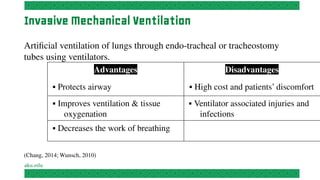
Invasive Mechanical Ventilation
Artificial ventilation of lungs through endo-tracheal or tracheostomy
tubes using ventilators.
Advantages
▪ Protects airway
Disadvantages
▪ High cost and patients’ discomfort
▪ Improves ventilation & tissue
oxygenation
▪ Ventilator associated injuries and
infections
▪ Decreases the work of breathing
(Chang, 2014; Wunsch, 2010)
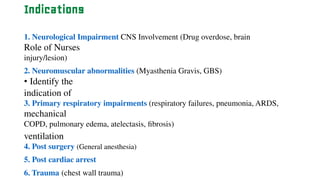
Indications
1. Neurological Impairment CNS Involvement (Drug overdose, brain
Role of Nurses
injury/lesion)
2. Neuromuscular abnormalities (Myasthenia Gravis, GBS)
• Identify the
indication of
3. Primary respiratory impairments (respiratory failures, pneumonia, ARDS,
mechanical
COPD, pulmonary edema, atelectasis, fibrosis)
ventilation
4. Post surgery (General anesthesia)
5. Post cardiac arrest
6. Trauma (chest wall trauma)
(Iqbal et al., 2015)
Types of Invasive Mechanical Ventilation
Positive-pressure Ventilation
Mechanical Ventilation
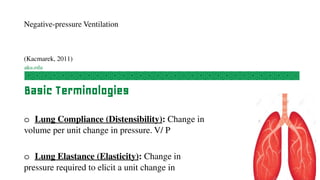
Negative-pressure Ventilation
(Kacmarek, 2011)
Basic Terminologies
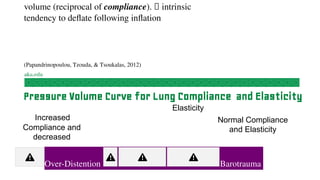
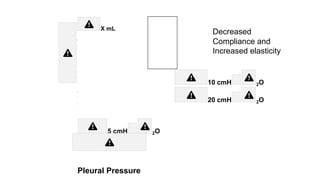
o Lung Compliance (Distensibility): Change in
volume per unit change in pressure. V/ P
o Lung Elastance (Elasticity): Change in
pressure required to elicit a unit change in
volume (reciprocal of compliance). 🡪 intrinsic
tendency to deflate following inflation
(Papandrinopoulou, Tzouda, & Tsoukalas, 2012)
Pressure Volume Curve for Lung Compliance and Elasticity
Increased
Compliance and
decreased
Elasticity
Normal Compliance
and Elasticity
Over-Distention Barotrauma Dynamic
hyperinflation
X mL e
m
u
Decreased
Compliance and
Increased elasticity
l
o
V
g
n
u
L
5 cmH 2O
Pleural Pressure
10 cmH 2O
20 cmH 2O
Terms and Definitions
o Tidal Volume (Vt): Amount of air passes in and out of lungs with each cycle.
(volume delivered with each preset breath)
o Minute Ventilation (VE): Volume of gas exchanged per minute [RR x TV]
o Inspiratory:Expiratory (I:E) Ratio: the ratio of inspiratory to expiratory
time determined by the speed of gas flow (1:2)
o Vital Capacity (VC): Maximum air expelled from lungs after a maximum
inhalation
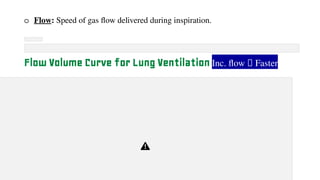
o Flow: Speed of gas flow delivered during inspiration.
Flow Volume Curve for Lung Ventilation Inc. flow 🡪 Faster
speed of gas 🡪 shorter Inspiratory time (Ti)
FRC: volume
of air left in
the lungs
after a
normal
expiration
Terms and Definitions
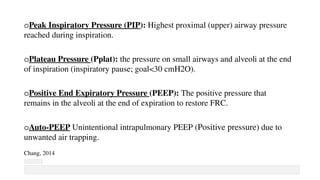
oPeak Inspiratory Pressure (PIP): Highest proximal (upper) airway pressure
reached during inspiration.
oPlateau Pressure (Pplat): the pressure on small airways and alveoli at the end
of inspiration (inspiratory pause; goal<30 cmH2O).
oPositive End Expiratory Pressure (PEEP): The positive pressure that
remains in the alveoli at the end of expiration to restore FRC.
oAuto-PEEP Unintentional intrapulmonary PEEP (Positive pressure) due to
unwanted air trapping.
Chang, 2014
(Gattinoni, 2016)
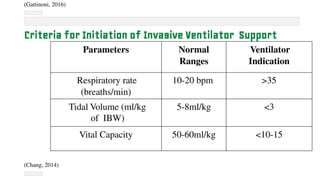
Criteria for Initiation of Invasive Ventilator Support
Parameters Normal
Ranges
Ventilator
Indication
Respiratory rate
(breaths/min)
10-20 bpm >35
Tidal Volume (ml/kg
of IBW)
5-8ml/kg <3
Vital Capacity 50-60ml/kg <10-15
(Chang, 2014)
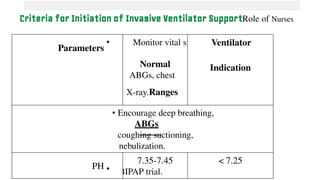
Criteria for Initiation of Invasive Ventilator SupportRole of Nurses
Parameters
• Monitor vital si
Normal
ABGs, chest
X-ray.Ranges
Ventilator
Indication
• Encourage deep breathing,
ABGs
coughing suctioning,
nebulization.
PH •
7.35-7.45
BIPAP trial.
< 7.25
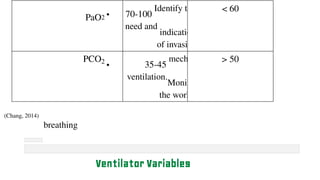
PaO2 • 70-100
Identify th
need and
indicatio
of invasi
< 60
PCO2
• 35-45
mech
ventilation.
Monit
the work
> 50
(Chang, 2014)
breathing
Ventilator Variables
Control Variables
Time
Flow
Volume
Pressure
Phase Variables
Sensitivity Trigger
Independent & fixed during every breaths
Control initiation of inspiratory phase in the
ventilator cycle
Time
Flow
Drop 🡪 begins the
inspiration.
Identifies patients’
respiratory effort
Initiates
response to that
effort
Pressure
PVA due to ineffective trier settin occurred in 93% Mellot et al. 2014
Triggers
Variables
Role of Nurses
• Determine correct
Cycle Variable • Determines the termination of the
Inspiration is terminated after
trigger
and
Inspiration is terminated after
a preset pressure has been
inspiration
a preset tidal volume has been
Pressure
Flow sensitivity.
• Breath gets terminated once the pre
Volume
set value is reached Time
delivered by the ventilator delivered by the ventilator
• Set correct values
and achieved by the patient. for
control
and achieved by the patient
Inspiration is terminated after a preset
variables.
inspiratory time (Ti) is achieved.
• Determine the
patient required
Inspiration is terminated when
cycle variable.
a preset air flow is delivered
in the preset inspiratory time.
(Chang, 2014)
Types of Breaths
Breath Types
Mandatory Spontaneous
(Kim & Doyle, 2012)
Modes of Ventilator
Control Mode Ventilation
Assist control Mode Ventilation
Synchronized Intermittent Mandatory Ventilation
Spontaneous/pressure Support Mode Ventilation
(Kim & Doyle, 2012)
Controlled Mode Ventilation (CMV)
Type of breaths: Mandatory breaths mechanically delivered. Trigger and
cycle: Ventilator controlled (Breaths are initiated and terminated by the
ventilator).
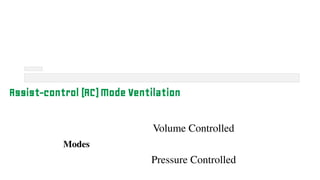
Assist-control (AC) Mode Ventilation
Volume Controlled
Modes
Pressure Controlled
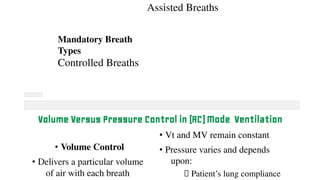
Mandatory Breath
Types
Controlled Breaths
Assisted Breaths
Volume Versus Pressure Control in (AC) Mode Ventilation
• Volume Control
• Delivers a particular volume
of air with each breath
• Vt and MV remain constant
• Pressure varies and depends
upon:
⮚ Patient’s lung compliance
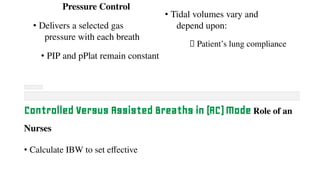
Pressure Control
• Delivers a selected gas
pressure with each breath
• PIP and pPlat remain constant
• Tidal volumes vary and
depend upon:
⮚ Patient’s lung compliance
Controlled Versus Assisted Breaths in (AC) Mode Role of an
Nurses
• Calculate IBW to set effective
Vt.
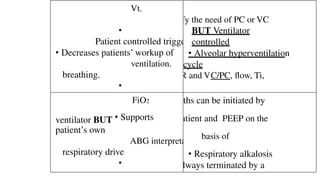
Advantages
•
Patient controlled trigge
• Decreases patients’ workup of
ventilation.
breathing.
•
Disadvantages
fy the need of PC or VC
BUT Ventilator
controlled
• Alveolar hyperventilation
cycle
R and VC/PC, flow, Ti,
FiO2
ventilator BUT • Supports
patient’s own
ABG interpreta
respiratory drive
•
ths can be initiated by
atient and PEEP on the
basis of
• Respiratory alkalosis
lways terminated by a
ventilator.
or MV and modulate the
RR and Vt.
• Look for patient triggering.
• Assess for sedation
Synchronized Intermittent Mandatory Ventilation
Role of an Nurses
• Monitor ABGS and V/S.
Delievers a preset Vt at a preset Rate (RR)
• Monitor the Vt of the
Spontaneous breaths between mandatory breaths are:
• patient triggered spontaneous breaths.
• Set backup Vt,
flow,
• Supported by the
patient’s strength
and lung
mechanics
sensitivity, Ti,
FiO2,
PEEP.
• Ensure back-up PS to help
spontaneous breaths.
(Donn & Sinha, 2012)
Spontaneous Mode OR Pressure Support Ventilation
Role of Nurses
• Set backup pressure
support to facilitate dead
space ventilation.
Type of breath: Spontaneous
• Ensure Apnea backup
Trigger and cycle: Patient
controlled
• Monitor ABGs
• Breaths are initiated and terminated by the patient.
• Monitor for work of
breathing
• prepare for extubation
after a SBT
(Pilbeam, 2015)
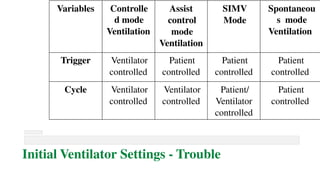
Summarizing the Modes
Variables Controlle
d mode
Ventilation
Assist
control
mode
Ventilation
SIMV
Mode
Spontaneou
s mode
Ventilation
Trigger Ventilator
controlled
Patient
controlled
Patient
controlled
Patient
controlled
Cycle Ventilator
controlled
Ventilator
controlled
Patient/
Ventilator
controlled
Patient
controlled
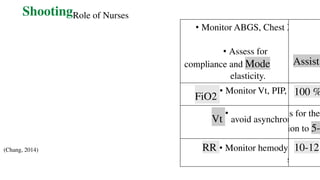
Initial Ventilator Settings - Trouble
ShootingRole of Nurses
(Chang, 2014)
• Monitor ABGS, Chest X
Parameters
• Assess for
compliance and Mode
elasticity.
Assist
FiO2
• Monitor Vt, PIP, 100 %
Vt
•
avoid asynchron
es for the
ion to 5-
RR • Monitor hemodyn
s
10-12
Inspiratory Flow
ventila
0L/min
PEEP accordingly.
5 cmH
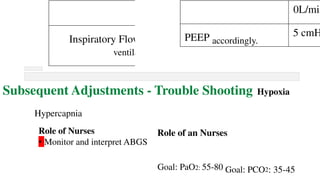
Subsequent Adjustments - Trouble Shooting Hypoxia
Hypercapnia
Role of Nurses
• Monitor and interpret ABGS
Role of an Nurses
Goal: PaO2: 55-80 Goal: PCO2: 35-45
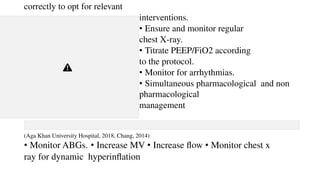
correctly to opt for relevant
interventions.
• Ensure and monitor regular
chest X-ray.
• Titrate PEEP/FiO2 according
to the protocol.
• Monitor for arrhythmias.
• Simultaneous pharmacological and non
pharmacological
management
(Aga Khan University Hospital, 2018, Chang, 2014)
• Monitor ABGs. • Increase MV • Increase flow • Monitor chest x
ray for dynamic hyperinflation
Inspiratory (Ti) and Expiratory (TE) Times- Trouble Shooting
• Total cycle time (TCT):
• Inspiratory time + Expiratory time
• RR 20 breaths/min 🡪3 seconds (TCT)
Inspiratory time (Ti): 1 second (if)
Vt: 1000ml and Inspiratory flow: 60L/min
I:E: (1:2)
1 lit Vt delivered in 60L/min: 1 lit/sec
3sec – 1 sec = 2 sec for expiration
Role of Nurses
• Air entry at
least per sift
• Set required
RR,Vt, Flow.
• Ensure I:E
ratio 1:2
• Monitor for auto-PEEP
(expiratory hold maneuver)
o Prolong expiratory time, Increase
flow, Decrease RR
• Monitor for signs of
pneumothorax.
• Check plateau pressure q4H.
• Monitor vital signs.
Compliance and Resistance - Trouble Shooting (Chang,
2014)
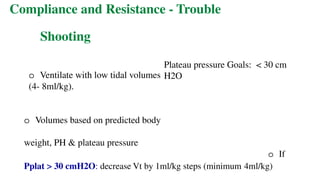
Compliance and Resistance - Trouble
Shooting Protective Lung Ventilation
o Ventilate with low tidal volumes
(4- 8ml/kg).
Plateau pressure Goals: < 30 cm
H2O
RCT: Patients given smaller ventilator breaths had significantly
higher
o Volumes based on predicted body
survival than patients with conventional treatment. use of large
weight, PH & plateau pressure.
breaths resulted in ongoing inflammation (Bein et.al, 2013) o If
Pplat > 30 cmH2O: decrease Vt by 1ml/kg steps (minimum 4ml/kg)
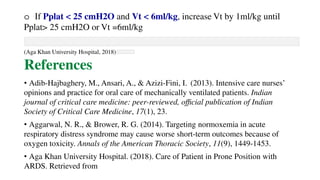
o If Pplat < 25 cmH2O and Vt < 6ml/kg, increase Vt by 1ml/kg until
Pplat> 25 cmH2O or Vt =6ml/kg
(Aga Khan University Hospital, 2018)
References
• Adib-Hajbaghery, M., Ansari, A., & Azizi-Fini, I. (2013). Intensive care nurses’
opinions and practice for oral care of mechanically ventilated patients. Indian
journal of critical care medicine: peer-reviewed, official publication of Indian
Society of Critical Care Medicine, 17(1), 23.
• Aggarwal, N. R., & Brower, R. G. (2014). Targeting normoxemia in acute
respiratory distress syndrome may cause worse short-term outcomes because of
oxygen toxicity. Annals of the American Thoracic Society, 11(9), 1449-1453.
• Aga Khan University Hospital. (2018). Care of Patient in Prone Position with
ARDS. Retrieved from
https://betaportal.aku.edu/qps/Key%20Documents/Policies,%20Procedures,%20Pro
tocols,%20Clinical%20Practice%20Guideline/05%20Care%20of%20Patient%20in
%20Prone%20Position%20with%20ARDS.pdf
• AKUH. (2014). Brain Death testing criteria at AKUH, Karachi. Retrieved from
https://betaportal.aku.edu/qps/Key%20Documents/Policies,%20Procedures,%20Pro
tocols,%20Clinical%20Practice%20Guideline/Brain%20Death%20Policy.pdf
References
• Amato, M. B., Meade, M. O., Slutsky, A. S., Brochard, L., Costa, E. L.,
Schoenfeld, D. A., ... & Richard, J. C. M. (2015).
• Ayub, F., Haider, I. Z., Saeed, S., Murtaza, B., & Tariq, M. (2018). short-term
outcomes in patients undergoing mechanical ventilation in a tertiary care centre in
Sialkot. Pakistan Armed Forces Medical Journal, 68(4), 1007-12.
• Driving pressure and survival in the acute respiratory distress syndrome. New
England Journal of Medicine, 372(8), 747-755.
• Bein, T., Weber-Carstens, S., Goldmann, A., Müller, T., Staudinger, T., Brederlau,
J., ... & Philipp, A. (2013). Lower tidal volume strategy (≈ 3 ml/kg) combined with
extracorporeal CO 2 removal versus ‘conventional’protective ventilation (6 ml/kg) in
severe ARDS. Intensive care medicine, 39(5), 847-856.
• Chang, D. (2014). Clinical application of mechanical ventilation (4th ed.).
• Cheraghi, M. A., Bahramnezhad, F., & Mehrdad, N. (2018). Review of Ordering
Don’t Resuscitate in Iranian Dying Patients. Journal of religion and health, 57(3),
951-959.
References
• Donn, S. M., & Sinha, S. K. (2012). Synchronized intermittent mandatory
ventilation. In Manual of Neonatal Respiratory Care (pp. 267-269). Springer,
Boston, MA.
• Cairo, J. M. (2015). Pilbeam's Mechanical Ventilation-E-Book: Physiological and
Clinical Applications. Elsevier Health Sciences.
• Gattinoni, L., Tonetti, T., Cressoni, M., Cadringher, P., Herrmann, P., Moerer, O.,
... & Chiumello, D. (2016). Ventilator-related causes of lung injury: the mechanical
power. Intensive care medicine, 42(10), 1567-1575.
• Iqbal, Q., Younus, M. M., Ahmed, A., Ahmad, I., Iqbal, J., Charoo, B. A., & Ali, S.
W. (2015). Neonatal mechanical ventilation: Indications and outcome. Indian
journal of critical care medicine: peer-reviewed, official publication of Indian
Society of Critical Care Medicine, 19(9), 523.
• Isgandarova, N. (2015). Physician-assisted suicide and other forms of euthanasia in
Islamic spiritual care. Journal of Pastoral Care & Counseling, 69(4), 215-221.
References
• Jaber, S., Petrof, B. J., Jung, B., Chanques, G., Berthet, J. P., Rabuel, C., ... & Similowski, T.
(2011). Rapidly progressive diaphragmatic weakness and injury during mechanical ventilation in
humans. American journal of respiratory and critical care medicine, 183(3), 364-371.
• Jubran, A. (2012). Nurses and ventilators. Critical Care, 16(1), 115.
• Kacmarek, R. M. (2011). The mechanical ventilator: past, present, and future. Respiratory care,
56(8), 1170-1180. • Kimm, G., & Doyle, P. (2012). U.S. Patent Application No. 13/036,825.
• Mellott, K. G., Grap, M. J., Munro, C. L., Sessler, C. N., Wetzel, P. A., Nilsestuen, J. O., &
Ketchum, J. M. (2014). Patient ventilator asynchrony in critically ill adults: frequency and types.
Heart & Lung: The Journal of Acute and Critical Care, 43(3), 231-243.
• Nayfeh, A. (2014). Advance Care Planning for Mechanical Ventilation: Health Care Providers'
Perspectives on Cross-Cultural Care (Doctoral dissertation, Université d'Ottawa/University of
Ottawa).
• Papandrinopoulou, D., Tzouda, V., & Tsoukalas, G. (2012). Lung compliance and chronic
obstructive pulmonary disease. Pulmonary medicine, 2012.
• Ratnani, I., Khan, S., Ashraf, S., Ali, S., & Masud, F. (2019). 332: Icu mortalities in a Pakistan
tertiary care center: Call for preventive and logistic interventions. Critical Care Medicine, 47(1),
147.
References
• Saddy, F., Sutherasan, Y., Rocco, P. R., & Pelosi, P. (2014, August).
Ventilator-associated lung injury during assisted mechanical ventilation. In
Seminars in respiratory and critical care medicine (Vol. 35, No. 04, pp. 409-417).
Thieme Medical Publishers.
• Slutsky, A. S. (2015). History of mechanical ventilation. From Vesalius to
ventilator induced lung injury. American journal of respiratory and critical care
medicine, 191(10), 1106-1115.
• Wunsch, H., Linde-Zwirble, W. T., Angus, D. C., Hartman, M. E., Milbrandt, E.
B., & Kahn, J. M. (2010). The epidemiology of mechanical ventilation use in the
United States. Critical care medicine, 38(10), 1947-1953.
Acknowledgements
• Ms Ambreen Gowani
• Dr. Rubina Barolia
• Dr. Naveed Haroon
• Mr. Usman (Respiratory
Therapist)
• Dr. Sadaf Hanif
• Dr. Faheem Sheikh
• Anaiz Khowaja

Ventilator mechanics and invasive mechanical ventilation.pdf

  • 1.
  • 2.
    Objectives • Definition ofmechanical ventilation • Indication and types of mechanical ventilation • Basic ventilation terminologies • Criteria of mechanical ventilation • Variable for ventilatory breaths • Types of breaths and Modes of ventilation • Basic ventilator settings • Ethical consideration
  • 3.
    Invasive Mechanical Ventilation Artificialventilation of lungs through endo-tracheal or tracheostomy tubes using ventilators. Advantages ▪ Protects airway Disadvantages ▪ High cost and patients’ discomfort ▪ Improves ventilation & tissue oxygenation ▪ Ventilator associated injuries and infections ▪ Decreases the work of breathing (Chang, 2014; Wunsch, 2010)
  • 4.
    Indications 1. Neurological ImpairmentCNS Involvement (Drug overdose, brain Role of Nurses injury/lesion) 2. Neuromuscular abnormalities (Myasthenia Gravis, GBS) • Identify the indication of 3. Primary respiratory impairments (respiratory failures, pneumonia, ARDS, mechanical COPD, pulmonary edema, atelectasis, fibrosis) ventilation 4. Post surgery (General anesthesia) 5. Post cardiac arrest 6. Trauma (chest wall trauma)
  • 5.
    (Iqbal et al.,2015) Types of Invasive Mechanical Ventilation Positive-pressure Ventilation Mechanical Ventilation
  • 6.
    Negative-pressure Ventilation (Kacmarek, 2011) BasicTerminologies o Lung Compliance (Distensibility): Change in volume per unit change in pressure. V/ P o Lung Elastance (Elasticity): Change in pressure required to elicit a unit change in
  • 7.
    volume (reciprocal ofcompliance). 🡪 intrinsic tendency to deflate following inflation (Papandrinopoulou, Tzouda, & Tsoukalas, 2012) Pressure Volume Curve for Lung Compliance and Elasticity Increased Compliance and decreased Elasticity Normal Compliance and Elasticity Over-Distention Barotrauma Dynamic
  • 8.
    hyperinflation X mL e m u Decreased Complianceand Increased elasticity l o V g n u L 5 cmH 2O Pleural Pressure 10 cmH 2O 20 cmH 2O
  • 9.
    Terms and Definitions oTidal Volume (Vt): Amount of air passes in and out of lungs with each cycle. (volume delivered with each preset breath) o Minute Ventilation (VE): Volume of gas exchanged per minute [RR x TV] o Inspiratory:Expiratory (I:E) Ratio: the ratio of inspiratory to expiratory time determined by the speed of gas flow (1:2) o Vital Capacity (VC): Maximum air expelled from lungs after a maximum inhalation
  • 10.
    o Flow: Speedof gas flow delivered during inspiration. Flow Volume Curve for Lung Ventilation Inc. flow 🡪 Faster
  • 11.
    speed of gas🡪 shorter Inspiratory time (Ti) FRC: volume of air left in the lungs after a normal expiration Terms and Definitions
  • 12.
    oPeak Inspiratory Pressure(PIP): Highest proximal (upper) airway pressure reached during inspiration. oPlateau Pressure (Pplat): the pressure on small airways and alveoli at the end of inspiration (inspiratory pause; goal<30 cmH2O). oPositive End Expiratory Pressure (PEEP): The positive pressure that remains in the alveoli at the end of expiration to restore FRC. oAuto-PEEP Unintentional intrapulmonary PEEP (Positive pressure) due to unwanted air trapping. Chang, 2014
  • 13.
    (Gattinoni, 2016) Criteria forInitiation of Invasive Ventilator Support Parameters Normal Ranges Ventilator Indication Respiratory rate (breaths/min) 10-20 bpm >35 Tidal Volume (ml/kg of IBW) 5-8ml/kg <3 Vital Capacity 50-60ml/kg <10-15 (Chang, 2014)
  • 14.
    Criteria for Initiationof Invasive Ventilator SupportRole of Nurses Parameters • Monitor vital si Normal ABGs, chest X-ray.Ranges Ventilator Indication • Encourage deep breathing, ABGs coughing suctioning, nebulization. PH • 7.35-7.45 BIPAP trial. < 7.25
  • 15.
    PaO2 • 70-100 Identifyth need and indicatio of invasi < 60 PCO2 • 35-45 mech ventilation. Monit the work > 50 (Chang, 2014) breathing Ventilator Variables
  • 16.
    Control Variables Time Flow Volume Pressure Phase Variables SensitivityTrigger Independent & fixed during every breaths Control initiation of inspiratory phase in the ventilator cycle Time Flow Drop 🡪 begins the inspiration. Identifies patients’ respiratory effort Initiates
  • 17.
    response to that effort Pressure PVAdue to ineffective trier settin occurred in 93% Mellot et al. 2014 Triggers
  • 19.
    Variables Role of Nurses •Determine correct Cycle Variable • Determines the termination of the Inspiration is terminated after trigger and Inspiration is terminated after a preset pressure has been inspiration a preset tidal volume has been Pressure Flow sensitivity. • Breath gets terminated once the pre Volume set value is reached Time delivered by the ventilator delivered by the ventilator
  • 20.
    • Set correctvalues and achieved by the patient. for control and achieved by the patient Inspiration is terminated after a preset variables. inspiratory time (Ti) is achieved. • Determine the
  • 21.
    patient required Inspiration isterminated when cycle variable. a preset air flow is delivered in the preset inspiratory time. (Chang, 2014) Types of Breaths Breath Types
  • 22.
    Mandatory Spontaneous (Kim &Doyle, 2012) Modes of Ventilator Control Mode Ventilation
  • 23.
    Assist control ModeVentilation Synchronized Intermittent Mandatory Ventilation Spontaneous/pressure Support Mode Ventilation (Kim & Doyle, 2012) Controlled Mode Ventilation (CMV)
  • 24.
    Type of breaths:Mandatory breaths mechanically delivered. Trigger and cycle: Ventilator controlled (Breaths are initiated and terminated by the ventilator).
  • 25.
    Assist-control (AC) ModeVentilation Volume Controlled Modes Pressure Controlled
  • 26.
    Mandatory Breath Types Controlled Breaths AssistedBreaths Volume Versus Pressure Control in (AC) Mode Ventilation • Volume Control • Delivers a particular volume of air with each breath • Vt and MV remain constant • Pressure varies and depends upon: ⮚ Patient’s lung compliance
  • 27.
    Pressure Control • Deliversa selected gas pressure with each breath • PIP and pPlat remain constant • Tidal volumes vary and depend upon: ⮚ Patient’s lung compliance Controlled Versus Assisted Breaths in (AC) Mode Role of an Nurses • Calculate IBW to set effective
  • 28.
    Vt. Advantages • Patient controlled trigge •Decreases patients’ workup of ventilation. breathing. • Disadvantages fy the need of PC or VC BUT Ventilator controlled • Alveolar hyperventilation cycle R and VC/PC, flow, Ti, FiO2 ventilator BUT • Supports patient’s own ABG interpreta respiratory drive • ths can be initiated by atient and PEEP on the basis of • Respiratory alkalosis lways terminated by a
  • 29.
    ventilator. or MV andmodulate the RR and Vt. • Look for patient triggering. • Assess for sedation Synchronized Intermittent Mandatory Ventilation Role of an Nurses
  • 30.
    • Monitor ABGSand V/S. Delievers a preset Vt at a preset Rate (RR) • Monitor the Vt of the Spontaneous breaths between mandatory breaths are: • patient triggered spontaneous breaths. • Set backup Vt, flow, • Supported by the patient’s strength and lung mechanics sensitivity, Ti, FiO2, PEEP.
  • 31.
    • Ensure back-upPS to help spontaneous breaths. (Donn & Sinha, 2012) Spontaneous Mode OR Pressure Support Ventilation Role of Nurses • Set backup pressure support to facilitate dead space ventilation. Type of breath: Spontaneous • Ensure Apnea backup Trigger and cycle: Patient
  • 32.
    controlled • Monitor ABGs •Breaths are initiated and terminated by the patient. • Monitor for work of breathing • prepare for extubation after a SBT (Pilbeam, 2015) Summarizing the Modes
  • 33.
    Variables Controlle d mode Ventilation Assist control mode Ventilation SIMV Mode Spontaneou smode Ventilation Trigger Ventilator controlled Patient controlled Patient controlled Patient controlled Cycle Ventilator controlled Ventilator controlled Patient/ Ventilator controlled Patient controlled Initial Ventilator Settings - Trouble
  • 34.
    ShootingRole of Nurses (Chang,2014) • Monitor ABGS, Chest X Parameters • Assess for compliance and Mode elasticity. Assist FiO2 • Monitor Vt, PIP, 100 % Vt • avoid asynchron es for the ion to 5- RR • Monitor hemodyn s 10-12
  • 35.
    Inspiratory Flow ventila 0L/min PEEP accordingly. 5cmH Subsequent Adjustments - Trouble Shooting Hypoxia Hypercapnia Role of Nurses • Monitor and interpret ABGS Role of an Nurses Goal: PaO2: 55-80 Goal: PCO2: 35-45
  • 36.
    correctly to optfor relevant interventions. • Ensure and monitor regular chest X-ray. • Titrate PEEP/FiO2 according to the protocol. • Monitor for arrhythmias. • Simultaneous pharmacological and non pharmacological management (Aga Khan University Hospital, 2018, Chang, 2014) • Monitor ABGs. • Increase MV • Increase flow • Monitor chest x ray for dynamic hyperinflation
  • 37.
    Inspiratory (Ti) andExpiratory (TE) Times- Trouble Shooting • Total cycle time (TCT): • Inspiratory time + Expiratory time • RR 20 breaths/min 🡪3 seconds (TCT) Inspiratory time (Ti): 1 second (if) Vt: 1000ml and Inspiratory flow: 60L/min
  • 38.
    I:E: (1:2) 1 litVt delivered in 60L/min: 1 lit/sec 3sec – 1 sec = 2 sec for expiration Role of Nurses • Air entry at least per sift • Set required RR,Vt, Flow. • Ensure I:E ratio 1:2
  • 39.
    • Monitor forauto-PEEP (expiratory hold maneuver) o Prolong expiratory time, Increase flow, Decrease RR • Monitor for signs of pneumothorax. • Check plateau pressure q4H. • Monitor vital signs. Compliance and Resistance - Trouble Shooting (Chang,
  • 40.
  • 41.
    Compliance and Resistance- Trouble Shooting Protective Lung Ventilation o Ventilate with low tidal volumes (4- 8ml/kg). Plateau pressure Goals: < 30 cm H2O RCT: Patients given smaller ventilator breaths had significantly higher o Volumes based on predicted body survival than patients with conventional treatment. use of large weight, PH & plateau pressure. breaths resulted in ongoing inflammation (Bein et.al, 2013) o If Pplat > 30 cmH2O: decrease Vt by 1ml/kg steps (minimum 4ml/kg)
  • 42.
    o If Pplat< 25 cmH2O and Vt < 6ml/kg, increase Vt by 1ml/kg until Pplat> 25 cmH2O or Vt =6ml/kg (Aga Khan University Hospital, 2018) References • Adib-Hajbaghery, M., Ansari, A., & Azizi-Fini, I. (2013). Intensive care nurses’ opinions and practice for oral care of mechanically ventilated patients. Indian journal of critical care medicine: peer-reviewed, official publication of Indian Society of Critical Care Medicine, 17(1), 23. • Aggarwal, N. R., & Brower, R. G. (2014). Targeting normoxemia in acute respiratory distress syndrome may cause worse short-term outcomes because of oxygen toxicity. Annals of the American Thoracic Society, 11(9), 1449-1453. • Aga Khan University Hospital. (2018). Care of Patient in Prone Position with ARDS. Retrieved from
  • 43.
    https://betaportal.aku.edu/qps/Key%20Documents/Policies,%20Procedures,%20Pro tocols,%20Clinical%20Practice%20Guideline/05%20Care%20of%20Patient%20in %20Prone%20Position%20with%20ARDS.pdf • AKUH. (2014).Brain Death testing criteria at AKUH, Karachi. Retrieved from https://betaportal.aku.edu/qps/Key%20Documents/Policies,%20Procedures,%20Pro tocols,%20Clinical%20Practice%20Guideline/Brain%20Death%20Policy.pdf References • Amato, M. B., Meade, M. O., Slutsky, A. S., Brochard, L., Costa, E. L., Schoenfeld, D. A., ... & Richard, J. C. M. (2015). • Ayub, F., Haider, I. Z., Saeed, S., Murtaza, B., & Tariq, M. (2018). short-term outcomes in patients undergoing mechanical ventilation in a tertiary care centre in Sialkot. Pakistan Armed Forces Medical Journal, 68(4), 1007-12. • Driving pressure and survival in the acute respiratory distress syndrome. New
  • 44.
    England Journal ofMedicine, 372(8), 747-755. • Bein, T., Weber-Carstens, S., Goldmann, A., Müller, T., Staudinger, T., Brederlau, J., ... & Philipp, A. (2013). Lower tidal volume strategy (≈ 3 ml/kg) combined with extracorporeal CO 2 removal versus ‘conventional’protective ventilation (6 ml/kg) in severe ARDS. Intensive care medicine, 39(5), 847-856. • Chang, D. (2014). Clinical application of mechanical ventilation (4th ed.). • Cheraghi, M. A., Bahramnezhad, F., & Mehrdad, N. (2018). Review of Ordering Don’t Resuscitate in Iranian Dying Patients. Journal of religion and health, 57(3), 951-959. References • Donn, S. M., & Sinha, S. K. (2012). Synchronized intermittent mandatory ventilation. In Manual of Neonatal Respiratory Care (pp. 267-269). Springer, Boston, MA.
  • 45.
    • Cairo, J.M. (2015). Pilbeam's Mechanical Ventilation-E-Book: Physiological and Clinical Applications. Elsevier Health Sciences. • Gattinoni, L., Tonetti, T., Cressoni, M., Cadringher, P., Herrmann, P., Moerer, O., ... & Chiumello, D. (2016). Ventilator-related causes of lung injury: the mechanical power. Intensive care medicine, 42(10), 1567-1575. • Iqbal, Q., Younus, M. M., Ahmed, A., Ahmad, I., Iqbal, J., Charoo, B. A., & Ali, S. W. (2015). Neonatal mechanical ventilation: Indications and outcome. Indian journal of critical care medicine: peer-reviewed, official publication of Indian Society of Critical Care Medicine, 19(9), 523. • Isgandarova, N. (2015). Physician-assisted suicide and other forms of euthanasia in Islamic spiritual care. Journal of Pastoral Care & Counseling, 69(4), 215-221. References
  • 46.
    • Jaber, S.,Petrof, B. J., Jung, B., Chanques, G., Berthet, J. P., Rabuel, C., ... & Similowski, T. (2011). Rapidly progressive diaphragmatic weakness and injury during mechanical ventilation in humans. American journal of respiratory and critical care medicine, 183(3), 364-371. • Jubran, A. (2012). Nurses and ventilators. Critical Care, 16(1), 115. • Kacmarek, R. M. (2011). The mechanical ventilator: past, present, and future. Respiratory care, 56(8), 1170-1180. • Kimm, G., & Doyle, P. (2012). U.S. Patent Application No. 13/036,825. • Mellott, K. G., Grap, M. J., Munro, C. L., Sessler, C. N., Wetzel, P. A., Nilsestuen, J. O., & Ketchum, J. M. (2014). Patient ventilator asynchrony in critically ill adults: frequency and types. Heart & Lung: The Journal of Acute and Critical Care, 43(3), 231-243. • Nayfeh, A. (2014). Advance Care Planning for Mechanical Ventilation: Health Care Providers' Perspectives on Cross-Cultural Care (Doctoral dissertation, Université d'Ottawa/University of Ottawa). • Papandrinopoulou, D., Tzouda, V., & Tsoukalas, G. (2012). Lung compliance and chronic obstructive pulmonary disease. Pulmonary medicine, 2012. • Ratnani, I., Khan, S., Ashraf, S., Ali, S., & Masud, F. (2019). 332: Icu mortalities in a Pakistan tertiary care center: Call for preventive and logistic interventions. Critical Care Medicine, 47(1), 147.
  • 47.
    References • Saddy, F.,Sutherasan, Y., Rocco, P. R., & Pelosi, P. (2014, August). Ventilator-associated lung injury during assisted mechanical ventilation. In Seminars in respiratory and critical care medicine (Vol. 35, No. 04, pp. 409-417). Thieme Medical Publishers. • Slutsky, A. S. (2015). History of mechanical ventilation. From Vesalius to ventilator induced lung injury. American journal of respiratory and critical care medicine, 191(10), 1106-1115. • Wunsch, H., Linde-Zwirble, W. T., Angus, D. C., Hartman, M. E., Milbrandt, E. B., & Kahn, J. M. (2010). The epidemiology of mechanical ventilation use in the United States. Critical care medicine, 38(10), 1947-1953.
  • 48.
    Acknowledgements • Ms AmbreenGowani • Dr. Rubina Barolia • Dr. Naveed Haroon • Mr. Usman (Respiratory Therapist) • Dr. Sadaf Hanif • Dr. Faheem Sheikh
  • 49.