Mechanical Ventilation
Dr. R.BRINDHA MD
Dr. R.BRINDHA MD
Assistant Professor
Assistant Professor
Anaesthesiology
Anaesthesiology
• Mechanical Ventilation is ventilation
Mechanical Ventilation is ventilation
of the lungs by artificial means
usually by a
usually by a ventilator
ventilator.
.
Purposes
Purposes
:
:
• To maintain Gas exchange & improve
To maintain Gas exchange & improve
tissue oxygenation.
tissue oxygenation.
• To decrease the work of breathing &
To decrease the work of breathing &
improve patient
improve patient’
’s comfort.
s comfort.
Indications
Indications
:
:
1-
1- Acute respiratory failure due to:
Acute respiratory failure due to:
• Mechanical failure
Mechanical failure, includes neuromuscular
, includes neuromuscular
diseases as Myasthenia Gravis, Guillain-Barré
Syndrome, and Poliomyelitis (failure of the
normal respiratory neuromuscular system)
• Musculoskeletal abnormalities
Musculoskeletal abnormalities, such as chest wall
, such as chest wall
trauma (flail chest)
• Infectious diseases
Infectious diseases of the lung such as pneumonia,
of the lung such as pneumonia,
tuberculosis.
tuberculosis.
2-
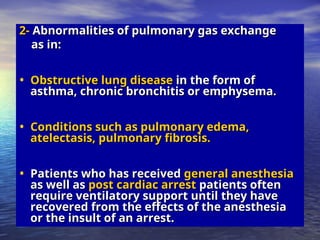
2- Abnormalities of pulmonary gas exchange
Abnormalities of pulmonary gas exchange
as in:
as in:
• Obstructive lung disease
Obstructive lung disease in the form of
in the form of
asthma, chronic bronchitis or emphysema.
• Conditions such as pulmonary edema,
Conditions such as pulmonary edema,
atelectasis, pulmonary fibrosis.
• Patients who has received
Patients who has received general anesthesia
general anesthesia
as well as
as well as post cardiac arrest
post cardiac arrest patients often
patients often
require ventilatory support until they have
recovered from the effects of the anesthesia
or the insult of an arrest.
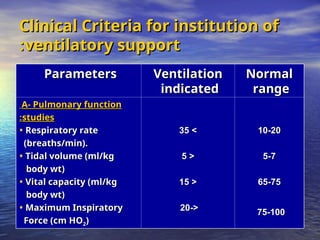
Clinical Criteria for institution of
ventilatory support
ventilatory support
:
:
Parameters
Parameters Ventilation
Ventilation
indicated
indicated
Normal
Normal
range
range
A- Pulmonary function
studies
studies
:
:
• Respiratory rate
Respiratory rate
(breaths/min).
(breaths/min).
• Tidal volume (ml/kg
Tidal volume (ml/kg
body wt)
body wt)
• Vital capacity (ml/kg
Vital capacity (ml/kg
body wt)
body wt)
• Maximum Inspiratory
Maximum Inspiratory
Force (cm HO
Force (cm HO2)
)
>
>
35
35
<
<
5
5
<
<
15
15
-<
-<
20
20
10-20
10-20
5-7
5-7
65-75
65-75
75-100
75-100
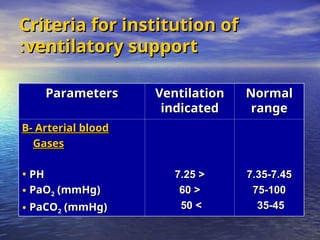
Criteria for institution of
ventilatory support
ventilatory support
:
:
Parameters
Parameters Ventilation
Ventilation
indicated
indicated
Normal
Normal
range
range
B- Arterial blood
B- Arterial blood
Gases
Gases
• PH
PH
• PaO
PaO2 (mmHg)
(mmHg)
• PaCO
PaCO2 (mmHg)
(mmHg)
<
<
7.25
7.25
<
<
60
60
>
>
50
50
7.35-7.45
7.35-7.45
75-100
75-100
35-45
35-45
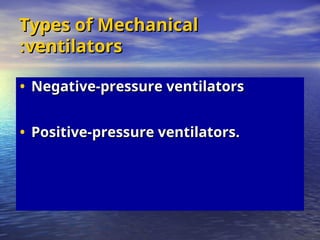
Types of Mechanical
Types of Mechanical
ventilators
ventilators
:
:
• Negative-pressure ventilators
Negative-pressure ventilators
• Positive-pressure ventilators.
Positive-pressure ventilators.
Negative-Pressure Ventilators
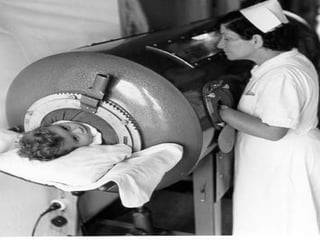
• Early negative-pressure ventilators
Early negative-pressure ventilators
were known as
were known as “
“iron lungs.
iron lungs.”
”
• The patient
The patient’
’s body was encased in an
s body was encased in an
iron cylinder and negative pressure
was generated .
was generated .
Positive-pressure ventilators
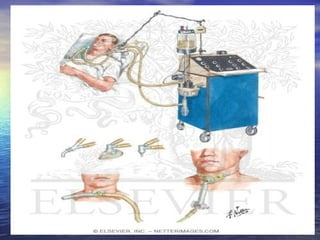
• Positive-pressure ventilators deliver
Positive-pressure ventilators deliver
gas to the patient under positive-
pressure, during the inspiratory
phase.
phase.
Types of Positive-Pressure
Ventilators
Ventilators
1-
1- Volume Ventilators.
Volume Ventilators.
2-
2- Pressure Ventilators
Pressure Ventilators
• The volume ventilator is
The volume ventilator is commonly used
commonly used in
in
emergency situations.
• The basic principle of this ventilator is that
The basic principle of this ventilator is that
a designated volume of air is delivered
with each breath.
with each breath.
• With this mode of ventilation, a
With this mode of ventilation, a respiratory
respiratory
rate, inspiratory time, and tidal volume
rate, inspiratory time, and tidal volume are
are
selected for the mechanical breaths.
1-
1- Volume Ventilators
Volume Ventilators
• The amount of
The amount of pressure
pressure required to deliver
required to deliver
the set volume
the set volume depends on :-
depends on :-
- Patient
- Patient’
’s lung compliance
s lung compliance
- Patient
- Patient–
–ventilator resistance factors.
ventilator resistance factors.
• Therefore,
Therefore, peak inspiratory pressure
peak inspiratory pressure (PIP )
(PIP )
must be monitored
must be monitored in volume modes
in volume modes
because it varies from breath to breath.
• The use of pressure ventilators
The use of pressure ventilators is increasing
is increasing
in critical care units.
• A typical pressure mode
A typical pressure mode delivers a selected
delivers a selected
gas pressure to the patient early in
inspiration, and sustains the pressure
throughout the inspiratory phase.
• By meeting the patient
By meeting the patient’
’s inspiratory flow
s inspiratory flow
demand throughout inspiration,
demand throughout inspiration, patient
patient
effort is reduced and comfort increased.
2-
2- Pressure Ventilators
Pressure Ventilators
• Although
Although pressure is consistent
pressure is consistent with these
with these
modes, volume is not.
• Volume will change with changes in
Volume will change with changes in
resistance or compliance,
• Therefore,
Therefore, exhaled tidal volume is the
exhaled tidal volume is the
variable to monitor closely.
• With pressure modes,
With pressure modes, the pressure level to
the pressure level to
be delivered is selected, and with some
mode options
mode options (i.e., pressure controlled [PC],
(i.e., pressure controlled [PC],
described later),
described later), rate and inspiratory time
rate and inspiratory time
are preset as well.
are preset as well.
Ventilator mode
Ventilator mode
• The way the machine ventilates the
The way the machine ventilates the
patient
patient
• How much the patient will participate
How much the patient will participate
in his own ventilatory pattern.
• Each mode is different in determining
Each mode is different in determining
how much work of breathing the
patient has to do.
patient has to do.
1- Control Mode (CM)
Continuous Mandatory Ventilation
( CMV)
( CMV)
• Ventilation is completely provided by the mechanical
Ventilation is completely provided by the mechanical
ventilator with
ventilator with a preset tidal volume, respiratory rate
a preset tidal volume, respiratory rate
and oxygen concentration
• Ventilator
Ventilator totally controls the patient
totally controls the patient’
’s ventilation
s ventilation i.e.
i.e.
the ventilator initiates and controls both the volume
delivered and the frequency of breath.
• Patient does not breathe spontaneously.
Patient does not breathe spontaneously.
• It can be both
It can be both volume controlled or pressure
volume controlled or pressure
controlled.
controlled.
Pressure-Controlled
Pressure-Controlled
Ventilation Mode ( PCV)
• In pressure controlled ventilation the breathing gas
In pressure controlled ventilation the breathing gas
flows under constant pressure into the lungs during
the selected inspiratory time.
• The flow is highest at the beginning of inspiration( i.e
The flow is highest at the beginning of inspiration( i.e
when the volume is lowest in the lungs).
• As the pressure is constant the flow is initially high
As the pressure is constant the flow is initially high
and then decreases with increasing filling of the
lungs.
lungs.
Assist Control Mode A/C
• The ventilator provides the patient with a
The ventilator provides the patient with a
pre-set tidal volume at a pre-set rate .
• The patient may
The patient may initiate a breath on his
initiate a breath on his
own
own, but the
, but the ventilator assists by delivering
ventilator assists by delivering
a specified tidal volume to the patient.
Client can initiate breaths that are
delivered at the preset tidal volume.
• Client can breathe at a higher rate than the
Client can breathe at a higher rate than the
preset number of breaths/minute
• Often used as initial mode of
Often used as initial mode of
ventilation
ventilation
Disadvantages:
Disadvantages:
• Hyperventilation,
Hyperventilation,
Synchronized Intermittent
Mandatory Ventilation (SIMV)
• The ventilator provides the patient with a pre-set
The ventilator provides the patient with a pre-set
number of breaths/minute at a specified tidal
volume and FiO
volume and FiO2.
.
• In between the ventilator-delivered breaths
In between the ventilator-delivered breaths, the
, the
patient is able to
patient is able to breathe spontaneously at his
breathe spontaneously at his
own tidal volume and rate
own tidal volume and rate with no assistance
with no assistance
from the ventilator.
• However, unlike the A/C mode,
However, unlike the A/C mode, any breaths taken
any breaths taken
above the set rate are spontaneous breaths taken
through the ventilator circuit.
• The tidal volume of these breaths can vary
The tidal volume of these breaths can vary
drastically from the tidal volume set on the
ventilator
ventilator, because the tidal volume is
, because the tidal volume is
determined by the
determined by the patient
patient’
’s spontaneous
s spontaneous
effort.
effort.
• Adding pressure support
Adding pressure support during
during
spontaneous breaths can
spontaneous breaths can minimize the risk
minimize the risk
of increased work of breathing.
• Ventilators breaths are
Ventilators breaths are synchronized
synchronized with
with
the patient spontaneous breathe.
( no fighting)
( no fighting)
• Used to wean the patient from the
Used to wean the patient from the
mechanical ventilator.
• Weaning
Weaning is accomplished by
is accomplished by
gradually lowering the set rate and
allowing the patient to assume more
work
work
3
3
-
-
Pressure Support Ventilation
( PSV)
( PSV)
• Pressure support ventilation augments
Pressure support ventilation augments
patient
patient’
’s spontaneous breaths with
s spontaneous breaths with
positive pressure boost during inspiration
i.e. assisting each spontaneous inspiration.
• Helps to overcome airway resistance and
Helps to overcome airway resistance and
reducing the work of breathing
reducing the work of breathing.
.
• It is a mode
It is a mode used primarily for weaning from
used primarily for weaning from
mechanical ventilation.
• Constant positive airway pressure
Constant positive airway pressure during spontaneous
during spontaneous
breathing
breathing
• CPAP allows the nurse to observe the ability of the patient
CPAP allows the nurse to observe the ability of the patient
to breathe spontaneously while still on the ventilator.
• CPAP can be used
CPAP can be used for intubated and nonintubated patients.
for intubated and nonintubated patients.
• It may be used as
It may be used as a weaning mode
a weaning mode and for
and for nocturnal
nocturnal
ventilation
ventilation (nasal or mask CPAP)
(nasal or mask CPAP)
4
4
-
-
Continuous Positive Airway
Pressure (CPAP)
Pressure (CPAP)
5
5
-
-
Positive end expiratory
pressure (PEEP)
pressure (PEEP)
• Positive pressure applied at the end
Positive pressure applied at the end
of expiration during mandatory 
ventilator breath
ventilator breath
• positive end-expiratory pressure with
positive end-expiratory pressure with
positive-pressure (machine) breaths.
Uses of CPAP & PEEP
Uses of CPAP & PEEP
• Prevent atelactasis or collapse of alveoli
Prevent atelactasis or collapse of alveoli
• Treat atelactasis or collapse of alveoli
Treat atelactasis or collapse of alveoli
• Improve gas exchange & oxygenation
Improve gas exchange & oxygenation
• Treat hypoxemia refractory to oxygen
Treat hypoxemia refractory to oxygen
therapy.(prevent oxygen toxicity
• Treat pulmonary edema ( pressure help
Treat pulmonary edema ( pressure help
expulsion of fluids from alveoli
6
6
-
-
Noninvasive Bilateral Positive
Airway Pressure Ventilation (BiPAP)
• BiPAP is a noninvasive form of mechanical
BiPAP is a noninvasive form of mechanical
ventilation
ventilation provided by means of a nasal mask
provided by means of a nasal mask
or nasal prongs, or a full-face mask.
• The system allows the clinician to select
The system allows the clinician to select two
two
levels of positive-pressure support
levels of positive-pressure support:
:
• An inspiratory pressure support level (referred
An inspiratory pressure support level (referred
to as IPAP)
to as IPAP)
• An expiratory pressure called EPAP (PEEP/CPAP
An expiratory pressure called EPAP (PEEP/CPAP
level).
level).
Common Ventilator Settings
parameters/ controls
• Fraction of inspired oxygen (FIO
Fraction of inspired oxygen (FIO2)
)
• Tidal Volume (VT)
Tidal Volume (VT)
• Peak Flow/ Flow Rate
Peak Flow/ Flow Rate
• Respiratory Rate/ Breath Rate /
Respiratory Rate/ Breath Rate /
Frequency ( F)
Frequency ( F)
• Minute Volume (VE)
Minute Volume (VE)
• I:E Ratio (Inspiration to Expiration
I:E Ratio (Inspiration to Expiration
Ratio)
Ratio)
• Sigh
Sigh
●
●
Fraction of inspired oxygen
(FIO
(FIO2)
)
• The percent of oxygen concentration that
the patient is receiving from the
ventilator. (Between 21% & 100%)
(room air has 21% oxygen content).
• Initially a patient is placed on a high level
of FIO2 (60% or higher).
• Subsequent changes in FIO2 are based on
ABGs and the SaO2.
●
●
Tidal Volume (VT)
Tidal Volume (VT)
• The volume of air delivered to a patient
The volume of air delivered to a patient
during a ventilator breath.
• The amount of air inspired and expired
The amount of air inspired and expired
with each breath.
with each breath.
• Usual volume selected is between
Usual volume selected is between 5 to 15
5 to 15
ml/ kg body weight)
ml/ kg body weight)
• In the volume ventilator, Tidal volumes of
In the volume ventilator, Tidal volumes of
10 to 15 mL/kg of body weight were
traditionally used.
traditionally used.
• the large tidal volumes may lead to
the large tidal volumes may lead to
(volutrauma)
(volutrauma) aggravate the damage
aggravate the damage
inflicted on the lungs
• For this reason, lower tidal volume targets
For this reason, lower tidal volume targets
(6 to 8 mL/kg) are now recommended.
●
●
Peak Flow/ Flow Rate
• The speed of delivering air per unit of
The speed of delivering air per unit of
time, and is expressed in liters per
minute.
minute.
• The higher the flow rate, the faster
The higher the flow rate, the faster
peak airway pressure is reached and
the shorter the inspiration;
• The lower the flow rate, the longer the
The lower the flow rate, the longer the
inspiration.
inspiration.
●
●
Respiratory Rate/ Breath
Rate / Frequency ( F)
• The number of breaths the ventilator will
The number of breaths the ventilator will
deliver/minute
deliver/minute (10-16 b/m).
(10-16 b/m).
• Total respiratory rate equals
Total respiratory rate equals patient rate
patient rate
plus ventilator rate.
• The nurse double-checks the functioning of
The nurse double-checks the functioning of
the ventilator by observing the patient
the ventilator by observing the patient’
’s
s
respiratory rate.
respiratory rate.
●
●
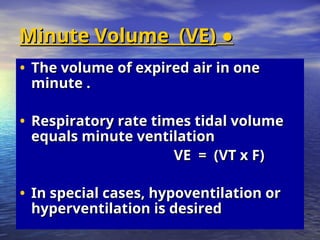
Minute Volume (VE)
Minute Volume (VE)
• The volume of expired air in one
The volume of expired air in one
minute .
minute .
• Respiratory rate times tidal volume
Respiratory rate times tidal volume
equals minute ventilation
VE = (VT x F)
VE = (VT x F)
• In special cases, hypoventilation or
In special cases, hypoventilation or
hyperventilation is desired
●
●
I:E Ratio (Inspiration to
Expiration Ratio)
Expiration Ratio)
-:
-:
• The ratio of inspiratory time to
The ratio of inspiratory time to
expiratory time during a breath
(Usually = 1:2)
(Usually = 1:2)
●
●
Peak Airway Pressure
-:
-:
• In adults
In adults if the peak airway pressure
if the peak airway pressure
is persistently
is persistently above 45 cmH
above 45 cmH2O, the
O, the
risk of barotrauma is increased
risk of barotrauma is increased and
and
efforts should be made to try to
reduce the peak airway pressure.
• In infants and children
In infants and children it is unclear
it is unclear
what level of peak pressure may
cause damage.
cause damage. In general, keeping
In general, keeping
peak pressures below 30 is desirable
peak pressures below 30 is desirable.
.
●
●
Pressure Limit
Pressure Limit
• On volume-cycled ventilators, the pressure
On volume-cycled ventilators, the pressure
limit dial
limit dial limits the highest pressure
limits the highest pressure
allowed in the ventilator circuit.
• Once the high pressure limit is reached,
Once the high pressure limit is reached,
inspiration is terminated.
• Therefore, if the pressure limit is being
Therefore, if the pressure limit is being
constantly reached,
constantly reached, the designated tidal
the designated tidal
volume is not being delivered to the
patient.
patient.
SCENARIO-1
SCENARIO-1
In a patient with head injury
In a patient with head injury,
,
• Respiratory alkalosis may be required to
Respiratory alkalosis may be required to
promote cerebral vasoconstriction, with a
resultant decrease in ICP.
• In this case, the tidal volume and
In this case, the tidal volume and
respiratory rate are increased
( hyperventilation) to achieve the desired
alkalotic pH by manipulating the PaCO
alkalotic pH by manipulating the PaCO2.
.
SCENARIO-2
SCENARIO-2
In a patient with COPD
• Baseline ABGs reflect an elevated PaCO
Baseline ABGs reflect an elevated PaCO2
should not hyperventilated. Instead, the
goal should be restoration of the baseline
PaCO
PaCO2.
.
• These patients usually have a large
These patients usually have a large
carbonic acid load, and lowering their
carbon dioxide levels rapidly may result in
seizures.
seizures.
SCENARIO-3
SCENARIO-3
In a patient in SHOCK
• Low PEEP.
Low PEEP.
• Higher FiO2.
Higher FiO2.
• Peak pressure to be limited.
Peak pressure to be limited.
SCENARIO-4
SCENARIO-4
In a patient in ARDS:
• LUNG PROTECTIVE VENTILATION.
LUNG PROTECTIVE VENTILATION.
• Low Tidal volume.
Low Tidal volume.
• High respiratory rate.
High respiratory rate.
• High PEEP.
High PEEP.
• Inverse ratio ventilation.
Inverse ratio ventilation.
Complications
Complications
of Mechanical Ventilation:-
I-
I- Airway Complications,
Airway Complications,
II-
II- Mechanical complications,
Mechanical complications,
III-
III- Physiological Complications,
Physiological Complications,
IV-
IV- Artificial Airway Complications.
Artificial Airway Complications.
I- Airway Complications
1-
1- Aspiration
Aspiration
2-
2- Decreased clearance of secretions
Decreased clearance of secretions
3-
3- Nosocomial or ventilator-acquired
Nosocomial or ventilator-acquired
pneumonia
pneumonia
II- Mechanical complications
1-
1- Hypoventilation with atelectasis with respiratory
Hypoventilation with atelectasis with respiratory
acidosis or hypoxemia.
2-
2- Hyperventilation with hypocapnia and respiratory
Hyperventilation with hypocapnia and respiratory
alkalosis
alkalosis
3-
3- Barotrauma
Barotrauma
a- Closed pneumothorax,
b- Tension pneumothorax,
c- Pneumomediastinum,
d- Subcutaneous emphysema.
4-
4- Alarm
Alarm “
“turned off
turned off”
”
5-
5- Failure of alarms or ventilator
Failure of alarms or ventilator
6-
6- Inadequate nebulization or humidification
Inadequate nebulization or humidification
7-
7- Overheated inspired air, resulting in hyperthermia
Overheated inspired air, resulting in hyperthermia
III- Physiological Complications
1-
1- Fluid overload with humidified air and
Fluid overload with humidified air and
sodium chloride (NaCl) retention
2-
2- Depressed cardiac function and
Depressed cardiac function and
hypotension
hypotension
3-
3- Stress ulcers
Stress ulcers
4-
4- Paralytic ileus
Paralytic ileus
5-
5- Gastric distension
Gastric distension
6-
6- Starvation
Starvation
7-
7- Dyssynchronous breathing pattern
Dyssynchronous breathing pattern
Thank you
Thank you

MECHANICAL VENTILATION anaesthesiology.ppt

  • 1.
    Mechanical Ventilation Mechanical Ventilation Dr.R.BRINDHA MD Dr. R.BRINDHA MD Assistant Professor Assistant Professor Anaesthesiology Anaesthesiology
  • 2.
    • Mechanical Ventilationis ventilation Mechanical Ventilation is ventilation of the lungs by artificial means of the lungs by artificial means usually by a usually by a ventilator ventilator. .
  • 3.
    Purposes Purposes : : • To maintainGas exchange & improve To maintain Gas exchange & improve tissue oxygenation. tissue oxygenation. • To decrease the work of breathing & To decrease the work of breathing & improve patient improve patient’ ’s comfort. s comfort.
  • 4.
    Indications Indications : : 1- 1- Acute respiratoryfailure due to: Acute respiratory failure due to: • Mechanical failure Mechanical failure, includes neuromuscular , includes neuromuscular diseases as Myasthenia Gravis, Guillain-Barré diseases as Myasthenia Gravis, Guillain-Barré Syndrome, and Poliomyelitis (failure of the Syndrome, and Poliomyelitis (failure of the normal respiratory neuromuscular system) normal respiratory neuromuscular system) • Musculoskeletal abnormalities Musculoskeletal abnormalities, such as chest wall , such as chest wall trauma (flail chest) trauma (flail chest) • Infectious diseases Infectious diseases of the lung such as pneumonia, of the lung such as pneumonia, tuberculosis. tuberculosis.
  • 5.
    2- 2- Abnormalities ofpulmonary gas exchange Abnormalities of pulmonary gas exchange as in: as in: • Obstructive lung disease Obstructive lung disease in the form of in the form of asthma, chronic bronchitis or emphysema. asthma, chronic bronchitis or emphysema. • Conditions such as pulmonary edema, Conditions such as pulmonary edema, atelectasis, pulmonary fibrosis. atelectasis, pulmonary fibrosis. • Patients who has received Patients who has received general anesthesia general anesthesia as well as as well as post cardiac arrest post cardiac arrest patients often patients often require ventilatory support until they have require ventilatory support until they have recovered from the effects of the anesthesia recovered from the effects of the anesthesia or the insult of an arrest. or the insult of an arrest.
  • 6.
    Clinical Criteria forinstitution of Clinical Criteria for institution of ventilatory support ventilatory support : : Parameters Parameters Ventilation Ventilation indicated indicated Normal Normal range range A- Pulmonary function A- Pulmonary function studies studies : : • Respiratory rate Respiratory rate (breaths/min). (breaths/min). • Tidal volume (ml/kg Tidal volume (ml/kg body wt) body wt) • Vital capacity (ml/kg Vital capacity (ml/kg body wt) body wt) • Maximum Inspiratory Maximum Inspiratory Force (cm HO Force (cm HO2) ) > > 35 35 < < 5 5 < < 15 15 -< -< 20 20 10-20 10-20 5-7 5-7 65-75 65-75 75-100 75-100
  • 7.
    Criteria for institutionof Criteria for institution of ventilatory support ventilatory support : : Parameters Parameters Ventilation Ventilation indicated indicated Normal Normal range range B- Arterial blood B- Arterial blood Gases Gases • PH PH • PaO PaO2 (mmHg) (mmHg) • PaCO PaCO2 (mmHg) (mmHg) < < 7.25 7.25 < < 60 60 > > 50 50 7.35-7.45 7.35-7.45 75-100 75-100 35-45 35-45
  • 8.
    Types of Mechanical Typesof Mechanical ventilators ventilators : : • Negative-pressure ventilators Negative-pressure ventilators • Positive-pressure ventilators. Positive-pressure ventilators.
  • 9.
    Negative-Pressure Ventilators Negative-Pressure Ventilators •Early negative-pressure ventilators Early negative-pressure ventilators were known as were known as “ “iron lungs. iron lungs.” ” • The patient The patient’ ’s body was encased in an s body was encased in an iron cylinder and negative pressure iron cylinder and negative pressure was generated . was generated .
  • 11.
    Positive-pressure ventilators Positive-pressure ventilators •Positive-pressure ventilators deliver Positive-pressure ventilators deliver gas to the patient under positive- gas to the patient under positive- pressure, during the inspiratory pressure, during the inspiratory phase. phase.
  • 13.
    Types of Positive-Pressure Typesof Positive-Pressure Ventilators Ventilators 1- 1- Volume Ventilators. Volume Ventilators. 2- 2- Pressure Ventilators Pressure Ventilators
  • 14.
    • The volumeventilator is The volume ventilator is commonly used commonly used in in emergency situations. emergency situations. • The basic principle of this ventilator is that The basic principle of this ventilator is that a designated volume of air is delivered a designated volume of air is delivered with each breath. with each breath. • With this mode of ventilation, a With this mode of ventilation, a respiratory respiratory rate, inspiratory time, and tidal volume rate, inspiratory time, and tidal volume are are selected for the mechanical breaths. selected for the mechanical breaths. 1- 1- Volume Ventilators Volume Ventilators
  • 15.
    • The amountof The amount of pressure pressure required to deliver required to deliver the set volume the set volume depends on :- depends on :- - Patient - Patient’ ’s lung compliance s lung compliance - Patient - Patient– –ventilator resistance factors. ventilator resistance factors. • Therefore, Therefore, peak inspiratory pressure peak inspiratory pressure (PIP ) (PIP ) must be monitored must be monitored in volume modes in volume modes because it varies from breath to breath. because it varies from breath to breath.
  • 16.
    • The useof pressure ventilators The use of pressure ventilators is increasing is increasing in critical care units. in critical care units. • A typical pressure mode A typical pressure mode delivers a selected delivers a selected gas pressure to the patient early in gas pressure to the patient early in inspiration, and sustains the pressure inspiration, and sustains the pressure throughout the inspiratory phase. throughout the inspiratory phase. • By meeting the patient By meeting the patient’ ’s inspiratory flow s inspiratory flow demand throughout inspiration, demand throughout inspiration, patient patient effort is reduced and comfort increased. effort is reduced and comfort increased. 2- 2- Pressure Ventilators Pressure Ventilators
  • 17.
    • Although Although pressureis consistent pressure is consistent with these with these modes, volume is not. modes, volume is not. • Volume will change with changes in Volume will change with changes in resistance or compliance, resistance or compliance, • Therefore, Therefore, exhaled tidal volume is the exhaled tidal volume is the variable to monitor closely. variable to monitor closely. • With pressure modes, With pressure modes, the pressure level to the pressure level to be delivered is selected, and with some be delivered is selected, and with some mode options mode options (i.e., pressure controlled [PC], (i.e., pressure controlled [PC], described later), described later), rate and inspiratory time rate and inspiratory time are preset as well. are preset as well.
  • 18.
    Ventilator mode Ventilator mode •The way the machine ventilates the The way the machine ventilates the patient patient • How much the patient will participate How much the patient will participate in his own ventilatory pattern. in his own ventilatory pattern. • Each mode is different in determining Each mode is different in determining how much work of breathing the how much work of breathing the patient has to do. patient has to do.
  • 19.
    1- Control Mode(CM) 1- Control Mode (CM) Continuous Mandatory Ventilation Continuous Mandatory Ventilation ( CMV) ( CMV) • Ventilation is completely provided by the mechanical Ventilation is completely provided by the mechanical ventilator with ventilator with a preset tidal volume, respiratory rate a preset tidal volume, respiratory rate and oxygen concentration and oxygen concentration • Ventilator Ventilator totally controls the patient totally controls the patient’ ’s ventilation s ventilation i.e. i.e. the ventilator initiates and controls both the volume the ventilator initiates and controls both the volume delivered and the frequency of breath. delivered and the frequency of breath. • Patient does not breathe spontaneously. Patient does not breathe spontaneously. • It can be both It can be both volume controlled or pressure volume controlled or pressure controlled. controlled.
  • 20.
    Pressure-Controlled Pressure-Controlled Ventilation Mode (PCV) Ventilation Mode ( PCV) • In pressure controlled ventilation the breathing gas In pressure controlled ventilation the breathing gas flows under constant pressure into the lungs during flows under constant pressure into the lungs during the selected inspiratory time. the selected inspiratory time. • The flow is highest at the beginning of inspiration( i.e The flow is highest at the beginning of inspiration( i.e when the volume is lowest in the lungs). when the volume is lowest in the lungs). • As the pressure is constant the flow is initially high As the pressure is constant the flow is initially high and then decreases with increasing filling of the and then decreases with increasing filling of the lungs. lungs.
  • 21.
    Assist Control ModeA/C Assist Control Mode A/C • The ventilator provides the patient with a The ventilator provides the patient with a pre-set tidal volume at a pre-set rate . pre-set tidal volume at a pre-set rate . • The patient may The patient may initiate a breath on his initiate a breath on his own own, but the , but the ventilator assists by delivering ventilator assists by delivering a specified tidal volume to the patient. a specified tidal volume to the patient. Client can initiate breaths that are Client can initiate breaths that are delivered at the preset tidal volume. delivered at the preset tidal volume. • Client can breathe at a higher rate than the Client can breathe at a higher rate than the preset number of breaths/minute preset number of breaths/minute
  • 22.
    • Often usedas initial mode of Often used as initial mode of ventilation ventilation Disadvantages: Disadvantages: • Hyperventilation, Hyperventilation,
  • 23.
    Synchronized Intermittent Synchronized Intermittent MandatoryVentilation (SIMV) Mandatory Ventilation (SIMV) • The ventilator provides the patient with a pre-set The ventilator provides the patient with a pre-set number of breaths/minute at a specified tidal number of breaths/minute at a specified tidal volume and FiO volume and FiO2. . • In between the ventilator-delivered breaths In between the ventilator-delivered breaths, the , the patient is able to patient is able to breathe spontaneously at his breathe spontaneously at his own tidal volume and rate own tidal volume and rate with no assistance with no assistance from the ventilator. from the ventilator. • However, unlike the A/C mode, However, unlike the A/C mode, any breaths taken any breaths taken above the set rate are spontaneous breaths taken above the set rate are spontaneous breaths taken through the ventilator circuit. through the ventilator circuit.
  • 24.
    • The tidalvolume of these breaths can vary The tidal volume of these breaths can vary drastically from the tidal volume set on the drastically from the tidal volume set on the ventilator ventilator, because the tidal volume is , because the tidal volume is determined by the determined by the patient patient’ ’s spontaneous s spontaneous effort. effort. • Adding pressure support Adding pressure support during during spontaneous breaths can spontaneous breaths can minimize the risk minimize the risk of increased work of breathing. of increased work of breathing. • Ventilators breaths are Ventilators breaths are synchronized synchronized with with the patient spontaneous breathe. the patient spontaneous breathe. ( no fighting) ( no fighting)
  • 25.
    • Used towean the patient from the Used to wean the patient from the mechanical ventilator. mechanical ventilator. • Weaning Weaning is accomplished by is accomplished by gradually lowering the set rate and gradually lowering the set rate and allowing the patient to assume more allowing the patient to assume more work work
  • 26.
    3 3 - - Pressure Support Ventilation PressureSupport Ventilation ( PSV) ( PSV) • Pressure support ventilation augments Pressure support ventilation augments patient patient’ ’s spontaneous breaths with s spontaneous breaths with positive pressure boost during inspiration positive pressure boost during inspiration i.e. assisting each spontaneous inspiration. i.e. assisting each spontaneous inspiration. • Helps to overcome airway resistance and Helps to overcome airway resistance and reducing the work of breathing reducing the work of breathing. . • It is a mode It is a mode used primarily for weaning from used primarily for weaning from mechanical ventilation. mechanical ventilation.
  • 27.
    • Constant positiveairway pressure Constant positive airway pressure during spontaneous during spontaneous breathing breathing • CPAP allows the nurse to observe the ability of the patient CPAP allows the nurse to observe the ability of the patient to breathe spontaneously while still on the ventilator. to breathe spontaneously while still on the ventilator. • CPAP can be used CPAP can be used for intubated and nonintubated patients. for intubated and nonintubated patients. • It may be used as It may be used as a weaning mode a weaning mode and for and for nocturnal nocturnal ventilation ventilation (nasal or mask CPAP) (nasal or mask CPAP) 4 4 - - Continuous Positive Airway Continuous Positive Airway Pressure (CPAP) Pressure (CPAP)
  • 28.
    5 5 - - Positive end expiratory Positiveend expiratory pressure (PEEP) pressure (PEEP) • Positive pressure applied at the end Positive pressure applied at the end of expiration during mandatory of expiration during mandatory ventilator breath ventilator breath • positive end-expiratory pressure with positive end-expiratory pressure with positive-pressure (machine) breaths. positive-pressure (machine) breaths.
  • 29.
    Uses of CPAP& PEEP Uses of CPAP & PEEP • Prevent atelactasis or collapse of alveoli Prevent atelactasis or collapse of alveoli • Treat atelactasis or collapse of alveoli Treat atelactasis or collapse of alveoli • Improve gas exchange & oxygenation Improve gas exchange & oxygenation • Treat hypoxemia refractory to oxygen Treat hypoxemia refractory to oxygen therapy.(prevent oxygen toxicity therapy.(prevent oxygen toxicity • Treat pulmonary edema ( pressure help Treat pulmonary edema ( pressure help expulsion of fluids from alveoli expulsion of fluids from alveoli
  • 30.
    6 6 - - Noninvasive Bilateral Positive NoninvasiveBilateral Positive Airway Pressure Ventilation (BiPAP) Airway Pressure Ventilation (BiPAP) • BiPAP is a noninvasive form of mechanical BiPAP is a noninvasive form of mechanical ventilation ventilation provided by means of a nasal mask provided by means of a nasal mask or nasal prongs, or a full-face mask. or nasal prongs, or a full-face mask. • The system allows the clinician to select The system allows the clinician to select two two levels of positive-pressure support levels of positive-pressure support: : • An inspiratory pressure support level (referred An inspiratory pressure support level (referred to as IPAP) to as IPAP) • An expiratory pressure called EPAP (PEEP/CPAP An expiratory pressure called EPAP (PEEP/CPAP level). level).
  • 31.
    Common Ventilator Settings CommonVentilator Settings parameters/ controls parameters/ controls • Fraction of inspired oxygen (FIO Fraction of inspired oxygen (FIO2) ) • Tidal Volume (VT) Tidal Volume (VT) • Peak Flow/ Flow Rate Peak Flow/ Flow Rate • Respiratory Rate/ Breath Rate / Respiratory Rate/ Breath Rate / Frequency ( F) Frequency ( F) • Minute Volume (VE) Minute Volume (VE) • I:E Ratio (Inspiration to Expiration I:E Ratio (Inspiration to Expiration Ratio) Ratio) • Sigh Sigh
  • 32.
    ● ● Fraction of inspiredoxygen Fraction of inspired oxygen (FIO (FIO2) ) • The percent of oxygen concentration that the patient is receiving from the ventilator. (Between 21% & 100%) (room air has 21% oxygen content). • Initially a patient is placed on a high level of FIO2 (60% or higher). • Subsequent changes in FIO2 are based on ABGs and the SaO2.
  • 33.
    ● ● Tidal Volume (VT) TidalVolume (VT) • The volume of air delivered to a patient The volume of air delivered to a patient during a ventilator breath. during a ventilator breath. • The amount of air inspired and expired The amount of air inspired and expired with each breath. with each breath. • Usual volume selected is between Usual volume selected is between 5 to 15 5 to 15 ml/ kg body weight) ml/ kg body weight)
  • 34.
    • In thevolume ventilator, Tidal volumes of In the volume ventilator, Tidal volumes of 10 to 15 mL/kg of body weight were 10 to 15 mL/kg of body weight were traditionally used. traditionally used. • the large tidal volumes may lead to the large tidal volumes may lead to (volutrauma) (volutrauma) aggravate the damage aggravate the damage inflicted on the lungs inflicted on the lungs • For this reason, lower tidal volume targets For this reason, lower tidal volume targets (6 to 8 mL/kg) are now recommended. (6 to 8 mL/kg) are now recommended.
  • 35.
    ● ● Peak Flow/ FlowRate Peak Flow/ Flow Rate • The speed of delivering air per unit of The speed of delivering air per unit of time, and is expressed in liters per time, and is expressed in liters per minute. minute. • The higher the flow rate, the faster The higher the flow rate, the faster peak airway pressure is reached and peak airway pressure is reached and the shorter the inspiration; the shorter the inspiration; • The lower the flow rate, the longer the The lower the flow rate, the longer the inspiration. inspiration.
  • 36.
    ● ● Respiratory Rate/ Breath RespiratoryRate/ Breath Rate / Frequency ( F) Rate / Frequency ( F) • The number of breaths the ventilator will The number of breaths the ventilator will deliver/minute deliver/minute (10-16 b/m). (10-16 b/m). • Total respiratory rate equals Total respiratory rate equals patient rate patient rate plus ventilator rate. plus ventilator rate. • The nurse double-checks the functioning of The nurse double-checks the functioning of the ventilator by observing the patient the ventilator by observing the patient’ ’s s respiratory rate. respiratory rate.
  • 37.
    ● ● Minute Volume (VE) MinuteVolume (VE) • The volume of expired air in one The volume of expired air in one minute . minute . • Respiratory rate times tidal volume Respiratory rate times tidal volume equals minute ventilation equals minute ventilation VE = (VT x F) VE = (VT x F) • In special cases, hypoventilation or In special cases, hypoventilation or hyperventilation is desired hyperventilation is desired
  • 38.
    ● ● I:E Ratio (Inspirationto I:E Ratio (Inspiration to Expiration Ratio) Expiration Ratio) -: -: • The ratio of inspiratory time to The ratio of inspiratory time to expiratory time during a breath expiratory time during a breath (Usually = 1:2) (Usually = 1:2)
  • 39.
    ● ● Peak Airway Pressure PeakAirway Pressure -: -: • In adults In adults if the peak airway pressure if the peak airway pressure is persistently is persistently above 45 cmH above 45 cmH2O, the O, the risk of barotrauma is increased risk of barotrauma is increased and and efforts should be made to try to efforts should be made to try to reduce the peak airway pressure. reduce the peak airway pressure. • In infants and children In infants and children it is unclear it is unclear what level of peak pressure may what level of peak pressure may cause damage. cause damage. In general, keeping In general, keeping peak pressures below 30 is desirable peak pressures below 30 is desirable. .
  • 40.
    ● ● Pressure Limit Pressure Limit •On volume-cycled ventilators, the pressure On volume-cycled ventilators, the pressure limit dial limit dial limits the highest pressure limits the highest pressure allowed in the ventilator circuit. allowed in the ventilator circuit. • Once the high pressure limit is reached, Once the high pressure limit is reached, inspiration is terminated. inspiration is terminated. • Therefore, if the pressure limit is being Therefore, if the pressure limit is being constantly reached, constantly reached, the designated tidal the designated tidal volume is not being delivered to the volume is not being delivered to the patient. patient.
  • 41.
    SCENARIO-1 SCENARIO-1 In a patientwith head injury In a patient with head injury, , • Respiratory alkalosis may be required to Respiratory alkalosis may be required to promote cerebral vasoconstriction, with a promote cerebral vasoconstriction, with a resultant decrease in ICP. resultant decrease in ICP. • In this case, the tidal volume and In this case, the tidal volume and respiratory rate are increased respiratory rate are increased ( hyperventilation) to achieve the desired ( hyperventilation) to achieve the desired alkalotic pH by manipulating the PaCO alkalotic pH by manipulating the PaCO2. .
  • 42.
    SCENARIO-2 SCENARIO-2 In a patientwith COPD In a patient with COPD • Baseline ABGs reflect an elevated PaCO Baseline ABGs reflect an elevated PaCO2 should not hyperventilated. Instead, the should not hyperventilated. Instead, the goal should be restoration of the baseline goal should be restoration of the baseline PaCO PaCO2. . • These patients usually have a large These patients usually have a large carbonic acid load, and lowering their carbonic acid load, and lowering their carbon dioxide levels rapidly may result in carbon dioxide levels rapidly may result in seizures. seizures.
  • 43.
    SCENARIO-3 SCENARIO-3 In a patientin SHOCK In a patient in SHOCK • Low PEEP. Low PEEP. • Higher FiO2. Higher FiO2. • Peak pressure to be limited. Peak pressure to be limited.
  • 44.
    SCENARIO-4 SCENARIO-4 In a patientin ARDS: In a patient in ARDS: • LUNG PROTECTIVE VENTILATION. LUNG PROTECTIVE VENTILATION. • Low Tidal volume. Low Tidal volume. • High respiratory rate. High respiratory rate. • High PEEP. High PEEP. • Inverse ratio ventilation. Inverse ratio ventilation.
  • 45.
    Complications Complications of Mechanical Ventilation:- ofMechanical Ventilation:- I- I- Airway Complications, Airway Complications, II- II- Mechanical complications, Mechanical complications, III- III- Physiological Complications, Physiological Complications, IV- IV- Artificial Airway Complications. Artificial Airway Complications.
  • 46.
    I- Airway Complications I-Airway Complications 1- 1- Aspiration Aspiration 2- 2- Decreased clearance of secretions Decreased clearance of secretions 3- 3- Nosocomial or ventilator-acquired Nosocomial or ventilator-acquired pneumonia pneumonia
  • 47.
    II- Mechanical complications II-Mechanical complications 1- 1- Hypoventilation with atelectasis with respiratory Hypoventilation with atelectasis with respiratory acidosis or hypoxemia. acidosis or hypoxemia. 2- 2- Hyperventilation with hypocapnia and respiratory Hyperventilation with hypocapnia and respiratory alkalosis alkalosis 3- 3- Barotrauma Barotrauma a- Closed pneumothorax, a- Closed pneumothorax, b- Tension pneumothorax, b- Tension pneumothorax, c- Pneumomediastinum, c- Pneumomediastinum, d- Subcutaneous emphysema. d- Subcutaneous emphysema. 4- 4- Alarm Alarm “ “turned off turned off” ” 5- 5- Failure of alarms or ventilator Failure of alarms or ventilator 6- 6- Inadequate nebulization or humidification Inadequate nebulization or humidification 7- 7- Overheated inspired air, resulting in hyperthermia Overheated inspired air, resulting in hyperthermia
  • 48.
    III- Physiological Complications III-Physiological Complications 1- 1- Fluid overload with humidified air and Fluid overload with humidified air and sodium chloride (NaCl) retention sodium chloride (NaCl) retention 2- 2- Depressed cardiac function and Depressed cardiac function and hypotension hypotension 3- 3- Stress ulcers Stress ulcers 4- 4- Paralytic ileus Paralytic ileus 5- 5- Gastric distension Gastric distension 6- 6- Starvation Starvation 7- 7- Dyssynchronous breathing pattern Dyssynchronous breathing pattern
  • 49.