Variable
F requency
Drive
(VF D)P arth De s ai : Author
What Is a VF D?
[1 ]
◎ A type of adjustable-speed drive
◎ Vary motor input frequency and voltage <=> C ontrol AC
motor output speed & torque
◎ Part of “electro-mechanical” drive systems
2
https://en.wikipedia.org/wiki/Variable -frequency_ drive [1 ]
Also known as
Adjustable
Frequency
Drive (AFD)
Variable -
Voltage
/Variable
- Frequency
(VVVFD)
Variable
S peed Drive
(VSD)
AC Drive
Micro Drive
Inverter Drive
Need
[2]
C ontrolled S tarting
C urrent
Reduced Power Line
Disturbances
Lower Power Demand
on S tart
Adjustable Operating
S peed
Adjustable Torque
Limit
3
S peed C ontrol Is one of the primary advantages of switching to VF Ds. VF Ds allow motor speeds
to be ramped up and ramped down ensuring connected load is aintained at the required speeds with
necessary energy utilization.
C ontrolled
Acceleration
C ontrolled S topping E nergy S avings Reverse Operation
E liminates Use of
Mech. Drive
C omponents https://www.wolfautomation.com/blog/benefits -vfd/ [2]
https://www.paddockindustries.com/wp-content/uploads/201 7/05/Why-Variable-F requency-Drive-F inal-2-1 6-
1 1 .pdf[3]
Lower Maintenance
C osts
[3]
Longer Motor Life
[3]
What Is a VF D? - S chematic & Internal C onstruction[4]
4
https://www.youtube.com/watch? reload=9&v=3-cs 4eE iB Wo [4]
What Is a VF D? - S chematic & Internal C onstruction[4]
5
Motor S tarter C ircuit - Direct-On-L ine (DOL )
6
[5]
Motor S tarter C ircuit - S tar Delta
7
[6]
Manual Motor S tarting
Other S tarters [4]
8
Magnetic Motor S tarting
Primary Resistor S tarting
Auto Transformer S tarting
S C R S tarting /S oft S tarting
https://www.youtube.com/watch? reload=9&v=3-cs 4eE iB Wo [4]
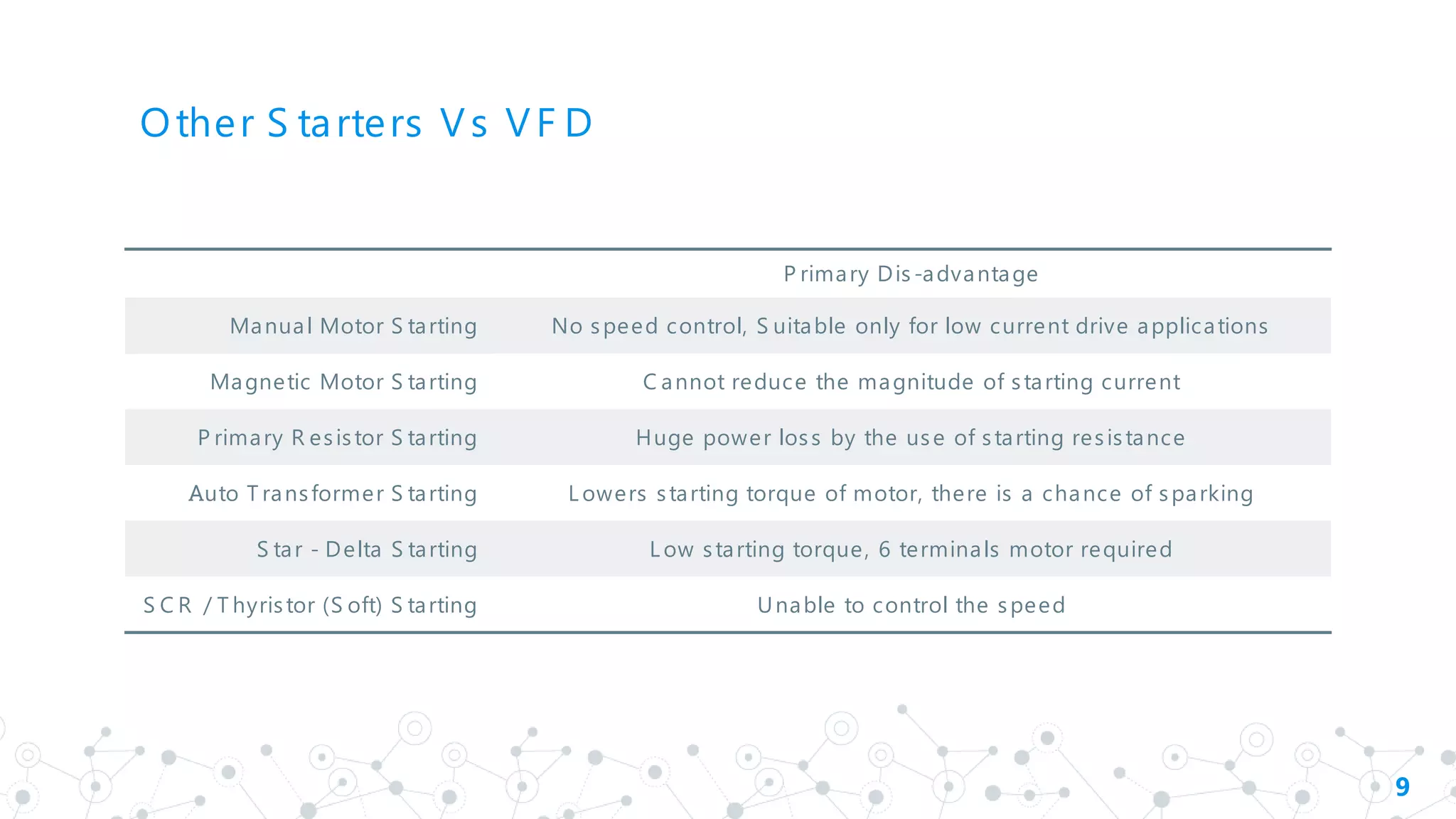
Other S tarters Vs VF D
P rimary Dis -advantage
Manual Motor S tarting No speed control, S uitable only for low current drive applications
Magnetic Motor S tarting C annot reduce the magnitude of starting current
P rimary R esistor S tarting Huge power loss by the use of starting resistance
Auto T ransformer S tarting L owers starting torque of motor, there is a chance of sparking
S tar - Delta S tarting L ow starting torque, 6 terminals motor required
S C R / T hyristor (S oft) S tarting Unable to control the speed
9
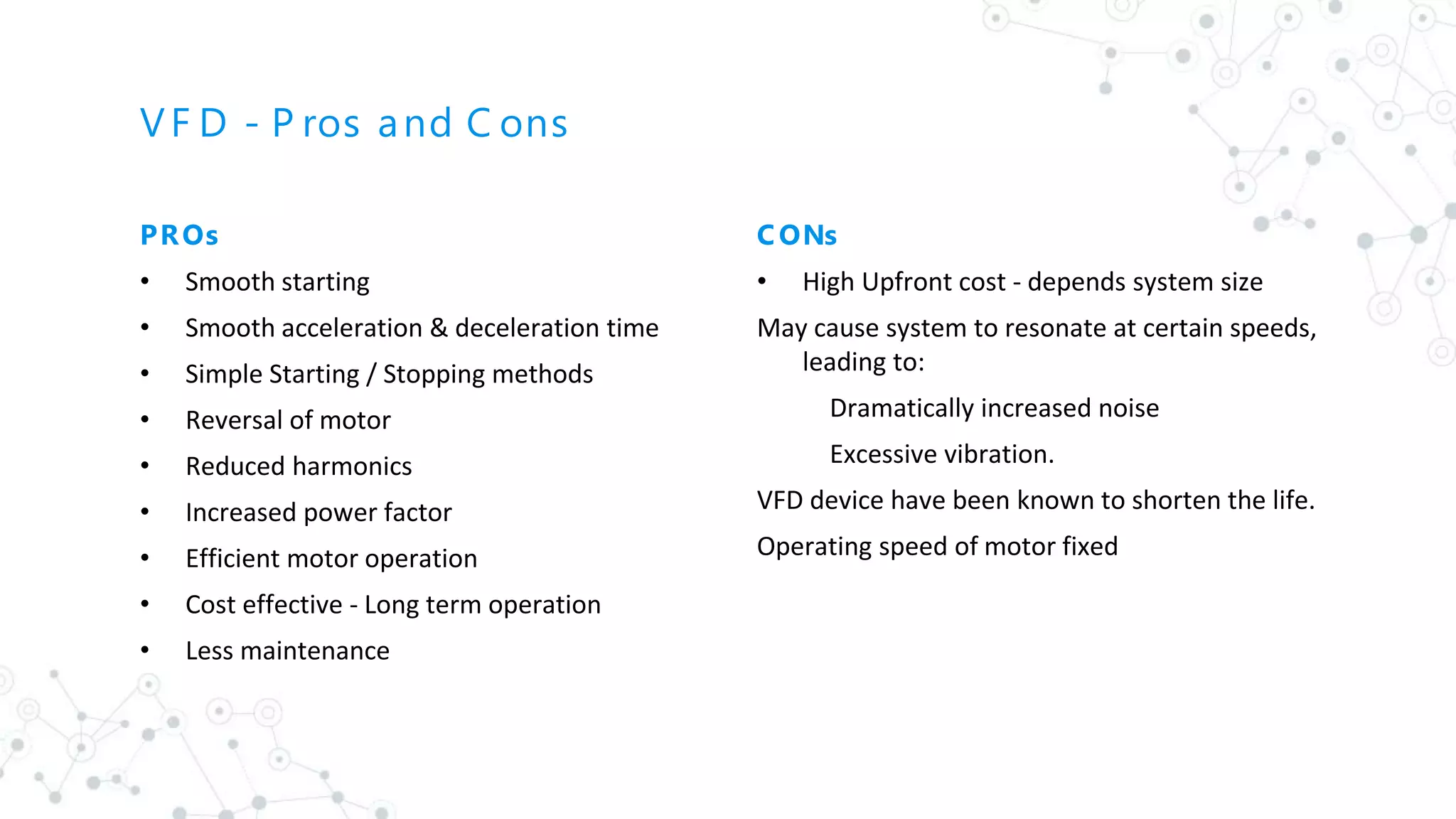
VF D - P ros and C ons
PROs
• Smooth starting
• Smooth acceleration & deceleration time
• Simple Starting / Stopping methods
• Reversal of motor
• Reduced harmonics
• Increased power factor
• Efficient motor operation
• Cost effective - Long term operation
• Less maintenance
C ONs
• High Upfront cost - depends system size
May cause system to resonate at certain speeds,
leading to:
Dramatically increased noise
Excessive vibration.
VFD device have been known to shorten the life.
Operating speed of motor fixed
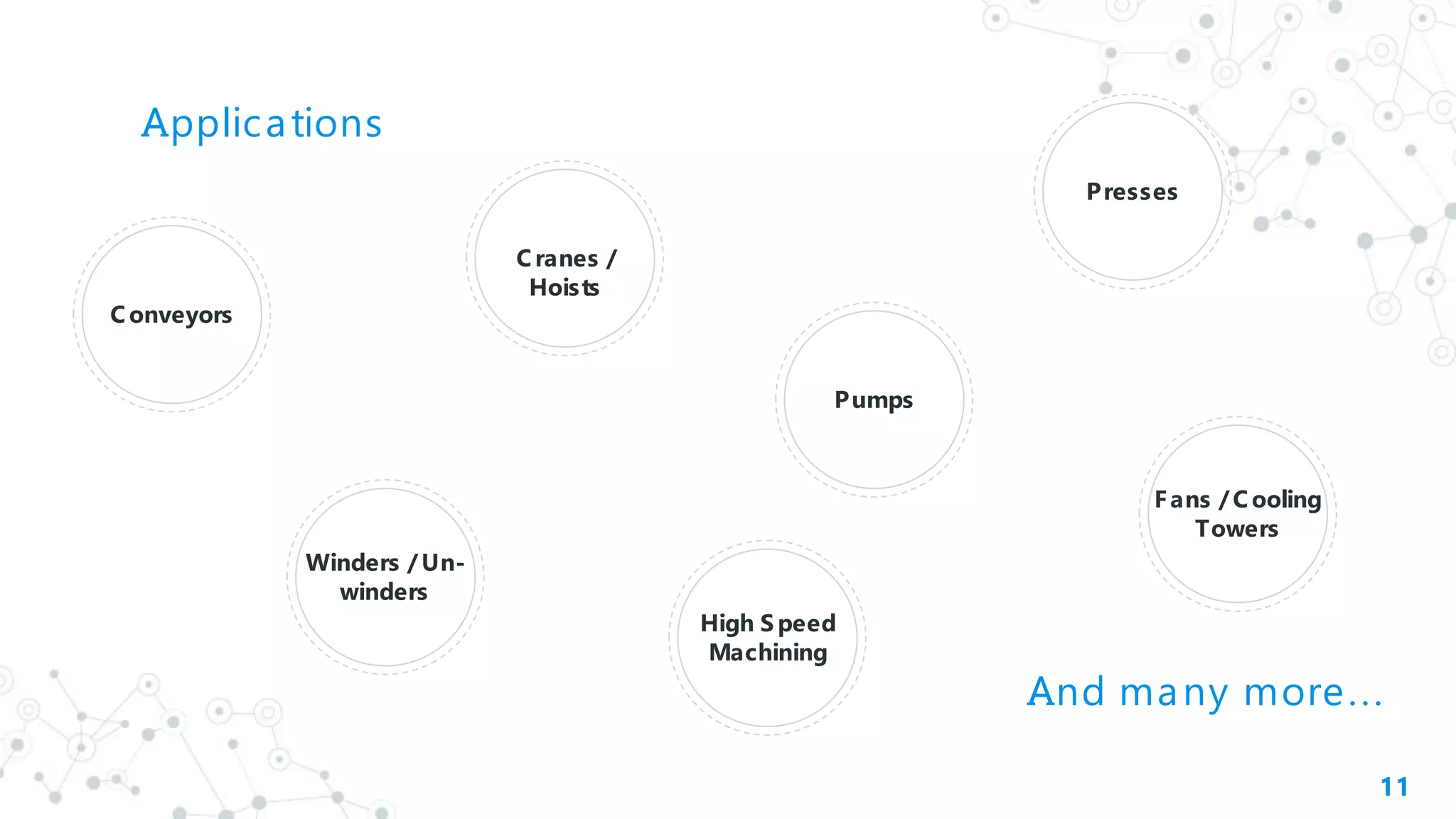
Applications
11
And many more...
C onveyors
Fans /C ooling
Towers
C ranes /
Hoists
High S peed
Machining
Winders /Un-
winders
Presses
Pumps
“
12
How to Select a VFD
 Operating Voltage
 Max. Horsepower rating
 Max. Output Current
 E nclosure Type (if applicable)
 Application
 Operating S peed limits
 Mounting & Wiring
considerations
 Communication
 Part S tandarization
 Cost
VF D Models & Manufacturers
 Allen Bradley
(P ower F lex 4M
S eries)
13
 Danfoss
(VLT Micro S eries)
Other VFD Manufacturers: ABB, Toshiba, F uji E lectrica, Y askawa,
E merson
 S chneider E lectric
(Altivar S eries)
Allen Bradley VF D - Power F lex 4M S eries
Part No.
14
Allen Bradley VF D - Power F lex 4M S eries
Pinout
15
Allen Bradley VF D - Power F lex 4M S eries
Motor Connections
16
Power Terminal Block
R/l1, S/L2 1-Phase Input
R/l1, S/L2, T/L3 3-Phase Input
U/T1, V/T2, T/L3 To Motor
BR+, BR- Dynamic Brake Resistor
Safety Ground - PE
Allen Bradley VF D - Power F lex 4M S eries
Control Panel
17
Console Display Parameter Group
Display Group (View Only)
Basic Program Group
Terminal Block Group
Communications Group
Advanced Program Group
Allen Bradley VF D - Power F lex 4M S eries
Parameter Configuration
18
No. Parameter
Min / Max
Value
Display/Options
Default
Value
P101 [Motor Nameplate Volts]
20 to Drive
Rated Volts
1 VAC
Based on
Drive Rating
P102 [Motor Nameplate Hertz] 10 to 400 Hz 1 Hz 60 Hz
P103 [Motor Overload Current]
0.0 to (Drive
Rated Amps x2)
0.1 Amps
Based on
Drive Rating
P104 [Minimum Frequency] 0.0 to 400 Hz 0.1 Hz 0.0 Hz
P105 [Maximum Frequency] 0.0 to 400 Hz 1 Hz 60 Hz
P106 [Start Source] 0 to 5
Keypad, 3 Wire, 2 Wire, 2 Wire
Level Sensor, 2 Wire High
Speed, Communication Port
0
P107 [Stop Mode] 0 to 7
Ramp, Coast, DC Brake, DC
Brake Auto
0
P108 [Speed Reference] 0 to 5
Drive Potentiometer, Internal
Frequency, 0-10V input, 4-
20mA input, Preset Frequency,
Communication Port
0
P109 [Acceleration time 1] 0.0 to 600 Secs 0.1 Secs 10.0 Secs
P110 [Deceleration time 1] 0.0 to 600 Secs 0.1 Secs 10.0 Secs
P111
[Motor Overload
Retention]
0 or 1 0 = Disabled 1= Enabled 0
P112 [Reset To Defaults] 0 or 1 0 = Idle State 1 = Reset Defaults 0
No. Parameter Min/max Value Display/Options
Default
Value
D001
The Output Frequency
Present at T1,T2 & T3.
0.0 to (P105)
Maximum Freq
0.1 Hz Read Only
D003
The Output Current present
at T1,T2 & T3.
0.0 to (Drive
Rated Amps x2)
0.01 Amps Read Only
D004
Output voltage present at
terminals T1, T2 & T3
0 to Drive Rated
Volts
0.1 VAC Read Only
D020
The present value of the
voltage at I/O Terminal 13
(100.0% = 10 volts).
0.0 to 100.0% 0.1% Read Only
D022
Present operating
temperature of the drive
power section.
0 to 120 degC 1 degC Read Only
No. Parameter Min/max Value Display/Options
Default
Value
T212
Sets analog input level
corresponding to P105 - if a
0-10V input is used by P108
0.0 to 100.0% 0.1% 100.0%
T221
Sets condition that changes
state of o/p relay contacts.
0 to 13 0 = Ready/Fault 0
No. Parameter Min/max Value Display/Options
Default
Value
A434
A442
Allen Bradley VF D - Power F lex 4M S eries
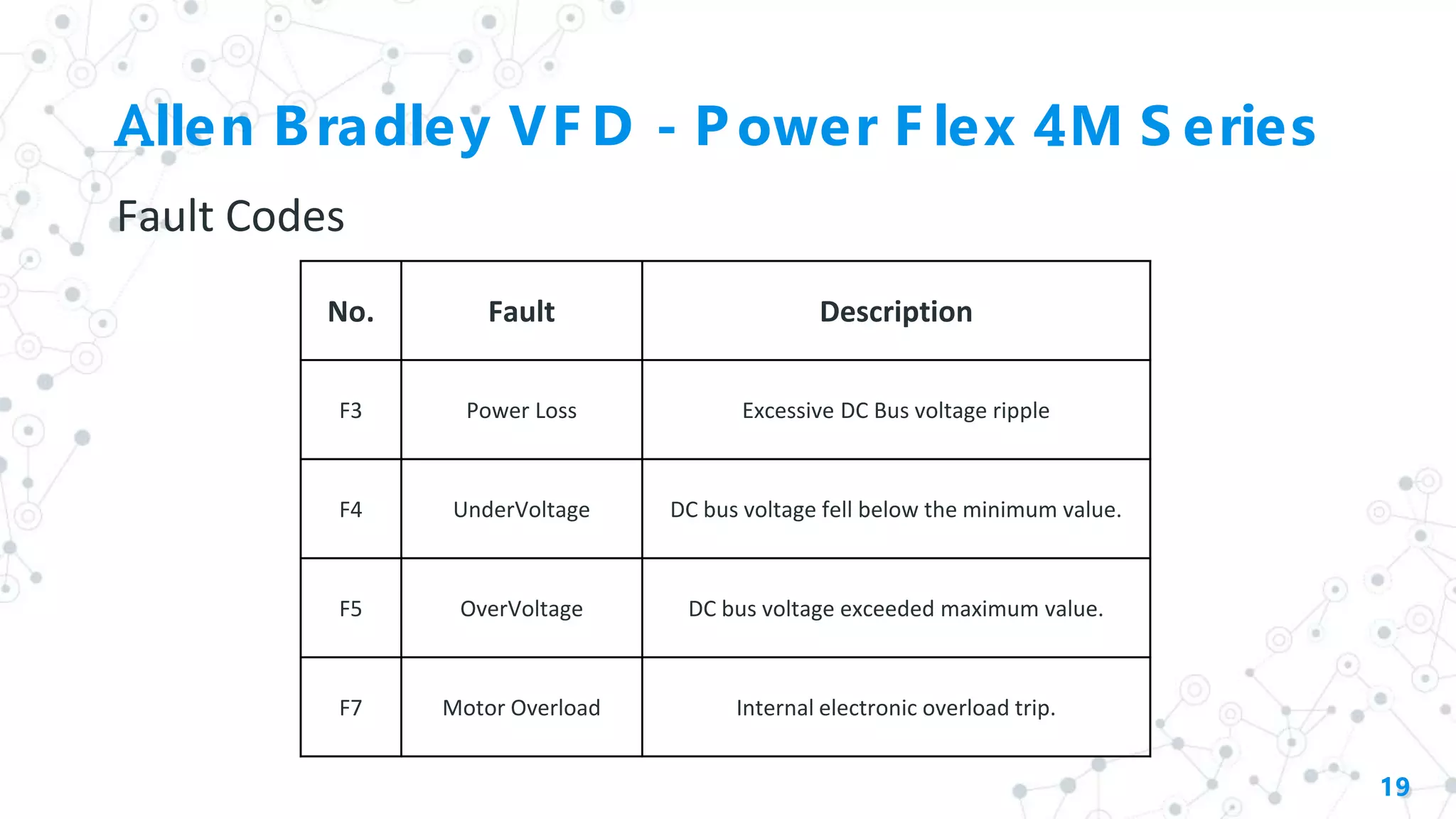
Fault Codes
19
No. Fault Description
F3 Power Loss Excessive DC Bus voltage ripple
F4 UnderVoltage DC bus voltage fell below the minimum value.
F5 OverVoltage DC bus voltage exceeded maximum value.
F7 Motor Overload Internal electronic overload trip.
“
20
Routine Data Logging
 Drive Input Voltage
 No Load Current
 F ull Load Current
 No Load Torque
 F ull Load Torque
 Operating F requency
 MPM S peed at Operating
F requency
Thanks!
Questions?
21
Other Reference links:
https://www.slideshare.net/michaeljmack/soft-starters-60308355
22

Variable Frequency Drives

  • 1.
    Variable F requency Drive (VF D)Parth De s ai : Author
  • 2.
    What Is aVF D? [1 ] ◎ A type of adjustable-speed drive ◎ Vary motor input frequency and voltage <=> C ontrol AC motor output speed & torque ◎ Part of “electro-mechanical” drive systems 2 https://en.wikipedia.org/wiki/Variable -frequency_ drive [1 ] Also known as Adjustable Frequency Drive (AFD) Variable - Voltage /Variable - Frequency (VVVFD) Variable S peed Drive (VSD) AC Drive Micro Drive Inverter Drive
  • 3.
    Need [2] C ontrolled Starting C urrent Reduced Power Line Disturbances Lower Power Demand on S tart Adjustable Operating S peed Adjustable Torque Limit 3 S peed C ontrol Is one of the primary advantages of switching to VF Ds. VF Ds allow motor speeds to be ramped up and ramped down ensuring connected load is aintained at the required speeds with necessary energy utilization. C ontrolled Acceleration C ontrolled S topping E nergy S avings Reverse Operation E liminates Use of Mech. Drive C omponents https://www.wolfautomation.com/blog/benefits -vfd/ [2] https://www.paddockindustries.com/wp-content/uploads/201 7/05/Why-Variable-F requency-Drive-F inal-2-1 6- 1 1 .pdf[3] Lower Maintenance C osts [3] Longer Motor Life [3]
  • 4.
    What Is aVF D? - S chematic & Internal C onstruction[4] 4 https://www.youtube.com/watch? reload=9&v=3-cs 4eE iB Wo [4]
  • 5.
    What Is aVF D? - S chematic & Internal C onstruction[4] 5
  • 6.
    Motor S tarterC ircuit - Direct-On-L ine (DOL ) 6 [5]
  • 7.
    Motor S tarterC ircuit - S tar Delta 7 [6]
  • 8.
    Manual Motor Starting Other S tarters [4] 8 Magnetic Motor S tarting Primary Resistor S tarting Auto Transformer S tarting S C R S tarting /S oft S tarting https://www.youtube.com/watch? reload=9&v=3-cs 4eE iB Wo [4]
  • 9.
    Other S tartersVs VF D P rimary Dis -advantage Manual Motor S tarting No speed control, S uitable only for low current drive applications Magnetic Motor S tarting C annot reduce the magnitude of starting current P rimary R esistor S tarting Huge power loss by the use of starting resistance Auto T ransformer S tarting L owers starting torque of motor, there is a chance of sparking S tar - Delta S tarting L ow starting torque, 6 terminals motor required S C R / T hyristor (S oft) S tarting Unable to control the speed 9
  • 10.
    VF D -P ros and C ons PROs • Smooth starting • Smooth acceleration & deceleration time • Simple Starting / Stopping methods • Reversal of motor • Reduced harmonics • Increased power factor • Efficient motor operation • Cost effective - Long term operation • Less maintenance C ONs • High Upfront cost - depends system size May cause system to resonate at certain speeds, leading to: Dramatically increased noise Excessive vibration. VFD device have been known to shorten the life. Operating speed of motor fixed
  • 11.
    Applications 11 And many more... Conveyors Fans /C ooling Towers C ranes / Hoists High S peed Machining Winders /Un- winders Presses Pumps
  • 12.
    “ 12 How to Selecta VFD  Operating Voltage  Max. Horsepower rating  Max. Output Current  E nclosure Type (if applicable)  Application  Operating S peed limits  Mounting & Wiring considerations  Communication  Part S tandarization  Cost
  • 13.
    VF D Models& Manufacturers  Allen Bradley (P ower F lex 4M S eries) 13  Danfoss (VLT Micro S eries) Other VFD Manufacturers: ABB, Toshiba, F uji E lectrica, Y askawa, E merson  S chneider E lectric (Altivar S eries)
  • 14.
    Allen Bradley VFD - Power F lex 4M S eries Part No. 14
  • 15.
    Allen Bradley VFD - Power F lex 4M S eries Pinout 15
  • 16.
    Allen Bradley VFD - Power F lex 4M S eries Motor Connections 16 Power Terminal Block R/l1, S/L2 1-Phase Input R/l1, S/L2, T/L3 3-Phase Input U/T1, V/T2, T/L3 To Motor BR+, BR- Dynamic Brake Resistor Safety Ground - PE
  • 17.
    Allen Bradley VFD - Power F lex 4M S eries Control Panel 17 Console Display Parameter Group Display Group (View Only) Basic Program Group Terminal Block Group Communications Group Advanced Program Group
  • 18.
    Allen Bradley VFD - Power F lex 4M S eries Parameter Configuration 18 No. Parameter Min / Max Value Display/Options Default Value P101 [Motor Nameplate Volts] 20 to Drive Rated Volts 1 VAC Based on Drive Rating P102 [Motor Nameplate Hertz] 10 to 400 Hz 1 Hz 60 Hz P103 [Motor Overload Current] 0.0 to (Drive Rated Amps x2) 0.1 Amps Based on Drive Rating P104 [Minimum Frequency] 0.0 to 400 Hz 0.1 Hz 0.0 Hz P105 [Maximum Frequency] 0.0 to 400 Hz 1 Hz 60 Hz P106 [Start Source] 0 to 5 Keypad, 3 Wire, 2 Wire, 2 Wire Level Sensor, 2 Wire High Speed, Communication Port 0 P107 [Stop Mode] 0 to 7 Ramp, Coast, DC Brake, DC Brake Auto 0 P108 [Speed Reference] 0 to 5 Drive Potentiometer, Internal Frequency, 0-10V input, 4- 20mA input, Preset Frequency, Communication Port 0 P109 [Acceleration time 1] 0.0 to 600 Secs 0.1 Secs 10.0 Secs P110 [Deceleration time 1] 0.0 to 600 Secs 0.1 Secs 10.0 Secs P111 [Motor Overload Retention] 0 or 1 0 = Disabled 1= Enabled 0 P112 [Reset To Defaults] 0 or 1 0 = Idle State 1 = Reset Defaults 0 No. Parameter Min/max Value Display/Options Default Value D001 The Output Frequency Present at T1,T2 & T3. 0.0 to (P105) Maximum Freq 0.1 Hz Read Only D003 The Output Current present at T1,T2 & T3. 0.0 to (Drive Rated Amps x2) 0.01 Amps Read Only D004 Output voltage present at terminals T1, T2 & T3 0 to Drive Rated Volts 0.1 VAC Read Only D020 The present value of the voltage at I/O Terminal 13 (100.0% = 10 volts). 0.0 to 100.0% 0.1% Read Only D022 Present operating temperature of the drive power section. 0 to 120 degC 1 degC Read Only No. Parameter Min/max Value Display/Options Default Value T212 Sets analog input level corresponding to P105 - if a 0-10V input is used by P108 0.0 to 100.0% 0.1% 100.0% T221 Sets condition that changes state of o/p relay contacts. 0 to 13 0 = Ready/Fault 0 No. Parameter Min/max Value Display/Options Default Value A434 A442
  • 19.
    Allen Bradley VFD - Power F lex 4M S eries Fault Codes 19 No. Fault Description F3 Power Loss Excessive DC Bus voltage ripple F4 UnderVoltage DC bus voltage fell below the minimum value. F5 OverVoltage DC bus voltage exceeded maximum value. F7 Motor Overload Internal electronic overload trip.
  • 20.
    “ 20 Routine Data Logging Drive Input Voltage  No Load Current  F ull Load Current  No Load Torque  F ull Load Torque  Operating F requency  MPM S peed at Operating F requency
  • 21.
  • 22.

Editor's Notes

  • #4 Since input frequency is directly related to motor RPM speed. Controlled Starting Current When an AC motor is started “across the line,” it can take up to as much as seven-to-eight times the motor full-load current to start the motor and load. This current flexes the motor windings and generates heat, which will, over time, reduce the longevity of the motor. An VFD Drive starts a motor at zero frequency and voltage. As the frequency and voltage “build,” it “magnetizes” the motor windings, which typically takes 50-70% of the motor full-load current. Additional current above this level is dependent upon the connected load, the acceleration rate and the speed being accelerated, too. Bottom line…this extends motor life! Reduced Power Line Disturbances Starting an AC motor across the line, and the subsequent demand for 300-600 % the motor full-load current, places an enormous drain on the power distribution system connected to the motor. When the supply voltage sags, depending on the size of the motor and the capacity of the distribution system, the voltage sags can cause sensitive equipment connected on the same distribution system to trip offline due to the low voltage. Items such as computers, sensors, proximity switches, and contactors are voltage sensitive and, when subjected to a large AC motor line started nearby, can drop out. Using VFD eliminates this voltage sag, since the motor is started at zero voltage and ramped up. Lower Power Demand on Start If power is proportional to current-times-voltage, then power needed to start an AC motor across the line is significantly higher than with a VFD. This will be true only at the start up. The primary issue is that some electrical distribution systems might be at their limit during specific times of day, usually considered “Peak Hours.” When industrial customers start their motors during these peak hours of electrical consumption, it is not uncommon for the customer to be stung with charges for surges in power during peak periods. These demand factors would not be an issue with VFD’S. Controlled Acceleration A VFD starts at zero speed and accelerates smoothly on a customer-adjustable ramp. Conversely, an AC motor started “across the line” triggers higher mechanical shock loads both for the motor and mechanically connected load. This shock will, over time, increase the wear and tear not only on the connected load but the AC motor as well. Applications that include easy-to-tip product, such as bottling lines, greatly benefit from a slow ramp up in power which allows the conveyor belt to smoothly speed up rather than an abrupt jerk to full power. Adjustable Operating Speed Unlike the traditional stop-and-go motor, the use of a VFD enables optimizes a process, by making changes in a process. This allows starting at reduced speed, and allows remote adjustment of speed by programmable controller or process controller. Control, in an industrial sense, is always a big bonus for production! Adjustable Torque Limit Use of a VFD can protect machinery from damage and protect the process or product (because the amount of torque being applied can be controlled accurately). An example would be a conveyor jam. If just an AC motor connected, the motor will continue to try to rotate until the motor’s overload device opens (due to the excessive current being drawn as a result of the heavy load). A VFD, in turn, can be set to limit the amount of torque (AMP/CURRENT), so the AC motor never exceeds this limit. Controlled Stopping Is just as important as controlled (ramped) acceleration, controlled (ramped) stopping can be important to reduce mechanical wear and tear — due to shocks to the process or loss of product due to breakage. Energy Savings Variable torque loads, such as, Centrifugal fans and pump loads operated with a VFD will reduces energy consumption. Centrifugal fans and pumps follow a variable torque load, which has horsepower proportional to the cube of speed and torque varying proportional to the square of speed, also known as the “Affinity Laws”. Example; if the speed of a fan is cut in half, the horsepower needed to run the fan at load is cut by a factor of eight (1/2)3 = 1/8. In trying to duplicate this advantage with standard inductive motor would require some type of mechanical throttling device, such as a vane or damper; but the motor would still be running full load and full speed (full power). Example: A VFD controlling a pump motor that usually runs less than full speed can substantially reduce energy consumption over a motor running at constant speed for the same period. For a 25 horsepower motor running 23 hours per day (2 hours at 100% speed; 8 hours at 75%; 8 hours at 67%; and 5 hours at 50%) a variable-frequency drives can reduce understanding-variable-frequency-drives-47-638energy use by 45%. At $0.10 per kilowatt hour, this saves $5,374 annually. Because this benefit varies depending on system variables such as pump size, load profile, amount of static head, and friction, it is important to calculate benefits for each application before specifying a VFD. Savings of a VFD can be sufficient which would allow for shortened payback period. Reverse Operation Using a VFD eliminates the need for a reversing starters, a VFD allows electronic ability reversing either by integrated reversing or an external switch added to the VFD terminal control board. The elimination of a reversing starter eliminates its maintenance cost and reduces panel space. Elimination of Mechanical Drive Components Using a VFD Drive could potentially eliminate the need for expensive mechanical drive components such as gearboxes. Because the VFD can operate with an infinite variable speed, it can deliver the low- or high-speed required by the load, without a speed-increasing or reduction devices between the motor and load, of course this is application dependent. This eliminates maintenance costs, as well as reducing floor-space requirements. Maintenance costs can be lowered, since lower operating speeds result in longer life for bearings and motors.