o refers to the act of creating a virtual (rather than actual) version of something, including
virtual computer hardware platforms, storage devices, and computer network resources.
o Virtualization began in the 1960s
o Type of virtualization
o Server Virtualization
o Storage Virtualization
o Desktop Virtualization
o Application Virtualization
o Network Virtualization
Physical server
Operating system
application
Drawback
Cost
Maintenance
OS Doesn't Match With Application
Compatibility
Physical server
Operating system
application
Virtual machine monitor or hypervisor
Operating system
application
Operating system
application
VM VM VM
Fidelity The environment it creates for the VM is essentially identical to the
original (hardware) physical machine.
Isolation or Safety The VMM must have complete control of the system
resources.
Performance There should be little or no difference in performance between
the VM and a physical equivalent.
• Layer that exits between the operating system and hardware
• Provides the necessary services
• Provide features for the smooth running of multiple operating systems.
Physical server
Virtual machine monitor or hypervisor
VM VM VM
Server virtualization is the partitioning of a physical server into
smaller virtual servers to help maximize your server resources.
Para Virtualization
Full Virtualization
•Hardware Assisted
•Software Assisted
Hybrid Virtualization: ( Hardware Virtualized with PV Drivers )
OS level Virtualization:
 Virtual machine simulates hardware to allow an
unmodified guest OS to be run in isolation
 There is two type of Full virtualizations in the
enterprise market:
 Software assisted full virtualization
 Hardware-assisted full virtualization
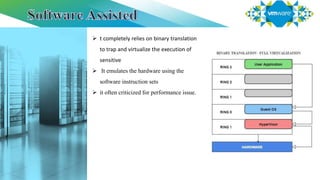
 t completely relies on binary translation
to trap and virtualize the execution of
sensitive
 It emulates the hardware using the
software instruction sets
 it often criticized for performance issue.
 eliminates the binary translation
and it directly interrupts with
hardware using the
virtualization technology
 hardware using the
virtualization technology (Intel
VT-x and AMD-V)
Full Virtualization. A full virtualization solution is one that creates virtual and isolated
versions of an entire computer, including CPU, memory, and I/O devices. The key
characteristic of a full virtualization solution is that it allows you to run arbitrary guest
operating systems. This is because the virtual machine looks and feels exactly like a real
computer, up to the point where a guest operating system cannot tell the difference. Full
virtualization should be contrasted with other solutions like paravirtualization, where the
guest OS is specifically modified to run on a hypervisor, and OS-level virtualization, where
groups of processes are isolated from the rest of the system using OS-level features.
Software-only. A software-only virtualization solution is one that does not need special
hardware support, specifically the Intel "VT-x" or "AMD-V" features.
Binary translation. Binary translation is one specific approach to implementing full
virtualization that does not require hardware virtualization features. It involves examining
the executable code of the virtual guest for "unsafe" instructions, translating these into
"safe" equivalents, and then executing the translated code. Alternatives to binary
translation are binary patching, and full system emulation.
Direct execution. This is a mode that can be combined with binary translation. With direct
execution, most code is executed directly on the CPU, and only the code that needs to be
translated is actually translated.
 Executable code from the guest is allowed to execute directly on
the host CPU by the hypervisor
 Hypervisor has configured the CPU in such a way that all
potentially unsafe instructions will caused a "trap“
 An unsafe instruction is one that for example tries to access or
modify the memory of another guest
 A trap is an exceptional condition that transfers control back to the
hypervisor
 Once the hypervisor has received a trap, it will inspect the
offending instruction, emulate it in a safe way, and continue
execution after the instruction
 The approach usually has good performance, because the majority
of the instructions will not cause a trap, and will execute straight
on the CPU with no overhead.
 It doesn’t need to simulate the hardware for the
virtual machines.
 The hypervisor is installed on a physical server (host)
 guest OS is installed into the environment
 Virtual guests aware that it has been virtualized
 guest source codes will be modified with sensitive
information
 guests will directly communicate with the host
(hypervisor) using the drivers.
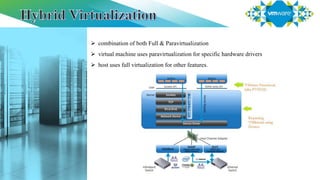
 combination of both Full & Paravirtualization
 virtual machine uses paravirtualization for specific hardware drivers
 host uses full virtualization for other features.
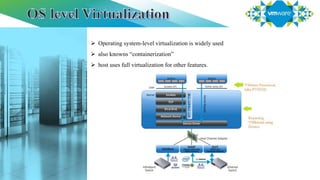
 Operating system-level virtualization is widely used
 also knowns “containerization”
 host uses full virtualization for other features.

Vcp6.7 episode 1

  • 2.
    o refers tothe act of creating a virtual (rather than actual) version of something, including virtual computer hardware platforms, storage devices, and computer network resources. o Virtualization began in the 1960s o Type of virtualization o Server Virtualization o Storage Virtualization o Desktop Virtualization o Application Virtualization o Network Virtualization
  • 3.
  • 4.
    Physical server Operating system application Virtualmachine monitor or hypervisor Operating system application Operating system application VM VM VM
  • 5.
    Fidelity The environmentit creates for the VM is essentially identical to the original (hardware) physical machine. Isolation or Safety The VMM must have complete control of the system resources. Performance There should be little or no difference in performance between the VM and a physical equivalent.
  • 6.
    • Layer thatexits between the operating system and hardware • Provides the necessary services • Provide features for the smooth running of multiple operating systems. Physical server Virtual machine monitor or hypervisor VM VM VM
  • 7.
    Server virtualization isthe partitioning of a physical server into smaller virtual servers to help maximize your server resources. Para Virtualization Full Virtualization •Hardware Assisted •Software Assisted Hybrid Virtualization: ( Hardware Virtualized with PV Drivers ) OS level Virtualization:
  • 8.
     Virtual machinesimulates hardware to allow an unmodified guest OS to be run in isolation  There is two type of Full virtualizations in the enterprise market:  Software assisted full virtualization  Hardware-assisted full virtualization
  • 9.
     t completelyrelies on binary translation to trap and virtualize the execution of sensitive  It emulates the hardware using the software instruction sets  it often criticized for performance issue.
  • 10.
     eliminates thebinary translation and it directly interrupts with hardware using the virtualization technology  hardware using the virtualization technology (Intel VT-x and AMD-V)
  • 11.
    Full Virtualization. Afull virtualization solution is one that creates virtual and isolated versions of an entire computer, including CPU, memory, and I/O devices. The key characteristic of a full virtualization solution is that it allows you to run arbitrary guest operating systems. This is because the virtual machine looks and feels exactly like a real computer, up to the point where a guest operating system cannot tell the difference. Full virtualization should be contrasted with other solutions like paravirtualization, where the guest OS is specifically modified to run on a hypervisor, and OS-level virtualization, where groups of processes are isolated from the rest of the system using OS-level features. Software-only. A software-only virtualization solution is one that does not need special hardware support, specifically the Intel "VT-x" or "AMD-V" features. Binary translation. Binary translation is one specific approach to implementing full virtualization that does not require hardware virtualization features. It involves examining the executable code of the virtual guest for "unsafe" instructions, translating these into "safe" equivalents, and then executing the translated code. Alternatives to binary translation are binary patching, and full system emulation. Direct execution. This is a mode that can be combined with binary translation. With direct execution, most code is executed directly on the CPU, and only the code that needs to be translated is actually translated.
  • 12.
     Executable codefrom the guest is allowed to execute directly on the host CPU by the hypervisor  Hypervisor has configured the CPU in such a way that all potentially unsafe instructions will caused a "trap“  An unsafe instruction is one that for example tries to access or modify the memory of another guest  A trap is an exceptional condition that transfers control back to the hypervisor  Once the hypervisor has received a trap, it will inspect the offending instruction, emulate it in a safe way, and continue execution after the instruction  The approach usually has good performance, because the majority of the instructions will not cause a trap, and will execute straight on the CPU with no overhead.
  • 13.
     It doesn’tneed to simulate the hardware for the virtual machines.  The hypervisor is installed on a physical server (host)  guest OS is installed into the environment  Virtual guests aware that it has been virtualized  guest source codes will be modified with sensitive information  guests will directly communicate with the host (hypervisor) using the drivers.
  • 14.
     combination ofboth Full & Paravirtualization  virtual machine uses paravirtualization for specific hardware drivers  host uses full virtualization for other features.
  • 15.
     Operating system-levelvirtualization is widely used  also knowns “containerization”  host uses full virtualization for other features.