Cloud
Virtualization Technology
By-
B.PAVANI
PRATHYUSHA
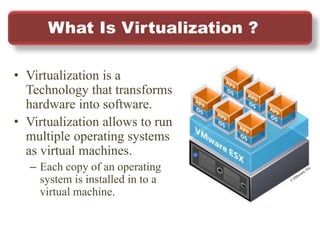
What Is Virtualization ?
• Virtualization is a
Technology that transforms
hardware into software.
• Virtualization allows to run
multiple operating systems
as virtual machines.
– Each copy of an operating
system is installed in to a
virtual machine.
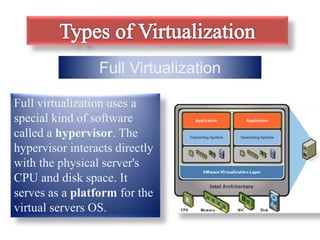
Full Virtualization
Full virtualization uses a
special kind of software
called a hypervisor. The
hypervisor interacts directly
with the physical server's
CPU and disk space. It
serves as a platform for the
virtual servers OS.
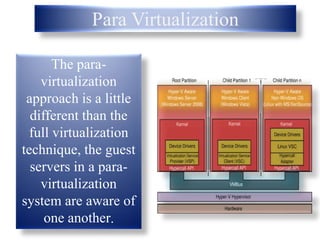
Para Virtualization
The para-
virtualization
approach is a little
different than the
full virtualization
technique, the guest
servers in a para-
virtualization
system are aware of
one another.
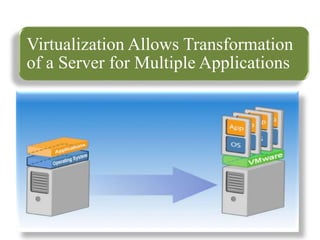
Virtualization Allows Transformation
of a Server for Multiple Applications
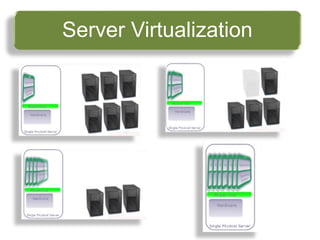
Server Virtualization
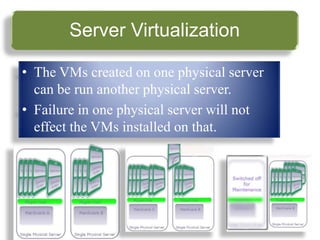
• The VMs created on one physical server
can be run another physical server.
• Failure in one physical server will not
effect the VMs installed on that.
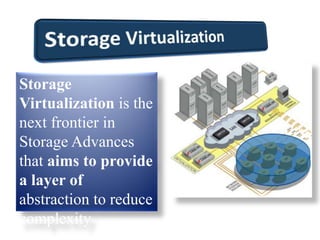
Storage
Virtualization is the
next frontier in
Storage Advances
that aims to provide
a layer of
abstraction to reduce
complexity
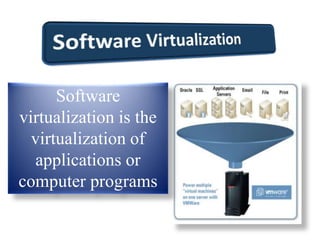
Software
virtualization is the
virtualization of
applications or
computer programs
Cloud
Virtualization
Technology
INTRODUCTION
 Virtualization represents the logical
view of data representation- the power
to compute in virtualized environments.
It is a technique that has been used in
large mainframe computer for 30+
years. It is used to manage a group of
computers together- instead of managing
resources separately.
Cloud Virtualization Technology
Virtualization Defined
Virtualization is an abstraction layer that
decouples the physical hardware from the
os to deliver greater IT resources utilization
and flexibility.
Virtualization can bring the following
benefits
● save money
● increased control
● simplify disaster recovery
Cloud Virtualization Technology
Benefits
1. Traditional benefits
a) server consolidation
b) “Green IT” - reduced power and cooling
2. Additional Benefits
a) increased availability/business continuity and
disaster recovery
b) efficient application and desktop software
deployment and
Maintenance
c) dynamic and extensible infrastructure to rapidly
address new business requirements
Current Virtualization Initiatives
Here is a list of different virtualization
initiative actively pursued in industry
Today
● Virtual Networking
● Virtual Disk
● Consolidated management
● Vmotion
● Svmotion
● Dynamic load balancing
● Zones
Cloud Virtualization Technology
Virtual Machine
Often called Virtual environment or container.
A Virtual machine is a server environment that
does not physically exist but is created within
another server.
For user interacting with a VM is seen or
presented as a physical machine providing
access to an operating system and machine
resources like CPU memory, hard disk and
network.
Cloud Virtualization Technology
Virtualization Technologies
Two major types of virtualization
technologies widely used are
● Hardware Virtualization
○ virtualizes the server hardware
● OS virtualization
○ virtualizes application environment
Cloud Virtualization Technology
Hardware based Virtual Machine
(HVM)
● Hardware based Virtual Machine or
Hardware assisted Virtualization ( HAV) is
done possible by using new features
developed by Intel and AMD
● These new features include Intel
Virtualization Technology (VT-x) and
AMD’s AMD-V
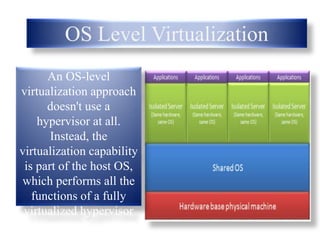
OS Level Virtualization
An OS-level
virtualization approach
doesn't use a
hypervisor at all.
Instead, the
virtualization capability
is part of the host OS,
which performs all the
functions of a fully
virtualized hypervisor
DetailedDesign
It introduces many changes into the
environment, and ensures that the platform can co-
exist and interact with existing infrastructure.
The purpose of detailed design to set naming and
security standards, define the disk and network
structure. It includes the following
● Security and Administrative Model
● Back up methodology
● VMware service console configuration
● implement tables and configuration setting
Summary
This focuses on cloud virtualization and also
covers other flavours of virtualization. It
also covers software components used for
managing virtualization process
entirely…….
virtualization in cloud technology

virtualization in cloud technology

  • 1.
  • 5.
    What Is Virtualization? • Virtualization is a Technology that transforms hardware into software. • Virtualization allows to run multiple operating systems as virtual machines. – Each copy of an operating system is installed in to a virtual machine.
  • 6.
    Full Virtualization Full virtualizationuses a special kind of software called a hypervisor. The hypervisor interacts directly with the physical server's CPU and disk space. It serves as a platform for the virtual servers OS.
  • 7.
    Para Virtualization The para- virtualization approachis a little different than the full virtualization technique, the guest servers in a para- virtualization system are aware of one another.
  • 8.
    Virtualization Allows Transformation ofa Server for Multiple Applications
  • 9.
  • 10.
    Server Virtualization • TheVMs created on one physical server can be run another physical server. • Failure in one physical server will not effect the VMs installed on that.
  • 11.
    Storage Virtualization is the nextfrontier in Storage Advances that aims to provide a layer of abstraction to reduce complexity
  • 12.
    Software virtualization is the virtualizationof applications or computer programs
  • 13.
  • 14.
    INTRODUCTION  Virtualization representsthe logical view of data representation- the power to compute in virtualized environments. It is a technique that has been used in large mainframe computer for 30+ years. It is used to manage a group of computers together- instead of managing resources separately. Cloud Virtualization Technology
  • 15.
    Virtualization Defined Virtualization isan abstraction layer that decouples the physical hardware from the os to deliver greater IT resources utilization and flexibility. Virtualization can bring the following benefits ● save money ● increased control ● simplify disaster recovery Cloud Virtualization Technology
  • 16.
    Cloud Virtualization Technology Benefits 1.Traditional benefits a) server consolidation b) “Green IT” - reduced power and cooling 2. Additional Benefits a) increased availability/business continuity and disaster recovery b) efficient application and desktop software deployment and Maintenance c) dynamic and extensible infrastructure to rapidly address new business requirements
  • 17.
    Current Virtualization Initiatives Hereis a list of different virtualization initiative actively pursued in industry Today ● Virtual Networking ● Virtual Disk ● Consolidated management ● Vmotion ● Svmotion ● Dynamic load balancing ● Zones
  • 18.
    Cloud Virtualization Technology VirtualMachine Often called Virtual environment or container. A Virtual machine is a server environment that does not physically exist but is created within another server. For user interacting with a VM is seen or presented as a physical machine providing access to an operating system and machine resources like CPU memory, hard disk and network.
  • 19.
    Cloud Virtualization Technology VirtualizationTechnologies Two major types of virtualization technologies widely used are ● Hardware Virtualization ○ virtualizes the server hardware ● OS virtualization ○ virtualizes application environment
  • 20.
    Cloud Virtualization Technology Hardwarebased Virtual Machine (HVM) ● Hardware based Virtual Machine or Hardware assisted Virtualization ( HAV) is done possible by using new features developed by Intel and AMD ● These new features include Intel Virtualization Technology (VT-x) and AMD’s AMD-V
  • 21.
    OS Level Virtualization AnOS-level virtualization approach doesn't use a hypervisor at all. Instead, the virtualization capability is part of the host OS, which performs all the functions of a fully virtualized hypervisor
  • 22.
    DetailedDesign It introduces manychanges into the environment, and ensures that the platform can co- exist and interact with existing infrastructure. The purpose of detailed design to set naming and security standards, define the disk and network structure. It includes the following ● Security and Administrative Model ● Back up methodology ● VMware service console configuration ● implement tables and configuration setting
  • 23.
    Summary This focuses oncloud virtualization and also covers other flavours of virtualization. It also covers software components used for managing virtualization process entirely…….