Brief introduction to the One Health
concept, and beyond
Alexandre Caron, Hélène de Nys, Alexandre Hobeika and Vladimir Grosbois
Capacitating One Health in Eastern and Southern Africa (COHESA) partner orientation
workshop
16 December 2021
1
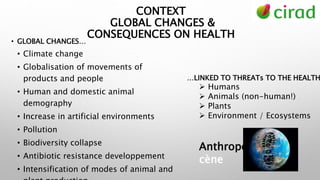
CONTEXT
GLOBAL CHANGES &
CONSEQUENCES ON HEALTH
• GLOBAL CHANGES…
• Climate change
• Globalisation of movements of
products and people
• Human and domestic animal
demography
• Increase in artificial environments
• Pollution
• Biodiversity collapse
• Antibiotic resistance developpement
• Intensification of modes of animal and
2
…LINKED TO THREATs TO THE HEALTH
 Humans
 Animals (non-human!)
 Plants
 Environment / Ecosystems
Anthropo
cène
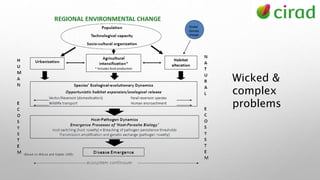
Wicked &
complex
problems
4
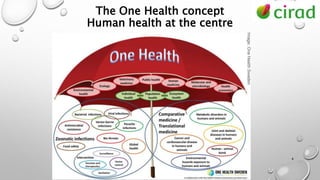
The One Health concept
Human health at the centre
Buse, et al. 2018, J Epidemiol Community Health
Integrated approaches to
HEALTH
doi:10.1136/jech-2017-210
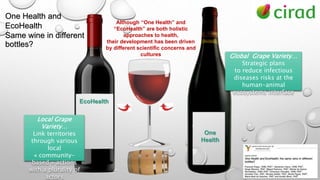
Although “One Health” and
“EcoHealth” are both holistic
approaches to health,
their development has been driven
by different scientific concerns and
cultures
EcoHealth
One
Health
One Health and
EcoHealth
Same wine in different
bottles?
Local Grape
Variety…
Link territories
through various
local
« community-
based » actions
with a plurality of
actors
Global Grape Variety…
Strategic plans
to reduce infectious
diseases risks at the
human-animal
ecosystems interface
8
https://www.onehealth-oi.org
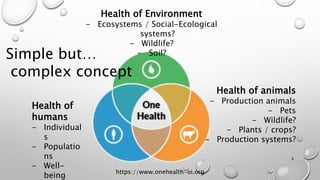
Health of
humans
- Individual
s
- Populatio
ns
- Well-
being
Health of animals
- Production animals
- Pets
- Wildlife?
- Plants / crops?
- Production systems?
Health of Environment
- Ecosystems / Social-Ecological
systems?
- Wildlife?
- Soil?
Simple but…
complex concept
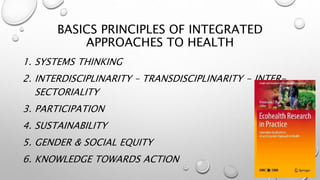
BASICS PRINCIPLES OF INTEGRATED
APPROACHES TO HEALTH
1. SYSTEMS THINKING
2. INTERDISCIPLINARITY – TRANSDISCIPLINARITY - INTER-
SECTORIALITY
3. PARTICIPATION
4. SUSTAINABILITY
5. GENDER & SOCIAL EQUITY
6. KNOWLEDGE TOWARDS ACTION 9
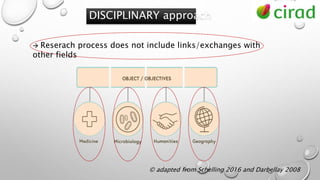
© adapted from Schelling 2016 and Darbellay 2008
DISCIPLINARY approach
 Reserach process does not include links/exchanges with
other fields
© adapted from Schelling 2016 and Darbellay 2008
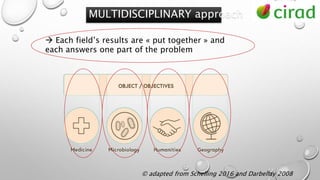
MULTIDISCIPLINARY approach
 Each field’s results are « put together » and
each answers one part of the problem
© adapted from Schelling 2016 and Darbellay 2008
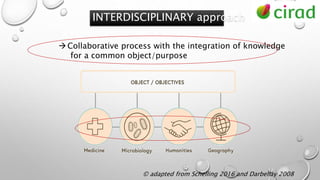
INTERDISCIPLINARY approach
Collaborative process with the integration of knowledge
for a common object/purpose
© adapted from Schelling 2016 and Darbellay 2008
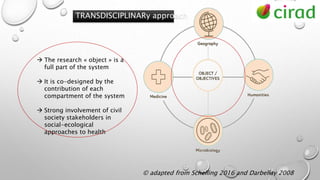
TRANSDISCIPLINARy approach
 The research « object » is a
full part of the system
 It is co-designed by the
contribution of each
compartment of the system
 Strong involvement of civil
society stakeholders in
social-ecological
approaches to health
14
INTEGRATED APPROACHES TO HEALTH IN
SEA REGIONS
• DIVERSITY OF CULTURES
(political, economic, relational with humans, animals & Nature)
• SAVANNA SOCIO-ECOSYSTEMS
(rich mammal biodiversity)
• EXTENSIVE PRODUCTION SYSTEMS
(pastoralism, agro-pastoralism)
• WILDLIFE ECONOMY
• CONSTRAINED ECONOMIC ENVIRONMENT
• What else...
15
16
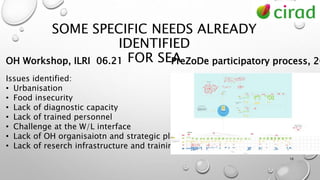
SOME SPECIFIC NEEDS ALREADY
IDENTIFIED
FOR SEA
OH Workshop, ILRI 06.21
Issues identified:
• Urbanisation
• Food insecurity
• Lack of diagnostic capacity
• Lack of trained personnel
• Challenge at the W/L interface
• Lack of OH organisaiotn and strategic planning
• Lack of reserch infrastructure and training
PreZoDe participatory process, 20

Brief introduction to the One Health concept, and beyond

  • 1.
    Brief introduction tothe One Health concept, and beyond Alexandre Caron, Hélène de Nys, Alexandre Hobeika and Vladimir Grosbois Capacitating One Health in Eastern and Southern Africa (COHESA) partner orientation workshop 16 December 2021 1
  • 2.
    CONTEXT GLOBAL CHANGES & CONSEQUENCESON HEALTH • GLOBAL CHANGES… • Climate change • Globalisation of movements of products and people • Human and domestic animal demography • Increase in artificial environments • Pollution • Biodiversity collapse • Antibiotic resistance developpement • Intensification of modes of animal and 2 …LINKED TO THREATs TO THE HEALTH  Humans  Animals (non-human!)  Plants  Environment / Ecosystems Anthropo cène
  • 3.
  • 4.
    4 The One Healthconcept Human health at the centre
  • 6.
    Buse, et al.2018, J Epidemiol Community Health Integrated approaches to HEALTH doi:10.1136/jech-2017-210
  • 7.
    Although “One Health”and “EcoHealth” are both holistic approaches to health, their development has been driven by different scientific concerns and cultures EcoHealth One Health One Health and EcoHealth Same wine in different bottles? Local Grape Variety… Link territories through various local « community- based » actions with a plurality of actors Global Grape Variety… Strategic plans to reduce infectious diseases risks at the human-animal ecosystems interface
  • 8.
    8 https://www.onehealth-oi.org Health of humans - Individual s -Populatio ns - Well- being Health of animals - Production animals - Pets - Wildlife? - Plants / crops? - Production systems? Health of Environment - Ecosystems / Social-Ecological systems? - Wildlife? - Soil? Simple but… complex concept
  • 9.
    BASICS PRINCIPLES OFINTEGRATED APPROACHES TO HEALTH 1. SYSTEMS THINKING 2. INTERDISCIPLINARITY – TRANSDISCIPLINARITY - INTER- SECTORIALITY 3. PARTICIPATION 4. SUSTAINABILITY 5. GENDER & SOCIAL EQUITY 6. KNOWLEDGE TOWARDS ACTION 9
  • 10.
    © adapted fromSchelling 2016 and Darbellay 2008 DISCIPLINARY approach  Reserach process does not include links/exchanges with other fields
  • 11.
    © adapted fromSchelling 2016 and Darbellay 2008 MULTIDISCIPLINARY approach  Each field’s results are « put together » and each answers one part of the problem
  • 12.
    © adapted fromSchelling 2016 and Darbellay 2008 INTERDISCIPLINARY approach Collaborative process with the integration of knowledge for a common object/purpose
  • 13.
    © adapted fromSchelling 2016 and Darbellay 2008 TRANSDISCIPLINARy approach  The research « object » is a full part of the system  It is co-designed by the contribution of each compartment of the system  Strong involvement of civil society stakeholders in social-ecological approaches to health
  • 14.
  • 15.
    INTEGRATED APPROACHES TOHEALTH IN SEA REGIONS • DIVERSITY OF CULTURES (political, economic, relational with humans, animals & Nature) • SAVANNA SOCIO-ECOSYSTEMS (rich mammal biodiversity) • EXTENSIVE PRODUCTION SYSTEMS (pastoralism, agro-pastoralism) • WILDLIFE ECONOMY • CONSTRAINED ECONOMIC ENVIRONMENT • What else... 15
  • 16.
    16 SOME SPECIFIC NEEDSALREADY IDENTIFIED FOR SEA OH Workshop, ILRI 06.21 Issues identified: • Urbanisation • Food insecurity • Lack of diagnostic capacity • Lack of trained personnel • Challenge at the W/L interface • Lack of OH organisaiotn and strategic planning • Lack of reserch infrastructure and training PreZoDe participatory process, 20

Editor's Notes

  • #4 Beyond all theses mechanisms there are social actors who make choices, take decision trade offs etc. Increasing urbanization, intensification of trade and farming systems and drastic land use change are affecting the drivers of health risks emergence, notably in Southeast Asia. It calls for a better integration between animal health and public health sectors, social and environmental sciences, and agriculture (including livestock production) to address associated health issues. It also calls for integrated Systems approaches involving all relevant stakeholders in the risk management process This is really challenging in health domain, as pratictionners a re used to be experts fighting pathogens. With EcoHealth there is anew postures: enabling and empowering communities and at risk population managing their health
  • #11 On parle de recherche disciplinaire lorsque chaque discipline utilise un set d’outils et d’approches méthodologiques pour étudier son objet ou atteindre son objectif de recherche et que ce processus n’implique aucun échange avec d’autres disciplines. Chaque discipline définit son point de départ dans la quête de connaissance et prédétermine les résultats à atteindre.
  • #12 On parle de recherche multidisciplinaire quand les différentes disciplines impliquées partagent leur objectif à atteindre et cherchent à relier leurs résultats de recherche entre eux pour ce faire. Toutefois, cette liaison se fait dans le cadre d’une collaboration qui n’est pas réellement coordonnée ni pilotée par le souci d’intégration des données produites par des chercheurs de disciplines différentes (on est plutôt dans la juxtaposition des résultats). En d’autres mots, chaque discipline travaille de manière isolée sans fertilisation croisée ou réelle synergie au niveau de l’interprétation des résultats.
  • #13 Dans la recherche interdisciplinaire, il y a une démarche collaborative d’intégration (des questions de recherche, des méthodes, des résultats) entre des chercheurs de disciplines différentes qui s’intéressent au même objet d’étude ou partagent un objectif commun. Les concepts et les méthodologies sont échangées et discutées entre des chercheurs de disciplines, en vue d’un enrichissement mutuel et d’une meilleure compréhension collective de l’objet d’étude. Cette démarche est de plus en plus plébiscitée par les bailleurs et les agences, et il est de plus en plus facile de publier des travaux interdisciplinaires. Cependant cela reste une démarche plus couteuse en temps et en énergie, ce qui n’est pas forcément pris pleinement en considération dans les processus d’évaluation de al recherche.
  • #14 Dans un processus transdisciplinaire, « l'objet » de recherche est considéré comme un agent du système à part entière et cela s’accompagne souvent d’une démarche d’échange mutuel de connaissances et de savoir-faire entre le monde académique et la société civile. Les recherches transdisciplinaires s’attachent à des objets complexes du monde « réel » ‘dimension appliquée très forte), avec un niveau élevé d’incertitude, une situation multi acteurs souvent conflictuelle (conflits d’intérêts, conflits de valeurs) et un dispositif institutionnel qui n’est pas suffisamment adapté a la complexité de la situation. Au démarrage de tels processus de recherche, des questions fondamentales se posent telles que: Quels sont le paramètres/composantes du système que nous devons prendre en considération pour résoudre notre problème? Comment ces paramètres sont ils interconnectés? Quelles disciplines/quels acteurs devraient être impliquées dans le processus? [pour rappel, Cela fait grandement écho à la démarche de modélisation participative/collaborative] (cf. perspective 41, à lire et à relire)