WELCOME
Capt.Shams
(www.facebook.com/dr.imanns)
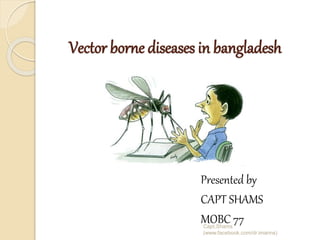
Vector borne diseases in bangladesh
Presented by
CAPT SHAMS
MOBC 77Capt.Shams
(www.facebook.com/dr.imanns)
Introduction
Vector borne diseases is 17% of all
infectious diseases. 2.5 billion people
in over 100 countries are at risk of
these diseases. Every year, more than
1 billion people are infected and more
than 1 million die from vector-borne
diseases. Among them Malaria causes
more than 6,00,000 deaths every year
globally.
Capt.Shams
(www.facebook.com/dr.imanns)
Aim
To know about the common vector
borne
diseases in Bangladesh and how to
prevent
these diseases.
Capt.Shams
(www.facebook.com/dr.imanns)
Scope
 What is vector and common vectors.
 What is vector borne diseases and
common VBD.
 Common vector borne diseases in
Bangladesh.
 Prevention and control.
Capt.Shams
(www.facebook.com/dr.imanns)
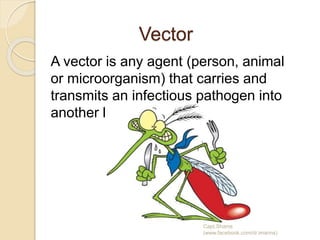
Vector
A vector is any agent (person, animal
or microorganism) that carries and
transmits an infectious pathogen into
another living organism.
Capt.Shams
(www.facebook.com/dr.imanns)
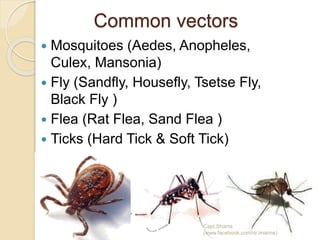
Common vectors
 Mosquitoes (Aedes, Anopheles,
Culex, Mansonia)
 Fly (Sandfly, Housefly, Tsetse Fly,
Black Fly )
 Flea (Rat Flea, Sand Flea )
 Ticks (Hard Tick & Soft Tick)
 Lice / Bugs/ Mites/ Cyclops
Capt.Shams
(www.facebook.com/dr.imanns)
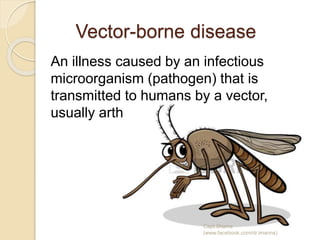
Vector-borne disease
An illness caused by an infectious
microorganism (pathogen) that is
transmitted to humans by a vector,
usually arthropods.
Capt.Shams
(www.facebook.com/dr.imanns)
Major vector borne disease in
world
 Malaria
 Filaria
 Leishmaniasis
 Japanese Encephalitis
 Dengue / Dengue
Hemorrhagic fevers
 Chikungunya
 Chagas Diseases (American
Trypanosomiasis) Capt.Shams
(www.facebook.com/dr.imanns)
Contd…
 Yellow Fever
 Onchocerciasis (River Blindness)
 CCHF (Crimean Congo Haemorrhagic
Fever)
 Lyme Disease
 Tick Borne Encephalitis
 Schistosomiasis (Bilharzia)
Capt.Shams
(www.facebook.com/dr.imanns)
Common vector borne disease in
Bangladesh
 Malaria
 Filariasis
 Leishmaniasis
 Dengue
Capt.Shams
(www.facebook.com/dr.imanns)
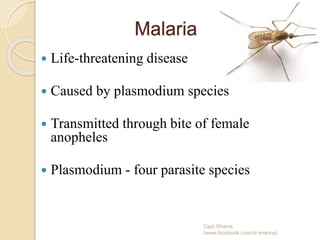
Malaria
 Life-threatening disease
 Caused by plasmodium species
 Transmitted through bite of female
anopheles
 Plasmodium - four parasite species
Capt.Shams
(www.facebook.com/dr.imanns)
Malaria Facts
 Malaria kills in one year ,what AIDS kills
in 15 years
 For every death due to HIV/AIDS, there
are about 50 deaths due to malaria
Capt.Shams
(www.facebook.com/dr.imanns)
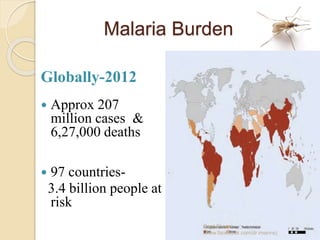
Malaria Burden
Globally-2012
 Approx 207
million cases &
6,27,000 deaths
 97 countries-
3.4 billion people at
risk
Capt.Shams
(www.facebook.com/dr.imanns)
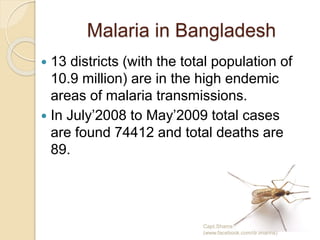
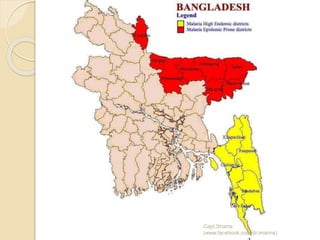
Malaria in Bangladesh
 13 districts (with the total population of
10.9 million) are in the high endemic
areas of malaria transmissions.
 In July’2008 to May’2009 total cases
are found 74412 and total deaths are
89.
Capt.Shams
(www.facebook.com/dr.imanns)
Capt.Shams
(www.facebook.com/dr.imanns)
Filariasis
 Lymphatic filariasis is infection with
the filarial worms, Wuchereria
bancrofti, Brugia malayi or B. timori.
 A wide range of mosquitoes can
transmit the parasite, depending on
the geographic area. In Africa, the
most common vector is Anopheles
and in the Americas, it is Culex quilex.
Aedes and Mansonia can transmit the
infection in the Pacific and in Asia.Capt.Shams
(www.facebook.com/dr.imanns)
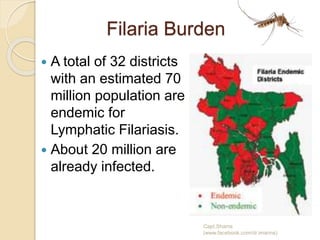
Filaria Burden
 A total of 32 districts
with an estimated 70
million population are
endemic for
Lymphatic Filariasis.
 About 20 million are
already infected.
Capt.Shams
(www.facebook.com/dr.imanns)
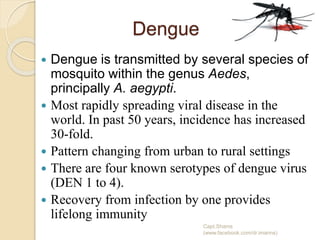
Dengue
 Dengue is transmitted by several species of
mosquito within the genus Aedes,
principally A. aegypti.
 Most rapidly spreading viral disease in the
world. In past 50 years, incidence has increased
30-fold.
 Pattern changing from urban to rural settings
 There are four known serotypes of dengue virus
(DEN 1 to 4).
 Recovery from infection by one provides
lifelong immunity
Capt.Shams
(www.facebook.com/dr.imanns)
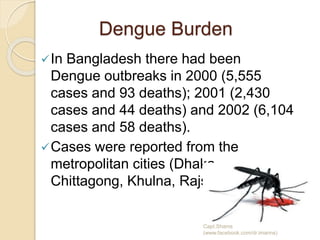
Dengue Burden
In Bangladesh there had been
Dengue outbreaks in 2000 (5,555
cases and 93 deaths); 2001 (2,430
cases and 44 deaths) and 2002 (6,104
cases and 58 deaths).
Cases were reported from the
metropolitan cities (Dhaka,
Chittagong, Khulna, Rajshahi)
Capt.Shams
(www.facebook.com/dr.imanns)
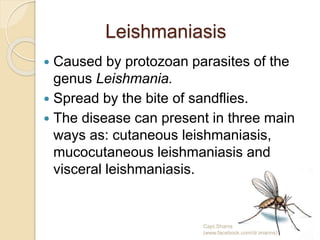
Leishmaniasis
 Caused by protozoan parasites of the
genus Leishmania.
 Spread by the bite of sandflies.
 The disease can present in three main
ways as: cutaneous leishmaniasis,
mucocutaneous leishmaniasis and
visceral leishmaniasis.
Capt.Shams
(www.facebook.com/dr.imanns)
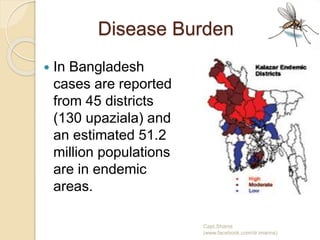
Disease Burden
 In Bangladesh
cases are reported
from 45 districts
(130 upaziala) and
an estimated 51.2
million populations
are in endemic
areas.
Capt.Shams
(www.facebook.com/dr.imanns)
Prevention and Control
New strategies have taken by WHO to
control vector borne diseases. No
single measure can control these
diseases. It needs multiple approach
both from government and non
government institutes.
Capt.Shams
(www.facebook.com/dr.imanns)
Strategies
 Needs sound knowledge of the
Bionomics
Distribution
Seasonal prevalence
Vectorial capacity
Insecticide susceptibility status
Role of arthropods in disease transmission
Capt.Shams
(www.facebook.com/dr.imanns)
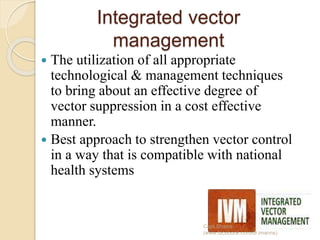
Integrated vector
management
 The utilization of all appropriate
technological & management techniques
to bring about an effective degree of
vector suppression in a cost effective
manner.
 Best approach to strengthen vector control
in a way that is compatible with national
health systems
Capt.Shams
(www.facebook.com/dr.imanns)
Key Elements of IVM
 Evidence-based decision-making
 Monitoring & Evaluation
 Advocacy & Social mobilization
 Intra & intersectoral Collaboration
 Capacity-building
 Legislation & Regulation
Capt.Shams
(www.facebook.com/dr.imanns)
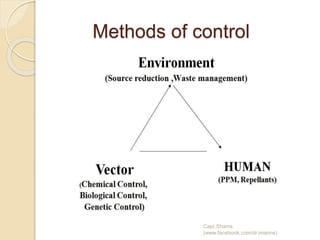
Methods of control
Capt.Shams
(www.facebook.com/dr.imanns)
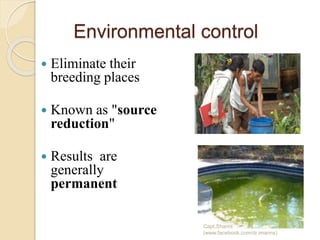
Environmental control
 Eliminate their
breeding places
 Known as "source
reduction"
 Results are
generally
permanent
Capt.Shams
(www.facebook.com/dr.imanns)
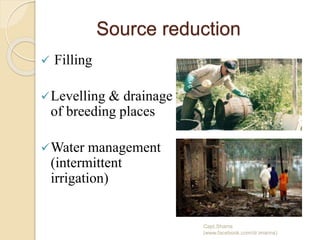
Source reduction
 Filling
Levelling & drainage
of breeding places
Water management
(intermittent
irrigation)
Capt.Shams
(www.facebook.com/dr.imanns)
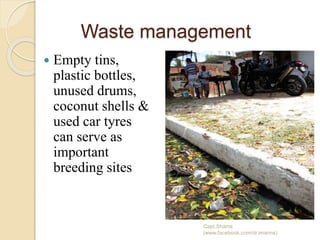
Waste management
 Empty tins,
plastic bottles,
unused drums,
coconut shells &
used car tyres
can serve as
important
breeding sites
Capt.Shams
(www.facebook.com/dr.imanns)
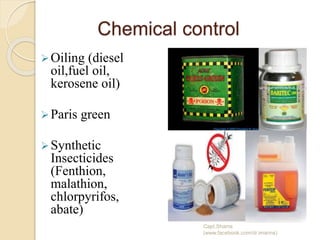
Chemical control
Oiling (diesel
oil,fuel oil,
kerosene oil)
Paris green
Synthetic
Insecticides
(Fenthion,
malathion,
chlorpyrifos,
abate)
Capt.Shams
(www.facebook.com/dr.imanns)
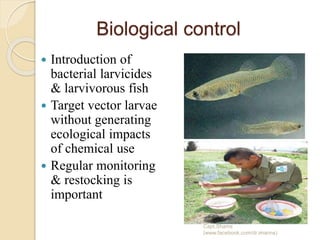
Biological control
 Introduction of
bacterial larvicides
& larvivorous fish
 Target vector larvae
without generating
ecological impacts
of chemical use
 Regular monitoring
& restocking is
important
Capt.Shams
(www.facebook.com/dr.imanns)
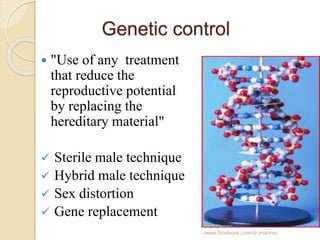
Genetic control
 "Use of any treatment
that reduce the
reproductive potential
by replacing the
hereditary material"
 Sterile male technique
 Hybrid male technique
 Sex distortion
 Gene replacement
Capt.Shams
(www.facebook.com/dr.imanns)
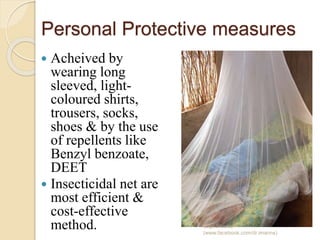
Personal Protective measures
 Acheived by
wearing long
sleeved, light-
coloured shirts,
trousers, socks,
shoes & by the use
of repellents like
Benzyl benzoate,
DEET
 Insecticidal net are
most efficient &
cost-effective
method. Capt.Shams
(www.facebook.com/dr.imanns)
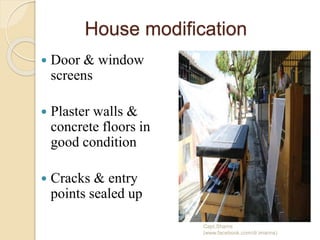
House modification
 Door & window
screens
 Plaster walls &
concrete floors in
good condition
 Cracks & entry
points sealed up
Capt.Shams
(www.facebook.com/dr.imanns)
Indoor residual spray
 Most widely used method
 Effective way to reduce
sandflies & bugs inside
homes
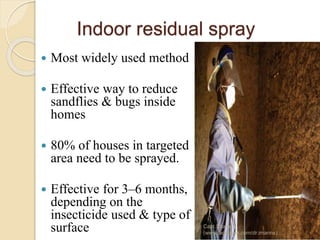
 80% of houses in targeted
area need to be sprayed.
 Effective for 3–6 months,
depending on the
insecticide used & type of
surface Capt.Shams
(www.facebook.com/dr.imanns)
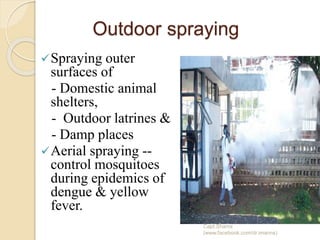
Outdoor spraying
Spraying outer
surfaces of
- Domestic animal
shelters,
- Outdoor latrines &
- Damp places
Aerial spraying --
control mosquitoes
during epidemics of
dengue & yellow
fever.
Capt.Shams
(www.facebook.com/dr.imanns)
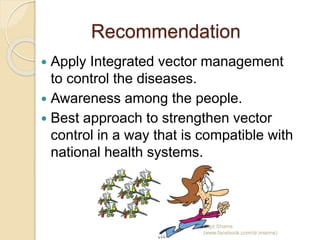
Recommendation
 Apply Integrated vector management
to control the diseases.
 Awareness among the people.
 Best approach to strengthen vector
control in a way that is compatible with
national health systems.
Capt.Shams
(www.facebook.com/dr.imanns)
Conclusion
Vector-borne diseases are one of the
greatest contributors to human mortality
and morbidity in tropical settings and
beyond. Although significant progress is
being made in combating some diseases
such as malaria, lymphatic filariasis and
Chagas disease, other diseases such as
dengue continue to spread at an
alarming pace. Governments, local
authorities, community groups, and
individuals should work togather to
prevent disease. Capt.Shams
(www.facebook.com/dr.imanns)
?
Capt.Shams
(www.facebook.com/dr.imanns)
THANK YOU
Capt.Shams
(www.facebook.com/dr.imanns)

Vector borne diseases in Bangladesh

  • 1.
  • 2.
    Vector borne diseasesin bangladesh Presented by CAPT SHAMS MOBC 77Capt.Shams (www.facebook.com/dr.imanns)
  • 3.
    Introduction Vector borne diseasesis 17% of all infectious diseases. 2.5 billion people in over 100 countries are at risk of these diseases. Every year, more than 1 billion people are infected and more than 1 million die from vector-borne diseases. Among them Malaria causes more than 6,00,000 deaths every year globally. Capt.Shams (www.facebook.com/dr.imanns)
  • 4.
    Aim To know aboutthe common vector borne diseases in Bangladesh and how to prevent these diseases. Capt.Shams (www.facebook.com/dr.imanns)
  • 5.
    Scope  What isvector and common vectors.  What is vector borne diseases and common VBD.  Common vector borne diseases in Bangladesh.  Prevention and control. Capt.Shams (www.facebook.com/dr.imanns)
  • 6.
    Vector A vector isany agent (person, animal or microorganism) that carries and transmits an infectious pathogen into another living organism. Capt.Shams (www.facebook.com/dr.imanns)
  • 7.
    Common vectors  Mosquitoes(Aedes, Anopheles, Culex, Mansonia)  Fly (Sandfly, Housefly, Tsetse Fly, Black Fly )  Flea (Rat Flea, Sand Flea )  Ticks (Hard Tick & Soft Tick)  Lice / Bugs/ Mites/ Cyclops Capt.Shams (www.facebook.com/dr.imanns)
  • 8.
    Vector-borne disease An illnesscaused by an infectious microorganism (pathogen) that is transmitted to humans by a vector, usually arthropods. Capt.Shams (www.facebook.com/dr.imanns)
  • 9.
    Major vector bornedisease in world  Malaria  Filaria  Leishmaniasis  Japanese Encephalitis  Dengue / Dengue Hemorrhagic fevers  Chikungunya  Chagas Diseases (American Trypanosomiasis) Capt.Shams (www.facebook.com/dr.imanns)
  • 10.
    Contd…  Yellow Fever Onchocerciasis (River Blindness)  CCHF (Crimean Congo Haemorrhagic Fever)  Lyme Disease  Tick Borne Encephalitis  Schistosomiasis (Bilharzia) Capt.Shams (www.facebook.com/dr.imanns)
  • 11.
    Common vector bornedisease in Bangladesh  Malaria  Filariasis  Leishmaniasis  Dengue Capt.Shams (www.facebook.com/dr.imanns)
  • 12.
    Malaria  Life-threatening disease Caused by plasmodium species  Transmitted through bite of female anopheles  Plasmodium - four parasite species Capt.Shams (www.facebook.com/dr.imanns)
  • 13.
    Malaria Facts  Malariakills in one year ,what AIDS kills in 15 years  For every death due to HIV/AIDS, there are about 50 deaths due to malaria Capt.Shams (www.facebook.com/dr.imanns)
  • 14.
    Malaria Burden Globally-2012  Approx207 million cases & 6,27,000 deaths  97 countries- 3.4 billion people at risk Capt.Shams (www.facebook.com/dr.imanns)
  • 15.
    Malaria in Bangladesh 13 districts (with the total population of 10.9 million) are in the high endemic areas of malaria transmissions.  In July’2008 to May’2009 total cases are found 74412 and total deaths are 89. Capt.Shams (www.facebook.com/dr.imanns)
  • 16.
  • 17.
    Filariasis  Lymphatic filariasisis infection with the filarial worms, Wuchereria bancrofti, Brugia malayi or B. timori.  A wide range of mosquitoes can transmit the parasite, depending on the geographic area. In Africa, the most common vector is Anopheles and in the Americas, it is Culex quilex. Aedes and Mansonia can transmit the infection in the Pacific and in Asia.Capt.Shams (www.facebook.com/dr.imanns)
  • 18.
    Filaria Burden  Atotal of 32 districts with an estimated 70 million population are endemic for Lymphatic Filariasis.  About 20 million are already infected. Capt.Shams (www.facebook.com/dr.imanns)
  • 19.
    Dengue  Dengue istransmitted by several species of mosquito within the genus Aedes, principally A. aegypti.  Most rapidly spreading viral disease in the world. In past 50 years, incidence has increased 30-fold.  Pattern changing from urban to rural settings  There are four known serotypes of dengue virus (DEN 1 to 4).  Recovery from infection by one provides lifelong immunity Capt.Shams (www.facebook.com/dr.imanns)
  • 20.
    Dengue Burden In Bangladeshthere had been Dengue outbreaks in 2000 (5,555 cases and 93 deaths); 2001 (2,430 cases and 44 deaths) and 2002 (6,104 cases and 58 deaths). Cases were reported from the metropolitan cities (Dhaka, Chittagong, Khulna, Rajshahi) Capt.Shams (www.facebook.com/dr.imanns)
  • 21.
    Leishmaniasis  Caused byprotozoan parasites of the genus Leishmania.  Spread by the bite of sandflies.  The disease can present in three main ways as: cutaneous leishmaniasis, mucocutaneous leishmaniasis and visceral leishmaniasis. Capt.Shams (www.facebook.com/dr.imanns)
  • 22.
    Disease Burden  InBangladesh cases are reported from 45 districts (130 upaziala) and an estimated 51.2 million populations are in endemic areas. Capt.Shams (www.facebook.com/dr.imanns)
  • 23.
    Prevention and Control Newstrategies have taken by WHO to control vector borne diseases. No single measure can control these diseases. It needs multiple approach both from government and non government institutes. Capt.Shams (www.facebook.com/dr.imanns)
  • 24.
    Strategies  Needs soundknowledge of the Bionomics Distribution Seasonal prevalence Vectorial capacity Insecticide susceptibility status Role of arthropods in disease transmission Capt.Shams (www.facebook.com/dr.imanns)
  • 25.
    Integrated vector management  Theutilization of all appropriate technological & management techniques to bring about an effective degree of vector suppression in a cost effective manner.  Best approach to strengthen vector control in a way that is compatible with national health systems Capt.Shams (www.facebook.com/dr.imanns)
  • 26.
    Key Elements ofIVM  Evidence-based decision-making  Monitoring & Evaluation  Advocacy & Social mobilization  Intra & intersectoral Collaboration  Capacity-building  Legislation & Regulation Capt.Shams (www.facebook.com/dr.imanns)
  • 27.
  • 28.
    Environmental control  Eliminatetheir breeding places  Known as "source reduction"  Results are generally permanent Capt.Shams (www.facebook.com/dr.imanns)
  • 29.
    Source reduction  Filling Levelling& drainage of breeding places Water management (intermittent irrigation) Capt.Shams (www.facebook.com/dr.imanns)
  • 30.
    Waste management  Emptytins, plastic bottles, unused drums, coconut shells & used car tyres can serve as important breeding sites Capt.Shams (www.facebook.com/dr.imanns)
  • 31.
    Chemical control Oiling (diesel oil,fueloil, kerosene oil) Paris green Synthetic Insecticides (Fenthion, malathion, chlorpyrifos, abate) Capt.Shams (www.facebook.com/dr.imanns)
  • 32.
    Biological control  Introductionof bacterial larvicides & larvivorous fish  Target vector larvae without generating ecological impacts of chemical use  Regular monitoring & restocking is important Capt.Shams (www.facebook.com/dr.imanns)
  • 33.
    Genetic control  "Useof any treatment that reduce the reproductive potential by replacing the hereditary material"  Sterile male technique  Hybrid male technique  Sex distortion  Gene replacement Capt.Shams (www.facebook.com/dr.imanns)
  • 34.
    Personal Protective measures Acheived by wearing long sleeved, light- coloured shirts, trousers, socks, shoes & by the use of repellents like Benzyl benzoate, DEET  Insecticidal net are most efficient & cost-effective method. Capt.Shams (www.facebook.com/dr.imanns)
  • 35.
    House modification  Door& window screens  Plaster walls & concrete floors in good condition  Cracks & entry points sealed up Capt.Shams (www.facebook.com/dr.imanns)
  • 36.
    Indoor residual spray Most widely used method  Effective way to reduce sandflies & bugs inside homes  80% of houses in targeted area need to be sprayed.  Effective for 3–6 months, depending on the insecticide used & type of surface Capt.Shams (www.facebook.com/dr.imanns)
  • 37.
    Outdoor spraying Spraying outer surfacesof - Domestic animal shelters, - Outdoor latrines & - Damp places Aerial spraying -- control mosquitoes during epidemics of dengue & yellow fever. Capt.Shams (www.facebook.com/dr.imanns)
  • 38.
    Recommendation  Apply Integratedvector management to control the diseases.  Awareness among the people.  Best approach to strengthen vector control in a way that is compatible with national health systems. Capt.Shams (www.facebook.com/dr.imanns)
  • 39.
    Conclusion Vector-borne diseases areone of the greatest contributors to human mortality and morbidity in tropical settings and beyond. Although significant progress is being made in combating some diseases such as malaria, lymphatic filariasis and Chagas disease, other diseases such as dengue continue to spread at an alarming pace. Governments, local authorities, community groups, and individuals should work togather to prevent disease. Capt.Shams (www.facebook.com/dr.imanns)
  • 40.
  • 41.