Clozapine
Presenter: Abdul Waris Khan
5th Year M.B.B.S
Sulaiman Al-Rajhi Colleges
Welcome!
Obectives
SLIDE 2
Introduction to
clozapine
Indications
Treatment
protocol
1 2 3 4
Side effects
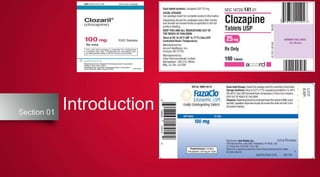
IntroductionSection 01
SLIDE 4
• Clozapine is an Atypical antipsychotic.
• First of the antipsychotics to be developed by Sandoz in
1961.
• Introduced in Europe in 1971 and withdrawn in 1975.why?
• FDA approved clozapine for only treatment-resistant
schizophrenia
SLIDE 5Mechanism of action
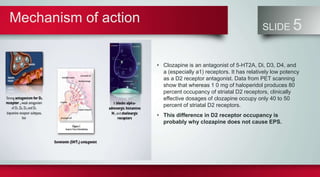
• Clozapine is an antagonist of 5-HT2A, Di, D3, D4, and
a (especially a1) receptors. It has relatively low potency
as a D2 receptor antagonist. Data from PET scanning
show that whereas 1 0 mg of haloperidol produces 80
percent occupancy of striatal D2 receptors, clinically
effective dosages of clozapine occupy only 40 to 50
percent of striatal D2 receptors.
• This difference in D2 receptor occupancy is
probably why clozapine does not cause EPS.
SLIDE 6
Indications
SLIDE 7
Treatment-resistant schizophrenia
Tardive dyskinesia
Patients suffering from EPS (due to other class of
medications)
Treatment resistant mania
Psychotic depression
Idiopthic parkinsons disease
Suicide patients with schizophrenia
Treatment protocol
SLIDE 8
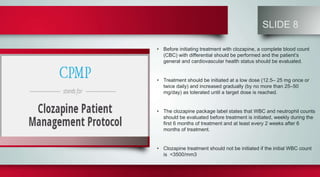
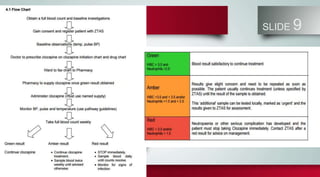
• Before initiating treatment with clozapine, a complete blood count
(CBC) with differential should be performed and the patient’s
general and cardiovascular health status should be evaluated.
• Treatment should be initiated at a low dose (12.5– 25 mg once or
twice daily) and increased gradually (by no more than 25–50
mg/day) as tolerated until a target dose is reached.
• The clozapine package label states that WBC and neutrophil counts
should be evaluated before treatment is initiated, weekly during the
first 6 months of treatment and at least every 2 weeks after 6
months of treatment.
• Clozapine treatment should not be initiated if the initial WBC count
is <3500/mm3
SLIDE 9
Dozages
SLIDE 10
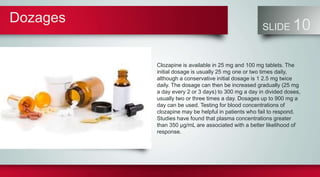
Clozapine is available in 25 mg and 100 mg tablets. The
initial dosage is usually 25 mg one or two times daily,
although a conservative initial dosage is 1 2.5 mg twice
daily. The dosage can then be increased gradually (25 mg
a day every 2 or 3 days) to 300 mg a day in divided doses,
usually two or three times a day. Dosages up to 900 mg a
day can be used. Testing for blood concentrations of
clozapine may be helpful in patients who fail to respond.
Studies have found that plasma concentrations greater
than 350 μg/mL are associated with a better likelihood of
response.
Side effects
Side effects
SLIDE 11
• The most common:
• sedation
• dizziness
• syncope
• tachycardia
• hypotension
• electrocardiography (ECG) changes
• nausea, and vomiting
• Fatigue
• weight gain
• subjective muscle weakness
• sialorrhea
• Seizures
• Leukopenia
• Agranulocytosis (0.73% risk)
• Neutropenia
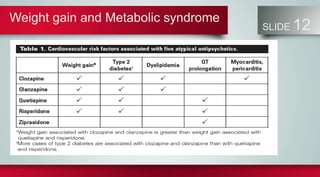
Weight gain and Metabolic syndrome
SLIDE 12
References
SLIDE 13
American psychiatric association
guidelines.
Kaplan and sedock’s synopsis of
psychiatry.
That’s all. Thank you very much! 
Any Questions?

Clozapine

  • 1.
    Clozapine Presenter: Abdul WarisKhan 5th Year M.B.B.S Sulaiman Al-Rajhi Colleges Welcome!
  • 2.
  • 3.
  • 4.
    SLIDE 4 • Clozapineis an Atypical antipsychotic. • First of the antipsychotics to be developed by Sandoz in 1961. • Introduced in Europe in 1971 and withdrawn in 1975.why? • FDA approved clozapine for only treatment-resistant schizophrenia
  • 5.
    SLIDE 5Mechanism ofaction • Clozapine is an antagonist of 5-HT2A, Di, D3, D4, and a (especially a1) receptors. It has relatively low potency as a D2 receptor antagonist. Data from PET scanning show that whereas 1 0 mg of haloperidol produces 80 percent occupancy of striatal D2 receptors, clinically effective dosages of clozapine occupy only 40 to 50 percent of striatal D2 receptors. • This difference in D2 receptor occupancy is probably why clozapine does not cause EPS.
  • 6.
  • 7.
    Indications SLIDE 7 Treatment-resistant schizophrenia Tardivedyskinesia Patients suffering from EPS (due to other class of medications) Treatment resistant mania Psychotic depression Idiopthic parkinsons disease Suicide patients with schizophrenia
  • 8.
  • 9.
    SLIDE 8 • Beforeinitiating treatment with clozapine, a complete blood count (CBC) with differential should be performed and the patient’s general and cardiovascular health status should be evaluated. • Treatment should be initiated at a low dose (12.5– 25 mg once or twice daily) and increased gradually (by no more than 25–50 mg/day) as tolerated until a target dose is reached. • The clozapine package label states that WBC and neutrophil counts should be evaluated before treatment is initiated, weekly during the first 6 months of treatment and at least every 2 weeks after 6 months of treatment. • Clozapine treatment should not be initiated if the initial WBC count is <3500/mm3
  • 10.
  • 11.
    Dozages SLIDE 10 Clozapine isavailable in 25 mg and 100 mg tablets. The initial dosage is usually 25 mg one or two times daily, although a conservative initial dosage is 1 2.5 mg twice daily. The dosage can then be increased gradually (25 mg a day every 2 or 3 days) to 300 mg a day in divided doses, usually two or three times a day. Dosages up to 900 mg a day can be used. Testing for blood concentrations of clozapine may be helpful in patients who fail to respond. Studies have found that plasma concentrations greater than 350 μg/mL are associated with a better likelihood of response.
  • 12.
  • 13.
    Side effects SLIDE 11 •The most common: • sedation • dizziness • syncope • tachycardia • hypotension • electrocardiography (ECG) changes • nausea, and vomiting • Fatigue • weight gain • subjective muscle weakness • sialorrhea • Seizures • Leukopenia • Agranulocytosis (0.73% risk) • Neutropenia
  • 14.
    Weight gain andMetabolic syndrome SLIDE 12
  • 15.
    References SLIDE 13 American psychiatricassociation guidelines. Kaplan and sedock’s synopsis of psychiatry.
  • 16.
    That’s all. Thankyou very much!  Any Questions?