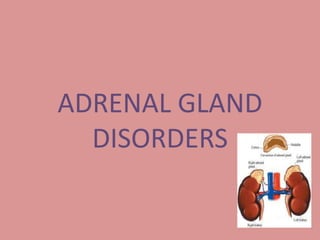
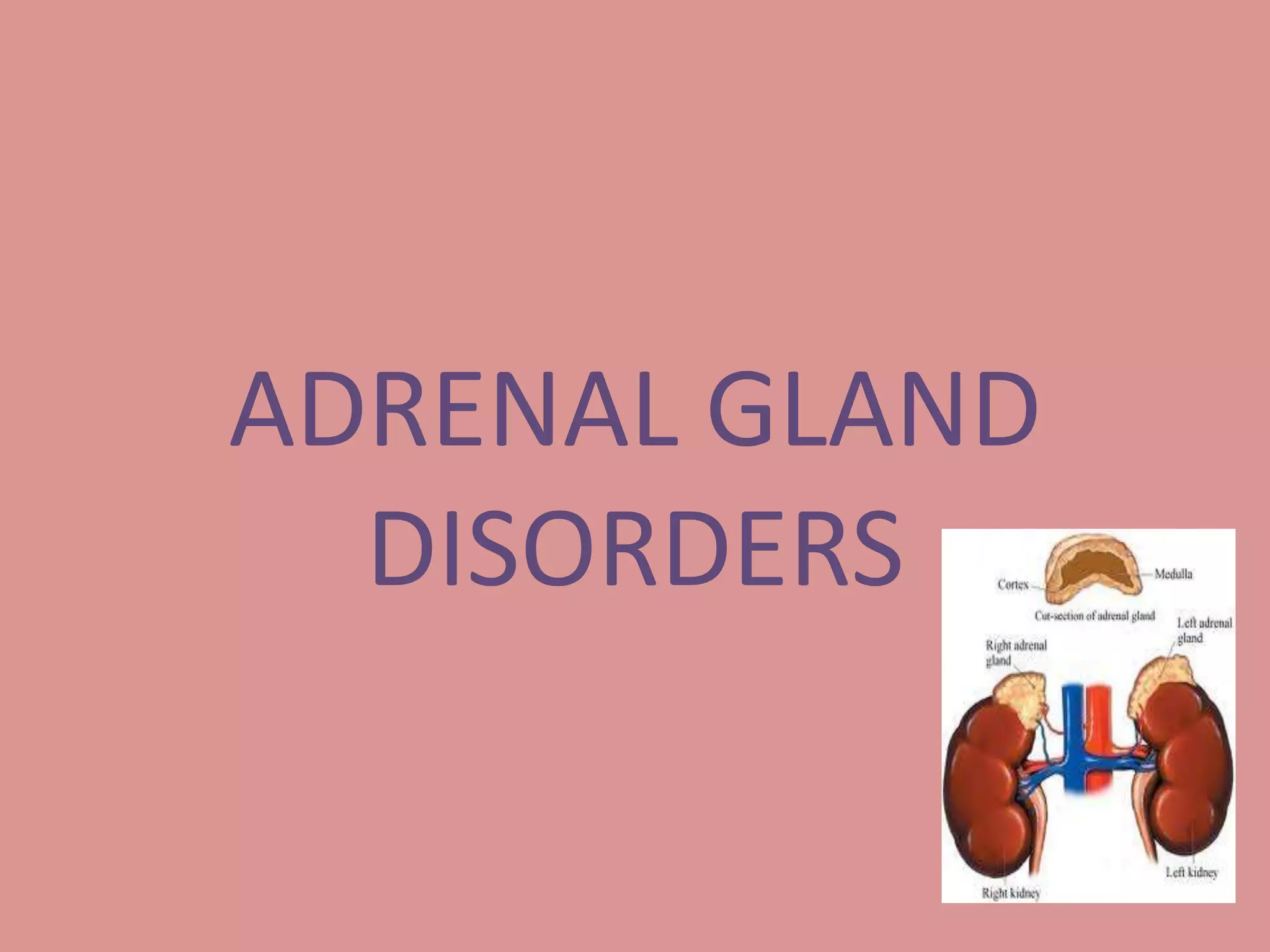
ADRENAL GLAND
  DISORDERS
INTRODUCTION
• Each person has 2 adrenal glands
• 2 separate glands with independent function
• Hypofunction and hyperfunction of adrenal cortex
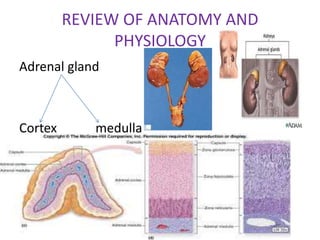
REVIEW OF ANATOMY AND
               PHYSIOLOGY
Adrenal gland


Cortex      medulla
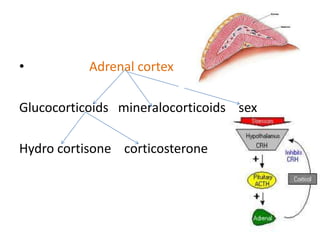
•          Adrenal cortex

Glucocorticoids mineralocorticoids sex

Hydro cortisone corticosterone
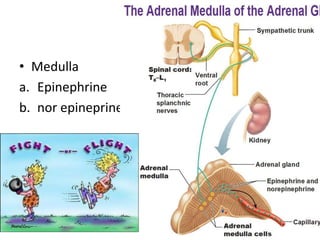
• Medulla
a. Epinephrine
b. nor epineprine
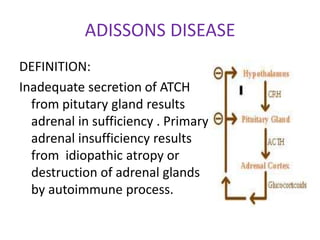
ADISSONS DISEASE
DEFINITION:
Inadequate secretion of ATCH
  from pitutary gland results
  adrenal in sufficiency . Primary
  adrenal insufficiency results
  from idiopathic atropy or
  destruction of adrenal glands
  by autoimmune process.
ETIOLOGY AND RISK FACTORS
• Tuberculosis (TB) :TB is an infection which
  usually affects the lungs. In some cases the
  infection can spread to, and gradually
  destroy, the adrenals
• Other infections can sometimes affect
  both adrenals.
• Cancers of other parts of the body can
  spread and destroy the adrenals.
• Rare hereditary conditions.
• adrenalectomy
• Auto immune diseases: auto-immune
  diseases the immune system makes
  antibodies against part or parts of the
  body. In auto-immune Addison's disease,
  you make antibodies which attach to cells
  in the adrenal cortex
CLINICAL MANIFESTATION
• General weakness and becoming easily tired.
• Darkened areas of skin ('pigmentation').
• Blood pressure is low and falls further when
  you stand which can make you dizzy.
• Being off your food and weight loss.
• Feeling sick and vomiting from time to time.
• Abdominal pains which may come and go.
• Diarrhoea or constipation which may come and
  go.
• Cramps and pains in muscles.
• Craving for salt, or salty foods and drinks.
• Menstrual periods in women may become
  irregular, or stop.
DIAGNOSTIC TESTS
•   Serum electrolyte levels
•   Blood glucose levels
•   CBC
•   X ray studies
•   Computed tomography
•   MRI
TREATMENT
• Cortisol replacement
• You need steroid medication to replace the cortisol
  which you no longer make. This is usually with a
  medicine called hydrocortisone which is very similar to
  cortisol. The amount is usually about 15-25 mg each
  day. Some people need more than this, and others less.
  The daily amount is broken up into two or three doses
  each day with a higher dose taken in the morning than
  in the evening. For example, you may be advised to
  take 15 mg in the morning and 10 mg early evening.
• Replacing aldosterone
Fludrocortisone is a substitute medicine for
  aldosterone. This helps to regulate blood
  pressure and blood salt level. You may also be
  advised to take extra salt each day.
• Addisonian crisis
• This is a medical emergency. You will be given
  hydrocortisone injections, a 'drip' of fluid to bring
  up your blood pressure, and may need intensive
  care until the crisis is over. then need to continue
  taking hydrocortisone medication
CUSHING SYNDROME
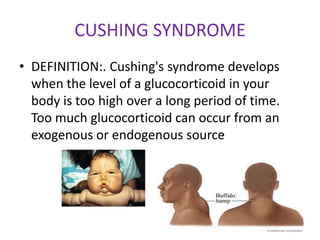
• DEFINITION:. Cushing's syndrome develops
  when the level of a glucocorticoid in your
  body is too high over a long period of time.
  Too much glucocorticoid can occur from an
  exogenous or endogenous source
ETIOLOGY
• Adrenal hyperplasia - which means there is
  increased number and growth of the cells in
  the adrenal glands. These cells then make too
  much cortisol. There are various different
  types of adrenal hyperplasia.
• A benign (noncancerous) tumour of an
  adrenal gland.
• A malignant (cancerous) tumour of an adrenal
  gland
SIGNS AND SYMPTOMS
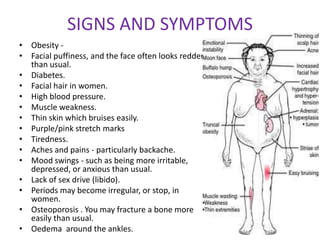
• Obesity -
• Facial puffiness, and the face often looks redder
  than usual.
• Diabetes.
• Facial hair in women.
• High blood pressure.
• Muscle weakness.
• Thin skin which bruises easily.
• Purple/pink stretch marks
• Tiredness.
• Aches and pains - particularly backache.
• Mood swings - such as being more irritable,
  depressed, or anxious than usual.
• Lack of sex drive (libido).
• Periods may become irregular, or stop, in
  women.
• Osteoporosis . You may fracture a bone more
  easily than usual.
• Oedema around the ankles.
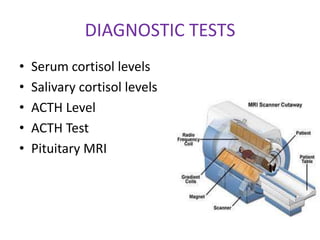
DIAGNOSTIC TESTS
•   Serum cortisol levels
•   Salivary cortisol levels
•   ACTH Level
•   ACTH Test
•   Pituitary MRI
TREATMENT
• Radiotherapy to the pituitary gland can destroy the pituitary
  adenoma. This has a good chance of success, but may take months
  or years to take effect. Medication (see below) may be needed until
  the radiation treatment takes effect. Also, the radiotherapy may
  damage the normal pituitary cells, and may cause low levels of
  other hormones made by the pituitary gland. However,
  replacement hormone therapy can usually be taken if this occurs.
• Surgery to remove both adrenal glands is an option. This stops your
  body making any cortisol (and other hormones) from your adrenal
  glands. You will need lifelong replacement therapy of certain
  hormones. However, the adenoma will remain in the pituitary and
  continue to produce high levels of ACTH which can cause problems
  in some cases.
• Medication to block the production or effects of cortisol may work.
  There are several medicines which can be tried with various levels
  of success.
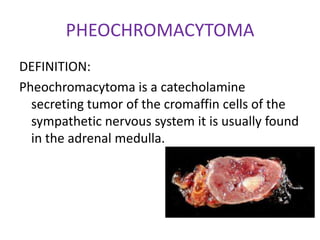
PHEOCHROMACYTOMA
DEFINITION:
Pheochromacytoma is a catecholamine
  secreting tumor of the cromaffin cells of the
  sympathetic nervous system it is usually found
  in the adrenal medulla.
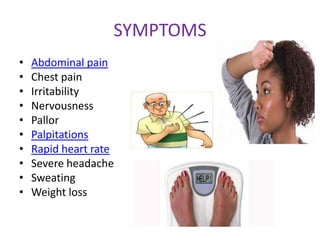
SYMPTOMS
•   Abdominal pain
•   Chest pain
•   Irritability
•   Nervousness
•   Pallor
•   Palpitations
•   Rapid heart rate
•   Severe headache
•   Sweating
•   Weight loss
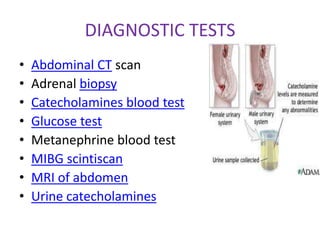
DIAGNOSTIC TESTS
•   Abdominal CT scan
•   Adrenal biopsy
•   Catecholamines blood test
•   Glucose test
•   Metanephrine blood test
•   MIBG scintiscan
•   MRI of abdomen
•   Urine catecholamines
TREATMENT
• Treatment involves removing the tumor with surgery. It
  is important to stabilize blood pressure and pulse with
  medication before surgery. close monitoring of vital
  signs.
• After surgery, it is necessary to continually monitor all
  vital signs in an intensive care unit. When the tumor
  cannot be surgically removed, medication is needed to
  manage it. This usually requires a combination of
  medications to control the effects of the excessive
  hormones. Radiation therapy and chemotherapy have
  not been effective in curing this kind of tumor.
NURSING MANAGEMENT
• Risk for injury related to weakness
• Risk for infection related to altered protein
  metabolism
• Self care deficit related to fatigue and muscle
  wasting
• Altered body image related to tunical obesity
Corticotropin-Releasing Factor Test in Normal Subjects and
         Patients with Hypothalamic-Pituitary-Adrenal Disorders*

•   Corticotropin-releasing factor (CRF) tests were performed in normal subjects and
    patients with hypothalamicpituitary-adrenal disorders. In normal subjects, after iv
    administation of 500 μg synthetic ovine CRF, plasma ACTH rose significantly to
    approximately 3.6 times the basal level at 30–60 min and cortisol reached a peak
    of 2.3 times the basal level at 60–90 min, whereas aldosterone peaked at 1.6 times
    the basal level at 60 min. Injection of 100 μg CRF in normal subjects also caused a
    significant increase in plasma ACTH and cortisol levels but only a slight increase in
    aldosterone. However, the total hormone released and their peak levels were
    lower than those elicited by the 500-μg dosage. In patients with Cushing’s disease,
    although the basal and peak levels of plasma ACTH and cortisol induced by
    administration of CRF were variable, the ratios of increase for the two hormones
    elicited by CRF were lower than those in normal subjects, especially for cortisol. In
    patients with Cushing’s syndrome due to an adrenal adenoma, basal levels of
    ACTH were markedly suppressed and plasma ACTH and cortisol did not rise after
    CRF. In patients with isolated ACTH deficiency or Sheehan’s syndrome the basal
    level of plasma ACTH was less than 5 pg/ml and no change in plasma ACTH
    occurred after injection of CRF. In patients with Nelson’s syndrome or Addison’s
    disease the basal levels of ACTH were extremely elevated but infusion of CRF
    increased plasma ACTH to even higher levels.
presented by,
   samantha
  14/4/2012

Adrenal gland disorders

  • 1.
    ADRENAL GLAND DISORDERS
  • 2.
    INTRODUCTION • Each personhas 2 adrenal glands • 2 separate glands with independent function • Hypofunction and hyperfunction of adrenal cortex
  • 3.
    REVIEW OF ANATOMYAND PHYSIOLOGY Adrenal gland Cortex medulla
  • 4.
    Adrenal cortex Glucocorticoids mineralocorticoids sex Hydro cortisone corticosterone
  • 5.
  • 6.
    ADISSONS DISEASE DEFINITION: Inadequate secretionof ATCH from pitutary gland results adrenal in sufficiency . Primary adrenal insufficiency results from idiopathic atropy or destruction of adrenal glands by autoimmune process.
  • 7.
    ETIOLOGY AND RISKFACTORS • Tuberculosis (TB) :TB is an infection which usually affects the lungs. In some cases the infection can spread to, and gradually destroy, the adrenals • Other infections can sometimes affect both adrenals. • Cancers of other parts of the body can spread and destroy the adrenals. • Rare hereditary conditions. • adrenalectomy • Auto immune diseases: auto-immune diseases the immune system makes antibodies against part or parts of the body. In auto-immune Addison's disease, you make antibodies which attach to cells in the adrenal cortex
  • 8.
    CLINICAL MANIFESTATION • Generalweakness and becoming easily tired. • Darkened areas of skin ('pigmentation'). • Blood pressure is low and falls further when you stand which can make you dizzy. • Being off your food and weight loss. • Feeling sick and vomiting from time to time. • Abdominal pains which may come and go. • Diarrhoea or constipation which may come and go. • Cramps and pains in muscles. • Craving for salt, or salty foods and drinks. • Menstrual periods in women may become irregular, or stop.
  • 9.
    DIAGNOSTIC TESTS • Serum electrolyte levels • Blood glucose levels • CBC • X ray studies • Computed tomography • MRI
  • 10.
    TREATMENT • Cortisol replacement •You need steroid medication to replace the cortisol which you no longer make. This is usually with a medicine called hydrocortisone which is very similar to cortisol. The amount is usually about 15-25 mg each day. Some people need more than this, and others less. The daily amount is broken up into two or three doses each day with a higher dose taken in the morning than in the evening. For example, you may be advised to take 15 mg in the morning and 10 mg early evening.
  • 11.
    • Replacing aldosterone Fludrocortisoneis a substitute medicine for aldosterone. This helps to regulate blood pressure and blood salt level. You may also be advised to take extra salt each day. • Addisonian crisis • This is a medical emergency. You will be given hydrocortisone injections, a 'drip' of fluid to bring up your blood pressure, and may need intensive care until the crisis is over. then need to continue taking hydrocortisone medication
  • 12.
    CUSHING SYNDROME • DEFINITION:.Cushing's syndrome develops when the level of a glucocorticoid in your body is too high over a long period of time. Too much glucocorticoid can occur from an exogenous or endogenous source
  • 13.
    ETIOLOGY • Adrenal hyperplasia- which means there is increased number and growth of the cells in the adrenal glands. These cells then make too much cortisol. There are various different types of adrenal hyperplasia. • A benign (noncancerous) tumour of an adrenal gland. • A malignant (cancerous) tumour of an adrenal gland
  • 14.
    SIGNS AND SYMPTOMS •Obesity - • Facial puffiness, and the face often looks redder than usual. • Diabetes. • Facial hair in women. • High blood pressure. • Muscle weakness. • Thin skin which bruises easily. • Purple/pink stretch marks • Tiredness. • Aches and pains - particularly backache. • Mood swings - such as being more irritable, depressed, or anxious than usual. • Lack of sex drive (libido). • Periods may become irregular, or stop, in women. • Osteoporosis . You may fracture a bone more easily than usual. • Oedema around the ankles.
  • 15.
    DIAGNOSTIC TESTS • Serum cortisol levels • Salivary cortisol levels • ACTH Level • ACTH Test • Pituitary MRI
  • 16.
    TREATMENT • Radiotherapy tothe pituitary gland can destroy the pituitary adenoma. This has a good chance of success, but may take months or years to take effect. Medication (see below) may be needed until the radiation treatment takes effect. Also, the radiotherapy may damage the normal pituitary cells, and may cause low levels of other hormones made by the pituitary gland. However, replacement hormone therapy can usually be taken if this occurs. • Surgery to remove both adrenal glands is an option. This stops your body making any cortisol (and other hormones) from your adrenal glands. You will need lifelong replacement therapy of certain hormones. However, the adenoma will remain in the pituitary and continue to produce high levels of ACTH which can cause problems in some cases. • Medication to block the production or effects of cortisol may work. There are several medicines which can be tried with various levels of success.
  • 17.
    PHEOCHROMACYTOMA DEFINITION: Pheochromacytoma is acatecholamine secreting tumor of the cromaffin cells of the sympathetic nervous system it is usually found in the adrenal medulla.
  • 18.
    SYMPTOMS • Abdominal pain • Chest pain • Irritability • Nervousness • Pallor • Palpitations • Rapid heart rate • Severe headache • Sweating • Weight loss
  • 19.
    DIAGNOSTIC TESTS • Abdominal CT scan • Adrenal biopsy • Catecholamines blood test • Glucose test • Metanephrine blood test • MIBG scintiscan • MRI of abdomen • Urine catecholamines
  • 20.
    TREATMENT • Treatment involvesremoving the tumor with surgery. It is important to stabilize blood pressure and pulse with medication before surgery. close monitoring of vital signs. • After surgery, it is necessary to continually monitor all vital signs in an intensive care unit. When the tumor cannot be surgically removed, medication is needed to manage it. This usually requires a combination of medications to control the effects of the excessive hormones. Radiation therapy and chemotherapy have not been effective in curing this kind of tumor.
  • 21.
    NURSING MANAGEMENT • Riskfor injury related to weakness • Risk for infection related to altered protein metabolism • Self care deficit related to fatigue and muscle wasting • Altered body image related to tunical obesity
  • 22.
    Corticotropin-Releasing Factor Testin Normal Subjects and Patients with Hypothalamic-Pituitary-Adrenal Disorders* • Corticotropin-releasing factor (CRF) tests were performed in normal subjects and patients with hypothalamicpituitary-adrenal disorders. In normal subjects, after iv administation of 500 μg synthetic ovine CRF, plasma ACTH rose significantly to approximately 3.6 times the basal level at 30–60 min and cortisol reached a peak of 2.3 times the basal level at 60–90 min, whereas aldosterone peaked at 1.6 times the basal level at 60 min. Injection of 100 μg CRF in normal subjects also caused a significant increase in plasma ACTH and cortisol levels but only a slight increase in aldosterone. However, the total hormone released and their peak levels were lower than those elicited by the 500-μg dosage. In patients with Cushing’s disease, although the basal and peak levels of plasma ACTH and cortisol induced by administration of CRF were variable, the ratios of increase for the two hormones elicited by CRF were lower than those in normal subjects, especially for cortisol. In patients with Cushing’s syndrome due to an adrenal adenoma, basal levels of ACTH were markedly suppressed and plasma ACTH and cortisol did not rise after CRF. In patients with isolated ACTH deficiency or Sheehan’s syndrome the basal level of plasma ACTH was less than 5 pg/ml and no change in plasma ACTH occurred after injection of CRF. In patients with Nelson’s syndrome or Addison’s disease the basal levels of ACTH were extremely elevated but infusion of CRF increased plasma ACTH to even higher levels.
  • 23.
    presented by, samantha 14/4/2012