SOEPEL: HEPATITIS-C 
Abdul Waris Khan 
Dept: Internal medicine
SOEPEL 
Subjective: a 55 years old male smoker presented to ER with 
complains of right hypochondrical pain, fatigue, fever, and 
weight loss and jaundice. 
H/O of presenting i l lness: He has been having these complaints 
for the past 1 month. He is a known case of IV drug abuser in 
the past.
 Objective: history taking and P.E 
 Evaluation: hepatitis, cirrhosis, l iver CA, cholecystitis. 
 Plan: CBC, LFTs, U&E 
 Elaboration: pain ki l lers and antibiotics 
 Learning goals: Hepatitis C
DEFINITION 
 Hepatitis C is an infection caused by the hepatitis C virus 
(HCV) that attacks the l iver and leads to inflammation. 
 Hepatitis C is a RNA virus.
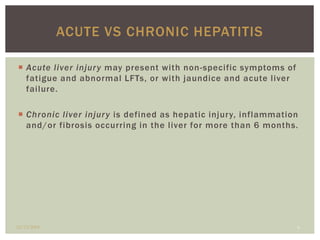
ACUTE VS CHRONIC HEPATITIS 
 Acute l iver injury may present with non-specific symptoms of 
fatigue and abnormal LFTs, or with jaundice and acute l iver 
fai lure. 
 Chronic l iver injury is defined as hepatic injury, inflammation 
and/or fibrosis occurring in the l iver for more than 6 months. 
12/13/2014 6
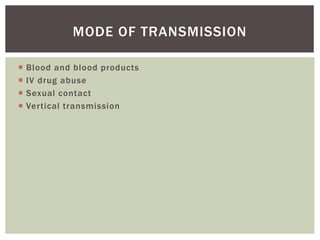
MODE OF TRANSMISSION 
 Blood and blood products 
 IV drug abuse 
 Sexual contact 
 Ver tical transmission
Hepatitis B and C are also considered as 
Sexually transmitted Diseases. 
Hepatitis A can also be transmitted 
through sexual activity. 
12/13/2014 8
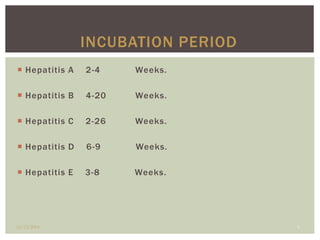
INCUBATION PERIOD 
 Hepatitis A 2-4 Weeks. 
 Hepatitis B 4-20 Weeks. 
 Hepatitis C 2-26 Weeks. 
 Hepatitis D 6-9 Weeks. 
 Hepatitis E 3-8 Weeks. 
12/13/2014 9
CLINICAL FEATURES 
 Most acute infect ions are asymptomat ic, wi th about 10% of pat ients having 
a mi ld f lu- l ike i l lness wi th jaundice and a r ise in serum aminot ransferases. 
 Most pat ients wi l l not be diagnosed unt i l they present , years later, wi th 
evidence of abnormal t ransferase values at heal th checks or wi th chronic 
l iver disease. 
 Fever 
 Fat igue 
 Loss of appet i te 
 Nausea 
 Vomi t ing 
 Abdominal pain 
 Dark ur ine 
 Clay -colored bowel movements 
 Joint pain 
 Jaundice (yel low color in the skin or eyes)
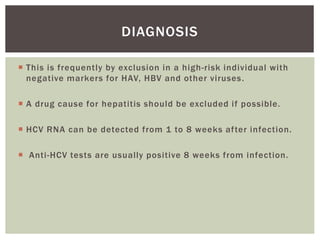
DIAGNOSIS 
 This is frequently by exclusion in a high-risk individual with 
negative markers for HAV, HBV and other viruses . 
 A drug cause for hepatitis should be excluded i f possible. 
 HCV RNA can be detected from 1 to 8 weeks af ter infection. 
 Anti -HCV tests are usually positive 8 weeks from infection.
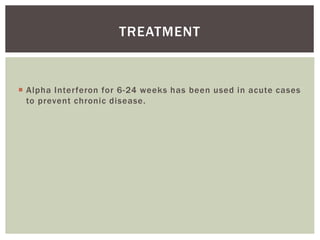
TREATMENT 
 Alpha Inter feron for 6-24 weeks has been used in acute cases 
to prevent chronic disease.
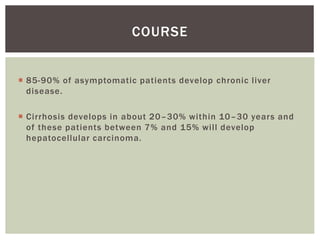
COURSE 
 85-90% of asymptomatic patients develop chronic l iver 
disease. 
 Cirrhosis develops in about 20–30% within 10–30 years and 
of these patients between 7% and 15% wi l l develop 
hepatocellular carcinoma.
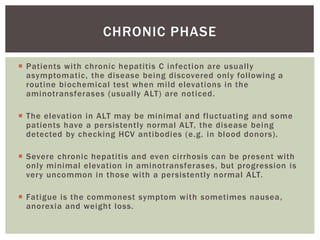
CHRONIC PHASE 
 Patients wi th chronic hepati tis C infection are usual ly 
asymptomatic, the disease being discovered only fol lowing a 
routine biochemical test when mi ld elevations in the 
aminotransferases (usual ly ALT) are noticed. 
 The elevation in ALT may be minimal and fluctuating and some 
patients have a persistently normal ALT, the disease being 
detected by checking HCV antibodies (e.g. in blood donors). 
 Severe chronic hepati tis and even cirrhosis can be present wi th 
only minimal elevation in aminotransferases, but progression is 
very uncommon in those wi th a persistently normal ALT. 
 Fatigue is the commonest symptom wi th sometimes nausea, 
anorexia and weight loss.
 11 dif ferent genotypes and 50 dif ferent subtypes 
 Used to asses need for treatment and how long the treatment 
regime should be. 
 Genotype 1 is most di f ficult to treat and needs 48 weeks to 
treat. 
 Other needs 24 weeks to treat and respond wel l to inter feron 
based therapy. 
GENOTYPES
DIAGNOSIS 
 This is made by finding HCV antibody in the serum using third-generation 
ELISA-3 tests. 
 HCV RNA should be assayed using quantitative HCV-RNA PCR. 
 The viraemia is usually variable; less than 600 000 iu/mL 
signi fies a greater l ikelihood of response to antiviral therapy.
TREATMENT 
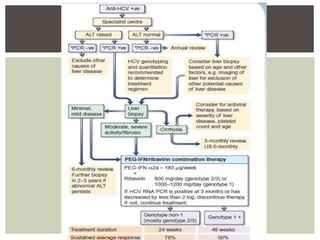
 Current treatment is combination therapy with pegylated 
inter feron, which is inter feron with a polyethyleneglycol tai l 
( α − 2 a 1 8 0 μ g /we e k o r α − 2 b 1 . 5 μ g/kg/week), and ribavirin 
(1000–1200 mg/day for genotype 1, 800 mg/day for 
genotype 2 or 3) in dai ly divided doses for 12 months for 
genotype 
 1, and 6 months for other genotypes. Ef ficacy is also 
determined by viral load, with HCV RNA > 600 000 iu/L less 
l ikely to respond. 
 Ribavirin is usual ly wel l tolerated but side-ef fects include a 
dose-related haemolysis, pruritus and nasal congestion. 
 Pregnancy should be avoided as ribavirin is teratogenic.
 Kumar and Clark cl inical medicine 7th edition 
 Emedicne.medscape.com 
 Shor t textbook of medical diagnosis and management by M. 
Inam Danish 
 www.cdc.gov 
REFERENCES

Hepatitis c

  • 2.
    SOEPEL: HEPATITIS-C AbdulWaris Khan Dept: Internal medicine
  • 3.
    SOEPEL Subjective: a55 years old male smoker presented to ER with complains of right hypochondrical pain, fatigue, fever, and weight loss and jaundice. H/O of presenting i l lness: He has been having these complaints for the past 1 month. He is a known case of IV drug abuser in the past.
  • 4.
     Objective: historytaking and P.E  Evaluation: hepatitis, cirrhosis, l iver CA, cholecystitis.  Plan: CBC, LFTs, U&E  Elaboration: pain ki l lers and antibiotics  Learning goals: Hepatitis C
  • 5.
    DEFINITION  HepatitisC is an infection caused by the hepatitis C virus (HCV) that attacks the l iver and leads to inflammation.  Hepatitis C is a RNA virus.
  • 6.
    ACUTE VS CHRONICHEPATITIS  Acute l iver injury may present with non-specific symptoms of fatigue and abnormal LFTs, or with jaundice and acute l iver fai lure.  Chronic l iver injury is defined as hepatic injury, inflammation and/or fibrosis occurring in the l iver for more than 6 months. 12/13/2014 6
  • 7.
    MODE OF TRANSMISSION  Blood and blood products  IV drug abuse  Sexual contact  Ver tical transmission
  • 8.
    Hepatitis B andC are also considered as Sexually transmitted Diseases. Hepatitis A can also be transmitted through sexual activity. 12/13/2014 8
  • 9.
    INCUBATION PERIOD Hepatitis A 2-4 Weeks.  Hepatitis B 4-20 Weeks.  Hepatitis C 2-26 Weeks.  Hepatitis D 6-9 Weeks.  Hepatitis E 3-8 Weeks. 12/13/2014 9
  • 10.
    CLINICAL FEATURES Most acute infect ions are asymptomat ic, wi th about 10% of pat ients having a mi ld f lu- l ike i l lness wi th jaundice and a r ise in serum aminot ransferases.  Most pat ients wi l l not be diagnosed unt i l they present , years later, wi th evidence of abnormal t ransferase values at heal th checks or wi th chronic l iver disease.  Fever  Fat igue  Loss of appet i te  Nausea  Vomi t ing  Abdominal pain  Dark ur ine  Clay -colored bowel movements  Joint pain  Jaundice (yel low color in the skin or eyes)
  • 11.
    DIAGNOSIS  Thisis frequently by exclusion in a high-risk individual with negative markers for HAV, HBV and other viruses .  A drug cause for hepatitis should be excluded i f possible.  HCV RNA can be detected from 1 to 8 weeks af ter infection.  Anti -HCV tests are usually positive 8 weeks from infection.
  • 12.
    TREATMENT  AlphaInter feron for 6-24 weeks has been used in acute cases to prevent chronic disease.
  • 13.
    COURSE  85-90%of asymptomatic patients develop chronic l iver disease.  Cirrhosis develops in about 20–30% within 10–30 years and of these patients between 7% and 15% wi l l develop hepatocellular carcinoma.
  • 14.
    CHRONIC PHASE Patients wi th chronic hepati tis C infection are usual ly asymptomatic, the disease being discovered only fol lowing a routine biochemical test when mi ld elevations in the aminotransferases (usual ly ALT) are noticed.  The elevation in ALT may be minimal and fluctuating and some patients have a persistently normal ALT, the disease being detected by checking HCV antibodies (e.g. in blood donors).  Severe chronic hepati tis and even cirrhosis can be present wi th only minimal elevation in aminotransferases, but progression is very uncommon in those wi th a persistently normal ALT.  Fatigue is the commonest symptom wi th sometimes nausea, anorexia and weight loss.
  • 15.
     11 different genotypes and 50 dif ferent subtypes  Used to asses need for treatment and how long the treatment regime should be.  Genotype 1 is most di f ficult to treat and needs 48 weeks to treat.  Other needs 24 weeks to treat and respond wel l to inter feron based therapy. GENOTYPES
  • 16.
    DIAGNOSIS  Thisis made by finding HCV antibody in the serum using third-generation ELISA-3 tests.  HCV RNA should be assayed using quantitative HCV-RNA PCR.  The viraemia is usually variable; less than 600 000 iu/mL signi fies a greater l ikelihood of response to antiviral therapy.
  • 17.
    TREATMENT  Currenttreatment is combination therapy with pegylated inter feron, which is inter feron with a polyethyleneglycol tai l ( α − 2 a 1 8 0 μ g /we e k o r α − 2 b 1 . 5 μ g/kg/week), and ribavirin (1000–1200 mg/day for genotype 1, 800 mg/day for genotype 2 or 3) in dai ly divided doses for 12 months for genotype  1, and 6 months for other genotypes. Ef ficacy is also determined by viral load, with HCV RNA > 600 000 iu/L less l ikely to respond.  Ribavirin is usual ly wel l tolerated but side-ef fects include a dose-related haemolysis, pruritus and nasal congestion.  Pregnancy should be avoided as ribavirin is teratogenic.
  • 20.
     Kumar andClark cl inical medicine 7th edition  Emedicne.medscape.com  Shor t textbook of medical diagnosis and management by M. Inam Danish  www.cdc.gov REFERENCES