Evaluation and Treatment of
Vascular Injury
Hope University
Department of medicine
Orthopedic lecture
Potential Orthopedic Emergencies
Open fracture
Irreducible dislocations
Vascular injury
Amputation
Compartment syndrome
Unstable pelvic fracture/ hemodynamic instability
Multiply-injured patient
Spinal cord injury
Potential Orthopedic Emergencies
Open fracture
Irreducible dislocations
Vascular injury
Amputation
Compartment syndrome
Unstable pelvic fracture/ hemodynamic instability
Multiply-injured patient
Spinal cord injury
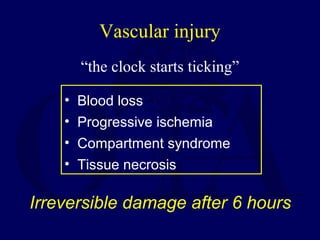
Vascular injury
“the clock starts ticking”
• Blood loss
• Progressive ischemia
• Compartment syndrome
• Tissue necrosis
Irreversible damage after 6 hours
Vascular injury
Potentially frequent incidence
• Proximity of vessels to bone
• Tethering of vessels at joints
• Superficial location of vessels
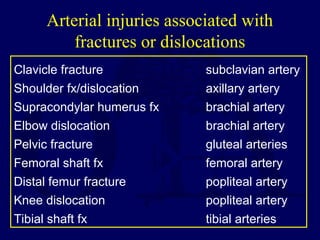
Arterial injuries associated with
fractures or dislocations
Clavicle fracture subclavian artery
Shoulder fx/dislocation axillary artery
Supracondylar humerus fx brachial artery
Elbow dislocation brachial artery
Pelvic fracture gluteal arteries
Femoral shaft fx femoral artery
Distal femur fracture popliteal artery
Knee dislocation popliteal artery
Tibial shaft fx tibial arteries
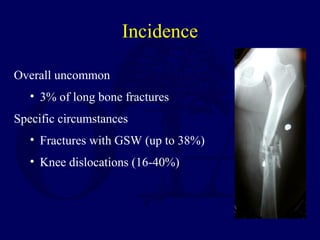
Incidence
Overall uncommon
• 3% of long bone fractures
Specific circumstances
• Fractures with GSW (up to 38%)
• Knee dislocations (16-40%)
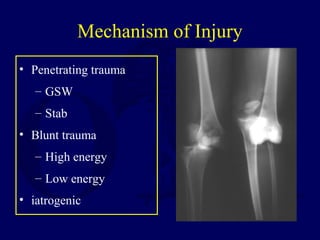
Mechanism of Injury
• Penetrating trauma
– GSW
– Stab
• Blunt trauma
– High energy
– Low energy
• iatrogenic
Types of vascular injuries
• Spasm
• Intimal flaps
• Subintimal hematoma
• Laceration
• Transection
• A-V fistula
Some require treatment, some do not
Consequences of vascular injury
• Blood loss
• Ischemia
• Compartment syndrome
• Tissue necrosis
• Amputation
• Death
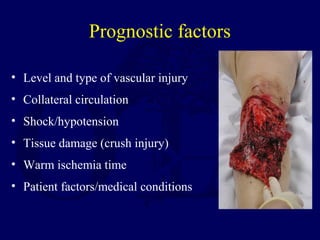
Prognostic factors
• Level and type of vascular injury
• Collateral circulation
• Shock/hypotension
• Tissue damage (crush injury)
• Warm ischemia time
• Patient factors/medical conditions
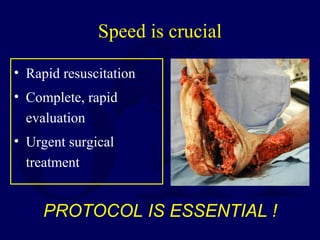
Speed is crucial
• Rapid resuscitation
• Complete, rapid
evaluation
• Urgent surgical
treatment
PROTOCOL IS ESSENTIAL !
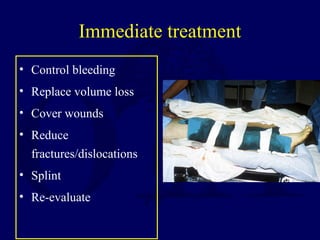
Immediate treatment
• Control bleeding
• Replace volume loss
• Cover wounds
• Reduce
fractures/dislocations
• Splint
• Re-evaluate
Diagnosis
• Physical exam
• Doppler pressure (Ankle/brachial
systolic pressure index)
• Duplex scanning
• Arteriogram
• Exploration
Diagnosis
• Physical exam
• Doppler pressure (Ankle/brachial
systolic pressure index)
• Duplex scanning
• Arteriogram
• Exploration Careful physical exam and
high index of suspicion are
most important !
Physical exam
• Major hemorrhage/hypotension
• Arterial bleeding
• Expanding hematoma
• Altered distal pulses
• Pallor
• Temperature differential between extremities
• Injury to anatomically-related nerve
• Asymmetric pulses warrant doppler
examination (determine ABI)
• Absent pulses warrant emergent
vascular consultation/surgical
exploration
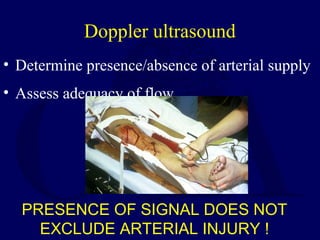
Doppler ultrasound
• Determine presence/absence of arterial supply
• Assess adequacy of flow
PRESENCE OF SIGNAL DOES NOT
EXCLUDE ARTERIAL INJURY !
Doppler ultrasound
• Normal > 0.95
• Abnormal < 0.90
• Does not define extent or level of injury
• Abnormal values warrant further evaluation
Mills, et al. J. Trauma 2004
Duplex scanning
• Noninvasive
• Safe
• Rapid
• Reliable for
– Injury to arteries and veins
– A-V fistulas
– Pseudoaneurysms
Duplex scanning
• Requires technician and scanner availability
• Not all surgeons will operate based on duplex
information
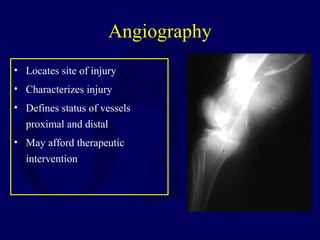
Angiography
• Locates site of injury
• Characterizes injury
• Defines status of vessels
proximal and distal
• May afford therapeutic
intervention
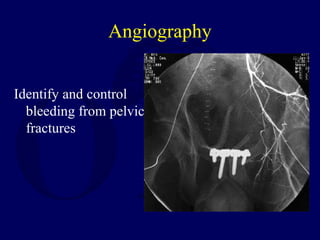
Angiography
Identify and control
bleeding from pelvic
fractures
Angiography
• Expensive
• Time-consuming
• Difficult to monitor/treat patient
• Procedural risks
– Renal burden from dye
– Possibility of anaphylaxis
– Injury to proximal vessels
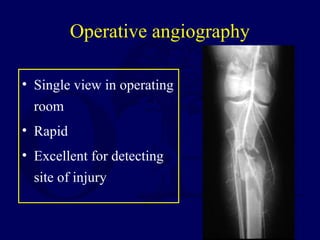
Operative angiography
• Single view in operating
room
• Rapid
• Excellent for detecting
site of injury
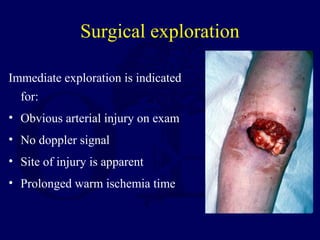
Surgical exploration
Immediate exploration is indicated
for:
• Obvious arterial injury on exam
• No doppler signal
• Site of injury is apparent
• Prolonged warm ischemia time
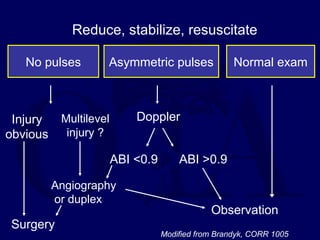
No pulses Asymmetric pulses Normal exam
Reduce, stabilize, resuscitate
Injury
obvious
Multilevel
injury ?
Doppler
ABI >0.9ABI <0.9
Angiography
or duplex
Surgery
Observation
Modified from Brandyk, CORR 1005
Continued evaluation
• Vascular injuries are dynamic
• Evaluation should continue after the initial
injury or surgery
Continued evaluation
• Circulation
• Neurologic function
• Compartment pressures
Surgical considerations
• Who goes first?
• Temporary shunts
• Fracture stabilization techniques
• Salvage vs amputation
• Fasciotomies
Conclusions
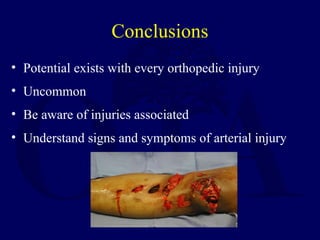
• Potential exists with every orthopedic injury
• Uncommon
• Be aware of injuries associated
• Understand signs and symptoms of arterial injury
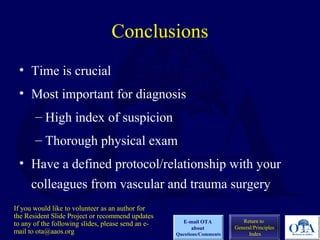
Conclusions
• Time is crucial
• Most important for diagnosis
– High index of suspicion
– Thorough physical exam
• Have a defined protocol/relationship with your
colleagues from vascular and trauma surgery
Return to
General/Principles
Index
E-mail OTA
about
Questions/Comments
If you would like to volunteer as an author for
the Resident Slide Project or recommend updates
to any of the following slides, please send an e-
mail to ota@aaos.org

vascular injury

  • 1.
    Evaluation and Treatmentof Vascular Injury Hope University Department of medicine Orthopedic lecture
  • 2.
    Potential Orthopedic Emergencies Openfracture Irreducible dislocations Vascular injury Amputation Compartment syndrome Unstable pelvic fracture/ hemodynamic instability Multiply-injured patient Spinal cord injury
  • 3.
    Potential Orthopedic Emergencies Openfracture Irreducible dislocations Vascular injury Amputation Compartment syndrome Unstable pelvic fracture/ hemodynamic instability Multiply-injured patient Spinal cord injury
  • 4.
    Vascular injury “the clockstarts ticking” • Blood loss • Progressive ischemia • Compartment syndrome • Tissue necrosis Irreversible damage after 6 hours
  • 5.
    Vascular injury Potentially frequentincidence • Proximity of vessels to bone • Tethering of vessels at joints • Superficial location of vessels
  • 6.
    Arterial injuries associatedwith fractures or dislocations Clavicle fracture subclavian artery Shoulder fx/dislocation axillary artery Supracondylar humerus fx brachial artery Elbow dislocation brachial artery Pelvic fracture gluteal arteries Femoral shaft fx femoral artery Distal femur fracture popliteal artery Knee dislocation popliteal artery Tibial shaft fx tibial arteries
  • 7.
    Incidence Overall uncommon • 3%of long bone fractures Specific circumstances • Fractures with GSW (up to 38%) • Knee dislocations (16-40%)
  • 8.
    Mechanism of Injury •Penetrating trauma – GSW – Stab • Blunt trauma – High energy – Low energy • iatrogenic
  • 9.
    Types of vascularinjuries • Spasm • Intimal flaps • Subintimal hematoma • Laceration • Transection • A-V fistula Some require treatment, some do not
  • 10.
    Consequences of vascularinjury • Blood loss • Ischemia • Compartment syndrome • Tissue necrosis • Amputation • Death
  • 11.
    Prognostic factors • Leveland type of vascular injury • Collateral circulation • Shock/hypotension • Tissue damage (crush injury) • Warm ischemia time • Patient factors/medical conditions
  • 12.
    Speed is crucial •Rapid resuscitation • Complete, rapid evaluation • Urgent surgical treatment PROTOCOL IS ESSENTIAL !
  • 13.
    Immediate treatment • Controlbleeding • Replace volume loss • Cover wounds • Reduce fractures/dislocations • Splint • Re-evaluate
  • 14.
    Diagnosis • Physical exam •Doppler pressure (Ankle/brachial systolic pressure index) • Duplex scanning • Arteriogram • Exploration
  • 15.
    Diagnosis • Physical exam •Doppler pressure (Ankle/brachial systolic pressure index) • Duplex scanning • Arteriogram • Exploration Careful physical exam and high index of suspicion are most important !
  • 16.
    Physical exam • Majorhemorrhage/hypotension • Arterial bleeding • Expanding hematoma • Altered distal pulses • Pallor • Temperature differential between extremities • Injury to anatomically-related nerve
  • 17.
    • Asymmetric pulseswarrant doppler examination (determine ABI) • Absent pulses warrant emergent vascular consultation/surgical exploration
  • 18.
    Doppler ultrasound • Determinepresence/absence of arterial supply • Assess adequacy of flow PRESENCE OF SIGNAL DOES NOT EXCLUDE ARTERIAL INJURY !
  • 19.
    Doppler ultrasound • Normal> 0.95 • Abnormal < 0.90 • Does not define extent or level of injury • Abnormal values warrant further evaluation Mills, et al. J. Trauma 2004
  • 20.
    Duplex scanning • Noninvasive •Safe • Rapid • Reliable for – Injury to arteries and veins – A-V fistulas – Pseudoaneurysms
  • 21.
    Duplex scanning • Requirestechnician and scanner availability • Not all surgeons will operate based on duplex information
  • 22.
    Angiography • Locates siteof injury • Characterizes injury • Defines status of vessels proximal and distal • May afford therapeutic intervention
  • 23.
  • 24.
    Angiography • Expensive • Time-consuming •Difficult to monitor/treat patient • Procedural risks – Renal burden from dye – Possibility of anaphylaxis – Injury to proximal vessels
  • 25.
    Operative angiography • Singleview in operating room • Rapid • Excellent for detecting site of injury
  • 26.
    Surgical exploration Immediate explorationis indicated for: • Obvious arterial injury on exam • No doppler signal • Site of injury is apparent • Prolonged warm ischemia time
  • 27.
    No pulses Asymmetricpulses Normal exam Reduce, stabilize, resuscitate Injury obvious Multilevel injury ? Doppler ABI >0.9ABI <0.9 Angiography or duplex Surgery Observation Modified from Brandyk, CORR 1005
  • 28.
    Continued evaluation • Vascularinjuries are dynamic • Evaluation should continue after the initial injury or surgery
  • 29.
    Continued evaluation • Circulation •Neurologic function • Compartment pressures
  • 30.
    Surgical considerations • Whogoes first? • Temporary shunts • Fracture stabilization techniques • Salvage vs amputation • Fasciotomies
  • 31.
    Conclusions • Potential existswith every orthopedic injury • Uncommon • Be aware of injuries associated • Understand signs and symptoms of arterial injury
  • 32.
    Conclusions • Time iscrucial • Most important for diagnosis – High index of suspicion – Thorough physical exam • Have a defined protocol/relationship with your colleagues from vascular and trauma surgery Return to General/Principles Index E-mail OTA about Questions/Comments If you would like to volunteer as an author for the Resident Slide Project or recommend updates to any of the following slides, please send an e- mail to ota@aaos.org