Vascular
Vascular injury
•
•
•
•
•
•

Vessel
Site
Type
Pathology
Investigation
Management
Vascular injury
• Arterial
• Venous
• Combined
Basic principle
•
•
•
•
•
•
•

Anatomy
Type of injury
Mechanism of injury
Clinical manifestation
Clinical evaluation
Investigation
Management
Types of injury
• Laceration
• Transection
– Defect
– No defect

•
•
•
•

Dissection
Crush
Thrombosis/Embolus
Spasm
Type of injury
• (1) intimal injuries (flaps, disruptions, or
subintimal/ intramural hematomas);
• (2) complete wall defects with
pseudoaneurysms or hemorrhage;
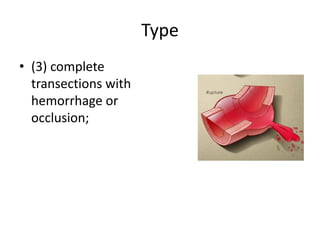
• (3) complete transections with hemorrhage or
occlusion;
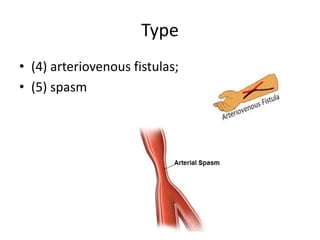
• (4) arteriovenous fistulas; and
• (5) spasm
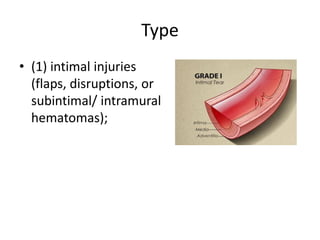
Type
• (1) intimal injuries
(flaps, disruptions, or
subintimal/ intramural
hematomas);
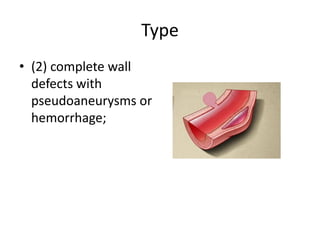
Type
• (2) complete wall
defects with
pseudoaneurysms or
hemorrhage;
Type
• (3) complete
transections with
hemorrhage or
occlusion;
Type
• (4) arteriovenous fistulas;
• (5) spasm
Mechanism of injury
• Penetrating
– Knife
– Jambia
– GSW
• Sharpnel

• Blunt
–
–
–
–

Direct (contusion)
Traction (avulsion(
Deceleration
Torsion
Hard sign
– Active pulsatile haemorrhage
– Pulsatile or expanding haematoma
– Sign of limb ischaemia
• 5ps

– Diminished or absent pulse
– Bruit and thrill
Soft sign
•
•
•
•

Hypotension/shock
Neurological deficit
Stable, non pulsatile small haematoma
Proximity of wound to major vessel
Investigation
• Doppler
• Duplex ultrasound
– As screening test

• Angiography gold standard
• CT angiography
• MRI
Doppler/Duplex
• Sound
• Colored duplex
• First line investigation
•
Magnetic Resonance Angiography
• MRA has the advantage of not requiring
iodinated contrast agents to provide vessel
opacification
• Gadolinium is used as a contrast agent for
MRA studies, and as it is generally not
nephrotoxic, it can be used in patients with
elevated creatinine.
Angiography
•
•
•
•
•
•

Advantage
Gold standard
Detect occult injury
Exclude need for OR
Operative planning
Endovascular repair
Site
•
•
•
•

Neck
Chest
Abdomen
Lower limb
Neck
• Anatomy
– Carotid
– Vertebral
– Jugular
– Subclavian
– Innominate
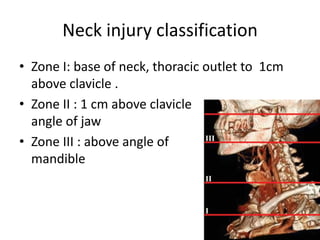
Neck injury classification
• Zone I: base of neck, thoracic outlet to 1cm
above clavicle .
• Zone II : 1 cm above clavicle
to
angle of jaw
• Zone III : above angle of
mandible
Neck
•
•
•
•
•

Zone I and III are difficult to assess
Image the stable patient
Mandatory exploration unstable patient
Exclude :
Associated injuries on the
– cervical spine,
– airway, and
– digestive tract
Management guideline
• 1. Immediate operation is indicated for unstable patients with
active bleeding not responsive to vigorous resuscitation or with
rapidly expanding hematoma or airway obstruction, irrespective
• of anatomical zone.
• 2. Injuries in zone II not penetrating the platysma need no further
examination.
• 3. All others require further diagnostic evaluation with
angiography, duplex ultrasound, and CT to determine whether
critical structures have been injured.
• If angiography or high-quality duplex ultrasound is not available,
injuries in zone II need to be surgically explored
Neck exposure
•
•
•
•
•
•
•

Venous injuries exploration of a neck injury can be treated either
by repair using simple or running sutures or by ligation.
In bilateral injuries to the
internal jugular veins, however,
reconstruction of one of the sides
is indicated to avoid
severe venous hypertension.
Chest
•
•
•
•

Anatomy:
Aorta,
supra-aortic trunk,
intercostal
IVC, SVC,
brachiocephali/
subclavian
Chest
•
•
•
•
•
•
•

Aerodigestive tract.
Air bubbles in the wound
Respiratory distress
Subcutaneous emphysema
Hoarseness
Hemoptysis
Hematemesis
Chest
Indication for thoracotomy
• Penetrating unstable, unresponsive to resuscitation
• Chest tube
• Deterioration of vital signs when the drain is started
• 1.500–2.000 ml of blood within the first 4–8 h
• Drainage of blood exceeding 300 ml/h for more than
4h
• More than half of pleural cavity filled with blood on
x-ray despite a well functioning chest tube
Aorta
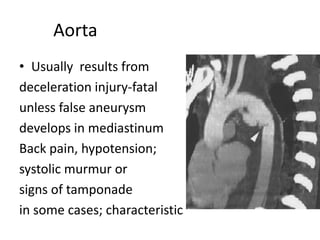
• Usually results from
deceleration injury-fatal
unless false aneurysm
develops in mediastinum
Back pain, hypotension;
systolic murmur or
signs of tamponade
in some cases; characteristic
Investigation
•
•
•
•

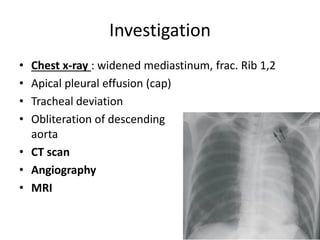
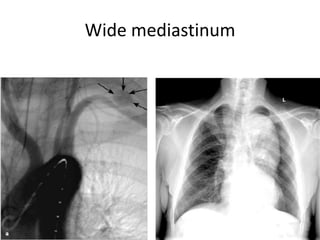
Chest x-ray : widened mediastinum, frac. Rib 1,2
Apical pleural effusion (cap)
Tracheal deviation
Obliteration of descending
aorta
• CT scan
• Angiography
• MRI
Wide mediastinum
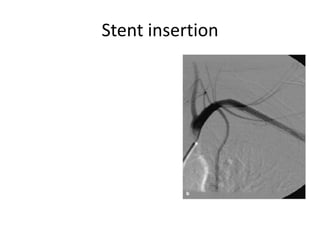
Stent insertion
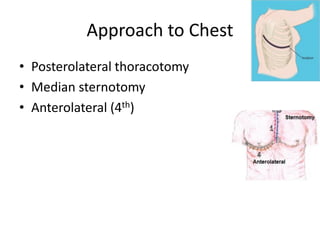
Approach to Chest
• Posterolateral thoracotomy
• Median sternotomy
• Anterolateral (4th)
Rupture of aorta
• widening of mediastinum on chest X-ray;
diagnosis confirmed by arteriography
• Urgent thoracotomy and Dacron graft or
minimal-access stent graft if available
Rates
• Major abdominal vascular injury is seen in up to 25% of
patients admitted with vascular trauma.
• Blunt trauma/penetrating trauma.
• Abdominal injury represents 10–20% of all traumas to the
body caused by road traffic accidents.
• Major vascular injury is estimated to occur in about 10% of
cases of penetrating stab wounds in the abdomen
• and in about 25% of gunshot wounds.
• Blunt abdominal trauma affects major vessels less frequently,
estimates of below 5% is common in the literature
Abdomen
• Aorta and its branches,
• IVC, portal and iliac veins
– Indication for laparotomy
– Damage control
– Re-explore
– Control bleeding
– Avoid prosthesis
Abdomen
• Contron
– Supra diaphragmatic
– Supr-celiac
– Infra-renal
– Ballon, occlusion

• Exposure
– From the left
– From the right
Boundaries of the Retroperitoneal Region
• Above: T12 and 12th rib
• Below: Base of the sacrum, the iliac crest, the
upper rami of the pubic bones, and the pelvic
diaphragm
• Anterior: parietal peritoneum of the
retroperitoneal space, part of the liver and its
bare area, part of the duodenum, part of the
ascending colon, part of the descending colon,
and much of the pancreas within the lesser
sac.
ZONES
• Zone I (centromedial)
• Upper: Diaphragmatic, esophageal, and
aortic openings
• Lower: Sacral promontories
• Lateral: Psoas muscles
• Contents: Abdominal aorta, inferior vena cava,
pancreas, duodenum (partial) .
Zone II (lateral)
•
•
•
•

Upper: Diaphragm
Lower: Iliac crests
Lateral: Psoas muscles
Contents: Kidneys and their vessels, ureters
and their abdominal parts, ascending and
descending colon, hepatic and splenic flexure
Zone III (pelvic)
• Anterior: Space of Retzius (symphysis pubis
and pubic bones, separated from the bladder
by the space of Retzius)
• Posterior: Sacrum
• Lateral: Bony pelvis
• Contents: Pelvis in content, pelvic wall,
rectosigmoid colon, iliac vessels, urogenital
organs (partial)
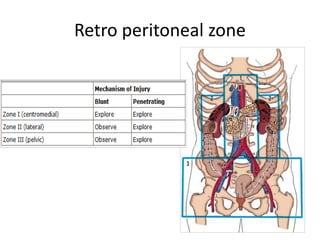
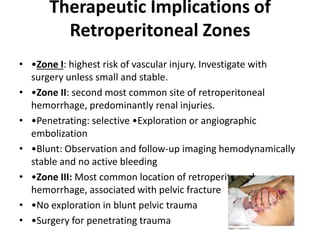
Retro peritoneal zone
Therapeutic Implications of
Retroperitoneal Zones
• •Zone I: highest risk of vascular injury. Investigate with
surgery unless small and stable.
• •Zone II: second most common site of retroperitoneal
hemorrhage, predominantly renal injuries.
• •Penetrating: selective •Exploration or angiographic
embolization
• •Blunt: Observation and follow-up imaging hemodynamically
stable and no active bleeding
• •Zone III: Most common location of retroperitoneal
hemorrhage, associated with pelvic fracture
• •No exploration in blunt pelvic trauma
• •Surgery for penetrating trauma
Limbs
• Vascular injuries associated with fractures are
rare, occurring in only 0.5 to 3% of all patients
with extremity fractures.
• The importance of a careful neurologic
examination is important .
• Three different mechanisms can produce
paralysis and numbness in an injured
extremity: ischemia, nerve injury, and
compartment syndrome.
Prehospital
• As manual compression or the application of a
pressure dressing and
• Elevation of the extremity can almost always
control arterial bleeding from an extremity in
the field,
• Loss of life should be infrequent in an urban
setting.
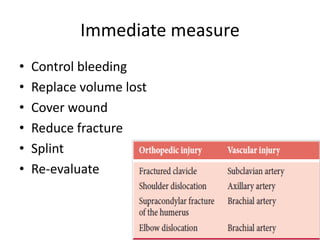
Immediate measure
•
•
•
•
•
•

Control bleeding
Replace volume lost
Cover wound
Reduce fracture
Splint
Re-evaluate
Post op
• Postoperative monitoring of hand
perfusion and radial pulse is
recommended at least every 30 min
for the first 6 h. When deteriorated
function of the repaired artery is
suspected, duplex scanning can
verify or exclude postoperative
problems.
• Occausion ......reoperation
• Compartment syndrome
Complication
• Delayed diagnosis and treatment may lead
– Thrombosis
– Embolisation
– Rupture with hge.

• Risk factor for amputation
– Elevated compartment pressure
– Arterial transection
– Associate open fracture
– Combination above and below knee
Lower limb
•
•
•
•
•

Doppler
Doplex
CT angio
MRI (MRA)
Angiography
In theatre
• Always establish good exposure
• Establish proximal then distal arterial control
• Use a shunt if the bones need to be fixed first to
buy you some time
• Use local heparin flush
• Make your arterial repair tension-free
• Use autogenous vein
• Repair concomitant venous injury if patient is
stable
Shunting
• Intra-luminal shunt temporary save limb
– Simple tume can be constructed
– Transfer
– Manipulation of bonw
Management
• Conservative
• Endovascular
• Operative
– Local
•
•
•
•
•

Suture
Patch
Primary anastomosis
autogenous
Prosthetic

– Fasciotomy
Limbs
• Operative Principle
– Proximalldistal control
– Primary repair where possible
– Graft autogenous vein (contralateral limb)
– Temporary shunt
– Fixation of ortho-injury
– Coverage of repair (muscle, soft tissue)
– Fasciotomy
Extremities
•
•
•
•
•

Ligation may be acceptable in rare circumstances
If major Musculo-skeletal, neurological injury
Popliteal have the highest rate
Repair vein first
Compaerment syndrome
Others
• Catheter injury
• Intra-arterial drug injuries
• Cold Injury
– Frost bite
– Immersion (trench) foot
– Frostnip

Vascular

  • 1.
  • 2.
  • 3.
  • 4.
    Basic principle • • • • • • • Anatomy Type ofinjury Mechanism of injury Clinical manifestation Clinical evaluation Investigation Management
  • 5.
    Types of injury •Laceration • Transection – Defect – No defect • • • • Dissection Crush Thrombosis/Embolus Spasm
  • 6.
    Type of injury •(1) intimal injuries (flaps, disruptions, or subintimal/ intramural hematomas); • (2) complete wall defects with pseudoaneurysms or hemorrhage; • (3) complete transections with hemorrhage or occlusion; • (4) arteriovenous fistulas; and • (5) spasm
  • 7.
    Type • (1) intimalinjuries (flaps, disruptions, or subintimal/ intramural hematomas);
  • 8.
    Type • (2) completewall defects with pseudoaneurysms or hemorrhage;
  • 9.
    Type • (3) complete transectionswith hemorrhage or occlusion;
  • 10.
    Type • (4) arteriovenousfistulas; • (5) spasm
  • 11.
    Mechanism of injury •Penetrating – Knife – Jambia – GSW • Sharpnel • Blunt – – – – Direct (contusion) Traction (avulsion( Deceleration Torsion
  • 12.
    Hard sign – Activepulsatile haemorrhage – Pulsatile or expanding haematoma – Sign of limb ischaemia • 5ps – Diminished or absent pulse – Bruit and thrill
  • 13.
    Soft sign • • • • Hypotension/shock Neurological deficit Stable,non pulsatile small haematoma Proximity of wound to major vessel
  • 14.
    Investigation • Doppler • Duplexultrasound – As screening test • Angiography gold standard • CT angiography • MRI
  • 15.
    Doppler/Duplex • Sound • Coloredduplex • First line investigation •
  • 16.
    Magnetic Resonance Angiography •MRA has the advantage of not requiring iodinated contrast agents to provide vessel opacification • Gadolinium is used as a contrast agent for MRA studies, and as it is generally not nephrotoxic, it can be used in patients with elevated creatinine.
  • 17.
    Angiography • • • • • • Advantage Gold standard Detect occultinjury Exclude need for OR Operative planning Endovascular repair
  • 18.
  • 19.
    Neck • Anatomy – Carotid –Vertebral – Jugular – Subclavian – Innominate
  • 20.
    Neck injury classification •Zone I: base of neck, thoracic outlet to 1cm above clavicle . • Zone II : 1 cm above clavicle to angle of jaw • Zone III : above angle of mandible
  • 21.
    Neck • • • • • Zone I andIII are difficult to assess Image the stable patient Mandatory exploration unstable patient Exclude : Associated injuries on the – cervical spine, – airway, and – digestive tract
  • 22.
    Management guideline • 1.Immediate operation is indicated for unstable patients with active bleeding not responsive to vigorous resuscitation or with rapidly expanding hematoma or airway obstruction, irrespective • of anatomical zone. • 2. Injuries in zone II not penetrating the platysma need no further examination. • 3. All others require further diagnostic evaluation with angiography, duplex ultrasound, and CT to determine whether critical structures have been injured. • If angiography or high-quality duplex ultrasound is not available, injuries in zone II need to be surgically explored
  • 23.
    Neck exposure • • • • • • • Venous injuriesexploration of a neck injury can be treated either by repair using simple or running sutures or by ligation. In bilateral injuries to the internal jugular veins, however, reconstruction of one of the sides is indicated to avoid severe venous hypertension.
  • 24.
  • 25.
    Chest • • • • • • • Aerodigestive tract. Air bubblesin the wound Respiratory distress Subcutaneous emphysema Hoarseness Hemoptysis Hematemesis
  • 26.
    Chest Indication for thoracotomy •Penetrating unstable, unresponsive to resuscitation • Chest tube • Deterioration of vital signs when the drain is started • 1.500–2.000 ml of blood within the first 4–8 h • Drainage of blood exceeding 300 ml/h for more than 4h • More than half of pleural cavity filled with blood on x-ray despite a well functioning chest tube
  • 27.
    Aorta • Usually resultsfrom deceleration injury-fatal unless false aneurysm develops in mediastinum Back pain, hypotension; systolic murmur or signs of tamponade in some cases; characteristic
  • 28.
    Investigation • • • • Chest x-ray :widened mediastinum, frac. Rib 1,2 Apical pleural effusion (cap) Tracheal deviation Obliteration of descending aorta • CT scan • Angiography • MRI
  • 29.
  • 30.
  • 31.
    Approach to Chest •Posterolateral thoracotomy • Median sternotomy • Anterolateral (4th)
  • 32.
    Rupture of aorta •widening of mediastinum on chest X-ray; diagnosis confirmed by arteriography • Urgent thoracotomy and Dacron graft or minimal-access stent graft if available
  • 33.
    Rates • Major abdominalvascular injury is seen in up to 25% of patients admitted with vascular trauma. • Blunt trauma/penetrating trauma. • Abdominal injury represents 10–20% of all traumas to the body caused by road traffic accidents. • Major vascular injury is estimated to occur in about 10% of cases of penetrating stab wounds in the abdomen • and in about 25% of gunshot wounds. • Blunt abdominal trauma affects major vessels less frequently, estimates of below 5% is common in the literature
  • 34.
    Abdomen • Aorta andits branches, • IVC, portal and iliac veins – Indication for laparotomy – Damage control – Re-explore – Control bleeding – Avoid prosthesis
  • 35.
    Abdomen • Contron – Supradiaphragmatic – Supr-celiac – Infra-renal – Ballon, occlusion • Exposure – From the left – From the right
  • 36.
    Boundaries of theRetroperitoneal Region • Above: T12 and 12th rib • Below: Base of the sacrum, the iliac crest, the upper rami of the pubic bones, and the pelvic diaphragm • Anterior: parietal peritoneum of the retroperitoneal space, part of the liver and its bare area, part of the duodenum, part of the ascending colon, part of the descending colon, and much of the pancreas within the lesser sac.
  • 37.
    ZONES • Zone I(centromedial) • Upper: Diaphragmatic, esophageal, and aortic openings • Lower: Sacral promontories • Lateral: Psoas muscles • Contents: Abdominal aorta, inferior vena cava, pancreas, duodenum (partial) .
  • 38.
    Zone II (lateral) • • • • Upper:Diaphragm Lower: Iliac crests Lateral: Psoas muscles Contents: Kidneys and their vessels, ureters and their abdominal parts, ascending and descending colon, hepatic and splenic flexure
  • 39.
    Zone III (pelvic) •Anterior: Space of Retzius (symphysis pubis and pubic bones, separated from the bladder by the space of Retzius) • Posterior: Sacrum • Lateral: Bony pelvis • Contents: Pelvis in content, pelvic wall, rectosigmoid colon, iliac vessels, urogenital organs (partial)
  • 40.
  • 41.
    Therapeutic Implications of RetroperitonealZones • •Zone I: highest risk of vascular injury. Investigate with surgery unless small and stable. • •Zone II: second most common site of retroperitoneal hemorrhage, predominantly renal injuries. • •Penetrating: selective •Exploration or angiographic embolization • •Blunt: Observation and follow-up imaging hemodynamically stable and no active bleeding • •Zone III: Most common location of retroperitoneal hemorrhage, associated with pelvic fracture • •No exploration in blunt pelvic trauma • •Surgery for penetrating trauma
  • 42.
    Limbs • Vascular injuriesassociated with fractures are rare, occurring in only 0.5 to 3% of all patients with extremity fractures. • The importance of a careful neurologic examination is important . • Three different mechanisms can produce paralysis and numbness in an injured extremity: ischemia, nerve injury, and compartment syndrome.
  • 43.
    Prehospital • As manualcompression or the application of a pressure dressing and • Elevation of the extremity can almost always control arterial bleeding from an extremity in the field, • Loss of life should be infrequent in an urban setting.
  • 44.
    Immediate measure • • • • • • Control bleeding Replacevolume lost Cover wound Reduce fracture Splint Re-evaluate
  • 45.
    Post op • Postoperativemonitoring of hand perfusion and radial pulse is recommended at least every 30 min for the first 6 h. When deteriorated function of the repaired artery is suspected, duplex scanning can verify or exclude postoperative problems. • Occausion ......reoperation • Compartment syndrome
  • 46.
    Complication • Delayed diagnosisand treatment may lead – Thrombosis – Embolisation – Rupture with hge. • Risk factor for amputation – Elevated compartment pressure – Arterial transection – Associate open fracture – Combination above and below knee
  • 47.
  • 48.
    In theatre • Alwaysestablish good exposure • Establish proximal then distal arterial control • Use a shunt if the bones need to be fixed first to buy you some time • Use local heparin flush • Make your arterial repair tension-free • Use autogenous vein • Repair concomitant venous injury if patient is stable
  • 49.
    Shunting • Intra-luminal shunttemporary save limb – Simple tume can be constructed – Transfer – Manipulation of bonw
  • 50.
    Management • Conservative • Endovascular •Operative – Local • • • • • Suture Patch Primary anastomosis autogenous Prosthetic – Fasciotomy
  • 51.
    Limbs • Operative Principle –Proximalldistal control – Primary repair where possible – Graft autogenous vein (contralateral limb) – Temporary shunt – Fixation of ortho-injury – Coverage of repair (muscle, soft tissue) – Fasciotomy
  • 52.
    Extremities • • • • • Ligation may beacceptable in rare circumstances If major Musculo-skeletal, neurological injury Popliteal have the highest rate Repair vein first Compaerment syndrome
  • 53.
    Others • Catheter injury •Intra-arterial drug injuries • Cold Injury – Frost bite – Immersion (trench) foot – Frostnip