Pelvic Trauma
Stud.: Andris Džeriņš, MF V 5.gr.
Mentor: Dr. Med. Ruta Jakušonoka
Background
• “Pelvic fractures are one of the true (few) life-threatening
orthopaedic emergencies” (Dr. Archdeacon )
• Fractures of the bony pelvis account for 3% of all fractures;
• The overall mortality from pelvic ring injuries is 9% to 22%,
in open fractures- 30-50%.
• Patients with pelvic fractures and with shock on arrival to
the hospital have mortality rates of 33 to 57%.
Anatomy I
• Ring Structure of three Bones—
Two innominate bones (ilium,
ischium, pubis) and the sacrum.
• Anteriorly -pubic and ischial rami
connected with the symphysis
pubis.
• Posteriorly- sacrum and the two
innominate bones are joined at
the sacroiliac joint by:
- interosseous sacroiliac
ligaments,
- anterior and posterior
sacroiliac ligaments,
- sacrotuberous ligaments,
- sacrospinous ligaments,
- iliolumbar ligaments.
Rosen's Emergency Medicine Eighth Edition
John A. Marx MD, Robert S. Hockberger MD and Ron M. Walls MD
Anatomy II
1. Visceral organs- urine bladder,
ureters, urethra, large intestine,
uterus, vagina, prostate gland
2. Blood vesels (superior gluteal
artery, internal pudendal artery,
pelvic veins)
3. Nerves- Lumbosacral plexus,
sciatic nerve, Lumbosacral trunk,
L5 nerve root, cauda equina
http://doctorstock.photoshelter.com/image/I0000jIX1zJjr810https://bluestarr.wordpress.com/2012/01/19/urinary-system/
Etiology
• High-energy pelvic fractures result most commonly from:
- motor vehicle accidents, motorcycle accidents, automobile-
pedestrian encounters (60- 84%),
- Falls from height (5-12-30%),
- Industrial crush injuries, e.c.
Rosen's Emergency Medicine Eighth Edition John A. Marx MD.
Emergency Medicine Second Edition James G. Adams MD.
http://venturegalleries.com/blog/finding-the-truth-in-news-reporting/http://blog.er24.co.za/wp-content/uploads/2011/12/Motorbike-accident-Potch-300x222.jpg
Tile's Classification of Pelvic Fractures
• Type A —Stable
• Type B —Partially stable
• Type C —Unstable
A
C
B
Pelvis - Orthopaedic Trauma Association
Tile’s- Type A
• Stable, posterior arch intact;
• A1 Avulsion injury
• A2 Iliac wing or anterior arch fracture caused by a direct
blow
• A3 Transverse sacrococcygeal fracture
A1 A2 A3
Pelvis - Orthopaedic Trauma Association
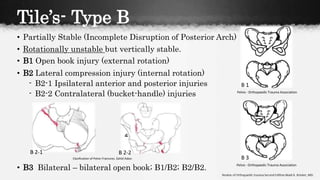
Tile’s- Type B
• Partially Stable (Incomplete Disruption of Posterior Arch)
• Rotationally unstable but vertically stable.
• B1 Open book injury (external rotation)
• B2 Lateral compression injury (internal rotation)
- B2-1 Ipsilateral anterior and posterior injuries
- B2-2 Contralateral (bucket-handle) injuries
• B3 Bilateral – bilateral open book; B1/B2; B2/B2.
B 1
B 2-1 B 2-2
B 3
Pelvis - Orthopaedic Trauma Association
Clasification of Pelvic Fractures. Zahid Askar.
Pelvis - Orthopaedic Trauma Association
Tile’s- Type C
• Unstable (Complete Disruption of Posterior Arch)
• C1 Unilateral
- C1-1 Iliac fracture
- C1-2 Sacroiliac fracture-
dislocation
- C1-3 Sacral fracture
• C2 Bilateral, with one
side type B, one side
type C
C1 C2 C3
Pelvis-OrthopaedicTraumaAssociation
• C3 Bilateral with
both sides type C
Young-Burgess Classification of Pelvic Fractures
Based on the direction of forces causing fracture, associated
instability of pelivs, mechanism of injury
1. Lateral compression
2. Anterior–posterior compression
3. Vertical shear
4. Combined mechanism
Y-B: Lateral Compression
• I Sacral crush injury on ipsilateral side
• II Sacral crush injury with disruption of posterior SI ligaments; iliac
wing fracture may be present (rotationally unstable)
• III LC-I or LC-II injury on side of impact, contralateral side external
rotation (open-book injury) (rotationally unstable)
Browner BD: Skeletal Trauma: Basic Science, Management, and Reconstruction, 3rd ed.
Y-B: Anteroposterior Compression
• I Slight widening of pubic symphisis (<2,5cm) and/or aneterior SI joint;
intact posterior SI ligaments
• II Symphysis diastasis >2.5 cm, sacrospinous, sacrotuberous and anterior
SI ligament disruption, intact posterior SI ligaments (rotational instability)
• III Symphysis diastasis >2.5 cm, with complete disruption of the anterior
and posterior SI ligament, (complete rotational and vertical instability)
Browner BD: Skeletal Trauma: Basic Science, Management, and Reconstruction, 3rd ed.
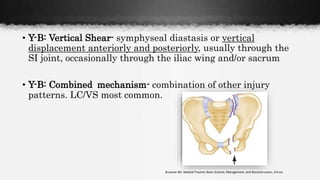
• Y-B: Vertical Shear- symphyseal diastasis or vertical
displacement anteriorly and posteriorly, usually through the
SI joint, occasionally through the iliac wing and/or sacrum
• Y-B: Combined mechanism- combination of other injury
patterns. LC/VS most common.
Browner BD: Skeletal Trauma: Basic Science, Management, and Reconstruction, 3rd ed.
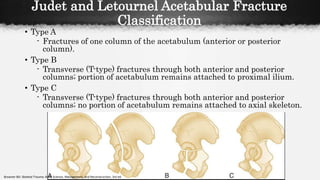
Judet and Letournel Acetabular Fracture
Classification
• Type A
- Fractures of one column of the acetabulum (anterior or posterior
column).
• Type B
- Transverse (T-type) fractures through both anterior and posterior
columns; portion of acetabulum remains attached to proximal ilium.
• Type C
- Transverse (T-type) fractures through both anterior and posterior
columns; no portion of acetabulum remains attached to axial skeleton.
Browner BD: Skeletal Trauma: Basic Science, Management, and Reconstruction, 3rd ed.
Presenting Signs and Symptoms
• Pelvic pain
• Inability to bear weight
• Swelling of the pelvic area
• Hematoma in the area of the pelvic bone
• Pelvic deformity
• Uneven leg length or asymmetry of the iliac wings
• Numbness or tingling in the perineum or at the top of the
thigh
• Perineal ecchymoses, scrotal or labial hematomas
• Blood at the urethral meatus
Physical Examination
1. Assess for other life-threatening injuries using Primary Survey
(cABCDE).
2. Careful palpation of the posterior pelvis in awake patients can
identify posterior pelvic injuries.
3. Rectal examination—high-riding prostate may indicate urethral
tear. Palpation of the sacrum for irregularity.
4. Vaginal examination —bleeding or lacerations indicating open
fractures.
5. Perineal skin —lacerations may indicate open fracture, scrotal,
labial hematoma, swelling or ecchymosis, flank hematoma
Imaging
• Radiographs
1. Anteroposterior pelvis - part of the initial trauma series along
with a chest and lateral cervical spine X-ray. Can identify up to
90% of pelvic injuries.
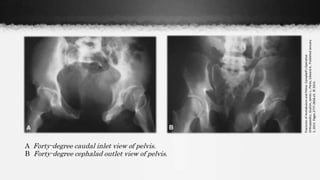
2. Pelvic inlet view - 40° to 45° caudal tilt. Shows anterior–
posterior displacement (rotational deformity), internal or
external rotation of the hemipelvis; widening of SI joint; sacral
ala impaction.
3. Pelvic outlet view - 40° to 45° cephalad tilt. Shows superior–
inferior displacement (vertical displacement) and visualizes the
sacral foramen.
A Forty-degree caudal inlet view of pelvis.
B Forty-degree cephalad outlet view of pelvis.
FracturesofAcetabulumandPelvis-Campbell'sOperative
Orthopaedics.Guyton,JamesL.;Perez,EdwardA..PublishedJanuary
2,2013.Pages2777-2828.e5.©2013.
• CT
• CT is the diagnostic test of choice for detecting pelvic and
intraabdominal injuries.
• Better characterization of posterior ring injuries.
• Reveals bleeding in both the peritoneal and retroperitoneal spaces.
• CT with intravenous contrast often can distinguish a stable
hematoma from ongoing bleeding from pelvic arteries.
• FAST
• Identify free intraperitoneal fluid in the trauma patient.
• FAST is not helpful for evaluating the retroperitoneal space where
pelvic hemorrhage occurs.
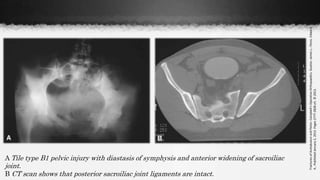
A Tile type B1 pelvic injury with diastasis of symphysis and anterior widening of sacroiliac
joint.
B CT scan shows that posterior sacroiliac joint ligaments are intact.
FracturesofAcetabulumandPelvis-Campbell'sOperativeOrthopaedics.Guyton,JamesL.;Perez,Edward
A..PublishedJanuary2,2013.Pages2777-2828.e5.©2013.
Initial Treatment
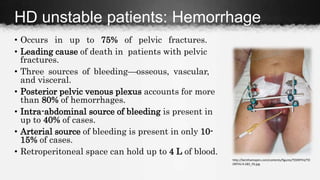
HD unstable patients: Hemorrhage
• Occurs in up to 75% of pelvic fractures.
• Leading cause of death in patients with pelvic
fractures.
• Three sources of bleeding—osseous, vascular,
and visceral.
• Posterior pelvic venous plexus accounts for more
than 80% of hemorrhages.
• Intra-abdominal source of bleeding is present in
up to 40% of cases.
• Arterial source of bleeding is present in only 10-
15% of cases.
• Retroperitoneal space can hold up to 4 L of blood.
http://benthamopen.com/contents/figures/TOORTHJ/TO
ORTHJ-9-283_F6.jpg
HD unstable patients
• Damage Control Orthopedics
1. Temporary stabilisation of the pelvis
2. Resuscitation of Patients in Hypovolemic Shock (i/v fluids)
3. External Fixation- AEF, Pelvic C-Clamp
• Open reduction and internal fixation when the patient's state
of health has stabilized:
- ≥5 days
- Acetabular fractures 5-10 days
Stabilization
• Pelvic Binder
˗ Commercial device that can be
used for prehospital and emergent
stabilization of pelvic fractures.
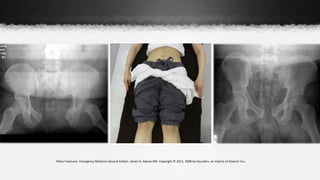
˗ In APC (“open-book”) fractures,
use of a pelvic binder will close the
ring and tamponade venous
bleeding.
˗ An improvised binder can be made
using a sheet to provide
circumferential compression
around the pelvis.
• Skeletal Traction —May be used
to correct vertical displacement
of the hemipelvis.
Fractures of Acetabulum and Pelvis- Campbell's Operative Orthopaedics. Guyton,
James L.; Perez, Edward A.. Published January 2, 2013. Pages 2777-2828.e5. ©
2013.
Fractures of Acetabulum and Pelvis- Campbell's Operative Orthopaedics.
Guyton, James L.; Perez, Edward A.. Published January 2, 2013. Pages 2777-
2828.e5. © 2013.
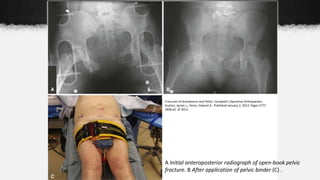
A Initial anteroposterior radiograph of open-book pelvic
fracture. B After application of pelvic binder (C) .
Pelvic Fractures- Emergency Medicine Second Edition. James G. Adams MD. Copyright © 2013, 2008 by Saunders, an imprint of Elsevier Inc.
Resuscitation of Patients in Hypovolemic Shock
• Two large bore intravenous lines (16G or larger) in the upper
extremities.
• Administer crystalloid, coloid solution and determine response.
• If only a transient improvement or no response then begin EM
administration.
• Platelets and fresh frozen plasma will be required with massive
transfusions to correct dilutional coagulopathy.
• Avoid or correct hypothermia. Warm fluids, increase ambient
temperature, and avoid heat loss. Hypothermia can lead to coagulation
problems, ventricular fibrillation and acid– base disturbances.
External Fixation: Anterior external fixator
• Anterior superior iliac spine (ASIS) pin and the anterior inferior
iliac spine (AIIS) pin.
• Two 5-mm pins are placed in between the iliac cortical
tables and placement is confirmed on fluoroscopy.
• Emergently placed in hemodynamically unstable patient
who does not respond to initial fluid resuscitation.
• Anterior external fixation alone does not provide adequate
posterior stabilization if the posterior ring is disrupted.
• Indications
- pelvic ring injuries with an external rotation component (APC, VS)
- unstable ring injury with ongoing blood loss
• Contraindications
- ilium fracture that does not allow safe application
PokaA,LibbyEP:Indicationsandtechniquesforexternalfixationofthepelvis,Clin
OrthopRelatRes329:54,1996.
External Fixation: Pelvic Clamps
• Pelvic clamps have been developed to help control the posterior
pelvis in the resuscitation phase: the Ganz C-clamp.
• These devices use large, percutaneously placed pins over the
region of the sacroiliac joint posteriorly.
• Pelvic C-Clamps—in original design, points of clamp applied to
posterior ilium in line with the sacrum.
• Requires fluoroscopy and technical expertise.
• Higher risk of iatrogenic injury than standard anterior external
fixator.
Fractures of Acetabulum and Pelvis- Campbell's Operative Orthopaedics.
Guyton, James L.; Perez, Edward A.. Published January 2, 2013. Pages 2777-
2828.e5. © 2013.
FracturesofAcetabulumandPelvis-Campbell'sOperativeOrthopaedics.Guyton,JamesL.;Perez,
EdwardA..PublishedJanuary2,2013.Pages2777-2828.e5.©2013.
http://www.hwbf.org/ota/s2k/images/pohlcs.jpg
Pelvic Packing
• Patients who hemorrhage from both the pelvis and the
abdomen have mortality rates above 40%.
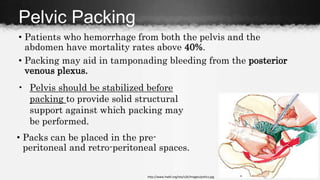
• Packing may aid in tamponading bleeding from the posterior
venous plexus.
• Pelvis should be stabilized before
packing to provide solid structural
support against which packing may
be performed.
• Packs can be placed in the pre-
peritoneal and retro-peritoneal spaces.
Angiography / embolization
• Contrast material injected through
the femoral artery on the less-injured
side or via the upper extremity.
• Transcatheter embolization with
thrombogenic coils, foam, or
spherules
• Indicated for patients who remain
HD unstable following resuscitation,
application of external fixator, and
after other sources of bleeding
(abdomen, chest) are ruled out.
• Arterial source of bleeding is present
in only 10% to 15% of patients.
http:// www.wheelessonline.com/images/
HD stable patient
• Stable pelvic fracture- nonoperative treatment
• Unstable pelvic fracture
- External fixation- anterior external fixator/ Pelvic-clamps
- Open Reduction and Internal Fixation
Nonoperative Treatment
• Stable nondisplaced or minimally displaced fractures may be treated
nonoperatively (isolated pubic ramus fractures, B1-1).
• Bed rest 2-3 weeks
• Lateral compresion fractures- weight bearing only on the unaffected
side.
• Vertically unstable fractures in which there is a contraindication to
operative treatment may be treated with skeletal traction.
Internal Fixation
• Indications:
- symphysis diastasis > 2.5 cm
- SI joint displacement > 1 cm
- sacral fracture with displacement >1 cm
- pubic rami fractures >2 cm displacement
- displacement or rotation of hemipelvis
- open fracture
- rotationally unstable pelvic injuries with significant limb-length
discrepancy >1.5 cm or unacceptable pelvic rotational deformity
Fractures of Acetabulum and Pelvis- Campbell's
Operative Orthopaedics. Guyton, James L.; Perez,
Edward A.. Published January 2, 2013. Pages 2777-
2828.e5. © 2013.
• Tile type C pelvic injuries require anterior and posterior fixation to
regain rotational and vertical stability.
• Anterior ring stabilization
- single superior plate
• Posterior ring stabilization
- anterior SI plating
- iliosacral screws
- posterior SI "tension" plating
A and B Anterior plating of sacroiliac joint.
Fractures of Acetabulum and Pelvis- Campbell's Operative Orthopaedics. Guyton, James L.; Perez,
Edward A.. Published January 2, 2013. Pages 2777-2828.e5. © 2013.
Associated Injuries
1. Hemorrhage 75%
2. Chest injury 63%
3. Long bone fractures 50%
4. Head and abdominal injury 40%
5. Spine fractures 25%
6. Urogenital injuries (posterior urethral tear, bladder rupture) 12-20%
7. Lumbosacral plexus injuries 8%
http://www.orthobullets.com/trauma/1030/pelvic-ring-fractures
Case report
• A 37 year old man was brought into the Hospital of Traumatology and orthopedics
Emergency Department after falling of a motorcycle.
• The patient had severe pain in the pelvic area, left upper leg, right shoulder and
inability to move his left leg about the hip joint.
• BP- 115/73mmHg
• P- 87’
• BF-16’
• Radiographs of the pelvis, right shoulder and lungs were made.
Radiographs of the pelvis and right
shoulder
Images from TOS archive
• Abdominal USG- small amount of fluid int the pelvis.
• Lab.: Er- 3,68x10¹²/L (4,5-5,9) ↓; Hb-110g/L (132-175g/L)↓; Ht- 32% (40-51%)↓
• NISS-24
• ISS-16
• Dg:
- Patient after polytrauma including pelvic fractures: Partially stable pelvic injury
injury including disruption of the pubic symphysis, left-sided fracture of the
the acetabulum, fracture of both pubic rami, fracture of inferior pubic rami in
in the right side, partial disruption of the left posterior arch (B2), left-sided hip
sided hip posterior dislocation. Wedge fracture of the right clavicle.
Hypovolemic shock.
• Treatment:
- Closed reduction of the left hip dislocation- unsuccesful!
- Open reduction of the left hip dislocation
- Left leg skeletal traction
• The next day patient was transported to RAKUS for further
investigation and treatment. An external fixator was put to
stabilase the pelvis. No other traumas were diagnosted.
• The next day patient was transported back to Hospital of
Traumatology and Orthopedics for further treatment:
- After 3 days- Reconstruction of the left acetabulum, OS of
the symphisis and pubic rami with REKO plate.
- After 7 days- OS of the right clavicle with REKO plate.
Postoperative Radiographs
Images from TOS archive
Conclusion
• “Pelvic fractures are one of the true (few) life-threatening orthopaedic
emergencies” (Dr. Archdeacon )
• The overall mortality from pelvic ring injuries is still high
• Bleeding is the leading cause of death in patients with pelvic
fractures.
• High-energy pelvic fractures result most commonly from motor
vehicle accidents.
• First priority is to assess for other life-threatening injuries using
Primary Survey (cABCDE).
• The initial treatment for HD stable/unstable patients varies.
• Damage Control Orthopedics.
Literature
• Pelvic Ring Injuries- Skeletal Trauma: Basic Science, Management, and Reconstruction.
Bellabarba, Carlo; Winkelmann, Marcel. Published January 1, 2015. Pages 1021-1105.e7.
© 2015. Pelvic Fractures- Emergency Medicine. Patterson, Leigh A.. Published January 2,
2013. Pages 710-715.e1. © 2013.
• Pelvic Trauma- Rosen's Emergency Medicine. Choi, Stephen B.; Cwinn, A. Adam. Published
January 1, 2014. Pages 656-671.e2. © 2014.
• Fractures of Acetabulum and Pelvis- Campbell's Operative Orthopaedics. Guyton, James L.; Perez,
Edward A.. Published January 2, 2013. Pages 2777-2828.e5. © 2013.
• Pelvic Fractures- Emergency Medicine Second Edition. James G. Adams MD. Copyright ©
2013, 2008 by Saunders, an imprint of Elsevier Inc.
• The Pelvis and Acetabulum- Review of Orthoppaedic Trauma. Mark R. Brinker, MD. Copyright ©
2013 by Lippincott Williams and Wilkins
• Pelvis - Orthopaedic Trauma Association http://ota.org/media/23066/97042.7pelvis-s59-s67.pdf
• Pelvic Ring Fractures, Acetabulum Fractures- Orthobullets
http://www.orthobullets.com/trauma/1030/pelvic-ring-fractures
• Clasification of Pelvic Fractures. Zahid Askar. Prof of Orthopaedics & Trauma, Khyber Medical
College, Peshawer http://www.slideshare.net/zahidaskar/pelvic-fracture-classification
Pelvic trauma

Pelvic trauma

  • 1.
    Pelvic Trauma Stud.: AndrisDžeriņš, MF V 5.gr. Mentor: Dr. Med. Ruta Jakušonoka
  • 2.
    Background • “Pelvic fracturesare one of the true (few) life-threatening orthopaedic emergencies” (Dr. Archdeacon ) • Fractures of the bony pelvis account for 3% of all fractures; • The overall mortality from pelvic ring injuries is 9% to 22%, in open fractures- 30-50%. • Patients with pelvic fractures and with shock on arrival to the hospital have mortality rates of 33 to 57%.
  • 3.
    Anatomy I • RingStructure of three Bones— Two innominate bones (ilium, ischium, pubis) and the sacrum. • Anteriorly -pubic and ischial rami connected with the symphysis pubis. • Posteriorly- sacrum and the two innominate bones are joined at the sacroiliac joint by: - interosseous sacroiliac ligaments, - anterior and posterior sacroiliac ligaments, - sacrotuberous ligaments, - sacrospinous ligaments, - iliolumbar ligaments. Rosen's Emergency Medicine Eighth Edition John A. Marx MD, Robert S. Hockberger MD and Ron M. Walls MD
  • 4.
    Anatomy II 1. Visceralorgans- urine bladder, ureters, urethra, large intestine, uterus, vagina, prostate gland 2. Blood vesels (superior gluteal artery, internal pudendal artery, pelvic veins) 3. Nerves- Lumbosacral plexus, sciatic nerve, Lumbosacral trunk, L5 nerve root, cauda equina http://doctorstock.photoshelter.com/image/I0000jIX1zJjr810https://bluestarr.wordpress.com/2012/01/19/urinary-system/
  • 5.
    Etiology • High-energy pelvicfractures result most commonly from: - motor vehicle accidents, motorcycle accidents, automobile- pedestrian encounters (60- 84%), - Falls from height (5-12-30%), - Industrial crush injuries, e.c. Rosen's Emergency Medicine Eighth Edition John A. Marx MD. Emergency Medicine Second Edition James G. Adams MD. http://venturegalleries.com/blog/finding-the-truth-in-news-reporting/http://blog.er24.co.za/wp-content/uploads/2011/12/Motorbike-accident-Potch-300x222.jpg
  • 6.
    Tile's Classification ofPelvic Fractures • Type A —Stable • Type B —Partially stable • Type C —Unstable A C B Pelvis - Orthopaedic Trauma Association
  • 7.
    Tile’s- Type A •Stable, posterior arch intact; • A1 Avulsion injury • A2 Iliac wing or anterior arch fracture caused by a direct blow • A3 Transverse sacrococcygeal fracture A1 A2 A3 Pelvis - Orthopaedic Trauma Association
  • 8.
    Tile’s- Type B •Partially Stable (Incomplete Disruption of Posterior Arch) • Rotationally unstable but vertically stable. • B1 Open book injury (external rotation) • B2 Lateral compression injury (internal rotation) - B2-1 Ipsilateral anterior and posterior injuries - B2-2 Contralateral (bucket-handle) injuries • B3 Bilateral – bilateral open book; B1/B2; B2/B2. B 1 B 2-1 B 2-2 B 3 Pelvis - Orthopaedic Trauma Association Clasification of Pelvic Fractures. Zahid Askar. Pelvis - Orthopaedic Trauma Association
  • 9.
    Tile’s- Type C •Unstable (Complete Disruption of Posterior Arch) • C1 Unilateral - C1-1 Iliac fracture - C1-2 Sacroiliac fracture- dislocation - C1-3 Sacral fracture • C2 Bilateral, with one side type B, one side type C C1 C2 C3 Pelvis-OrthopaedicTraumaAssociation • C3 Bilateral with both sides type C
  • 10.
    Young-Burgess Classification ofPelvic Fractures Based on the direction of forces causing fracture, associated instability of pelivs, mechanism of injury 1. Lateral compression 2. Anterior–posterior compression 3. Vertical shear 4. Combined mechanism
  • 11.
    Y-B: Lateral Compression •I Sacral crush injury on ipsilateral side • II Sacral crush injury with disruption of posterior SI ligaments; iliac wing fracture may be present (rotationally unstable) • III LC-I or LC-II injury on side of impact, contralateral side external rotation (open-book injury) (rotationally unstable) Browner BD: Skeletal Trauma: Basic Science, Management, and Reconstruction, 3rd ed.
  • 12.
    Y-B: Anteroposterior Compression •I Slight widening of pubic symphisis (<2,5cm) and/or aneterior SI joint; intact posterior SI ligaments • II Symphysis diastasis >2.5 cm, sacrospinous, sacrotuberous and anterior SI ligament disruption, intact posterior SI ligaments (rotational instability) • III Symphysis diastasis >2.5 cm, with complete disruption of the anterior and posterior SI ligament, (complete rotational and vertical instability) Browner BD: Skeletal Trauma: Basic Science, Management, and Reconstruction, 3rd ed.
  • 13.
    • Y-B: VerticalShear- symphyseal diastasis or vertical displacement anteriorly and posteriorly, usually through the SI joint, occasionally through the iliac wing and/or sacrum • Y-B: Combined mechanism- combination of other injury patterns. LC/VS most common. Browner BD: Skeletal Trauma: Basic Science, Management, and Reconstruction, 3rd ed.
  • 14.
    Judet and LetournelAcetabular Fracture Classification • Type A - Fractures of one column of the acetabulum (anterior or posterior column). • Type B - Transverse (T-type) fractures through both anterior and posterior columns; portion of acetabulum remains attached to proximal ilium. • Type C - Transverse (T-type) fractures through both anterior and posterior columns; no portion of acetabulum remains attached to axial skeleton. Browner BD: Skeletal Trauma: Basic Science, Management, and Reconstruction, 3rd ed.
  • 15.
    Presenting Signs andSymptoms • Pelvic pain • Inability to bear weight • Swelling of the pelvic area • Hematoma in the area of the pelvic bone • Pelvic deformity • Uneven leg length or asymmetry of the iliac wings • Numbness or tingling in the perineum or at the top of the thigh • Perineal ecchymoses, scrotal or labial hematomas • Blood at the urethral meatus
  • 16.
    Physical Examination 1. Assessfor other life-threatening injuries using Primary Survey (cABCDE). 2. Careful palpation of the posterior pelvis in awake patients can identify posterior pelvic injuries. 3. Rectal examination—high-riding prostate may indicate urethral tear. Palpation of the sacrum for irregularity. 4. Vaginal examination —bleeding or lacerations indicating open fractures. 5. Perineal skin —lacerations may indicate open fracture, scrotal, labial hematoma, swelling or ecchymosis, flank hematoma
  • 17.
    Imaging • Radiographs 1. Anteroposteriorpelvis - part of the initial trauma series along with a chest and lateral cervical spine X-ray. Can identify up to 90% of pelvic injuries. 2. Pelvic inlet view - 40° to 45° caudal tilt. Shows anterior– posterior displacement (rotational deformity), internal or external rotation of the hemipelvis; widening of SI joint; sacral ala impaction. 3. Pelvic outlet view - 40° to 45° cephalad tilt. Shows superior– inferior displacement (vertical displacement) and visualizes the sacral foramen.
  • 18.
    A Forty-degree caudalinlet view of pelvis. B Forty-degree cephalad outlet view of pelvis. FracturesofAcetabulumandPelvis-Campbell'sOperative Orthopaedics.Guyton,JamesL.;Perez,EdwardA..PublishedJanuary 2,2013.Pages2777-2828.e5.©2013.
  • 19.
    • CT • CTis the diagnostic test of choice for detecting pelvic and intraabdominal injuries. • Better characterization of posterior ring injuries. • Reveals bleeding in both the peritoneal and retroperitoneal spaces. • CT with intravenous contrast often can distinguish a stable hematoma from ongoing bleeding from pelvic arteries. • FAST • Identify free intraperitoneal fluid in the trauma patient. • FAST is not helpful for evaluating the retroperitoneal space where pelvic hemorrhage occurs.
  • 20.
    A Tile typeB1 pelvic injury with diastasis of symphysis and anterior widening of sacroiliac joint. B CT scan shows that posterior sacroiliac joint ligaments are intact. FracturesofAcetabulumandPelvis-Campbell'sOperativeOrthopaedics.Guyton,JamesL.;Perez,Edward A..PublishedJanuary2,2013.Pages2777-2828.e5.©2013.
  • 21.
  • 22.
    HD unstable patients:Hemorrhage • Occurs in up to 75% of pelvic fractures. • Leading cause of death in patients with pelvic fractures. • Three sources of bleeding—osseous, vascular, and visceral. • Posterior pelvic venous plexus accounts for more than 80% of hemorrhages. • Intra-abdominal source of bleeding is present in up to 40% of cases. • Arterial source of bleeding is present in only 10- 15% of cases. • Retroperitoneal space can hold up to 4 L of blood. http://benthamopen.com/contents/figures/TOORTHJ/TO ORTHJ-9-283_F6.jpg
  • 23.
    HD unstable patients •Damage Control Orthopedics 1. Temporary stabilisation of the pelvis 2. Resuscitation of Patients in Hypovolemic Shock (i/v fluids) 3. External Fixation- AEF, Pelvic C-Clamp • Open reduction and internal fixation when the patient's state of health has stabilized: - ≥5 days - Acetabular fractures 5-10 days
  • 24.
    Stabilization • Pelvic Binder ˗Commercial device that can be used for prehospital and emergent stabilization of pelvic fractures. ˗ In APC (“open-book”) fractures, use of a pelvic binder will close the ring and tamponade venous bleeding. ˗ An improvised binder can be made using a sheet to provide circumferential compression around the pelvis. • Skeletal Traction —May be used to correct vertical displacement of the hemipelvis. Fractures of Acetabulum and Pelvis- Campbell's Operative Orthopaedics. Guyton, James L.; Perez, Edward A.. Published January 2, 2013. Pages 2777-2828.e5. © 2013.
  • 25.
    Fractures of Acetabulumand Pelvis- Campbell's Operative Orthopaedics. Guyton, James L.; Perez, Edward A.. Published January 2, 2013. Pages 2777- 2828.e5. © 2013. A Initial anteroposterior radiograph of open-book pelvic fracture. B After application of pelvic binder (C) .
  • 26.
    Pelvic Fractures- EmergencyMedicine Second Edition. James G. Adams MD. Copyright © 2013, 2008 by Saunders, an imprint of Elsevier Inc.
  • 27.
    Resuscitation of Patientsin Hypovolemic Shock • Two large bore intravenous lines (16G or larger) in the upper extremities. • Administer crystalloid, coloid solution and determine response. • If only a transient improvement or no response then begin EM administration. • Platelets and fresh frozen plasma will be required with massive transfusions to correct dilutional coagulopathy. • Avoid or correct hypothermia. Warm fluids, increase ambient temperature, and avoid heat loss. Hypothermia can lead to coagulation problems, ventricular fibrillation and acid– base disturbances.
  • 28.
    External Fixation: Anteriorexternal fixator • Anterior superior iliac spine (ASIS) pin and the anterior inferior iliac spine (AIIS) pin. • Two 5-mm pins are placed in between the iliac cortical tables and placement is confirmed on fluoroscopy. • Emergently placed in hemodynamically unstable patient who does not respond to initial fluid resuscitation. • Anterior external fixation alone does not provide adequate posterior stabilization if the posterior ring is disrupted. • Indications - pelvic ring injuries with an external rotation component (APC, VS) - unstable ring injury with ongoing blood loss • Contraindications - ilium fracture that does not allow safe application PokaA,LibbyEP:Indicationsandtechniquesforexternalfixationofthepelvis,Clin OrthopRelatRes329:54,1996.
  • 29.
    External Fixation: PelvicClamps • Pelvic clamps have been developed to help control the posterior pelvis in the resuscitation phase: the Ganz C-clamp. • These devices use large, percutaneously placed pins over the region of the sacroiliac joint posteriorly. • Pelvic C-Clamps—in original design, points of clamp applied to posterior ilium in line with the sacrum. • Requires fluoroscopy and technical expertise. • Higher risk of iatrogenic injury than standard anterior external fixator. Fractures of Acetabulum and Pelvis- Campbell's Operative Orthopaedics. Guyton, James L.; Perez, Edward A.. Published January 2, 2013. Pages 2777- 2828.e5. © 2013.
  • 30.
  • 31.
    http://www.hwbf.org/ota/s2k/images/pohlcs.jpg Pelvic Packing • Patientswho hemorrhage from both the pelvis and the abdomen have mortality rates above 40%. • Packing may aid in tamponading bleeding from the posterior venous plexus. • Pelvis should be stabilized before packing to provide solid structural support against which packing may be performed. • Packs can be placed in the pre- peritoneal and retro-peritoneal spaces.
  • 32.
    Angiography / embolization •Contrast material injected through the femoral artery on the less-injured side or via the upper extremity. • Transcatheter embolization with thrombogenic coils, foam, or spherules • Indicated for patients who remain HD unstable following resuscitation, application of external fixator, and after other sources of bleeding (abdomen, chest) are ruled out. • Arterial source of bleeding is present in only 10% to 15% of patients. http:// www.wheelessonline.com/images/
  • 33.
    HD stable patient •Stable pelvic fracture- nonoperative treatment • Unstable pelvic fracture - External fixation- anterior external fixator/ Pelvic-clamps - Open Reduction and Internal Fixation
  • 34.
    Nonoperative Treatment • Stablenondisplaced or minimally displaced fractures may be treated nonoperatively (isolated pubic ramus fractures, B1-1). • Bed rest 2-3 weeks • Lateral compresion fractures- weight bearing only on the unaffected side. • Vertically unstable fractures in which there is a contraindication to operative treatment may be treated with skeletal traction.
  • 35.
    Internal Fixation • Indications: -symphysis diastasis > 2.5 cm - SI joint displacement > 1 cm - sacral fracture with displacement >1 cm - pubic rami fractures >2 cm displacement - displacement or rotation of hemipelvis - open fracture - rotationally unstable pelvic injuries with significant limb-length discrepancy >1.5 cm or unacceptable pelvic rotational deformity Fractures of Acetabulum and Pelvis- Campbell's Operative Orthopaedics. Guyton, James L.; Perez, Edward A.. Published January 2, 2013. Pages 2777- 2828.e5. © 2013.
  • 36.
    • Tile typeC pelvic injuries require anterior and posterior fixation to regain rotational and vertical stability. • Anterior ring stabilization - single superior plate • Posterior ring stabilization - anterior SI plating - iliosacral screws - posterior SI "tension" plating
  • 37.
    A and BAnterior plating of sacroiliac joint. Fractures of Acetabulum and Pelvis- Campbell's Operative Orthopaedics. Guyton, James L.; Perez, Edward A.. Published January 2, 2013. Pages 2777-2828.e5. © 2013.
  • 38.
    Associated Injuries 1. Hemorrhage75% 2. Chest injury 63% 3. Long bone fractures 50% 4. Head and abdominal injury 40% 5. Spine fractures 25% 6. Urogenital injuries (posterior urethral tear, bladder rupture) 12-20% 7. Lumbosacral plexus injuries 8% http://www.orthobullets.com/trauma/1030/pelvic-ring-fractures
  • 39.
    Case report • A37 year old man was brought into the Hospital of Traumatology and orthopedics Emergency Department after falling of a motorcycle. • The patient had severe pain in the pelvic area, left upper leg, right shoulder and inability to move his left leg about the hip joint. • BP- 115/73mmHg • P- 87’ • BF-16’ • Radiographs of the pelvis, right shoulder and lungs were made.
  • 40.
    Radiographs of thepelvis and right shoulder Images from TOS archive
  • 41.
    • Abdominal USG-small amount of fluid int the pelvis. • Lab.: Er- 3,68x10¹²/L (4,5-5,9) ↓; Hb-110g/L (132-175g/L)↓; Ht- 32% (40-51%)↓ • NISS-24 • ISS-16 • Dg: - Patient after polytrauma including pelvic fractures: Partially stable pelvic injury injury including disruption of the pubic symphysis, left-sided fracture of the the acetabulum, fracture of both pubic rami, fracture of inferior pubic rami in in the right side, partial disruption of the left posterior arch (B2), left-sided hip sided hip posterior dislocation. Wedge fracture of the right clavicle. Hypovolemic shock. • Treatment: - Closed reduction of the left hip dislocation- unsuccesful! - Open reduction of the left hip dislocation - Left leg skeletal traction
  • 42.
    • The nextday patient was transported to RAKUS for further investigation and treatment. An external fixator was put to stabilase the pelvis. No other traumas were diagnosted. • The next day patient was transported back to Hospital of Traumatology and Orthopedics for further treatment: - After 3 days- Reconstruction of the left acetabulum, OS of the symphisis and pubic rami with REKO plate. - After 7 days- OS of the right clavicle with REKO plate.
  • 43.
  • 44.
    Conclusion • “Pelvic fracturesare one of the true (few) life-threatening orthopaedic emergencies” (Dr. Archdeacon ) • The overall mortality from pelvic ring injuries is still high • Bleeding is the leading cause of death in patients with pelvic fractures. • High-energy pelvic fractures result most commonly from motor vehicle accidents. • First priority is to assess for other life-threatening injuries using Primary Survey (cABCDE). • The initial treatment for HD stable/unstable patients varies. • Damage Control Orthopedics.
  • 45.
    Literature • Pelvic RingInjuries- Skeletal Trauma: Basic Science, Management, and Reconstruction. Bellabarba, Carlo; Winkelmann, Marcel. Published January 1, 2015. Pages 1021-1105.e7. © 2015. Pelvic Fractures- Emergency Medicine. Patterson, Leigh A.. Published January 2, 2013. Pages 710-715.e1. © 2013. • Pelvic Trauma- Rosen's Emergency Medicine. Choi, Stephen B.; Cwinn, A. Adam. Published January 1, 2014. Pages 656-671.e2. © 2014. • Fractures of Acetabulum and Pelvis- Campbell's Operative Orthopaedics. Guyton, James L.; Perez, Edward A.. Published January 2, 2013. Pages 2777-2828.e5. © 2013. • Pelvic Fractures- Emergency Medicine Second Edition. James G. Adams MD. Copyright © 2013, 2008 by Saunders, an imprint of Elsevier Inc. • The Pelvis and Acetabulum- Review of Orthoppaedic Trauma. Mark R. Brinker, MD. Copyright © 2013 by Lippincott Williams and Wilkins • Pelvis - Orthopaedic Trauma Association http://ota.org/media/23066/97042.7pelvis-s59-s67.pdf • Pelvic Ring Fractures, Acetabulum Fractures- Orthobullets http://www.orthobullets.com/trauma/1030/pelvic-ring-fractures • Clasification of Pelvic Fractures. Zahid Askar. Prof of Orthopaedics & Trauma, Khyber Medical College, Peshawer http://www.slideshare.net/zahidaskar/pelvic-fracture-classification

Editor's Notes

  • #5 Median sacral artery—continuation of the aorta, which travels along the vertebral column. Small caliber and not of major significance. Superior rectal artery (hemorrhoidal artery)— continuation of the superior mesenteric artery. Rarely involved in pelvic trauma. Common iliac artery—Divides into internal and external iliac arteries. Internal iliac artery (hypogastric artery)— major importance in pelvic trauma. Anterior division Inferior gluteal artery—exits the pelvis through the greater sciatic notch inferior to the piriformis (between piriformis and superior gamelli). Supplies the gluteus maximus. Internal pudendal artery—crosses the ischial spine and exits through the lesser sciatic notch. Commonly injured in pelvic fractures. Obturator  artery—may  be  disrupted  in  pubic rami fractures. Superior  vesical  artery—A  branch  of  the obturator artery that supplies the bladder. Inferior vesical. (e) Middle rectal artery. •   Posterior division More prone to damage due to posterior pelvic displacement. Superior gluteal artery—Largest branch of the internal iliac artery. Most commonly injured vessel in pelvic fractures with posterior ring disruptions. Iliolumbar artery. Lateral sacral artery. 5. Corona mortis- Common anastomosis between the  obturator  and external iliac systems. Crosses the superior pubic ramus in a vertical orientation at an average of 6.2 cm (range, 3 to 9 cm) from the pubic symphysis. If accidentally cut, the vessels may retract inferiorly into the obturator foramen and cause serious bleeding. Pelvic veins—Massive venous plexus that drain into the internal iliac vein. Major source of hemorrhage in most pelvic fractures. The veins are arranged in a plexus that adheres closely to the pelvic walls. Because these veins are thin-walled, they do not have the ability to constrict in response to damage. Internal iliac artery (hypogastric artery) •   Posterior division More prone to damage due to posterior pelvic displacement. Superior gluteal artery —Most commonly injured vessel in pelvic fractures with posterior ring disruptions. Iliolumbar artery. Lateral sacral artery. 5. Corona mortis- If cut, the vessels may retract inferiorly into the obturator foramen and cause serious bleeding. 6. Pelvic veins —Major source of hemorrhage in most pelvic fractures. Sciatic nerve —formed by roots from the lumbosacral plexus (L4, L5, S1, S2, S3). Lumbosacral trunk —formed from anterior rami of L4 and L5, crosses the anterior sacral ala and SI joint. Fractures of the sacral ala or dislocations of the SI joint are most likely to injure the lumbosacral trunk. L5 nerve root —exits below L5 transverse process and crosses the sacral ala 2 cm medial to the SI joint. May be injured during anterior approach to the SI joint. The cauda equina courses through the sacral spinal canal and exits through the sacral neural foramina to form the lumbar and sacral plexus. Injury to the posterior bony pelvis and sacrum may result in neurologic deficits in the lower extremities and autonomic dysfunction involving the bowel, bladder, and genitalia.
  • #7 Tile’s Clasification- describes pelvic fractures by the degree of stability
  • #8 Type A (stable) fractures are further divided into three groups. Type A1 fractures do not involve the pelvic ring, such as avulsion fractures of the iliac spines or the ischial tuberosity and isolated fractures of the iliac wing. Type A2 fractures are stable fractures of the pelvic ring with minimal displacement, such as commonly result from low-energy falls in elderly patients. Type A3 fractures are transverse lesions of the sacrum and coccyx; these are considered spinal injuries rather than pelvic ring disruptions.
  • #9 Unilateral, partial disruption of posterior arch, external rotation (“open-book” injury) B2-1 Ipsilateral anterior and posterior injuries; B2-2 Contralateral (bucket-handle) injuries Bilateral, partial lesion of posterior arch Type B fractures are rotationally unstable. Type B1 fractures include “open book” fractures or anterior compression injuries in which the anterior pelvis opens through a diastasis of the symphysis or through a fracture of the anterior pelvic ring. The posterior sacroiliac and interosseous ligaments remain intact. In the first stage, the symphysis separation is less than 2.5 cm and the sacrospinous ligament remains intact. In the second stage, the diastasis is more than 2.5 cm with rupture of the sacrospinous ligament and the anterior sacroiliac ligament. In the third stage, the lesions are bilateral, creating a B3 injury. Type B2-1 fractures are lateral compression injuries with ipsilateral fractures ; type B2-2 fractures have a lateral compression component but the fractures are contralateral—a “bucket handle” injury. The ligamentous structures generally are not disrupted by the internal rotation of the hemipelvis. B2- ipsilateral
  • #10 1. Unilateral, complete disruption of posterior arch. 2. Bilateral, ipsilateral complete, contralateral incomplete. 3. Bilateral, complete disruption Complete disruption of the posterior arch; Includes iliac, sacroiliac, and vertical sacral injuries that result from vertical shearing forces. May be unilateral or bilateral. These injuries are both rotationally and vertically unstable. Type C fractures are unstable both rotationally and vertically. These include vertical shear injuries and anterior compression injuries with disruption of the posterior ligamentous complex. Type C1 fractures include unilateral fractures of the anterior and posterior complex, subdivided by the location of the posterior fracture. Type C2 fractures include bilateral injuries with one hemipelvis vertically stable and the other unstable. Type C3 fractures are bilateral fractures that are both vertically and rotationally unstable. Tile's classification of pelvic ring fractures relates directly to the type of treatment indicated and the prognosis of the injury.
  • #11 The classification also is mechanistic, with the main energy vectors being anteroposterior compression, lateral compression, and vertical shear. The AP I (anteroposterior compression type I) and LC I (lateral compression type I) fractures are rotationally and vertically stable (Tile A). The AP II and LC II fractures are rotationally unstable but vertically stable (Tile B). The AP III and often the LC III fractures are both rotationally and vertically unstable (Tile C).
  • #15 Many pelvic fractures in adults involve the acetabulum. Pain and inability to bear weight are the hallmark complaints associated with acetabular fractures. On clinical examination, tenderness with percussion of the heel of the foot or medial pressure on the greater trochanter is an important clue to the presence of an acetabular fracture. It is important to note the presence of neurologic deficit, as the sciatic nerve is commonly injured. A common mechanism of acetabular injury is the so-called “dashboard” injury whereby the knee of a person seated in the front seat of a car strikes the dashboard in sudden deceleration, driving the head of the femur into the acetabulum; as a result, concurrent fracture or dislocation of the patella (or both) are common.
  • #19  Common radiographic signs of pelvic instability >5mm displacement of posterior SI complex Presence of posterior sacral fracture gap Avulsion fractures (ischial spine, ischial tuberosity, sacrum, lumbar vertebrae) Widening of the symphysis >2.5 cm - correlated with rupture of the sacrospinous ligament Vertical instability ≥1 cm of cephalad migration of one hemipelvis.
  • #20 FAST should include views of (1) the hepatorenal recess (Morison pouch), (2) the perisplenic view, (3) the subxiphoid pericardial window, and (4) the suprapubic window (Douglas pouch).
  • #26 A, Initial anteroposterior radiograph of open-book pelvic fracture. B, After application of pelvic binder (C) .
  • #28 Crystalloids Colloids EM TM, FFP Acidum tranexamicum- antifibrynolitic
  • #31 Application of Ganz fixator (see text). A, Nail insertion site. B, Steinmann pins are inserted, and free sliding of side arm is ensured. C, Pins are driven approximately 1 cm into bone. D, Driving threaded bolts inward applies compression to close diastasis and stabilize posterior pelvic ring. E, Crossbar can be rotated to allow laparotomy or access to proximal femur.
  • #39 Urethral injuries More common in males. Stricture is the most common complication seen in patients sustaining a urethral injury. Impotence may be present in 25% to 47% of patients with urethral rupture. Obtain retrograde urethrogram to rule out urethral injury prior to insertion of a Foley catheter if there is anterior pelvic disruption or any sign of urethral injury. Passing a Foley may turn a small perforation  into a large perforation. Bladder injuries May be caused by bony spicules from pubic  rami fractures, blunt force injuries causing rupture, or shearing injuries. Intraperitoneal ruptures—Require operative  repair. Extraperitoneal  ruptures—Managed  nonoperatively unless undergoing ex lap for other reasons or a bony spicule invading the bladder. Catheter drainage and broad-spectrum antibiotics. Cystogram prior to catheter removal to verify healing. About 87%, healed by 10 days. Virtually all healed by 3 weeks. Neurologic injuries Injury to S1 and S2 roots may cause weakness of hip extension, knee flexion, and plantar flexion and sensory deficits on the posterior aspect of the leg, sole and lateral foot, and genitalia. Injury to S2-5 roots and distal afferent, efferent, and autonomic fibers causes sensory deficits in the perineum, sexual dysfunction, and bowel and bladder dysfunction. Cauda equina syndrome may be fully or partially present with sacral fractures. Hyperesthesia and later anesthesia occur in a saddle-shaped distribution in the groin; in addition, weakness of ankle plantar flexion, hamstrings, and gluteus muscles and decreased or absent ankle jerk are present.
  • #42 New injury severity score -