What is it?
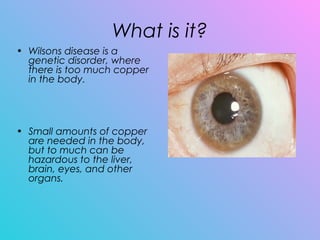
• Wilsons disease is a
genetic disorder, where
there is too much copper
in the body.
• Small amounts of copper
are needed in the body,
but to much can be
hazardous to the liver,
brain, eyes, and other
organs.
Hepatolenticular
degeneration
• Another name for Wilson’s disease is Hepatolenticular
degeneration.
• The special proteins in the liver are called Hepacytes
• Degeneration of the liver and the central nervous
system.
Bile
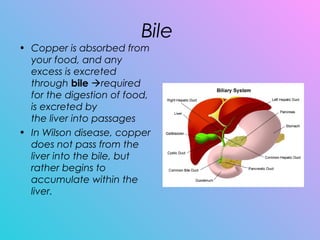
• Copper is absorbed from
your food, and any
excess is excreted
through bile required
for the digestion of food,
is excreted by
the liver into passages
• In Wilson disease, copper
does not pass from the
liver into the bile, but
rather begins to
accumulate within the
liver. 
How it was found
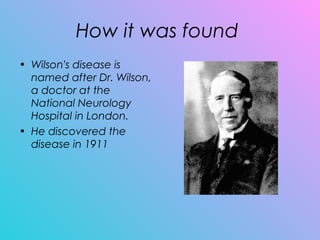
• Wilson's disease is
named after Dr. Wilson,
a doctor at the
National Neurology
Hospital in London.
• He discovered the
disease in 1911
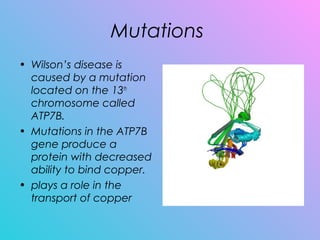
Mutations
• Wilson’s disease is
caused by a mutation
located on the 13th
chromosome called
ATP7B.
• Mutations in the ATP7B
gene produce a
protein with decreased
ability to bind copper. 
• plays a role in the
transport of copper
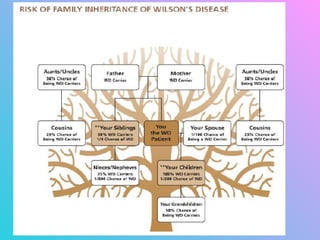
Inheritance
• Autosomal recessive
disease
• In order to inherit
Wilson disease, both
parents must carry
one genetic
mutation
•  Wilson disease
carriers, who have
only one copy of the
abnormal gene, do
not have symptoms
Inheritance
• When two people who carry the abnormal gene have a
child, there is a:
– 1 in 4 chance that the child will have Wilson's disease
by inheriting the abnormal ATP7B gene from both
parents)
– 2 in 4 chance that the child will not have Wilson's
disease, but will be a carrier by inheriting the
abnormal ATP7B gene from one parent but the
normal gene form the other parent.
– 1 in 4 chance that the child will not have Wilson's
disease, and will not be a carrier by inheriting the
normal gene from both parents.
Symptoms
• Wilson’s disease first attacks the liver, the central
nervous system, or both.
• swelling of the liver or spleen
• Jaundice
• fluid buildup in the legs or abdomen
• a tendency to bruise easily
• fatigue
Diagnosis
• The disease is diagnosed through a physical examination
and laboratory tests.
• Physical: Slit lamp, a special light is used to look for
Kayser-Fleischer rings in the eyes. (a rusty brown
discoloration at the rims of the corneas) become
evident as the copper begins to affect the nervous
system. 
• Laboratory tests: Measure the amount of copper in the
blood, urine, and liver tissue.
 Urine collection will show increased copper in the
urine in most patients who display symptoms  
 liver biopsy—a procedure that removes a small
piece of liver tissue, this can show if the liver is
retaining too much copper.
Diagnosis Count.
• Laboratory tests: Measure the amount of copper in the
blood, urine, and liver tissue.
 Urine collection will show increased copper in the
urine in most patients who display symptoms  
 liver biopsy—a procedure that removes a small
piece of liver tissue, this can show if the liver is
retaining too much copper.
Diagnosis
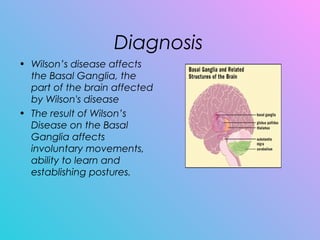
• Wilson’s disease affects
the Basal Ganglia, the
part of the brain affected
by Wilson's disease
• The result of Wilson’s
Disease on the Basal
Ganglia affects
involuntary movements,
ability to learn and
establishing postures.
Treatment
• Treatment for Wilson disease is a life long process
• Drugs : d-penicillamine and trientine hydrochloride
 Both of these drugs release copper from organs
into the bloodstream. Most of the copper is then
filtered out by the kidneys and excreted moment.
• Zinc acetate  prevents your body from absorbing
copper from the food you eat. 
• Liver Transplant  removes your diseased liver and
replaces it with a healthy liver from a donor.
• Diet Reduced copper levels in food. Including,
Chocolate, Nuts, Shellfish, and mushrooms.
At home remedies
• Avoid high levels of copper in food. Things to avoid :
– Shellfish
– Mushrooms
– Nuts
– Chocolate
– Dried fruit
• Copper in water
– If you have copper pipes, run the tap for several
seconds before collecting water for drinking or
cooking. Water that sits in the copper pipes can pick
up copper particles.
• Copper pots and pans 
– Don't use copper pots, pans or storage containers for
your food or drinks.
Summary
• Genetic disorder, where there is too much copper in the
body.
• Caused by a mutation located on the 13th
chromosome
called ATP7B
• Autosomal recessive disease
• Wilson’s disease first attacks the liver, the central nervous
system, or both.
• Treatment : Drugs, Zinc acetate, liver transplant or
healthy diet.

Wilson’s disease

  • 2.
    What is it? •Wilsons disease is a genetic disorder, where there is too much copper in the body. • Small amounts of copper are needed in the body, but to much can be hazardous to the liver, brain, eyes, and other organs.
  • 3.
    Hepatolenticular degeneration • Another namefor Wilson’s disease is Hepatolenticular degeneration. • The special proteins in the liver are called Hepacytes • Degeneration of the liver and the central nervous system.
  • 4.
    Bile • Copper isabsorbed from your food, and any excess is excreted through bile required for the digestion of food, is excreted by the liver into passages • In Wilson disease, copper does not pass from the liver into the bile, but rather begins to accumulate within the liver. 
  • 5.
    How it wasfound • Wilson's disease is named after Dr. Wilson, a doctor at the National Neurology Hospital in London. • He discovered the disease in 1911
  • 6.
    Mutations • Wilson’s diseaseis caused by a mutation located on the 13th chromosome called ATP7B. • Mutations in the ATP7B gene produce a protein with decreased ability to bind copper.  • plays a role in the transport of copper
  • 7.
    Inheritance • Autosomal recessive disease •In order to inherit Wilson disease, both parents must carry one genetic mutation •  Wilson disease carriers, who have only one copy of the abnormal gene, do not have symptoms
  • 9.
    Inheritance • When twopeople who carry the abnormal gene have a child, there is a: – 1 in 4 chance that the child will have Wilson's disease by inheriting the abnormal ATP7B gene from both parents) – 2 in 4 chance that the child will not have Wilson's disease, but will be a carrier by inheriting the abnormal ATP7B gene from one parent but the normal gene form the other parent. – 1 in 4 chance that the child will not have Wilson's disease, and will not be a carrier by inheriting the normal gene from both parents.
  • 10.
    Symptoms • Wilson’s diseasefirst attacks the liver, the central nervous system, or both. • swelling of the liver or spleen • Jaundice • fluid buildup in the legs or abdomen • a tendency to bruise easily • fatigue
  • 11.
    Diagnosis • The diseaseis diagnosed through a physical examination and laboratory tests. • Physical: Slit lamp, a special light is used to look for Kayser-Fleischer rings in the eyes. (a rusty brown discoloration at the rims of the corneas) become evident as the copper begins to affect the nervous system.  • Laboratory tests: Measure the amount of copper in the blood, urine, and liver tissue.  Urine collection will show increased copper in the urine in most patients who display symptoms    liver biopsy—a procedure that removes a small piece of liver tissue, this can show if the liver is retaining too much copper.
  • 12.
    Diagnosis Count. • Laboratorytests: Measure the amount of copper in the blood, urine, and liver tissue.  Urine collection will show increased copper in the urine in most patients who display symptoms    liver biopsy—a procedure that removes a small piece of liver tissue, this can show if the liver is retaining too much copper.
  • 13.
    Diagnosis • Wilson’s diseaseaffects the Basal Ganglia, the part of the brain affected by Wilson's disease • The result of Wilson’s Disease on the Basal Ganglia affects involuntary movements, ability to learn and establishing postures.
  • 14.
    Treatment • Treatment forWilson disease is a life long process • Drugs : d-penicillamine and trientine hydrochloride  Both of these drugs release copper from organs into the bloodstream. Most of the copper is then filtered out by the kidneys and excreted moment. • Zinc acetate  prevents your body from absorbing copper from the food you eat.  • Liver Transplant  removes your diseased liver and replaces it with a healthy liver from a donor. • Diet Reduced copper levels in food. Including, Chocolate, Nuts, Shellfish, and mushrooms.
  • 15.
    At home remedies •Avoid high levels of copper in food. Things to avoid : – Shellfish – Mushrooms – Nuts – Chocolate – Dried fruit • Copper in water – If you have copper pipes, run the tap for several seconds before collecting water for drinking or cooking. Water that sits in the copper pipes can pick up copper particles. • Copper pots and pans  – Don't use copper pots, pans or storage containers for your food or drinks.
  • 16.
    Summary • Genetic disorder,where there is too much copper in the body. • Caused by a mutation located on the 13th chromosome called ATP7B • Autosomal recessive disease • Wilson’s disease first attacks the liver, the central nervous system, or both. • Treatment : Drugs, Zinc acetate, liver transplant or healthy diet.