STROKESTROKE
 The termThe term CerebrovascularCerebrovascular diseasedisease
refers to disorders of the arterial orrefers to disorders of the arterial or
venous circulatory systems of the centralvenous circulatory systems of the central
nervous system.nervous system.
 The termThe term StrokeStroke is used whenis used when thethe
symptoms begin abruptly,symptoms begin abruptly, either as aeither as a
result ofresult of
 ischemic strokeischemic stroke
 hemorrhagic strokehemorrhagic stroke..
 Approximately 80-85% of strokes areApproximately 80-85% of strokes are
ischemic in origin.ischemic in origin.
StrokeStroke
 A sudden attack of weakness affectingA sudden attack of weakness affecting
one side of the body .one side of the body .
 It consequence of an interruption to theIt consequence of an interruption to the
flow of blood to brain.flow of blood to brain.
Ischaemic strokeIschaemic stroke
 An ischaemic stroke occurs when the flowAn ischaemic stroke occurs when the flow
of blood is prevented by clotting .of blood is prevented by clotting .
Haemorrhagic strokeHaemorrhagic stroke
 A haemorrhagic stroke result from ruptureA haemorrhagic stroke result from rupture
of an artery wall.of an artery wall.
 Prolonged reduction of blood pressureProlonged reduction of blood pressure
may result in more diffuse brain damagemay result in more diffuse brain damage
EpidemiologyEpidemiology
 EpidemiologyEpidemiology
 Stroke is theStroke is the secondsecond commonest cause ofcommonest cause of
death,death, and theand the secondsecond most frequentmost frequent
cause ofcause of morbiditymorbidity worldwide.worldwide.
 In an average population, the annualIn an average population, the annual
incidence of new strokes is 2 per 1000incidence of new strokes is 2 per 1000
people.people.
AnatomyAnatomy
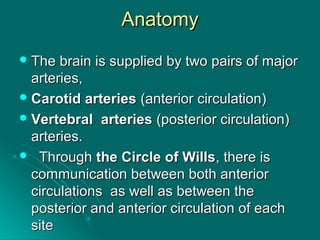
 The brain is supplied by two pairs of majorThe brain is supplied by two pairs of major
arteries,arteries,
 Carotid arteriesCarotid arteries (anterior circulation)(anterior circulation)
 VertebralVertebral arteriesarteries (posterior circulation)(posterior circulation)
arteries.arteries.
 ThroughThrough the Circle of Willsthe Circle of Wills, there is, there is
communication between both anteriorcommunication between both anterior
circulations as well as between thecirculations as well as between the
posterior and anterior circulation of eachposterior and anterior circulation of each
sitesite
A very selfish organA very selfish organ
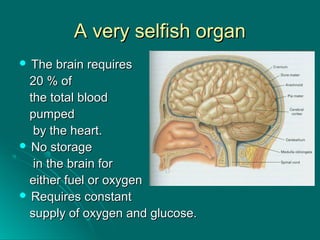
 The brain requiresThe brain requires
20 % of20 % of
the total bloodthe total blood
pumpedpumped
by the heart.by the heart.
 No storageNo storage
in the brain forin the brain for
either fuel or oxygeneither fuel or oxygen
 Requires constantRequires constant
supply of oxygen and glucose.supply of oxygen and glucose.
Blood Supply to the BrainBlood Supply to the Brain
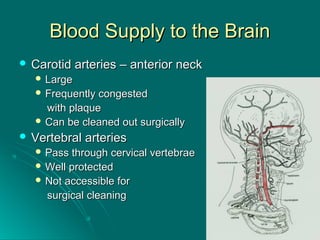
 Carotid arteries – anterior neckCarotid arteries – anterior neck
 LargeLarge
 Frequently congestedFrequently congested
with plaquewith plaque
 Can be cleaned out surgicallyCan be cleaned out surgically
 Vertebral arteriesVertebral arteries
 Pass through cervical vertebraePass through cervical vertebrae
 Well protectedWell protected
 Not accessible forNot accessible for
surgical cleaningsurgical cleaning
What can go wrong???What can go wrong???
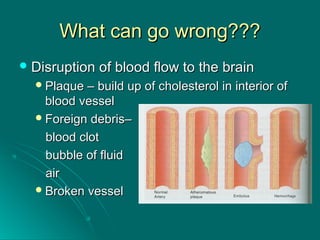
 Disruption of blood flow to the brainDisruption of blood flow to the brain
Plaque – build up of cholesterol in interior ofPlaque – build up of cholesterol in interior of
blood vesselblood vessel
Foreign debris–Foreign debris–
blood clotblood clot
bubble of fluidbubble of fluid
airair
Broken vesselBroken vessel
Risk factors for strokeRisk factors for stroke
 Major risksMajor risks
 Arterial hypertensionArterial hypertension
 High alcohol intakeHigh alcohol intake
 Cigarette smokingCigarette smoking
 Positive family historyPositive family history
 Diabetes mellitusDiabetes mellitus
Risk factors for strokeRisk factors for stroke
 HyperlipidaemiaHyperlipidaemia
 TraumaTrauma
 Oral contraceptives.Oral contraceptives.
 PolycythaemiaPolycythaemia
 ThrombocythaemiaThrombocythaemia
Ischemic StrokeIschemic Stroke
 PathogenesisPathogenesis
 Cerebral ischemia my result fromCerebral ischemia my result from :-:-
 a)a) thrombotic or embolicthrombotic or embolic occlusionocclusion ofof
major vessel(focal ischemia).major vessel(focal ischemia).
 b)b) diminished systemic perfusiondiminished systemic perfusion
(global ischemia), usually from cardiac(global ischemia), usually from cardiac
arrest or ventricular fibrillation.arrest or ventricular fibrillation.
Ischemic StrokeIschemic Stroke
 Prolonged brain ischemia results inProlonged brain ischemia results in
InfarctionInfarction ( necrosis of neurons and( necrosis of neurons and
endothelial cells).endothelial cells).
 Cerebral infarcts are classified as eitherCerebral infarcts are classified as either
Anemic (pale)Anemic (pale) oror HemorrhagicHemorrhagic ( in areas( in areas
of endothelial necrosis ).of endothelial necrosis ).
Ischaemic strokeIschaemic stroke
 EtiologyEtiology
 Major causes of acute cerebralMajor causes of acute cerebral
ischemia are:ischemia are:--
 AtherosclerosisAtherosclerosis
 Cardiogenic EmboliCardiogenic Emboli
 VasculitisVasculitis
 atherosclerosisatherosclerosis in situin situ thrombosis.thrombosis.
Ischaemic strokeIschaemic stroke
 atherosclerosisatherosclerosis of the intra-and –of the intra-and –
extracranial vasculature accounts forextracranial vasculature accounts for
approximately two thirds of strokes, eitherapproximately two thirds of strokes, either
throughthrough embolizationembolization of plaque to distalof plaque to distal
vessels (artery-to-artery embolus).vessels (artery-to-artery embolus).
Ischaemic strokeIschaemic stroke
 cardiogenic embolicardiogenic emboli make up the majoritymake up the majority
of the remaining third of ischemic strokes,of the remaining third of ischemic strokes,
arising most commonly as a result ofarising most commonly as a result of
atrial fibrillation.atrial fibrillation.
 VasculitisVasculitis,, vasospasmvasospasm..
 compressioncompression (by tumor, aneurysm).(by tumor, aneurysm).
 septicseptic..
 fatfat ..
Ischaemic strokeIschaemic stroke
 hypercoagulable statehypercoagulable state..
 Sickle cell diseaseSickle cell disease, etc, are also, etc, are also
potential sources of emboluspotential sources of embolus
Hemorrhagic StrokeHemorrhagic Stroke
 About half the Strokes caused by cerebralAbout half the Strokes caused by cerebral
hemorrhage are due tohemorrhage are due to subarachnoidsubarachnoid
bleedingbleeding from an aneurysm at thefrom an aneurysm at the circlecircle
of Willisof Willis or less commonly from anor less commonly from an
arteriovenous malformationarteriovenous malformation..
Hemorrhagic StrokeHemorrhagic Stroke
In other patients, hemorrhage is mainly intoIn other patients, hemorrhage is mainly into
the cerebral substancethe cerebral substance (intracebral(intracebral
hemorrhage)hemorrhage) and is due to rupture ofand is due to rupture of
small perforating arteries or arteriolessmall perforating arteries or arterioles
weakened by chronic hypertension orweakened by chronic hypertension or
atheromatous degeneration.atheromatous degeneration.
Hemorrhagic StrokeHemorrhagic Stroke
 Intracerebral hemorrhageIntracerebral hemorrhage this type tendsthis type tends
to occur at three distinct sites:-to occur at three distinct sites:-
 The internal capsuleThe internal capsule
 The ponsThe pons
 The cerebellum.The cerebellum.
Hemorrhagic StrokeHemorrhagic Stroke
 Subarachnoid hemorrhage may induceSubarachnoid hemorrhage may induce
secondary arterial spasm and therebysecondary arterial spasm and thereby
cerebral infarction.cerebral infarction.
 Cerebral hemorrhage can be fatal ifCerebral hemorrhage can be fatal if
secondary compression of the brain stemsecondary compression of the brain stem
occurs (herniations).occurs (herniations).
How big is the problem ofHow big is the problem of
STROKE?STROKE?
Stroke in the USStroke in the US
 One case of stroke every 45 secondsOne case of stroke every 45 seconds
 Results in devastating disabilityResults in devastating disability
16% institutionalized in nursing homes16% institutionalized in nursing homes
31% assistance with Activities of Daily Living31% assistance with Activities of Daily Living

(bathing, dressing eating)(bathing, dressing eating)
20% assistance with walking20% assistance with walking
30% depressed30% depressed
Annual cost of $68 billionAnnual cost of $68 billion
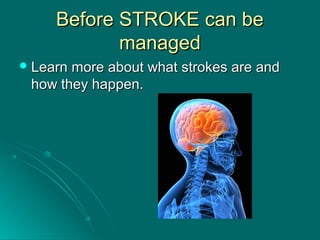
Before STROKE can beBefore STROKE can be
managedmanaged
 Learn more about what strokes are andLearn more about what strokes are and
how they happen.how they happen.
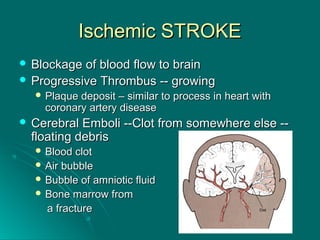
Ischemic STROKEIschemic STROKE
 Blockage of blood flow to brainBlockage of blood flow to brain
 Progressive Thrombus -- growingProgressive Thrombus -- growing
 Plaque deposit – similar to process in heart withPlaque deposit – similar to process in heart with
coronary artery diseasecoronary artery disease
 Cerebral Emboli --Clot from somewhere else --Cerebral Emboli --Clot from somewhere else --
floating debrisfloating debris
 Blood clotBlood clot
 Air bubbleAir bubble
 Bubble of amniotic fluidBubble of amniotic fluid
 Bone marrow fromBone marrow from
a fracturea fracture
HemorrhagicHemorrhagic STROKESTROKE
 Aneurysm – weakened area in arteryAneurysm – weakened area in artery
CongenitalCongenital
Younger population younger than 40 yearsYounger population younger than 40 years
Complain of “worst headache in my life”Complain of “worst headache in my life”
 Spontaneous Hypertensive BleedSpontaneous Hypertensive Bleed
Due to BP > 200/100Due to BP > 200/100
 Malformed ArteryMalformed Artery
50% younger than 30 years50% younger than 30 years
Transient Ischemic AttackTransient Ischemic Attack
Looks like a stroke but, symptoms improve inLooks like a stroke but, symptoms improve in
1-24 hours1-24 hours
Temporary disruption of blood flow to theTemporary disruption of blood flow to the
brain .brain .
Warning sign (15% of strokes have TIA first)Warning sign (15% of strokes have TIA first)
Mimicked by low blood sugar.Mimicked by low blood sugar.
1 in 20 patients will have a true stroke in 31 in 20 patients will have a true stroke in 3
monthsmonths
Can STROKES be prevented?Can STROKES be prevented?
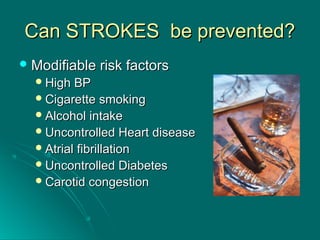
 Modifiable risk factorsModifiable risk factors
High BPHigh BP
Cigarette smokingCigarette smoking
Alcohol intakeAlcohol intake
Uncontrolled Heart diseaseUncontrolled Heart disease
Atrial fibrillationAtrial fibrillation
Uncontrolled DiabetesUncontrolled Diabetes
Carotid congestionCarotid congestion
 High blood cholesterol.High blood cholesterol.
 ObesityObesity
 StressStress
Risk Factors Unable to ControlRisk Factors Unable to Control
 AgeAge
 GenderGender
 more women than menmore women than men
 RaceRace
 African American high riskAfrican American high risk
 Prior strokesPrior strokes
 HeredityHeredity
 Sickle Cell DiseaseSickle Cell Disease
 Causes clot formation andCauses clot formation and
strokes even in childrenstrokes even in children
……………………………………
…………..……………………………………....
Signs and Symptoms ofSigns and Symptoms of
STROKESTROKE
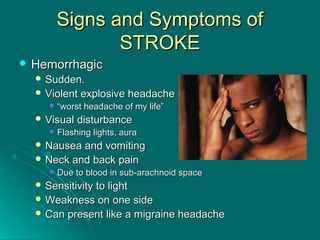
 HemorrhagicHemorrhagic
 Sudden.Sudden.
 Violent explosive headacheViolent explosive headache
 ““worst headache of my life”worst headache of my life”
 Visual disturbanceVisual disturbance
 Flashing lights, auraFlashing lights, aura
 Nausea and vomitingNausea and vomiting
 Neck and back painNeck and back pain
 Due to blood in sub-arachnoid spaceDue to blood in sub-arachnoid space
 Sensitivity to lightSensitivity to light
 Weakness on one sideWeakness on one side
 Can present like a migraine headacheCan present like a migraine headache
Signs and Symptoms ofSigns and Symptoms of
STROKESTROKE
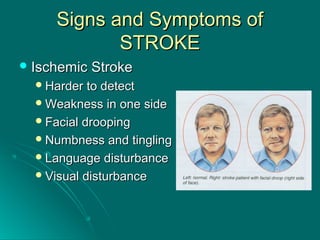
 Ischemic StrokeIschemic Stroke
Harder to detectHarder to detect
Weakness in one sideWeakness in one side
Facial droopingFacial drooping
Numbness and tinglingNumbness and tingling
Language disturbanceLanguage disturbance
Visual disturbanceVisual disturbance
Left Brain StrokeLeft Brain Stroke
 Right side paralysisRight side paralysis
 Speech and language disturbanceSpeech and language disturbance
 Behavioral changesBehavioral changes
 Swallowing problemsSwallowing problems
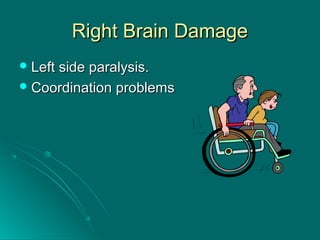
Right Brain DamageRight Brain Damage
 Left side paralysis.Left side paralysis.
 Coordination problemsCoordination problems
……………………………………
…………..……………………………………....
Primary Stroke CarePrimary Stroke Care
 180 minute window of time180 minute window of time
 Time is tissueTime is tissue
 The longer the brain is withoutThe longer the brain is without
oxygen and glucose the moreoxygen and glucose the more
brain cells diebrain cells die
Goal is to restore blood flow asGoal is to restore blood flow as
soon as possiblesoon as possible
 Treatment is a system beginning with earlyTreatment is a system beginning with early
recognition and continuing through rehabilitationrecognition and continuing through rehabilitation
Goals of Primary STROKE CareGoals of Primary STROKE Care
 Rapid Recognition of STROKE SymptomsRapid Recognition of STROKE Symptoms
 Rapid access in to the medical systemRapid access in to the medical system
 AssessmentAssessment
 TreatmentTreatment
Seven D’s of STROKE CareSeven D’s of STROKE Care
 Detection –Detection –of STROKE symptomsof STROKE symptoms
 DeliveryDelivery – to a facility prepared to manage STROKE– to a facility prepared to manage STROKE
 Door to treatment–Door to treatment– rapid diagnosis and decisionrapid diagnosis and decision
makingmaking
 Data–Data– CT ScanCT Scan
 Decision–Decision– Ischemic or Hemorrhagic, does the patientIschemic or Hemorrhagic, does the patient
meet the criteria to receive thrombolytic drugsmeet the criteria to receive thrombolytic drugs
 Drug –Drug – thrombolytic when appropriate.thrombolytic when appropriate.
 D?D?
Use a “Use a “FASTFAST” STROKE” STROKE
AssessmentAssessment
 Modification of Pre-Hospital Stroke ScreenModification of Pre-Hospital Stroke Screen
FaceFace
ArmArm
SpeechSpeech
Time of onsetTime of onset
FACEFACE
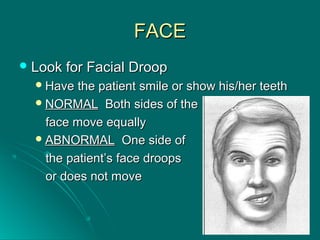
 Look for Facial DroopLook for Facial Droop
Have the patient smile or show his/her teethHave the patient smile or show his/her teeth
NORMALNORMAL Both sides of theBoth sides of the
face move equallyface move equally
ABNORMALABNORMAL One side ofOne side of
the patient’s face droopsthe patient’s face droops
or does not moveor does not move
ARMSARMS
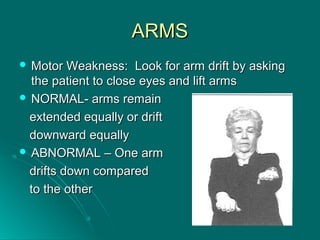
 Motor Weakness: Look for arm drift by askingMotor Weakness: Look for arm drift by asking
the patient to close eyes and lift armsthe patient to close eyes and lift arms
 NORMAL- arms remainNORMAL- arms remain
extended equally or driftextended equally or drift
downward equallydownward equally
 ABNORMAL – One armABNORMAL – One arm
drifts down compareddrifts down compared
to the otherto the other
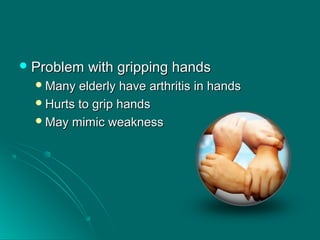
 Problem with gripping handsProblem with gripping hands
Many elderly have arthritis in handsMany elderly have arthritis in hands
Hurts to grip handsHurts to grip hands
May mimic weaknessMay mimic weakness
SPEECHSPEECH
 Ask the patient to sayAsk the patient to say “You can’t teach an“You can’t teach an
old dog new tricks”old dog new tricks”
Lots of tLots of t’s,’s, k’s and c’sk’s and c’s
 NORMAL –Phrase repeated clearly andNORMAL –Phrase repeated clearly and
plainlyplainly
 ABNORMAL – Words slurred, abnormal orABNORMAL – Words slurred, abnormal or
unable to speakunable to speak
Abnormal SpeechAbnormal Speech
 Slurring of speechSlurring of speech
 Unable to think of wordsUnable to think of words
 Inappropriate wordsInappropriate words
 Expressive aphasia – unable to speak wordsExpressive aphasia – unable to speak words
 Area of brain where words are created is damagedArea of brain where words are created is damaged
 Receptive aphasia – unable to understandReceptive aphasia – unable to understand
wordswords
 Area where words are interpreted is damagedArea where words are interpreted is damaged
TIME OF ONSETTIME OF ONSET
 The window of opportunity to effectivelyThe window of opportunity to effectively
treat STROKE is 3 hours (180 minutes)treat STROKE is 3 hours (180 minutes)
May be extended to 4 ½ hours in some casesMay be extended to 4 ½ hours in some cases
 Need to know “ last known well”.Need to know “ last known well”.
 Difficult whenDifficult when
Patient lives alonePatient lives alone
Woke up with symptomsWoke up with symptoms
Assessing the Stroke PatientAssessing the Stroke Patient
 Initial AssessmentInitial Assessment
General ImpressionGeneral Impression
Airway Airway Airway!!Airway Airway Airway!!
High-flow O2High-flow O2
CirculationCirculation
 Focused history and physical examFocused history and physical exam
Perform thorough neurologic exam.Perform thorough neurologic exam.
FAST Stroke ScreenFAST Stroke Screen
History ofHistory of
 SeizuresSeizures
 HeadacheHeadache
 Nausea/vomitingNausea/vomiting
 Neck painNeck pain
Obtain baseline set of vitalsObtain baseline set of vitals
Recheck Vital Signs frequentlyRecheck Vital Signs frequently
Priorities of carePriorities of care
 Conduct general assessmentConduct general assessment
 Trauma – recent or within last monthTrauma – recent or within last month
 Recent seizureRecent seizure
 Could be a subdural hematomaCould be a subdural hematoma
 Cardiovascular – on heart medicationsCardiovascular – on heart medications
 Does the patient have atrial fibrillationDoes the patient have atrial fibrillation
 Does the patient take blood thinnersDoes the patient take blood thinners
 Pulse oximetry > 94%Pulse oximetry > 94%
 Blood sugar treat if ableBlood sugar treat if able
 Low blood sugars mimic a strokeLow blood sugars mimic a stroke
 PupilsPupils
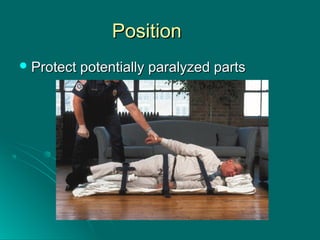
PositionPosition
 Protect potentially paralyzed partsProtect potentially paralyzed parts
STROKE Check ListSTROKE Check List
 Securing A B CsSecuring A B Cs
 Stroke identificationStroke identification
 Use of FAST ScreenUse of FAST Screen
 EKG monitoring if ableEKG monitoring if able
 Oxygen saturation of > 94%Oxygen saturation of > 94%
 Management of blood glucoseManagement of blood glucose
 IV access.IV access.
 Blood specimens obtained.Blood specimens obtained.
 Head of Bed elevated 15 degreesHead of Bed elevated 15 degrees
 Urgent CT ScanUrgent CT Scan
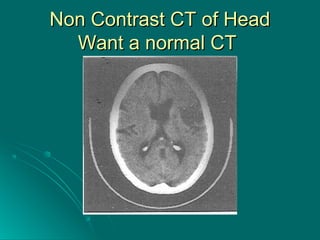
Non Contrast CT of HeadNon Contrast CT of Head
Want a normal CTWant a normal CT
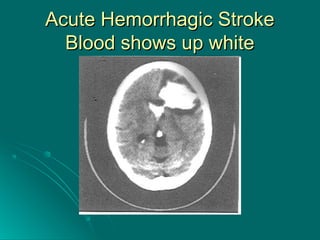
Acute Hemorrhagic StrokeAcute Hemorrhagic Stroke
Blood shows up whiteBlood shows up white
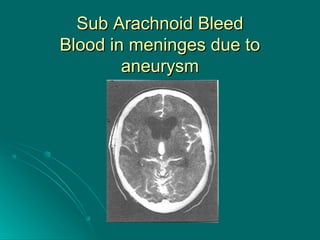
Sub Arachnoid BleedSub Arachnoid Bleed
Blood in meninges due toBlood in meninges due to
aneurysmaneurysm
Could this be anything otherCould this be anything other
than a STROKE?than a STROKE?
 Transient Ischemic AttackTransient Ischemic Attack
 HypoglycemiaHypoglycemia
Race Against TimeRace Against Time
Goals of STROKE CareGoals of STROKE Care
 Standardized assessments.Standardized assessments.
 Door to treatment (with thrombolytic) goalDoor to treatment (with thrombolytic) goal
is 60 minutesis 60 minutes
 Early identification of candidatesEarly identification of candidates
 Direct CT scanDirect CT scan
Case Study 1: 6:30 pmCase Study 1: 6:30 pm
 You are called by a family member toYou are called by a family member to
assess a patient who is not acting right.assess a patient who is not acting right.
 What could be the problem?What could be the problem?
 Keep an eye on the timeKeep an eye on the time
you have 180 minutesyou have 180 minutes
What could be the problem?What could be the problem?
 Seizure.Seizure.
 Myocardial infarctionMyocardial infarction
 Diabetic reactionDiabetic reaction
 Medication reactionMedication reaction
 Anxiety attackAnxiety attack
 STROKESTROKE
6:35 pm6:35 pm
 you find the patient, Short of breathingyou find the patient, Short of breathing
sitting in bed. She is confused, butsitting in bed. She is confused, but
responds to verbal stimuli.responds to verbal stimuli.
 What assessments do you need?What assessments do you need?
ABC/FASTABC/FAST
 Airway and ventilations are adequateAirway and ventilations are adequate
 Regular pulse and good perfusionRegular pulse and good perfusion
 Speech is garbledSpeech is garbled
 Unable to move her right arm and legUnable to move her right arm and leg
 Denies chest pain.Denies chest pain.
 BP 195/105, pulse 90, respirations 18BP 195/105, pulse 90, respirations 18
 The patient’s daughter reports that her motherThe patient’s daughter reports that her mother
felt fine a few minutes ago when suddenly herfelt fine a few minutes ago when suddenly her
arm felt .arm felt .
 She did not lose consciousness and did notShe did not lose consciousness and did not
have a seizure.have a seizure.
 The woman complain of a headache, and hasThe woman complain of a headache, and has
no history of seizures, diabetes, chest pain orno history of seizures, diabetes, chest pain or
palpitations.palpitations.
How can you manage this caseHow can you manage this case
Case twoCase two
 This patient is 65 years old.This patient is 65 years old.
 She has left sided facial drooping and rightShe has left sided facial drooping and right
arm and leg weakness. She can move thearm and leg weakness. She can move the
right arm and leg slightly, but with greatright arm and leg slightly, but with great
difficulty. Her speech is slurred.difficulty. Her speech is slurred.
 All of these signs and symptoms are newAll of these signs and symptoms are new
in the last 10 minutes.in the last 10 minutes.
FASTFAST
 How does on the FAST Screen?How does on the FAST Screen?
FaceFace
ArmArm
SpeechSpeech
TimeTime
Case 1 contCase 1 cont
 Face -- left sided facial droopingFace -- left sided facial drooping
 Arm – right arm and leg weaknessArm – right arm and leg weakness
 Speech – speech is slurredSpeech – speech is slurred
 Time last known well – within 20 minutesTime last known well – within 20 minutes
HIGH PRIORITYHIGH PRIORITY
 Determine precise time of onset of signsDetermine precise time of onset of signs
and symptoms.and symptoms.
 If thrombolytic therapy is to be considered,If thrombolytic therapy is to be considered,
itsits infusioninfusion must begin within 3 hours ofmust begin within 3 hours of
the onset of symptoms.the onset of symptoms.
 Does she meet the criteria so far to be onDoes she meet the criteria so far to be on
the Primary STROKE Care track tothe Primary STROKE Care track to
receive thrombolytic?receive thrombolytic?
 YES, Proceed with Stroke protocolYES, Proceed with Stroke protocol
Case Study 3Case Study 3
 70 year-old woman70 year-old woman
 Awake with slight weakness and tinglingAwake with slight weakness and tingling
in her left side.in her left side.
 Speech is hesitant and slightly slurredSpeech is hesitant and slightly slurred
 No facial droopingNo facial drooping
 Good eye contactGood eye contact
 Symptoms began before 20min.Symptoms began before 20min.
 Speech was fine before thatSpeech was fine before that
 Blood sugar 50 mg/dlBlood sugar 50 mg/dl
 No emesis or seizureNo emesis or seizure
 BP 150/90, Pulse 80, Respirations 16BP 150/90, Pulse 80, Respirations 16
 O2 sat 92%O2 sat 92%
FASTFAST
 How does sheHow does she
on the FAST Screen?on the FAST Screen?
FaceFace
ArmArm
SpeechSpeech
TimeTime
Case contCase cont
 Face -- no droopingFace -- no drooping
 Arm – slight weakness and tinglingArm – slight weakness and tingling
 Speech -- Speech is hesitant and slightlySpeech -- Speech is hesitant and slightly
slurredslurred
 Time known well -- 20 minutes agoTime known well -- 20 minutes ago
 BUT blood sugar is low!BUT blood sugar is low!
 Treat the blood sugar and reassess theTreat the blood sugar and reassess the
need for additional treatmentneed for additional treatment
 High priorityHigh priority
a CT for acute STROKEa CT for acute STROKE
Case Study 4Case Study 4
 80 year-old man.80 year-old man.
 Daughter found him 15 minutes ago fall onDaughter found him 15 minutes ago fall on
the floor.the floor.
 Unknown down timeUnknown down time
 AwakeAwake
 Drooping left side of faceDrooping left side of face
 No movement of right arm and legNo movement of right arm and leg
 Speech too slurred to understandSpeech too slurred to understand
FASTFAST
 How doesHow does
on the FAST Screen?on the FAST Screen?
FaceFace
ArmArm
SpeechSpeech
TimeTime
QuizQuiz
 What are the 2 general types of stroke?What are the 2 general types of stroke?
 1.1.
 2.2.
 What condition is equivalent to “angina” of theWhat condition is equivalent to “angina” of the
brain?brain?
 3.3.
 What are 3 risk factors for stroke that can beWhat are 3 risk factors for stroke that can be
modified?modified?
 4.4.
 5.5.
 6.6.
 What are 2 risk factors for stroke that cannot beWhat are 2 risk factors for stroke that cannot be
modified?modified?
 7.7.
 8.8.
 What are you measuring in a FAST StrokeWhat are you measuring in a FAST Stroke
Screen?Screen?
 9.9.
 10.10.
 11.11.
 12.12.
 In the 21In the 21stst
century, some patients sufferingcentury, some patients suffering
from STROKE can be treated using whatfrom STROKE can be treated using what
type of medication?type of medication?
13.13.
 What is the time deadline that must beWhat is the time deadline that must be
met in order to use the aggressivemet in order to use the aggressive
medication in the question above?medication in the question above?
14.14.
AnswersAnswers
 1. Hemorrhagic stroke1. Hemorrhagic stroke
 2. Ischemic stroke2. Ischemic stroke
 3. TIA (transient ischemic attack)3. TIA (transient ischemic attack)
 4. – 6.4. – 6. High BPHigh BP
 Cigarette smokingCigarette smoking High blood cholesterolHigh blood cholesterol
 Sedentary lifestyleSedentary lifestyle Carotid CongestionCarotid Congestion
 ObesityObesity Uncontrolled diabetesUncontrolled diabetes
 SeasonsSeasons Atrial fibrillationAtrial fibrillation
 StressStress Uncontrolled heart diseaseUncontrolled heart disease
 Alcohol intakeAlcohol intake
 7-87-8
 AgeAge prior strokesprior strokes
 GenderGender heredityheredity
 RaceRace Sickle cell diseaseSickle cell disease
9. Face9. Face
10. Arm10. Arm
11. Speech11. Speech
12. Last known well12. Last known well
 13. Clot busting drugs, thrombolytics, tPA13. Clot busting drugs, thrombolytics, tPA
 14. 3 hours (180 minutes)14. 3 hours (180 minutes)
8484

Stroke

  • 1.
  • 2.
     The termTheterm CerebrovascularCerebrovascular diseasedisease refers to disorders of the arterial orrefers to disorders of the arterial or venous circulatory systems of the centralvenous circulatory systems of the central nervous system.nervous system.  The termThe term StrokeStroke is used whenis used when thethe symptoms begin abruptly,symptoms begin abruptly, either as aeither as a result ofresult of  ischemic strokeischemic stroke  hemorrhagic strokehemorrhagic stroke..  Approximately 80-85% of strokes areApproximately 80-85% of strokes are ischemic in origin.ischemic in origin.
  • 3.
    StrokeStroke  A suddenattack of weakness affectingA sudden attack of weakness affecting one side of the body .one side of the body .  It consequence of an interruption to theIt consequence of an interruption to the flow of blood to brain.flow of blood to brain.
  • 4.
    Ischaemic strokeIschaemic stroke An ischaemic stroke occurs when the flowAn ischaemic stroke occurs when the flow of blood is prevented by clotting .of blood is prevented by clotting .
  • 5.
    Haemorrhagic strokeHaemorrhagic stroke A haemorrhagic stroke result from ruptureA haemorrhagic stroke result from rupture of an artery wall.of an artery wall.  Prolonged reduction of blood pressureProlonged reduction of blood pressure may result in more diffuse brain damagemay result in more diffuse brain damage
  • 6.
    EpidemiologyEpidemiology  EpidemiologyEpidemiology  Strokeis theStroke is the secondsecond commonest cause ofcommonest cause of death,death, and theand the secondsecond most frequentmost frequent cause ofcause of morbiditymorbidity worldwide.worldwide.  In an average population, the annualIn an average population, the annual incidence of new strokes is 2 per 1000incidence of new strokes is 2 per 1000 people.people.
  • 7.
    AnatomyAnatomy  The brainis supplied by two pairs of majorThe brain is supplied by two pairs of major arteries,arteries,  Carotid arteriesCarotid arteries (anterior circulation)(anterior circulation)  VertebralVertebral arteriesarteries (posterior circulation)(posterior circulation) arteries.arteries.  ThroughThrough the Circle of Willsthe Circle of Wills, there is, there is communication between both anteriorcommunication between both anterior circulations as well as between thecirculations as well as between the posterior and anterior circulation of eachposterior and anterior circulation of each sitesite
  • 8.
    A very selfishorganA very selfish organ  The brain requiresThe brain requires 20 % of20 % of the total bloodthe total blood pumpedpumped by the heart.by the heart.  No storageNo storage in the brain forin the brain for either fuel or oxygeneither fuel or oxygen  Requires constantRequires constant supply of oxygen and glucose.supply of oxygen and glucose.
  • 9.
    Blood Supply tothe BrainBlood Supply to the Brain  Carotid arteries – anterior neckCarotid arteries – anterior neck  LargeLarge  Frequently congestedFrequently congested with plaquewith plaque  Can be cleaned out surgicallyCan be cleaned out surgically  Vertebral arteriesVertebral arteries  Pass through cervical vertebraePass through cervical vertebrae  Well protectedWell protected  Not accessible forNot accessible for surgical cleaningsurgical cleaning
  • 10.
    What can gowrong???What can go wrong???  Disruption of blood flow to the brainDisruption of blood flow to the brain Plaque – build up of cholesterol in interior ofPlaque – build up of cholesterol in interior of blood vesselblood vessel Foreign debris–Foreign debris– blood clotblood clot bubble of fluidbubble of fluid airair Broken vesselBroken vessel
  • 11.
    Risk factors forstrokeRisk factors for stroke  Major risksMajor risks  Arterial hypertensionArterial hypertension  High alcohol intakeHigh alcohol intake  Cigarette smokingCigarette smoking  Positive family historyPositive family history  Diabetes mellitusDiabetes mellitus
  • 12.
    Risk factors forstrokeRisk factors for stroke  HyperlipidaemiaHyperlipidaemia  TraumaTrauma  Oral contraceptives.Oral contraceptives.  PolycythaemiaPolycythaemia  ThrombocythaemiaThrombocythaemia
  • 13.
    Ischemic StrokeIschemic Stroke PathogenesisPathogenesis  Cerebral ischemia my result fromCerebral ischemia my result from :-:-  a)a) thrombotic or embolicthrombotic or embolic occlusionocclusion ofof major vessel(focal ischemia).major vessel(focal ischemia).  b)b) diminished systemic perfusiondiminished systemic perfusion (global ischemia), usually from cardiac(global ischemia), usually from cardiac arrest or ventricular fibrillation.arrest or ventricular fibrillation.
  • 14.
    Ischemic StrokeIschemic Stroke Prolonged brain ischemia results inProlonged brain ischemia results in InfarctionInfarction ( necrosis of neurons and( necrosis of neurons and endothelial cells).endothelial cells).  Cerebral infarcts are classified as eitherCerebral infarcts are classified as either Anemic (pale)Anemic (pale) oror HemorrhagicHemorrhagic ( in areas( in areas of endothelial necrosis ).of endothelial necrosis ).
  • 15.
    Ischaemic strokeIschaemic stroke EtiologyEtiology  Major causes of acute cerebralMajor causes of acute cerebral ischemia are:ischemia are:--  AtherosclerosisAtherosclerosis  Cardiogenic EmboliCardiogenic Emboli  VasculitisVasculitis  atherosclerosisatherosclerosis in situin situ thrombosis.thrombosis.
  • 16.
    Ischaemic strokeIschaemic stroke atherosclerosisatherosclerosis of the intra-and –of the intra-and – extracranial vasculature accounts forextracranial vasculature accounts for approximately two thirds of strokes, eitherapproximately two thirds of strokes, either throughthrough embolizationembolization of plaque to distalof plaque to distal vessels (artery-to-artery embolus).vessels (artery-to-artery embolus).
  • 17.
    Ischaemic strokeIschaemic stroke cardiogenic embolicardiogenic emboli make up the majoritymake up the majority of the remaining third of ischemic strokes,of the remaining third of ischemic strokes, arising most commonly as a result ofarising most commonly as a result of atrial fibrillation.atrial fibrillation.  VasculitisVasculitis,, vasospasmvasospasm..  compressioncompression (by tumor, aneurysm).(by tumor, aneurysm).  septicseptic..  fatfat ..
  • 18.
    Ischaemic strokeIschaemic stroke hypercoagulable statehypercoagulable state..  Sickle cell diseaseSickle cell disease, etc, are also, etc, are also potential sources of emboluspotential sources of embolus
  • 19.
    Hemorrhagic StrokeHemorrhagic Stroke About half the Strokes caused by cerebralAbout half the Strokes caused by cerebral hemorrhage are due tohemorrhage are due to subarachnoidsubarachnoid bleedingbleeding from an aneurysm at thefrom an aneurysm at the circlecircle of Willisof Willis or less commonly from anor less commonly from an arteriovenous malformationarteriovenous malformation..
  • 20.
    Hemorrhagic StrokeHemorrhagic Stroke Inother patients, hemorrhage is mainly intoIn other patients, hemorrhage is mainly into the cerebral substancethe cerebral substance (intracebral(intracebral hemorrhage)hemorrhage) and is due to rupture ofand is due to rupture of small perforating arteries or arteriolessmall perforating arteries or arterioles weakened by chronic hypertension orweakened by chronic hypertension or atheromatous degeneration.atheromatous degeneration.
  • 21.
    Hemorrhagic StrokeHemorrhagic Stroke Intracerebral hemorrhageIntracerebral hemorrhage this type tendsthis type tends to occur at three distinct sites:-to occur at three distinct sites:-  The internal capsuleThe internal capsule  The ponsThe pons  The cerebellum.The cerebellum.
  • 22.
    Hemorrhagic StrokeHemorrhagic Stroke Subarachnoid hemorrhage may induceSubarachnoid hemorrhage may induce secondary arterial spasm and therebysecondary arterial spasm and thereby cerebral infarction.cerebral infarction.  Cerebral hemorrhage can be fatal ifCerebral hemorrhage can be fatal if secondary compression of the brain stemsecondary compression of the brain stem occurs (herniations).occurs (herniations).
  • 23.
    How big isthe problem ofHow big is the problem of STROKE?STROKE?
  • 24.
    Stroke in theUSStroke in the US  One case of stroke every 45 secondsOne case of stroke every 45 seconds  Results in devastating disabilityResults in devastating disability 16% institutionalized in nursing homes16% institutionalized in nursing homes 31% assistance with Activities of Daily Living31% assistance with Activities of Daily Living (bathing, dressing eating)(bathing, dressing eating) 20% assistance with walking20% assistance with walking 30% depressed30% depressed Annual cost of $68 billionAnnual cost of $68 billion
  • 25.
    Before STROKE canbeBefore STROKE can be managedmanaged  Learn more about what strokes are andLearn more about what strokes are and how they happen.how they happen.
  • 26.
    Ischemic STROKEIschemic STROKE Blockage of blood flow to brainBlockage of blood flow to brain  Progressive Thrombus -- growingProgressive Thrombus -- growing  Plaque deposit – similar to process in heart withPlaque deposit – similar to process in heart with coronary artery diseasecoronary artery disease  Cerebral Emboli --Clot from somewhere else --Cerebral Emboli --Clot from somewhere else -- floating debrisfloating debris  Blood clotBlood clot  Air bubbleAir bubble  Bubble of amniotic fluidBubble of amniotic fluid  Bone marrow fromBone marrow from a fracturea fracture
  • 27.
    HemorrhagicHemorrhagic STROKESTROKE  Aneurysm– weakened area in arteryAneurysm – weakened area in artery CongenitalCongenital Younger population younger than 40 yearsYounger population younger than 40 years Complain of “worst headache in my life”Complain of “worst headache in my life”  Spontaneous Hypertensive BleedSpontaneous Hypertensive Bleed Due to BP > 200/100Due to BP > 200/100  Malformed ArteryMalformed Artery 50% younger than 30 years50% younger than 30 years
  • 28.
    Transient Ischemic AttackTransientIschemic Attack Looks like a stroke but, symptoms improve inLooks like a stroke but, symptoms improve in 1-24 hours1-24 hours Temporary disruption of blood flow to theTemporary disruption of blood flow to the brain .brain . Warning sign (15% of strokes have TIA first)Warning sign (15% of strokes have TIA first) Mimicked by low blood sugar.Mimicked by low blood sugar. 1 in 20 patients will have a true stroke in 31 in 20 patients will have a true stroke in 3 monthsmonths
  • 29.
    Can STROKES beprevented?Can STROKES be prevented?  Modifiable risk factorsModifiable risk factors High BPHigh BP Cigarette smokingCigarette smoking Alcohol intakeAlcohol intake Uncontrolled Heart diseaseUncontrolled Heart disease Atrial fibrillationAtrial fibrillation Uncontrolled DiabetesUncontrolled Diabetes Carotid congestionCarotid congestion
  • 30.
     High bloodcholesterol.High blood cholesterol.  ObesityObesity  StressStress
  • 31.
    Risk Factors Unableto ControlRisk Factors Unable to Control  AgeAge  GenderGender  more women than menmore women than men  RaceRace  African American high riskAfrican American high risk  Prior strokesPrior strokes  HeredityHeredity  Sickle Cell DiseaseSickle Cell Disease  Causes clot formation andCauses clot formation and strokes even in childrenstrokes even in children
  • 32.
  • 33.
    Signs and SymptomsofSigns and Symptoms of STROKESTROKE  HemorrhagicHemorrhagic  Sudden.Sudden.  Violent explosive headacheViolent explosive headache  ““worst headache of my life”worst headache of my life”  Visual disturbanceVisual disturbance  Flashing lights, auraFlashing lights, aura  Nausea and vomitingNausea and vomiting  Neck and back painNeck and back pain  Due to blood in sub-arachnoid spaceDue to blood in sub-arachnoid space  Sensitivity to lightSensitivity to light  Weakness on one sideWeakness on one side  Can present like a migraine headacheCan present like a migraine headache
  • 34.
    Signs and SymptomsofSigns and Symptoms of STROKESTROKE  Ischemic StrokeIschemic Stroke Harder to detectHarder to detect Weakness in one sideWeakness in one side Facial droopingFacial drooping Numbness and tinglingNumbness and tingling Language disturbanceLanguage disturbance Visual disturbanceVisual disturbance
  • 35.
    Left Brain StrokeLeftBrain Stroke  Right side paralysisRight side paralysis  Speech and language disturbanceSpeech and language disturbance  Behavioral changesBehavioral changes  Swallowing problemsSwallowing problems
  • 36.
    Right Brain DamageRightBrain Damage  Left side paralysis.Left side paralysis.  Coordination problemsCoordination problems
  • 37.
  • 38.
    Primary Stroke CarePrimaryStroke Care  180 minute window of time180 minute window of time  Time is tissueTime is tissue  The longer the brain is withoutThe longer the brain is without oxygen and glucose the moreoxygen and glucose the more brain cells diebrain cells die Goal is to restore blood flow asGoal is to restore blood flow as soon as possiblesoon as possible  Treatment is a system beginning with earlyTreatment is a system beginning with early recognition and continuing through rehabilitationrecognition and continuing through rehabilitation
  • 39.
    Goals of PrimarySTROKE CareGoals of Primary STROKE Care  Rapid Recognition of STROKE SymptomsRapid Recognition of STROKE Symptoms  Rapid access in to the medical systemRapid access in to the medical system  AssessmentAssessment  TreatmentTreatment
  • 40.
    Seven D’s ofSTROKE CareSeven D’s of STROKE Care  Detection –Detection –of STROKE symptomsof STROKE symptoms  DeliveryDelivery – to a facility prepared to manage STROKE– to a facility prepared to manage STROKE  Door to treatment–Door to treatment– rapid diagnosis and decisionrapid diagnosis and decision makingmaking  Data–Data– CT ScanCT Scan  Decision–Decision– Ischemic or Hemorrhagic, does the patientIschemic or Hemorrhagic, does the patient meet the criteria to receive thrombolytic drugsmeet the criteria to receive thrombolytic drugs  Drug –Drug – thrombolytic when appropriate.thrombolytic when appropriate.  D?D?
  • 41.
    Use a “Usea “FASTFAST” STROKE” STROKE AssessmentAssessment  Modification of Pre-Hospital Stroke ScreenModification of Pre-Hospital Stroke Screen FaceFace ArmArm SpeechSpeech Time of onsetTime of onset
  • 42.
    FACEFACE  Look forFacial DroopLook for Facial Droop Have the patient smile or show his/her teethHave the patient smile or show his/her teeth NORMALNORMAL Both sides of theBoth sides of the face move equallyface move equally ABNORMALABNORMAL One side ofOne side of the patient’s face droopsthe patient’s face droops or does not moveor does not move
  • 43.
    ARMSARMS  Motor Weakness:Look for arm drift by askingMotor Weakness: Look for arm drift by asking the patient to close eyes and lift armsthe patient to close eyes and lift arms  NORMAL- arms remainNORMAL- arms remain extended equally or driftextended equally or drift downward equallydownward equally  ABNORMAL – One armABNORMAL – One arm drifts down compareddrifts down compared to the otherto the other
  • 44.
     Problem withgripping handsProblem with gripping hands Many elderly have arthritis in handsMany elderly have arthritis in hands Hurts to grip handsHurts to grip hands May mimic weaknessMay mimic weakness
  • 45.
    SPEECHSPEECH  Ask thepatient to sayAsk the patient to say “You can’t teach an“You can’t teach an old dog new tricks”old dog new tricks” Lots of tLots of t’s,’s, k’s and c’sk’s and c’s  NORMAL –Phrase repeated clearly andNORMAL –Phrase repeated clearly and plainlyplainly  ABNORMAL – Words slurred, abnormal orABNORMAL – Words slurred, abnormal or unable to speakunable to speak
  • 46.
    Abnormal SpeechAbnormal Speech Slurring of speechSlurring of speech  Unable to think of wordsUnable to think of words  Inappropriate wordsInappropriate words  Expressive aphasia – unable to speak wordsExpressive aphasia – unable to speak words  Area of brain where words are created is damagedArea of brain where words are created is damaged  Receptive aphasia – unable to understandReceptive aphasia – unable to understand wordswords  Area where words are interpreted is damagedArea where words are interpreted is damaged
  • 47.
    TIME OF ONSETTIMEOF ONSET  The window of opportunity to effectivelyThe window of opportunity to effectively treat STROKE is 3 hours (180 minutes)treat STROKE is 3 hours (180 minutes) May be extended to 4 ½ hours in some casesMay be extended to 4 ½ hours in some cases  Need to know “ last known well”.Need to know “ last known well”.  Difficult whenDifficult when Patient lives alonePatient lives alone Woke up with symptomsWoke up with symptoms
  • 48.
    Assessing the StrokePatientAssessing the Stroke Patient  Initial AssessmentInitial Assessment General ImpressionGeneral Impression Airway Airway Airway!!Airway Airway Airway!! High-flow O2High-flow O2 CirculationCirculation
  • 49.
     Focused historyand physical examFocused history and physical exam Perform thorough neurologic exam.Perform thorough neurologic exam. FAST Stroke ScreenFAST Stroke Screen History ofHistory of  SeizuresSeizures  HeadacheHeadache  Nausea/vomitingNausea/vomiting  Neck painNeck pain Obtain baseline set of vitalsObtain baseline set of vitals Recheck Vital Signs frequentlyRecheck Vital Signs frequently
  • 50.
    Priorities of carePrioritiesof care  Conduct general assessmentConduct general assessment  Trauma – recent or within last monthTrauma – recent or within last month  Recent seizureRecent seizure  Could be a subdural hematomaCould be a subdural hematoma  Cardiovascular – on heart medicationsCardiovascular – on heart medications  Does the patient have atrial fibrillationDoes the patient have atrial fibrillation  Does the patient take blood thinnersDoes the patient take blood thinners  Pulse oximetry > 94%Pulse oximetry > 94%  Blood sugar treat if ableBlood sugar treat if able  Low blood sugars mimic a strokeLow blood sugars mimic a stroke  PupilsPupils
  • 51.
    PositionPosition  Protect potentiallyparalyzed partsProtect potentially paralyzed parts
  • 52.
    STROKE Check ListSTROKECheck List  Securing A B CsSecuring A B Cs  Stroke identificationStroke identification  Use of FAST ScreenUse of FAST Screen  EKG monitoring if ableEKG monitoring if able  Oxygen saturation of > 94%Oxygen saturation of > 94%  Management of blood glucoseManagement of blood glucose  IV access.IV access.  Blood specimens obtained.Blood specimens obtained.  Head of Bed elevated 15 degreesHead of Bed elevated 15 degrees  Urgent CT ScanUrgent CT Scan
  • 53.
    Non Contrast CTof HeadNon Contrast CT of Head Want a normal CTWant a normal CT
  • 54.
    Acute Hemorrhagic StrokeAcuteHemorrhagic Stroke Blood shows up whiteBlood shows up white
  • 55.
    Sub Arachnoid BleedSubArachnoid Bleed Blood in meninges due toBlood in meninges due to aneurysmaneurysm
  • 56.
    Could this beanything otherCould this be anything other than a STROKE?than a STROKE?  Transient Ischemic AttackTransient Ischemic Attack  HypoglycemiaHypoglycemia
  • 57.
  • 58.
    Goals of STROKECareGoals of STROKE Care  Standardized assessments.Standardized assessments.  Door to treatment (with thrombolytic) goalDoor to treatment (with thrombolytic) goal is 60 minutesis 60 minutes  Early identification of candidatesEarly identification of candidates  Direct CT scanDirect CT scan
  • 59.
    Case Study 1:6:30 pmCase Study 1: 6:30 pm  You are called by a family member toYou are called by a family member to assess a patient who is not acting right.assess a patient who is not acting right.  What could be the problem?What could be the problem?  Keep an eye on the timeKeep an eye on the time you have 180 minutesyou have 180 minutes
  • 60.
    What could bethe problem?What could be the problem?  Seizure.Seizure.  Myocardial infarctionMyocardial infarction  Diabetic reactionDiabetic reaction  Medication reactionMedication reaction  Anxiety attackAnxiety attack  STROKESTROKE
  • 61.
    6:35 pm6:35 pm you find the patient, Short of breathingyou find the patient, Short of breathing sitting in bed. She is confused, butsitting in bed. She is confused, but responds to verbal stimuli.responds to verbal stimuli.  What assessments do you need?What assessments do you need?
  • 62.
    ABC/FASTABC/FAST  Airway andventilations are adequateAirway and ventilations are adequate  Regular pulse and good perfusionRegular pulse and good perfusion  Speech is garbledSpeech is garbled  Unable to move her right arm and legUnable to move her right arm and leg  Denies chest pain.Denies chest pain.  BP 195/105, pulse 90, respirations 18BP 195/105, pulse 90, respirations 18
  • 63.
     The patient’sdaughter reports that her motherThe patient’s daughter reports that her mother felt fine a few minutes ago when suddenly herfelt fine a few minutes ago when suddenly her arm felt .arm felt .  She did not lose consciousness and did notShe did not lose consciousness and did not have a seizure.have a seizure.  The woman complain of a headache, and hasThe woman complain of a headache, and has no history of seizures, diabetes, chest pain orno history of seizures, diabetes, chest pain or palpitations.palpitations.
  • 64.
    How can youmanage this caseHow can you manage this case
  • 65.
    Case twoCase two This patient is 65 years old.This patient is 65 years old.  She has left sided facial drooping and rightShe has left sided facial drooping and right arm and leg weakness. She can move thearm and leg weakness. She can move the right arm and leg slightly, but with greatright arm and leg slightly, but with great difficulty. Her speech is slurred.difficulty. Her speech is slurred.  All of these signs and symptoms are newAll of these signs and symptoms are new in the last 10 minutes.in the last 10 minutes.
  • 66.
    FASTFAST  How doeson the FAST Screen?How does on the FAST Screen? FaceFace ArmArm SpeechSpeech TimeTime
  • 67.
    Case 1 contCase1 cont  Face -- left sided facial droopingFace -- left sided facial drooping  Arm – right arm and leg weaknessArm – right arm and leg weakness  Speech – speech is slurredSpeech – speech is slurred  Time last known well – within 20 minutesTime last known well – within 20 minutes
  • 68.
    HIGH PRIORITYHIGH PRIORITY Determine precise time of onset of signsDetermine precise time of onset of signs and symptoms.and symptoms.  If thrombolytic therapy is to be considered,If thrombolytic therapy is to be considered, itsits infusioninfusion must begin within 3 hours ofmust begin within 3 hours of the onset of symptoms.the onset of symptoms.
  • 69.
     Does shemeet the criteria so far to be onDoes she meet the criteria so far to be on the Primary STROKE Care track tothe Primary STROKE Care track to receive thrombolytic?receive thrombolytic?  YES, Proceed with Stroke protocolYES, Proceed with Stroke protocol
  • 70.
    Case Study 3CaseStudy 3  70 year-old woman70 year-old woman  Awake with slight weakness and tinglingAwake with slight weakness and tingling in her left side.in her left side.  Speech is hesitant and slightly slurredSpeech is hesitant and slightly slurred  No facial droopingNo facial drooping  Good eye contactGood eye contact
  • 71.
     Symptoms beganbefore 20min.Symptoms began before 20min.  Speech was fine before thatSpeech was fine before that  Blood sugar 50 mg/dlBlood sugar 50 mg/dl  No emesis or seizureNo emesis or seizure  BP 150/90, Pulse 80, Respirations 16BP 150/90, Pulse 80, Respirations 16  O2 sat 92%O2 sat 92%
  • 72.
    FASTFAST  How doessheHow does she on the FAST Screen?on the FAST Screen? FaceFace ArmArm SpeechSpeech TimeTime
  • 73.
    Case contCase cont Face -- no droopingFace -- no drooping  Arm – slight weakness and tinglingArm – slight weakness and tingling  Speech -- Speech is hesitant and slightlySpeech -- Speech is hesitant and slightly slurredslurred  Time known well -- 20 minutes agoTime known well -- 20 minutes ago
  • 74.
     BUT bloodsugar is low!BUT blood sugar is low!  Treat the blood sugar and reassess theTreat the blood sugar and reassess the need for additional treatmentneed for additional treatment  High priorityHigh priority a CT for acute STROKEa CT for acute STROKE
  • 75.
    Case Study 4CaseStudy 4  80 year-old man.80 year-old man.  Daughter found him 15 minutes ago fall onDaughter found him 15 minutes ago fall on the floor.the floor.  Unknown down timeUnknown down time  AwakeAwake  Drooping left side of faceDrooping left side of face  No movement of right arm and legNo movement of right arm and leg  Speech too slurred to understandSpeech too slurred to understand
  • 76.
    FASTFAST  How doesHowdoes on the FAST Screen?on the FAST Screen? FaceFace ArmArm SpeechSpeech TimeTime
  • 77.
    QuizQuiz  What arethe 2 general types of stroke?What are the 2 general types of stroke?  1.1.  2.2.  What condition is equivalent to “angina” of theWhat condition is equivalent to “angina” of the brain?brain?  3.3.  What are 3 risk factors for stroke that can beWhat are 3 risk factors for stroke that can be modified?modified?  4.4.  5.5.  6.6.
  • 78.
     What are2 risk factors for stroke that cannot beWhat are 2 risk factors for stroke that cannot be modified?modified?  7.7.  8.8.  What are you measuring in a FAST StrokeWhat are you measuring in a FAST Stroke Screen?Screen?  9.9.  10.10.  11.11.  12.12.
  • 79.
     In the21In the 21stst century, some patients sufferingcentury, some patients suffering from STROKE can be treated using whatfrom STROKE can be treated using what type of medication?type of medication? 13.13.  What is the time deadline that must beWhat is the time deadline that must be met in order to use the aggressivemet in order to use the aggressive medication in the question above?medication in the question above? 14.14.
  • 80.
    AnswersAnswers  1. Hemorrhagicstroke1. Hemorrhagic stroke  2. Ischemic stroke2. Ischemic stroke  3. TIA (transient ischemic attack)3. TIA (transient ischemic attack)  4. – 6.4. – 6. High BPHigh BP  Cigarette smokingCigarette smoking High blood cholesterolHigh blood cholesterol  Sedentary lifestyleSedentary lifestyle Carotid CongestionCarotid Congestion  ObesityObesity Uncontrolled diabetesUncontrolled diabetes  SeasonsSeasons Atrial fibrillationAtrial fibrillation  StressStress Uncontrolled heart diseaseUncontrolled heart disease  Alcohol intakeAlcohol intake
  • 81.
     7-87-8  AgeAgeprior strokesprior strokes  GenderGender heredityheredity  RaceRace Sickle cell diseaseSickle cell disease 9. Face9. Face 10. Arm10. Arm 11. Speech11. Speech 12. Last known well12. Last known well
  • 82.
     13. Clotbusting drugs, thrombolytics, tPA13. Clot busting drugs, thrombolytics, tPA  14. 3 hours (180 minutes)14. 3 hours (180 minutes)
  • 84.

Editor's Notes

  • #40 What is your gut reaction to Aunt Betty? Will this be a good outcome? Will Aunt Betty ever be the same? 15 years ago in UK no treatment but rehab. Essentially the same here. In last 5 years more aggressive research. Beginnings of treatment with thrombolytics. Push by AHA to inform healthcare providers and the general public in: Rapid Recognition of signs and symptoms Access in to the healthcare system Assessment Aggressive treatment
  • #41 Goals of AHA Put together in a case study
  • #47 Listen to them, don’t do hard tests
  • #49 HISTORY IS CRUCIAL FIND OUT WHEN PT LAST APPEARED NORMAL FAMILY/BYSTANDERS PT MAY APPEAR UNRESPONSIVE BUT STILL UNDERSTANDS WHAT YOU SAY DIABETES? HYPERTENSION? NEUROLOGIC EXAM: (HANDOUT) CINCINNATI PREHOSPITAL STROKE SCALE GCS
  • #51 Brain craves oxygen. May change Good assessment to rule out trauma, dysrhythmias like Atrial fib, and SAMPLE History Low blood sugar What are pupils doing? Mirror to brain swelling.
  • #57 TIA is like angina of the brain. Stroke like symptoms that go away. Important forecaster of a stroke. 5% will have full stroke in 1 month. 12% will stroke within a year. Hypoglycemia mimics stroke. Once blood sugar is corrected symptoms go away. Not necessarily insulin dependent.
  • #60 Note the clock. There is a time limit in which treatment is effective. You have 3 hours (180 minutes) to deliver definitive treatment.
  • #63 You need the basics: Airway Breathing Circulation Begin to rule out what is not the problem
  • #66 So at this point, we think she has had a stroke. Left face and right arm due to motor neurons crossing over in brain stem.
  • #69 You have to know when the clock started.