ORTHOPAEDIC EMERGENCIES
ORTHOPAEDIC DEPARTMENT
KHOULA HOSPITAL
By
Dr. AHMED AZMY
 Open Fractures
 Acute Compartment Syndrome
 Dislocations
 Neurovascular injuries
 Septic Joints
 Cauda Equina Syndrome
OPEN FRACTURES
Open Fractures
 An open (or compound) fracture occurs when the skin overlying a
fracture is broken, allowing communication between the fracture and
the external environment.
Open Fractures- Gustilo-Anderson Classification
--Grade I: wound < 1cm
– Grade II: wound 1-5 cm without excessive
contamination, crush injury or soft tissue
loss
– Grade III: wound >5cm, or gross
contamination, crush injury, or excessive
soft tissue loss
A – adequate soft tissue coverage
B – fracture cover not possible without local
/distant flaps
C – arterial injury that needs to be repaired.
Open Fractures- Management
 ABCDE
 Check neurovascular status, fluid resuscitation
 Remove large pieces of debris and
cover with sterile wet dressing
 Immediate parenteral antimicrobials
– 1st generation cephalosporin
– add aminoglycoside for types ii and iii
 Urgent orthopedic consultation
 most require irrigation and debridement in OR
Open Fractures- Complications
 Wound infection – 2% in Type I , >10% in Type III
 Osteomyelitis – staph aureus, pseudomona sp.
 Gas gangrene
 Tetanus
 Non-union/malunion
Acute Compartment
Syndrome
Acute Compartment Syndrome
# Case
 16 yrs old , soccer player
 Forearm trauma/deformity
 Skin intact
 Placed in a long arm splint
 Neurovascular examination is normal
** C/O thumb numbness
Epidemiology
 Compartment syndrome (CS) is a serious life and limb threatening
complications of extremity trauma
 ACS- Etiology:-
 Crush injury
 Circumferential burns
 Snake bites
 Fractures – 75%
 Tourniquets, constrictive dressings/plasters
 Haematoma – pt with coagulopathy at increased risk
Pathophysiology
ACS- FINDINGS
(5 Ps) of ischaemia
 Pain
 Paresthesias
 Paralysis
 Pulselessness
 Pallor
 Severe pain (out of proportion to
injury)
 Pain with passive stretch
 Tense compartment
 Tight, shiny skin
Can confirm diagnosis by measuring intracompartmental
pressures (Stryker STIC)
0 mm Hg
10 mm Hg
30 mm Hg
60 mm Hg
120 mm Hg
Pulse Pressure
Ischemia
Elevated Pressure
Normal
Difference between
diastolic pressure and
compartment
pressure (delta
pressure)< 30mmHg
is indication for
immediate
decompression
ACS - Mangement
Early recognition
Muscle necrosis at delta
pressure < 30mm Hg
Irreversible injury 4-6 hrs
Remove cast, bandages and
dressings
Arrange urgent fasciotomy
Fasciotomy
ACS- Complications
Volkman ischaemic contractures
Permanent nerve damage
Limb ischaemia and amputation
Rhabdomyolysis and renal failure
JOINTS
DISLOCATIONS
JOINT DISLOCATIONS
Displacement of bones at a joint from their normal position
Do x-rays before and after reduction to look for any associated
fractures
DISLOCATION- SHOULDER
Most common major joint dislocation
Anterior (95%) - Usually caused by fall on hand
Posterior (2-4%) – Electrocution/seizure
May be associated with:
Fracture dislocation
Rotator cuff tear
Neurovascular injury
DISLOCATION- KNEE
 Injury to popliteal artery and vein is common
 Peroneal nerve injury in 20-40% of knee dislocations
 Associated with ligamentous injury
 Anterior (31%)
 Posterior (25%)
 Lateral (13%)
 Medial (3%)
DISLOCATION- HIP
 Usually high-energy trauma
 More frequent in young patients
 Posterior- hip in internal rotation, most common
 Anterior- hip in external rotation
 Central - acetabular fracture
 May result in avascular necrosis of femoral head
 Sciatic nerve injury in 10-35%
NEUROVASCULAR
INJURIES
 Fractures and dislocations
 Always check before and after reduction
Neurovascular Injuries - Etiology
 Fracture
 Humerus, femur
 Dislocation
 Elbow, knee
 Direct/penetrating trauma
 Thrombus
 Direct Compression/
Acute Compartment Syndrome
 Cast, unconscious
Common vascular injuries
Injury Vessel
1st rib fracture Subclavian artery/vein
Shoulder dislocation Axillary artery
Humeral supracondylar fracture Brachial artery
Elbow Dislocation Brachial artery
Pelvic fracture Presacral and internal iliac
Femoral supracondylar fracture Femoral artery
Knee dislocation Popliteal artery/vein
Proximal tibial Popliteal artery/vein
CLINICAL FEATURES & MX.
Paraesthesia/numbness
Injured limb cold, cyanosed, pulse weak/absent
Call for help!
 Remove all bandages and splints
 Reduce the fracture/ dislocation and reassess
circulation
If no improvement then vessels must be explored
by operation
If vascular injury suspected angiogram should be
performed immediately
Injury Nerve
Shoulder dislocation Axillary
Humeral shaft fracture Radial
Humeral supracondylar fracture Radial or median
Elbow medial condyle Ulnar
Monteggia fracture-dislocation Posterior-interosseous
Hip dislocation Sciatic
Knee dislocation Peroneal
Common nerve injuries
 Paraesthesia and weakness to supplied area
 Closed injuries: nerve seldom severed, 90% recovery in 4 months. If not do
nerve conduction studies +/- repair
 Open injuries: Nerve injury likely complete. Should be explored at time of
debridement/repair
 Indications for early exploration:
 Nerve injury associated with open fracture
 Nerve injury in fracture that needs internal fixation
 Presence of concomitant vascular injury
 Nerve damage diagnosed after manipulation of fracture
Clinical Features & Mx
SEPTIC JOINTS/
SEPTIC ARTHRITIS
SEPTIC JOINT/SEPTIC ARTHRITIS
Inflammation of a synovial membrane with purulent effusion
into the joint capsule. Followed by articular cartilage erosion by
bacterial and cellular enzymes.
Usually monoarticular
Usually bacterial
Staph aureus
Streptococcus
Neisseria gonorrhoeae
SEPTIC JOINT- ETIOLOGY
Direct invasion through penetrating wound, intra-
articular injection, arthroscopy
Direct spread from adjacent bone abcess
Blood spread from distant site
SEPTIC JOINT- LOCATION
Knee- 40-50%
Hip- 20-25%*
*Hip is the most common in infants and
very young children
Wrist- 10%
Shoulder, ankle, elbow- 10-15%
SEPTIC JOINT- RISK FACTORS
Prosthetic joint
Joint surgery
Rheumatoid arthritis
Elderly
Diabetes Mellitus
IV drug use
Immunosupression
AIDS
 Rapid onset
 Joint pain
 Joint swelling
 Joint warmth
 Joint erythema
 Decreased range of motion
 Pain with active and passive ROM
 Fever, raised WCC/CRP, positive blood
cultures
Septic Joint- Signs and Symptoms
Septic Joint- Diagnosis
Diagnosis by aspiration
Gram stain, microscopy, culture
Leucocytes >50 000/ml highly
suggestive of sepsis
Septic arthritis
vs.
Cellulitis
 Joint washout in theatre
 IV Abx 4-7 days then orally for another 3 weeks
 Analgesia
 Splintage
Septic Joint- Treatment
Septic Joint- Complications
 Rapid destruction of joint with delayed treatment (>24
hours)
 Growth retardation, deformity of joint (children)
 Degenerative joint disease
 Osteomyelitis
 Joint fibrosis and ankylosing
 Sepsis
 Death
CAUDA EQUINA
SYNDROME
CAUDA EQUINA SYNDROME
Compression of lumbosacral nerve roots below
conus medullaris secondary to large central
herniated disc/extrinsic mass/infection/trauma
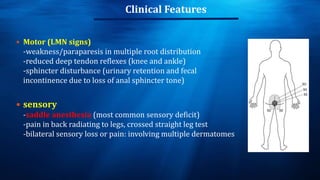
Clinical Features
 Motor (LMN signs)
-weakness/paraparesis in multiple root distribution
-reduced deep tendon reflexes (knee and ankle)
-sphincter disturbance (urinary retention and fecal
incontinence due to loss of anal sphincter tone)
 sensory
-saddle anesthesia (most common sensory deficit)
-pain in back radiating to legs, crossed straight leg test
-bilateral sensory loss or pain: involving multiple dermatomes
Management
 Surgical emergency - requires urgent investigation and
decompression (<48 hrs) to preserve bowel and bladder
function
Take
Home
message
Thank
you

Orthopaedic Emergencies

  • 1.
  • 5.
     Open Fractures Acute Compartment Syndrome  Dislocations  Neurovascular injuries  Septic Joints  Cauda Equina Syndrome
  • 6.
  • 7.
    Open Fractures  Anopen (or compound) fracture occurs when the skin overlying a fracture is broken, allowing communication between the fracture and the external environment.
  • 8.
    Open Fractures- Gustilo-AndersonClassification --Grade I: wound < 1cm – Grade II: wound 1-5 cm without excessive contamination, crush injury or soft tissue loss – Grade III: wound >5cm, or gross contamination, crush injury, or excessive soft tissue loss A – adequate soft tissue coverage B – fracture cover not possible without local /distant flaps C – arterial injury that needs to be repaired.
  • 9.
    Open Fractures- Management ABCDE  Check neurovascular status, fluid resuscitation  Remove large pieces of debris and cover with sterile wet dressing  Immediate parenteral antimicrobials – 1st generation cephalosporin – add aminoglycoside for types ii and iii  Urgent orthopedic consultation  most require irrigation and debridement in OR
  • 11.
    Open Fractures- Complications Wound infection – 2% in Type I , >10% in Type III  Osteomyelitis – staph aureus, pseudomona sp.  Gas gangrene  Tetanus  Non-union/malunion
  • 12.
  • 13.
    Acute Compartment Syndrome #Case  16 yrs old , soccer player  Forearm trauma/deformity  Skin intact  Placed in a long arm splint  Neurovascular examination is normal ** C/O thumb numbness
  • 14.
    Epidemiology  Compartment syndrome(CS) is a serious life and limb threatening complications of extremity trauma  ACS- Etiology:-  Crush injury  Circumferential burns  Snake bites  Fractures – 75%  Tourniquets, constrictive dressings/plasters  Haematoma – pt with coagulopathy at increased risk
  • 15.
  • 16.
    ACS- FINDINGS (5 Ps)of ischaemia  Pain  Paresthesias  Paralysis  Pulselessness  Pallor  Severe pain (out of proportion to injury)  Pain with passive stretch  Tense compartment  Tight, shiny skin Can confirm diagnosis by measuring intracompartmental pressures (Stryker STIC)
  • 17.
    0 mm Hg 10mm Hg 30 mm Hg 60 mm Hg 120 mm Hg Pulse Pressure Ischemia Elevated Pressure Normal Difference between diastolic pressure and compartment pressure (delta pressure)< 30mmHg is indication for immediate decompression
  • 18.
    ACS - Mangement Earlyrecognition Muscle necrosis at delta pressure < 30mm Hg Irreversible injury 4-6 hrs Remove cast, bandages and dressings Arrange urgent fasciotomy
  • 19.
  • 21.
    ACS- Complications Volkman ischaemiccontractures Permanent nerve damage Limb ischaemia and amputation Rhabdomyolysis and renal failure
  • 22.
  • 23.
    JOINT DISLOCATIONS Displacement ofbones at a joint from their normal position Do x-rays before and after reduction to look for any associated fractures
  • 24.
    DISLOCATION- SHOULDER Most commonmajor joint dislocation Anterior (95%) - Usually caused by fall on hand Posterior (2-4%) – Electrocution/seizure May be associated with: Fracture dislocation Rotator cuff tear Neurovascular injury
  • 26.
    DISLOCATION- KNEE  Injuryto popliteal artery and vein is common  Peroneal nerve injury in 20-40% of knee dislocations  Associated with ligamentous injury  Anterior (31%)  Posterior (25%)  Lateral (13%)  Medial (3%)
  • 27.
    DISLOCATION- HIP  Usuallyhigh-energy trauma  More frequent in young patients  Posterior- hip in internal rotation, most common  Anterior- hip in external rotation  Central - acetabular fracture  May result in avascular necrosis of femoral head  Sciatic nerve injury in 10-35%
  • 28.
  • 29.
     Fractures anddislocations  Always check before and after reduction
  • 30.
    Neurovascular Injuries -Etiology  Fracture  Humerus, femur  Dislocation  Elbow, knee  Direct/penetrating trauma  Thrombus  Direct Compression/ Acute Compartment Syndrome  Cast, unconscious
  • 31.
    Common vascular injuries InjuryVessel 1st rib fracture Subclavian artery/vein Shoulder dislocation Axillary artery Humeral supracondylar fracture Brachial artery Elbow Dislocation Brachial artery Pelvic fracture Presacral and internal iliac Femoral supracondylar fracture Femoral artery Knee dislocation Popliteal artery/vein Proximal tibial Popliteal artery/vein
  • 32.
    CLINICAL FEATURES &MX. Paraesthesia/numbness Injured limb cold, cyanosed, pulse weak/absent Call for help!  Remove all bandages and splints  Reduce the fracture/ dislocation and reassess circulation If no improvement then vessels must be explored by operation If vascular injury suspected angiogram should be performed immediately
  • 34.
    Injury Nerve Shoulder dislocationAxillary Humeral shaft fracture Radial Humeral supracondylar fracture Radial or median Elbow medial condyle Ulnar Monteggia fracture-dislocation Posterior-interosseous Hip dislocation Sciatic Knee dislocation Peroneal Common nerve injuries
  • 35.
     Paraesthesia andweakness to supplied area  Closed injuries: nerve seldom severed, 90% recovery in 4 months. If not do nerve conduction studies +/- repair  Open injuries: Nerve injury likely complete. Should be explored at time of debridement/repair  Indications for early exploration:  Nerve injury associated with open fracture  Nerve injury in fracture that needs internal fixation  Presence of concomitant vascular injury  Nerve damage diagnosed after manipulation of fracture Clinical Features & Mx
  • 36.
  • 37.
    SEPTIC JOINT/SEPTIC ARTHRITIS Inflammationof a synovial membrane with purulent effusion into the joint capsule. Followed by articular cartilage erosion by bacterial and cellular enzymes. Usually monoarticular Usually bacterial Staph aureus Streptococcus Neisseria gonorrhoeae
  • 38.
    SEPTIC JOINT- ETIOLOGY Directinvasion through penetrating wound, intra- articular injection, arthroscopy Direct spread from adjacent bone abcess Blood spread from distant site
  • 39.
    SEPTIC JOINT- LOCATION Knee-40-50% Hip- 20-25%* *Hip is the most common in infants and very young children Wrist- 10% Shoulder, ankle, elbow- 10-15%
  • 40.
    SEPTIC JOINT- RISKFACTORS Prosthetic joint Joint surgery Rheumatoid arthritis Elderly Diabetes Mellitus IV drug use Immunosupression AIDS
  • 41.
     Rapid onset Joint pain  Joint swelling  Joint warmth  Joint erythema  Decreased range of motion  Pain with active and passive ROM  Fever, raised WCC/CRP, positive blood cultures Septic Joint- Signs and Symptoms
  • 42.
    Septic Joint- Diagnosis Diagnosisby aspiration Gram stain, microscopy, culture Leucocytes >50 000/ml highly suggestive of sepsis
  • 43.
  • 44.
     Joint washoutin theatre  IV Abx 4-7 days then orally for another 3 weeks  Analgesia  Splintage Septic Joint- Treatment
  • 45.
    Septic Joint- Complications Rapid destruction of joint with delayed treatment (>24 hours)  Growth retardation, deformity of joint (children)  Degenerative joint disease  Osteomyelitis  Joint fibrosis and ankylosing  Sepsis  Death
  • 46.
  • 47.
    CAUDA EQUINA SYNDROME Compressionof lumbosacral nerve roots below conus medullaris secondary to large central herniated disc/extrinsic mass/infection/trauma
  • 48.
    Clinical Features  Motor(LMN signs) -weakness/paraparesis in multiple root distribution -reduced deep tendon reflexes (knee and ankle) -sphincter disturbance (urinary retention and fecal incontinence due to loss of anal sphincter tone)  sensory -saddle anesthesia (most common sensory deficit) -pain in back radiating to legs, crossed straight leg test -bilateral sensory loss or pain: involving multiple dermatomes
  • 49.
    Management  Surgical emergency- requires urgent investigation and decompression (<48 hrs) to preserve bowel and bladder function
  • 50.
  • 51.