Direct & Indirect Variation
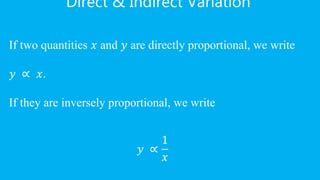
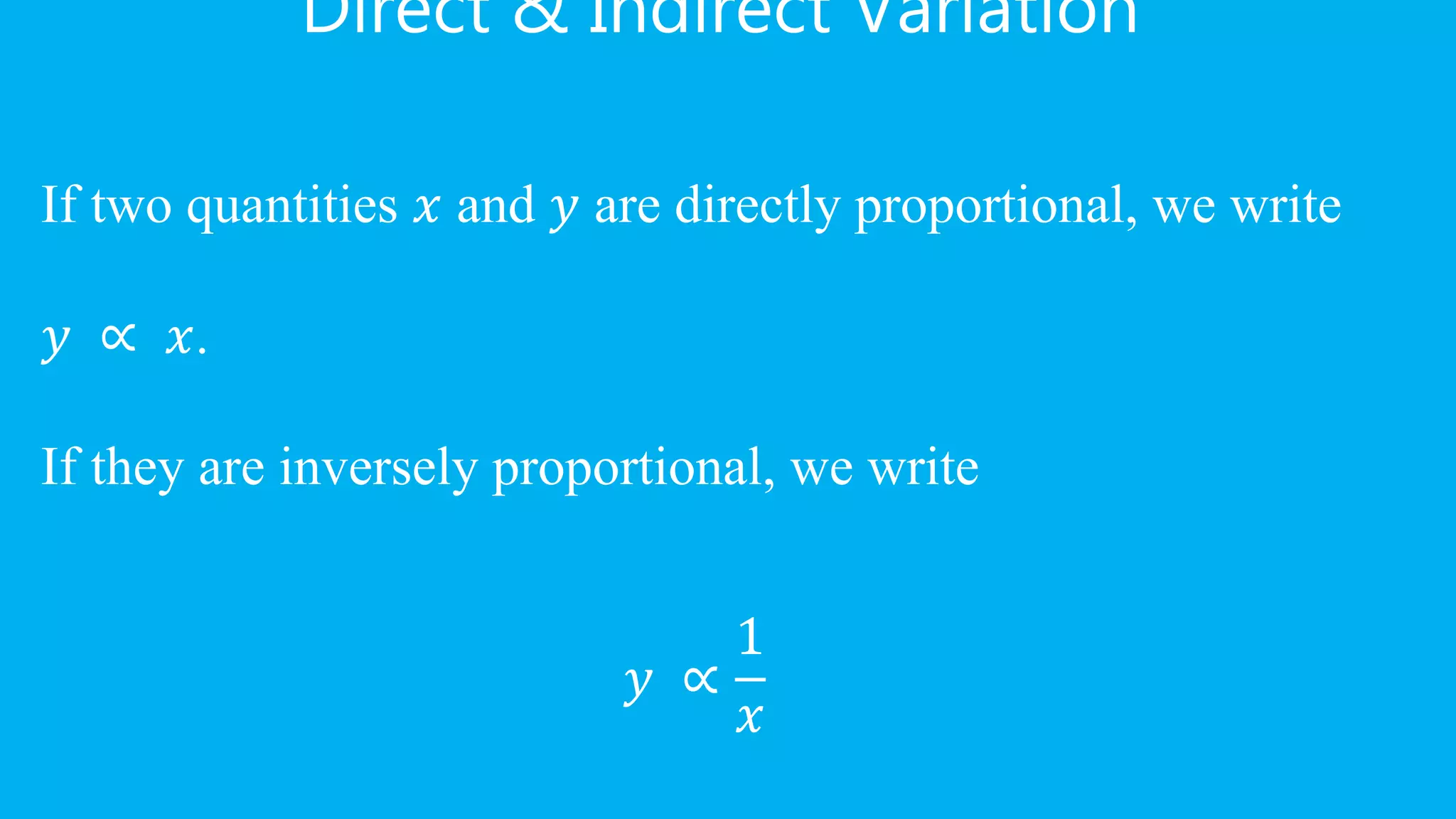
If two quantities 𝑥 and 𝑦 are directly proportional, we write
𝑦 ∝ 𝑥.
If they are inversely proportional, we write
𝑦 ∝
1
𝑥
Joint Variation
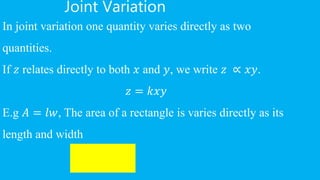
In joint variation one quantity varies directly as two
quantities.
If 𝑧 relates directly to both 𝑥 and 𝑦, we write 𝑧 ∝ 𝑥𝑦.
𝑧 = 𝑘𝑥𝑦
E.g 𝐴 = 𝑙𝑤, The area of a rectangle is varies directly as its
length and width
Partial Variation
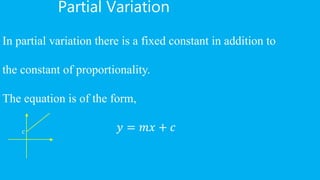
In partial variation there is a fixed constant in addition to
the constant of proportionality.
The equation is of the form,
𝑦 = 𝑚𝑥 + 𝑐𝑐
Solution
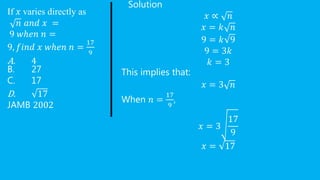
𝑥 ∝ 𝑛
𝑥 = 𝑘 𝑛
9 = 𝑘 9
9 = 3𝑘
𝑘 = 3
This implies that:
𝑥 = 3 𝑛
When 𝑛 =
17
9
,
𝑥 = 3
17
9
𝑥 = 17
If 𝑥 varies directly as
𝑛 𝑎𝑛𝑑 𝑥 =
9 𝑤ℎ𝑒𝑛 𝑛 =
9, 𝑓𝑖𝑛𝑑 𝑥 𝑤ℎ𝑒𝑛 𝑛 =
17
9
A. 4
B. 27
C. 17
D. 17
JAMB 2002
Solution
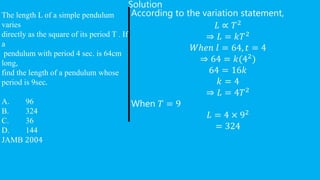
According to the variation statement,
𝐿 ∝ 𝑇2
⇒ 𝐿 = 𝑘𝑇2
𝑊ℎ𝑒𝑛 𝑙 = 64, 𝑡 = 4
⇒ 64 = 𝑘(42)
64 = 16𝑘
𝑘 = 4
⇒ 𝐿 = 4𝑇2
When 𝑇 = 9
𝐿 = 4 × 92
= 324
The length L of a simple pendulum
varies
directly as the square of its period T . If
a
pendulum with period 4 sec. is 64cm
long,
find the length of a pendulum whose
period is 9sec.
A. 96
B. 324
C. 36
D. 144
JAMB 2004
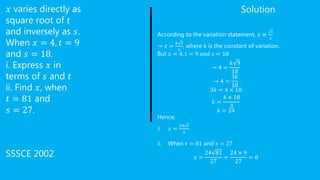
𝑥 varies directly as
square root of 𝑡
and inversely as 𝑠.
When 𝑥 = 4, 𝑡 = 9
and 𝑠 = 18.
i. Express 𝑥 in
terms of 𝑠 and 𝑡
ii. Find 𝑥, when
𝑡 = 81 and
𝑠 = 27.
SSSCE 2002
Solution
According to the variation statement, 𝑥 ∝
𝑡
𝑠
→ 𝑥 =
𝑘 𝑡
𝑠
, where k is the constant of variation.
But 𝑥 = 4, 𝑡 = 9 𝑎𝑛𝑑 𝑠 = 18
→ 4 =
𝑘 9
18
→ 4 =
3𝑘
18
3𝑘 = 4 × 18
𝑘 =
4 × 18
3
𝑘 = 24
Hence,
i. 𝑥 =
24 𝑡
𝑠
ii. When 𝑡 = 81 and 𝑠 = 27
𝑥 =
24 81
27
=
24 × 9
27
= 8
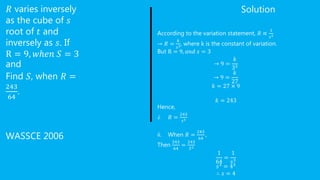
𝑅 varies inversely
as the cube of 𝑠
root of 𝑡 and
inversely as 𝑠. If
R = 9, 𝑤ℎ𝑒𝑛 𝑆 = 3
and
Find 𝑆, when 𝑅 =
243
64
.
WASSCE 2006
Solution
According to the variation statement, 𝑅 ∝
1
𝑠3
→ 𝑅 =
𝑘
𝑠3, where k is the constant of variation.
But R = 9, 𝑎𝑛𝑑 𝑠 = 3
→ 9 =
𝑘
33
→ 9 =
𝑘
27
𝑘 = 27 × 9
𝑘 = 243
Hence,
i. 𝑅 =
243
𝑠3
ii. When 𝑅 =
243
64
,
Then
243
64
=
243
𝑆3
1
64
=
1
𝑠3
𝑠3
= 43
∴ 𝑠 = 4
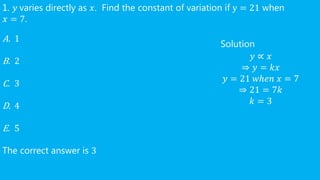
1. 𝑦 varies directly as 𝑥. Find the constant of variation if y = 21 when
𝑥 = 7.
A. 1
B. 2
C. 3
D. 4
E. 5
The correct answer is 3
Solution
𝑦 ∝ 𝑥
⇒ 𝑦 = 𝑘𝑥
𝑦 = 21 𝑤ℎ𝑒𝑛 𝑥 = 7
⇒ 21 = 7𝑘
𝑘 = 3
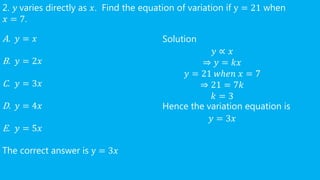
2. 𝑦 varies directly as 𝑥. Find the equation of variation if y = 21 when
𝑥 = 7.
A. 𝑦 = 𝑥
B. 𝑦 = 2𝑥
C. 𝑦 = 3𝑥
D. 𝑦 = 4𝑥
E. 𝑦 = 5𝑥
The correct answer is y = 3𝑥
Solution
𝑦 ∝ 𝑥
⇒ 𝑦 = 𝑘𝑥
𝑦 = 21 𝑤ℎ𝑒𝑛 𝑥 = 7
⇒ 21 = 7𝑘
𝑘 = 3
Hence the variation equation is
𝑦 = 3𝑥
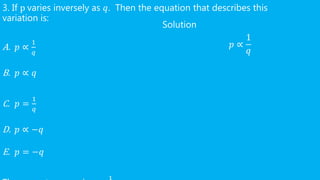
3. If p varies inversely as 𝑞. Then the equation that describes this
variation is:
A. 𝑝 ∝
1
𝑞
B. 𝑝 ∝ 𝑞
C. 𝑝 =
1
𝑞
D. 𝑝 ∝ −𝑞
E. 𝑝 = −𝑞
Solution
𝑝 ∝
1
𝑞
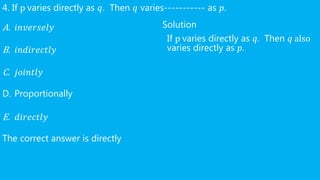
4. If p varies directly as 𝑞. Then 𝑞 varies----------- as 𝑝.
A. 𝑖𝑛𝑣𝑒𝑟𝑠𝑒𝑙𝑦
B. 𝑖𝑛𝑑𝑖𝑟𝑒𝑐𝑡𝑙𝑦
C. 𝑗𝑜𝑖𝑛𝑡𝑙𝑦
D. Proportionally
E. 𝑑𝑖𝑟𝑒𝑐𝑡𝑙𝑦
The correct answer is directly
Solution
If p varies directly as 𝑞. Then 𝑞 also
varies directly as 𝑝.
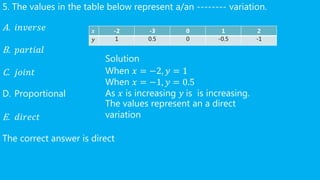
5. The values in the table below represent a/an -------- variation.
A. 𝑖𝑛𝑣𝑒𝑟𝑠𝑒
B. 𝑝𝑎𝑟𝑡𝑖𝑎𝑙
C. 𝑗𝑜𝑖𝑛𝑡
D. Proportional
E. 𝑑𝑖𝑟𝑒𝑐𝑡
The correct answer is direct
Solution
When 𝑥 = −2, 𝑦 = 1
When 𝑥 = −1, 𝑦 = 0.5
As 𝑥 is increasing 𝑦 is is increasing.
The values represent an a direct
variation
𝒙 -2 -3 0 1 2
𝑦 1 0.5 0 -0.5 -1
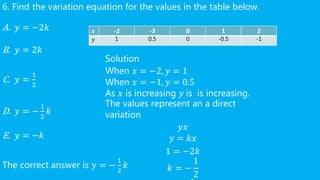
6. Find the variation equation for the values in the table below.
A. 𝑦 = −2𝑘
B. 𝑦 = 2𝑘
C. 𝑦 =
1
2
D. 𝑦 = −
1
2
𝑘
E. 𝑦 = −𝑘
The correct answer is 𝑦 = −
1
2
𝑘
Solution
When 𝑥 = −2, 𝑦 = 1
When 𝑥 = −1, 𝑦 = 0.5
As 𝑥 is increasing 𝑦 is is increasing.
The values represent an a direct
variation
𝑦𝑥
𝑦 = 𝑘𝑥
1 = −2𝑘
𝑘 = −
1
2
𝒙 -2 -3 0 1 2
𝑦 1 0.5 0 -0.5 -1
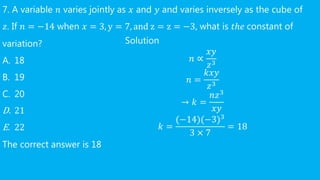
7. A variable 𝑛 varies jointly as 𝑥 and 𝑦 and varies inversely as the cube of
𝑧. If 𝑛 = −14 when 𝑥 = 3, y = 7, and z = z = −3, what is 𝑡ℎ𝑒 constant of
variation?
A. 18
B. 19
C. 20
D. 21
E. 22
The correct answer is 18
Solution
𝑛 ∝
𝑥𝑦
𝑧3
𝑛 =
𝑘𝑥𝑦
𝑧3
→ 𝑘 =
𝑛𝑧3
𝑥𝑦
𝑘 =
(−14)(−3)3
3 × 7
= 18
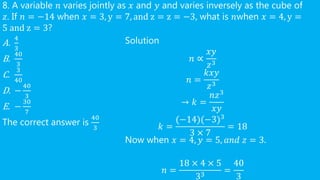
8. A variable 𝑛 varies jointly as 𝑥 and 𝑦 and varies inversely as the cube of
𝑧. If 𝑛 = −14 when 𝑥 = 3, y = 7, and z = z = −3, what is 𝑛when 𝑥 = 4, y =
5 and z = 3?
A.
4
3
B.
40
3
C.
3
40
D. −
40
3
E. −
30
7
The correct answer is
40
3
Solution
𝑛 ∝
𝑥𝑦
𝑧3
𝑛 =
𝑘𝑥𝑦
𝑧3
→ 𝑘 =
𝑛𝑧3
𝑥𝑦
𝑘 =
(−14)(−3)3
3 × 7
= 18
Now when 𝑥 = 4, 𝑦 = 5, 𝑎𝑛𝑑 𝑧 = 3.
𝑛 =
18 × 4 × 5
33
=
40
3
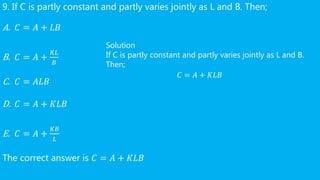
9. If C is partly constant and partly varies jointly as L and B. Then;
A. 𝐶 = 𝐴 + 𝐿𝐵
B. 𝐶 = 𝐴 +
𝐾𝐿
𝐵
C. 𝐶 = 𝐴𝐿𝐵
D. 𝐶 = 𝐴 + 𝐾𝐿𝐵
E. 𝐶 = 𝐴 +
𝐾𝐵
𝐿
The correct answer is 𝐶 = 𝐴 + 𝐾𝐿𝐵
Solution
If C is partly constant and partly varies jointly as L and B.
Then;
𝐶 = 𝐴 + 𝐾𝐿𝐵
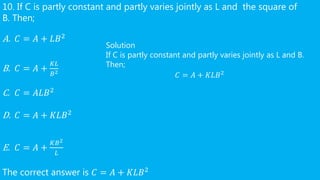
10. If C is partly constant and partly varies jointly as L and the square of
B. Then;
A. 𝐶 = 𝐴 + 𝐿𝐵2
B. 𝐶 = 𝐴 +
𝐾𝐿
𝐵2
C. 𝐶 = 𝐴𝐿𝐵2
D. 𝐶 = 𝐴 + 𝐾𝐿𝐵2
E. 𝐶 = 𝐴 +
𝐾𝐵2
𝐿
The correct answer is 𝐶 = 𝐴 + 𝐾𝐿𝐵2
Solution
If C is partly constant and partly varies jointly as L and B.
Then;
𝐶 = 𝐴 + 𝐾𝐿𝐵2
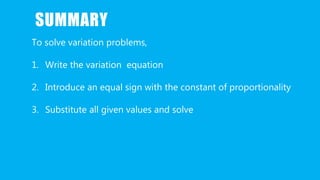
SUMMARY
To solve variation problems,
1. Write the variation equation
2. Introduce an equal sign with the constant of proportionality
3. Substitute all given values and solve

Variation revision card

  • 1.
    Direct & IndirectVariation If two quantities 𝑥 and 𝑦 are directly proportional, we write 𝑦 ∝ 𝑥. If they are inversely proportional, we write 𝑦 ∝ 1 𝑥
  • 2.
    Joint Variation In jointvariation one quantity varies directly as two quantities. If 𝑧 relates directly to both 𝑥 and 𝑦, we write 𝑧 ∝ 𝑥𝑦. 𝑧 = 𝑘𝑥𝑦 E.g 𝐴 = 𝑙𝑤, The area of a rectangle is varies directly as its length and width
  • 3.
    Partial Variation In partialvariation there is a fixed constant in addition to the constant of proportionality. The equation is of the form, 𝑦 = 𝑚𝑥 + 𝑐𝑐
  • 4.
    Solution 𝑥 ∝ 𝑛 𝑥= 𝑘 𝑛 9 = 𝑘 9 9 = 3𝑘 𝑘 = 3 This implies that: 𝑥 = 3 𝑛 When 𝑛 = 17 9 , 𝑥 = 3 17 9 𝑥 = 17 If 𝑥 varies directly as 𝑛 𝑎𝑛𝑑 𝑥 = 9 𝑤ℎ𝑒𝑛 𝑛 = 9, 𝑓𝑖𝑛𝑑 𝑥 𝑤ℎ𝑒𝑛 𝑛 = 17 9 A. 4 B. 27 C. 17 D. 17 JAMB 2002
  • 5.
    Solution According to thevariation statement, 𝐿 ∝ 𝑇2 ⇒ 𝐿 = 𝑘𝑇2 𝑊ℎ𝑒𝑛 𝑙 = 64, 𝑡 = 4 ⇒ 64 = 𝑘(42) 64 = 16𝑘 𝑘 = 4 ⇒ 𝐿 = 4𝑇2 When 𝑇 = 9 𝐿 = 4 × 92 = 324 The length L of a simple pendulum varies directly as the square of its period T . If a pendulum with period 4 sec. is 64cm long, find the length of a pendulum whose period is 9sec. A. 96 B. 324 C. 36 D. 144 JAMB 2004
  • 6.
    𝑥 varies directlyas square root of 𝑡 and inversely as 𝑠. When 𝑥 = 4, 𝑡 = 9 and 𝑠 = 18. i. Express 𝑥 in terms of 𝑠 and 𝑡 ii. Find 𝑥, when 𝑡 = 81 and 𝑠 = 27. SSSCE 2002 Solution According to the variation statement, 𝑥 ∝ 𝑡 𝑠 → 𝑥 = 𝑘 𝑡 𝑠 , where k is the constant of variation. But 𝑥 = 4, 𝑡 = 9 𝑎𝑛𝑑 𝑠 = 18 → 4 = 𝑘 9 18 → 4 = 3𝑘 18 3𝑘 = 4 × 18 𝑘 = 4 × 18 3 𝑘 = 24 Hence, i. 𝑥 = 24 𝑡 𝑠 ii. When 𝑡 = 81 and 𝑠 = 27 𝑥 = 24 81 27 = 24 × 9 27 = 8
  • 7.
    𝑅 varies inversely asthe cube of 𝑠 root of 𝑡 and inversely as 𝑠. If R = 9, 𝑤ℎ𝑒𝑛 𝑆 = 3 and Find 𝑆, when 𝑅 = 243 64 . WASSCE 2006 Solution According to the variation statement, 𝑅 ∝ 1 𝑠3 → 𝑅 = 𝑘 𝑠3, where k is the constant of variation. But R = 9, 𝑎𝑛𝑑 𝑠 = 3 → 9 = 𝑘 33 → 9 = 𝑘 27 𝑘 = 27 × 9 𝑘 = 243 Hence, i. 𝑅 = 243 𝑠3 ii. When 𝑅 = 243 64 , Then 243 64 = 243 𝑆3 1 64 = 1 𝑠3 𝑠3 = 43 ∴ 𝑠 = 4
  • 8.
    1. 𝑦 variesdirectly as 𝑥. Find the constant of variation if y = 21 when 𝑥 = 7. A. 1 B. 2 C. 3 D. 4 E. 5 The correct answer is 3 Solution 𝑦 ∝ 𝑥 ⇒ 𝑦 = 𝑘𝑥 𝑦 = 21 𝑤ℎ𝑒𝑛 𝑥 = 7 ⇒ 21 = 7𝑘 𝑘 = 3
  • 9.
    2. 𝑦 variesdirectly as 𝑥. Find the equation of variation if y = 21 when 𝑥 = 7. A. 𝑦 = 𝑥 B. 𝑦 = 2𝑥 C. 𝑦 = 3𝑥 D. 𝑦 = 4𝑥 E. 𝑦 = 5𝑥 The correct answer is y = 3𝑥 Solution 𝑦 ∝ 𝑥 ⇒ 𝑦 = 𝑘𝑥 𝑦 = 21 𝑤ℎ𝑒𝑛 𝑥 = 7 ⇒ 21 = 7𝑘 𝑘 = 3 Hence the variation equation is 𝑦 = 3𝑥
  • 10.
    3. If pvaries inversely as 𝑞. Then the equation that describes this variation is: A. 𝑝 ∝ 1 𝑞 B. 𝑝 ∝ 𝑞 C. 𝑝 = 1 𝑞 D. 𝑝 ∝ −𝑞 E. 𝑝 = −𝑞 Solution 𝑝 ∝ 1 𝑞
  • 11.
    4. If pvaries directly as 𝑞. Then 𝑞 varies----------- as 𝑝. A. 𝑖𝑛𝑣𝑒𝑟𝑠𝑒𝑙𝑦 B. 𝑖𝑛𝑑𝑖𝑟𝑒𝑐𝑡𝑙𝑦 C. 𝑗𝑜𝑖𝑛𝑡𝑙𝑦 D. Proportionally E. 𝑑𝑖𝑟𝑒𝑐𝑡𝑙𝑦 The correct answer is directly Solution If p varies directly as 𝑞. Then 𝑞 also varies directly as 𝑝.
  • 12.
    5. The valuesin the table below represent a/an -------- variation. A. 𝑖𝑛𝑣𝑒𝑟𝑠𝑒 B. 𝑝𝑎𝑟𝑡𝑖𝑎𝑙 C. 𝑗𝑜𝑖𝑛𝑡 D. Proportional E. 𝑑𝑖𝑟𝑒𝑐𝑡 The correct answer is direct Solution When 𝑥 = −2, 𝑦 = 1 When 𝑥 = −1, 𝑦 = 0.5 As 𝑥 is increasing 𝑦 is is increasing. The values represent an a direct variation 𝒙 -2 -3 0 1 2 𝑦 1 0.5 0 -0.5 -1
  • 13.
    6. Find thevariation equation for the values in the table below. A. 𝑦 = −2𝑘 B. 𝑦 = 2𝑘 C. 𝑦 = 1 2 D. 𝑦 = − 1 2 𝑘 E. 𝑦 = −𝑘 The correct answer is 𝑦 = − 1 2 𝑘 Solution When 𝑥 = −2, 𝑦 = 1 When 𝑥 = −1, 𝑦 = 0.5 As 𝑥 is increasing 𝑦 is is increasing. The values represent an a direct variation 𝑦𝑥 𝑦 = 𝑘𝑥 1 = −2𝑘 𝑘 = − 1 2 𝒙 -2 -3 0 1 2 𝑦 1 0.5 0 -0.5 -1
  • 14.
    7. A variable𝑛 varies jointly as 𝑥 and 𝑦 and varies inversely as the cube of 𝑧. If 𝑛 = −14 when 𝑥 = 3, y = 7, and z = z = −3, what is 𝑡ℎ𝑒 constant of variation? A. 18 B. 19 C. 20 D. 21 E. 22 The correct answer is 18 Solution 𝑛 ∝ 𝑥𝑦 𝑧3 𝑛 = 𝑘𝑥𝑦 𝑧3 → 𝑘 = 𝑛𝑧3 𝑥𝑦 𝑘 = (−14)(−3)3 3 × 7 = 18
  • 15.
    8. A variable𝑛 varies jointly as 𝑥 and 𝑦 and varies inversely as the cube of 𝑧. If 𝑛 = −14 when 𝑥 = 3, y = 7, and z = z = −3, what is 𝑛when 𝑥 = 4, y = 5 and z = 3? A. 4 3 B. 40 3 C. 3 40 D. − 40 3 E. − 30 7 The correct answer is 40 3 Solution 𝑛 ∝ 𝑥𝑦 𝑧3 𝑛 = 𝑘𝑥𝑦 𝑧3 → 𝑘 = 𝑛𝑧3 𝑥𝑦 𝑘 = (−14)(−3)3 3 × 7 = 18 Now when 𝑥 = 4, 𝑦 = 5, 𝑎𝑛𝑑 𝑧 = 3. 𝑛 = 18 × 4 × 5 33 = 40 3
  • 16.
    9. If Cis partly constant and partly varies jointly as L and B. Then; A. 𝐶 = 𝐴 + 𝐿𝐵 B. 𝐶 = 𝐴 + 𝐾𝐿 𝐵 C. 𝐶 = 𝐴𝐿𝐵 D. 𝐶 = 𝐴 + 𝐾𝐿𝐵 E. 𝐶 = 𝐴 + 𝐾𝐵 𝐿 The correct answer is 𝐶 = 𝐴 + 𝐾𝐿𝐵 Solution If C is partly constant and partly varies jointly as L and B. Then; 𝐶 = 𝐴 + 𝐾𝐿𝐵
  • 17.
    10. If Cis partly constant and partly varies jointly as L and the square of B. Then; A. 𝐶 = 𝐴 + 𝐿𝐵2 B. 𝐶 = 𝐴 + 𝐾𝐿 𝐵2 C. 𝐶 = 𝐴𝐿𝐵2 D. 𝐶 = 𝐴 + 𝐾𝐿𝐵2 E. 𝐶 = 𝐴 + 𝐾𝐵2 𝐿 The correct answer is 𝐶 = 𝐴 + 𝐾𝐿𝐵2 Solution If C is partly constant and partly varies jointly as L and B. Then; 𝐶 = 𝐴 + 𝐾𝐿𝐵2
  • 18.
    SUMMARY To solve variationproblems, 1. Write the variation equation 2. Introduce an equal sign with the constant of proportionality 3. Substitute all given values and solve