Quarter 2 – Module 2 Solving
Problems Involving Variation
M9AL-IIb-c-1
Objectives:
1.Translate the given statements into equations.
2. Solve Problems involving variations.
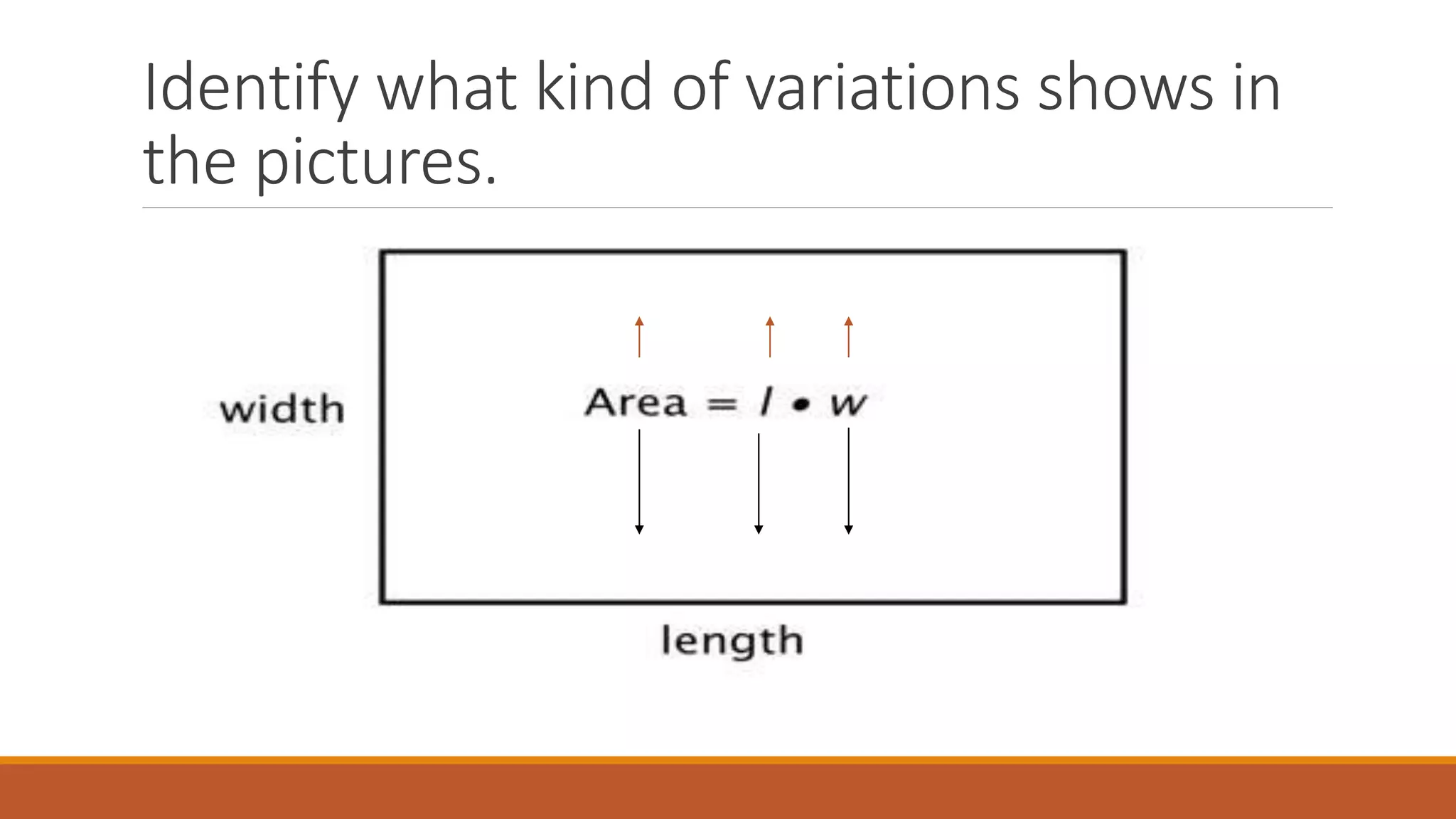
Identify what kind of variations shows in
the pictures.
Identify what kind of variations shows in
the pictures.
Identify what kind of variations shows in
the pictures.
Identify what kind of variations shows in
the pictures.
Identify what kind of variations shows in
the pictures.
Identify what kind of variations shows in
the pictures.
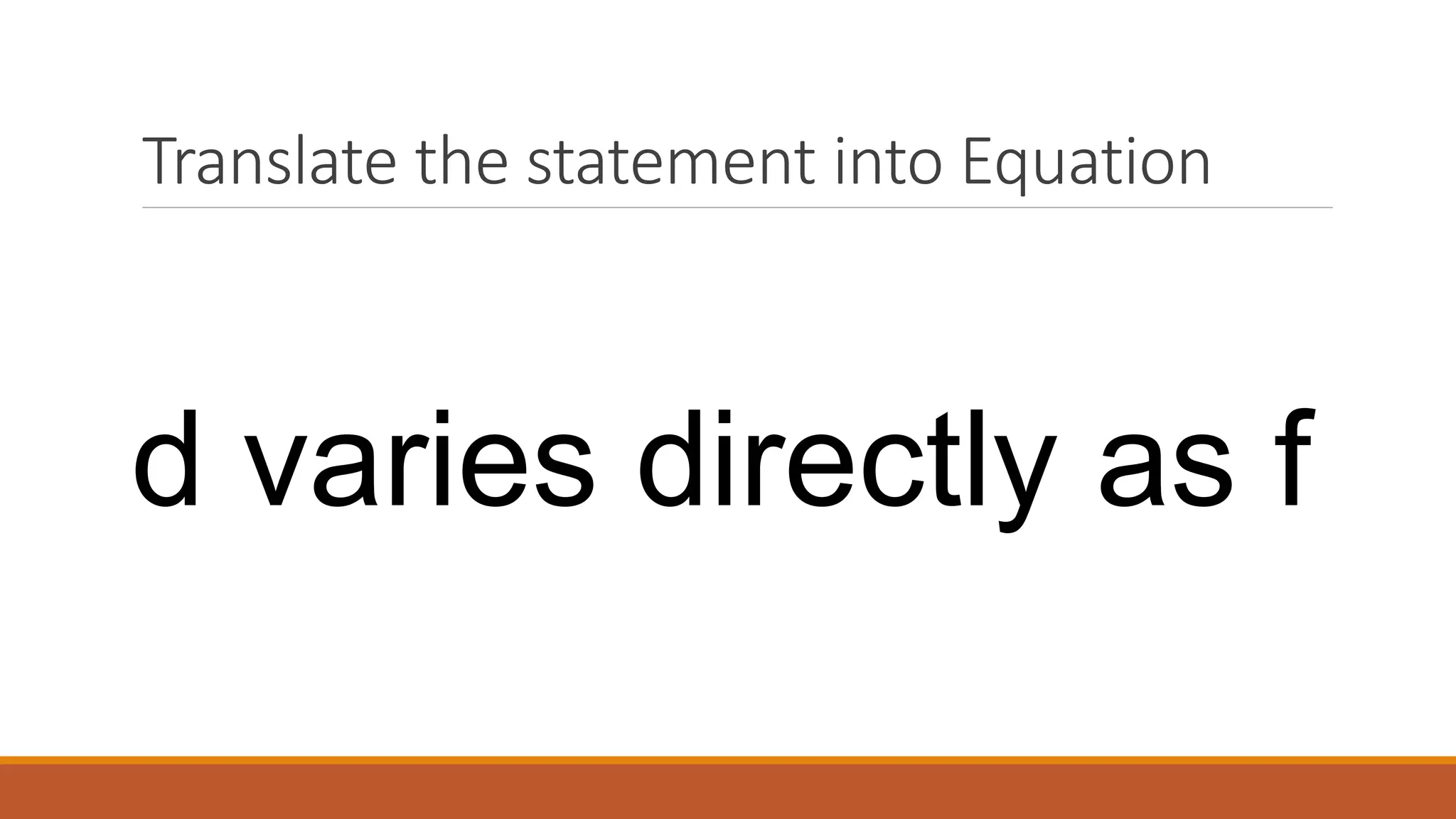
Translate the statement into Equation
d varies directly as f
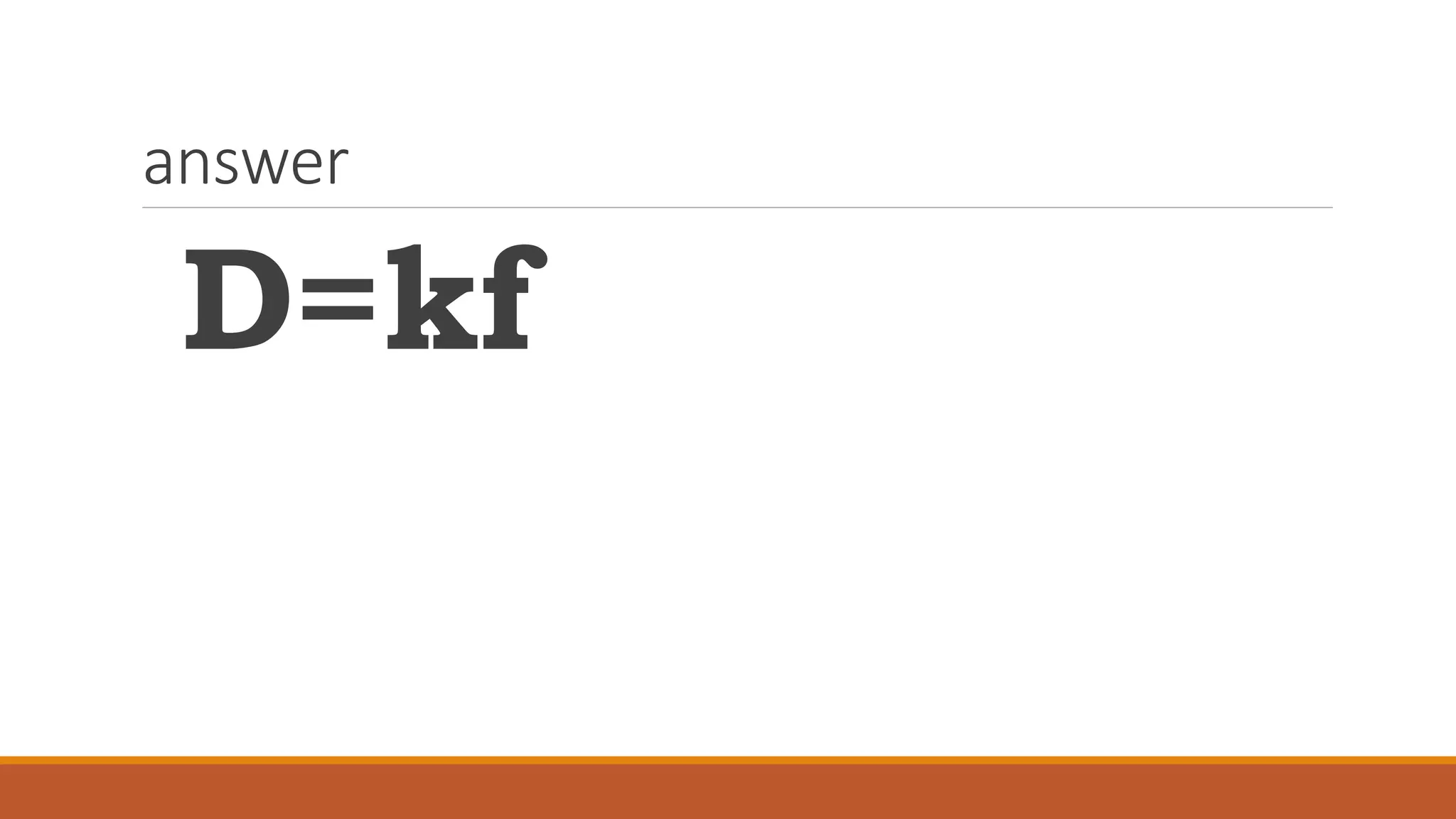
answer
D=kf
Translate the statement into Equation
z varies jointly as x and y
answer
Z=kxy
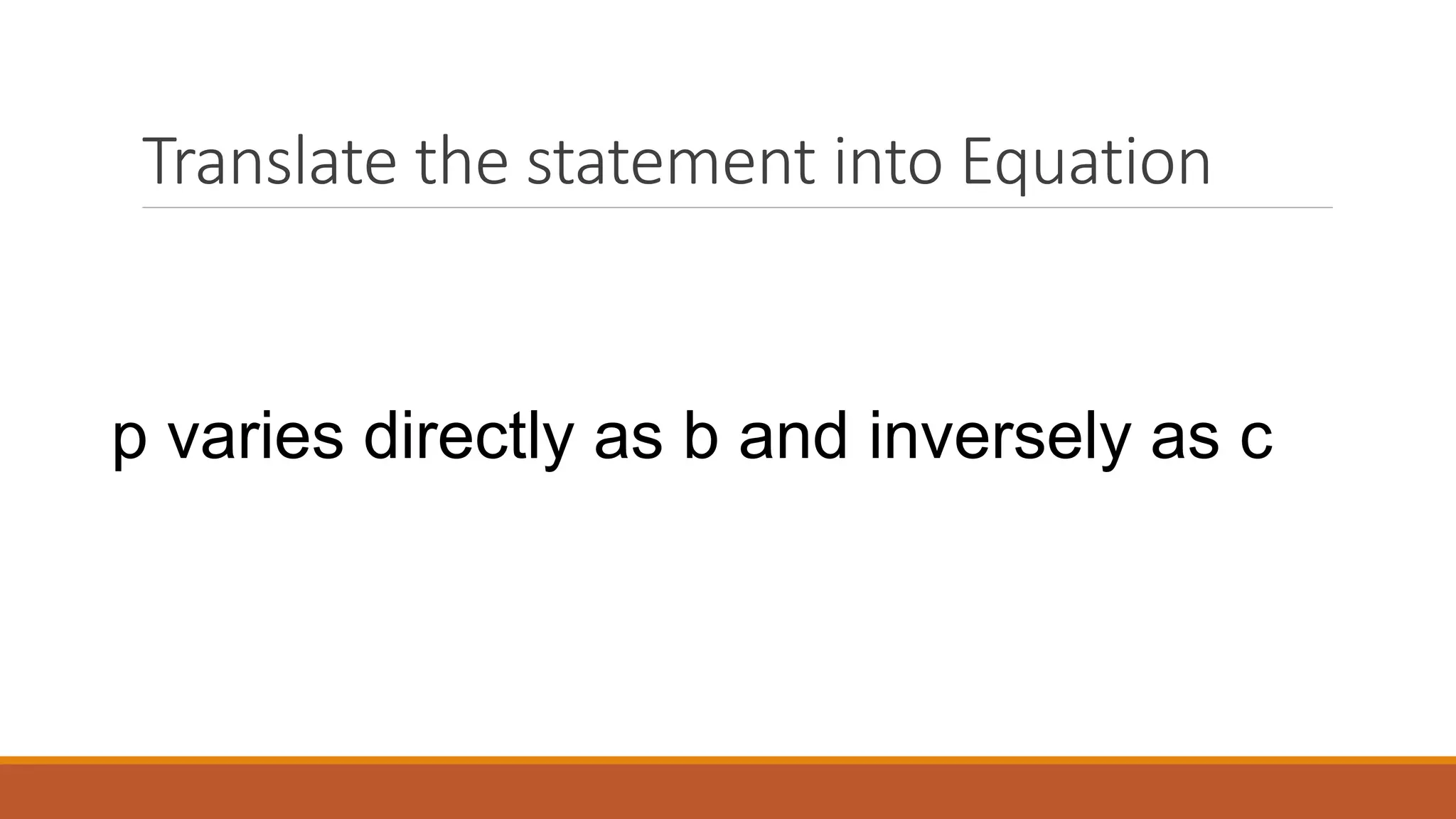
Translate the statement into Equation
p varies directly as b and inversely as c
answer
P=
𝑘𝑏
𝑐
Translate the statement into Equation
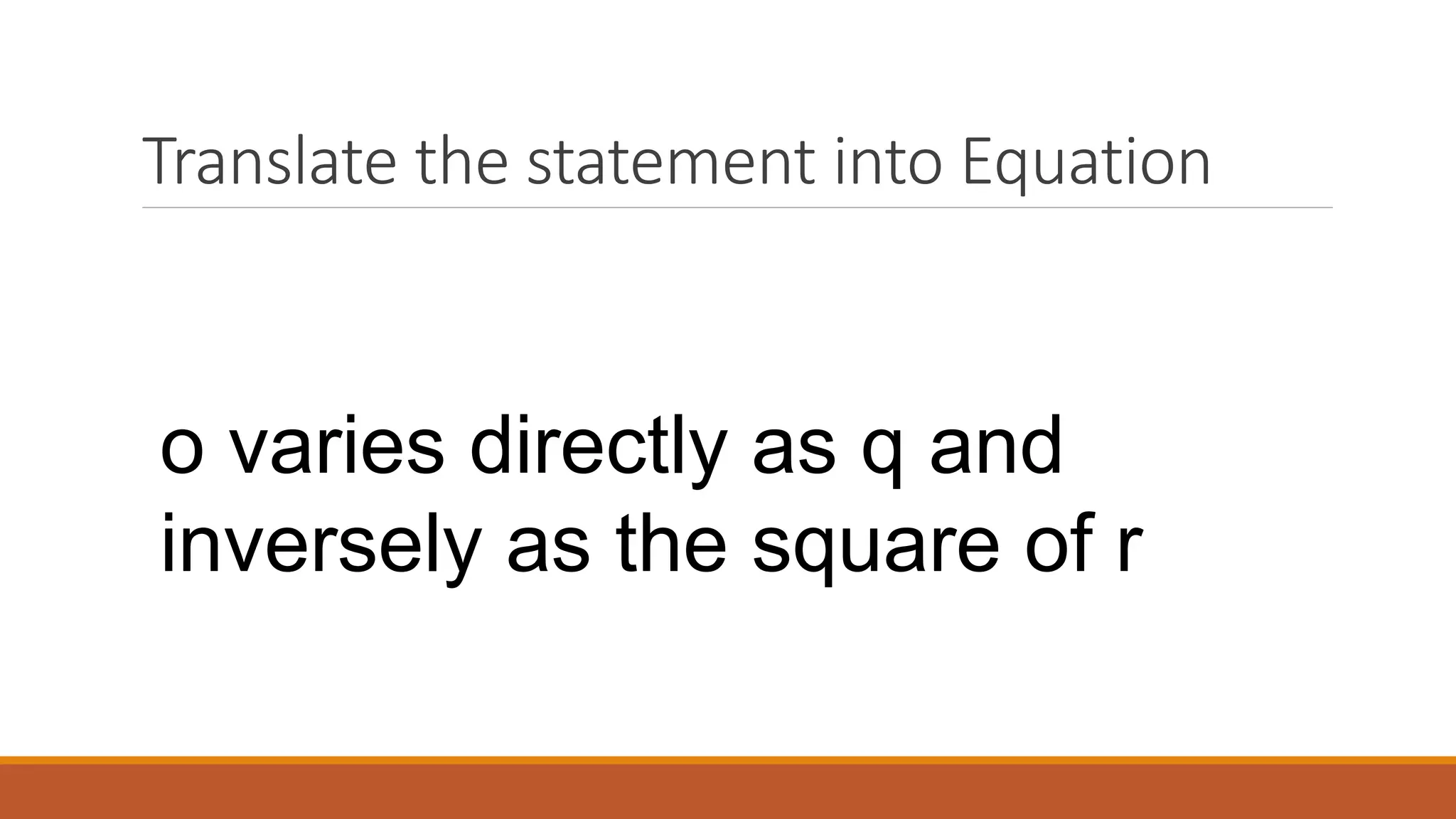
o varies directly as q and
inversely as the square of r
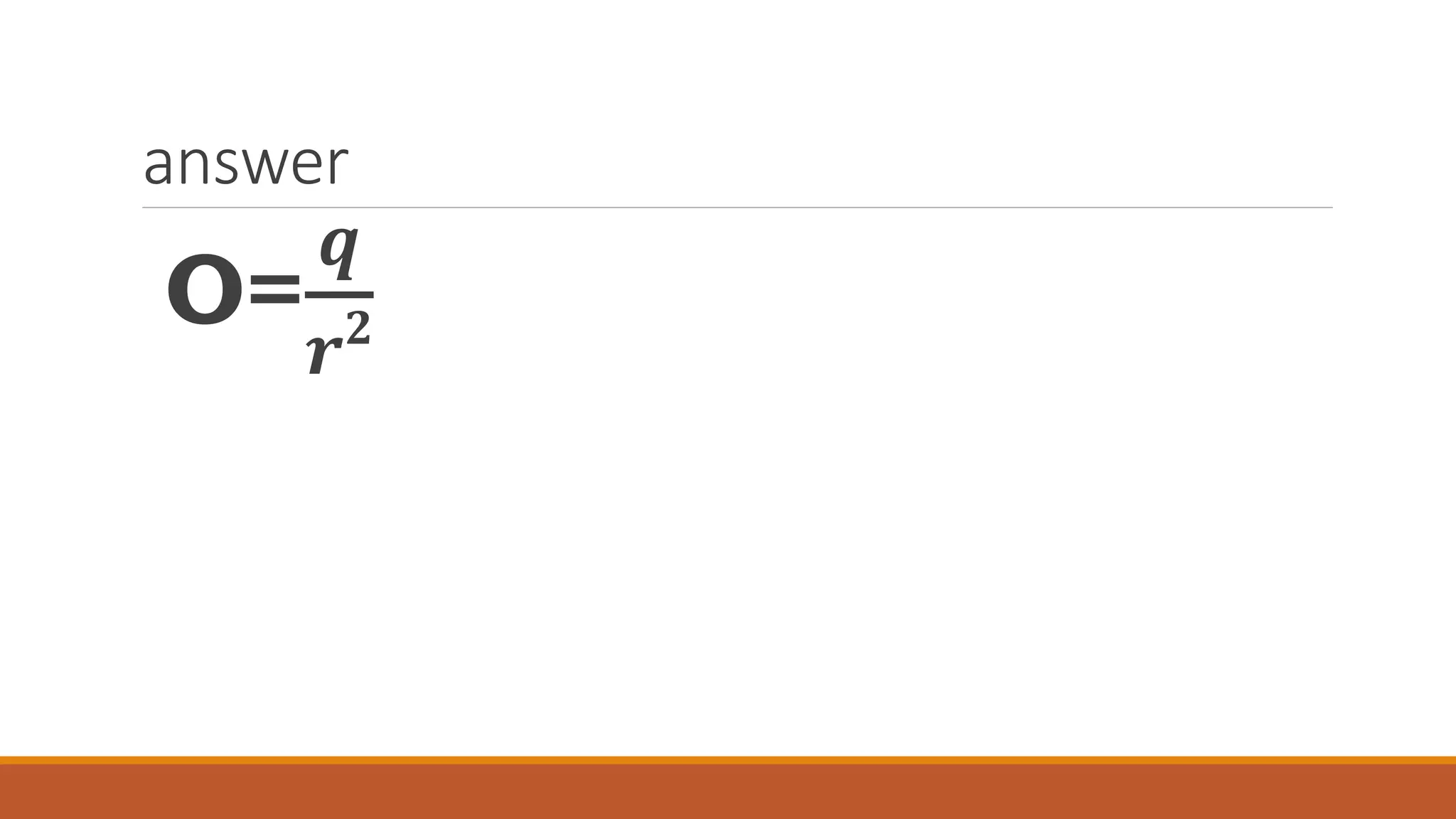
answer
O=
𝒒
𝒓𝟐
Translate the statement into Equation
v varies jointly as l, w, and h
answer
V=klwh
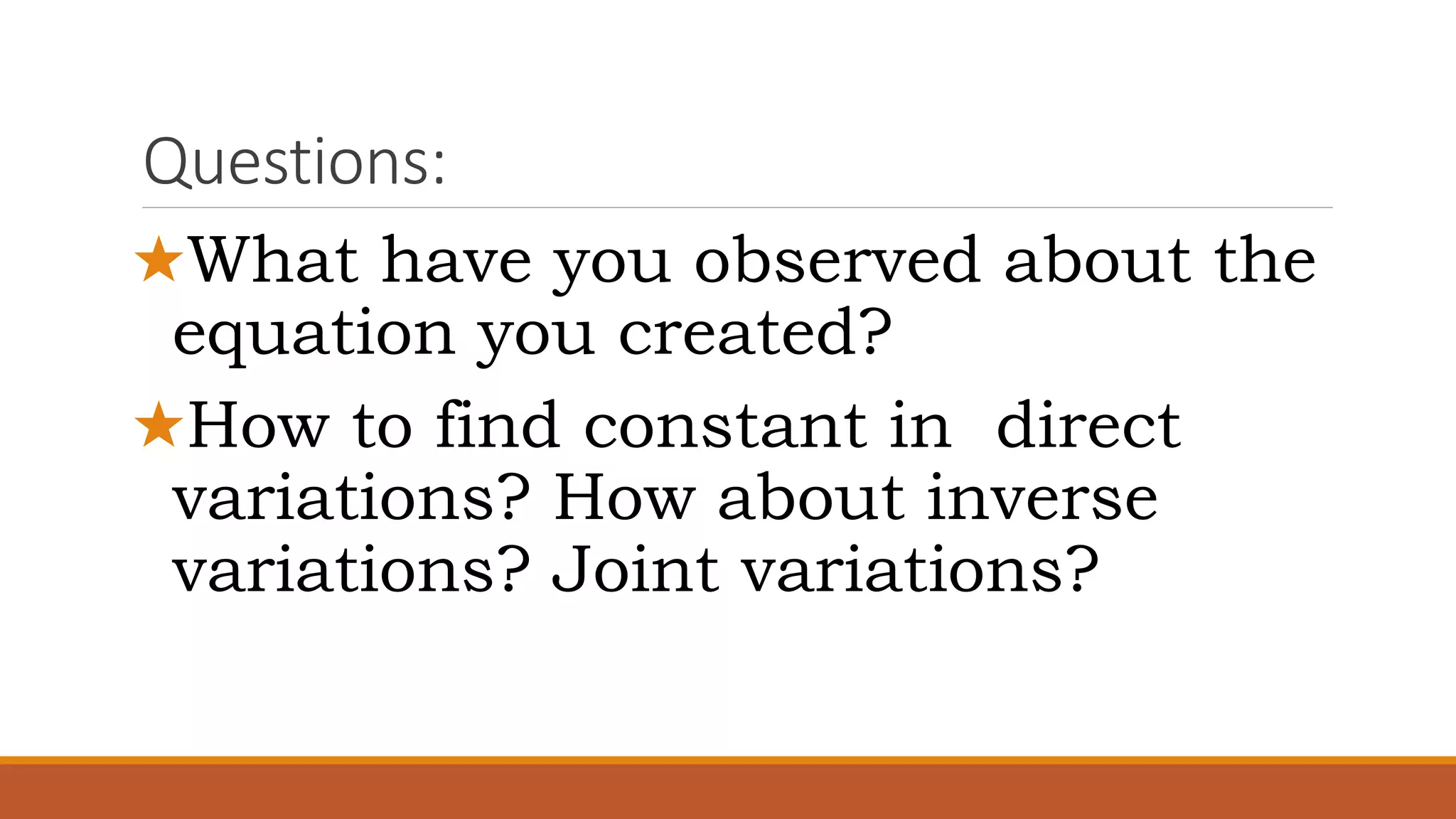
Questions:
★What have you observed about the
equation you created?
★How to find constant in direct
variations? How about inverse
variations? Joint variations?
Direct variations
Direct variations whenever a situation produces pairs of numbers in which
their ratio is constant .
The statements: “y varies directly as x”
“y is directly proportional to x”
and “y is proportional to x”
May be translated mathematically as y=kx, where k is the constant of variation.
For two quantities, x and y, an increase in x causes an increase in y as well.
Similarly, a decrease in x causes a decrease in y.
Example 1:
The table below shows that the distance d varies directly as the time t. Find the
constant of variation and the equation which describes the relation.
Since the distance d varies directly as the time t, then d=kt. Using one of the pairs of
values, (2,20), from the table, substitute the values of d and t in d = kt and solve for k.
d = kt write the equation involving d and t 20=2k substitute the given values in the
equation K= solve for k K=10
Find the distance if he/she travelled in 8hours?
Example 2:
If y varies directly as x and that y=32
and when x=4 . Find the variation
constant and the equation of
variation.
Inverse variation
Inverse variation occurs whenever a situation produces pairs of numbers whose
product is constant.
For two quantities x and y, an increase in x causes a decrease in y or vise
versa. We can say that y varies inversely as x or y =
𝑘
𝑥
.The statement, “y varies
inversely to x” translates to y =
𝑘
𝑥
, where k is the constant of variation.
Example:
Find the equation and solve for k: y varies inversely as x and y=6 when x= 18
example
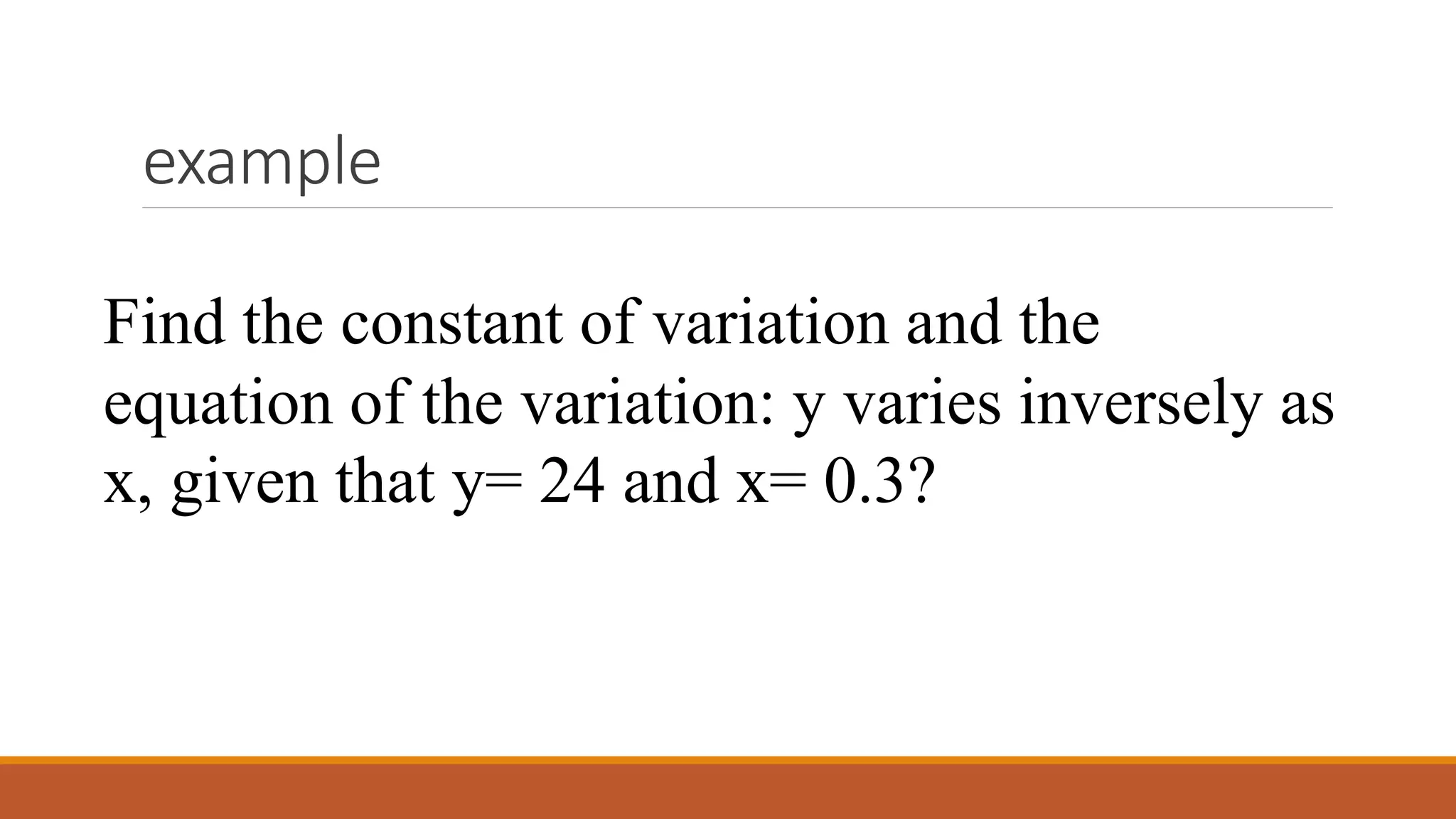
Find the constant of variation and the
equation of the variation: y varies inversely as
x, given that y= 24 and x= 0.3?
Joint Variation
Joint Variation The statement “ a
varies jointly as b and c” means
a=kbc, or k =
𝑎
𝑏𝑐
, where k is the
constant of variation.
example
The area of triangle varies jointly as the
base and the height. A triangle with a base
8 cm and a height of 9 cm has an area of 36
square centimeters. Find the area when the
base is 10 cm and the height is 7 cm.
Combined Variation
Combined Variation The statement
“ z varies directly as x and inversely
as y” means z =
𝑘𝑥
𝑦
, or k =
𝑧𝑦
𝑥
, where
k is the constant of variation.
example
The current I varies directly as the electromotive
force E and inversely as the resistance R. If a
current of 30 amperes flows through a system
with 16 ohms resistance and electromotive force
of 120 volts, find the current that a 200 volt-
electromotive force will send through the system.
Offline activities
Answer Independent Activity 1,
Independent assessment 1, Independent
Activity 3 and Independent assessment 3.
All your answers should be written neatly
on your answer sheet.
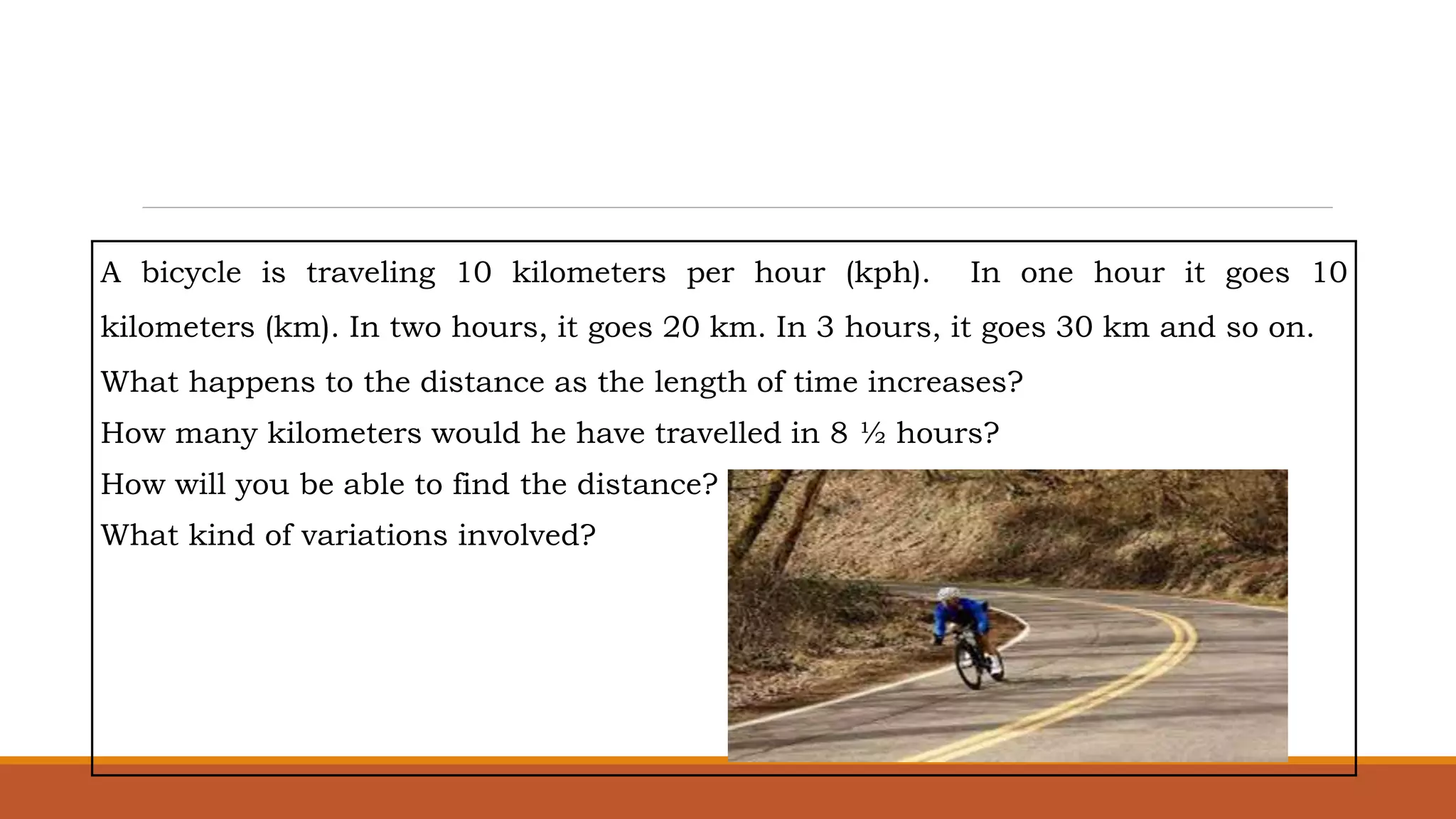
A bicycle is traveling 10 kilometers per hour (kph). In one hour it goes 10
kilometers (km). In two hours, it goes 20 km. In 3 hours, it goes 30 km and so on.
What happens to the distance as the length of time increases?
How many kilometers would he have travelled in 8 ½ hours?
How will you be able to find the distance?
What kind of variations involved?
Assessment
Time to challenge yourself and see how much
you have learned. Please answer Assessment
on pages 15-16 numbers 1 to 15.
The teacher reminds again the learner the
value of honesty and integrity when taking
the test.
Variation

Variation

  • 1.
    Quarter 2 –Module 2 Solving Problems Involving Variation M9AL-IIb-c-1
  • 2.
    Objectives: 1.Translate the givenstatements into equations. 2. Solve Problems involving variations.
  • 3.
    Identify what kindof variations shows in the pictures.
  • 4.
    Identify what kindof variations shows in the pictures.
  • 5.
    Identify what kindof variations shows in the pictures.
  • 6.
    Identify what kindof variations shows in the pictures.
  • 7.
    Identify what kindof variations shows in the pictures.
  • 8.
    Identify what kindof variations shows in the pictures.
  • 9.
    Translate the statementinto Equation d varies directly as f
  • 10.
  • 11.
    Translate the statementinto Equation z varies jointly as x and y
  • 12.
  • 13.
    Translate the statementinto Equation p varies directly as b and inversely as c
  • 14.
  • 15.
    Translate the statementinto Equation o varies directly as q and inversely as the square of r
  • 16.
  • 17.
    Translate the statementinto Equation v varies jointly as l, w, and h
  • 18.
  • 19.
    Questions: ★What have youobserved about the equation you created? ★How to find constant in direct variations? How about inverse variations? Joint variations?
  • 20.
    Direct variations Direct variationswhenever a situation produces pairs of numbers in which their ratio is constant . The statements: “y varies directly as x” “y is directly proportional to x” and “y is proportional to x” May be translated mathematically as y=kx, where k is the constant of variation. For two quantities, x and y, an increase in x causes an increase in y as well. Similarly, a decrease in x causes a decrease in y.
  • 21.
    Example 1: The tablebelow shows that the distance d varies directly as the time t. Find the constant of variation and the equation which describes the relation. Since the distance d varies directly as the time t, then d=kt. Using one of the pairs of values, (2,20), from the table, substitute the values of d and t in d = kt and solve for k. d = kt write the equation involving d and t 20=2k substitute the given values in the equation K= solve for k K=10 Find the distance if he/she travelled in 8hours?
  • 22.
    Example 2: If yvaries directly as x and that y=32 and when x=4 . Find the variation constant and the equation of variation.
  • 23.
    Inverse variation Inverse variationoccurs whenever a situation produces pairs of numbers whose product is constant. For two quantities x and y, an increase in x causes a decrease in y or vise versa. We can say that y varies inversely as x or y = 𝑘 𝑥 .The statement, “y varies inversely to x” translates to y = 𝑘 𝑥 , where k is the constant of variation.
  • 24.
    Example: Find the equationand solve for k: y varies inversely as x and y=6 when x= 18
  • 25.
    example Find the constantof variation and the equation of the variation: y varies inversely as x, given that y= 24 and x= 0.3?
  • 26.
    Joint Variation Joint VariationThe statement “ a varies jointly as b and c” means a=kbc, or k = 𝑎 𝑏𝑐 , where k is the constant of variation.
  • 27.
    example The area oftriangle varies jointly as the base and the height. A triangle with a base 8 cm and a height of 9 cm has an area of 36 square centimeters. Find the area when the base is 10 cm and the height is 7 cm.
  • 28.
    Combined Variation Combined VariationThe statement “ z varies directly as x and inversely as y” means z = 𝑘𝑥 𝑦 , or k = 𝑧𝑦 𝑥 , where k is the constant of variation.
  • 29.
    example The current Ivaries directly as the electromotive force E and inversely as the resistance R. If a current of 30 amperes flows through a system with 16 ohms resistance and electromotive force of 120 volts, find the current that a 200 volt- electromotive force will send through the system.
  • 30.
    Offline activities Answer IndependentActivity 1, Independent assessment 1, Independent Activity 3 and Independent assessment 3. All your answers should be written neatly on your answer sheet.
  • 31.
    A bicycle istraveling 10 kilometers per hour (kph). In one hour it goes 10 kilometers (km). In two hours, it goes 20 km. In 3 hours, it goes 30 km and so on. What happens to the distance as the length of time increases? How many kilometers would he have travelled in 8 ½ hours? How will you be able to find the distance? What kind of variations involved?
  • 32.
    Assessment Time to challengeyourself and see how much you have learned. Please answer Assessment on pages 15-16 numbers 1 to 15. The teacher reminds again the learner the value of honesty and integrity when taking the test.