Variations
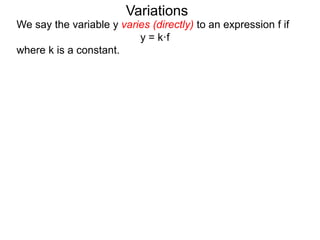
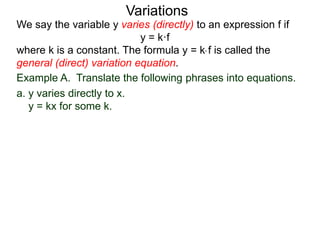
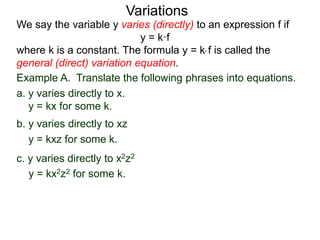
We say the variable y varies (directly) to an expression f if
y = k·f
where k is a constant.
Variations
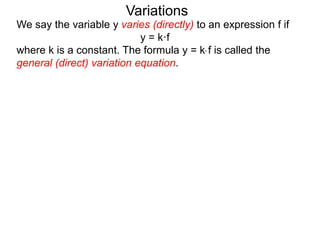
We say the variable y varies (directly) to an expression f if
y = k·f
where k is a constant. The formula y = k* f is called the
general (direct) variation equation.
Variations
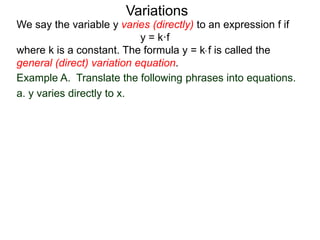
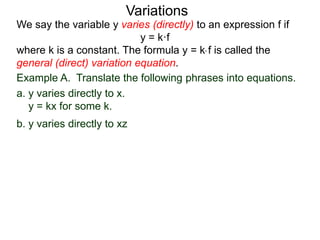
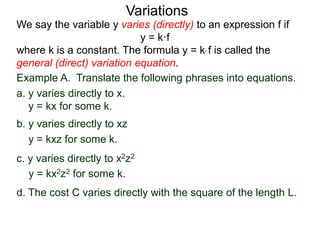
Example A. Translate the following phrases into equations.
a. y varies directly to x.
We say the variable y varies (directly) to an expression f if
y = k·f
where k is a constant. The formula y = k* f is called the
general (direct) variation equation.
Variations
Example A. Translate the following phrases into equations.
a. y varies directly to x.
y = kx for some k.
We say the variable y varies (directly) to an expression f if
y = k·f
where k is a constant. The formula y = k* f is called the
general (direct) variation equation.
Variations
Example A. Translate the following phrases into equations.
a. y varies directly to x.
y = kx for some k.
We say the variable y varies (directly) to an expression f if
y = k·f
where k is a constant. The formula y = k* f is called the
general (direct) variation equation.
Variations
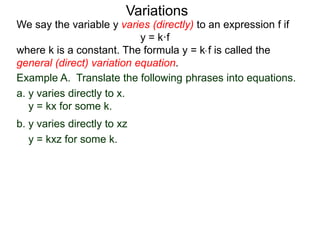
b. y varies directly to xz
Example A. Translate the following phrases into equations.
a. y varies directly to x.
y = kx for some k.
We say the variable y varies (directly) to an expression f if
y = k·f
where k is a constant. The formula y = k* f is called the
general (direct) variation equation.
Variations
b. y varies directly to xz
y = kxz for some k.
Example A. Translate the following phrases into equations.
a. y varies directly to x.
y = kx for some k.
We say the variable y varies (directly) to an expression f if
y = k·f
where k is a constant. The formula y = k* f is called the
general (direct) variation equation.
Variations
b. y varies directly to xz
y = kxz for some k.
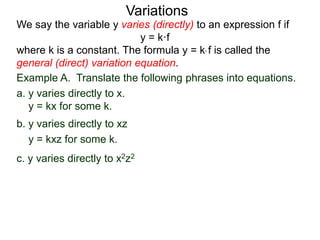
c. y varies directly to x2z2
Example A. Translate the following phrases into equations.
a. y varies directly to x.
y = kx for some k.
We say the variable y varies (directly) to an expression f if
y = k·f
where k is a constant. The formula y = k* f is called the
general (direct) variation equation.
Variations
b. y varies directly to xz
y = kxz for some k.
c. y varies directly to x2z2
y = kx2z2 for some k.
Example A. Translate the following phrases into equations.
a. y varies directly to x.
y = kx for some k.
We say the variable y varies (directly) to an expression f if
y = k·f
where k is a constant. The formula y = k* f is called the
general (direct) variation equation.
Variations
b. y varies directly to xz
y = kxz for some k.
c. y varies directly to x2z2
y = kx2z2 for some k.
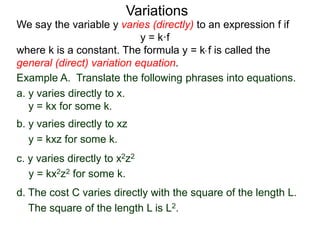
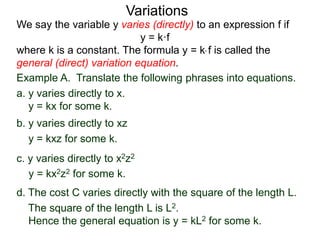
d. The cost C varies directly with the square of the length L.
Example A. Translate the following phrases into equations.
a. y varies directly to x.
y = kx for some k.
We say the variable y varies (directly) to an expression f if
y = k·f
where k is a constant. The formula y = k* f is called the
general (direct) variation equation.
Variations
b. y varies directly to xz
y = kxz for some k.
c. y varies directly to x2z2
y = kx2z2 for some k.
d. The cost C varies directly with the square of the length L.
The square of the length L is L2.
Example A. Translate the following phrases into equations.
a. y varies directly to x.
y = kx for some k.
We say the variable y varies (directly) to an expression f if
y = k·f
where k is a constant. The formula y = k* f is called the
general (direct) variation equation.
Variations
b. y varies directly to xz
y = kxz for some k.
c. y varies directly to x2z2
y = kx2z2 for some k.
d. The cost C varies directly with the square of the length L.
The square of the length L is L2.
Hence the general equation is y = kL2 for some k.
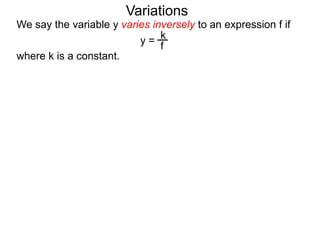
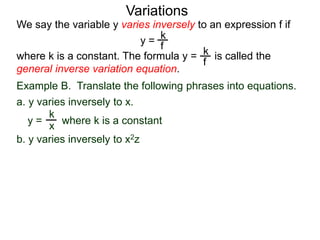
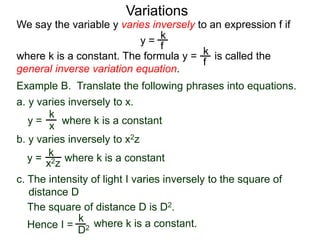
We say the variable y varies inversely to an expression f if
y =
where k is a constant.
Variations
k
f
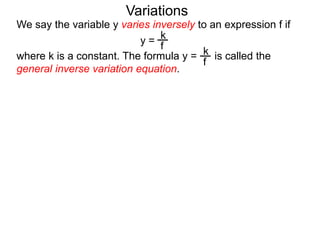
We say the variable y varies inversely to an expression f if
y =
where k is a constant. The formula y = is called the
general inverse variation equation.
Variations
k
f
k
f
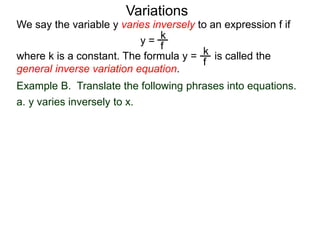
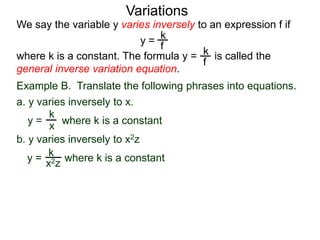
Example B. Translate the following phrases into equations.
a. y varies inversely to x.
We say the variable y varies inversely to an expression f if
y =
where k is a constant. The formula y = is called the
general inverse variation equation.
Variations
k
f
k
f
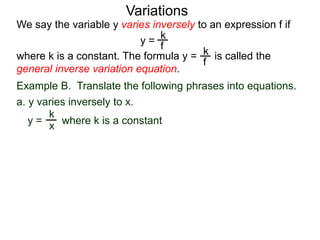
Example B. Translate the following phrases into equations.
a. y varies inversely to x.
k
x
We say the variable y varies inversely to an expression f if
y =
where k is a constant. The formula y = is called the
general inverse variation equation.
Variations
k
f
k
f
y = where k is a constant
Example B. Translate the following phrases into equations.
a. y varies inversely to x.
k
x
We say the variable y varies inversely to an expression f if
y =
where k is a constant. The formula y = is called the
general inverse variation equation.
Variations
k
f
k
f
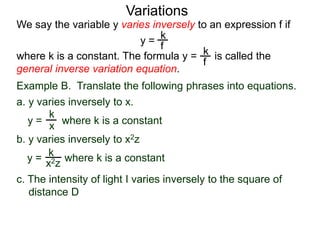
b. y varies inversely to x2z
y = where k is a constant
Example B. Translate the following phrases into equations.
a. y varies inversely to x.
k
x
k
x2z
We say the variable y varies inversely to an expression f if
y =
where k is a constant. The formula y = is called the
general inverse variation equation.
Variations
k
f
k
f
b. y varies inversely to x2z
y = where k is a constant
Example B. Translate the following phrases into equations.
a. y varies inversely to x.
k
x
k
x2z
We say the variable y varies inversely to an expression f if
y =
where k is a constant. The formula y = is called the
general inverse variation equation.
Variations
k
f
k
f
b. y varies inversely to x2z
y = where k is a constant
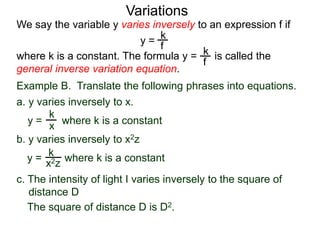
c. The intensity of light I varies inversely to the square of
distance D
Example B. Translate the following phrases into equations.
a. y varies inversely to x.
k
x
k
x2z
We say the variable y varies inversely to an expression f if
y =
where k is a constant. The formula y = is called the
general inverse variation equation.
Variations
k
f
k
f
b. y varies inversely to x2z
y = where k is a constant
c. The intensity of light I varies inversely to the square of
distance D
The square of distance D is D2.
Example B. Translate the following phrases into equations.
a. y varies inversely to x.
k
x
k
x2z
We say the variable y varies inversely to an expression f if
y =
where k is a constant. The formula y = is called the
general inverse variation equation.
Variations
k
f
k
f
b. y varies inversely to x2z
y = where k is a constant
c. The intensity of light I varies inversely to the square of
distance D
The square of distance D is D2.
Hence I =
k
D2 where k is a constant.
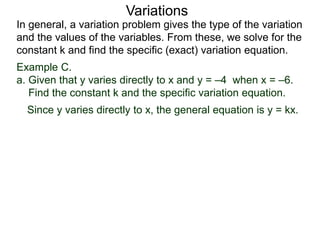
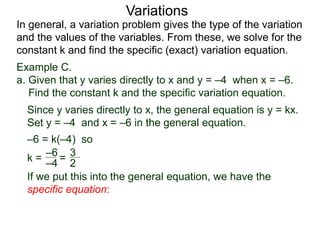
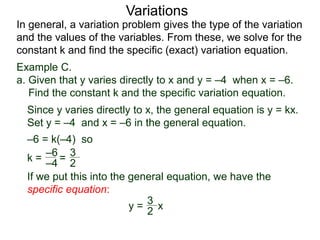
In general, a variation problem gives the type of the variation
and the values of the variables.
Variations
In general, a variation problem gives the type of the variation
and the values of the variables. From these, we solve for the
constant k and find the specific (exact) variation equation.
Variations
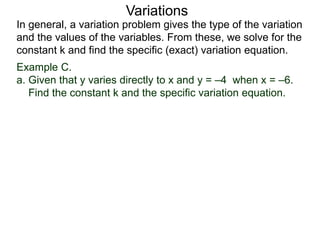
Example C.
a. Given that y varies directly to x and y = –4 when x = –6.
Find the constant k and the specific variation equation.
In general, a variation problem gives the type of the variation
and the values of the variables. From these, we solve for the
constant k and find the specific (exact) variation equation.
Variations
Example C.
a. Given that y varies directly to x and y = –4 when x = –6.
Find the constant k and the specific variation equation.
In general, a variation problem gives the type of the variation
and the values of the variables. From these, we solve for the
constant k and find the specific (exact) variation equation.
Variations
Since y varies directly to x, the general equation is y = kx.
Example C.
a. Given that y varies directly to x and y = –4 when x = –6.
Find the constant k and the specific variation equation.
In general, a variation problem gives the type of the variation
and the values of the variables. From these, we solve for the
constant k and find the specific (exact) variation equation.
Variations
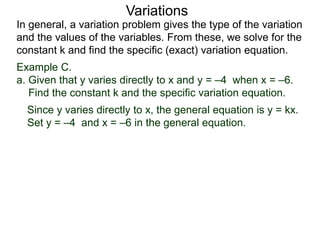
Since y varies directly to x, the general equation is y = kx.
Set y = –4 and x = –6 in the general equation.
Example C.
a. Given that y varies directly to x and y = –4 when x = –6.
Find the constant k and the specific variation equation.
In general, a variation problem gives the type of the variation
and the values of the variables. From these, we solve for the
constant k and find the specific (exact) variation equation.
Variations
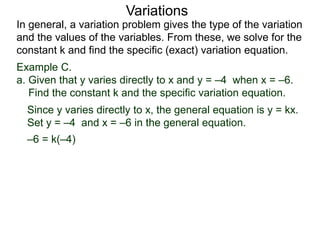
Since y varies directly to x, the general equation is y = kx.
Set y = –4 and x = –6 in the general equation.
–6 = k(–4)
Example C.
a. Given that y varies directly to x and y = –4 when x = –6.
Find the constant k and the specific variation equation.
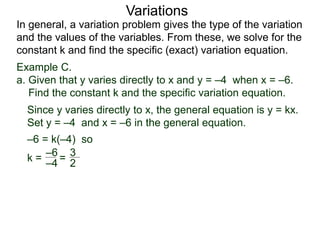
k = =
–6
–4 2
3
In general, a variation problem gives the type of the variation
and the values of the variables. From these, we solve for the
constant k and find the specific (exact) variation equation.
Variations
Since y varies directly to x, the general equation is y = kx.
Set y = –4 and x = –6 in the general equation.
–6 = k(–4) so
Example C.
a. Given that y varies directly to x and y = –4 when x = –6.
Find the constant k and the specific variation equation.
k = =
–6
–4
If we put this into the general equation, we have the
specific equation:
In general, a variation problem gives the type of the variation
and the values of the variables. From these, we solve for the
constant k and find the specific (exact) variation equation.
Variations
Since y varies directly to x, the general equation is y = kx.
Set y = –4 and x = –6 in the general equation.
–6 = k(–4) so
2
3
Example C.
a. Given that y varies directly to x and y = –4 when x = –6.
Find the constant k and the specific variation equation.
k = =
–6
–4
If we put this into the general equation, we have the
specific equation:
In general, a variation problem gives the type of the variation
and the values of the variables. From these, we solve for the
constant k and find the specific (exact) variation equation.
Variations
Since y varies directly to x, the general equation is y = kx.
Set y = –4 and x = –6 in the general equation.
–6 = k(–4) so
y = x
2
3
2
3
Variations
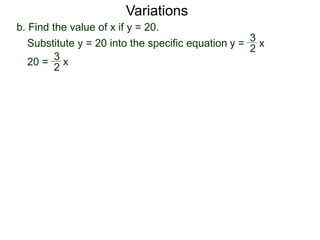
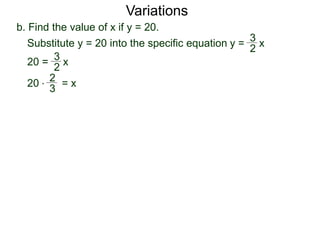
b. Find the value of x if y = 20.
Variations
b. Find the value of x if y = 20.
20 = x
2
3
Substitute y = 20 into the specific equation y = x
2
3
Variations
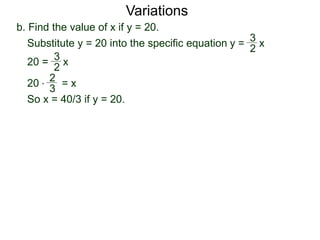
b. Find the value of x if y = 20.
20 = x
2
3
Substitute y = 20 into the specific equation
20 * = x
2
3
y = x
2
3
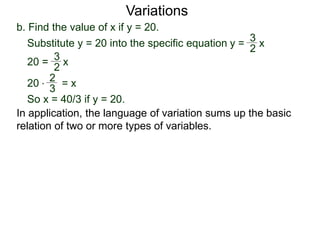
b. Find the value of x if y = 20.
Variations
20 = x
2
3
Substitute y = 20 into the specific equation
20 * = x
2
3
So x = 40/3 if y = 20.
y = x
2
3
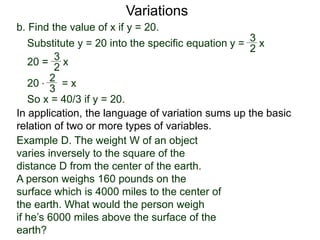
b. Find the value of x if y = 20.
Variations
20 = x
2
3
Substitute y = 20 into the specific equation
20 * = x
2
3
So x = 40/3 if y = 20.
In application, the language of variation sums up the basic
relation of two or more types of variables.
y = x
2
3
b. Find the value of x if y = 20.
Variations
20 = x
2
3
Substitute y = 20 into the specific equation
20 * = x
2
3
So x = 40/3 if y = 20.
In application, the language of variation sums up the basic
relation of two or more types of variables.
y = x
2
3
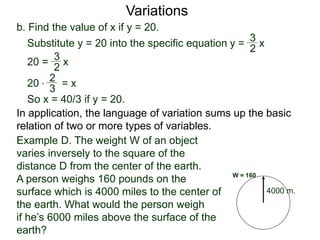
Example D. The weight W of an object
varies inversely to the square of the
distance D from the center of the earth.
A person weighs 160 pounds on the
surface which is 4000 miles to the center of
the earth. What would the person weigh
if he’s 6000 miles above the surface of the
earth?
b. Find the value of x if y = 20.
Variations
20 = x
2
3
Substitute y = 20 into the specific equation
20 * = x
2
3
So x = 40/3 if y = 20.
In application, the language of variation sums up the basic
relation of two or more types of variables.
y = x
2
3
4000 m.
W = 160
Example D. The weight W of an object
varies inversely to the square of the
distance D from the center of the earth.
A person weighs 160 pounds on the
surface which is 4000 miles to the center of
the earth. What would the person weigh
if he’s 6000 miles above the surface of the
earth?
b. Find the value of x if y = 20.
Variations
20 = x
2
3
Substitute y = 20 into the specific equation
20 * = x
2
3
So x = 40/3 if y = 20.
In application, the language of variation sums up the basic
relation of two or more types of variables.
y = x
2
3
4000 m.
6000 m.
W = 160
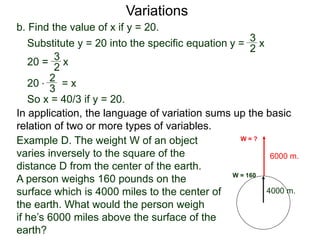
W = ?Example D. The weight W of an object
varies inversely to the square of the
distance D from the center of the earth.
A person weighs 160 pounds on the
surface which is 4000 miles to the center of
the earth. What would the person weigh
if he’s 6000 miles above the surface of the
earth?
Variations
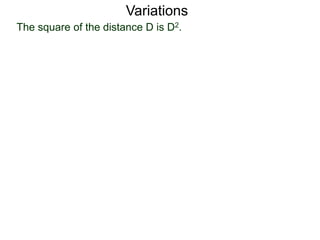
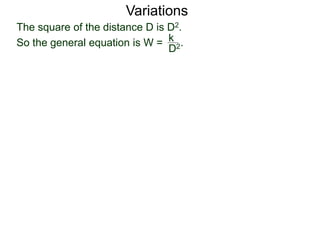
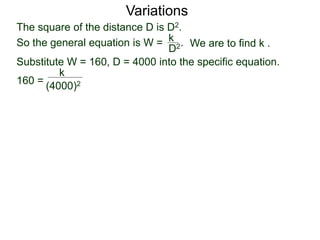
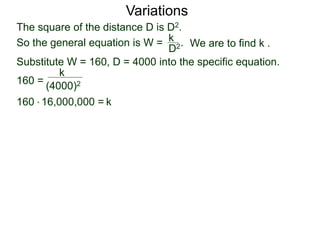
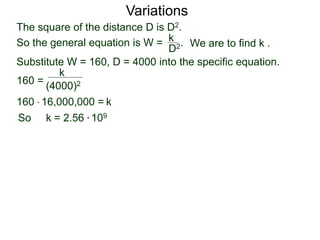
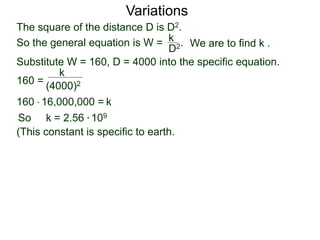
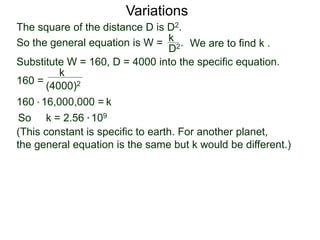
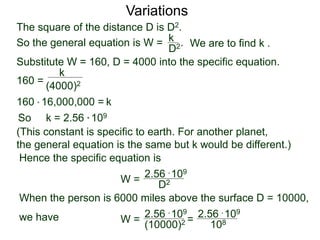
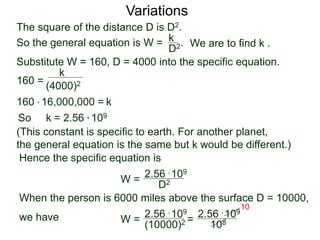
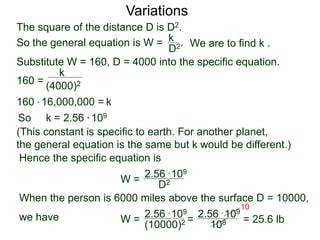
The square of the distance D is D2.
Variations
The square of the distance D is D2.
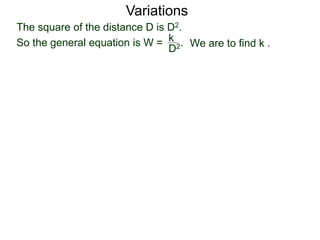
So the general equation is W = .
D2
k
Variations
The square of the distance D is D2.
So the general equation is W = .
D2
k
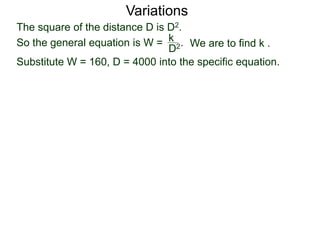
We are to find k .
Variations
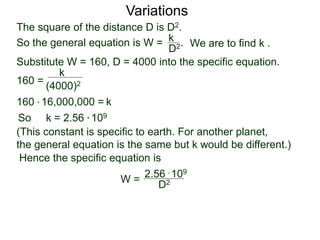
Substitute W = 160, D = 4000 into the specific equation.
The square of the distance D is D2.
So the general equation is W = .
D2
k
We are to find k .
Variations
160 =
(4000)2
k
Substitute W = 160, D = 4000 into the specific equation.
The square of the distance D is D2.
So the general equation is W = .
D2
k
We are to find k .
Variations
160 =
(4000)2
k
Substitute W = 160, D = 4000 into the specific equation.
k160 * 16,000,000 =
The square of the distance D is D2.
So the general equation is W = .
D2
k
We are to find k .
Variations
160 =
(4000)2
k
Substitute W = 160, D = 4000 into the specific equation.
So k = 2.56 * 109
k160 * 16,000,000 =
The square of the distance D is D2.
So the general equation is W = .
D2
k
We are to find k .
Variations
160 =
(4000)2
k
Substitute W = 160, D = 4000 into the specific equation.
So k = 2.56 * 109
(This constant is specific to earth.
k160 * 16,000,000 =
The square of the distance D is D2.
So the general equation is W = .
D2
k
We are to find k .
Variations
160 =
(4000)2
k
Substitute W = 160, D = 4000 into the specific equation.
So k = 2.56 * 109
(This constant is specific to earth. For another planet,
the general equation is the same but k would be different.)
k160 * 16,000,000 =
The square of the distance D is D2.
So the general equation is W = .
D2
k
We are to find k .
Variations
160 =
(4000)2
k
Substitute W = 160, D = 4000 into the specific equation.
So k = 2.56 * 109
(This constant is specific to earth. For another planet,
the general equation is the same but k would be different.)
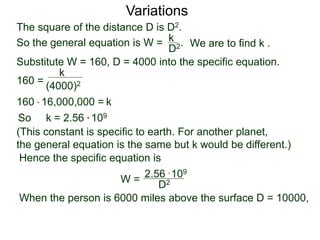
Hence the specific equation is
k160 * 16,000,000 =
W = D2
2.56 * 109
The square of the distance D is D2.
So the general equation is W = .
D2
k
We are to find k .
Variations
160 =
(4000)2
k
Substitute W = 160, D = 4000 into the specific equation.
So k = 2.56 * 109
(This constant is specific to earth. For another planet,
the general equation is the same but k would be different.)
Hence the specific equation is
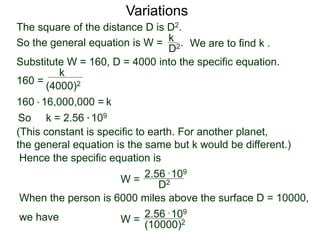
When the person is 6000 miles above the surface D = 10000,
k160 * 16,000,000 =
W = D2
2.56 * 109
The square of the distance D is D2.
So the general equation is W = .
D2
k
We are to find k .
Variations
160 =
(4000)2
k
Substitute W = 160, D = 4000 into the specific equation.
So k = 2.56 * 109
(This constant is specific to earth. For another planet,
the general equation is the same but k would be different.)
Hence the specific equation is
When the person is 6000 miles above the surface D = 10000,
we have
k160 * 16,000,000 =
W = D2
2.56 * 109
W =
(10000)2
2.56 * 109
The square of the distance D is D2.
So the general equation is W = .
D2
k
We are to find k .
Variations
160 =
(4000)2
k
Substitute W = 160, D = 4000 into the specific equation.
So k = 2.56 * 109
(This constant is specific to earth. For another planet,
the general equation is the same but k would be different.)
Hence the specific equation is
When the person is 6000 miles above the surface D = 10000,
we have
k160 * 16,000,000 =
W = D2
2.56 * 109
W =
(10000)2
2.56 * 109
=
108
2.56 * 109
The square of the distance D is D2.
So the general equation is W = .
D2
k
We are to find k .
Variations
160 =
(4000)2
k
Substitute W = 160, D = 4000 into the specific equation.
So k = 2.56 * 109
(This constant is specific to earth. For another planet,
the general equation is the same but k would be different.)
Hence the specific equation is
When the person is 6000 miles above the surface D = 10000,
we have
k160 * 16,000,000 =
W = D2
2.56 * 109
W =
(10000)2
2.56 * 109
=
108
2.56 * 109
The square of the distance D is D2.
So the general equation is W = .
D2
k
We are to find k .
108
10
Variations
160 =
(4000)2
k
Substitute W = 160, D = 4000 into the specific equation.
So k = 2.56 * 109
(This constant is specific to earth. For another planet,
the general equation is the same but k would be different.)
Hence the specific equation is
When the person is 6000 miles above the surface D = 10000,
we have
k160 * 16,000,000 =
W = D2
2.56 * 109
W =
(10000)2
2.56 * 109
=
108
2.56 * 109
The square of the distance D is D2.
So the general equation is W = .
D2
k
We are to find k .
108
10
= 25.6 lb
Variations
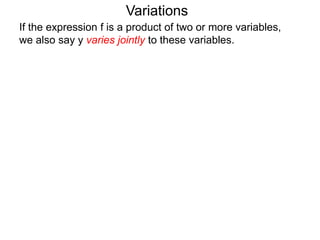
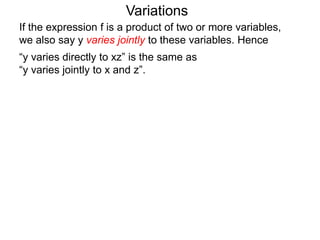
If the expression f is a product of two or more variables,
we also say y varies jointly to these variables.
Variations
If the expression f is a product of two or more variables,
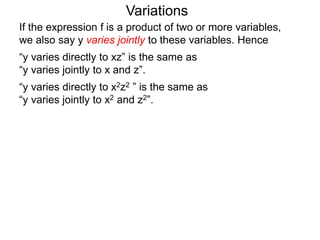
we also say y varies jointly to these variables. Hence
“y varies directly to xz” is the same as
“y varies jointly to x and z”.
Variations
If the expression f is a product of two or more variables,
we also say y varies jointly to these variables. Hence
“y varies directly to xz” is the same as
“y varies jointly to x and z”.
“y varies directly to x2z2 ” is the same as
“y varies jointly to x2 and z2”.
Variations
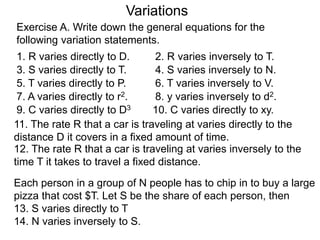
Exercise A. Write down the general equations for the
following variation statements.
5. T varies directly to P. 6. T varies inversely to V.
1. R varies directly to D. 2. R varies inversely to T.
7. A varies directly to r2.
9. C varies directly to D3
8. y varies inversely to d2.
3. S varies directly to T. 4. S varies inversely to N.
10. C varies directly to xy.
11. The rate R that a car is traveling at varies directly to the
distance D it covers in a fixed amount of time.
12. The rate R that a car is traveling at varies inversely to the
time T it takes to travel a fixed distance.
Each person in a group of N people has to chip in to buy a large
pizza that cost $T. Let S be the share of each person, then
13. S varies directly to T
14. N varies inversely to S.
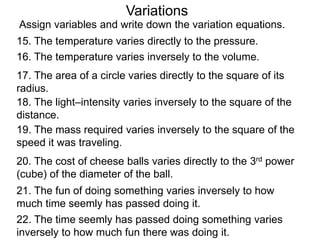
Variations
16. The temperature varies inversely to the volume.
17. The area of a circle varies directly to the square of its
radius.
18. The light–intensity varies inversely to the square of the
distance.
19. The mass required varies inversely to the square of the
speed it was traveling.
20. The cost of cheese balls varies directly to the 3rd power
(cube) of the diameter of the ball.
22. The time seemly has passed doing something varies
inversely to how much fun there was doing it.
21. The fun of doing something varies inversely to how
much time seemly has passed doing it.
15. The temperature varies directly to the pressure.
Assign variables and write down the variation equations.
Variations
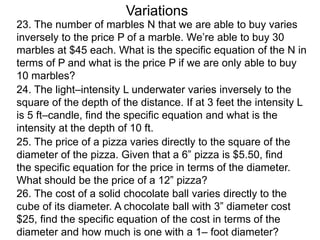
24. The light–intensity L underwater varies inversely to the
square of the depth of the distance. If at 3 feet the intensity L
is 5 ft–candle, find the specific equation and what is the
intensity at the depth of 10 ft.
25. The price of a pizza varies directly to the square of the
diameter of the pizza. Given that a 6” pizza is $5.50, find
the specific equation for the price in terms of the diameter.
What should be the price of a 12” pizza?
26. The cost of a solid chocolate ball varies directly to the
cube of its diameter. A chocolate ball with 3” diameter cost
$25, find the specific equation of the cost in terms of the
diameter and how much is one with a 1– foot diameter?
23. The number of marbles N that we are able to buy varies
inversely to the price P of a marble. We’re able to buy 30
marbles at $45 each. What is the specific equation of the N in
terms of P and what is the price P if we are only able to buy
10 marbles?

2 8 variations-xy

  • 1.
  • 2.
    We say thevariable y varies (directly) to an expression f if y = k·f where k is a constant. Variations
  • 3.
    We say thevariable y varies (directly) to an expression f if y = k·f where k is a constant. The formula y = k* f is called the general (direct) variation equation. Variations
  • 4.
    Example A. Translatethe following phrases into equations. a. y varies directly to x. We say the variable y varies (directly) to an expression f if y = k·f where k is a constant. The formula y = k* f is called the general (direct) variation equation. Variations
  • 5.
    Example A. Translatethe following phrases into equations. a. y varies directly to x. y = kx for some k. We say the variable y varies (directly) to an expression f if y = k·f where k is a constant. The formula y = k* f is called the general (direct) variation equation. Variations
  • 6.
    Example A. Translatethe following phrases into equations. a. y varies directly to x. y = kx for some k. We say the variable y varies (directly) to an expression f if y = k·f where k is a constant. The formula y = k* f is called the general (direct) variation equation. Variations b. y varies directly to xz
  • 7.
    Example A. Translatethe following phrases into equations. a. y varies directly to x. y = kx for some k. We say the variable y varies (directly) to an expression f if y = k·f where k is a constant. The formula y = k* f is called the general (direct) variation equation. Variations b. y varies directly to xz y = kxz for some k.
  • 8.
    Example A. Translatethe following phrases into equations. a. y varies directly to x. y = kx for some k. We say the variable y varies (directly) to an expression f if y = k·f where k is a constant. The formula y = k* f is called the general (direct) variation equation. Variations b. y varies directly to xz y = kxz for some k. c. y varies directly to x2z2
  • 9.
    Example A. Translatethe following phrases into equations. a. y varies directly to x. y = kx for some k. We say the variable y varies (directly) to an expression f if y = k·f where k is a constant. The formula y = k* f is called the general (direct) variation equation. Variations b. y varies directly to xz y = kxz for some k. c. y varies directly to x2z2 y = kx2z2 for some k.
  • 10.
    Example A. Translatethe following phrases into equations. a. y varies directly to x. y = kx for some k. We say the variable y varies (directly) to an expression f if y = k·f where k is a constant. The formula y = k* f is called the general (direct) variation equation. Variations b. y varies directly to xz y = kxz for some k. c. y varies directly to x2z2 y = kx2z2 for some k. d. The cost C varies directly with the square of the length L.
  • 11.
    Example A. Translatethe following phrases into equations. a. y varies directly to x. y = kx for some k. We say the variable y varies (directly) to an expression f if y = k·f where k is a constant. The formula y = k* f is called the general (direct) variation equation. Variations b. y varies directly to xz y = kxz for some k. c. y varies directly to x2z2 y = kx2z2 for some k. d. The cost C varies directly with the square of the length L. The square of the length L is L2.
  • 12.
    Example A. Translatethe following phrases into equations. a. y varies directly to x. y = kx for some k. We say the variable y varies (directly) to an expression f if y = k·f where k is a constant. The formula y = k* f is called the general (direct) variation equation. Variations b. y varies directly to xz y = kxz for some k. c. y varies directly to x2z2 y = kx2z2 for some k. d. The cost C varies directly with the square of the length L. The square of the length L is L2. Hence the general equation is y = kL2 for some k.
  • 13.
    We say thevariable y varies inversely to an expression f if y = where k is a constant. Variations k f
  • 14.
    We say thevariable y varies inversely to an expression f if y = where k is a constant. The formula y = is called the general inverse variation equation. Variations k f k f
  • 15.
    Example B. Translatethe following phrases into equations. a. y varies inversely to x. We say the variable y varies inversely to an expression f if y = where k is a constant. The formula y = is called the general inverse variation equation. Variations k f k f
  • 16.
    Example B. Translatethe following phrases into equations. a. y varies inversely to x. k x We say the variable y varies inversely to an expression f if y = where k is a constant. The formula y = is called the general inverse variation equation. Variations k f k f y = where k is a constant
  • 17.
    Example B. Translatethe following phrases into equations. a. y varies inversely to x. k x We say the variable y varies inversely to an expression f if y = where k is a constant. The formula y = is called the general inverse variation equation. Variations k f k f b. y varies inversely to x2z y = where k is a constant
  • 18.
    Example B. Translatethe following phrases into equations. a. y varies inversely to x. k x k x2z We say the variable y varies inversely to an expression f if y = where k is a constant. The formula y = is called the general inverse variation equation. Variations k f k f b. y varies inversely to x2z y = where k is a constant y = where k is a constant
  • 19.
    Example B. Translatethe following phrases into equations. a. y varies inversely to x. k x k x2z We say the variable y varies inversely to an expression f if y = where k is a constant. The formula y = is called the general inverse variation equation. Variations k f k f b. y varies inversely to x2z y = where k is a constant y = where k is a constant c. The intensity of light I varies inversely to the square of distance D
  • 20.
    Example B. Translatethe following phrases into equations. a. y varies inversely to x. k x k x2z We say the variable y varies inversely to an expression f if y = where k is a constant. The formula y = is called the general inverse variation equation. Variations k f k f b. y varies inversely to x2z y = where k is a constant y = where k is a constant c. The intensity of light I varies inversely to the square of distance D The square of distance D is D2.
  • 21.
    Example B. Translatethe following phrases into equations. a. y varies inversely to x. k x k x2z We say the variable y varies inversely to an expression f if y = where k is a constant. The formula y = is called the general inverse variation equation. Variations k f k f b. y varies inversely to x2z y = where k is a constant y = where k is a constant c. The intensity of light I varies inversely to the square of distance D The square of distance D is D2. Hence I = k D2 where k is a constant.
  • 22.
    In general, avariation problem gives the type of the variation and the values of the variables. Variations
  • 23.
    In general, avariation problem gives the type of the variation and the values of the variables. From these, we solve for the constant k and find the specific (exact) variation equation. Variations
  • 24.
    Example C. a. Giventhat y varies directly to x and y = –4 when x = –6. Find the constant k and the specific variation equation. In general, a variation problem gives the type of the variation and the values of the variables. From these, we solve for the constant k and find the specific (exact) variation equation. Variations
  • 25.
    Example C. a. Giventhat y varies directly to x and y = –4 when x = –6. Find the constant k and the specific variation equation. In general, a variation problem gives the type of the variation and the values of the variables. From these, we solve for the constant k and find the specific (exact) variation equation. Variations Since y varies directly to x, the general equation is y = kx.
  • 26.
    Example C. a. Giventhat y varies directly to x and y = –4 when x = –6. Find the constant k and the specific variation equation. In general, a variation problem gives the type of the variation and the values of the variables. From these, we solve for the constant k and find the specific (exact) variation equation. Variations Since y varies directly to x, the general equation is y = kx. Set y = –4 and x = –6 in the general equation.
  • 27.
    Example C. a. Giventhat y varies directly to x and y = –4 when x = –6. Find the constant k and the specific variation equation. In general, a variation problem gives the type of the variation and the values of the variables. From these, we solve for the constant k and find the specific (exact) variation equation. Variations Since y varies directly to x, the general equation is y = kx. Set y = –4 and x = –6 in the general equation. –6 = k(–4)
  • 28.
    Example C. a. Giventhat y varies directly to x and y = –4 when x = –6. Find the constant k and the specific variation equation. k = = –6 –4 2 3 In general, a variation problem gives the type of the variation and the values of the variables. From these, we solve for the constant k and find the specific (exact) variation equation. Variations Since y varies directly to x, the general equation is y = kx. Set y = –4 and x = –6 in the general equation. –6 = k(–4) so
  • 29.
    Example C. a. Giventhat y varies directly to x and y = –4 when x = –6. Find the constant k and the specific variation equation. k = = –6 –4 If we put this into the general equation, we have the specific equation: In general, a variation problem gives the type of the variation and the values of the variables. From these, we solve for the constant k and find the specific (exact) variation equation. Variations Since y varies directly to x, the general equation is y = kx. Set y = –4 and x = –6 in the general equation. –6 = k(–4) so 2 3
  • 30.
    Example C. a. Giventhat y varies directly to x and y = –4 when x = –6. Find the constant k and the specific variation equation. k = = –6 –4 If we put this into the general equation, we have the specific equation: In general, a variation problem gives the type of the variation and the values of the variables. From these, we solve for the constant k and find the specific (exact) variation equation. Variations Since y varies directly to x, the general equation is y = kx. Set y = –4 and x = –6 in the general equation. –6 = k(–4) so y = x 2 3 2 3
  • 31.
    Variations b. Find thevalue of x if y = 20.
  • 32.
    Variations b. Find thevalue of x if y = 20. 20 = x 2 3 Substitute y = 20 into the specific equation y = x 2 3
  • 33.
    Variations b. Find thevalue of x if y = 20. 20 = x 2 3 Substitute y = 20 into the specific equation 20 * = x 2 3 y = x 2 3
  • 34.
    b. Find thevalue of x if y = 20. Variations 20 = x 2 3 Substitute y = 20 into the specific equation 20 * = x 2 3 So x = 40/3 if y = 20. y = x 2 3
  • 35.
    b. Find thevalue of x if y = 20. Variations 20 = x 2 3 Substitute y = 20 into the specific equation 20 * = x 2 3 So x = 40/3 if y = 20. In application, the language of variation sums up the basic relation of two or more types of variables. y = x 2 3
  • 36.
    b. Find thevalue of x if y = 20. Variations 20 = x 2 3 Substitute y = 20 into the specific equation 20 * = x 2 3 So x = 40/3 if y = 20. In application, the language of variation sums up the basic relation of two or more types of variables. y = x 2 3 Example D. The weight W of an object varies inversely to the square of the distance D from the center of the earth. A person weighs 160 pounds on the surface which is 4000 miles to the center of the earth. What would the person weigh if he’s 6000 miles above the surface of the earth?
  • 37.
    b. Find thevalue of x if y = 20. Variations 20 = x 2 3 Substitute y = 20 into the specific equation 20 * = x 2 3 So x = 40/3 if y = 20. In application, the language of variation sums up the basic relation of two or more types of variables. y = x 2 3 4000 m. W = 160 Example D. The weight W of an object varies inversely to the square of the distance D from the center of the earth. A person weighs 160 pounds on the surface which is 4000 miles to the center of the earth. What would the person weigh if he’s 6000 miles above the surface of the earth?
  • 38.
    b. Find thevalue of x if y = 20. Variations 20 = x 2 3 Substitute y = 20 into the specific equation 20 * = x 2 3 So x = 40/3 if y = 20. In application, the language of variation sums up the basic relation of two or more types of variables. y = x 2 3 4000 m. 6000 m. W = 160 W = ?Example D. The weight W of an object varies inversely to the square of the distance D from the center of the earth. A person weighs 160 pounds on the surface which is 4000 miles to the center of the earth. What would the person weigh if he’s 6000 miles above the surface of the earth?
  • 39.
    Variations The square ofthe distance D is D2.
  • 40.
    Variations The square ofthe distance D is D2. So the general equation is W = . D2 k
  • 41.
    Variations The square ofthe distance D is D2. So the general equation is W = . D2 k We are to find k .
  • 42.
    Variations Substitute W =160, D = 4000 into the specific equation. The square of the distance D is D2. So the general equation is W = . D2 k We are to find k .
  • 43.
    Variations 160 = (4000)2 k Substitute W= 160, D = 4000 into the specific equation. The square of the distance D is D2. So the general equation is W = . D2 k We are to find k .
  • 44.
    Variations 160 = (4000)2 k Substitute W= 160, D = 4000 into the specific equation. k160 * 16,000,000 = The square of the distance D is D2. So the general equation is W = . D2 k We are to find k .
  • 45.
    Variations 160 = (4000)2 k Substitute W= 160, D = 4000 into the specific equation. So k = 2.56 * 109 k160 * 16,000,000 = The square of the distance D is D2. So the general equation is W = . D2 k We are to find k .
  • 46.
    Variations 160 = (4000)2 k Substitute W= 160, D = 4000 into the specific equation. So k = 2.56 * 109 (This constant is specific to earth. k160 * 16,000,000 = The square of the distance D is D2. So the general equation is W = . D2 k We are to find k .
  • 47.
    Variations 160 = (4000)2 k Substitute W= 160, D = 4000 into the specific equation. So k = 2.56 * 109 (This constant is specific to earth. For another planet, the general equation is the same but k would be different.) k160 * 16,000,000 = The square of the distance D is D2. So the general equation is W = . D2 k We are to find k .
  • 48.
    Variations 160 = (4000)2 k Substitute W= 160, D = 4000 into the specific equation. So k = 2.56 * 109 (This constant is specific to earth. For another planet, the general equation is the same but k would be different.) Hence the specific equation is k160 * 16,000,000 = W = D2 2.56 * 109 The square of the distance D is D2. So the general equation is W = . D2 k We are to find k .
  • 49.
    Variations 160 = (4000)2 k Substitute W= 160, D = 4000 into the specific equation. So k = 2.56 * 109 (This constant is specific to earth. For another planet, the general equation is the same but k would be different.) Hence the specific equation is When the person is 6000 miles above the surface D = 10000, k160 * 16,000,000 = W = D2 2.56 * 109 The square of the distance D is D2. So the general equation is W = . D2 k We are to find k .
  • 50.
    Variations 160 = (4000)2 k Substitute W= 160, D = 4000 into the specific equation. So k = 2.56 * 109 (This constant is specific to earth. For another planet, the general equation is the same but k would be different.) Hence the specific equation is When the person is 6000 miles above the surface D = 10000, we have k160 * 16,000,000 = W = D2 2.56 * 109 W = (10000)2 2.56 * 109 The square of the distance D is D2. So the general equation is W = . D2 k We are to find k .
  • 51.
    Variations 160 = (4000)2 k Substitute W= 160, D = 4000 into the specific equation. So k = 2.56 * 109 (This constant is specific to earth. For another planet, the general equation is the same but k would be different.) Hence the specific equation is When the person is 6000 miles above the surface D = 10000, we have k160 * 16,000,000 = W = D2 2.56 * 109 W = (10000)2 2.56 * 109 = 108 2.56 * 109 The square of the distance D is D2. So the general equation is W = . D2 k We are to find k .
  • 52.
    Variations 160 = (4000)2 k Substitute W= 160, D = 4000 into the specific equation. So k = 2.56 * 109 (This constant is specific to earth. For another planet, the general equation is the same but k would be different.) Hence the specific equation is When the person is 6000 miles above the surface D = 10000, we have k160 * 16,000,000 = W = D2 2.56 * 109 W = (10000)2 2.56 * 109 = 108 2.56 * 109 The square of the distance D is D2. So the general equation is W = . D2 k We are to find k . 108 10
  • 53.
    Variations 160 = (4000)2 k Substitute W= 160, D = 4000 into the specific equation. So k = 2.56 * 109 (This constant is specific to earth. For another planet, the general equation is the same but k would be different.) Hence the specific equation is When the person is 6000 miles above the surface D = 10000, we have k160 * 16,000,000 = W = D2 2.56 * 109 W = (10000)2 2.56 * 109 = 108 2.56 * 109 The square of the distance D is D2. So the general equation is W = . D2 k We are to find k . 108 10 = 25.6 lb
  • 54.
    Variations If the expressionf is a product of two or more variables, we also say y varies jointly to these variables.
  • 55.
    Variations If the expressionf is a product of two or more variables, we also say y varies jointly to these variables. Hence “y varies directly to xz” is the same as “y varies jointly to x and z”.
  • 56.
    Variations If the expressionf is a product of two or more variables, we also say y varies jointly to these variables. Hence “y varies directly to xz” is the same as “y varies jointly to x and z”. “y varies directly to x2z2 ” is the same as “y varies jointly to x2 and z2”.
  • 57.
    Variations Exercise A. Writedown the general equations for the following variation statements. 5. T varies directly to P. 6. T varies inversely to V. 1. R varies directly to D. 2. R varies inversely to T. 7. A varies directly to r2. 9. C varies directly to D3 8. y varies inversely to d2. 3. S varies directly to T. 4. S varies inversely to N. 10. C varies directly to xy. 11. The rate R that a car is traveling at varies directly to the distance D it covers in a fixed amount of time. 12. The rate R that a car is traveling at varies inversely to the time T it takes to travel a fixed distance. Each person in a group of N people has to chip in to buy a large pizza that cost $T. Let S be the share of each person, then 13. S varies directly to T 14. N varies inversely to S.
  • 58.
    Variations 16. The temperaturevaries inversely to the volume. 17. The area of a circle varies directly to the square of its radius. 18. The light–intensity varies inversely to the square of the distance. 19. The mass required varies inversely to the square of the speed it was traveling. 20. The cost of cheese balls varies directly to the 3rd power (cube) of the diameter of the ball. 22. The time seemly has passed doing something varies inversely to how much fun there was doing it. 21. The fun of doing something varies inversely to how much time seemly has passed doing it. 15. The temperature varies directly to the pressure. Assign variables and write down the variation equations.
  • 59.
    Variations 24. The light–intensityL underwater varies inversely to the square of the depth of the distance. If at 3 feet the intensity L is 5 ft–candle, find the specific equation and what is the intensity at the depth of 10 ft. 25. The price of a pizza varies directly to the square of the diameter of the pizza. Given that a 6” pizza is $5.50, find the specific equation for the price in terms of the diameter. What should be the price of a 12” pizza? 26. The cost of a solid chocolate ball varies directly to the cube of its diameter. A chocolate ball with 3” diameter cost $25, find the specific equation of the cost in terms of the diameter and how much is one with a 1– foot diameter? 23. The number of marbles N that we are able to buy varies inversely to the price P of a marble. We’re able to buy 30 marbles at $45 each. What is the specific equation of the N in terms of P and what is the price P if we are only able to buy 10 marbles?