Future State Map
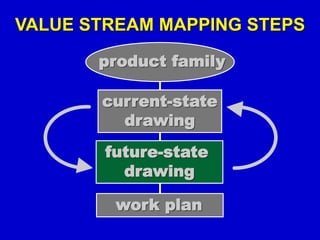
VALUE STREAM MAPPING STEPS
product family
current-state
drawing
future-state
drawing
work plan
future-state
drawing
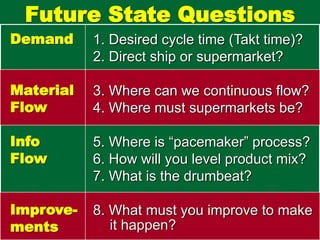
Future State Questions
1. Desired cycle time (Takt time)?
2. Direct ship or supermarket?
3. Where can we continuous flow?
4. Where must supermarkets be?
5. Where is “pacemaker” process?
6. How will you level product mix?
7. What is the drumbeat?
8. What must you improve to make
Demand
Material
Flow
Info
Flow
Improve-
ments it happen?
Future State Question #1
What is the takt time (desired cycle
time), based on the available working
time of the downstream processes
that are closest to the customer?
1. DESIRED CYCLE (TAKT) TIME?
Takt time is the average interval at
which the customer takes your
product during a production period.
It is the desired cycle time for your
entire value-stream process.
Producing to Takt time requires:
• Short leadtimes (small lots)
• Fast setup times
• Reliable processes
• Fast response to problems
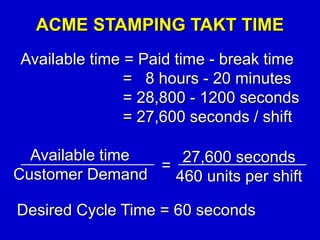
ACME STAMPING TAKT TIME
Available time = Paid time - break time
= 8 hours - 20 minutes
= 28,800 - 1200 seconds
= 27,600 seconds / shift
Available time
Customer Demand
=
27,600 seconds
460 units per shift
Desired Cycle Time = 60 seconds
Future State Question #2
Will you build to a finished goods
supermarket, from which the
customer pulls, or build directly to
shipping?
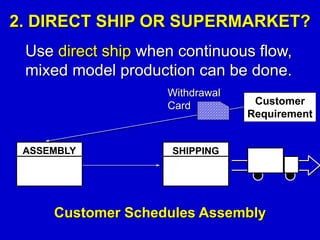
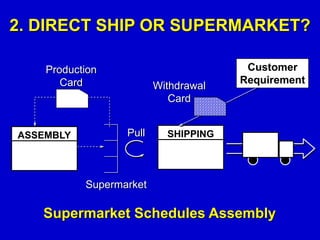
2. DIRECT SHIP OR SUPERMARKET?
Use direct ship when continuous flow,
mixed model production can be done.
ASSEMBLY
Customer
Requirement
Withdrawal
Card
SHIPPING
Customer Schedules Assembly
2. DIRECT SHIP OR SUPERMARKET?
Use supermarkets when batching is
necessary due to:
• Short cycle times in lead-off ops

• Multiple customer cells
• Long setup times
• Long or unreliable processes
• Distant outside supply
SHIPPING
Customer
Requirement
Withdrawal
Card
Pull
Supermarket
Production
Card
ASSEMBLY
Supermarket Schedules Assembly
2. DIRECT SHIP OR SUPERMARKET?
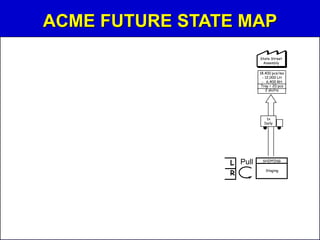
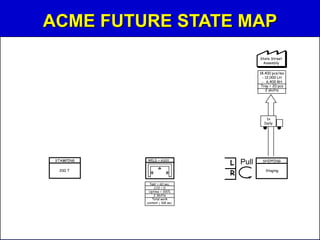
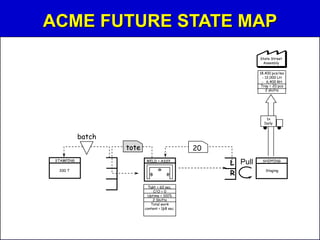
ACME FUTURE STATE MAP
State Street
Assembly
18,400 pcs/mo
- 12,000 LH
- 6,400 RH
Tray = 20 pcs
2 shifts
1x
Daily
SHIPPING
Staging
L
R
Pull
Future State Question #3
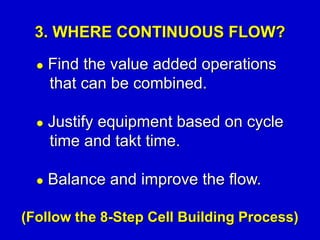
Where can you use continuous flow
processing?
 Find the value added operations
that can be combined.
 Justify equipment based on cycle
time and takt time.
 Balance and improve the flow.
3. WHERE CONTINUOUS FLOW?
(Follow the 8-Step Cell Building Process)
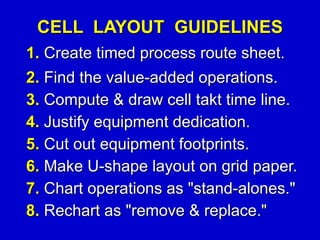
CELL LAYOUT GUIDELINES
2. Find the value-added operations.
3. Compute & draw cell takt time line.
4. Justify equipment dedication.
5. Cut out equipment footprints.
6. Make U-shape layout on grid paper.
7. Chart operations as "stand-alones."
8. Rechart as "remove & replace."
1. Create timed process route sheet.
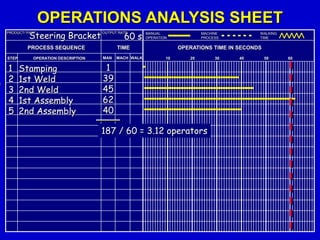
OPERATIONS ANALYSIS SHEET
10 20 30 40 50
OPERATIONS TIME IN SECONDSPROCESS SEQUENCE TIME
STEP OPERATION DESCRIPTION MAN MACH WALK
PRODUCT/ PART OUTPUT RATE MANUAL
OPERATION
MACHINE
PROCESS
WALKING
TIME
60
Stamping
1st Weld
2nd Weld
1st Assembly
2nd Assembly
1
2
3
4
5
Steering Bracket 60 s.
1
39
45
62
40
187 / 60 = 3.12 operators
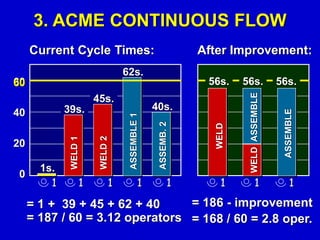
3. ACME CONTINUOUS FLOW
After Improvement:Current Cycle Times:
1 1 1 1 1
39s.
45s.
62s.
1s.
40s.
60
40
20
0
WELD1
WELD2
ASSEMBLE1
ASSEMB.2
60
= 1 + 39 + 45 + 62 + 40
= 187 / 60 = 3.12 operators
= 186 - improvement
= 168 / 60 = 2.8 oper.
1 1 1
56s. 56s. 56s.
WELD
WELDASSEMBLE
ASSEMBLE
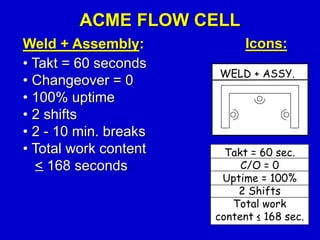
Weld + Assembly:
• Takt = 60 seconds
• Changeover = 0
• 100% uptime
• 2 shifts
• 2 - 10 min. breaks
• Total work content
< 168 seconds
ACME FLOW CELL
Icons:
_
WELD + ASSY.
Takt = 60 sec.
C/O = 0
Uptime = 100%
2 Shifts
Total work
content < 168 sec.-
ACME FUTURE STATE MAP
State Street
Assembly
18,400 pcs/mo
- 12,000 LH
- 6,400 RH
Tray = 20 pcs
2 shifts
1x
Daily
WELD + ASSY.
Takt = 60 sec.
C/O = 0
Uptime = 100%
2 Shifts
Total work
content < 168 sec.-
STAMPING
200 T
SHIPPING
Staging
L
R
Pull
Future State Question #4
Where will you need to use
supermarket pull systems in order to
control production of upstream
processes?
4. WHERE SUPERMARKETS?
Use supermarkets when batching
is necessary due to:
• Short cycle times in lead-off ops
• Multiple customer cells
• Long setup times
• Long or unreliable processes
• Distant outside supply
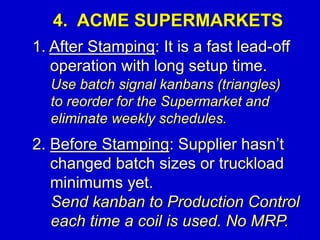
4. ACME SUPERMARKETS
1. After Stamping: It is a fast lead-off
operation with long setup time.
Use batch signal kanbans (triangles)
to reorder for the Supermarket and
eliminate weekly schedules.
2. Before Stamping: Supplier hasn’t
changed batch sizes or truckload
minimums yet.
Send kanban to Production Control
each time a coil is used. No MRP.
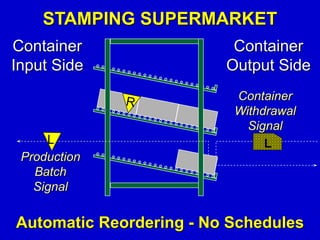
STAMPING SUPERMARKET
Container
Input Side
Container
Output Side
Container
Withdrawal
Signal
L
Production
Batch
Signal
Automatic Reordering - No Schedules
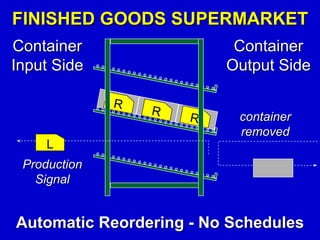
FINISHED GOODS SUPERMARKET
Container
Input Side
Container
Output Side
container
removed
Production
Signal
L
Automatic Reordering - No Schedules
ACME FUTURE STATE MAP
State Street
Assembly
18,400 pcs/mo
- 12,000 LH
- 6,400 RH
Tray = 20 pcs
2 shifts
1x
Daily
WELD + ASSY.
Takt = 60 sec.
C/O = 0
Uptime = 100%
2 Shifts
Total work
content < 168 sec.-
STAMPING
200 T
20tote
batch
SHIPPING
Staging
L
R
Pull
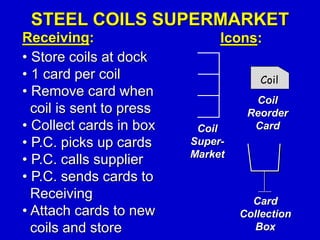
STEEL COILS SUPERMARKET
Receiving:
• Store coils at dock
• 1 card per coil
• Remove card when
coil is sent to press
• Collect cards in box
• P.C. picks up cards
• P.C. calls supplier
• P.C. sends cards to
Receiving
• Attach cards to new
coils and store
Coil
Super-
Market
Coil
Coil
Reorder
Card
Icons:
Card
Collection
Box
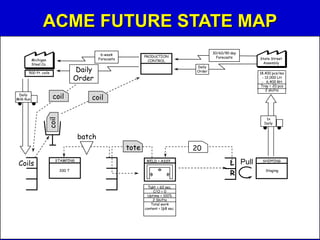
ACME FUTURE STATE MAP
1x
Daily
WELD + ASSY.
Takt = 60 sec.
C/O = 0
Uptime = 100%
2 Shifts
Total work
content < 168 sec.-
STAMPING
200 T
20
coil
coil
tote
batch
Coils
Michigan
Steel Co.
500 ft. coils
PRODUCTION
CONTROL
Daily
Order
6-week
Forecasts
coilDaily
Milk Run
Daily
Order
30/60/90 day
Forecasts State Street
Assembly
18,400 pcs/mo
- 12,000 LH
- 6,400 RH
Tray = 20 pcs
2 shifts
SHIPPING
Staging
L
R
Pull
Coils
5 d.
2 d.
Stamp
Parts
7.6 d.
1.5 d.
Weld/
Assy
WIP
6.5 d.
0
Fin.
Goods
4.5 d.
4.5 d.
Before
So Far
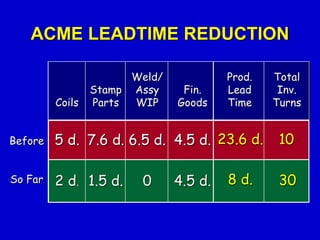
ACME LEADTIME REDUCTION
Prod.
Lead
Time
23.6 d.
8 d.
Total
Inv.
Turns
10
30
Future State Question #5
At what single point (the “pacemaker
process”) in the production chain
will you schedule production?
5. WHERE IS THE PACEMAKER?
• The pacemaker process is the only
one in the value stream that you
schedule.
• It sets the pace for and pulls from
the upstream processes.
• Its output flows through the rest of
the downstream processes.
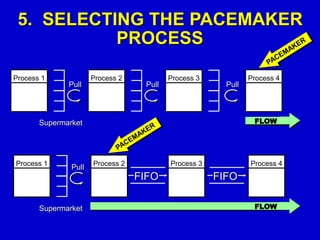
Process 1 Process 2 Process 3 Process 4
Pull Pull Pull
Pull
Supermarket
Supermarket
FLOW
FLOW
5. SELECTING THE PACEMAKER
PROCESS
Pull Pull
FIFO FIFO
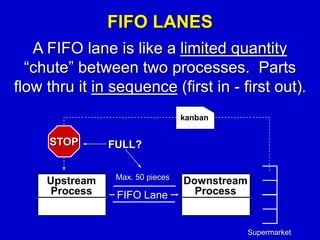
FIFO LANES
Upstream
Process FIFO Lane
Downstream
Process
Max. 50 pieces
Supermarket
kanban
FULL?STOP
A FIFO lane is like a limited quantity
“chute” between two processes. Parts
flow thru it in sequence (first in - first out).
Where is Acme Stamping’s
Pacemaker Process?
ACME FUTURE STATE MAP
1x
Daily
WELD + ASSY.
Takt = 60 sec.
C/O = 0
Uptime = 100%
2 Shifts
Total work
content < 168 sec.-
STAMPING
200 T
20
coil
coil
tote
batch
Coils
Michigan
Steel Co.
500 ft. coils
PRODUCTION
CONTROL
Daily
Order
6-week
Forecasts
coilDaily
Milk Run
Daily
Order
30/60/90 day
Forecasts State Street
Assembly
18,400 pcs/mo
- 12,000 LH
- 6,400 RH
Tray = 20 pcs
2 shifts
SHIPPING
Staging
L
R
Pull
Future State Question #6
How will you level the production
mix at the pacemaker process?
6. HOW TO LEVEL PRODUCT MIX?
Leveling the product mix is distributing
the production of all the products made
at the pacemaker evenly over the
shortest possible time period, leading to:
• Faster customer response
• Shorter leadtimes
• Less supermarket inventory
• No peaks or valleys
• Less expediting
• Fewer rejects
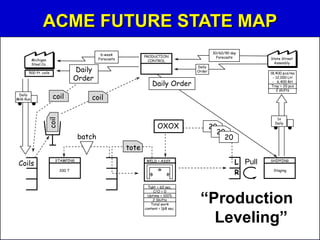
6. ACME PRODUCTION MIX
Daily requirement is 30 trays of Left-drive
units and 16 trays of right-drive brackets.
Normal batch scheduling would be:
1st shift 2nd Shift
LLLLLLLLLLLLLLLLLLLLLLLLLLLLLLRRRRRRRRRRRRRRRR
Level (uniform) schedule would be:
1st shift 2nd Shift
RLLRLLRLLRLLRLLRLLRLLRLLRLLRLLRLLRLLRLLRLLRLL
R
Leveling Icon is: OXOX
6. ACME LEVELING OPTION “A”
1x
Daily
SHIPPING
Staging
PRODUCTION
CONTROL
L
R
WELD + ASSY.
20 20
20
20
20
Daily Order
OXOX
“Withdrawal Leveling”
6. ACME LEVELING OPTION “B”
1x
Daily
SHIPPING
Staging
PRODUCTION
CONTROL
L
R
WELD + ASSY.
20
20
20
20
OXOX
“Production Leveling”
Daily Order
Pull
How should Acme Stamping
LEVEL its production mix?
ACME FUTURE STATE MAP
1x
Daily
SHIPPING
Staging
L
R
WELD + ASSY.
Takt = 60 sec.
C/O = 0
Uptime = 100%
2 Shifts
Total work
content < 168 sec.-
STAMPING
200 T
coil
coil
tote
batch
Coils
Michigan
Steel Co.
500 ft. coils
PRODUCTION
CONTROL
Daily
Order
6-week
Forecasts
coilDaily
Milk Run
Daily Order
20
20
20
OXOX
Daily
Order
30/60/90 day
Forecasts State Street
Assembly
18,400 pcs/mo
- 12,000 LH
- 6,400 RH
Tray = 20 pcs
2 shifts
“Production
Leveling”
Pull
Future State Question #7
What increment of work (drumbeat)
will you consistently release and
take away at the pacemaker
process?
7. WHAT IS THE DRUMBEAT?
The minimum batch of work time (pitch)
that can be released and withdrawn from
a pacemaker to establish a consistant,
level production flow, which enables:
• Takt (demand cycle) time drivers
• Pull system use
• Peaks & valleys minimization
• Visual progress awareness
• Valid priorities & less expediting
• Fast customer response
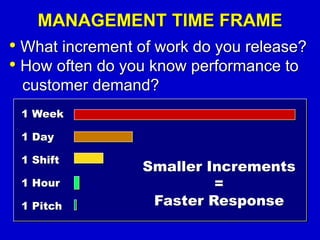
• What increment of work do you release?
• How often do you know performance to
customer demand?
MANAGEMENT TIME FRAME
1 Week
1 Day
1 Shift
1 Hour
1 Pitch
Smaller Increments
=
Faster Response
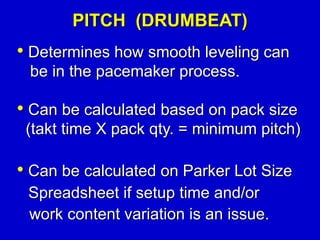
• Determines how smooth leveling can
PITCH (DRUMBEAT)
be in the pacemaker process.
• Can be calculated based on pack size
(takt time X pack qty. = minimum pitch)
For ACME: 60 sec. X 20 pcs = 20 min.
tray
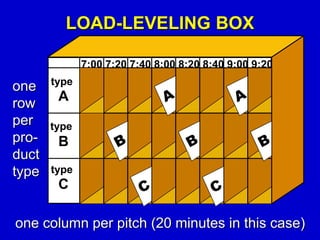
LOAD-LEVELING BOX
type
type
type
A
B
C
one
row
per
pro-
duct
type
one column per pitch (20 minutes in this case)
7:00 7:20 7:40 8:00 8:20 8:40 9:00 9:20
type
type
type
A
B
C
7:00 7:20 7:40 8:00 8:20 8:40 9:00 9:20
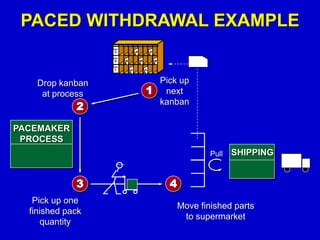
PACEMAKER
PROCESS
SHIPPINGPull
1
Pick up
next
kanban
PACED WITHDRAWAL EXAMPLE
2
Drop kanban
at process
3
Pick up one
finished pack
quantity
4
Move finished parts
to supermarket
• Determines how smooth leveling can
be in the pacemaker process.
• Can be calculated based on pack size
(takt time X pack qty. = minimum pitch)
PITCH (DRUMBEAT)
• Can be calculated on Parker Lot Size
Spreadsheet if setup time and/or
work content variation is an issue.
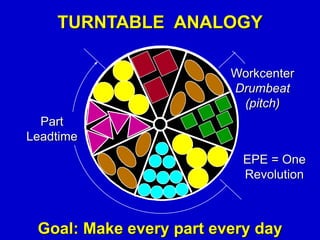
Workcenter
Drumbeat
(pitch)
TURNTABLE ANALOGY
Part
Leadtime
EPE = One
Revolution
Goal: Make every part every day
Future State Question #8
What process improvements will be
necessary for the value stream to
flow as the future-state design
specifies?
8. WHAT MUST BE IMPROVED?
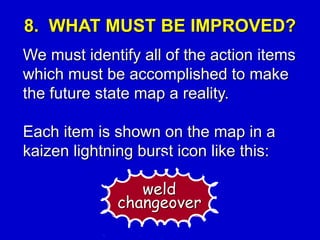
We must identify all of the action items
which must be accomplished to make
the future state map a reality.
Each item is shown on the map in a
kaizen lightning burst icon like this:
weld
changeover
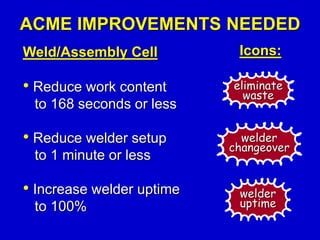
Weld/Assembly Cell
• Reduce work content
to 168 seconds or less
• Reduce welder setup
to 1 minute or less
• Increase welder uptime
to 100%
ACME IMPROVEMENTS NEEDED
Icons:
eliminate
waste
welder
changeover
welder
uptime
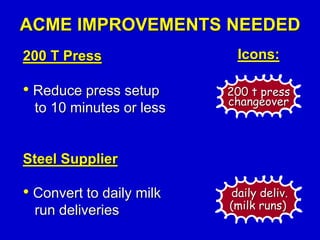
200 T Press
• Reduce press setup
to 10 minutes or less
Steel Supplier
• Convert to daily milk
run deliveries
ACME IMPROVEMENTS NEEDED
Icons:
200 t press
changeover
daily deliv.
(milk runs)
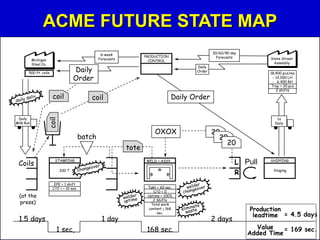
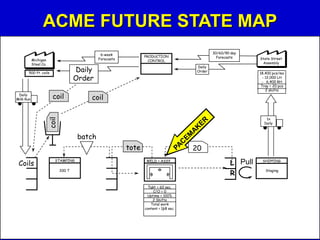
ACME FUTURE STATE MAP
1x
Daily
SHIPPING
Staging
L
R
WELD + ASSY.
Takt = 60 sec.
C/O = 0
Uptime = 100%
2 Shifts
Total work
content < 168
sec.
STAMPING
200 T
coil
coil
tote
batch
Coils
Michigan
Steel Co.
500 ft. coils
PRODUCTION
CONTROL
Daily
Order
6-week
Forecasts
coil
Daily
Milk Run
Daily Order
20
20
20
OXOX
Daily
Order
30/60/90 day
Forecasts State Street
Assembly
18,400 pcs/mo
- 12,000 LH
- 6,400 RH
Tray = 20 pcs
2 shifts
(at the
press)
EPE = 1 shift
C/O = < 10 min.
-
1.5 days
1 sec,
1 day
168 sec.
2 days
Production
leadtime
Value
Added Time
= 4.5 days
= 169 sec.
Pull
Coils
5 d.
2 d.
Stamp
Parts
7.6 d.
1.5 d.
Weld/
Assy
WIP
6.5 d.
0
Fin.
Goods
4.5 d.
4.5 d.
Before
Contin.
Flow &
Pull
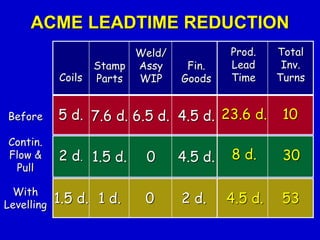
ACME LEADTIME REDUCTION
Prod.
Lead
Time
23.6 d.
8 d.
Total
Inv.
Turns
10
30
1.5 d. 4.5 d.1 d. 0 2 d. 53
With
Levelling
TWI CASE STUDY
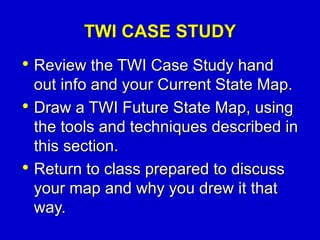
• Review the TWI Case Study hand
out info and your Current State Map.
• Draw a TWI Future State Map, using
the tools and techniques described in
this section.
• Return to class prepared to discuss
your map and why you drew it that
way.
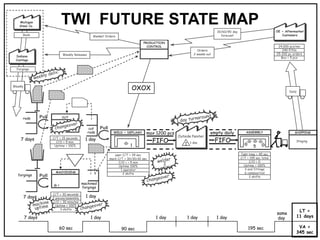
TWI FUTURE STATE MAP
OE + Aftermarket
Customers
24,000 pcs/mo
240 P/N’s
25-200 pc orders
Box = 5 pcs
Daily
SHIPPING
Takt time = 45 sec
C/T = 195 sec total
C/O = 0
Uptime = 100%
3 end fittings
6 combos/rod
2 shifts
WELD + DEFLASH
MACHINING
C/T = 30 seconds
2 pieces/assembly
C/O = 30 minutes
Uptime = 100%
3 shifts
Staging
Weekly
Blanket Orders
Michigan
Steel Co.
CUT
C/T = 15 seconds
C/O = 5 min.
Uptime = 100%
1
oper C/T = 39 sec
mach C/T = 30+30+30 sec
C/O = < 5 min
Uptime 100%
1 operator
2 shifts
Outside Painter
I 1 day
Indiana
Castings
Forgings
Rods
Weekly Releases
PRODUCTION
CONTROL
Orders
2 weeks out
FIFO FIFO
max 1200 pcs empty daily ASSEMBLY
5
OXOX
rods
forgings
7 days
7 days
machined
forgings
cut
rods
Pull
1 day
1 day
7 days 1 day 1 day 1 day
same
day1 day
60 sec 90 sec 195 sec
LT =
11 days
VA =
345 sec
Pull
Pull
1
30/60/90 day
forecast

Value stream mapping (future state)

  • 1.
  • 2.
    VALUE STREAM MAPPINGSTEPS product family current-state drawing future-state drawing work plan future-state drawing
  • 3.
    Future State Questions 1.Desired cycle time (Takt time)? 2. Direct ship or supermarket? 3. Where can we continuous flow? 4. Where must supermarkets be? 5. Where is “pacemaker” process? 6. How will you level product mix? 7. What is the drumbeat? 8. What must you improve to make Demand Material Flow Info Flow Improve- ments it happen?
  • 4.
    Future State Question#1 What is the takt time (desired cycle time), based on the available working time of the downstream processes that are closest to the customer?
  • 5.
    1. DESIRED CYCLE(TAKT) TIME? Takt time is the average interval at which the customer takes your product during a production period. It is the desired cycle time for your entire value-stream process. Producing to Takt time requires: • Short leadtimes (small lots) • Fast setup times • Reliable processes • Fast response to problems
  • 6.
    ACME STAMPING TAKTTIME Available time = Paid time - break time = 8 hours - 20 minutes = 28,800 - 1200 seconds = 27,600 seconds / shift Available time Customer Demand = 27,600 seconds 460 units per shift Desired Cycle Time = 60 seconds
  • 7.
    Future State Question#2 Will you build to a finished goods supermarket, from which the customer pulls, or build directly to shipping?
  • 8.
    2. DIRECT SHIPOR SUPERMARKET? Use direct ship when continuous flow, mixed model production can be done. ASSEMBLY Customer Requirement Withdrawal Card SHIPPING Customer Schedules Assembly
  • 9.
    2. DIRECT SHIPOR SUPERMARKET? Use supermarkets when batching is necessary due to: • Short cycle times in lead-off ops • Multiple customer cells • Long setup times • Long or unreliable processes • Distant outside supply
  • 10.
  • 11.
    ACME FUTURE STATEMAP State Street Assembly 18,400 pcs/mo - 12,000 LH - 6,400 RH Tray = 20 pcs 2 shifts 1x Daily SHIPPING Staging L R Pull
  • 12.
    Future State Question#3 Where can you use continuous flow processing?
  • 13.
     Find thevalue added operations that can be combined.  Justify equipment based on cycle time and takt time.  Balance and improve the flow. 3. WHERE CONTINUOUS FLOW? (Follow the 8-Step Cell Building Process)
  • 14.
    CELL LAYOUT GUIDELINES 2.Find the value-added operations. 3. Compute & draw cell takt time line. 4. Justify equipment dedication. 5. Cut out equipment footprints. 6. Make U-shape layout on grid paper. 7. Chart operations as "stand-alones." 8. Rechart as "remove & replace." 1. Create timed process route sheet.
  • 15.
    OPERATIONS ANALYSIS SHEET 1020 30 40 50 OPERATIONS TIME IN SECONDSPROCESS SEQUENCE TIME STEP OPERATION DESCRIPTION MAN MACH WALK PRODUCT/ PART OUTPUT RATE MANUAL OPERATION MACHINE PROCESS WALKING TIME 60 Stamping 1st Weld 2nd Weld 1st Assembly 2nd Assembly 1 2 3 4 5 Steering Bracket 60 s. 1 39 45 62 40 187 / 60 = 3.12 operators
  • 16.
    3. ACME CONTINUOUSFLOW After Improvement:Current Cycle Times: 1 1 1 1 1 39s. 45s. 62s. 1s. 40s. 60 40 20 0 WELD1 WELD2 ASSEMBLE1 ASSEMB.2 60 = 1 + 39 + 45 + 62 + 40 = 187 / 60 = 3.12 operators = 186 - improvement = 168 / 60 = 2.8 oper. 1 1 1 56s. 56s. 56s. WELD WELDASSEMBLE ASSEMBLE
  • 17.
    Weld + Assembly: •Takt = 60 seconds • Changeover = 0 • 100% uptime • 2 shifts • 2 - 10 min. breaks • Total work content < 168 seconds ACME FLOW CELL Icons: _ WELD + ASSY. Takt = 60 sec. C/O = 0 Uptime = 100% 2 Shifts Total work content < 168 sec.-
  • 18.
    ACME FUTURE STATEMAP State Street Assembly 18,400 pcs/mo - 12,000 LH - 6,400 RH Tray = 20 pcs 2 shifts 1x Daily WELD + ASSY. Takt = 60 sec. C/O = 0 Uptime = 100% 2 Shifts Total work content < 168 sec.- STAMPING 200 T SHIPPING Staging L R Pull
  • 19.
    Future State Question#4 Where will you need to use supermarket pull systems in order to control production of upstream processes?
  • 20.
    4. WHERE SUPERMARKETS? Usesupermarkets when batching is necessary due to: • Short cycle times in lead-off ops • Multiple customer cells • Long setup times • Long or unreliable processes • Distant outside supply
  • 21.
    4. ACME SUPERMARKETS 1.After Stamping: It is a fast lead-off operation with long setup time. Use batch signal kanbans (triangles) to reorder for the Supermarket and eliminate weekly schedules. 2. Before Stamping: Supplier hasn’t changed batch sizes or truckload minimums yet. Send kanban to Production Control each time a coil is used. No MRP.
  • 22.
    STAMPING SUPERMARKET Container Input Side Container OutputSide Container Withdrawal Signal L Production Batch Signal Automatic Reordering - No Schedules
  • 23.
    FINISHED GOODS SUPERMARKET Container InputSide Container Output Side container removed Production Signal L Automatic Reordering - No Schedules
  • 24.
    ACME FUTURE STATEMAP State Street Assembly 18,400 pcs/mo - 12,000 LH - 6,400 RH Tray = 20 pcs 2 shifts 1x Daily WELD + ASSY. Takt = 60 sec. C/O = 0 Uptime = 100% 2 Shifts Total work content < 168 sec.- STAMPING 200 T 20tote batch SHIPPING Staging L R Pull
  • 25.
    STEEL COILS SUPERMARKET Receiving: •Store coils at dock • 1 card per coil • Remove card when coil is sent to press • Collect cards in box • P.C. picks up cards • P.C. calls supplier • P.C. sends cards to Receiving • Attach cards to new coils and store Coil Super- Market Coil Coil Reorder Card Icons: Card Collection Box
  • 26.
    ACME FUTURE STATEMAP 1x Daily WELD + ASSY. Takt = 60 sec. C/O = 0 Uptime = 100% 2 Shifts Total work content < 168 sec.- STAMPING 200 T 20 coil coil tote batch Coils Michigan Steel Co. 500 ft. coils PRODUCTION CONTROL Daily Order 6-week Forecasts coilDaily Milk Run Daily Order 30/60/90 day Forecasts State Street Assembly 18,400 pcs/mo - 12,000 LH - 6,400 RH Tray = 20 pcs 2 shifts SHIPPING Staging L R Pull
  • 27.
    Coils 5 d. 2 d. Stamp Parts 7.6d. 1.5 d. Weld/ Assy WIP 6.5 d. 0 Fin. Goods 4.5 d. 4.5 d. Before So Far ACME LEADTIME REDUCTION Prod. Lead Time 23.6 d. 8 d. Total Inv. Turns 10 30
  • 28.
    Future State Question#5 At what single point (the “pacemaker process”) in the production chain will you schedule production?
  • 29.
    5. WHERE ISTHE PACEMAKER? • The pacemaker process is the only one in the value stream that you schedule. • It sets the pace for and pulls from the upstream processes. • Its output flows through the rest of the downstream processes.
  • 30.
    Process 1 Process2 Process 3 Process 4 Process 1 Process 2 Process 3 Process 4 Pull Pull Pull Pull Supermarket Supermarket FLOW FLOW 5. SELECTING THE PACEMAKER PROCESS Pull Pull FIFO FIFO
  • 31.
    FIFO LANES Upstream Process FIFOLane Downstream Process Max. 50 pieces Supermarket kanban FULL?STOP A FIFO lane is like a limited quantity “chute” between two processes. Parts flow thru it in sequence (first in - first out).
  • 32.
    Where is AcmeStamping’s Pacemaker Process?
  • 33.
    ACME FUTURE STATEMAP 1x Daily WELD + ASSY. Takt = 60 sec. C/O = 0 Uptime = 100% 2 Shifts Total work content < 168 sec.- STAMPING 200 T 20 coil coil tote batch Coils Michigan Steel Co. 500 ft. coils PRODUCTION CONTROL Daily Order 6-week Forecasts coilDaily Milk Run Daily Order 30/60/90 day Forecasts State Street Assembly 18,400 pcs/mo - 12,000 LH - 6,400 RH Tray = 20 pcs 2 shifts SHIPPING Staging L R Pull
  • 34.
    Future State Question#6 How will you level the production mix at the pacemaker process?
  • 35.
    6. HOW TOLEVEL PRODUCT MIX? Leveling the product mix is distributing the production of all the products made at the pacemaker evenly over the shortest possible time period, leading to: • Faster customer response • Shorter leadtimes • Less supermarket inventory • No peaks or valleys • Less expediting • Fewer rejects
  • 36.
    6. ACME PRODUCTIONMIX Daily requirement is 30 trays of Left-drive units and 16 trays of right-drive brackets. Normal batch scheduling would be: 1st shift 2nd Shift LLLLLLLLLLLLLLLLLLLLLLLLLLLLLLRRRRRRRRRRRRRRRR Level (uniform) schedule would be: 1st shift 2nd Shift RLLRLLRLLRLLRLLRLLRLLRLLRLLRLLRLLRLLRLLRLLRLL R Leveling Icon is: OXOX
  • 37.
    6. ACME LEVELINGOPTION “A” 1x Daily SHIPPING Staging PRODUCTION CONTROL L R WELD + ASSY. 20 20 20 20 20 Daily Order OXOX “Withdrawal Leveling”
  • 38.
    6. ACME LEVELINGOPTION “B” 1x Daily SHIPPING Staging PRODUCTION CONTROL L R WELD + ASSY. 20 20 20 20 OXOX “Production Leveling” Daily Order Pull
  • 39.
    How should AcmeStamping LEVEL its production mix?
  • 40.
    ACME FUTURE STATEMAP 1x Daily SHIPPING Staging L R WELD + ASSY. Takt = 60 sec. C/O = 0 Uptime = 100% 2 Shifts Total work content < 168 sec.- STAMPING 200 T coil coil tote batch Coils Michigan Steel Co. 500 ft. coils PRODUCTION CONTROL Daily Order 6-week Forecasts coilDaily Milk Run Daily Order 20 20 20 OXOX Daily Order 30/60/90 day Forecasts State Street Assembly 18,400 pcs/mo - 12,000 LH - 6,400 RH Tray = 20 pcs 2 shifts “Production Leveling” Pull
  • 41.
    Future State Question#7 What increment of work (drumbeat) will you consistently release and take away at the pacemaker process?
  • 42.
    7. WHAT ISTHE DRUMBEAT? The minimum batch of work time (pitch) that can be released and withdrawn from a pacemaker to establish a consistant, level production flow, which enables: • Takt (demand cycle) time drivers • Pull system use • Peaks & valleys minimization • Visual progress awareness • Valid priorities & less expediting • Fast customer response
  • 43.
    • What incrementof work do you release? • How often do you know performance to customer demand? MANAGEMENT TIME FRAME 1 Week 1 Day 1 Shift 1 Hour 1 Pitch Smaller Increments = Faster Response
  • 44.
    • Determines howsmooth leveling can PITCH (DRUMBEAT) be in the pacemaker process. • Can be calculated based on pack size (takt time X pack qty. = minimum pitch) For ACME: 60 sec. X 20 pcs = 20 min. tray
  • 45.
    LOAD-LEVELING BOX type type type A B C one row per pro- duct type one columnper pitch (20 minutes in this case) 7:00 7:20 7:40 8:00 8:20 8:40 9:00 9:20
  • 46.
    type type type A B C 7:00 7:20 7:408:00 8:20 8:40 9:00 9:20 PACEMAKER PROCESS SHIPPINGPull 1 Pick up next kanban PACED WITHDRAWAL EXAMPLE 2 Drop kanban at process 3 Pick up one finished pack quantity 4 Move finished parts to supermarket
  • 47.
    • Determines howsmooth leveling can be in the pacemaker process. • Can be calculated based on pack size (takt time X pack qty. = minimum pitch) PITCH (DRUMBEAT) • Can be calculated on Parker Lot Size Spreadsheet if setup time and/or work content variation is an issue.
  • 48.
    Workcenter Drumbeat (pitch) TURNTABLE ANALOGY Part Leadtime EPE =One Revolution Goal: Make every part every day
  • 49.
    Future State Question#8 What process improvements will be necessary for the value stream to flow as the future-state design specifies?
  • 50.
    8. WHAT MUSTBE IMPROVED? We must identify all of the action items which must be accomplished to make the future state map a reality. Each item is shown on the map in a kaizen lightning burst icon like this: weld changeover
  • 51.
    Weld/Assembly Cell • Reducework content to 168 seconds or less • Reduce welder setup to 1 minute or less • Increase welder uptime to 100% ACME IMPROVEMENTS NEEDED Icons: eliminate waste welder changeover welder uptime
  • 52.
    200 T Press •Reduce press setup to 10 minutes or less Steel Supplier • Convert to daily milk run deliveries ACME IMPROVEMENTS NEEDED Icons: 200 t press changeover daily deliv. (milk runs)
  • 53.
    ACME FUTURE STATEMAP 1x Daily SHIPPING Staging L R WELD + ASSY. Takt = 60 sec. C/O = 0 Uptime = 100% 2 Shifts Total work content < 168 sec. STAMPING 200 T coil coil tote batch Coils Michigan Steel Co. 500 ft. coils PRODUCTION CONTROL Daily Order 6-week Forecasts coil Daily Milk Run Daily Order 20 20 20 OXOX Daily Order 30/60/90 day Forecasts State Street Assembly 18,400 pcs/mo - 12,000 LH - 6,400 RH Tray = 20 pcs 2 shifts (at the press) EPE = 1 shift C/O = < 10 min. - 1.5 days 1 sec, 1 day 168 sec. 2 days Production leadtime Value Added Time = 4.5 days = 169 sec. Pull
  • 54.
    Coils 5 d. 2 d. Stamp Parts 7.6d. 1.5 d. Weld/ Assy WIP 6.5 d. 0 Fin. Goods 4.5 d. 4.5 d. Before Contin. Flow & Pull ACME LEADTIME REDUCTION Prod. Lead Time 23.6 d. 8 d. Total Inv. Turns 10 30 1.5 d. 4.5 d.1 d. 0 2 d. 53 With Levelling
  • 55.
    TWI CASE STUDY •Review the TWI Case Study hand out info and your Current State Map. • Draw a TWI Future State Map, using the tools and techniques described in this section. • Return to class prepared to discuss your map and why you drew it that way.
  • 56.
    TWI FUTURE STATEMAP OE + Aftermarket Customers 24,000 pcs/mo 240 P/N’s 25-200 pc orders Box = 5 pcs Daily SHIPPING Takt time = 45 sec C/T = 195 sec total C/O = 0 Uptime = 100% 3 end fittings 6 combos/rod 2 shifts WELD + DEFLASH MACHINING C/T = 30 seconds 2 pieces/assembly C/O = 30 minutes Uptime = 100% 3 shifts Staging Weekly Blanket Orders Michigan Steel Co. CUT C/T = 15 seconds C/O = 5 min. Uptime = 100% 1 oper C/T = 39 sec mach C/T = 30+30+30 sec C/O = < 5 min Uptime 100% 1 operator 2 shifts Outside Painter I 1 day Indiana Castings Forgings Rods Weekly Releases PRODUCTION CONTROL Orders 2 weeks out FIFO FIFO max 1200 pcs empty daily ASSEMBLY 5 OXOX rods forgings 7 days 7 days machined forgings cut rods Pull 1 day 1 day 7 days 1 day 1 day 1 day same day1 day 60 sec 90 sec 195 sec LT = 11 days VA = 345 sec Pull Pull 1 30/60/90 day forecast