Value Stream Mapping (VSM) Overview  Presented By: Jeffrey Heaton
What is Value Stream Mapping? A  visual   tool to help  see  and  understand  the  flow of material and information . Map of all actions currently required to deliver a  Product or Service. Big picture perspective that focuses on  improving the whole ,  not optimizing pieces of the  process. A pencil and paper tool that requires  physically  observing the process .
Why Map a Value Stream? To highlight sources of  waste  &  defects  and put in place a plan to eliminate them. Shows the linkage between the  information flow  and  material flow . To see  across the functional boundaries  over which a service or product’s value stream flows.
How Value Stream Mapping Helps? Helps visualize  the whole flow …  not an isolated process. Critical step on Roadmap for Lean implementation. Excellent tool to describe what  actions  are needed  to meet business goals .
Uses for Value Stream Mapping To help understand how your business  actually works (it is difficult to understand  the current process if you can’t draw it). A visual tool and common language for  talking about your business process.
Don’t Forget... The point of value stream mapping is not about creating the maps, but to really  understand the flow of information   and material  and then  use that understanding to improve your business .
The Art of Value Stream Mapping Value Stream Mapping seeks out  WASTE  & DEFECTS ! This requires you to be sensitive to  WASTE  & DEFECTS ! We recommend: You Constantly Look for  Waste & Defects !  You Constantly Listen for  Waste  & Defects !
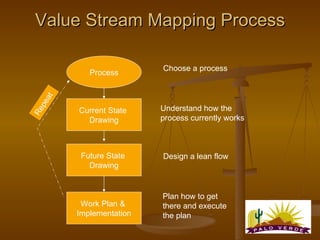
Value Stream Mapping Process Current State  Drawing Process Future State  Drawing Work Plan &  Implementation Choose a process Understand how the process currently works Design a lean flow Plan how to get there and execute the plan Repeat
What is a Current State Map? A pictorial view showing how a service, material and information currently flow. Emphasis should be on what actually takes place in the field, not just what the governing documents state.
Why Map the Current State? To  see the entire value stream ...not only an isolated operation or process. To show the process simply and visually. To clarify an organization’s understanding of how the current system “really works”. To  create a baseline  for future improvements to be made and measured.
Current State Mapping Process Steps Gather information about the customer Walk the process - sketch process boxes Fill in data boxes and inventory levels Document how goods/services are delivered to the customer
Current State Mapping Process Steps (cont’d) Gather information on suppliers. Add information flows. Sketch how material moves between processes. Draw production lead time/processing timeline.
Improvement Targets Gather Key Performance Indicators and record for the current state performance These metrics will be used to measure improvements gained in the improvement effort  Current State vs. Future State
Examples of Improvement Targets Reducing cycle time. Reducing inventory. Cost / Resource reduction. Increasing available capacity. Decreasing space. Reducing order lead time. Reducing scrap, rework or repair.
What is a Future State Map? Visual representation of improved material  and information flow. Unites Lean concepts and techniques. Used to drive detailed implementation plans.
Targeting your Future State What type of improvements are needed and why? What is the timeframe for achieving improvements? Have budgets been established to manage the costs of improvements? Are all stakeholders aligned?
Future State Questions What is the takt time (customer demand frequency) for the chosen service, product or product family? Where can you use continuous flow? At what single point in the production chain will you trigger (schedule) actions? Should you build to customer order or to stock?
Future State Questions Is there any batching that needs to be done or can it be a “single piece flow”? What process improvements will be necessary for the value stream to flow as your future state design specifies?
Implementation Planning Achieving future state is the goal of value stream mapping. Keys to success... Tasks identified and scheduled. Tasks assigned to individuals or teams. Required support obtained. Regular reviews to adhere to plan. Knowledge and support from management sponsor and leadership team.
Implementation Planning Guidelines Develop a realistic timeline. Prioritized action items supporting the improvement/transition process ( e.g., critical path). Hold regular reviews on adherence to the plan. Develop a plan to deal with issues/corrective actions. Keep management and the workforce informed of any changes that need to be made. Maintain the plan and  stick to it .
Value Stream Implementation Plan Plan will show you: Exactly what to do and when to do it, Measurable goals. Clear milestones. The names of those responsible for the task, additional resources required, as well as reviewers. How it maps to your business objectives.

Value Stream Mapping Overview Update

  • 1.
    Value Stream Mapping(VSM) Overview Presented By: Jeffrey Heaton
  • 2.
    What is ValueStream Mapping? A visual tool to help see and understand the flow of material and information . Map of all actions currently required to deliver a Product or Service. Big picture perspective that focuses on improving the whole , not optimizing pieces of the process. A pencil and paper tool that requires physically observing the process .
  • 3.
    Why Map aValue Stream? To highlight sources of waste & defects and put in place a plan to eliminate them. Shows the linkage between the information flow and material flow . To see across the functional boundaries over which a service or product’s value stream flows.
  • 4.
    How Value StreamMapping Helps? Helps visualize the whole flow … not an isolated process. Critical step on Roadmap for Lean implementation. Excellent tool to describe what actions are needed to meet business goals .
  • 5.
    Uses for ValueStream Mapping To help understand how your business actually works (it is difficult to understand the current process if you can’t draw it). A visual tool and common language for talking about your business process.
  • 6.
    Don’t Forget... Thepoint of value stream mapping is not about creating the maps, but to really understand the flow of information and material and then use that understanding to improve your business .
  • 7.
    The Art ofValue Stream Mapping Value Stream Mapping seeks out WASTE & DEFECTS ! This requires you to be sensitive to WASTE & DEFECTS ! We recommend: You Constantly Look for Waste & Defects ! You Constantly Listen for Waste & Defects !
  • 8.
    Value Stream MappingProcess Current State Drawing Process Future State Drawing Work Plan & Implementation Choose a process Understand how the process currently works Design a lean flow Plan how to get there and execute the plan Repeat
  • 9.
    What is aCurrent State Map? A pictorial view showing how a service, material and information currently flow. Emphasis should be on what actually takes place in the field, not just what the governing documents state.
  • 10.
    Why Map theCurrent State? To see the entire value stream ...not only an isolated operation or process. To show the process simply and visually. To clarify an organization’s understanding of how the current system “really works”. To create a baseline for future improvements to be made and measured.
  • 11.
    Current State MappingProcess Steps Gather information about the customer Walk the process - sketch process boxes Fill in data boxes and inventory levels Document how goods/services are delivered to the customer
  • 12.
    Current State MappingProcess Steps (cont’d) Gather information on suppliers. Add information flows. Sketch how material moves between processes. Draw production lead time/processing timeline.
  • 13.
    Improvement Targets GatherKey Performance Indicators and record for the current state performance These metrics will be used to measure improvements gained in the improvement effort Current State vs. Future State
  • 14.
    Examples of ImprovementTargets Reducing cycle time. Reducing inventory. Cost / Resource reduction. Increasing available capacity. Decreasing space. Reducing order lead time. Reducing scrap, rework or repair.
  • 15.
    What is aFuture State Map? Visual representation of improved material and information flow. Unites Lean concepts and techniques. Used to drive detailed implementation plans.
  • 16.
    Targeting your FutureState What type of improvements are needed and why? What is the timeframe for achieving improvements? Have budgets been established to manage the costs of improvements? Are all stakeholders aligned?
  • 17.
    Future State QuestionsWhat is the takt time (customer demand frequency) for the chosen service, product or product family? Where can you use continuous flow? At what single point in the production chain will you trigger (schedule) actions? Should you build to customer order or to stock?
  • 18.
    Future State QuestionsIs there any batching that needs to be done or can it be a “single piece flow”? What process improvements will be necessary for the value stream to flow as your future state design specifies?
  • 19.
    Implementation Planning Achievingfuture state is the goal of value stream mapping. Keys to success... Tasks identified and scheduled. Tasks assigned to individuals or teams. Required support obtained. Regular reviews to adhere to plan. Knowledge and support from management sponsor and leadership team.
  • 20.
    Implementation Planning GuidelinesDevelop a realistic timeline. Prioritized action items supporting the improvement/transition process ( e.g., critical path). Hold regular reviews on adherence to the plan. Develop a plan to deal with issues/corrective actions. Keep management and the workforce informed of any changes that need to be made. Maintain the plan and stick to it .
  • 21.
    Value Stream ImplementationPlan Plan will show you: Exactly what to do and when to do it, Measurable goals. Clear milestones. The names of those responsible for the task, additional resources required, as well as reviewers. How it maps to your business objectives.