Mouhcine NAHAL
mouhcine.nahal@gmail.com
What is Value Stream Mapping?
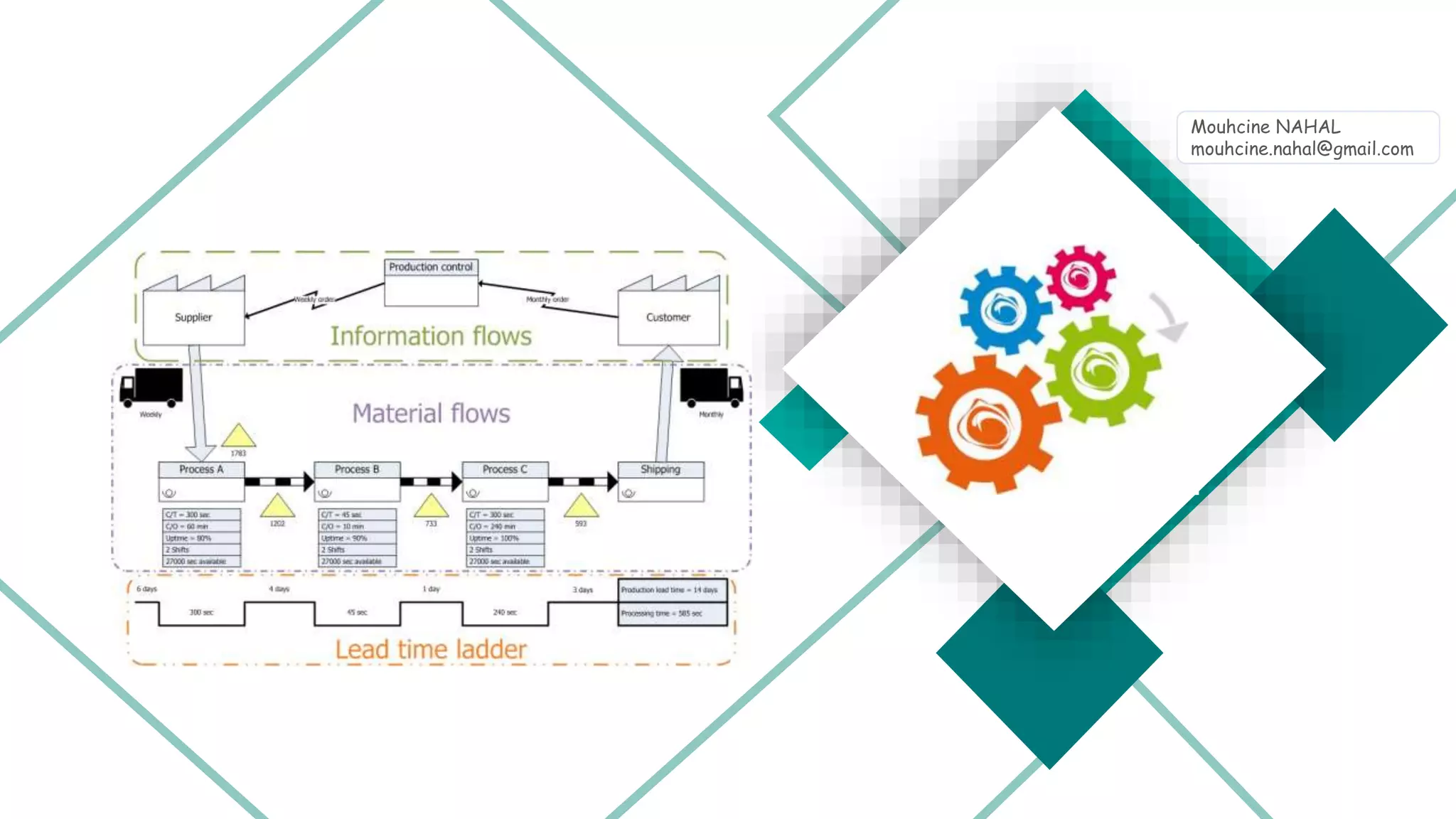
→ Value Stream Mapping is a graphical tool that helps us to see and understand the flow of process and
information as a product and service.
→ It is an improvement tool that is visualizing the entire operation of manufacturing or service representing
both material and information flow.
→ It is one of the best Lean Tool to eliminate waste.
→ A value stream usually includes people, tools and technologies, physical facilities, and communication
channels, etc...
→ This tool is associated with the manufacturing industry in major cases.
→ It can also be applied in various industries like Product development, Service-related industries:
e.g. healthcare, insurance, hospitality, and logistics, etc…
→ VSM Study is one of the important in the Lean Six Sigma Project.
History:
→ T. Ohno from Toyota Production gave the concept of a Value Stream Mapping in 1988.
→ It was introduced as 'Material and Information Flow Mapping’.
→ Later it is named as Value Stream Mapping by John Shook and Mike Rother.
→ Value Stream Mapping puts all the information in one place and it is a very much effective method
as compared to other tools.
→ This tool is also used in Six Sigma Projects.
What is Value?
→ "Value" is a product or service that the customer is buying.
→ It is the capability to provide a product or a service having the highest quality, at an appropriate
price, and at the right time as defined by the customer.
→ Customer’s expectation of value may be, price, quality, reliable delivery, rapid response to changing
needs, etc.……
What is a Value Stream?
→ “Value Stream” is to identify the wasteful activity from the system and eliminate it from the system.
→ This happens by checking all small activities from start to end which is necessary to convert all
input into an output.
→ The value chain refers to all of the activities within an organization.
→ While a Value Stream focuses on that activity which adds value in a service or in a product.
Different things flow through the Stream:
→ In manufacturing or distribution, materials flow.
→ Patients flow in health services
→ Information flows in office areas.
→ Internal customer flows in administration.
→ So, in various system services, information, or product flow.
Reason for Mapping & Analysis :
→ Find out the relationship between operation steps
→ We can get information and also we can have an actual illustration of the current process
→ For setting the improvement targets for the organization
→ Identify improvement opportunity
→ Provide product or service the highest quality, at an appropriate price, and at the right time as
defined by the customer
→ Design (concept to a customer)
→ Build (order to delivery)
→ Sustain (in-use through the life cycle to service)
Objectives:
→ To identify improvement possibilities in the entire operation flow and supply chain.
→ By eliminating lean wastes and improve the performances.
→ To improve efficiency.
→ Satisfy our customers with our service.
→ Performance improvement of the operation.
Team Members and Roles in VSM Study Project:
1. Executive Sponsor
2. Process Owner
3. VSM Coach (Facilitator)
4. Workshop/office Participants
Team Members and Roles in VSM Study Project:
[1] Executive Sponsor:
→ Executive Sponsor is the owner of the Charter
→ He/She decide the team members for the project
→ Executive Sponsor is responsible for ensuring the member's participation.
→ Ongoing project status is presented by the Executive Sponsor.
→ He/She takes part in define the scope, start the project, Active team member of review, audit &
follow-ups committee
Team Members and Roles in VSM Study Project:
[2] Process Owner:
→ They are responsible for the whole operation flow and they lead the VSM project from beginning to
end.
→ They take ownership during the VSM event
→ All meetings, progress, and MOMs are maintained by the Process Owner.
→ Ensures action item pre-work is complete for scoping, workshop/office, and reviews
→ Conduct the review of the implementation plan at a certain interval.
→ He/She gives information to sponsor about the progress of the project.
Team Members and Roles in VSM Study Project:
[3] VSM Coach:
→ VSM coach provides coaching to Process Owner and team.
→ He/She is responsible for defining the scope of the project.
→ Gives training to the VSM team and give coaching to the team.
→ VSM Coach gives training on Lean Manufacturing to the team.
→ Provide training on lean skills to all participants.
Team Members and Roles in VSM Study Project:
[4] Workshop/office Participants:
→ Participate in the VSM project as a Subject Matter Expert (SME)
→ All Workshop/office Participants are responsible for the operation steps.
→ They support the VSM project successfully run.
How to create a Value Stream Mapping?:
→ It is a team exercise so all department representatives should participate in this event.
→ This project should be lead by the expert and can guide other team members for the successful
project.
→ The best method of making Value Stream Mapping is by hand using a pencil and A3 drawing sheet.
→ During creating the process map all participants should be involved in this activity is always a
better decision.
→ Begin with a quick walk through the entire operation
→ Always trust on your own taken data
→ Map the whole operation flow yourself.
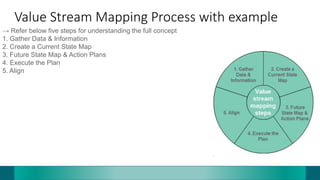
Value Stream Mapping Process with example
→ Refer below five steps for understanding the full concept
1. Gather Data & Information
2. Create a Current State Map
3. Future State Map & Action Plans
4. Execute the Plan
5. Align
Step 1 - Gather Data and Information:
→ Refer below five steps for understanding the full concept
→ Gather Information:
→ Define the start & end of the operation flow
→ Define the criteria for data collection
→ Walk and observe the actual workplace
→ Take all the information related to each and every step.
→ Measure actual lead time, actual cycle time, on-time delivery rate, and defect rate, etc...
Step 2 - Create a Current State Map
→ Refer below five steps for understanding the full concept
→ Record the detail about the current flow material or information.
→ Make an analysis of the data
→ In the current state of the VSM study, we have to mention the actual readings or data of the
operation flow.
→ In this stage, we do not have to worry about the future of the process.
→ We have to mention just as the process is and it should show the real picture of the ongoing
operation flow.
→ Then after we can check the possibility of improvement.
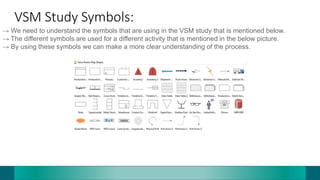
VSM Study Symbols:
→ We need to understand the symbols that are using in the VSM study that is mentioned below.
→ The different symbols are used for a different activity that is mentioned in the below picture.
→ By using these symbols we can make a more clear understanding of the process.
Collecting Data and Time Studies in VSM Study:
→ We need to understand the symbols that are using in the VSM study that is mentioned below.
→ This is a very important step in the entire study.
→ There are a few ways in which we get information.
→ The first, we get the data directly from the industry by contacting all relevant personnel.
→ Take the operation sequence flow and work instruction data from the company, as well as
observed.
→ The process in actual, and conduct own time studies to get exact information about the
processing time.
→ During the walk carefully observe all operation steps and ask as many as possible questions.
→ And collect all data related to that operation.
Examples of data required in this study:
→ No. of work in progress
→ Cycle Times for each operation
→ Inspection or testing time
→ Check for the wasteful activity
→ Waiting time and working time etc…
Process Steps in VSM Study:
→ Mention the process flow as actual it is.
→ Write down all operation steps in the format box and add all data in this box.
→ Note down inventory days, delay time, wait time, and working time
→ Then calculate all working time and waiting time.
→ Find out the Process Cycle Efficiency as calculation mentioned in the below picture.
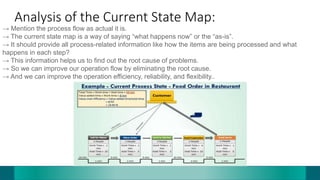
Analysis of the Current State Map:
→ Mention the process flow as actual it is.
→ The current state map is a way of saying “what happens now” or the “as-is”.
→ It should provide all process-related information like how the items are being processed and what
happens in each step?
→ This information helps us to find out the root cause of problems.
→ So we can improve our operation flow by eliminating the root cause.
→ And we can improve the operation efficiency, reliability, and flexibility..
Step 3 – Future State Map & Action Plans:
→ Discuss the ideal state
→ Develop the future state map & action plan
→ Build a draft timeline for implementation
→ Communication & training as required
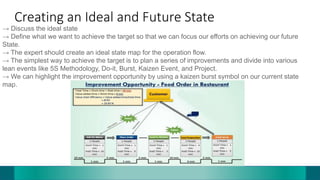
Creating an Ideal and Future State
→ Discuss the ideal state
→ Define what we want to achieve the target so that we can focus our efforts on achieving our future
State.
→ The expert should create an ideal state map for the operation flow.
→ The simplest way to achieve the target is to plan a series of improvements and divide into various
lean events like 5S Methodology, Do-it, Burst, Kaizen Event, and Project.
→ We can highlight the improvement opportunity by using a kaizen burst symbol on our current state
map.
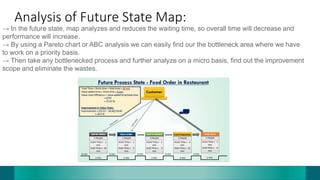
Analysis of Future State Map:
→ In the future state, map analyzes and reduces the waiting time, so overall time will decrease and
performance will increase.
→ By using a Pareto chart or ABC analysis we can easily find our the bottleneck area where we have
to work on a priority basis.
→ Then take any bottlenecked process and further analyze on a micro basis, find out the improvement
scope and eliminate the wastes.
Step 4 – Execute the Plan:
→ Implement improvements
→ Conduct Workshops, events, projects, bursts per the implementation plan
→ Achieve value stream objectives
→ Create an environment of Continuous Improvement or Kaizen.
→ During the execution of the plan eliminate all wasteful activity from the system or process flow.
Step 5 – Align & Analysis of Current and Future
State:
→ Arrange analysis and alignment meeting
→ Periodic basis (based on action plan schedule)
→ Review event implementations & results
→ Evaluate the impact to value stream metrics (individual events and overall)
→ Review next quarter events
→ Inspect changes in a business environment
→ Communicate results
→ Update implementation plan as required
→ Address resistance and sustainment issues
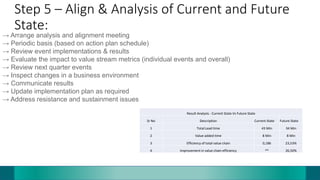
Result Analysis - Current State Vs Future State
Sr No Description Current State Future State
1 Total Lead time 43 Min 34 Min
2 Value added time 8 Min 8 Min
3 Efficiency of total value chain 0,186 23,53%
4 Improvement in value chain efficiency ** 26,50%
Keys Points for Successful VSM Study:
→ Select the right person in the VSM project team.
→ Give specific decision-making authority to the team member for the successful project run.
→ All team members give their participants effectively and efficiently.
→ Always attack the process, Don't attack people
→ Frequently analyze the progress of the project and motivate people for a successful project.

Value stream mapping study with example

  • 1.
  • 2.
    What is ValueStream Mapping? → Value Stream Mapping is a graphical tool that helps us to see and understand the flow of process and information as a product and service. → It is an improvement tool that is visualizing the entire operation of manufacturing or service representing both material and information flow. → It is one of the best Lean Tool to eliminate waste. → A value stream usually includes people, tools and technologies, physical facilities, and communication channels, etc... → This tool is associated with the manufacturing industry in major cases. → It can also be applied in various industries like Product development, Service-related industries: e.g. healthcare, insurance, hospitality, and logistics, etc… → VSM Study is one of the important in the Lean Six Sigma Project.
  • 3.
    History: → T. Ohnofrom Toyota Production gave the concept of a Value Stream Mapping in 1988. → It was introduced as 'Material and Information Flow Mapping’. → Later it is named as Value Stream Mapping by John Shook and Mike Rother. → Value Stream Mapping puts all the information in one place and it is a very much effective method as compared to other tools. → This tool is also used in Six Sigma Projects.
  • 4.
    What is Value? →"Value" is a product or service that the customer is buying. → It is the capability to provide a product or a service having the highest quality, at an appropriate price, and at the right time as defined by the customer. → Customer’s expectation of value may be, price, quality, reliable delivery, rapid response to changing needs, etc.……
  • 5.
    What is aValue Stream? → “Value Stream” is to identify the wasteful activity from the system and eliminate it from the system. → This happens by checking all small activities from start to end which is necessary to convert all input into an output. → The value chain refers to all of the activities within an organization. → While a Value Stream focuses on that activity which adds value in a service or in a product.
  • 6.
    Different things flowthrough the Stream: → In manufacturing or distribution, materials flow. → Patients flow in health services → Information flows in office areas. → Internal customer flows in administration. → So, in various system services, information, or product flow.
  • 7.
    Reason for Mapping& Analysis : → Find out the relationship between operation steps → We can get information and also we can have an actual illustration of the current process → For setting the improvement targets for the organization → Identify improvement opportunity → Provide product or service the highest quality, at an appropriate price, and at the right time as defined by the customer → Design (concept to a customer) → Build (order to delivery) → Sustain (in-use through the life cycle to service)
  • 8.
    Objectives: → To identifyimprovement possibilities in the entire operation flow and supply chain. → By eliminating lean wastes and improve the performances. → To improve efficiency. → Satisfy our customers with our service. → Performance improvement of the operation.
  • 9.
    Team Members andRoles in VSM Study Project: 1. Executive Sponsor 2. Process Owner 3. VSM Coach (Facilitator) 4. Workshop/office Participants
  • 10.
    Team Members andRoles in VSM Study Project: [1] Executive Sponsor: → Executive Sponsor is the owner of the Charter → He/She decide the team members for the project → Executive Sponsor is responsible for ensuring the member's participation. → Ongoing project status is presented by the Executive Sponsor. → He/She takes part in define the scope, start the project, Active team member of review, audit & follow-ups committee
  • 11.
    Team Members andRoles in VSM Study Project: [2] Process Owner: → They are responsible for the whole operation flow and they lead the VSM project from beginning to end. → They take ownership during the VSM event → All meetings, progress, and MOMs are maintained by the Process Owner. → Ensures action item pre-work is complete for scoping, workshop/office, and reviews → Conduct the review of the implementation plan at a certain interval. → He/She gives information to sponsor about the progress of the project.
  • 12.
    Team Members andRoles in VSM Study Project: [3] VSM Coach: → VSM coach provides coaching to Process Owner and team. → He/She is responsible for defining the scope of the project. → Gives training to the VSM team and give coaching to the team. → VSM Coach gives training on Lean Manufacturing to the team. → Provide training on lean skills to all participants.
  • 13.
    Team Members andRoles in VSM Study Project: [4] Workshop/office Participants: → Participate in the VSM project as a Subject Matter Expert (SME) → All Workshop/office Participants are responsible for the operation steps. → They support the VSM project successfully run.
  • 14.
    How to createa Value Stream Mapping?: → It is a team exercise so all department representatives should participate in this event. → This project should be lead by the expert and can guide other team members for the successful project. → The best method of making Value Stream Mapping is by hand using a pencil and A3 drawing sheet. → During creating the process map all participants should be involved in this activity is always a better decision. → Begin with a quick walk through the entire operation → Always trust on your own taken data → Map the whole operation flow yourself.
  • 15.
    Value Stream MappingProcess with example → Refer below five steps for understanding the full concept 1. Gather Data & Information 2. Create a Current State Map 3. Future State Map & Action Plans 4. Execute the Plan 5. Align
  • 16.
    Step 1 -Gather Data and Information: → Refer below five steps for understanding the full concept → Gather Information: → Define the start & end of the operation flow → Define the criteria for data collection → Walk and observe the actual workplace → Take all the information related to each and every step. → Measure actual lead time, actual cycle time, on-time delivery rate, and defect rate, etc...
  • 17.
    Step 2 -Create a Current State Map → Refer below five steps for understanding the full concept → Record the detail about the current flow material or information. → Make an analysis of the data → In the current state of the VSM study, we have to mention the actual readings or data of the operation flow. → In this stage, we do not have to worry about the future of the process. → We have to mention just as the process is and it should show the real picture of the ongoing operation flow. → Then after we can check the possibility of improvement.
  • 18.
    VSM Study Symbols: →We need to understand the symbols that are using in the VSM study that is mentioned below. → The different symbols are used for a different activity that is mentioned in the below picture. → By using these symbols we can make a more clear understanding of the process.
  • 19.
    Collecting Data andTime Studies in VSM Study: → We need to understand the symbols that are using in the VSM study that is mentioned below. → This is a very important step in the entire study. → There are a few ways in which we get information. → The first, we get the data directly from the industry by contacting all relevant personnel. → Take the operation sequence flow and work instruction data from the company, as well as observed. → The process in actual, and conduct own time studies to get exact information about the processing time. → During the walk carefully observe all operation steps and ask as many as possible questions. → And collect all data related to that operation.
  • 20.
    Examples of datarequired in this study: → No. of work in progress → Cycle Times for each operation → Inspection or testing time → Check for the wasteful activity → Waiting time and working time etc…
  • 21.
    Process Steps inVSM Study: → Mention the process flow as actual it is. → Write down all operation steps in the format box and add all data in this box. → Note down inventory days, delay time, wait time, and working time → Then calculate all working time and waiting time. → Find out the Process Cycle Efficiency as calculation mentioned in the below picture.
  • 22.
    Analysis of theCurrent State Map: → Mention the process flow as actual it is. → The current state map is a way of saying “what happens now” or the “as-is”. → It should provide all process-related information like how the items are being processed and what happens in each step? → This information helps us to find out the root cause of problems. → So we can improve our operation flow by eliminating the root cause. → And we can improve the operation efficiency, reliability, and flexibility..
  • 23.
    Step 3 –Future State Map & Action Plans: → Discuss the ideal state → Develop the future state map & action plan → Build a draft timeline for implementation → Communication & training as required
  • 24.
    Creating an Idealand Future State → Discuss the ideal state → Define what we want to achieve the target so that we can focus our efforts on achieving our future State. → The expert should create an ideal state map for the operation flow. → The simplest way to achieve the target is to plan a series of improvements and divide into various lean events like 5S Methodology, Do-it, Burst, Kaizen Event, and Project. → We can highlight the improvement opportunity by using a kaizen burst symbol on our current state map.
  • 25.
    Analysis of FutureState Map: → In the future state, map analyzes and reduces the waiting time, so overall time will decrease and performance will increase. → By using a Pareto chart or ABC analysis we can easily find our the bottleneck area where we have to work on a priority basis. → Then take any bottlenecked process and further analyze on a micro basis, find out the improvement scope and eliminate the wastes.
  • 26.
    Step 4 –Execute the Plan: → Implement improvements → Conduct Workshops, events, projects, bursts per the implementation plan → Achieve value stream objectives → Create an environment of Continuous Improvement or Kaizen. → During the execution of the plan eliminate all wasteful activity from the system or process flow.
  • 27.
    Step 5 –Align & Analysis of Current and Future State: → Arrange analysis and alignment meeting → Periodic basis (based on action plan schedule) → Review event implementations & results → Evaluate the impact to value stream metrics (individual events and overall) → Review next quarter events → Inspect changes in a business environment → Communicate results → Update implementation plan as required → Address resistance and sustainment issues Result Analysis - Current State Vs Future State Sr No Description Current State Future State 1 Total Lead time 43 Min 34 Min 2 Value added time 8 Min 8 Min 3 Efficiency of total value chain 0,186 23,53% 4 Improvement in value chain efficiency ** 26,50%
  • 28.
    Keys Points forSuccessful VSM Study: → Select the right person in the VSM project team. → Give specific decision-making authority to the team member for the successful project run. → All team members give their participants effectively and efficiently. → Always attack the process, Don't attack people → Frequently analyze the progress of the project and motivate people for a successful project.