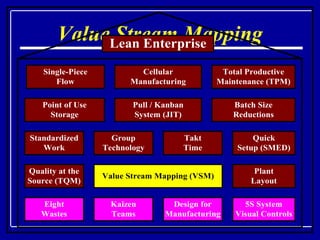
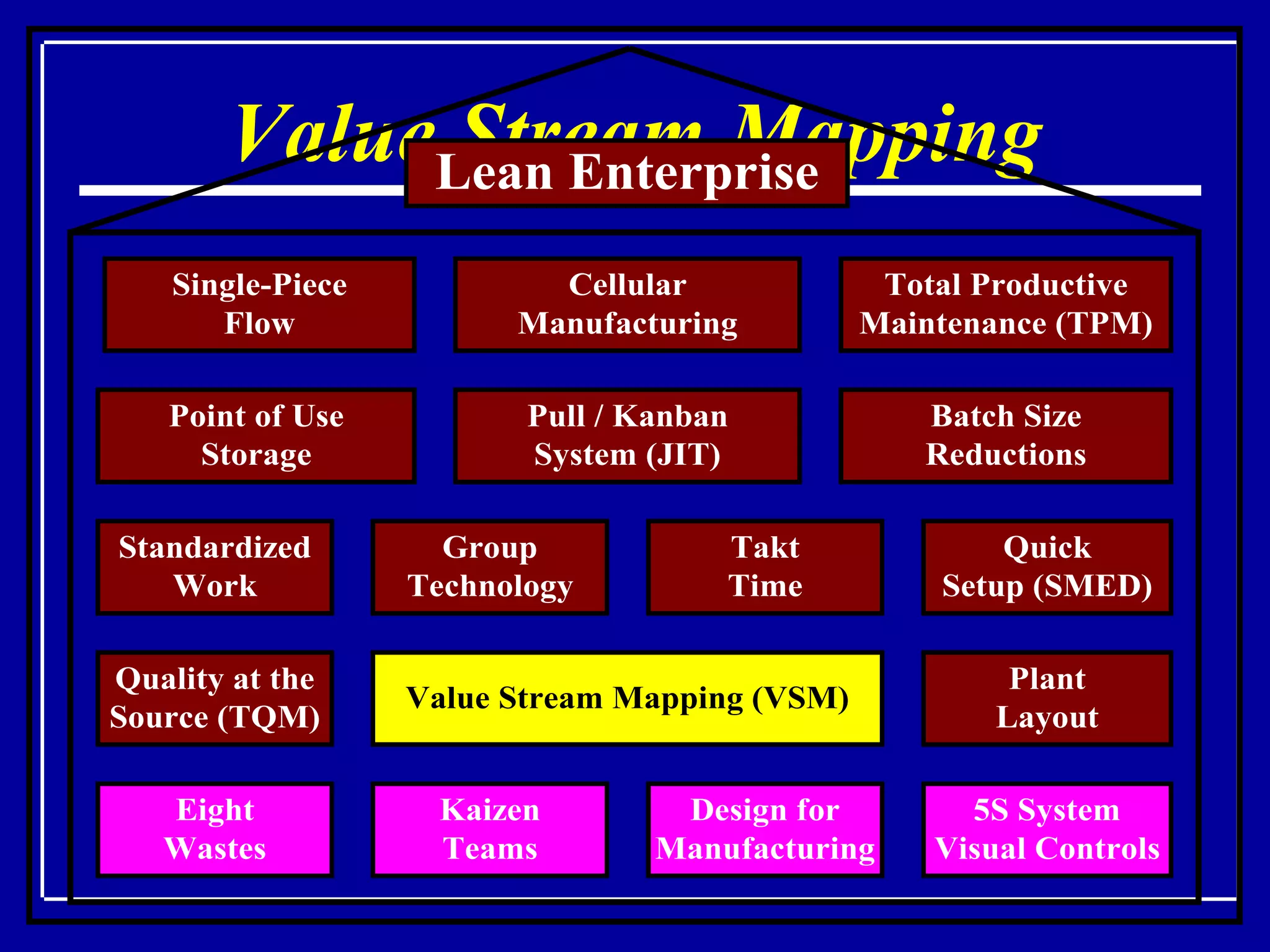
Value Stream Mapping
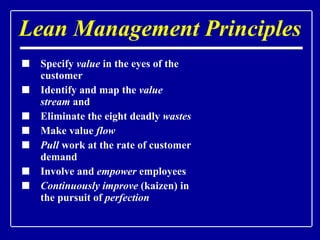
Lean Management Principles Specify  value  in the eyes of the customer Identify and map the  value stream  and  Eliminate the eight deadly  wastes Make value  flow  Pull  work at the rate of customer demand Involve and  empower  employees Continuously improve  (kaizen) in the pursuit of  perfection                                                                          
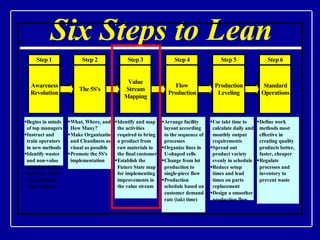
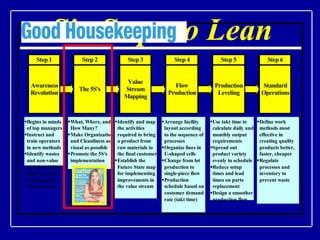
Six Steps to Lean
Value Stream Mapping Objectives of Lean Manufacturing Get one process to make only what the next process needs when it needs it Link all the processes from final customer back to raw material in a smooth flow without detours that generates the highest quality, shortest lead time, and lowest cost Lean Motto “ Better, Faster, Cheaper” Key Question How can you on the shop floor actually get one process to produce only what the next process needs when it needs it?
Cycle Time (CT) How often a part or product family actually is completed by a process, as timed by observation. Also, the time it takes an operator to go through all of their work elements before repeating them Value Added Time (VA) or Total Product Cycle Time (TPCT) Time of those work elements that actually transform the product in a way that the customer is willing to pay for or total of cycle times  Production Lead Time (PLT) The time it takes one piece to move all the way through a process or a value stream, from start to finish. Envision timing a marked part as it moves from beginning to end Usually:   VA  <  CT  <  PLT Takt Time Synchronizes pace of production to match pace of customer demand Lean Measurements
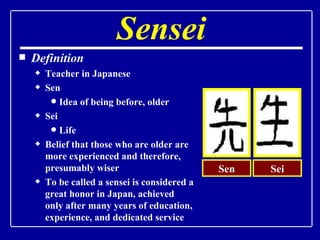
Sensei Definition Teacher in Japanese Sen Idea of being before, older Sei Life Belief that those who are older are more experienced and therefore, presumably wiser To be called a sensei is considered a great honor in Japan, achieved only after many years of education, experience, and dedicated service Sen Sei                                              
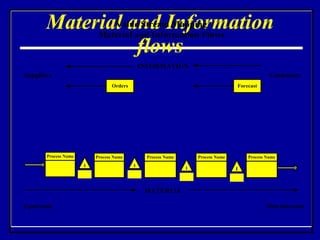
Value Stream Mapping Definition All the actions (both value and non-value added) currently required to bring a product through the main flows essential to every product Communication all along the supply chain regarding orders and order forecasts Material transport and conveyance Production planning and scheduling Network of processes and operations through which material and information flow from raw material into the arms of the customer Objective Cover door to door production flow inside a plant, including shipment to the plant’s customer and delivery of supplied parts and material You design a future state and start the implementation
Value Stream Mapping Reasons for Mapping Helps you visualize the flow rather than one process Helps you to see the sources of waste  Provides common language for talking about manufacturing processes Makes decisions about the flow apparent, so you can discuss them Ties together lean concepts and techniques Forms the basis of an implementation plan. Becomes a blueprint for lean implementation Shows the linkages between the information flow and material flow More useful than quantitative tools and layout diagrams. It is a qualitative tool that describes in detail how your facility should operate in order to create flow and value
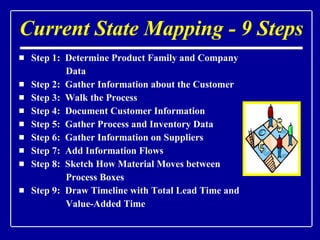
Current State Mapping - 9 Steps Step 1:  Determine Product Family and Company Data Step 2:  Gather Information about the Customer Step 3:  Walk the Process Step 4:  Document Customer Information Step 5:  Gather Process and Inventory Data Step 6:  Gather Information on Suppliers Step 7:  Add Information Flows Step 8:  Sketch How Material Moves between Process Boxes Step 9:  Draw Timeline with Total Lead Time and Value-Added Time
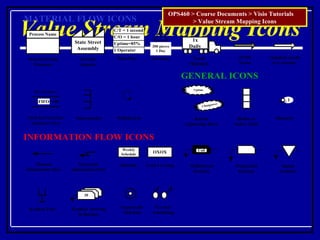
Value Stream Mapping Icons OPS460 > Course Documents > Visio Tutorials  > Value Stream Mapping Icons
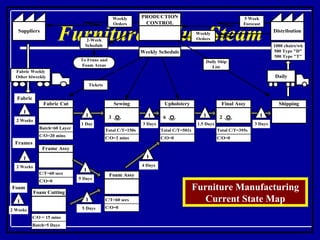
Furniture Value Steam Furniture Manufacturing Current State Map
Current State Mapping Steps Step 1: Determine Product Family and Company Data Select Product Family Create a Product-Process Matrix Rely on Downstream Processes (closer to the customer) to differentiate products Keep it simple, do not try to produce the perfect product-process matrix Group products into product families Select a Product Family for mapping Gather Company Data Days per work month Number of Shifts Total Hours per Shift Time for Breaks and lunch for each Shift
Current State Mapping Steps Step 2: Gather Information about the Customer Where is the customer(s) located? What are customer requirements? What are their packaging requirements? Product variety Number of Shifts Types of material handling for product (pallets, containers)
Current State Mapping Steps Step 3: Walk the Process Go the gemba (shop floor, engineering area, production control and order management department) Walk the process at least once before you draw the Current State Map Put yourself in the position of the customer and begin at the downstream end and walk back upstream: Design, order, and physical product from launch back to original concept Delivery back to sales Finished product back to raw materials Involve everyone with knowledge to share
Current State Mapping Steps Step 3: Walk the Process As you walk, ask the following questions: Does this product provide the  value  sought by the customer? Is the customer willing to  pay  for this activity? Do design, order, and product  flow continuously  through the necessary activities to reach the customer? Can the customer get just what they want, when they want it without holding mountains of inventory? Is the value stream performance continuously improving? If you answer no, ask a few more questions: Who is in charge of the value stream for each product? Who will be the change agent to lead the charge? Where is it most useful to start?
Material and Information flows
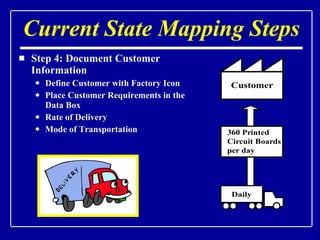
Current State Mapping Steps Step 4: Document Customer Information Define Customer with Factory Icon Place Customer Requirements in the Data Box Rate of Delivery Mode of Transportation
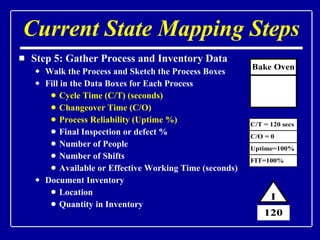
Current State Mapping Steps Step 5: Gather Process and Inventory Data Walk the Process and Sketch the Process Boxes Fill in the Data Boxes for Each Process Cycle Time (C/T) (seconds) Changeover Time (C/O) Process Reliability (Uptime %) Final Inspection or defect % Number of People Number of Shifts Available or Effective Working Time (seconds) Document Inventory Location Quantity in Inventory
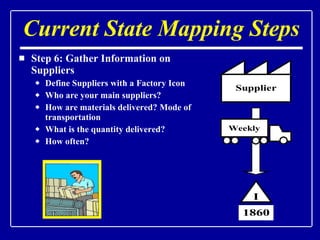
Current State Mapping Steps Step 6: Gather Information on Suppliers Define Suppliers with a Factory Icon Who are your main suppliers? How are materials delivered? Mode of transportation What is the quantity delivered? How often?
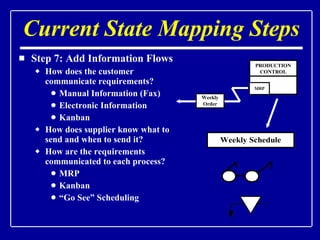
Current State Mapping Steps Step 7: Add Information Flows How does the customer communicate requirements? Manual Information (Fax) Electronic Information Kanban How does supplier know what to send and when to send it? How are the requirements communicated to each process? MRP Kanban “ Go See” Scheduling
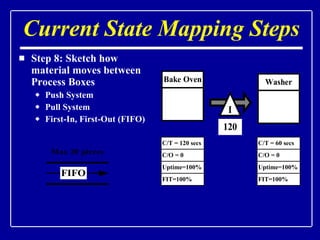
Current State Mapping Steps Step 8: Sketch how material moves between Process Boxes Push System Pull System First-In, First-Out (FIFO)
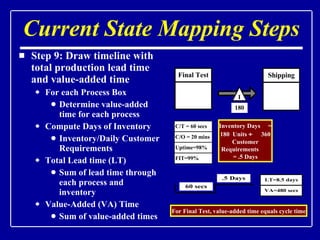
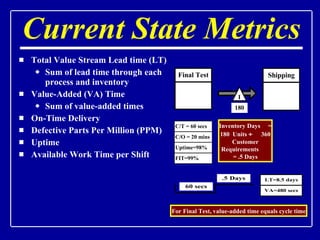
Current State Mapping Steps Step 9: Draw timeline with total production lead time and value-added time For each Process Box Determine value-added time for each process Compute Days of Inventory Inventory/Daily Customer Requirements Total Lead time (LT) Sum of lead time through each process and inventory Value-Added (VA) Time Sum of value-added times For Final Test, value-added time equals cycle time Inventory Days  = 180  Units     360 Customer Requirements  = .5 Days
Current State Mapping - 9 Steps Step 1:  Determine Product Family and Company Data Step 2:  Gather Information about the Customer Step 3:  Walk the Process Step 4:  Document Customer Information Step 5:  Gather Process and Inventory Data Step 6:  Gather Information on Suppliers Step 7:  Add Information Flows Step 8:  Sketch How Material Moves between Process Boxes Step 9:  Draw Timeline with Total Lead Time and Value-Added Time
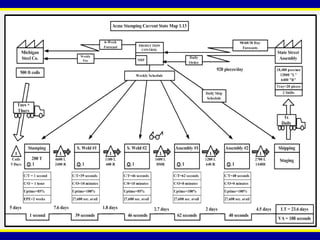
Acme Current State Map
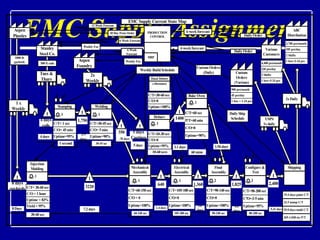
EMC Supply Assignment
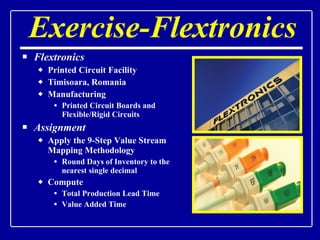
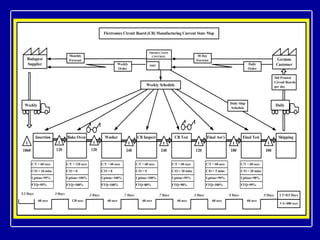
Exercise-Flextronics Flextronics Printed Circuit Facility Timisoara, Romania Manufacturing Printed Circuit Boards and Flexible/Rigid Circuits Assignment Apply the 9-Step Value Stream Mapping Methodology Round Days of Inventory to the nearest single decimal Compute Total Production Lead Time Value Added Time
Exercise-Flextronics Solution
Value Stream Mapping Progress Value Stream Approval Form Monday, 1 November  Presentation 5-Minute PowerPoint Presentation 2 Team Members Organization Selected for Project History and Location Product Family for Mapping Status of Project Assignment Due Email PowerPoint Slides to Professor Haug No later than noon on Monday, 1 November Team Meeting and Attendance Form
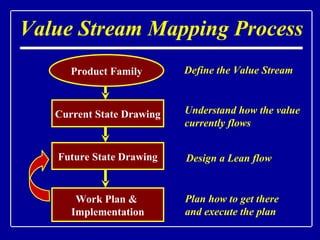
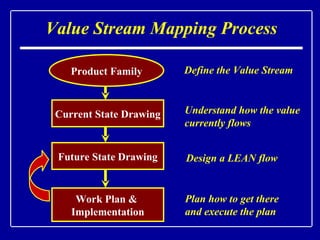
Value Stream Mapping Process Product Family Current State Drawing Work Plan &  Implementation Future State Drawing Understand how the value currently flows Design a Lean flow Plan how to get there and execute the plan Define the Value Stream
Lean VSM Project Questions Does the shop floor (gemba) promote waste-free flow of parts through the process? Is the work area messy and disorganized? Does the shop floor apply the principles of 5S? How are these principles applied? How would you rate the organization using the Crane Aerospace 5S scoring sheet? Is manufacturing managed through a push or pull system? How are orders communicated to the upstream process? How are components passed to the downstream process? Does production occur in large lots, small batches or one-piece flow Is customer demand being met? Does the company work to takt time? Have they determined the pitch? Are there many forms of inventory, transportation, waiting, and motion waste? How long are changeover or setup times?
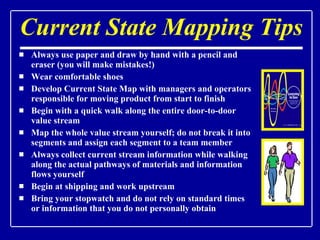
Current State Mapping Tips Always use paper and draw by hand with a pencil and eraser (you will make mistakes!) Wear comfortable shoes Develop Current State Map with managers and operators responsible for moving product from start to finish Begin with a quick walk along the entire door-to-door value stream Map the whole value stream yourself; do not break it into segments and assign each segment to a team member Always collect current stream information while walking along the actual pathways of materials and information flows yourself Begin at shipping and work upstream Bring your stopwatch and do not rely on standard times or information that you do not personally obtain
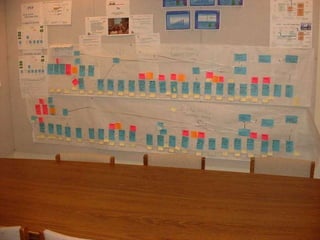
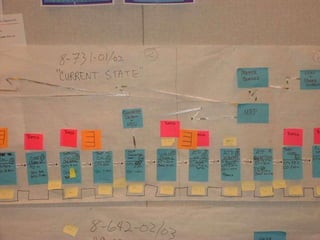
Crane Aerospace Mapping Tips Use post-it notes paper for Value Stream Mapping Easier to move post-it notes than to redraw the map Use a roll of butcher paper or presentation sheets so you can use a wall and see the whole Value Stream Map Use string or ribbon to show material & information flows Decide whether to count all parts or sample Best to map production lines between Tuesday - Thursday Use someone from the line to walk you through it first, post-it note process, come back and get real data  Calculate production lead time for inventory triangles by dividing quantity of inventory by the customer daily requirement This is a really neat trick!   It turns a count of inventory into the number of production days that inventory represents Title and date map See with your hands. No arm chair Lean!
Crane Aerospace Value Stream Map
Crane Aerospace Value Stream Map Detailed
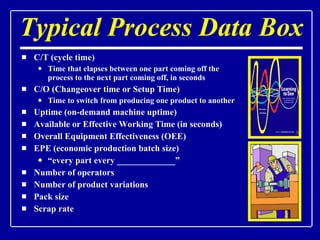
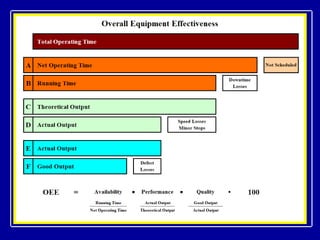
Typical Process Data Box C/T (cycle time) Time that elapses between one part coming off the process to the next part coming off, in seconds C/O (Changeover time or Setup Time) Time to switch from producing one product to another Uptime (on-demand machine uptime) Available or Effective Working Time (in seconds) Overall Equipment Effectiveness (OEE) EPE (economic production batch size) “ every part every _____________” Number of operators Number of product variations Pack size Scrap rate
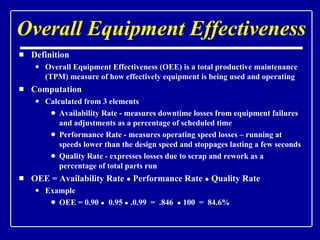
Overall Equipment Effectiveness Definition Overall Equipment Effectiveness (OEE) is a total productive maintenance (TPM) measure of how effectively equipment is being used and operating Computation Calculated from 3 elements Availability Rate - measures downtime losses from equipment failures and adjustments as a percentage of scheduled time Performance Rate - measures operating speed losses – running at speeds lower than the design speed and stoppages lasting a few seconds Quality Rate - expresses losses due to scrap and rework as a percentage of total parts run OEE = Availability Rate  ●  Performance Rate  ●  Quality Rate Example OEE = 0.90  ●   0.95  ●  .0.99  =  .846  ●  100  =  84.6%
OEE Elements
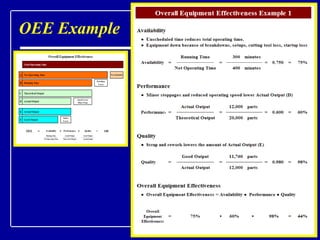
OEE Example
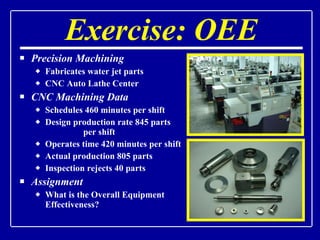
Precision Machining Fabricates water jet parts CNC Auto Lathe Center CNC Machining Data Schedules 460 minutes per shift Design production rate 845 parts  per shift Operates time 420 minutes per shift Actual production 805 parts Inspection rejects 40 parts Assignment What is the Overall Equipment Effectiveness? Exercise: OEE
Targeting Improvement Key Questions for Improvement What is the mission statement for the organization? What are the company’s strategic goals and objectives? What type of improvements are needed and why? How do these improvements support the business goals?  What is the cost and time frame for achieving these improvements? How do we measure lean key performance indicators for evaluating improvements?
Analyzing the Map Scan the Current State Map for waste Overproduction and Idle Materials Process time versus waiting time Non Value-Added processes Defects Fault finding and rework loops Incapable Processes High scrap rates Poor Uptime percentages Low Overall Equipment Effectiveness Transportation Long distances between processes Mark waste problems on copy of the Current State Map
Current State Metrics Total Value Stream Lead time (LT) Sum of lead time through each process and inventory Value-Added (VA) Time Sum of value-added times On-Time Delivery Defective Parts Per Million (PPM) Uptime Available Work Time per Shift For Final Test, value-added time equals cycle time Inventory Days  = 180  Units     360 Customer Requirements  = .5 Days
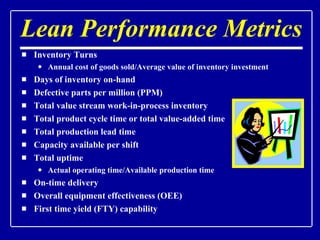
Lean Performance Metrics Inventory Turns Annual cost of goods sold/Average value of inventory investment Days of inventory on-hand Defective parts per million (PPM) Total value stream work-in-process inventory Total product cycle time or total value-added time Total production lead time Capacity available per shift Total uptime Actual operating time/Available production time On-time delivery Overall equipment effectiveness (OEE) First time yield (FTY) capability
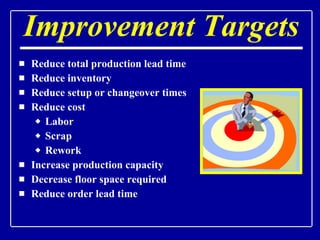
Improvement Targets Reduce total production lead time Reduce inventory Reduce setup or changeover times Reduce cost Labor Scrap Rework Increase production capacity Decrease floor space required Reduce order lead time
Value Stream Mapping Process Product Family Current State Drawing Work Plan &  Implementation Future State Drawing Understand how the value currently flows Design a LEAN flow Plan how to get there and execute the plan Define the Value Stream
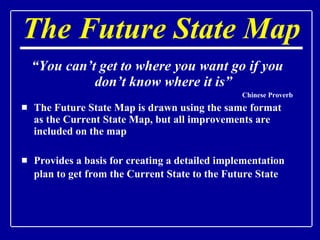
The Future State Map “ You can’t get to where you want go if you don’t know where it is” Chinese Proverb The Future State Map is drawn using the same format as the Current State Map, but all improvements are included on the map Provides a basis for creating a detailed implementation plan to get from the Current State to the Future State
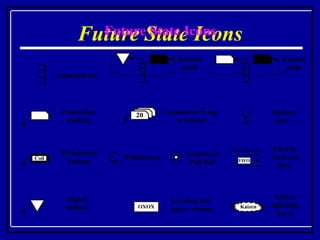
Future State Icons
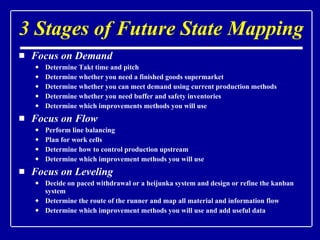
3 Stages of Future State Mapping Focus on Demand Determine Takt time and pitch Determine whether you need a finished goods supermarket Determine whether you can meet demand using current production methods Determine whether you need buffer and safety inventories Determine which improvements methods you will use Focus on Flow Perform line balancing Plan for work cells Determine how to control production upstream Determine which improvement methods you will use Focus on Leveling Decide on paced withdrawal or a heijunka system and design or refine the kanban system Determine the route of the runner and map all material and information flow Determine which improvement methods you will use and add useful data
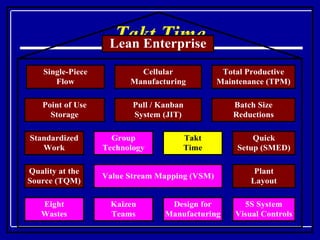
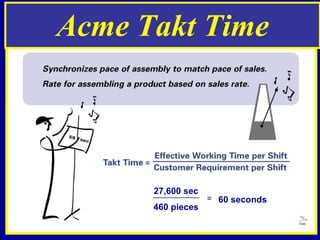
Takt Time
Future State Questions/Decisions Demand 1. What is the  takt   time  for the chosen product family? Takt   Time  is the average rate of delivery Requires concentrated effort to: Provide fast response to problems Eliminate causes of unplanned downtime Eliminate changeover time in downstream, assembly-type processes
Takt Time Takt Time The rate of customer demand or how often the customer requires one finished item Takt time is used to: Design assembly and pacemaker processes Assess production conditions Calculate pitch Develop material handling containerization and routes Determine problem-response requirements Heartbeat of a Lean System
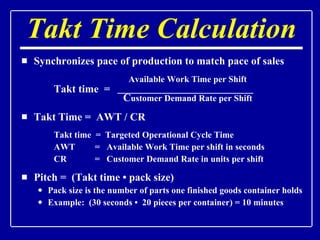
Takt Time Calculation Synchronizes pace of production to match pace of sales   Available Work Time per Shift Takt time  =    C ustomer Demand Rate per Shift Takt Time =  AWT / CR Takt time  =  Targeted Operational Cycle Time AWT    =  Available Work Time per shift in seconds CR    =  Customer Demand Rate in units per shift Pitch =  (Takt time  •  pack size) Pack size is the number of parts one finished goods container holds Example:  (30 seconds  •   20 pieces per container) = 10 minutes
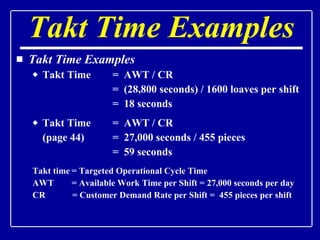
Takt Time Examples Takt Time Examples Takt Time =  AWT / CR =  (28,800 seconds) / 1600 loaves per shift =  18 seconds Takt Time =  AWT / CR (page 44) =  27,000 seconds / 455 pieces =  59 seconds Takt time   = Targeted Operational Cycle Time AWT  = Available Work Time per Shift = 27,000 seconds per day CR  = Customer Demand Rate per Shift =  455 pieces per shift
Acme Takt Time 60 seconds 27,600 sec 460 pieces
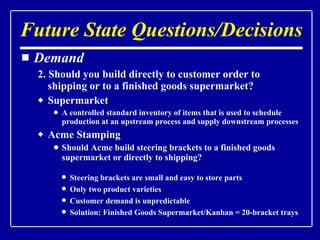
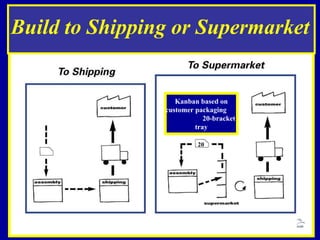
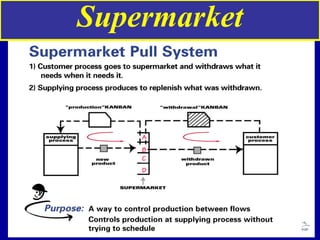
Future State Questions/Decisions Demand 2. Should you build directly to customer order to  shipping or to a finished goods supermarket? Supermarket A controlled standard inventory of items that is used to schedule production at an upstream process and supply downstream processes Acme Stamping Should Acme build steering brackets to a finished goods supermarket or directly to shipping? Steering brackets are small and easy to store parts Only two product varieties Customer demand is unpredictable Solution: Finished Goods Supermarket/Kanban = 20-bracket trays
Build to Shipping or Supermarket 20 Kanban based on customer packaging  20-bracket tray 20
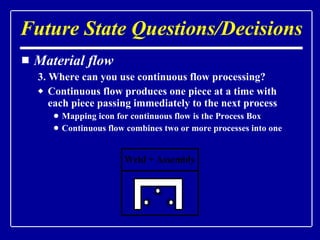
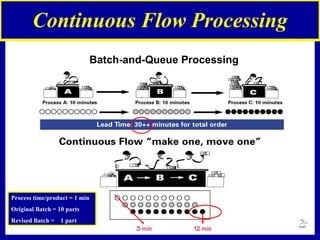
Material flow 3. Where can you use continuous flow processing? Continuous flow produces one piece at a time with each piece passing immediately to the next process Mapping icon for continuous flow is the Process Box Continuous flow combines two or more processes into one Future State Questions/Decisions
Continuous Flow Production Each process makes only the one piece that the next process needs. Motto: “Make one, Move one” Transfer batch size is one Also called “Single-Piece Flow” or “One-Piece Flow” Batch-and-Queue Producing more than one piece of an item and then moving these items forward to the next operation before they are all actually needed there Items wait in line for the next processing step Also called “Batch-and-Push” or “Push System” Continuous Flow
Continuous Flow Processing Batch-and-Queue Processing Process time/product = 1 min Original Batch = 10 parts Revised Batch =  1 part
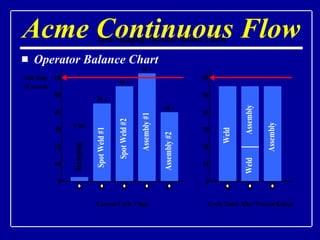
Operator Balance Chart Acme Continuous Flow
Cell Layout Guidelines 1 Place machines and workstations close together to minimize walking distance Remove obstacles from the efficient operator walking path Try to keep the inside width of a cell at around 5 feet to allow flexibility in reallocating work elements among team members Eliminate spaces and surfaces where work-in-process inventory can accumulate Maintain consistent heights for work surfaces and point of use Locate the leadoff and final processes near one another Avoid up-and-down and front-to-back transfers of the workplace
Cell Layout Guidelines 2 Use gravity to assist operators in placing parts and materials wherever possible Install flexible utility drops from the ceiling to make layout adjustment easier Keep hand tools as close as possible to the point of use and orient them in the direction that they are used by the operator Use dedicated hand tools instead of tools that require bit changes Absolutely ensure safety and good ergonomics Keep manual, operator-based work steps close together to allow flexible work element distribution and value-added operator work Segregate Level 5 automation and continuous-cycle operations (like ovens) from manual operators or operator-based work flow Level 5 automation (Automatic load, cycle, unload, transfer)
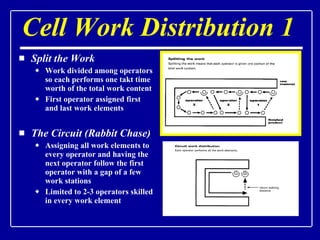
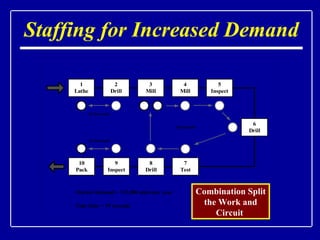
Cell Work Distribution 1  Split the Work Work divided among operators so each performs one takt time worth of the total work content First operator assigned first and last work elements The Circuit (Rabbit Chase) Assigning all work elements to every operator and having the next operator follow the first operator with a gap of a few work stations Limited to 2-3 operators skilled in every work element
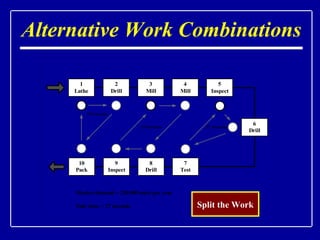
Alternative Work Combinations Split the Work
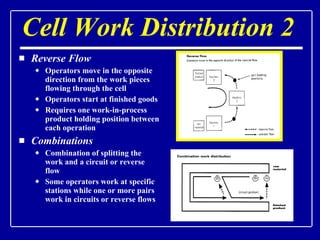
Cell Work Distribution 2  Reverse Flow Operators move in the opposite direction from the work pieces flowing through the cell Operators start at finished goods Requires one work-in-process product holding position between each operation Combinations Combination of splitting the work and a circuit or reverse flow Some operators work at specific stations while one or more pairs work in circuits or reverse flows
Staffing for Increased Demand Combination Split the Work and Circuit
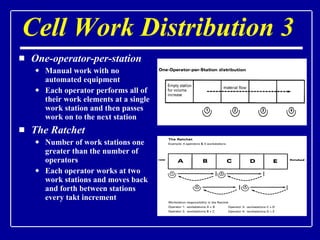
Cell Work Distribution 3  One-operator-per-station Manual work with no automated equipment Each operator performs all of their work elements at a single work station and then passes work on to the next station The Ratchet Number of work stations one greater than the number of operators Each operator works at two work stations and moves back and forth between stations every takt increment
Cellular Manufacturing Advantages Reduced Material Handling Reduced Tooling Reduced Setup Time Reduced Expediting Reduced Work-In-Process  (WIP) Inventory Reduced Part Makespan Improved Human Relations Improved Operator Expertise Shorten design time by starting with a similarly designed part
Cellular Manufacturing Disadvantages Increased Capital Investment Lower Machine Utilization Decreases Flexibility Possible Operator Conflicts
Material Flow 4. Where will you need to use supermarket pull systems to control production of upstream processes? Use supermarkets where continuous flow is not possible upstream and you must batch production Some processes operate at very fast or slow cycle times and need to change over to multiple product families Some processes are not close enough for single piece flow (location of suppliers) Some processes have too much lead time or cannot be coupled with other processes Control production to downstream processes with supermarket-based pull systems Future State Questions/Decisions
Supermarket
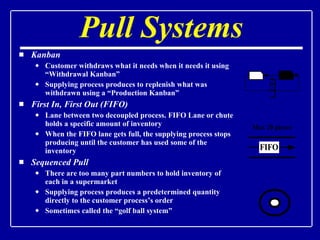
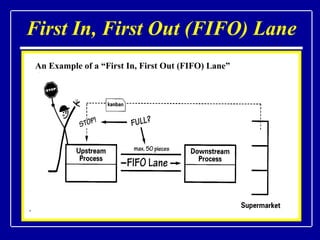
Pull Systems Kanban Customer withdraws what it needs when it needs it using “Withdrawal Kanban” Supplying process produces to replenish what was withdrawn using a “Production Kanban” First In, First Out (FIFO) Lane between two decoupled process. FIFO Lane or chute holds a specific amount of inventory When the FIFO lane gets full, the supplying process stops producing until the customer has used some of the inventory Sequenced Pull There are too many part numbers to hold inventory of each in a supermarket Supplying process produces a predetermined quantity directly to the customer process’s order Sometimes called the “golf ball system”
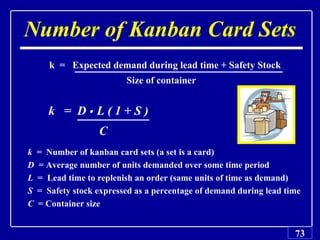
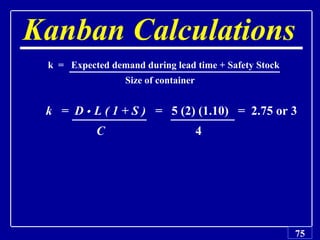
Number of Kanban Card Sets k  =  Expected demand during lead time + Safety Stock Size of container k  =  D     L ( 1 + S )   C k  =  Number of kanban card sets (a set is a card) D   = Average number of units demanded over some time period L   =  Lead time to replenish an order (same units of time as demand) S   =  Safety stock expressed as a percentage of demand during lead time C   = Container size
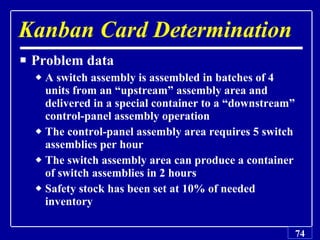
Kanban Card Determination   Problem data A switch assembly is assembled in batches of 4 units from an “upstream” assembly area and delivered in a special container to a “downstream” control-panel assembly operation The control-panel assembly area requires 5 switch assemblies per hour The switch assembly area can produce a container of switch assemblies in 2 hours Safety stock has been set at 10% of needed inventory
Kanban Calculations k  =  Expected demand during lead time + Safety Stock Size of container k  =  D     L ( 1 + S )  =  5 (2) (1.10)  =  2.75 or 3   C   4
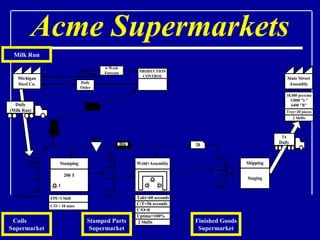
Acme Supermarkets Coils  Supermarket Finished Goods Supermarket Stamped Parts Supermarket Milk Run
First In, First Out (FIFO) Lane An Example of a “First In, First Out (FIFO) Lane”
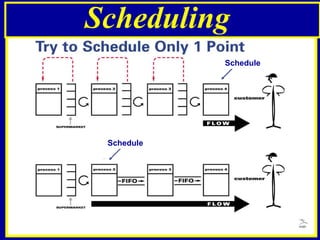
Information Flow 5. At what  single point  in the production stream will you send the customer schedule to trigger production? Schedule at only one point (pacemaker process) Pacemaker Process Series of production steps that are dedicated to a particular product family and respond to orders from external customers How well you operate here determines:  (1) how well you serve the external customer (2) the demand pattern for upstream fabrication processes Material transfers from pacemaker to finished goods needs to occur as a continuous flow Future State Questions/Decisions
Scheduling Schedule Schedule
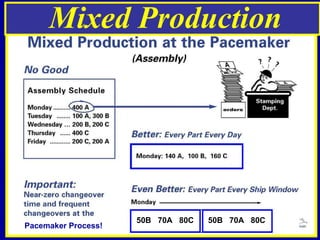
Information Flow 6. How will you level the production mix at the pacemaker process? Heijunka The act of leveling the variety and/or volume of items produced at a process over a period of time Used to avoid batching and volume fluctuations, especially at pacemaker process Mapping icon for leveling inserted into an information flow arrow: Future State Questions/Decisions
Mixed Production Pacemaker Process! 50B  70A  80C 50B  70A  80C
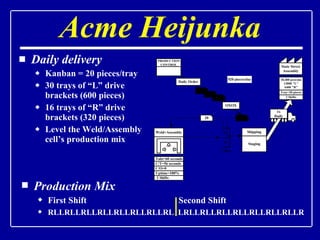
Daily delivery Kanban = 20 pieces/tray 30 trays of “L” drive brackets (600 pieces) 16 trays of “R” drive brackets (320 pieces) Level the Weld/Assembly cell’s production mix Acme Heijunka Production Mix First Shift  Second Shift   RLLRLLRLLRLLRLLRLLRLLRL  LRLLRLLRLLRLLRLLRLLRLLR
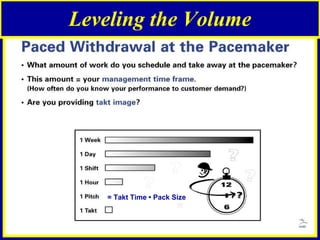
Information Flow 7. What increment of work will you consistently release  and take away at the pacemaker process? (leveling  the volume) Paced withdrawal A timed sequence of withdrawal of finished product from the pacemaker process Pitch Basic unit of your production schedule for a product family Frequency which you withdraw finished goods from a pacemaker process as well as the schedule of release to that process Often based on the customer’s ship quantity Pitch = Takt Time  • Pack Size Future State Questions/Decisions
Leveling the Volume = Takt Time  •  Pack Size
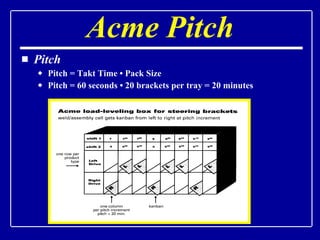
Pitch Pitch = Takt Time  • Pack Size Pitch = 60 seconds • 20 brackets per tray = 20 minutes Acme Pitch
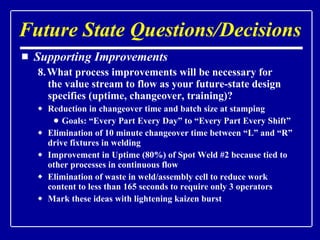
Supporting Improvements 8.   What process improvements will be necessary for  the value stream to flow as your future-state design specifies (uptime, changeover, training)? Reduction in changeover time and batch size at stamping Goals: “Every Part Every Day” to “Every Part Every Shift” Elimination of 10 minute changeover time between “L” and “R” drive fixtures in welding Improvement in Uptime (80%) of Spot Weld #2 because tied to other processes in continuous flow Elimination of waste in weld/assembly cell to reduce work content to less than 165 seconds to require only 3 operators Mark these ideas with lightening kaizen burst Future State Questions/Decisions
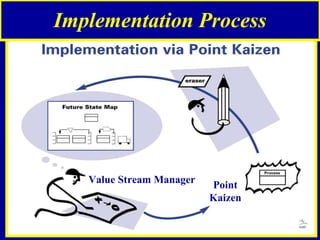
Implementation Process Value Stream Manager Point Kaizen
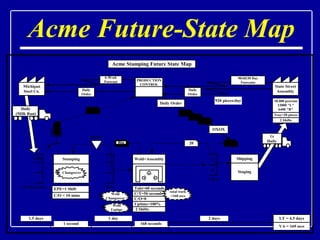
Acme Future-State Map
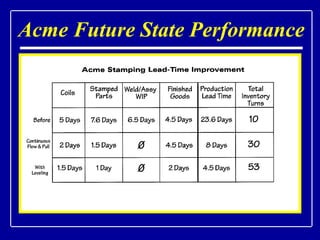
Acme Future State Performance
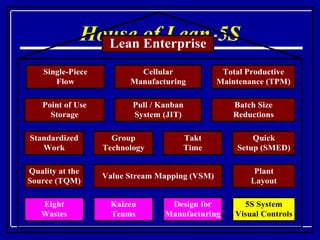
House of Lean-5S
Six Steps to Lean
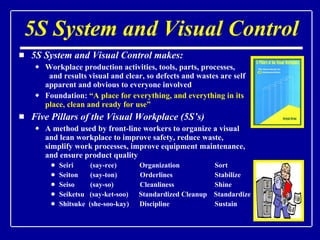
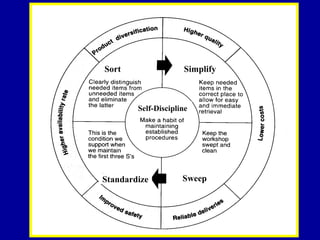
5S System and Visual Control 5S System and Visual Control makes: Workplace production activities, tools, parts, processes,  and results visual and clear, so defects and wastes are self apparent and obvious to everyone involved Foundation:  “A place for everything, and everything in its place, clean and ready for use”  Five Pillars of the Visual Workplace (5S’s) A method used by front-line workers to organize a visual and lean workplace to improve safety, reduce waste, simplify work processes, improve equipment maintenance, and ensure product quality Seiri    (say-ree)  Organization   Sort Seiton    (say-ton)  Orderlines   Stabilize Seiso    (say-so)   Cleanliness     Shine Seiketsu  (say-ket-soo)  Standardized Cleanup  Standardize Shitsuke  (she-soo-kay)  Discipline   Sustain
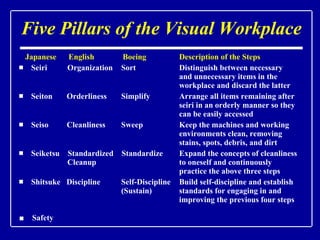
Five Pillars of the Visual Workplace Japanese  English  Boeing Description of the Steps Seiri   Organization   Sort Distinguish between necessary  and unnecessary items in the  workplace and discard the latter Seiton  Orderliness   Simplify Arrange all items remaining after  seiri in an orderly manner so they  can be easily accessed  Seiso  Cleanliness    Sweep Keep the machines and working  environments clean, removing  stains, spots, debris, and dirt Seiketsu  Standardized  Standardize Expand the concepts of cleanliness    Cleanup to oneself and continuously  practice the above three steps Shitsuke  Discipline    Self-Discipline Build self-discipline and establish    (Sustain) standards for engaging in and  improving the previous four steps ■  Safety
Meaning of the 5S’s Sort Simplify Sweep Standardize Self-Discipline
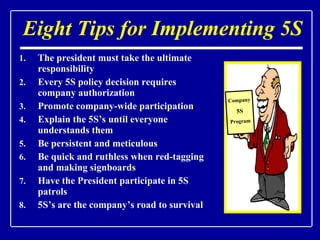
Eight Tips for Implementing 5S The president must take the ultimate responsibility Every 5S policy decision requires company authorization Promote company-wide participation Explain the 5S’s until everyone understands them Be persistent and meticulous Be quick and ruthless when red-tagging and making signboards Have the President participate in 5S patrols 5S’s are the company’s road to survival Company 5S Program
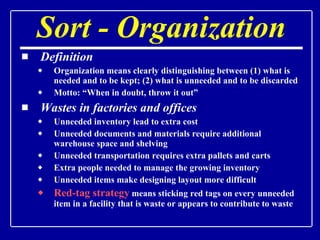
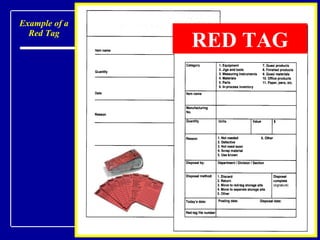
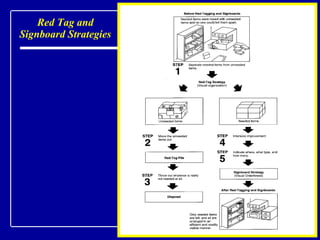
Sort - Organization Definition Organization means clearly distinguishing between (1) what is needed and to be kept; (2) what is unneeded and to be discarded Motto: “When in doubt, throw it out” Wastes in factories and offices   Unneeded inventory lead to extra cost Unneeded documents and materials require additional warehouse space and shelving Unneeded transportation requires extra pallets and carts Extra people needed to manage the growing inventory Unneeded items make designing layout more difficult Red-tag strategy  means sticking red tags on every unneeded item in a facility that is waste or appears to contribute to waste
Example of a Red Tag RED TAG
Red Tag and Signboard Strategies
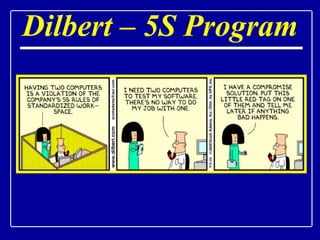
Dilbert – 5S Program
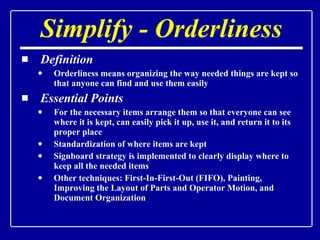
Simplify - Orderliness Definition Orderliness means organizing the way needed things are kept so that anyone can find and use them easily Essential Points For the necessary items arrange them so that everyone can see where it is kept, can easily pick it up, use it, and return it to its proper place Standardization of where items are kept Signboard strategy is implemented to clearly display where to keep all the needed items Other techniques: First-In-First-Out (FIFO), Painting, Improving the Layout of Parts and Operator Motion, and Document Organization
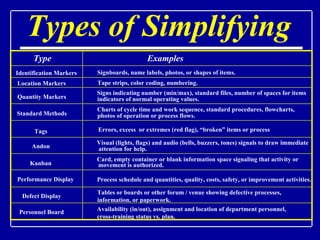
Types of Simplifying Type Identification Markers Location Markers Quantity Markers Standard Methods Tags Andon Kanban Performance Display Defect Display Personnel Board Examples Signboards, name labels, photos, or shapes of items. Tape strips, color coding, numbering. Signs indicating number (min/max), standard files, number of spaces for items indicators of normal operating values. Charts of cycle time and work sequence, standard procedures, flowcharts, photos of operation or process flows. Errors, excess  or extremes (red flag), “broken” items or process Visual (lights, flags) and audio (bells, buzzers, tones) signals to draw immediate attention for help. Card, empty container or blank information space signaling that activity or Process schedule and quantities, quality, costs, safety, or improvement activities. Tables or boards or other forum / venue showing defective processes,  information, or paperwork. Availability (in/out), assignment and location of department personnel,  cross-training status vs. plan. movement is authorized.
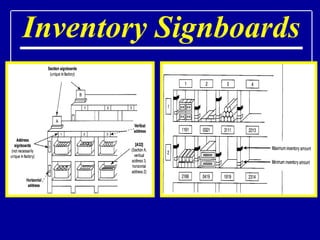
Inventory Signboards
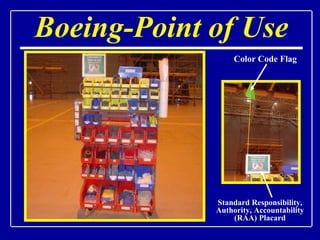
Boeing-Point of Use Standard Responsibility, Authority, Accountability (RAA) Placard Color Code Flag
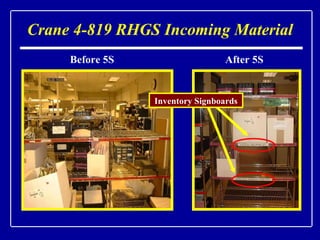
Crane 4-819 RHGS Incoming Material Before 5S After 5S Inventory Signboards
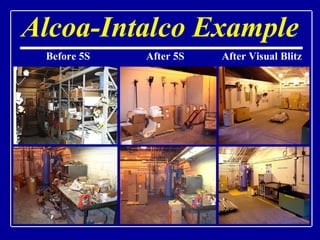
Alcoa-Intalco Example Before 5S  After 5S  After Visual Blitz
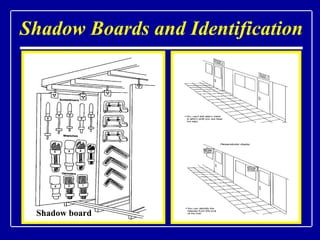
Shadow Boards and Identification Shadow board
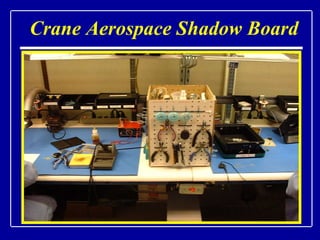
Crane Aerospace Shadow Board Lazy Susan for hand tools
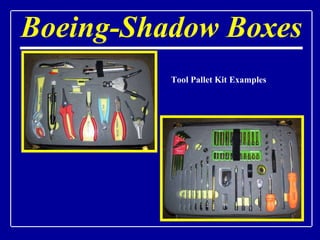
Boeing-Shadow Boxes Tool Pallet Kit Examples
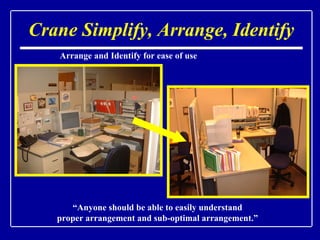
Crane Simplify, Arrange, Identify Arrange and Identify for ease of use “ Anyone should be able to easily understand proper arrangement and sub-optimal arrangement.”
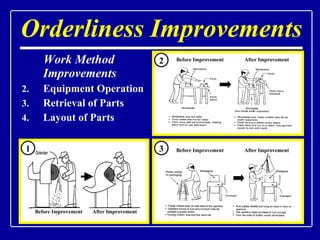
Orderliness Improvements Work Method Improvements Equipment Operation Retrieval of Parts Layout of Parts Before Improvement After Improvement Before Improvement Before Improvement After Improvement After Improvement 2 3 1
Sweep - Cleanliness Definition Cleanliness means sweeping floors and keeping things in order Essential Points The “make it shine” strategy is part of daily work habits Regular company-wide cleanup days should be held two to four times per year When you visit a company’s factory or office, go to the toilet and look around. Its condition will indicate the state of the company’s cleanliness improvement consciousness Purpose Turns the workplace into a nice, bright place for everyone Keep everything in top condition so when someone needs to use something, it is ready for use
Standardize-Standardized Cleanup Definition Standardized Cleanup means the Organization, Orderlinesss, and Cleanliness are being maintained Essential Points Conditions revert to their previous levels People must learn to regularly deal with unneeded items and mixed up tool storage sites at the end of every day Floor must be swept of litter every two to three days It does not take long for production and office workers to start accumulating unneeded items Implement the “5 Whys” (5W) or “5 Whys and 1 How” (5W1H) approach to determine the root cause for problems in the factory Standardized Cleanup exists only as long as Organization, Orderliness, and Cleanliness are maintained
5 Whys The U.S. Standard railroad gauge (distance between the rail tracks) is 4 feet and 8.5 inches, which is a very odd number Why  was that gauge used? Because that is the way they built the railroads in England, and the U.S. railroads were built by English expatriates    Why  did the English people build them like that? Because the first railroads were built by the same people who built the pre-railroad tramways, and that is the gauge they used    Why  did “they” use that gauge then?    Why  did the wagons use that odd wheel spacing?    Why  did the old wheel ruts have that distance for the wheel spacing? Because if they tried to use any other spacing, the wagons would break on some of the old, long distance roads because that was the spacing of the old wheel ruts Because the first long distance roads in Europe were built by Rome for the benefit of their legions, and the ruts were the spacing of Roman war chariots based on the back ends of 2 horses Because the people who built the pre-railroad tramways used the same jigs and tools they used for building wagons, which used that wheel spacing
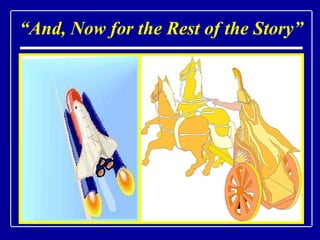
“ And, Now for the Rest of the Story” Space Shuttle Rocket Boosters The Space Shuttle has two giant solid rocket boosters (SRBs) built by Morton Thiokol at a factory in Utah The engineers who designed the SRBs wanted them wider However, the SRBs had to be shipped by train from Utah to the launch site in Florida The railroad from Utah ran through a mountain tunnel The SRBs had to fit through the tunnel, and the tunnel is slightly wider than the railroad track Result The design width specification of one of the major components on the world’s most advanced space vehicle was determined by the width of a Roman chariot or more accurately by the width of two horse’s rear ends
Crane Level 3 Office “ The Goal”
Standardize Process Define “best” way for each process Document the process making changes clearly Communicate the new process to everyone Review 5S steps and discuss “lessons learned” Standard Work Standard Work Sheet Time Observation Form Operator Balance Chart Standard Work Combination Form Process Capacity Form
Self-Discipline or Sustain Definition Discipline means always following specified (and standardized) procedures and continually looking for ways to improve Essential Points Discipline is best taught by the example and behavior of factory supervisors and managers Three points for enforcing discipline Be compassionate, not passionate Take care of the problem immediately Employees should be criticized by their workplace leaders, not directly by the supervisor or manager Visual Control through red-tags, kanbans, signboards, and painting divider lines to show if Sort (Organization), Simplify (Orderliness), and (Sweep) Cleanliness, are being maintained
Building Discipline Be polite in addressing others, starting with “good morning” If you have a work uniform, wear it neatly and with pride Good workplaces are made and destroyed by 5S conditions Divider lines can mark the difference between life and death Sort, Simplify, and Sweep must be maintained Apply Simplify to disorder and Sweep to dirt Inspect before working Immediately reprimand any slacking off on 5S conditions Know how to correct others and receive corrections from others Address the source or root cause of disorder or dirt Money is limited but wisdom is limitless Stick to a hands on, here and now approach For reports, 3 pages are unsatisfactory, 2 pages are better, & 1 page is best For meetings, 3 hours are wasteful, 2 hours are better, & 1 hour is best Improvement requires effort and effort requires enthusiasm
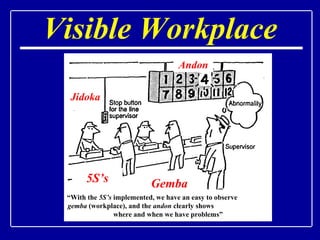
Visible Workplace “ With the  5S’s  implemented, we have an easy to observe  gemba  (workplace), and the  andon  clearly shows  where and when we have problems” Andon Jidoka Gemba 5S’s
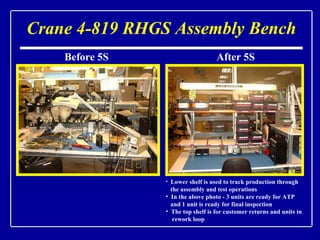
Crane 4-819 RHGS Assembly Bench Before 5S After 5S Lower shelf is used to track production through  the assembly and test operations In the above photo - 3 units are ready for ATP and 1 unit is ready for final inspection The top shelf is for customer returns and units in rework loop
Crane 5S Level of Factory Excellence

460 operations - 4.20

  • 1.
  • 2.
    Lean Management PrinciplesSpecify value in the eyes of the customer Identify and map the value stream and Eliminate the eight deadly wastes Make value flow Pull work at the rate of customer demand Involve and empower employees Continuously improve (kaizen) in the pursuit of perfection                                                                          
  • 3.
  • 4.
    Value Stream MappingObjectives of Lean Manufacturing Get one process to make only what the next process needs when it needs it Link all the processes from final customer back to raw material in a smooth flow without detours that generates the highest quality, shortest lead time, and lowest cost Lean Motto “ Better, Faster, Cheaper” Key Question How can you on the shop floor actually get one process to produce only what the next process needs when it needs it?
  • 5.
    Cycle Time (CT)How often a part or product family actually is completed by a process, as timed by observation. Also, the time it takes an operator to go through all of their work elements before repeating them Value Added Time (VA) or Total Product Cycle Time (TPCT) Time of those work elements that actually transform the product in a way that the customer is willing to pay for or total of cycle times Production Lead Time (PLT) The time it takes one piece to move all the way through a process or a value stream, from start to finish. Envision timing a marked part as it moves from beginning to end Usually: VA < CT < PLT Takt Time Synchronizes pace of production to match pace of customer demand Lean Measurements
  • 6.
    Sensei Definition Teacherin Japanese Sen Idea of being before, older Sei Life Belief that those who are older are more experienced and therefore, presumably wiser To be called a sensei is considered a great honor in Japan, achieved only after many years of education, experience, and dedicated service Sen Sei                                              
  • 7.
    Value Stream MappingDefinition All the actions (both value and non-value added) currently required to bring a product through the main flows essential to every product Communication all along the supply chain regarding orders and order forecasts Material transport and conveyance Production planning and scheduling Network of processes and operations through which material and information flow from raw material into the arms of the customer Objective Cover door to door production flow inside a plant, including shipment to the plant’s customer and delivery of supplied parts and material You design a future state and start the implementation
  • 8.
    Value Stream MappingReasons for Mapping Helps you visualize the flow rather than one process Helps you to see the sources of waste Provides common language for talking about manufacturing processes Makes decisions about the flow apparent, so you can discuss them Ties together lean concepts and techniques Forms the basis of an implementation plan. Becomes a blueprint for lean implementation Shows the linkages between the information flow and material flow More useful than quantitative tools and layout diagrams. It is a qualitative tool that describes in detail how your facility should operate in order to create flow and value
  • 9.
    Current State Mapping- 9 Steps Step 1: Determine Product Family and Company Data Step 2: Gather Information about the Customer Step 3: Walk the Process Step 4: Document Customer Information Step 5: Gather Process and Inventory Data Step 6: Gather Information on Suppliers Step 7: Add Information Flows Step 8: Sketch How Material Moves between Process Boxes Step 9: Draw Timeline with Total Lead Time and Value-Added Time
  • 10.
    Value Stream MappingIcons OPS460 > Course Documents > Visio Tutorials > Value Stream Mapping Icons
  • 11.
    Furniture Value SteamFurniture Manufacturing Current State Map
  • 12.
    Current State MappingSteps Step 1: Determine Product Family and Company Data Select Product Family Create a Product-Process Matrix Rely on Downstream Processes (closer to the customer) to differentiate products Keep it simple, do not try to produce the perfect product-process matrix Group products into product families Select a Product Family for mapping Gather Company Data Days per work month Number of Shifts Total Hours per Shift Time for Breaks and lunch for each Shift
  • 13.
    Current State MappingSteps Step 2: Gather Information about the Customer Where is the customer(s) located? What are customer requirements? What are their packaging requirements? Product variety Number of Shifts Types of material handling for product (pallets, containers)
  • 14.
    Current State MappingSteps Step 3: Walk the Process Go the gemba (shop floor, engineering area, production control and order management department) Walk the process at least once before you draw the Current State Map Put yourself in the position of the customer and begin at the downstream end and walk back upstream: Design, order, and physical product from launch back to original concept Delivery back to sales Finished product back to raw materials Involve everyone with knowledge to share
  • 15.
    Current State MappingSteps Step 3: Walk the Process As you walk, ask the following questions: Does this product provide the value sought by the customer? Is the customer willing to pay for this activity? Do design, order, and product flow continuously through the necessary activities to reach the customer? Can the customer get just what they want, when they want it without holding mountains of inventory? Is the value stream performance continuously improving? If you answer no, ask a few more questions: Who is in charge of the value stream for each product? Who will be the change agent to lead the charge? Where is it most useful to start?
  • 16.
  • 17.
    Current State MappingSteps Step 4: Document Customer Information Define Customer with Factory Icon Place Customer Requirements in the Data Box Rate of Delivery Mode of Transportation
  • 18.
    Current State MappingSteps Step 5: Gather Process and Inventory Data Walk the Process and Sketch the Process Boxes Fill in the Data Boxes for Each Process Cycle Time (C/T) (seconds) Changeover Time (C/O) Process Reliability (Uptime %) Final Inspection or defect % Number of People Number of Shifts Available or Effective Working Time (seconds) Document Inventory Location Quantity in Inventory
  • 19.
    Current State MappingSteps Step 6: Gather Information on Suppliers Define Suppliers with a Factory Icon Who are your main suppliers? How are materials delivered? Mode of transportation What is the quantity delivered? How often?
  • 20.
    Current State MappingSteps Step 7: Add Information Flows How does the customer communicate requirements? Manual Information (Fax) Electronic Information Kanban How does supplier know what to send and when to send it? How are the requirements communicated to each process? MRP Kanban “ Go See” Scheduling
  • 21.
    Current State MappingSteps Step 8: Sketch how material moves between Process Boxes Push System Pull System First-In, First-Out (FIFO)
  • 22.
    Current State MappingSteps Step 9: Draw timeline with total production lead time and value-added time For each Process Box Determine value-added time for each process Compute Days of Inventory Inventory/Daily Customer Requirements Total Lead time (LT) Sum of lead time through each process and inventory Value-Added (VA) Time Sum of value-added times For Final Test, value-added time equals cycle time Inventory Days = 180 Units  360 Customer Requirements = .5 Days
  • 23.
    Current State Mapping- 9 Steps Step 1: Determine Product Family and Company Data Step 2: Gather Information about the Customer Step 3: Walk the Process Step 4: Document Customer Information Step 5: Gather Process and Inventory Data Step 6: Gather Information on Suppliers Step 7: Add Information Flows Step 8: Sketch How Material Moves between Process Boxes Step 9: Draw Timeline with Total Lead Time and Value-Added Time
  • 24.
  • 25.
  • 26.
    Exercise-Flextronics Flextronics PrintedCircuit Facility Timisoara, Romania Manufacturing Printed Circuit Boards and Flexible/Rigid Circuits Assignment Apply the 9-Step Value Stream Mapping Methodology Round Days of Inventory to the nearest single decimal Compute Total Production Lead Time Value Added Time
  • 27.
  • 28.
    Value Stream MappingProgress Value Stream Approval Form Monday, 1 November Presentation 5-Minute PowerPoint Presentation 2 Team Members Organization Selected for Project History and Location Product Family for Mapping Status of Project Assignment Due Email PowerPoint Slides to Professor Haug No later than noon on Monday, 1 November Team Meeting and Attendance Form
  • 29.
    Value Stream MappingProcess Product Family Current State Drawing Work Plan & Implementation Future State Drawing Understand how the value currently flows Design a Lean flow Plan how to get there and execute the plan Define the Value Stream
  • 30.
    Lean VSM ProjectQuestions Does the shop floor (gemba) promote waste-free flow of parts through the process? Is the work area messy and disorganized? Does the shop floor apply the principles of 5S? How are these principles applied? How would you rate the organization using the Crane Aerospace 5S scoring sheet? Is manufacturing managed through a push or pull system? How are orders communicated to the upstream process? How are components passed to the downstream process? Does production occur in large lots, small batches or one-piece flow Is customer demand being met? Does the company work to takt time? Have they determined the pitch? Are there many forms of inventory, transportation, waiting, and motion waste? How long are changeover or setup times?
  • 31.
    Current State MappingTips Always use paper and draw by hand with a pencil and eraser (you will make mistakes!) Wear comfortable shoes Develop Current State Map with managers and operators responsible for moving product from start to finish Begin with a quick walk along the entire door-to-door value stream Map the whole value stream yourself; do not break it into segments and assign each segment to a team member Always collect current stream information while walking along the actual pathways of materials and information flows yourself Begin at shipping and work upstream Bring your stopwatch and do not rely on standard times or information that you do not personally obtain
  • 32.
    Crane Aerospace MappingTips Use post-it notes paper for Value Stream Mapping Easier to move post-it notes than to redraw the map Use a roll of butcher paper or presentation sheets so you can use a wall and see the whole Value Stream Map Use string or ribbon to show material & information flows Decide whether to count all parts or sample Best to map production lines between Tuesday - Thursday Use someone from the line to walk you through it first, post-it note process, come back and get real data Calculate production lead time for inventory triangles by dividing quantity of inventory by the customer daily requirement This is a really neat trick! It turns a count of inventory into the number of production days that inventory represents Title and date map See with your hands. No arm chair Lean!
  • 33.
  • 34.
    Crane Aerospace ValueStream Map Detailed
  • 35.
    Typical Process DataBox C/T (cycle time) Time that elapses between one part coming off the process to the next part coming off, in seconds C/O (Changeover time or Setup Time) Time to switch from producing one product to another Uptime (on-demand machine uptime) Available or Effective Working Time (in seconds) Overall Equipment Effectiveness (OEE) EPE (economic production batch size) “ every part every _____________” Number of operators Number of product variations Pack size Scrap rate
  • 36.
    Overall Equipment EffectivenessDefinition Overall Equipment Effectiveness (OEE) is a total productive maintenance (TPM) measure of how effectively equipment is being used and operating Computation Calculated from 3 elements Availability Rate - measures downtime losses from equipment failures and adjustments as a percentage of scheduled time Performance Rate - measures operating speed losses – running at speeds lower than the design speed and stoppages lasting a few seconds Quality Rate - expresses losses due to scrap and rework as a percentage of total parts run OEE = Availability Rate ● Performance Rate ● Quality Rate Example OEE = 0.90 ● 0.95 ● .0.99 = .846 ● 100 = 84.6%
  • 37.
  • 38.
  • 39.
    Precision Machining Fabricateswater jet parts CNC Auto Lathe Center CNC Machining Data Schedules 460 minutes per shift Design production rate 845 parts per shift Operates time 420 minutes per shift Actual production 805 parts Inspection rejects 40 parts Assignment What is the Overall Equipment Effectiveness? Exercise: OEE
  • 40.
    Targeting Improvement KeyQuestions for Improvement What is the mission statement for the organization? What are the company’s strategic goals and objectives? What type of improvements are needed and why? How do these improvements support the business goals? What is the cost and time frame for achieving these improvements? How do we measure lean key performance indicators for evaluating improvements?
  • 41.
    Analyzing the MapScan the Current State Map for waste Overproduction and Idle Materials Process time versus waiting time Non Value-Added processes Defects Fault finding and rework loops Incapable Processes High scrap rates Poor Uptime percentages Low Overall Equipment Effectiveness Transportation Long distances between processes Mark waste problems on copy of the Current State Map
  • 42.
    Current State MetricsTotal Value Stream Lead time (LT) Sum of lead time through each process and inventory Value-Added (VA) Time Sum of value-added times On-Time Delivery Defective Parts Per Million (PPM) Uptime Available Work Time per Shift For Final Test, value-added time equals cycle time Inventory Days = 180 Units  360 Customer Requirements = .5 Days
  • 43.
    Lean Performance MetricsInventory Turns Annual cost of goods sold/Average value of inventory investment Days of inventory on-hand Defective parts per million (PPM) Total value stream work-in-process inventory Total product cycle time or total value-added time Total production lead time Capacity available per shift Total uptime Actual operating time/Available production time On-time delivery Overall equipment effectiveness (OEE) First time yield (FTY) capability
  • 44.
    Improvement Targets Reducetotal production lead time Reduce inventory Reduce setup or changeover times Reduce cost Labor Scrap Rework Increase production capacity Decrease floor space required Reduce order lead time
  • 45.
    Value Stream MappingProcess Product Family Current State Drawing Work Plan & Implementation Future State Drawing Understand how the value currently flows Design a LEAN flow Plan how to get there and execute the plan Define the Value Stream
  • 46.
    The Future StateMap “ You can’t get to where you want go if you don’t know where it is” Chinese Proverb The Future State Map is drawn using the same format as the Current State Map, but all improvements are included on the map Provides a basis for creating a detailed implementation plan to get from the Current State to the Future State
  • 47.
  • 48.
    3 Stages ofFuture State Mapping Focus on Demand Determine Takt time and pitch Determine whether you need a finished goods supermarket Determine whether you can meet demand using current production methods Determine whether you need buffer and safety inventories Determine which improvements methods you will use Focus on Flow Perform line balancing Plan for work cells Determine how to control production upstream Determine which improvement methods you will use Focus on Leveling Decide on paced withdrawal or a heijunka system and design or refine the kanban system Determine the route of the runner and map all material and information flow Determine which improvement methods you will use and add useful data
  • 49.
  • 50.
    Future State Questions/DecisionsDemand 1. What is the takt time for the chosen product family? Takt Time is the average rate of delivery Requires concentrated effort to: Provide fast response to problems Eliminate causes of unplanned downtime Eliminate changeover time in downstream, assembly-type processes
  • 51.
    Takt Time TaktTime The rate of customer demand or how often the customer requires one finished item Takt time is used to: Design assembly and pacemaker processes Assess production conditions Calculate pitch Develop material handling containerization and routes Determine problem-response requirements Heartbeat of a Lean System
  • 52.
    Takt Time CalculationSynchronizes pace of production to match pace of sales Available Work Time per Shift Takt time = C ustomer Demand Rate per Shift Takt Time = AWT / CR Takt time = Targeted Operational Cycle Time AWT = Available Work Time per shift in seconds CR = Customer Demand Rate in units per shift Pitch = (Takt time • pack size) Pack size is the number of parts one finished goods container holds Example: (30 seconds • 20 pieces per container) = 10 minutes
  • 53.
    Takt Time ExamplesTakt Time Examples Takt Time = AWT / CR = (28,800 seconds) / 1600 loaves per shift = 18 seconds Takt Time = AWT / CR (page 44) = 27,000 seconds / 455 pieces = 59 seconds Takt time = Targeted Operational Cycle Time AWT = Available Work Time per Shift = 27,000 seconds per day CR = Customer Demand Rate per Shift = 455 pieces per shift
  • 54.
    Acme Takt Time60 seconds 27,600 sec 460 pieces
  • 55.
    Future State Questions/DecisionsDemand 2. Should you build directly to customer order to shipping or to a finished goods supermarket? Supermarket A controlled standard inventory of items that is used to schedule production at an upstream process and supply downstream processes Acme Stamping Should Acme build steering brackets to a finished goods supermarket or directly to shipping? Steering brackets are small and easy to store parts Only two product varieties Customer demand is unpredictable Solution: Finished Goods Supermarket/Kanban = 20-bracket trays
  • 56.
    Build to Shippingor Supermarket 20 Kanban based on customer packaging 20-bracket tray 20
  • 57.
    Material flow 3.Where can you use continuous flow processing? Continuous flow produces one piece at a time with each piece passing immediately to the next process Mapping icon for continuous flow is the Process Box Continuous flow combines two or more processes into one Future State Questions/Decisions
  • 58.
    Continuous Flow ProductionEach process makes only the one piece that the next process needs. Motto: “Make one, Move one” Transfer batch size is one Also called “Single-Piece Flow” or “One-Piece Flow” Batch-and-Queue Producing more than one piece of an item and then moving these items forward to the next operation before they are all actually needed there Items wait in line for the next processing step Also called “Batch-and-Push” or “Push System” Continuous Flow
  • 59.
    Continuous Flow ProcessingBatch-and-Queue Processing Process time/product = 1 min Original Batch = 10 parts Revised Batch = 1 part
  • 60.
    Operator Balance ChartAcme Continuous Flow
  • 61.
    Cell Layout Guidelines1 Place machines and workstations close together to minimize walking distance Remove obstacles from the efficient operator walking path Try to keep the inside width of a cell at around 5 feet to allow flexibility in reallocating work elements among team members Eliminate spaces and surfaces where work-in-process inventory can accumulate Maintain consistent heights for work surfaces and point of use Locate the leadoff and final processes near one another Avoid up-and-down and front-to-back transfers of the workplace
  • 62.
    Cell Layout Guidelines2 Use gravity to assist operators in placing parts and materials wherever possible Install flexible utility drops from the ceiling to make layout adjustment easier Keep hand tools as close as possible to the point of use and orient them in the direction that they are used by the operator Use dedicated hand tools instead of tools that require bit changes Absolutely ensure safety and good ergonomics Keep manual, operator-based work steps close together to allow flexible work element distribution and value-added operator work Segregate Level 5 automation and continuous-cycle operations (like ovens) from manual operators or operator-based work flow Level 5 automation (Automatic load, cycle, unload, transfer)
  • 63.
    Cell Work Distribution1 Split the Work Work divided among operators so each performs one takt time worth of the total work content First operator assigned first and last work elements The Circuit (Rabbit Chase) Assigning all work elements to every operator and having the next operator follow the first operator with a gap of a few work stations Limited to 2-3 operators skilled in every work element
  • 64.
  • 65.
    Cell Work Distribution2 Reverse Flow Operators move in the opposite direction from the work pieces flowing through the cell Operators start at finished goods Requires one work-in-process product holding position between each operation Combinations Combination of splitting the work and a circuit or reverse flow Some operators work at specific stations while one or more pairs work in circuits or reverse flows
  • 66.
    Staffing for IncreasedDemand Combination Split the Work and Circuit
  • 67.
    Cell Work Distribution3 One-operator-per-station Manual work with no automated equipment Each operator performs all of their work elements at a single work station and then passes work on to the next station The Ratchet Number of work stations one greater than the number of operators Each operator works at two work stations and moves back and forth between stations every takt increment
  • 68.
    Cellular Manufacturing AdvantagesReduced Material Handling Reduced Tooling Reduced Setup Time Reduced Expediting Reduced Work-In-Process (WIP) Inventory Reduced Part Makespan Improved Human Relations Improved Operator Expertise Shorten design time by starting with a similarly designed part
  • 69.
    Cellular Manufacturing DisadvantagesIncreased Capital Investment Lower Machine Utilization Decreases Flexibility Possible Operator Conflicts
  • 70.
    Material Flow 4.Where will you need to use supermarket pull systems to control production of upstream processes? Use supermarkets where continuous flow is not possible upstream and you must batch production Some processes operate at very fast or slow cycle times and need to change over to multiple product families Some processes are not close enough for single piece flow (location of suppliers) Some processes have too much lead time or cannot be coupled with other processes Control production to downstream processes with supermarket-based pull systems Future State Questions/Decisions
  • 71.
  • 72.
    Pull Systems KanbanCustomer withdraws what it needs when it needs it using “Withdrawal Kanban” Supplying process produces to replenish what was withdrawn using a “Production Kanban” First In, First Out (FIFO) Lane between two decoupled process. FIFO Lane or chute holds a specific amount of inventory When the FIFO lane gets full, the supplying process stops producing until the customer has used some of the inventory Sequenced Pull There are too many part numbers to hold inventory of each in a supermarket Supplying process produces a predetermined quantity directly to the customer process’s order Sometimes called the “golf ball system”
  • 73.
    Number of KanbanCard Sets k = Expected demand during lead time + Safety Stock Size of container k = D  L ( 1 + S ) C k = Number of kanban card sets (a set is a card) D = Average number of units demanded over some time period L = Lead time to replenish an order (same units of time as demand) S = Safety stock expressed as a percentage of demand during lead time C = Container size
  • 74.
    Kanban Card Determination Problem data A switch assembly is assembled in batches of 4 units from an “upstream” assembly area and delivered in a special container to a “downstream” control-panel assembly operation The control-panel assembly area requires 5 switch assemblies per hour The switch assembly area can produce a container of switch assemblies in 2 hours Safety stock has been set at 10% of needed inventory
  • 75.
    Kanban Calculations k = Expected demand during lead time + Safety Stock Size of container k = D  L ( 1 + S ) = 5 (2) (1.10) = 2.75 or 3 C 4
  • 76.
    Acme Supermarkets Coils Supermarket Finished Goods Supermarket Stamped Parts Supermarket Milk Run
  • 77.
    First In, FirstOut (FIFO) Lane An Example of a “First In, First Out (FIFO) Lane”
  • 78.
    Information Flow 5.At what single point in the production stream will you send the customer schedule to trigger production? Schedule at only one point (pacemaker process) Pacemaker Process Series of production steps that are dedicated to a particular product family and respond to orders from external customers How well you operate here determines: (1) how well you serve the external customer (2) the demand pattern for upstream fabrication processes Material transfers from pacemaker to finished goods needs to occur as a continuous flow Future State Questions/Decisions
  • 79.
  • 80.
    Information Flow 6.How will you level the production mix at the pacemaker process? Heijunka The act of leveling the variety and/or volume of items produced at a process over a period of time Used to avoid batching and volume fluctuations, especially at pacemaker process Mapping icon for leveling inserted into an information flow arrow: Future State Questions/Decisions
  • 81.
    Mixed Production PacemakerProcess! 50B 70A 80C 50B 70A 80C
  • 82.
    Daily delivery Kanban= 20 pieces/tray 30 trays of “L” drive brackets (600 pieces) 16 trays of “R” drive brackets (320 pieces) Level the Weld/Assembly cell’s production mix Acme Heijunka Production Mix First Shift Second Shift RLLRLLRLLRLLRLLRLLRLLRL LRLLRLLRLLRLLRLLRLLRLLR
  • 83.
    Information Flow 7.What increment of work will you consistently release and take away at the pacemaker process? (leveling the volume) Paced withdrawal A timed sequence of withdrawal of finished product from the pacemaker process Pitch Basic unit of your production schedule for a product family Frequency which you withdraw finished goods from a pacemaker process as well as the schedule of release to that process Often based on the customer’s ship quantity Pitch = Takt Time • Pack Size Future State Questions/Decisions
  • 84.
    Leveling the Volume= Takt Time • Pack Size
  • 85.
    Pitch Pitch =Takt Time • Pack Size Pitch = 60 seconds • 20 brackets per tray = 20 minutes Acme Pitch
  • 86.
    Supporting Improvements 8. What process improvements will be necessary for the value stream to flow as your future-state design specifies (uptime, changeover, training)? Reduction in changeover time and batch size at stamping Goals: “Every Part Every Day” to “Every Part Every Shift” Elimination of 10 minute changeover time between “L” and “R” drive fixtures in welding Improvement in Uptime (80%) of Spot Weld #2 because tied to other processes in continuous flow Elimination of waste in weld/assembly cell to reduce work content to less than 165 seconds to require only 3 operators Mark these ideas with lightening kaizen burst Future State Questions/Decisions
  • 87.
    Implementation Process ValueStream Manager Point Kaizen
  • 88.
  • 89.
    Acme Future StatePerformance
  • 90.
  • 91.
  • 92.
    5S System andVisual Control 5S System and Visual Control makes: Workplace production activities, tools, parts, processes, and results visual and clear, so defects and wastes are self apparent and obvious to everyone involved Foundation: “A place for everything, and everything in its place, clean and ready for use” Five Pillars of the Visual Workplace (5S’s) A method used by front-line workers to organize a visual and lean workplace to improve safety, reduce waste, simplify work processes, improve equipment maintenance, and ensure product quality Seiri (say-ree) Organization Sort Seiton (say-ton) Orderlines Stabilize Seiso (say-so) Cleanliness Shine Seiketsu (say-ket-soo) Standardized Cleanup Standardize Shitsuke (she-soo-kay) Discipline Sustain
  • 93.
    Five Pillars ofthe Visual Workplace Japanese English Boeing Description of the Steps Seiri Organization Sort Distinguish between necessary and unnecessary items in the workplace and discard the latter Seiton Orderliness Simplify Arrange all items remaining after seiri in an orderly manner so they can be easily accessed Seiso Cleanliness Sweep Keep the machines and working environments clean, removing stains, spots, debris, and dirt Seiketsu Standardized Standardize Expand the concepts of cleanliness Cleanup to oneself and continuously practice the above three steps Shitsuke Discipline Self-Discipline Build self-discipline and establish (Sustain) standards for engaging in and improving the previous four steps ■ Safety
  • 94.
    Meaning of the5S’s Sort Simplify Sweep Standardize Self-Discipline
  • 95.
    Eight Tips forImplementing 5S The president must take the ultimate responsibility Every 5S policy decision requires company authorization Promote company-wide participation Explain the 5S’s until everyone understands them Be persistent and meticulous Be quick and ruthless when red-tagging and making signboards Have the President participate in 5S patrols 5S’s are the company’s road to survival Company 5S Program
  • 96.
    Sort - OrganizationDefinition Organization means clearly distinguishing between (1) what is needed and to be kept; (2) what is unneeded and to be discarded Motto: “When in doubt, throw it out” Wastes in factories and offices Unneeded inventory lead to extra cost Unneeded documents and materials require additional warehouse space and shelving Unneeded transportation requires extra pallets and carts Extra people needed to manage the growing inventory Unneeded items make designing layout more difficult Red-tag strategy means sticking red tags on every unneeded item in a facility that is waste or appears to contribute to waste
  • 97.
    Example of aRed Tag RED TAG
  • 98.
    Red Tag andSignboard Strategies
  • 99.
  • 100.
    Simplify - OrderlinessDefinition Orderliness means organizing the way needed things are kept so that anyone can find and use them easily Essential Points For the necessary items arrange them so that everyone can see where it is kept, can easily pick it up, use it, and return it to its proper place Standardization of where items are kept Signboard strategy is implemented to clearly display where to keep all the needed items Other techniques: First-In-First-Out (FIFO), Painting, Improving the Layout of Parts and Operator Motion, and Document Organization
  • 101.
    Types of SimplifyingType Identification Markers Location Markers Quantity Markers Standard Methods Tags Andon Kanban Performance Display Defect Display Personnel Board Examples Signboards, name labels, photos, or shapes of items. Tape strips, color coding, numbering. Signs indicating number (min/max), standard files, number of spaces for items indicators of normal operating values. Charts of cycle time and work sequence, standard procedures, flowcharts, photos of operation or process flows. Errors, excess or extremes (red flag), “broken” items or process Visual (lights, flags) and audio (bells, buzzers, tones) signals to draw immediate attention for help. Card, empty container or blank information space signaling that activity or Process schedule and quantities, quality, costs, safety, or improvement activities. Tables or boards or other forum / venue showing defective processes, information, or paperwork. Availability (in/out), assignment and location of department personnel, cross-training status vs. plan. movement is authorized.
  • 102.
  • 103.
    Boeing-Point of UseStandard Responsibility, Authority, Accountability (RAA) Placard Color Code Flag
  • 104.
    Crane 4-819 RHGSIncoming Material Before 5S After 5S Inventory Signboards
  • 105.
    Alcoa-Intalco Example Before5S After 5S After Visual Blitz
  • 106.
    Shadow Boards andIdentification Shadow board
  • 107.
    Crane Aerospace ShadowBoard Lazy Susan for hand tools
  • 108.
    Boeing-Shadow Boxes ToolPallet Kit Examples
  • 109.
    Crane Simplify, Arrange,Identify Arrange and Identify for ease of use “ Anyone should be able to easily understand proper arrangement and sub-optimal arrangement.”
  • 110.
    Orderliness Improvements WorkMethod Improvements Equipment Operation Retrieval of Parts Layout of Parts Before Improvement After Improvement Before Improvement Before Improvement After Improvement After Improvement 2 3 1
  • 111.
    Sweep - CleanlinessDefinition Cleanliness means sweeping floors and keeping things in order Essential Points The “make it shine” strategy is part of daily work habits Regular company-wide cleanup days should be held two to four times per year When you visit a company’s factory or office, go to the toilet and look around. Its condition will indicate the state of the company’s cleanliness improvement consciousness Purpose Turns the workplace into a nice, bright place for everyone Keep everything in top condition so when someone needs to use something, it is ready for use
  • 112.
    Standardize-Standardized Cleanup DefinitionStandardized Cleanup means the Organization, Orderlinesss, and Cleanliness are being maintained Essential Points Conditions revert to their previous levels People must learn to regularly deal with unneeded items and mixed up tool storage sites at the end of every day Floor must be swept of litter every two to three days It does not take long for production and office workers to start accumulating unneeded items Implement the “5 Whys” (5W) or “5 Whys and 1 How” (5W1H) approach to determine the root cause for problems in the factory Standardized Cleanup exists only as long as Organization, Orderliness, and Cleanliness are maintained
  • 113.
    5 Whys TheU.S. Standard railroad gauge (distance between the rail tracks) is 4 feet and 8.5 inches, which is a very odd number Why was that gauge used? Because that is the way they built the railroads in England, and the U.S. railroads were built by English expatriates  Why did the English people build them like that? Because the first railroads were built by the same people who built the pre-railroad tramways, and that is the gauge they used  Why did “they” use that gauge then?  Why did the wagons use that odd wheel spacing?  Why did the old wheel ruts have that distance for the wheel spacing? Because if they tried to use any other spacing, the wagons would break on some of the old, long distance roads because that was the spacing of the old wheel ruts Because the first long distance roads in Europe were built by Rome for the benefit of their legions, and the ruts were the spacing of Roman war chariots based on the back ends of 2 horses Because the people who built the pre-railroad tramways used the same jigs and tools they used for building wagons, which used that wheel spacing
  • 114.
    “ And, Nowfor the Rest of the Story” Space Shuttle Rocket Boosters The Space Shuttle has two giant solid rocket boosters (SRBs) built by Morton Thiokol at a factory in Utah The engineers who designed the SRBs wanted them wider However, the SRBs had to be shipped by train from Utah to the launch site in Florida The railroad from Utah ran through a mountain tunnel The SRBs had to fit through the tunnel, and the tunnel is slightly wider than the railroad track Result The design width specification of one of the major components on the world’s most advanced space vehicle was determined by the width of a Roman chariot or more accurately by the width of two horse’s rear ends
  • 115.
    Crane Level 3Office “ The Goal”
  • 116.
    Standardize Process Define“best” way for each process Document the process making changes clearly Communicate the new process to everyone Review 5S steps and discuss “lessons learned” Standard Work Standard Work Sheet Time Observation Form Operator Balance Chart Standard Work Combination Form Process Capacity Form
  • 117.
    Self-Discipline or SustainDefinition Discipline means always following specified (and standardized) procedures and continually looking for ways to improve Essential Points Discipline is best taught by the example and behavior of factory supervisors and managers Three points for enforcing discipline Be compassionate, not passionate Take care of the problem immediately Employees should be criticized by their workplace leaders, not directly by the supervisor or manager Visual Control through red-tags, kanbans, signboards, and painting divider lines to show if Sort (Organization), Simplify (Orderliness), and (Sweep) Cleanliness, are being maintained
  • 118.
    Building Discipline Bepolite in addressing others, starting with “good morning” If you have a work uniform, wear it neatly and with pride Good workplaces are made and destroyed by 5S conditions Divider lines can mark the difference between life and death Sort, Simplify, and Sweep must be maintained Apply Simplify to disorder and Sweep to dirt Inspect before working Immediately reprimand any slacking off on 5S conditions Know how to correct others and receive corrections from others Address the source or root cause of disorder or dirt Money is limited but wisdom is limitless Stick to a hands on, here and now approach For reports, 3 pages are unsatisfactory, 2 pages are better, & 1 page is best For meetings, 3 hours are wasteful, 2 hours are better, & 1 hour is best Improvement requires effort and effort requires enthusiasm
  • 119.
    Visible Workplace “With the 5S’s implemented, we have an easy to observe gemba (workplace), and the andon clearly shows where and when we have problems” Andon Jidoka Gemba 5S’s
  • 120.
    Crane 4-819 RHGSAssembly Bench Before 5S After 5S Lower shelf is used to track production through the assembly and test operations In the above photo - 3 units are ready for ATP and 1 unit is ready for final inspection The top shelf is for customer returns and units in rework loop
  • 121.
    Crane 5S Levelof Factory Excellence

Editor's Notes