


SAMPLING
-VIPIN
PATIDAR
www.vipinpatidar.wordress.com
Introduction:-
 Researcher rarely study the whole
population of subjects.
 The safest choice is to study the whole
population.
www.vipinpatidar.wordress.com
terminology:-
 POPULATION-
 A complete set of persons or object that possess
some common Characterstics that is of interest to
the researcher.
 It is the entire aggregation of cases that meet a
specified set of criteria.
www.vipinpatidar.wordress.com
 KINDS OF POPULATION-
 Theoretical population-
 accessible population-
Contd…
 THEORITICAL POPULATION-
 The population you would like to generalize to
entire population in which researcher is
interested.
www.vipinpatidar.wordress.com
 ACCESSIBLE POPULATION-
 The population that will be accessible to
researcher.
terminology
 PARAMETER-
 The information or data collected from a
population called as parameter.
www.vipinpatidar.wordress.com
 STATISTIC-
 The information or data collected from a sample
called as statistic.
 RANDOMIZATION-
 It is the process of selecting a representation
sample of the target population ensuring that
every element in the target population has an
equal chance of being selected.
terminology
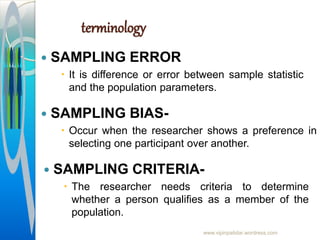
 SAMPLING ERROR
 It is difference or error between sample statistic
and the population parameters.
www.vipinpatidar.wordress.com
 SAMPLING BIAS-
 Occur when the researcher shows a preference in
selecting one participant over another.
 SAMPLING CRITERIA-
 The researcher needs criteria to determine
whether a person qualifies as a member of the
population.
terminology
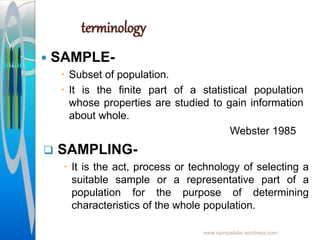
 SAMPLE-
 Subset of population.
 It is the finite part of a statistical population
whose properties are studied to gain information
about whole.
Webster 1985
www.vipinpatidar.wordress.com
 SAMPLING-
 It is the act, process or technology of selecting a
suitable sample or a representative part of a
population for the purpose of determining
characteristics of the whole population.
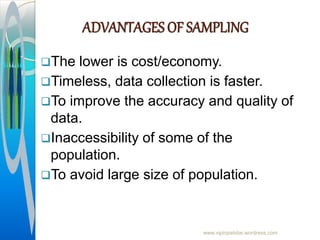
ADVANTAGES OF SAMPLING
The lower is cost/economy.
Timeless, data collection is faster.
To improve the accuracy and quality of
data.
Inaccessibility of some of the
population.
To avoid large size of population.
www.vipinpatidar.wordress.com
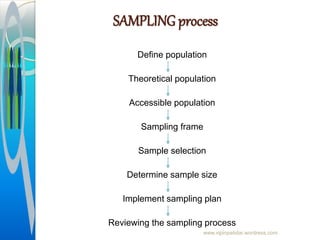
SAMPLING process
Define population
Theoretical population
Accessible population
Sampling frame
Sample selection
Determine sample size
Implement sampling plan
Reviewing the sampling process
www.vipinpatidar.wordress.com
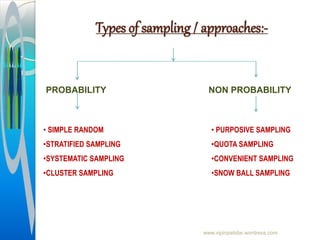
Types of sampling / approaches:-
www.vipinpatidar.wordress.com
PROBABILITY NON PROBABILITY
• SIMPLE RANDOM
•STRATIFIED SAMPLING
•SYSTEMATIC SAMPLING
•CLUSTER SAMPLING
• PURPOSIVE SAMPLING
•QUOTA SAMPLING
•CONVENIENT SAMPLING
•SNOW BALL SAMPLING
1) probability SAMPLING
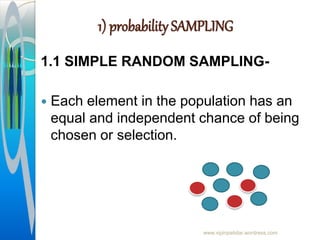
1.1 SIMPLE RANDOM SAMPLING-
 Each element in the population has an
equal and independent chance of being
chosen or selection.
www.vipinpatidar.wordress.com
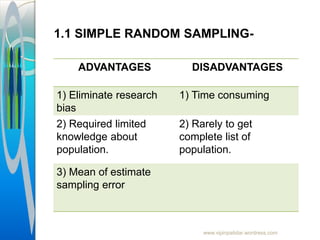
ADVANTAGES DISADVANTAGES
1) Eliminate research
bias
1) Time consuming
2) Required limited
knowledge about
population.
2) Rarely to get
complete list of
population.
3) Mean of estimate
sampling error
1.1 SIMPLE RANDOM SAMPLING-
1) probability SAMPLING
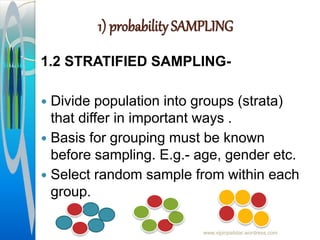
1.2 STRATIFIED SAMPLING-
 Divide population into groups (strata)
that differ in important ways .
 Basis for grouping must be known
before sampling. E.g.- age, gender etc.
 Select random sample from within each
group.
www.vipinpatidar.wordress.com
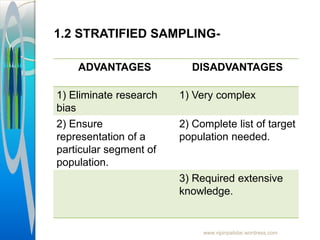
ADVANTAGES DISADVANTAGES
1) Eliminate research
bias
1) Very complex
2) Ensure
representation of a
particular segment of
population.
2) Complete list of target
population needed.
3) Required extensive
knowledge.
1.2 STRATIFIED SAMPLING-
1) probability SAMPLING
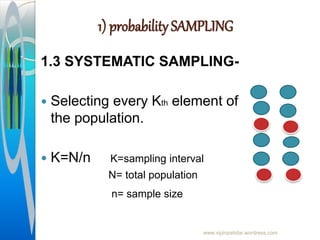
1.3 SYSTEMATIC SAMPLING-
 Selecting every Kth element of
the population.
 K=N/n K=sampling interval
N= total population
n= sample size
www.vipinpatidar.wordress.com
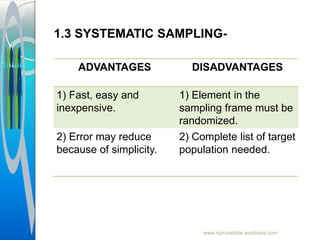
ADVANTAGES DISADVANTAGES
1) Fast, easy and
inexpensive.
1) Element in the
sampling frame must be
randomized.
2) Error may reduce
because of simplicity.
2) Complete list of target
population needed.
1.3 SYSTEMATIC SAMPLING-
1) probability SAMPLING
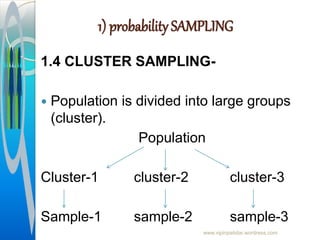
1.4 CLUSTER SAMPLING-
 Population is divided into large groups
(cluster).
Population
Cluster-1 cluster-2 cluster-3
Sample-1 sample-2 sample-3
www.vipinpatidar.wordress.com
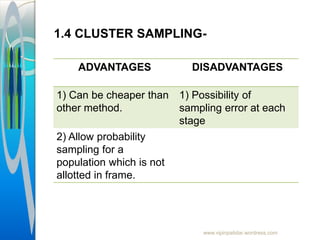
ADVANTAGES DISADVANTAGES
1) Can be cheaper than
other method.
1) Possibility of
sampling error at each
stage
2) Allow probability
sampling for a
population which is not
allotted in frame.
1.4 CLUSTER SAMPLING-
2) NON-probability SAMPLING
2.1 CONVENIENCE SAMPLING-
 Subjects selected because it is easy to
access them.
 No reason tied to purposes of research.
 Students in your class, people on State
Street, friends.
www.vipinpatidar.wordress.com
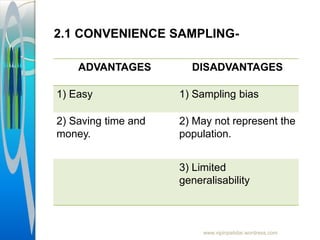
ADVANTAGES DISADVANTAGES
1) Easy 1) Sampling bias
2) Saving time and
money.
2) May not represent the
population.
3) Limited
generalisability
2.1 CONVENIENCE SAMPLING-
2) NON-probability SAMPLING
2.2 PURPOSIVE SAMPLING-
 Subjects selected for a good reason
tied to purposes of research.
 hand picking of subjects.
www.vipinpatidar.wordress.com
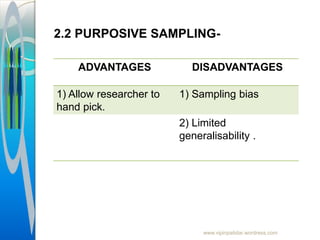
ADVANTAGES DISADVANTAGES
1) Allow researcher to
hand pick.
1) Sampling bias
2) Limited
generalisability .
2.2 PURPOSIVE SAMPLING-
2) NON-probability SAMPLING
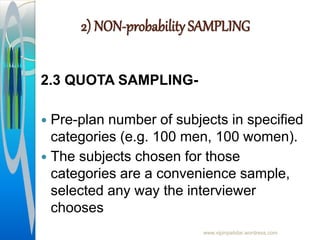
2.3 QUOTA SAMPLING-
 Pre-plan number of subjects in specified
categories (e.g. 100 men, 100 women).
 The subjects chosen for those
categories are a convenience sample,
selected any way the interviewer
chooses
www.vipinpatidar.wordress.com
2) NON-probability SAMPLING
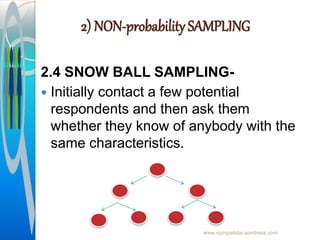
2.4 SNOW BALL SAMPLING-
 Initially contact a few potential
respondents and then ask them
whether they know of anybody with the
same characteristics.
www.vipinpatidar.wordress.com
Thank
you
www.vipinpatidar.wordress.com

Sampling_ vipin

  • 1.
  • 2.
    Introduction:-  Researcher rarelystudy the whole population of subjects.  The safest choice is to study the whole population. www.vipinpatidar.wordress.com
  • 3.
    terminology:-  POPULATION-  Acomplete set of persons or object that possess some common Characterstics that is of interest to the researcher.  It is the entire aggregation of cases that meet a specified set of criteria. www.vipinpatidar.wordress.com  KINDS OF POPULATION-  Theoretical population-  accessible population-
  • 4.
    Contd…  THEORITICAL POPULATION- The population you would like to generalize to entire population in which researcher is interested. www.vipinpatidar.wordress.com  ACCESSIBLE POPULATION-  The population that will be accessible to researcher.
  • 5.
    terminology  PARAMETER-  Theinformation or data collected from a population called as parameter. www.vipinpatidar.wordress.com  STATISTIC-  The information or data collected from a sample called as statistic.  RANDOMIZATION-  It is the process of selecting a representation sample of the target population ensuring that every element in the target population has an equal chance of being selected.
  • 6.
    terminology  SAMPLING ERROR It is difference or error between sample statistic and the population parameters. www.vipinpatidar.wordress.com  SAMPLING BIAS-  Occur when the researcher shows a preference in selecting one participant over another.  SAMPLING CRITERIA-  The researcher needs criteria to determine whether a person qualifies as a member of the population.
  • 7.
    terminology  SAMPLE-  Subsetof population.  It is the finite part of a statistical population whose properties are studied to gain information about whole. Webster 1985 www.vipinpatidar.wordress.com  SAMPLING-  It is the act, process or technology of selecting a suitable sample or a representative part of a population for the purpose of determining characteristics of the whole population.
  • 8.
    ADVANTAGES OF SAMPLING Thelower is cost/economy. Timeless, data collection is faster. To improve the accuracy and quality of data. Inaccessibility of some of the population. To avoid large size of population. www.vipinpatidar.wordress.com
  • 9.
    SAMPLING process Define population Theoreticalpopulation Accessible population Sampling frame Sample selection Determine sample size Implement sampling plan Reviewing the sampling process www.vipinpatidar.wordress.com
  • 10.
    Types of sampling/ approaches:- www.vipinpatidar.wordress.com PROBABILITY NON PROBABILITY • SIMPLE RANDOM •STRATIFIED SAMPLING •SYSTEMATIC SAMPLING •CLUSTER SAMPLING • PURPOSIVE SAMPLING •QUOTA SAMPLING •CONVENIENT SAMPLING •SNOW BALL SAMPLING
  • 11.
    1) probability SAMPLING 1.1SIMPLE RANDOM SAMPLING-  Each element in the population has an equal and independent chance of being chosen or selection. www.vipinpatidar.wordress.com
  • 12.
    www.vipinpatidar.wordress.com ADVANTAGES DISADVANTAGES 1) Eliminateresearch bias 1) Time consuming 2) Required limited knowledge about population. 2) Rarely to get complete list of population. 3) Mean of estimate sampling error 1.1 SIMPLE RANDOM SAMPLING-
  • 13.
    1) probability SAMPLING 1.2STRATIFIED SAMPLING-  Divide population into groups (strata) that differ in important ways .  Basis for grouping must be known before sampling. E.g.- age, gender etc.  Select random sample from within each group. www.vipinpatidar.wordress.com
  • 14.
    www.vipinpatidar.wordress.com ADVANTAGES DISADVANTAGES 1) Eliminateresearch bias 1) Very complex 2) Ensure representation of a particular segment of population. 2) Complete list of target population needed. 3) Required extensive knowledge. 1.2 STRATIFIED SAMPLING-
  • 15.
    1) probability SAMPLING 1.3SYSTEMATIC SAMPLING-  Selecting every Kth element of the population.  K=N/n K=sampling interval N= total population n= sample size www.vipinpatidar.wordress.com
  • 16.
    www.vipinpatidar.wordress.com ADVANTAGES DISADVANTAGES 1) Fast,easy and inexpensive. 1) Element in the sampling frame must be randomized. 2) Error may reduce because of simplicity. 2) Complete list of target population needed. 1.3 SYSTEMATIC SAMPLING-
  • 17.
    1) probability SAMPLING 1.4CLUSTER SAMPLING-  Population is divided into large groups (cluster). Population Cluster-1 cluster-2 cluster-3 Sample-1 sample-2 sample-3 www.vipinpatidar.wordress.com
  • 18.
    www.vipinpatidar.wordress.com ADVANTAGES DISADVANTAGES 1) Canbe cheaper than other method. 1) Possibility of sampling error at each stage 2) Allow probability sampling for a population which is not allotted in frame. 1.4 CLUSTER SAMPLING-
  • 19.
    2) NON-probability SAMPLING 2.1CONVENIENCE SAMPLING-  Subjects selected because it is easy to access them.  No reason tied to purposes of research.  Students in your class, people on State Street, friends. www.vipinpatidar.wordress.com
  • 20.
    www.vipinpatidar.wordress.com ADVANTAGES DISADVANTAGES 1) Easy1) Sampling bias 2) Saving time and money. 2) May not represent the population. 3) Limited generalisability 2.1 CONVENIENCE SAMPLING-
  • 21.
    2) NON-probability SAMPLING 2.2PURPOSIVE SAMPLING-  Subjects selected for a good reason tied to purposes of research.  hand picking of subjects. www.vipinpatidar.wordress.com
  • 22.
    www.vipinpatidar.wordress.com ADVANTAGES DISADVANTAGES 1) Allowresearcher to hand pick. 1) Sampling bias 2) Limited generalisability . 2.2 PURPOSIVE SAMPLING-
  • 23.
    2) NON-probability SAMPLING 2.3QUOTA SAMPLING-  Pre-plan number of subjects in specified categories (e.g. 100 men, 100 women).  The subjects chosen for those categories are a convenience sample, selected any way the interviewer chooses www.vipinpatidar.wordress.com
  • 24.
    2) NON-probability SAMPLING 2.4SNOW BALL SAMPLING-  Initially contact a few potential respondents and then ask them whether they know of anybody with the same characteristics. www.vipinpatidar.wordress.com
  • 25.