


-VIPIN PATIDAR
www.vipinpatidar.wordpress.com
 Rehabilitation is a treatment or treatments
designed to facilitate the process of
recovery from injury, illness, or disease to
as normal a condition as possible.
www.vipinpatidar.wordpress.com
 Regain patient's physical, sensory, and mental
capabilities that were lost due to injury, illness, or
disease.
 Assisting the patient to compensate for deficits that
cannot be reversed medically.
www.vipinpatidar.wordpress.com
 Preserve patient range of motion and
function
 Restore lost motion and function
 Return to preborn functional status
 Prevent excessive scar formation
www.vipinpatidar.wordpress.com
EMERGENT STAGE OF
REHABILITATION
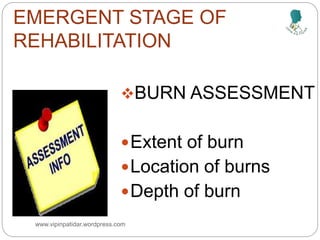
BURN ASSESSMENT
Extent of burn
Location of burns
Depth of burn
www.vipinpatidar.wordpress.com
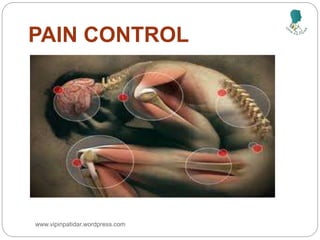
PAIN CONTROL
www.vipinpatidar.wordpress.com
 Obtain good baseline pain control and allow
functional movement and activities of daily living
to occur at any time during the day
 analgesics , non-steroidal anti-inflammatory
drugs, and slow release narcotics should be
used.
 Codeine should be avoided if possible because
of its negative effects on gut motility
www.vipinpatidar.wordpress.com
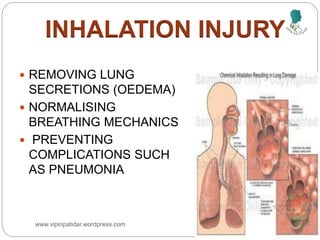
 REMOVING LUNG
SECRETIONS (OEDEMA)
 NORMALISING
BREATHING MECHANICS
 PREVENTING
COMPLICATIONS SUCH
AS PNEUMONIA
INHALATION INJURY
www.vipinpatidar.wordpress.com
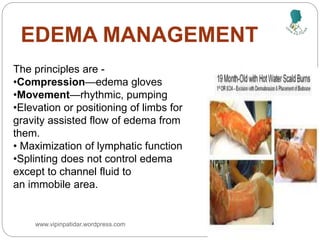
EDEMA MANAGEMENT
The principles are -
•Compression—edema gloves
•Movement—rhythmic, pumping
•Elevation or positioning of limbs for
gravity assisted flow of edema from
them.
• Maximization of lymphatic function
•Splinting does not control edema
except to channel fluid to
an immobile area.
www.vipinpatidar.wordpress.com
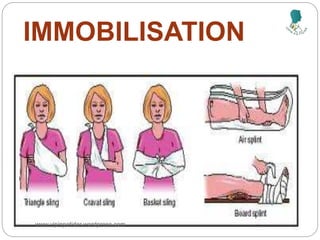
IMMOBILISATION
www.vipinpatidar.wordpress.com
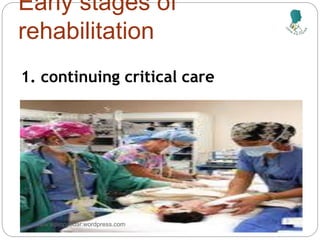
Early stages of
rehabilitation
1. continuing critical care
www.vipinpatidar.wordpress.com
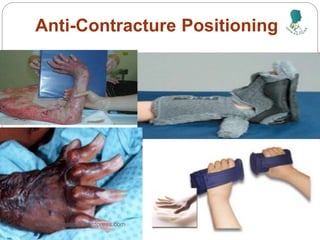
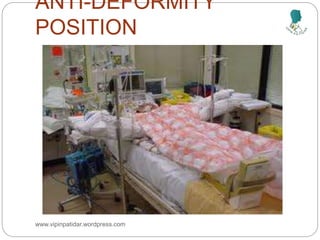
Anti-Contracture Positioning
www.vipinpatidar.wordpress.com
ANTI-DEFORMITY
POSITION
www.vipinpatidar.wordpress.com
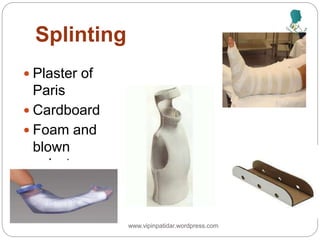
Splinting
 Plaster of
Paris
 Cardboard
 Foam and
blown
polystyrene
 PVC piping
www.vipinpatidar.wordpress.com
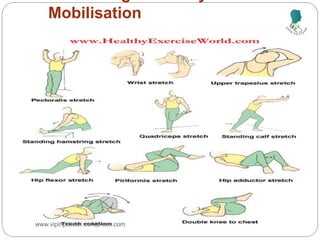
Mobilisation
www.vipinpatidar.wordpress.com
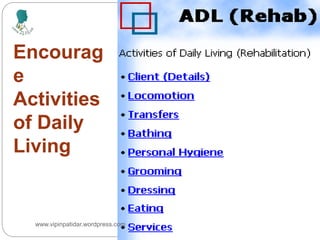
Encourag
e
Activities
of Daily
Living
www.vipinpatidar.wordpress.com
EDUCATION
www.vipinpatidar.wordpress.com
Later stages of
rehabilitation-
 Psychological impact
 Skin reconstruction
 Scar management
Positioning
Splinting
Stretching and exercise
www.vipinpatidar.wordpress.com
Definitions
Graft
A skin graft is a tissue of epidermis and
varying amounts of dermis that is
detached from its own blood supply and
placed in a new area with a new blood
supply.
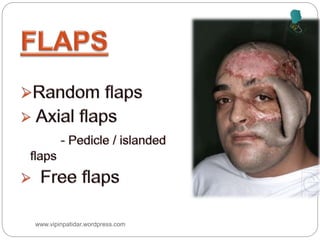
Flap
Any tissue used for reconstruction or
wound closure that retains all or part of
its original blood supply after the tissue
has been moved to the recipient
www.vipinpatidar.wordpress.com
Indications for Skin Grafts:
1)To achieve temporary cover
 To close an open wound
 To prevent infection
 Hasten initial healing
 And prevent exposure of underlying structures
2)For definitive cover:
 To provide permanent skin replacement which
is supple sensate and durable.
 or to resurface areas of scarring or contracture
www.vipinpatidar.wordpress.com
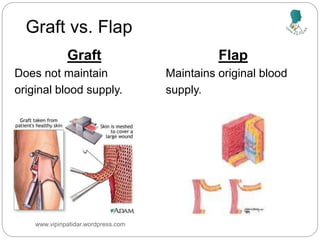
Graft vs. Flap
Graft
Does not maintain
original blood supply.
Flap
Maintains original blood
supply.
www.vipinpatidar.wordpress.com
Classification of Grafts
1. Auto grafts – A tissue transferred from one
part of the body to another.
2. Homograft's/Allograft – tissue transferred
from a genetically different individual of the
same species.
3. Xenografts – a graft transferred from an
individual of one species to an individual of
another species.
www.vipinpatidar.wordpress.com
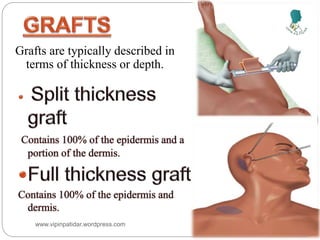
Grafts are typically described in
terms of thickness or depth.
www.vipinpatidar.wordpress.com
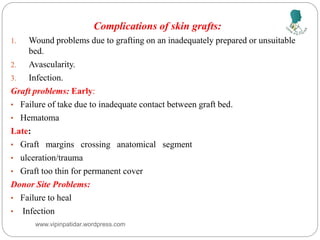
Complications of skin grafts:
1. Wound problems due to grafting on an inadequately prepared or unsuitable
bed.
2. Avascularity.
3. Infection.
Graft problems: Early:
• Failure of take due to inadequate contact between graft bed.
• Hematoma
Late:
• Graft margins crossing anatomical segment
• ulceration/trauma
• Graft too thin for permanent cover
Donor Site Problems:
• Failure to heal
• Infection
www.vipinpatidar.wordpress.com
• a) Positioning
• b) Splinting
• c) Stretching and exercise
• d)Massage and
moisturising
www.vipinpatidar.wordpress.com
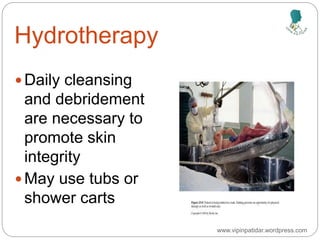
Hydrotherapy
 Daily cleansing
and debridement
are necessary to
promote skin
integrity
 May use tubs or
shower carts
www.vipinpatidar.wordpress.com
Massage and moisturizing
Deep pressure in circular or
perpendicular pattern
Monitor skin integrity and
tolerance
www.vipinpatidar.wordpress.com
Pressure therapy
Pressure garments appear to help
reduce scar thickness/lumpiness
reduce scar redness
reduce swelling
relieve itching
protect newly healed skin/graft
prevent contractures/ maintain
contours
www.vipinpatidar.wordpress.com
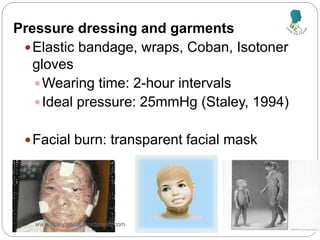
Pressure dressing and garments
Elastic bandage, wraps, Coban, Isotoner
gloves
Wearing time: 2-hour intervals
Ideal pressure: 25mmHg (Staley, 1994)
Facial burn: transparent facial mask
www.vipinpatidar.wordpress.com
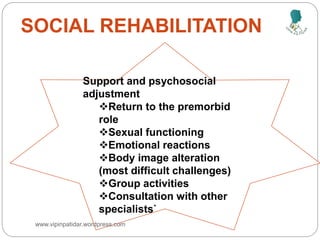
SOCIAL REHABILITATION
Support and psychosocial
adjustment
Return to the premorbid
role
Sexual functioning
Emotional reactions
Body image alteration
(most difficult challenges)
Group activities
Consultation with other
specialists`
www.vipinpatidar.wordpress.com

BURN REHABILITATION