Ε. ΑΝΔΡΙΩΣΗ΢


Ο ρόλοσ τησ ακτινοθεραπείασ ςτον
καρκίνο του προςτάτη


 1ο Συμπόσιο Κλινικής Ογκολογίας Ρόδου


        Ακτινοθεραπευτήσ Ογκολόγοσ
 Euromedica – Αθήναιον Α & Ιατρικό Κέντρο Αθηνών
Δηλώνω ότι δεν ζχω
(προςωπικά ή ωσ μζλοσ εργαςιακήσ/ερευνητικήσ ομάδασ) ή μζλοσ τησ
   οικογζνειάσ μου οποιοδήποτε οικονομικό ή άλλου είδους όφελος από τισ
   εταιρείεσ/επιχειρήςεισ που διοργανώνουν /χρηματοδοτοφν την άνω
   εκδήλωςη κατά τη διάρκεια των τελευταίων 4 ετών.


                      Χορηγοί Εταιρείεσ
                                  AMGEN
                                     ARITI
                                    ASTRA
                               GALENICA
                                  GENESIS
                             PHARMAZAC
                                   ROCHE
                           SANOFI AVENTIS
                                    PFIZER
                                     TEVA
2012 Estimates – American Cancer Society
INCIDENCE
DEATHS
ΚΙΝΔΥΝΟΣ ΕΜΦΑΝΙΣΗΣ
Relative Survival (%) during
               Source: SEER Program, 1975-2000, NCI, 2003.


      Site                        1974-1976             1983-1985   1992-1999


• Breast (female)                         75                 78       87
• Colon & rectum                          50                 57       62
• Leukemia                                34                 41       46
• Lung & bronchus                         12                 14       15
• Melanoma                                80                 85       90
• Non-Hodgkin lymphoma                    47                 54       56
• Ovary                                   37                 41       53
• Pancreas                                  3                 3        4
• Prostate                                67                 75       98
• Urinary bladder                         73                 78       82
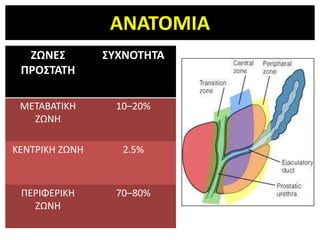
ΑΝΑΣΟΜΙΑ
  ΖΩΝΕ΢         ΢ΤΧΝΟΣΗΣΑ
 ΠΡΟ΢ΣΑΣΗ

 ΜΕΣΑΒΑΣΙΚΗ       10–20%
   ΖΩΝΗ

ΚΕΝΣΡΙΚΗ ΖΩΝΗ      2.5%


 ΠΕΡΙΦΕΡΙΚΗ       70–80%
   ΖΩΝΗ
Σταδιοποίηση


• Στάδια Τ1, Τ2 (Αρχικά): Όγκος ενηός ηης κάψας.

• Στάδιο Τ3: Ο όγκος διαζπά ηη κάψα.

• Στάδιο Τ4: (Τοπική επέκηαζη): Διήθηζη γειηονικών οργάνων.
Risk Stratification


 Normal                  Abnormal
Palpation                Palpation
CaPSURE: Risk Category at
                                   Diagnosis
                       100
                             High risk
                                                                                   16.0%
                                                    30.2%                  25.1%
                                   36.6%
                       80
        Patients (%)


                                                                                   37.2%
                       60
                             Intermediate risk      37.3%                  38.5%

                                   33.8%
                       40


                             Low risk                                              46.8%
                       20
                                                    32.5%                  36.4%
                                   29.5%

                         0
                          1989 1990 1991 1992 1993 1994     1995 1996 1997 1999 2000 2001 2002


Reprinted with permission from Cooperberg MR et al. J Urol. 2003;170:S21
• Γαθηπιηθή εμέηαζε
• PSA


                      Ηπέμηζε, δακηςλική εξέηαζη είναι.
ΓΑΚΣΤΛΙΚΗ ΔΞΔΣΑ΢Η
• Γιοπθική Τπεπησοηομογπαθία (TRUS)
• MRI (κε ή ρσξίο ελδννξζηθό πελίν)
• CT (δηήζεζε ππειηθώλ ιεκθαδέλσλ,
       απνκαθξπζκέλεο κεηαζηάζεηο).
• ΢πινθηπογπάθημα νζηώλ
ΑΝΑΣΟΜΙΑ


        bladder                 rectum


pubis                prostate
ΑΝΑΣΟΜΙΑ


    Bladder


        Prostate

       Rectum
ΜΑΓΝΗΣΙΚΗ ΣΟΜΟΓΡΑΦΙΑ

• Η Μαγνηηική Τομογπαθία επιδεικμύει ηημ ρσηλόηεοη ακοίβεια ζηημ
εκηίμηζη επέκηαζηπ ζηξμ έμα ή και ηξρπ δύξ λξβξύπ (Τ2), εντκασικήπ
επέκηαζηπ ή διήθηζηπ ζπεομαηξδόςξρ κύζηηπ (Τ3) όπτπ και ζηημ
διήθηζη γειηξμικώμ δξμώμ (Τ4).

Η βιβλιξγοαθία επιδεικμύει μεγάλεπ διακρμάμζειπ ζηημ ακπίβεια ηηπ
ηοπικήρ ζηαδιοποίηζηρ με πξζξζηά πξρ κρμαίμξμηαι από 50 – 92%.

Η ποξζθήκη ηηπ δρμαμικήπ εμιζςρόμεμηπ με ζκιαγοαθικό μαγμηηικήπ
ηξμξγοαθίαπ (DCE-MRI) μπξοεί μα απξδειςθεί ςοήζιμη ζε ύπξπηα
πεοιζηαηικά

Η ποξζθήκη ηηπ μαγμηηικήπ θαζμαηξζκξπίαπ (MRSI) ζηημ MRI επίζηπ
αρνάμει ηημ ακοίβεια και μειώμει ηιπ διακρμάμζειπ μεηανύ παοαηηοηηώμ
ζηημ εκηίμηζη ηηπ εντκασικήπ επέκηαζηπ.
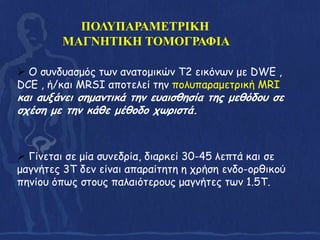
ΠΟΛΤΠΑΡΑΜΔΣΡΙΚΗ
        ΜΑΓΝΗΣΙΚΗ ΣΟΜΟΓΡΑΦΙΑ

 Ο ζρμδραζμόπ ητμ αμαηξμικώμ Τ2 εικόμτμ με DWE ,
DCE , ή/και MRSI απξηελεί ηημ πξλρπαοαμεηοική MRI
και αςξάνει ζημανηικά ηην εςαιζθηζία ηηρ μεθόδος ζε
ζσέζη με ηην κάθε μέθοδο σωπιζηά.


 Γίμεηαι ζε μία ζρμεδοία, διαοκεί 30-45 λεπηά και ζε
μαγμήηεπ 3Τ δεμ είμαι απαοαίηηηη η ςοήζη εμδξ-ξοθικξύ
πημίξρ όπτπ ζηξρπ παλαιόηεοξρπ μαγμήηεπ ητμ 1.5Τ.
Μελέηες ζτεδιαζμού προζηάηη
                        CT vs. MRI


CT υπερεκτίμηση του όγκου του προστάτη κατά ~ 30% σε σχέση με MRI
ΘΔΡΑΠΔΤΣΙΚΔ΢ ΔΠΙΛΟΓΔ΢ ΓΙΑ ΣΟΝ
    ΚΑΡΚΙΝΟ ΣΟΤ ΠΡΟ΢ΣΑΣΗ

• Παξαθνινύζεζε.

• Ρηδηθή πξνζηαηεθηνκή.

• Αθηηλνζεξαπεία.

• Οξκνλνζεξαπεία.

• Κξπνζεξαπεία
Καηεςθύνζειρ για ηην θεπαπεία ηοπικήρ νόζος


Ιαηπικά πποβλήμαηα αζθενούρ        Νοζηπόηηηα Ca πποζηάηος
Πποζδόκιμο επιβίυζηρ                  (αναμενόμενη)

• Δνδοκατική νόζορ (Σ1/Σ2), Gleason score (< 7) & PSA(<10)
  - Ρηδηθή πξνζηαηεθηνκή ή αθηηλνζεξαπεία ή παξαθνινύζεζε

• Σοπικά πποσυπημένη νόζορ (Σ3/Σ4)
   – Αθηηλνζεξαπεία + Οξκνληθόο απνθιεηζκόο (LHRH αλάινγα)
Roach formulas


Percentage risk of ECE  3/2 PSA + [(GS - 3) x 10]

Percentage risk of SVI  PSA + [(GS - 6) x 10]

Percentage risk of LN involvement  2/3 PSA + [(GS - 6) x 10]


                                              Roach III, J Urol 1993;150:1923
Nomograms/Prognostic Tools
 Definitive Therapy            Prognostic               Predicted Outcome
                               Tool/Nomogram

 RP                            Partin1                  Pathological stage


 RP                            Kattan2                  7-year disease recurrence


 RP                            Center for Prostate      Relative risk recurrence
                               Disease Research3

 EBRT                          Kattan4                  5-year biochemical risk recurrence


 Brachytherapy                 Kattan5                  5-year biochemical risk recurrence without
                                                        neoadjuvant hormonal therapy


1. Partin AW, et al. Urology. 2001;58:843-848.
2. Kattan MW, et al. J Clin Oncol. 1999;17:1499-1507.
3. Bauer JJ, et al. J Urol. 1998;159:929-933.
4. Kattan MW, et al. J Clin Oncol. 2000;18:3352-3359.
5. Kattan MW, et al. Urology. 2001;58:393-399.
ΚΑΡΚΙΝΟ΢ ΣΟΤ ΠΡΟ΢ΣΑΣΗ: ΑΚΣΙΝΟΘΕΡΑΠΕΙΑ

                  ΑΚΣΙΝΟΒΟΛΗ΢Η ΠΤΕΛΟΤ
ΥΠΟΛΟΓΙΣΜΟΣ ΚΙΝΔΥΝΟΥ ΜΕΤΑΣΤΑΣΕΩΝ ΣΤΟΥΣ ΠΥΕΛΙΚΟΥΣ ΛΕΜΦΑΔΕΝΕΣ

 1.        Αλγόριθμος ηοσ Roach: +LN = 2/3 PSA + [(GS-6) x 10]

 2.    Πίνακες ηοσ Partin:
                                     T2c
                                                       GS=7


       PSA=4-6                                          +LN
                                                        16%
Νομόγραμμα ηφν Katan et al.


Kattan et al, J Natl Cancer Inst 1998
ΝΟΜΟΓΡΑΜΜΑΣΑ – ΣΡΟΠΟ΢ ΥΡΗ΢Η΢


                    96


                     83 %
10-20
                       <10
                        >20
                       ενδιάμεζοσ κινδύνοσ
                       ταμηλού κινδύνοσ
                        συηλού κινδύνοσ


http://www.mskcc.org/applications/nomograms/prostate/PreTreatment.aspx
4
                                       3


                                       3
                                       4


                       ≤6
                       78-10
                       ενδιάμεζοσ κινδύνοσ
                       ταμηλού κινδύνοσ
                        συηλού κινδύνοσ


http://www.mskcc.org/applications/nomograms/prostate/PreTreatment.aspx
>50%
                      <50%
                      συηλού κινδύνοσ
                      ταμηλούκινδύνοσ


                                               421 patients with low or
                                               favorable intermediate-risk


                                                p=0.08


http://www.mskcc.org/applications/nomograms/prostate/PreTreatment.aspx
?
                                                               ?
                                                               ?


http://www.mskcc.org/applications/nomograms/prostate/PreTreatment.aspx
?
PSA: 15 ng/ml
GS: 4+3
cT2a
Κίνηςη του προςτάτη
Alignment on markers            Alignment on mid gland prostate

                 Prostate                 Prostate


             Seminal Vesicles            Seminal Vesicles


                                                     Courtesy: Chester Ramsey
AP  4.15 mm

SI  3.14 mm

RL  1.92 mm
ΔΙΓΗ ΑΚΣΙΝΟΘΔΡΑΠΔΙΑ΢


• External Beam: high energy X-rays
  given with linear accelerator
   • Primary therapy
   • Postoperative


• Brachytherapy: radioactive seeds
   • Primary therapy
   • After external: boost dose


• Proton Beam: heavy particle
   • Primary therapy
ΓΡΑΜΜΙΚΟ΢ ΔΠΙΣΑΥΤΝΣΗ΢
ΑΚΣΙΝΟΘΔΡΑΠΔΙΑ ΢ΣΟΝ ΠΡΩΙΜΟ
                ΚΑΡΚΙΝΟ ΣΟΤ ΠΡΟ΢ΣΑΣΗ
•   Δξυηεπική ακηινοθεπαπεία (EBRT)
     – ΢ςμβαηική εμσηεξηθή αθηηλνζεξαπεία (Conventional External Beam Radiation
       Therapy – CEBRT)
     – ΢ύμμοπθη ηξηζδηάζηαηε αθηηλνζεξαπεία (3 Dimensional Conformal Radiotherapy
       – 3D CRT)
     – Σξηζδηάζηαηε αθηηλνζεξαπεία δηακνξθνύκελεο έληαζεο (Intensity Modulated
       Radiation Therapy – IMRT/VMAT-IGRT)
     – Αθηηλνζεξαπεία κε πξσηόληα (Proton Beam Radiation Therapy)
     – ΢ηεξενηαθηηθή αθηηλνζεξαπεία ηνπ πξνζηάηε (Stereotactic Radiotherapy)
•   Βπασςθεπαπεία
     – Μόληκα εκθπηεύκαηα ρακεινύ ξπζκνύ δόζεο(LDR) (seeds I-125 ή Pd-103)
     – Πξνζσξηλά εκθπηεύκαηα πςεινύ ξπζκνύ δόζεο (HDR) (Iridium-192 sources)
Treatment Trends in the US


     1990              2005
• Surgery: 65%    • Surgery: 33%
• External: 30%   • External: 31%
• Brachy.: 5%     • Brachy.: 36%
ΜΟΝΑΓΑ ΜΔΣΡΗ΢Η΢ ΑΚΣΙΝΟΘΔΡΑΠΔΙΑ΢


   Dose is the amount of radiation used to treat
    a patient
   SI unit (joules/kg)
      Gray (Gy)

      Centigray (cGy)

      100 cGy = 1 Gy

   Similar to milligrams for drugs
   180 cGy or 200 cGy per day or 1.8 Gy or 2
    Gy per day is usually given to treat prostate
   1.8 Gy x 42 treatments = 75.6 Gy total
Treating prostate cancer


                   Surgery?


Radiation?
bRFS in pts with favorable tumors
           (T1-T2A, bGS< 6, iPSA< 10 ng/ml)


Kupelian PA, JCO 2002
bRFS in pts with unfavorable tumors
           (T2b-T2c, bGS> 6, iPSA>10 ng/ml)


Kupelian PA, JCO 2002
Treatment options
                     T1/T2 disease
• The standard approaches for men with organ-confined
  T1/T2 prostate cancer are
   –   radical prostatectomy (RP)
   –   external beam radiation therapy (EBRT),
   –   brachytherapy, and
   –   active surveillance

  For patients receiving definitive treatment for T1/T2
  prostate cancer, the choice of therapy is largely a matter
  of patient preference. There is no evidence that the cure
  rate is different with RP, EBRT, or brachytherapy when
  patients are stratified based upon prognostic
  characteristics
Intermediate- or high-risk

• Intermediate-risk disease
         EBRT, brachytherapy, or RP

• High-risk disease
        ADT plus EBRT or RP plus adjuvant EBRT
Typical PSA Decline after External Beam


        Months Since Completing Radiation
Declining PSA Levels after Seed Implant


                  PSA bounce


                Years
CT scan is obtained at this time


           CT images are then imported
           into the treatment planning
           computer
The CT scan images are then converted into a
3 dimensional view inside the patient


                               You can
                               actually see
                               inside the
                               man’s body
                               and locate
                               the key
                               organs
Entering GTV /PTV on Each Slice
In the simulation
process the CT
and PET scan
images are used
to create a
computer plan
Multileaf Collimator in LINAC
ΠΛΑΝΟ ΘΔΡΑΠΔΙΑ΢


   Conformal Radiotherapy Plan
Η ΛΤ΢Η


ΑΤΞΗ΢Η ΣΗ΢ ΓΟ΢Η΢
Σςσαιοποιημένερ μελέηερ πος δείσνοςν ηο όθελορ από ηην
  αύξηζη ηηρ δόζηρ (συπίρ IMRT και οπμονοθεπαπεία)


   RCT               N                      Comparison                               Result


  Pollack           301                 70Gy/35 vs. 78Gy/39                59% vs. 78% bPFS at
  (MDA)                                                                          5 years
2007 update
 Zietman            393           70.2Gy vs. 79.2Gy (proton boost)         61% vs. 80% bPFS at
  2005                                                                           5 years


  Peeters           664                 68Gy/34 vs. 78Gy/39               54% vs. 64% FFF at 5
  (Dutch)                                                                         years
   2006
 Dearnaley          843                 64Gy/32 vs. 74Gy/37                60% vs. 71% bPFS at
  (RTO1)                                                                         5 years
   2007
  Hoskin            220      55Gy/20 vs. 35.75Gy/13 + HDR 8.5Gy x 2        64% vs. 80% bPFS at
(Mt Vernon)                                                                      5 years
   2007
              bPFS=biochemical progression free survival FFF= freedom from failure
Prostate Cures Rates by Treatment and Dose

                            External beam > 72Gy


                             Surgery or Seeds


             External beam < 72Gy


            IJROBP 2004; 58:25

                   Months
Improving the Results of Radiotherapy


Dose escalation– increasing the dose of
 radiation by 10% can increase local control
 by 20%
  3D Conformal, IMRT, HDR Brachytherapy boost


Combination treatment with radiotherapy and
 androgen suppression
Απώηεπη Σοξικόηηηα ζηιρ μεγάλερ μη-
            IMRT μελέηερ αύξηζηρ ηηρ δόζηρ

              Γαζηπενηεπική Σοξικόηηηα   Σοξικόηηηα από Οςποποιηηικό


              Grade 2       Grade 3      Grade 2         Grade 3

Κλαζζική      8 – 23%       1 – 2%       6 – 28%         1 – 8%
Γόζη

Ττηλή Γόζη    7 – 30%       1 -7%        10 – 30%        1 – 15 %
(Μη-IMRT)


      2 θοπέρ μεγαλύηεπορ κίνδςνορ ζοβαπήρ ηοξικόηηηαρ !
≥ Grade 2 Απώηεξε Σνμηθόηεηα από Οξζό


              3D-CRT: 14%

                        p= 0.005

               IMRT: 2%


                                        J Urol 2001; 166: 876
Απώηεπη Σοξικόηηηα ζηιρ IMRT μελέηερ αύξηζηρ ηηρ
                     δόζηρ
            Γαζηπενηεπική Σοξικόηηηα Σοξικόηηηα από
                                     Οςποποιηηικό

            Grade 2     Grade 3      Grade 2          Grade 3

Κλαζζική    8 – 23%     1 – 2%       6 – 28%          1 – 8%
Γόζη

Ττηλή       7 – 30%     1 -7%        10 – 30%         1 – 15 %
Γόζη
(Μη-IMRT)
Ττηλή       1 – 2%      0 – 3%       9 – 23%          0 – 6%
Γόζη
(IMRT)

     Κίνδςνορ ζοβαπήρ ηοξικόηηηαρ
     Υαμηλή δόζη συπίρ IMRT = Ττηλή δόζη με IMRT
Κλινικό όθελορ IMRT ζε ζσέζη με 3D-CRT

Δληόπηζε         Διάηησζε Σνμηθόηεηαο         Αύμεζε Σνπηθνύ Διέγρνπ


Πποζηάηηρ        - Διάηησζε ηεο grade 2 & 3   Καιύηεξνο βηνρεκηθόο θαη
                 ηνμηθόηεηαο από ην νξζό      θιηληθόο έιεγρνο

                 - Βειηίσζε ζεμνπαιηθήο
                 ιεηηνπξγηθόηεηαο
IMRT (intensity
modulated
radiation therapy)
 using 7 different beams
to target the prostate


The computer can
determine the optimal
number of beams to
deliver the radiation
dose to hit the target and
avoid other structures
Intensity Modulated External Beam Radiotherapy
IMRT Prostate Dose Distribution


                         Dose
Memorial Sloan Kettering Cancer Center
           IMRT Dose Escalation


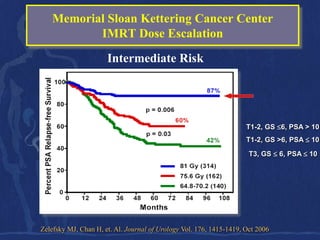
• Began using IMRT in 1996 to facilitate dose
  escalation
• high dose XRT using IMRT for localized prostate
  cancer
• 561pts. B/w April 1996 & Jan 2000
• Median age 68 (range 46-86)


  Zelefsky MJ, Chan H, et. Al. Journal of Urology Vol. 176, 1415-1419, Oct 2006
Memorial Sloan Kettering Cancer Center
          IMRT Dose Escalation
                                Low Risk


                T1-2, GS ≤6, PSA ≤10


Zelefsky MJ, Chan H, et. Al. Journal of Urology Vol. 176, 1415-1419, Oct 2006
Memorial Sloan Kettering Cancer Center
          IMRT Dose Escalation
                      Intermediate Risk


                                                                     T1-2, GS 6, PSA > 10
                                                                     T1-2, GS >6, PSA  10
                                                                      T3, GS  6, PSA  10


Zelefsky MJ, Chan H, et. Al. Journal of Urology Vol. 176, 1415-1419, Oct 2006
Memorial Sloan Kettering Cancer Center
          IMRT Dose Escalation
                              High Risk


                                                                        GS >6, PSA >10


Zelefsky MJ, Chan H, et. Al. Journal of Urology Vol. 176, 1415-1419, Oct 2006
Memorial Sloan Kettering Cancer Center
             IMRT Dose Escalation

Biochemical Control

• Using the ASTRO definition, the 8-year actuarial PSA
  relapse-free survival

   – Favorable risk: 85%
   – Intermediate risk: 76%
   – Unfavorable risk: 72%


  Zelefsky MJ, Chan H, et. Al. Journal of Urology Vol. 176, 1415-1419, Oct 2006
Loma Linda Proton Beam Experience
              Dose Escalation
.
• B/w Oct 1991 & Dec 1997,
• 1255 pts with Stages Ia-III prostate cancer
• No prior surgery, hormonal therapy, or distant
  mets
• Treated with protons alone or in combination with
  photon-beam XRT


              Slater JD, Rossi CJ, et. Al. IJROBP Vol 59, No. 2, 348-352, 2004.
There is significant movement of the prostate gland
             based on daily gas in rectum


     Planned
     target
                                          No Rectal
                                          gas
Planned target,
missed badly if
rectal gas pushes
the prostate                            Rectal gas
forward
Image Guided RT (IGRT)
•   ALL MODERN RT DELIVERY SHOULD BE IGRT
•   Improve accuracy of treatment
•   Track daily position of the prostate before delivering RT
•   Fiducial markers (x-rays), ultrasound scans, electromagnetic
    tracking, CT scans (cone beam CT, fiducials), endorectal
    balloon (x-rays, CT scan)
Image Guided Radiotherapy

■ IGRT Systems:


                      2D Images         Data volumes           ■CBCT
 ■Portal Imaging     Portal Imaging          CBCT
                                          CT Scanner
                   Exac Trac X-Ray 6D
                                        Ultrasounds (US)


                                                           ■CT Scanner


     ■Exac Trac X-Ray 6D
                                        ■Ultrasounds
The most sophisticated technique for image
  guided IMRT is Tomotherapy.


Combine a CT scan and linear accelerator to ultimate in
targeting (IGRT) and ultimate in delivery (dynamic, helical
IMRT) ability to daily adjust the beam (ART or adaptive
radiotherapy)
Cyberknife
Non Isocentric Delivery with CK Beams
Better Cure Rates with Image Guided IMRT
      compared to IMRT for Prostate

   Intermediate Risk       High Risk
Lower Risk of Side Effects with Image Guided IMRT
                compared to IMRT
CHHiP Trial
• Conventional or Hypofractionated High Dose
  Intensity Modulated Radiotherapy for Prostate
  Cancer


• Hypothesis: hypofractionated radiotherapy
  schedules for localised prostate cancer will
  improve the therapeutic ratio by either:
      a)    Improving tumour control
      b)    Reducing normal tissue side effects
Trial Schema


             T1B - T3A N0 M0
             Estimated Risk of SV involvement ≤ 30%
             PSA ≤ 30ng/ml


               Randomise


Group 1                Group 2                        Group 3

74Gy / 37F             60Gy / 20F                     57Gy / 19F
7.5 weeks              4.0 weeks                      3.8 weeks
(Standard)             (Hypofractionation)            (Hypofractionation)
RTOG 0415 Schema

                          73.8 Gy/41 Fx


 T1c-2a
 GS <7
 PSA <10


                           70 Gy/28 Fx
n=800
Endpoint is 5 Year BFFF
Non-inferiority margin 7% (Control 85%, Exp 78%)
ΣΙ ΔΙΝΑΙ Η ΒΡΑΥΤΘΔΡΑΠΔΙΑ ΣΟΤ
            ΠΡΟ΢ΣΑΣΗ (LDR)

• Δκθύηεπζε ξαδηελεξγώλ θόθθσλ εληόο ηνπ πξνζηάηε
  αδέλα
• Οη θόθθνη ρνξεγνύλ πςειή δόζε αθηηλνβνιίαο ζηνλ
  πξνζηάηε αδέλα
• Η αθηηλνβνιία ρνξεγείηαη ζε δηάζηεκα 3-9 κελώλ
• Οη θόθθνη παξακέλνπλ ζηνλ πξνζηάηε κόληκα
ΔΜΦΤΣΔΤ΢Η ΚΟΚΚΩΝ
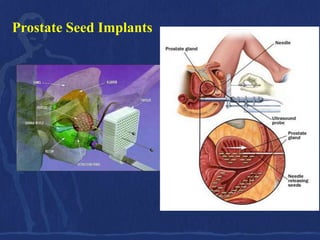
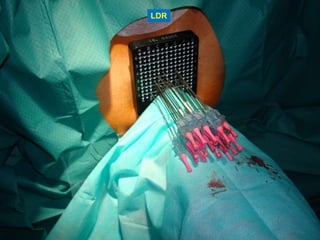
•   The implant is done under general
    anesthesia in OR.
•   Radioactive seeds are implanted into
    the prostate gland under transrectal
    ultrasound guidance, using needles
    that pass through the skin between the
    legs behind the scrotum (the
    perineum).
•   Each needle may deliver between 2-6
    seeds and, usually, 20-30 needles are
    required to implant 80-140 seeds.
•   The seeds are woven into a strand of
    absorbable material to help maintain
    their position and reduce the risk of
    seed migration.
•   The procedure takes about 90 minutes
    and after recovery the patient can go
    home.
ΔΜΦΤΣΔΤ΢Η ΚΟΚΚΩΝ
ΔΝΓΔΙΞΔΙ΢ ΒΡΑΥΤΘΔΡΑΠΔΙΑ΢
           ΣΟΤ ΠΡΟ΢ΣΑΣΗ (LDR)
                     RECOMMENDED              OPTIONAL                      INVESTIGATIONAL


                     Do well                  Fair                          Do poorly
PSA (ng/ml)          <10                      10-20                         >20
Gleason Score        5-6                      7                             8-10
Stage                T1c - T2a                T2b - T2c                     T3
IPSS                 0-8                      9 - 19                        >20
Prostate Volume (g) <40                       40 - 60                       >60
Q max mls/sec        >15                      15 - 10                       <10
Residual Volume cc                                                          >200
TURP +/-                                                                    +
                                 ESTRO/EAU/EORTC recommendations on seed implantation for localized prostate
                                          Cancer. Ash D et al. Radiother Oncol; 2000: 57, 315-321
ΠΡΟΘΔΡΑΠΔΤΣΙΚΗ ΔΚΣΙΜΗ΢Η
        ΘΔ΢Η ΣΟΤ Α΢ΘΔΝΗ
ΠΡΟΘΔΡΑΠΔΤΣΙΚΗ ΔΚΣΙΜΗ΢Η
       ΣΟΠΟΘΔΣΗ΢Η ΣΟΤ PROBE
The Mick ‘Gun’ is used to push the radioactive seeds
into the gland
Prostate Seed Implants
ΠΡΟΘΔΡΑΠΔΤΣΙΚΗ ΔΚΣΙΜΗ΢Η
                                    ΘΔ΢Η ΣΟΤ PROBE


Τςειή ζέζε ηνπ probe – πίεζε ζηνλ           Η νπίζζηα επηθάλεηα ηνπ πξνζηάηε ηδαληθά
πξνζηάηε                                    βξίζθεηαη πάλσ από ηε ζεηξά 1 ή 2
Treatment Planning
LDR
΢ΤΝΓΙΑ΢ΜΟ΢ ΔΞΩΣΔΡΙΚΗ΢ ΑΚΘ
     ΜΔ ΒΡΑΥΤΘΔΡΑΠΔΙΑ

• Δπξύηεξα όξηα, πην νκνηνγελήο δόζε
• Ο ζπλδπαζκόο πξνηηκάηαη αζζελείο κε πην
  θησρνύο πξνγλσζηηθνύο παξάγνληεο
• Ο ζπλδπαζκόο αλαηξεί ην πιενλέθηεκα ηεο
  κνλνζεξαπείαο (δηάξθεηα ζεξαπείαο) θαη
  απμάλεη ηελ ηνμηθόηεηα
BT ΜΔ Ή ΥΩΡΙ΢ ΑΝΓΡΟΓΟΝΙΚΟ ΑΠΟΚΛΔΙ΢ΜΟ

• Η ABS δελ κπνξεί πξνο ην παξόλ λα δώζεη μεθάζαξεο
  ζπζηάζεηο γηα ηε ρνξήγεζε νξκνλνζεξαπείαο (Potters, 2000)

• Η νξκνλνζεξαπεία είρε αξλεηηθή επίδξαζε ζηελ νιηθή θαη ηελ
  εηδηθή γηα ηε λόζν επηβίσζε (Beyer, 2003)

• Τςειή δόζε EBRT (>72Gy) δελ είρε όθεινο από ηελ
  πξνζζήθε ηεο νξκνλνζεξαπείαο.

• Παξόκνηα απνηειέζκαηα όζνλ αθνξά ηελ εηδηθή γηα ηε λόζν
  επηβίσζε είρε ε ρνξήγεζε ή κε neoadjuvant νξκνλνζεξαπείαο.
HDR brachytherapy


• 12-15 metal catheters
  inserted peripherally to
  about 1 cm beyond
  gland

• Template sutured and
  needles fixed in position
HDR brachytherapy
HDR PB ΣΔΥΝΙΚΗ

• Γηαπεξηλετθή, θαζνδεγνύκελε από δηνξζηθό
  ππεξερνγξάθεκα, εηζαγσγή ησλ βεινλώλ
• Κπζηενζθόπεζε
• Post-implant CT γηα δνζηκεηξία
• QA έιεγρνο γηα κεηαηόπηζε ησλ βεινλώλ
• 2 HDR ζεξαπείεο ζε δηάζηεκα 24ώξνπ
• EBRT δύν εβδνκάδεο κεηά ηελ εκθύηεπζε, 45 Gy
HDR


      102
HDR
HDR PB ΣΔΥΝΙΚΗ
HDR Brachytherapy Plus EBRT

• 1260 patients with a PSA >10 ng/mL, GS >7                            or
  >cT2b from 3 institutions

• EBRT to pelvis or prostate + HDR brachytherapy*
   – EBRT: 36-50 Gy + 1.8-2 Gy daily 5x per week
   – HDR brachytherapy: dose escalated from 5.5 Gy x 3
     to 15 Gy x 2

• At 4.4-years’ median follow-up, 8-year bNED
  was 81%                                                            Martinez et al 2005
                                                                    HDR, high dose rate
                            *Usually done with high activity iridium-192 (10 Ci sources);
AMERICAN BRACHYTHERAPY                                     AMERICAN BRACHYTHERAPY
           SOCIETY                                                    SOCIETY
   PROSTATE HIGH-DOSE RATE                                    PROSTATE LOW-DOSE RATE
         TASK GROUP                                                 TASK GROUP
I-Chow Hsu, MD, Yoshiya Yamada MD, Eric Vigneault MD, Jean   Gregory S. Merrick, M.D., Michael J. Zelefsky, M.D., John
                Pouliot, PhD August, 2008                      Sylvester, M.D., Subir Nag, M.D., William Bice, Ph.D.


                                                     Doses
                                                  Monotherapy

                                                                                Pd-103
                                                                          125 Gy (110-120 Gy)
                    10.5 Gy x 3
                                                                                 I-125
                   8.5-9.5 Gy x 4
                                                                          145 Gy (140-160 Gy)
                   6.0-7.5 Gy x 6
                                                                                Cs-131
                                                                                115 Gy
                                                   BT + EBRT

                                                                             Pd-103
      15 Gy x 1 (with 36-40 Gy XRT)                             Boost (with 41.4 – 50.4 Gy EBRT)
   9.5-10.5 Gy x 2 (with 40-50 Gy XRT)                                      90-100 Gy
    5.5-7.5 Gy x 3 (with 40-50 Gy XRT)                                        I-125
    4.0-6.0 Gy x 4 (with 36-50 Gy XRT)                          Boost (with 41.4 – 50.4 Gy EBRT)
                                                                           108-110 Gy
Seeds LDR brachytherapy
      Disadvantages over HDR
• Less likely to preserve erectile function
΢ΤΜΠΔΡΑ΢ΜΑΣΑ

• LDR SEEDS gold standard for prostate
  brachytherapy in low risk patients

• HDR BOOST effective dose escalation in
  intermediate and high risk patients

• HDR monotherapy still experimental
Locally Advanced prostate cancer:


  – Gleason 8-10
  – PSA ≥ 15
  – T3 disease
ΑΚΣΙΝΟΘΔΡΑΠΔΙΑ & ΑΝΓΡΟΓΟΝΙΚΟ΢ ΑΠΟΚΛΔΙ΢ΜΟ΢


      ADT + RT vs RT alone
Neoadjuvant Hormone Therapy
• 5 randomized trials
   –   RTOG 8610 (JCO 2008)
   –   Laverdiere (J Urol 2004)
   –   D’Amico (JAMA 2004)
   –   TROG 96-01 (Lancet Oncol 2005)
   –   RTOG 94-08 (unpublished – ASTRO 2009)
• Several differences in patient selection and end-
  points
   – Mixed population
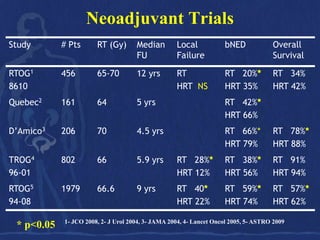
Neoadjuvant Trials
Study       # Pts      RT (Gy)       Median        Local            bNED             Overall
                                     FU            Failure                           Survival

RTOG1       456        65-70         12 yrs        RT               RT 20%*          RT 34%
8610                                               HRT NS           HRT 35%          HRT 42%
Quebec2     161        64            5 yrs                          RT 42%*
                                                                    HRT 66%
D’Amico3    206        70            4.5 yrs                        RT 66%*          RT 78%*
                                                                    HRT 79%          HRT 88%
TROG4       802        66            5.9 yrs       RT 28%*          RT 38%*          RT 91%
96-01                                              HRT 12%          HRT 56%          HRT 94%
RTOG5       1979       66.6          9 yrs         RT 40*           RT 59%*          RT 57%*
94-08                                              HRT 22%          HRT 74%          HRT 62%

            1- JCO 2008, 2- J Urol 2004, 3- JAMA 2004, 4- Lancet Oncol 2005, 5- ASTRO 2009
 * p<0.05
EORTC 22863 at 5.5 years’
               Median Follow-up

            100

             80
Patients
surviving
             60
(%)

             40
                      HR 0.51 (95% CI 0.36, 0.73; p<0.001)

             20          Goserelin + RT (n=207)
                         RT alone (n=208)
              0
                  0      1    2     3    4     5       6       7       8

                         Time since randomisation (years)
                                                                                Bolla et al 2002
                                                   T1-2 of WHO grade 3 or T3-4 N0-1, M0 disease
Bicalutamide Adjuvant to Radiotherapy
                  Significantly Improves Survival

            Locally advanced disease at 7.4 years’ median follow-up


              100
                        Total deaths
                        Prostate cancer-specific deaths
               80
                                           HR 0.65              In the RT group,
               60                          (p=0.03)             numerically fewer
Mortality
                                                                patients receiving
  (%)
               40                                               bicalutamide died due to
                                                                prostate cancer vs.
                                                                placebo (16.1% vs.
               20
                                                                24.3%)

                0
                               Bicalutamide      Radiotherapy
                              + radiotherapy        alone
Adjuvant Hormonal Therapy
• 4 randomized trials
  –   RTOG 85-31 Pilepich et al. IJROBP 2005
  –   EORTC 22863 Bolla et al. Lancet 2002
  –   RTOG 92-02 Horwitz et al. JCO 2008
  –   Quebec L-200 Laverdiere et al. J Urol 2004
• Higher risk patients
  – Mixed population
       •   T stage
       •   Post-op
       •   N positive
       •   Low/Intermediate Risk
Adjuvant Hormonal Therapy
Study       #       Median Local              Distant       bNED       Overall
            Pts     FU     Failure            Mets                     Survival
RTOG1       977     11 yrs      RT 38%*       RT 39%*                  RT 39% *
8531                            RTH 23%       RTH 24%                  RTH 49%

EORTC2      415     5.5 yrs     RT 16%*       RT 29%*       RT 45%*    RT 62% *
                                RTH 2%        RTH 10%       RTH 76%    RTH 78%
22863
RTOG3       1554    5.8 yrs     HRT 22%* HRT 15%*           HRT 32%* HRT 51%
9202                            HRTH 12% HRTH 23%           HRTH 48% HRTH 54%

Quebec4     296     3.7 yrs                                 HRT 70%
(L-200)                                                     HRTH 70%

          * p<0.05
          1- IJROBP 2005, 2- Lancet 2002, 3- JCO 2002, 4-J Urol 2004
Combination Therapy as an Adjuvant to
          Radiotherapy: Clinical Trials

Significant improvement in               Bolla et al, 1997, 1999, 2002
overall and disease-free survival        EORTC 22863

Significant improvement in               Pilepich et al, 1997, 2003
disease-free survival                    Lawton et al, 1999

Significant improvement in               RTOG 85-31
overall survival (patients with
Gleason scores 8–10)

Significant improvement in               Hanks et al, 2000
disease-free survival, local             RTOG 92-02
progression, distant metastases
and biochemical progression
                       EORTC, European Organisation for Research and Treatment of Cancer
Harvard Study: Adding 6 months of hormones to RT
improved survival in intermediate-risk and high-risk disease


   Intermediate-risk                 High-risk


                       IJROBP 2010
Harvard Study
• All patients were treated with ADT for 6 months (combined
androgen blockade) along with external beam radiotherapy and then
randomized to either 30 further months of ADT (LHRH agonist
monotherapy) or no further ADT.
• The study was designed to show non-inferiority between short-term
and-long term ADT.
• The study was stopped at a preplanned interim analysis.
• Long-term ADT significantly increased 5-year biochemical PFS
(78.3% vs 58.9%), 5-year clinical PFS (81.8% vs 68.9%) and 5-year
overall survival (85.3% vs 80.6%) in this patient population.
• This study’s conclusions support the previous EORTC study
published by Bolla et al (NEJM 1997, Lancet 2002) showing a
benefit with 3 years of ADT in patients with locally advanced prostate
cancer treated with external beam radiotherapy.
Short vs. long* adjuvant ADT after RT
                      *3 years vs. 6 months

   Overall survival


                                              Bolla et al., ASCO 2007
RT + Hormonal Therapy
              Summary
• Prolonged use of hormonal therapy beneficial for high risk
  patients
• Short use of hormonal therapy appears beneficial for
  intermediate risk
• Optimal duration of hormonal therapy still unknown
• Toxicity is increased
• Health costs is an issue
• Closed studies
   – 36 months vs 6 months (EORTC)
   – 36 months vs 18 months (Quebec)
Locally Advanced Prostate Cancer: A clinical
       dilemma that has not gone away


Multimodality therapy is the standard of
 care for these patients
  • EBRT/ADT
  • Surgery/adjuvant radiotherapy
ΑΚΣΙΝΟΘΔΡΑΠΔΙΑ ΜΔΣΑ ΑΠΟ
         ΠΡΟ΢ΣΑΣΔΚΣΟΜΗ


• Πόηε ?
  – Ακέζσο κεηά από ηελ πξνζηαηεθηνκή ?
  – Όηαλ ην PSA αλεβεί ζε αληρλεύζηκα επίπεδα?
• Σνμηθόηεηα?
  – Υακειή
• Κιηληθέο κειέηεο?
  – Λίγεο
Παπακολούθηζη μεηά ΡΠ


• Μόλν PSA
• Φπζηνινγηθά PSA<0,1 ng/ml
• Όξηα βηνρεκηθήο ππνηξνπήο (BF):   PSA>
  0,2 ή 0,4 ng/ml
PSA-relapse after RPE in locally
                   advanced PCa (n=2091)

% PSA-relapse (0.2 ng/ml) after 10 years


100

 80
                                                            preop. PSA
 60

 40
                                                             20+ ng/ml
 20                                                        10.1-20 ng/ml
                                                        4.1-10 ng/ml
                                                      0-4 ng/ml
  0
         6-          3+4          4+3      8-10

                       Gleason-Score
                                            Han, Partin et al., J Urol 2003
΢ηαηιζηικά ζηοισεία
• 15-40% ζα ππνηξνπηάζνπλ κεηά ξηδηθή πξ/εθηνκή.
• ΢ηνπο αζζελείο κε βηνρεκηθή ππνηξνπή
   – 60% πηζαλόηεηα γηα κεηάζηαζε
   – 20% θίλδπλν ζαλάηνπ ζηα 10 ρξόληα (ρσξίο
     ζεξαπεία)
• Μέζνο ρξόλνο γηα ‘Μ’ : 8 έηε
  Αιιά κόλν 3 έηε αλ GS≥8 ή PSADT≤3κήλεο
Άμεζα μεηεγσειπηηική ή
    α/θ διάζυζηρ;
Οπιζμοί
• Άκεζα κεηεγρεηξεηηθή (adjuvant)
  – Με αληρλεύζηκν PSA κεηεγρεηξεηηθά
  – Α/ζ ζε 3-12 κήλεο (αθνύ βειηησζεί ε αθξάηεηα)


• Αθηηλνζεξαπεία δηάζσζεο (salvage)
  – Αληρλεύζηκν PSA κεηεγρεηξεηηθά
  – ↑ ηνπ PSA αθνύ πξώηα κεδεληζηεί
Σςσαιοποιημένερ μελέηερ
     Ππ/εκηομή vs. Ππ/εκηομή+α/θ
• ECE, SVI ή ζεηηθά όξηα εθηνκήο


• 40-50% ↑ ηνπ FFBF
EORTC 22911
Failure-Free Survival


                        Bolla Lancet 2005; 366: 572–78
EORTC 22911: 10εηέρ follow-up

• ↓ βηνρεκηθήο ππνηξνπήο, ηνπηθήο ππνηξνπήο

• Όρη δηαθνξά ζε: απνκαθξπζκέλεο «Μ»,
  ζπλνιηθή επηβίσζε

                             Bolla et al., Lancet 2005
Δνδείξειρ adjuvant α/θ
    Αξλεηηθνί πξνγλσζηηθνί παξάγνληεο

• Καη ζηηο 3 κειέηεο : ε ECE, ε SVI θαη ηα (+) όξηα
  εθηνκήο
• ΢ηελ EORTC κεηά θεληξηθό έιεγρν ν θύξηνο
  παξάγνληαο: ηα (+) όξηα εθηνκήο

• NCCN Guidelines: ηα (+) όξηα εθηνκήο απνηεινύλ
  ηδηαίηεξα θαθό πξνγλσζηηθό παξάγνληα όηαλ είλαη
  >10mm ή ≥3 ζέζεηο
Ο ανηίλογορ ζηην άμεζη μεηεγx/ηικη α/θ

• ~50% ησλ αζζελώλ κε παξαθνινύζεζε δελ ζα
  παξνπζηάζνπλ βηνρεκηθή ππνηξνπή θαη δελ ζα
  ρξεηαζηνύλ α/ζ
• Ο ρξόλνο από ην ρεηξνπξγείν ζα είλαη
  κεγαιύηεξνο → ↓ ηνμηθόηεηαο

• Η θιηληθή ζεκαζία ηεο ↑ FFBF (επηβίσζεο ρσξίο
  βηνρεκηθή ππνηξνπή) δελ είλαη μεθάζαξε
Υπόνορ έναπξηρ ηηρ άμεζηρ α/θ
΢ηα πεξηζζόηεξα θέληξα 3-12 κήλεο κεηεγρ/θά
αθνύ απνθαηαζηαζεί ε εγθξάηεηα
 • Γελ θαίλεηαη λα επεξεάδεη ηελ λόζν
 • Η πνιύ πξώηκε έλαξμε → ↑ ηνπ % απώηεξεο
   ηνμηθόηεηαο από ην νπξνπνηεηηθό


≥ 3 επειζόδια ακράηειας : ζηοσς 6 μήνες: 33%, ζηοσς 12
μήνες: 18%, ζηοσς 24-60 μήνες: 15%
                                        Feng et al, IJROBP, 2005
Side Effects of Prostate Radiation
Σοξικόηηηα
Side Effects of Prostate Radiation

                                     Radiation
                                       zone


The structures that will get hit by radiation
and have inflammation or irritation:
bladder, urethra and rectum
Radiation
                                     zone


                              Short Term Side Effects:
                              Irritation of bladder, urethra
                              and rectum
1.   Urinary frequency (getting up at night very few hours,
     take NSAID’s, or may benefit from medication)
2.   Slight burning or stinging with urination (drink cranberry
     juice)
3.   Diarrhea or more frequent, softer bowel movements,
     rectal soreness (take Imodium)
4.   Mild skin irritation is now rarely seen
5.   Fatigue is common
Radiation
                                     zone


                              Long Term Side Effects:
                              Irritation of bladder,
                              urethra and rectum

Chronic radiation cystitis or proctitis: about 6% of the men
will have occasional episodes of blood in the urine or with
bowel movements, this usually responds to medication (e.g.
cortisone suppositories) The risk of serious damage to the
bladder and rectum is now less than 1%

Impotence: about 30% of men have problems after radiation
Quality of Life / Medicare Survey
      Prostate Cancer Patients

Symptom                           Surgery             Radiation
Wear Pads                             30%                7%
Potent (< 70y)                        11%               33%
Potent (>70y)                         12%               27%
More frequent bowel                    3%               10%
movements

                 J Clin Oncol 14 (8): 2258-65, 1996
Long Term Side
   Effects of
  Radiation
Responded to Viagra


Surgery:                   60%
External Radiation:        63%
Seeds:                     85%

      JAMA 2011:306:1205
Prostate Cancer:
Not The Only Cause Of Death In Men

Vakalis prostate

  • 1.
    Ε. ΑΝΔΡΙΩΣΗ΢ Ο ρόλοστησ ακτινοθεραπείασ ςτον καρκίνο του προςτάτη 1ο Συμπόσιο Κλινικής Ογκολογίας Ρόδου Ακτινοθεραπευτήσ Ογκολόγοσ Euromedica – Αθήναιον Α & Ιατρικό Κέντρο Αθηνών
  • 2.
    Δηλώνω ότι δενζχω (προςωπικά ή ωσ μζλοσ εργαςιακήσ/ερευνητικήσ ομάδασ) ή μζλοσ τησ οικογζνειάσ μου οποιοδήποτε οικονομικό ή άλλου είδους όφελος από τισ εταιρείεσ/επιχειρήςεισ που διοργανώνουν /χρηματοδοτοφν την άνω εκδήλωςη κατά τη διάρκεια των τελευταίων 4 ετών. Χορηγοί Εταιρείεσ AMGEN ARITI ASTRA GALENICA GENESIS PHARMAZAC ROCHE SANOFI AVENTIS PFIZER TEVA
  • 3.
    2012 Estimates –American Cancer Society INCIDENCE DEATHS
  • 4.
  • 5.
    Relative Survival (%)during Source: SEER Program, 1975-2000, NCI, 2003. Site 1974-1976 1983-1985 1992-1999 • Breast (female) 75 78 87 • Colon & rectum 50 57 62 • Leukemia 34 41 46 • Lung & bronchus 12 14 15 • Melanoma 80 85 90 • Non-Hodgkin lymphoma 47 54 56 • Ovary 37 41 53 • Pancreas 3 3 4 • Prostate 67 75 98 • Urinary bladder 73 78 82
  • 6.
    ΑΝΑΣΟΜΙΑ ΖΩΝΕ΢ ΢ΤΧΝΟΣΗΣΑ ΠΡΟ΢ΣΑΣΗ ΜΕΣΑΒΑΣΙΚΗ 10–20% ΖΩΝΗ ΚΕΝΣΡΙΚΗ ΖΩΝΗ 2.5% ΠΕΡΙΦΕΡΙΚΗ 70–80% ΖΩΝΗ
  • 7.
    Σταδιοποίηση • Στάδια Τ1,Τ2 (Αρχικά): Όγκος ενηός ηης κάψας. • Στάδιο Τ3: Ο όγκος διαζπά ηη κάψα. • Στάδιο Τ4: (Τοπική επέκηαζη): Διήθηζη γειηονικών οργάνων.
  • 8.
    Risk Stratification Normal Abnormal Palpation Palpation
  • 9.
    CaPSURE: Risk Categoryat Diagnosis 100 High risk 16.0% 30.2% 25.1% 36.6% 80 Patients (%) 37.2% 60 Intermediate risk 37.3% 38.5% 33.8% 40 Low risk 46.8% 20 32.5% 36.4% 29.5% 0 1989 1990 1991 1992 1993 1994 1995 1996 1997 1999 2000 2001 2002 Reprinted with permission from Cooperberg MR et al. J Urol. 2003;170:S21
  • 10.
    • Γαθηπιηθή εμέηαζε •PSA Ηπέμηζε, δακηςλική εξέηαζη είναι.
  • 11.
  • 13.
    • Γιοπθική Τπεπησοηομογπαθία(TRUS) • MRI (κε ή ρσξίο ελδννξζηθό πελίν) • CT (δηήζεζε ππειηθώλ ιεκθαδέλσλ, απνκαθξπζκέλεο κεηαζηάζεηο). • ΢πινθηπογπάθημα νζηώλ
  • 14.
    ΑΝΑΣΟΜΙΑ bladder rectum pubis prostate
  • 15.
    ΑΝΑΣΟΜΙΑ Bladder Prostate Rectum
  • 16.
    ΜΑΓΝΗΣΙΚΗ ΣΟΜΟΓΡΑΦΙΑ • ΗΜαγνηηική Τομογπαθία επιδεικμύει ηημ ρσηλόηεοη ακοίβεια ζηημ εκηίμηζη επέκηαζηπ ζηξμ έμα ή και ηξρπ δύξ λξβξύπ (Τ2), εντκασικήπ επέκηαζηπ ή διήθηζηπ ζπεομαηξδόςξρ κύζηηπ (Τ3) όπτπ και ζηημ διήθηζη γειηξμικώμ δξμώμ (Τ4). Η βιβλιξγοαθία επιδεικμύει μεγάλεπ διακρμάμζειπ ζηημ ακπίβεια ηηπ ηοπικήρ ζηαδιοποίηζηρ με πξζξζηά πξρ κρμαίμξμηαι από 50 – 92%. Η ποξζθήκη ηηπ δρμαμικήπ εμιζςρόμεμηπ με ζκιαγοαθικό μαγμηηικήπ ηξμξγοαθίαπ (DCE-MRI) μπξοεί μα απξδειςθεί ςοήζιμη ζε ύπξπηα πεοιζηαηικά Η ποξζθήκη ηηπ μαγμηηικήπ θαζμαηξζκξπίαπ (MRSI) ζηημ MRI επίζηπ αρνάμει ηημ ακοίβεια και μειώμει ηιπ διακρμάμζειπ μεηανύ παοαηηοηηώμ ζηημ εκηίμηζη ηηπ εντκασικήπ επέκηαζηπ.
  • 17.
    ΠΟΛΤΠΑΡΑΜΔΣΡΙΚΗ ΜΑΓΝΗΣΙΚΗ ΣΟΜΟΓΡΑΦΙΑ  Ο ζρμδραζμόπ ητμ αμαηξμικώμ Τ2 εικόμτμ με DWE , DCE , ή/και MRSI απξηελεί ηημ πξλρπαοαμεηοική MRI και αςξάνει ζημανηικά ηην εςαιζθηζία ηηρ μεθόδος ζε ζσέζη με ηην κάθε μέθοδο σωπιζηά.  Γίμεηαι ζε μία ζρμεδοία, διαοκεί 30-45 λεπηά και ζε μαγμήηεπ 3Τ δεμ είμαι απαοαίηηηη η ςοήζη εμδξ-ξοθικξύ πημίξρ όπτπ ζηξρπ παλαιόηεοξρπ μαγμήηεπ ητμ 1.5Τ.
  • 18.
    Μελέηες ζτεδιαζμού προζηάηη CT vs. MRI CT υπερεκτίμηση του όγκου του προστάτη κατά ~ 30% σε σχέση με MRI
  • 19.
    ΘΔΡΑΠΔΤΣΙΚΔ΢ ΔΠΙΛΟΓΔ΢ ΓΙΑΣΟΝ ΚΑΡΚΙΝΟ ΣΟΤ ΠΡΟ΢ΣΑΣΗ • Παξαθνινύζεζε. • Ρηδηθή πξνζηαηεθηνκή. • Αθηηλνζεξαπεία. • Οξκνλνζεξαπεία. • Κξπνζεξαπεία
  • 21.
    Καηεςθύνζειρ για ηηνθεπαπεία ηοπικήρ νόζος Ιαηπικά πποβλήμαηα αζθενούρ Νοζηπόηηηα Ca πποζηάηος Πποζδόκιμο επιβίυζηρ (αναμενόμενη) • Δνδοκατική νόζορ (Σ1/Σ2), Gleason score (< 7) & PSA(<10) - Ρηδηθή πξνζηαηεθηνκή ή αθηηλνζεξαπεία ή παξαθνινύζεζε • Σοπικά πποσυπημένη νόζορ (Σ3/Σ4) – Αθηηλνζεξαπεία + Οξκνληθόο απνθιεηζκόο (LHRH αλάινγα)
  • 22.
    Roach formulas Percentage riskof ECE  3/2 PSA + [(GS - 3) x 10] Percentage risk of SVI  PSA + [(GS - 6) x 10] Percentage risk of LN involvement  2/3 PSA + [(GS - 6) x 10] Roach III, J Urol 1993;150:1923
  • 23.
    Nomograms/Prognostic Tools DefinitiveTherapy Prognostic Predicted Outcome Tool/Nomogram RP Partin1 Pathological stage RP Kattan2 7-year disease recurrence RP Center for Prostate Relative risk recurrence Disease Research3 EBRT Kattan4 5-year biochemical risk recurrence Brachytherapy Kattan5 5-year biochemical risk recurrence without neoadjuvant hormonal therapy 1. Partin AW, et al. Urology. 2001;58:843-848. 2. Kattan MW, et al. J Clin Oncol. 1999;17:1499-1507. 3. Bauer JJ, et al. J Urol. 1998;159:929-933. 4. Kattan MW, et al. J Clin Oncol. 2000;18:3352-3359. 5. Kattan MW, et al. Urology. 2001;58:393-399.
  • 24.
    ΚΑΡΚΙΝΟ΢ ΣΟΤ ΠΡΟ΢ΣΑΣΗ:ΑΚΣΙΝΟΘΕΡΑΠΕΙΑ ΑΚΣΙΝΟΒΟΛΗ΢Η ΠΤΕΛΟΤ ΥΠΟΛΟΓΙΣΜΟΣ ΚΙΝΔΥΝΟΥ ΜΕΤΑΣΤΑΣΕΩΝ ΣΤΟΥΣ ΠΥΕΛΙΚΟΥΣ ΛΕΜΦΑΔΕΝΕΣ 1. Αλγόριθμος ηοσ Roach: +LN = 2/3 PSA + [(GS-6) x 10] 2. Πίνακες ηοσ Partin: T2c GS=7 PSA=4-6 +LN 16%
  • 25.
    Νομόγραμμα ηφν Katanet al. Kattan et al, J Natl Cancer Inst 1998
  • 26.
  • 27.
    10-20 <10 >20 ενδιάμεζοσ κινδύνοσ ταμηλού κινδύνοσ συηλού κινδύνοσ http://www.mskcc.org/applications/nomograms/prostate/PreTreatment.aspx
  • 28.
    4 3 3 4 ≤6 78-10 ενδιάμεζοσ κινδύνοσ ταμηλού κινδύνοσ συηλού κινδύνοσ http://www.mskcc.org/applications/nomograms/prostate/PreTreatment.aspx
  • 29.
    >50% <50% συηλού κινδύνοσ ταμηλούκινδύνοσ 421 patients with low or favorable intermediate-risk p=0.08 http://www.mskcc.org/applications/nomograms/prostate/PreTreatment.aspx
  • 30.
    ? ? ? http://www.mskcc.org/applications/nomograms/prostate/PreTreatment.aspx
  • 31.
  • 32.
    Κίνηςη του προςτάτη Alignmenton markers Alignment on mid gland prostate Prostate Prostate Seminal Vesicles Seminal Vesicles Courtesy: Chester Ramsey
  • 33.
    AP  4.15mm SI  3.14 mm RL  1.92 mm
  • 34.
    ΔΙΓΗ ΑΚΣΙΝΟΘΔΡΑΠΔΙΑ΢ • ExternalBeam: high energy X-rays given with linear accelerator • Primary therapy • Postoperative • Brachytherapy: radioactive seeds • Primary therapy • After external: boost dose • Proton Beam: heavy particle • Primary therapy
  • 35.
  • 37.
    ΑΚΣΙΝΟΘΔΡΑΠΔΙΑ ΢ΣΟΝ ΠΡΩΙΜΟ ΚΑΡΚΙΝΟ ΣΟΤ ΠΡΟ΢ΣΑΣΗ • Δξυηεπική ακηινοθεπαπεία (EBRT) – ΢ςμβαηική εμσηεξηθή αθηηλνζεξαπεία (Conventional External Beam Radiation Therapy – CEBRT) – ΢ύμμοπθη ηξηζδηάζηαηε αθηηλνζεξαπεία (3 Dimensional Conformal Radiotherapy – 3D CRT) – Σξηζδηάζηαηε αθηηλνζεξαπεία δηακνξθνύκελεο έληαζεο (Intensity Modulated Radiation Therapy – IMRT/VMAT-IGRT) – Αθηηλνζεξαπεία κε πξσηόληα (Proton Beam Radiation Therapy) – ΢ηεξενηαθηηθή αθηηλνζεξαπεία ηνπ πξνζηάηε (Stereotactic Radiotherapy) • Βπασςθεπαπεία – Μόληκα εκθπηεύκαηα ρακεινύ ξπζκνύ δόζεο(LDR) (seeds I-125 ή Pd-103) – Πξνζσξηλά εκθπηεύκαηα πςεινύ ξπζκνύ δόζεο (HDR) (Iridium-192 sources)
  • 38.
    Treatment Trends inthe US 1990 2005 • Surgery: 65% • Surgery: 33% • External: 30% • External: 31% • Brachy.: 5% • Brachy.: 36%
  • 39.
    ΜΟΝΑΓΑ ΜΔΣΡΗ΢Η΢ ΑΚΣΙΝΟΘΔΡΑΠΔΙΑ΢  Dose is the amount of radiation used to treat a patient  SI unit (joules/kg)  Gray (Gy)  Centigray (cGy)  100 cGy = 1 Gy  Similar to milligrams for drugs  180 cGy or 200 cGy per day or 1.8 Gy or 2 Gy per day is usually given to treat prostate  1.8 Gy x 42 treatments = 75.6 Gy total
  • 40.
    Treating prostate cancer Surgery? Radiation?
  • 41.
    bRFS in ptswith favorable tumors (T1-T2A, bGS< 6, iPSA< 10 ng/ml) Kupelian PA, JCO 2002
  • 42.
    bRFS in ptswith unfavorable tumors (T2b-T2c, bGS> 6, iPSA>10 ng/ml) Kupelian PA, JCO 2002
  • 43.
    Treatment options T1/T2 disease • The standard approaches for men with organ-confined T1/T2 prostate cancer are – radical prostatectomy (RP) – external beam radiation therapy (EBRT), – brachytherapy, and – active surveillance For patients receiving definitive treatment for T1/T2 prostate cancer, the choice of therapy is largely a matter of patient preference. There is no evidence that the cure rate is different with RP, EBRT, or brachytherapy when patients are stratified based upon prognostic characteristics
  • 44.
    Intermediate- or high-risk •Intermediate-risk disease EBRT, brachytherapy, or RP • High-risk disease ADT plus EBRT or RP plus adjuvant EBRT
  • 45.
    Typical PSA Declineafter External Beam Months Since Completing Radiation
  • 46.
    Declining PSA Levelsafter Seed Implant PSA bounce Years
  • 47.
    CT scan isobtained at this time CT images are then imported into the treatment planning computer
  • 48.
    The CT scanimages are then converted into a 3 dimensional view inside the patient You can actually see inside the man’s body and locate the key organs
  • 49.
    Entering GTV /PTVon Each Slice
  • 50.
    In the simulation processthe CT and PET scan images are used to create a computer plan
  • 52.
  • 54.
    ΠΛΑΝΟ ΘΔΡΑΠΔΙΑ΢ Conformal Radiotherapy Plan
  • 57.
  • 58.
    Σςσαιοποιημένερ μελέηερ ποςδείσνοςν ηο όθελορ από ηην αύξηζη ηηρ δόζηρ (συπίρ IMRT και οπμονοθεπαπεία) RCT N Comparison Result Pollack 301 70Gy/35 vs. 78Gy/39 59% vs. 78% bPFS at (MDA) 5 years 2007 update Zietman 393 70.2Gy vs. 79.2Gy (proton boost) 61% vs. 80% bPFS at 2005 5 years Peeters 664 68Gy/34 vs. 78Gy/39 54% vs. 64% FFF at 5 (Dutch) years 2006 Dearnaley 843 64Gy/32 vs. 74Gy/37 60% vs. 71% bPFS at (RTO1) 5 years 2007 Hoskin 220 55Gy/20 vs. 35.75Gy/13 + HDR 8.5Gy x 2 64% vs. 80% bPFS at (Mt Vernon) 5 years 2007 bPFS=biochemical progression free survival FFF= freedom from failure
  • 59.
    Prostate Cures Ratesby Treatment and Dose External beam > 72Gy Surgery or Seeds External beam < 72Gy IJROBP 2004; 58:25 Months
  • 60.
    Improving the Resultsof Radiotherapy Dose escalation– increasing the dose of radiation by 10% can increase local control by 20% 3D Conformal, IMRT, HDR Brachytherapy boost Combination treatment with radiotherapy and androgen suppression
  • 61.
    Απώηεπη Σοξικόηηηα ζηιρμεγάλερ μη- IMRT μελέηερ αύξηζηρ ηηρ δόζηρ Γαζηπενηεπική Σοξικόηηηα Σοξικόηηηα από Οςποποιηηικό Grade 2 Grade 3 Grade 2 Grade 3 Κλαζζική 8 – 23% 1 – 2% 6 – 28% 1 – 8% Γόζη Ττηλή Γόζη 7 – 30% 1 -7% 10 – 30% 1 – 15 % (Μη-IMRT) 2 θοπέρ μεγαλύηεπορ κίνδςνορ ζοβαπήρ ηοξικόηηηαρ !
  • 62.
    ≥ Grade 2Απώηεξε Σνμηθόηεηα από Οξζό 3D-CRT: 14% p= 0.005 IMRT: 2% J Urol 2001; 166: 876
  • 63.
    Απώηεπη Σοξικόηηηα ζηιρIMRT μελέηερ αύξηζηρ ηηρ δόζηρ Γαζηπενηεπική Σοξικόηηηα Σοξικόηηηα από Οςποποιηηικό Grade 2 Grade 3 Grade 2 Grade 3 Κλαζζική 8 – 23% 1 – 2% 6 – 28% 1 – 8% Γόζη Ττηλή 7 – 30% 1 -7% 10 – 30% 1 – 15 % Γόζη (Μη-IMRT) Ττηλή 1 – 2% 0 – 3% 9 – 23% 0 – 6% Γόζη (IMRT) Κίνδςνορ ζοβαπήρ ηοξικόηηηαρ Υαμηλή δόζη συπίρ IMRT = Ττηλή δόζη με IMRT
  • 64.
    Κλινικό όθελορ IMRTζε ζσέζη με 3D-CRT Δληόπηζε Διάηησζε Σνμηθόηεηαο Αύμεζε Σνπηθνύ Διέγρνπ Πποζηάηηρ - Διάηησζε ηεο grade 2 & 3 Καιύηεξνο βηνρεκηθόο θαη ηνμηθόηεηαο από ην νξζό θιηληθόο έιεγρνο - Βειηίσζε ζεμνπαιηθήο ιεηηνπξγηθόηεηαο
  • 65.
    IMRT (intensity modulated radiation therapy) using 7 different beams to target the prostate The computer can determine the optimal number of beams to deliver the radiation dose to hit the target and avoid other structures
  • 66.
  • 67.
    IMRT Prostate DoseDistribution Dose
  • 68.
    Memorial Sloan KetteringCancer Center IMRT Dose Escalation • Began using IMRT in 1996 to facilitate dose escalation • high dose XRT using IMRT for localized prostate cancer • 561pts. B/w April 1996 & Jan 2000 • Median age 68 (range 46-86) Zelefsky MJ, Chan H, et. Al. Journal of Urology Vol. 176, 1415-1419, Oct 2006
  • 69.
    Memorial Sloan KetteringCancer Center IMRT Dose Escalation Low Risk T1-2, GS ≤6, PSA ≤10 Zelefsky MJ, Chan H, et. Al. Journal of Urology Vol. 176, 1415-1419, Oct 2006
  • 70.
    Memorial Sloan KetteringCancer Center IMRT Dose Escalation Intermediate Risk T1-2, GS 6, PSA > 10 T1-2, GS >6, PSA  10 T3, GS  6, PSA  10 Zelefsky MJ, Chan H, et. Al. Journal of Urology Vol. 176, 1415-1419, Oct 2006
  • 71.
    Memorial Sloan KetteringCancer Center IMRT Dose Escalation High Risk GS >6, PSA >10 Zelefsky MJ, Chan H, et. Al. Journal of Urology Vol. 176, 1415-1419, Oct 2006
  • 72.
    Memorial Sloan KetteringCancer Center IMRT Dose Escalation Biochemical Control • Using the ASTRO definition, the 8-year actuarial PSA relapse-free survival – Favorable risk: 85% – Intermediate risk: 76% – Unfavorable risk: 72% Zelefsky MJ, Chan H, et. Al. Journal of Urology Vol. 176, 1415-1419, Oct 2006
  • 73.
    Loma Linda ProtonBeam Experience Dose Escalation . • B/w Oct 1991 & Dec 1997, • 1255 pts with Stages Ia-III prostate cancer • No prior surgery, hormonal therapy, or distant mets • Treated with protons alone or in combination with photon-beam XRT Slater JD, Rossi CJ, et. Al. IJROBP Vol 59, No. 2, 348-352, 2004.
  • 75.
    There is significantmovement of the prostate gland based on daily gas in rectum Planned target No Rectal gas Planned target, missed badly if rectal gas pushes the prostate Rectal gas forward
  • 76.
    Image Guided RT(IGRT) • ALL MODERN RT DELIVERY SHOULD BE IGRT • Improve accuracy of treatment • Track daily position of the prostate before delivering RT • Fiducial markers (x-rays), ultrasound scans, electromagnetic tracking, CT scans (cone beam CT, fiducials), endorectal balloon (x-rays, CT scan)
  • 77.
    Image Guided Radiotherapy ■IGRT Systems: 2D Images Data volumes ■CBCT ■Portal Imaging Portal Imaging CBCT CT Scanner Exac Trac X-Ray 6D Ultrasounds (US) ■CT Scanner ■Exac Trac X-Ray 6D ■Ultrasounds
  • 78.
    The most sophisticatedtechnique for image guided IMRT is Tomotherapy. Combine a CT scan and linear accelerator to ultimate in targeting (IGRT) and ultimate in delivery (dynamic, helical IMRT) ability to daily adjust the beam (ART or adaptive radiotherapy)
  • 79.
  • 80.
  • 81.
    Better Cure Rateswith Image Guided IMRT compared to IMRT for Prostate Intermediate Risk High Risk
  • 82.
    Lower Risk ofSide Effects with Image Guided IMRT compared to IMRT
  • 83.
    CHHiP Trial • Conventionalor Hypofractionated High Dose Intensity Modulated Radiotherapy for Prostate Cancer • Hypothesis: hypofractionated radiotherapy schedules for localised prostate cancer will improve the therapeutic ratio by either: a) Improving tumour control b) Reducing normal tissue side effects
  • 84.
    Trial Schema T1B - T3A N0 M0 Estimated Risk of SV involvement ≤ 30% PSA ≤ 30ng/ml Randomise Group 1 Group 2 Group 3 74Gy / 37F 60Gy / 20F 57Gy / 19F 7.5 weeks 4.0 weeks 3.8 weeks (Standard) (Hypofractionation) (Hypofractionation)
  • 85.
    RTOG 0415 Schema 73.8 Gy/41 Fx T1c-2a GS <7 PSA <10 70 Gy/28 Fx n=800 Endpoint is 5 Year BFFF Non-inferiority margin 7% (Control 85%, Exp 78%)
  • 86.
    ΣΙ ΔΙΝΑΙ ΗΒΡΑΥΤΘΔΡΑΠΔΙΑ ΣΟΤ ΠΡΟ΢ΣΑΣΗ (LDR) • Δκθύηεπζε ξαδηελεξγώλ θόθθσλ εληόο ηνπ πξνζηάηε αδέλα • Οη θόθθνη ρνξεγνύλ πςειή δόζε αθηηλνβνιίαο ζηνλ πξνζηάηε αδέλα • Η αθηηλνβνιία ρνξεγείηαη ζε δηάζηεκα 3-9 κελώλ • Οη θόθθνη παξακέλνπλ ζηνλ πξνζηάηε κόληκα
  • 87.
    ΔΜΦΤΣΔΤ΢Η ΚΟΚΚΩΝ • The implant is done under general anesthesia in OR. • Radioactive seeds are implanted into the prostate gland under transrectal ultrasound guidance, using needles that pass through the skin between the legs behind the scrotum (the perineum). • Each needle may deliver between 2-6 seeds and, usually, 20-30 needles are required to implant 80-140 seeds. • The seeds are woven into a strand of absorbable material to help maintain their position and reduce the risk of seed migration. • The procedure takes about 90 minutes and after recovery the patient can go home.
  • 88.
  • 89.
    ΔΝΓΔΙΞΔΙ΢ ΒΡΑΥΤΘΔΡΑΠΔΙΑ΢ ΣΟΤ ΠΡΟ΢ΣΑΣΗ (LDR) RECOMMENDED OPTIONAL INVESTIGATIONAL Do well Fair Do poorly PSA (ng/ml) <10 10-20 >20 Gleason Score 5-6 7 8-10 Stage T1c - T2a T2b - T2c T3 IPSS 0-8 9 - 19 >20 Prostate Volume (g) <40 40 - 60 >60 Q max mls/sec >15 15 - 10 <10 Residual Volume cc >200 TURP +/- + ESTRO/EAU/EORTC recommendations on seed implantation for localized prostate Cancer. Ash D et al. Radiother Oncol; 2000: 57, 315-321
  • 90.
  • 91.
    ΠΡΟΘΔΡΑΠΔΤΣΙΚΗ ΔΚΣΙΜΗ΢Η ΣΟΠΟΘΔΣΗ΢Η ΣΟΤ PROBE
  • 92.
    The Mick ‘Gun’is used to push the radioactive seeds into the gland
  • 93.
  • 94.
    ΠΡΟΘΔΡΑΠΔΤΣΙΚΗ ΔΚΣΙΜΗ΢Η ΘΔ΢Η ΣΟΤ PROBE Τςειή ζέζε ηνπ probe – πίεζε ζηνλ Η νπίζζηα επηθάλεηα ηνπ πξνζηάηε ηδαληθά πξνζηάηε βξίζθεηαη πάλσ από ηε ζεηξά 1 ή 2
  • 95.
  • 96.
  • 97.
    ΢ΤΝΓΙΑ΢ΜΟ΢ ΔΞΩΣΔΡΙΚΗ΢ ΑΚΘ ΜΔ ΒΡΑΥΤΘΔΡΑΠΔΙΑ • Δπξύηεξα όξηα, πην νκνηνγελήο δόζε • Ο ζπλδπαζκόο πξνηηκάηαη αζζελείο κε πην θησρνύο πξνγλσζηηθνύο παξάγνληεο • Ο ζπλδπαζκόο αλαηξεί ην πιενλέθηεκα ηεο κνλνζεξαπείαο (δηάξθεηα ζεξαπείαο) θαη απμάλεη ηελ ηνμηθόηεηα
  • 98.
    BT ΜΔ ΉΥΩΡΙ΢ ΑΝΓΡΟΓΟΝΙΚΟ ΑΠΟΚΛΔΙ΢ΜΟ • Η ABS δελ κπνξεί πξνο ην παξόλ λα δώζεη μεθάζαξεο ζπζηάζεηο γηα ηε ρνξήγεζε νξκνλνζεξαπείαο (Potters, 2000) • Η νξκνλνζεξαπεία είρε αξλεηηθή επίδξαζε ζηελ νιηθή θαη ηελ εηδηθή γηα ηε λόζν επηβίσζε (Beyer, 2003) • Τςειή δόζε EBRT (>72Gy) δελ είρε όθεινο από ηελ πξνζζήθε ηεο νξκνλνζεξαπείαο. • Παξόκνηα απνηειέζκαηα όζνλ αθνξά ηελ εηδηθή γηα ηε λόζν επηβίσζε είρε ε ρνξήγεζε ή κε neoadjuvant νξκνλνζεξαπείαο.
  • 99.
    HDR brachytherapy • 12-15metal catheters inserted peripherally to about 1 cm beyond gland • Template sutured and needles fixed in position
  • 100.
  • 101.
    HDR PB ΣΔΥΝΙΚΗ •Γηαπεξηλετθή, θαζνδεγνύκελε από δηνξζηθό ππεξερνγξάθεκα, εηζαγσγή ησλ βεινλώλ • Κπζηενζθόπεζε • Post-implant CT γηα δνζηκεηξία • QA έιεγρνο γηα κεηαηόπηζε ησλ βεινλώλ • 2 HDR ζεξαπείεο ζε δηάζηεκα 24ώξνπ • EBRT δύν εβδνκάδεο κεηά ηελ εκθύηεπζε, 45 Gy
  • 102.
    HDR 102
  • 103.
  • 104.
  • 105.
    HDR Brachytherapy PlusEBRT • 1260 patients with a PSA >10 ng/mL, GS >7 or >cT2b from 3 institutions • EBRT to pelvis or prostate + HDR brachytherapy* – EBRT: 36-50 Gy + 1.8-2 Gy daily 5x per week – HDR brachytherapy: dose escalated from 5.5 Gy x 3 to 15 Gy x 2 • At 4.4-years’ median follow-up, 8-year bNED was 81% Martinez et al 2005 HDR, high dose rate *Usually done with high activity iridium-192 (10 Ci sources);
  • 106.
    AMERICAN BRACHYTHERAPY AMERICAN BRACHYTHERAPY SOCIETY SOCIETY PROSTATE HIGH-DOSE RATE PROSTATE LOW-DOSE RATE TASK GROUP TASK GROUP I-Chow Hsu, MD, Yoshiya Yamada MD, Eric Vigneault MD, Jean Gregory S. Merrick, M.D., Michael J. Zelefsky, M.D., John Pouliot, PhD August, 2008 Sylvester, M.D., Subir Nag, M.D., William Bice, Ph.D. Doses Monotherapy Pd-103 125 Gy (110-120 Gy) 10.5 Gy x 3 I-125 8.5-9.5 Gy x 4 145 Gy (140-160 Gy) 6.0-7.5 Gy x 6 Cs-131 115 Gy BT + EBRT Pd-103 15 Gy x 1 (with 36-40 Gy XRT) Boost (with 41.4 – 50.4 Gy EBRT) 9.5-10.5 Gy x 2 (with 40-50 Gy XRT) 90-100 Gy 5.5-7.5 Gy x 3 (with 40-50 Gy XRT) I-125 4.0-6.0 Gy x 4 (with 36-50 Gy XRT) Boost (with 41.4 – 50.4 Gy EBRT) 108-110 Gy
  • 107.
    Seeds LDR brachytherapy Disadvantages over HDR • Less likely to preserve erectile function
  • 108.
    ΢ΤΜΠΔΡΑ΢ΜΑΣΑ • LDR SEEDSgold standard for prostate brachytherapy in low risk patients • HDR BOOST effective dose escalation in intermediate and high risk patients • HDR monotherapy still experimental
  • 109.
    Locally Advanced prostatecancer: – Gleason 8-10 – PSA ≥ 15 – T3 disease
  • 110.
    ΑΚΣΙΝΟΘΔΡΑΠΔΙΑ & ΑΝΓΡΟΓΟΝΙΚΟ΢ΑΠΟΚΛΔΙ΢ΜΟ΢ ADT + RT vs RT alone
  • 111.
    Neoadjuvant Hormone Therapy •5 randomized trials – RTOG 8610 (JCO 2008) – Laverdiere (J Urol 2004) – D’Amico (JAMA 2004) – TROG 96-01 (Lancet Oncol 2005) – RTOG 94-08 (unpublished – ASTRO 2009) • Several differences in patient selection and end- points – Mixed population
  • 112.
    Neoadjuvant Trials Study # Pts RT (Gy) Median Local bNED Overall FU Failure Survival RTOG1 456 65-70 12 yrs RT RT 20%* RT 34% 8610 HRT NS HRT 35% HRT 42% Quebec2 161 64 5 yrs RT 42%* HRT 66% D’Amico3 206 70 4.5 yrs RT 66%* RT 78%* HRT 79% HRT 88% TROG4 802 66 5.9 yrs RT 28%* RT 38%* RT 91% 96-01 HRT 12% HRT 56% HRT 94% RTOG5 1979 66.6 9 yrs RT 40* RT 59%* RT 57%* 94-08 HRT 22% HRT 74% HRT 62% 1- JCO 2008, 2- J Urol 2004, 3- JAMA 2004, 4- Lancet Oncol 2005, 5- ASTRO 2009 * p<0.05
  • 113.
    EORTC 22863 at5.5 years’ Median Follow-up 100 80 Patients surviving 60 (%) 40 HR 0.51 (95% CI 0.36, 0.73; p<0.001) 20 Goserelin + RT (n=207) RT alone (n=208) 0 0 1 2 3 4 5 6 7 8 Time since randomisation (years) Bolla et al 2002 T1-2 of WHO grade 3 or T3-4 N0-1, M0 disease
  • 114.
    Bicalutamide Adjuvant toRadiotherapy Significantly Improves Survival Locally advanced disease at 7.4 years’ median follow-up 100 Total deaths Prostate cancer-specific deaths 80 HR 0.65 In the RT group, 60 (p=0.03) numerically fewer Mortality patients receiving (%) 40 bicalutamide died due to prostate cancer vs. placebo (16.1% vs. 20 24.3%) 0 Bicalutamide Radiotherapy + radiotherapy alone
  • 115.
    Adjuvant Hormonal Therapy •4 randomized trials – RTOG 85-31 Pilepich et al. IJROBP 2005 – EORTC 22863 Bolla et al. Lancet 2002 – RTOG 92-02 Horwitz et al. JCO 2008 – Quebec L-200 Laverdiere et al. J Urol 2004 • Higher risk patients – Mixed population • T stage • Post-op • N positive • Low/Intermediate Risk
  • 116.
    Adjuvant Hormonal Therapy Study # Median Local Distant bNED Overall Pts FU Failure Mets Survival RTOG1 977 11 yrs RT 38%* RT 39%* RT 39% * 8531 RTH 23% RTH 24% RTH 49% EORTC2 415 5.5 yrs RT 16%* RT 29%* RT 45%* RT 62% * RTH 2% RTH 10% RTH 76% RTH 78% 22863 RTOG3 1554 5.8 yrs HRT 22%* HRT 15%* HRT 32%* HRT 51% 9202 HRTH 12% HRTH 23% HRTH 48% HRTH 54% Quebec4 296 3.7 yrs HRT 70% (L-200) HRTH 70% * p<0.05 1- IJROBP 2005, 2- Lancet 2002, 3- JCO 2002, 4-J Urol 2004
  • 117.
    Combination Therapy asan Adjuvant to Radiotherapy: Clinical Trials Significant improvement in Bolla et al, 1997, 1999, 2002 overall and disease-free survival EORTC 22863 Significant improvement in Pilepich et al, 1997, 2003 disease-free survival Lawton et al, 1999 Significant improvement in RTOG 85-31 overall survival (patients with Gleason scores 8–10) Significant improvement in Hanks et al, 2000 disease-free survival, local RTOG 92-02 progression, distant metastases and biochemical progression EORTC, European Organisation for Research and Treatment of Cancer
  • 118.
    Harvard Study: Adding6 months of hormones to RT improved survival in intermediate-risk and high-risk disease Intermediate-risk High-risk IJROBP 2010
  • 119.
    Harvard Study • Allpatients were treated with ADT for 6 months (combined androgen blockade) along with external beam radiotherapy and then randomized to either 30 further months of ADT (LHRH agonist monotherapy) or no further ADT. • The study was designed to show non-inferiority between short-term and-long term ADT. • The study was stopped at a preplanned interim analysis. • Long-term ADT significantly increased 5-year biochemical PFS (78.3% vs 58.9%), 5-year clinical PFS (81.8% vs 68.9%) and 5-year overall survival (85.3% vs 80.6%) in this patient population. • This study’s conclusions support the previous EORTC study published by Bolla et al (NEJM 1997, Lancet 2002) showing a benefit with 3 years of ADT in patients with locally advanced prostate cancer treated with external beam radiotherapy.
  • 120.
    Short vs. long*adjuvant ADT after RT *3 years vs. 6 months Overall survival Bolla et al., ASCO 2007
  • 121.
    RT + HormonalTherapy Summary • Prolonged use of hormonal therapy beneficial for high risk patients • Short use of hormonal therapy appears beneficial for intermediate risk • Optimal duration of hormonal therapy still unknown • Toxicity is increased • Health costs is an issue • Closed studies – 36 months vs 6 months (EORTC) – 36 months vs 18 months (Quebec)
  • 122.
    Locally Advanced ProstateCancer: A clinical dilemma that has not gone away Multimodality therapy is the standard of care for these patients • EBRT/ADT • Surgery/adjuvant radiotherapy
  • 123.
    ΑΚΣΙΝΟΘΔΡΑΠΔΙΑ ΜΔΣΑ ΑΠΟ ΠΡΟ΢ΣΑΣΔΚΣΟΜΗ • Πόηε ? – Ακέζσο κεηά από ηελ πξνζηαηεθηνκή ? – Όηαλ ην PSA αλεβεί ζε αληρλεύζηκα επίπεδα? • Σνμηθόηεηα? – Υακειή • Κιηληθέο κειέηεο? – Λίγεο
  • 124.
    Παπακολούθηζη μεηά ΡΠ •Μόλν PSA • Φπζηνινγηθά PSA<0,1 ng/ml • Όξηα βηνρεκηθήο ππνηξνπήο (BF): PSA> 0,2 ή 0,4 ng/ml
  • 125.
    PSA-relapse after RPEin locally advanced PCa (n=2091) % PSA-relapse (0.2 ng/ml) after 10 years 100 80 preop. PSA 60 40 20+ ng/ml 20 10.1-20 ng/ml 4.1-10 ng/ml 0-4 ng/ml 0 6- 3+4 4+3 8-10 Gleason-Score Han, Partin et al., J Urol 2003
  • 126.
    ΢ηαηιζηικά ζηοισεία • 15-40%ζα ππνηξνπηάζνπλ κεηά ξηδηθή πξ/εθηνκή. • ΢ηνπο αζζελείο κε βηνρεκηθή ππνηξνπή – 60% πηζαλόηεηα γηα κεηάζηαζε – 20% θίλδπλν ζαλάηνπ ζηα 10 ρξόληα (ρσξίο ζεξαπεία) • Μέζνο ρξόλνο γηα ‘Μ’ : 8 έηε Αιιά κόλν 3 έηε αλ GS≥8 ή PSADT≤3κήλεο
  • 127.
  • 128.
    Οπιζμοί • Άκεζα κεηεγρεηξεηηθή(adjuvant) – Με αληρλεύζηκν PSA κεηεγρεηξεηηθά – Α/ζ ζε 3-12 κήλεο (αθνύ βειηησζεί ε αθξάηεηα) • Αθηηλνζεξαπεία δηάζσζεο (salvage) – Αληρλεύζηκν PSA κεηεγρεηξεηηθά – ↑ ηνπ PSA αθνύ πξώηα κεδεληζηεί
  • 129.
    Σςσαιοποιημένερ μελέηερ Ππ/εκηομή vs. Ππ/εκηομή+α/θ • ECE, SVI ή ζεηηθά όξηα εθηνκήο • 40-50% ↑ ηνπ FFBF
  • 130.
    EORTC 22911 Failure-Free Survival Bolla Lancet 2005; 366: 572–78
  • 131.
    EORTC 22911: 10εηέρfollow-up • ↓ βηνρεκηθήο ππνηξνπήο, ηνπηθήο ππνηξνπήο • Όρη δηαθνξά ζε: απνκαθξπζκέλεο «Μ», ζπλνιηθή επηβίσζε Bolla et al., Lancet 2005
  • 132.
    Δνδείξειρ adjuvant α/θ Αξλεηηθνί πξνγλσζηηθνί παξάγνληεο • Καη ζηηο 3 κειέηεο : ε ECE, ε SVI θαη ηα (+) όξηα εθηνκήο • ΢ηελ EORTC κεηά θεληξηθό έιεγρν ν θύξηνο παξάγνληαο: ηα (+) όξηα εθηνκήο • NCCN Guidelines: ηα (+) όξηα εθηνκήο απνηεινύλ ηδηαίηεξα θαθό πξνγλσζηηθό παξάγνληα όηαλ είλαη >10mm ή ≥3 ζέζεηο
  • 133.
    Ο ανηίλογορ ζηηνάμεζη μεηεγx/ηικη α/θ • ~50% ησλ αζζελώλ κε παξαθνινύζεζε δελ ζα παξνπζηάζνπλ βηνρεκηθή ππνηξνπή θαη δελ ζα ρξεηαζηνύλ α/ζ • Ο ρξόλνο από ην ρεηξνπξγείν ζα είλαη κεγαιύηεξνο → ↓ ηνμηθόηεηαο • Η θιηληθή ζεκαζία ηεο ↑ FFBF (επηβίσζεο ρσξίο βηνρεκηθή ππνηξνπή) δελ είλαη μεθάζαξε
  • 134.
    Υπόνορ έναπξηρ ηηράμεζηρ α/θ ΢ηα πεξηζζόηεξα θέληξα 3-12 κήλεο κεηεγρ/θά αθνύ απνθαηαζηαζεί ε εγθξάηεηα • Γελ θαίλεηαη λα επεξεάδεη ηελ λόζν • Η πνιύ πξώηκε έλαξμε → ↑ ηνπ % απώηεξεο ηνμηθόηεηαο από ην νπξνπνηεηηθό ≥ 3 επειζόδια ακράηειας : ζηοσς 6 μήνες: 33%, ζηοσς 12 μήνες: 18%, ζηοσς 24-60 μήνες: 15% Feng et al, IJROBP, 2005
  • 135.
    Side Effects ofProstate Radiation
  • 136.
  • 137.
    Side Effects ofProstate Radiation Radiation zone The structures that will get hit by radiation and have inflammation or irritation: bladder, urethra and rectum
  • 138.
    Radiation zone Short Term Side Effects: Irritation of bladder, urethra and rectum 1. Urinary frequency (getting up at night very few hours, take NSAID’s, or may benefit from medication) 2. Slight burning or stinging with urination (drink cranberry juice) 3. Diarrhea or more frequent, softer bowel movements, rectal soreness (take Imodium) 4. Mild skin irritation is now rarely seen 5. Fatigue is common
  • 139.
    Radiation zone Long Term Side Effects: Irritation of bladder, urethra and rectum Chronic radiation cystitis or proctitis: about 6% of the men will have occasional episodes of blood in the urine or with bowel movements, this usually responds to medication (e.g. cortisone suppositories) The risk of serious damage to the bladder and rectum is now less than 1% Impotence: about 30% of men have problems after radiation
  • 140.
    Quality of Life/ Medicare Survey Prostate Cancer Patients Symptom Surgery Radiation Wear Pads 30% 7% Potent (< 70y) 11% 33% Potent (>70y) 12% 27% More frequent bowel 3% 10% movements J Clin Oncol 14 (8): 2258-65, 1996
  • 141.
    Long Term Side Effects of Radiation
  • 142.
    Responded to Viagra Surgery: 60% External Radiation: 63% Seeds: 85% JAMA 2011:306:1205
  • 144.
    Prostate Cancer: Not TheOnly Cause Of Death In Men

Editor's Notes

  • #81  Library of 1200 BeamletsPaints Multiple Points of the target rather than one fixed point, improved Conformality.