1
Prepared by: Anish Dhakal (Aryan)
anishdhakal718@gmail.com
MBBS Student
Patan Academy of Health Sciences
OBJECTIVES
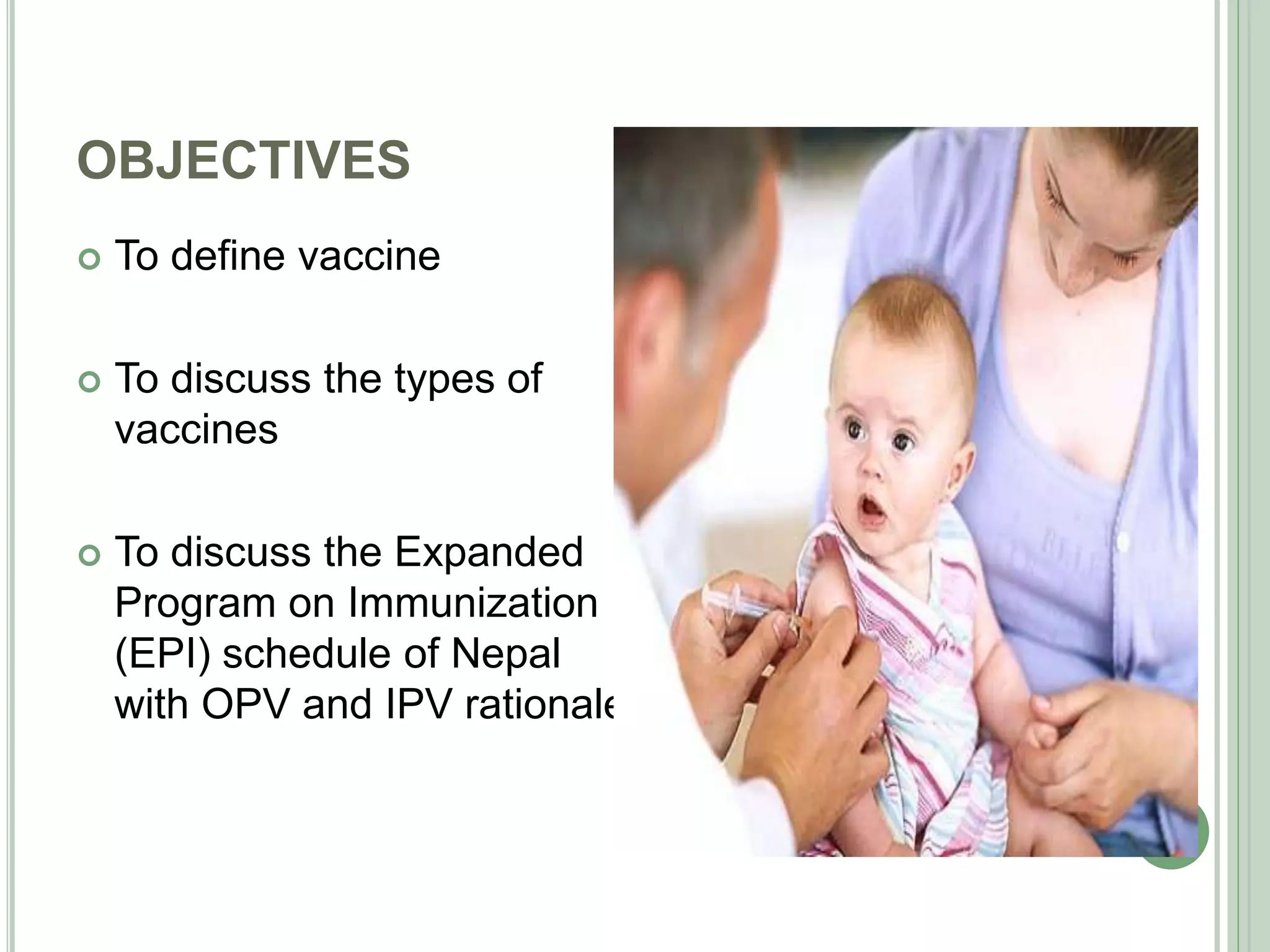
 To define vaccine
 To discuss the types of
vaccines
 To discuss the Expanded
Program on Immunization
(EPI) schedule of Nepal
with OPV and IPV rationale
2
WHAT IS VACCINE?
 Vaccine is an immuno biological substance
designed to produce specific protection against
a give disease
 Artificial Active Immunity
 Triggers humoral and cell mediated immune
response or both mimicking the natural infection
3
TYPES OF VACCINES
 Live attenuated vaccines
 Inactivated /Killed vaccines
 Toxoid vaccines
 Cellular fraction / sub unit
 Conjugate vaccines
 Acellular vaccines
 DNA vaccines
 Recombinant vaccines
 Combination vaccines
4
LIVE ATTENUATED VACCINE
 Prepared from live (generally attenuated) organism
 Organisms lost pathogenicity but retain immunogenicity
due to repeated culturing
 More potent than other vaccines because:
 Resultant antigenic dose is higher and sustained
 Contain all major and minor antigenic components
 Engage body tissues causing persistent immune response
 Viral live vaccines are provoke excellent immune response
 Immunization usually with a single dose
5
LIVE ATTENUATED VACCINE
 Example of live vaccines
include Measles, Mumps,
BCG, Influenza, Rubella and
oral polio vaccine
 Contraindication
 Immunocompromised state
(due to therapy or disease)
 Pregnancy
6
INACTIVATED OR KILLED VACCINE
 Organism are killed by heat or
chemical and injected into body
 Usually safe, requires adjuvants
and less efficacious than live
vaccine
 Requires booster dose
 Examples include J.E , Rabies,
Hepatitis B, IPV
 Contraindication
 Severe local or general reaction
in previous dose 7
TOXOID VACCINES
 Toxins produce by organism
are detoxicated and used in
preparation of vaccine
 Antibodies produced
neutralized the toxin rather
than act upon the organism
 Toxicity is lost but antigenicity
is retained
 Examples – Diphtheria and
Tetanus
8
CELLULAR FRACTION / SUB UNIT
 Conjugate vaccines
 Pieces from coats of bacteria are
linked to carrier protein which cause
immune response
 Example – Hib
 Acellular vaccines
 Vaccine that contain cellular material but
not complete cell
 Only those antigen/epitopes that evoke
best immune response are selected
 Example - Pertussis
9
DNA VACCINES
 Genes for microbe’s antigen are introduced into
body, some cells take up the DNA
 Microbe’s DNA then instructs cell to synthesize
antigens
 The person’s own body become vaccine making
factories creating antigens required to provoke
immune response
 DNA vaccines being tested in humans include
those against the viruses that cause influenza and
herpes
10
11
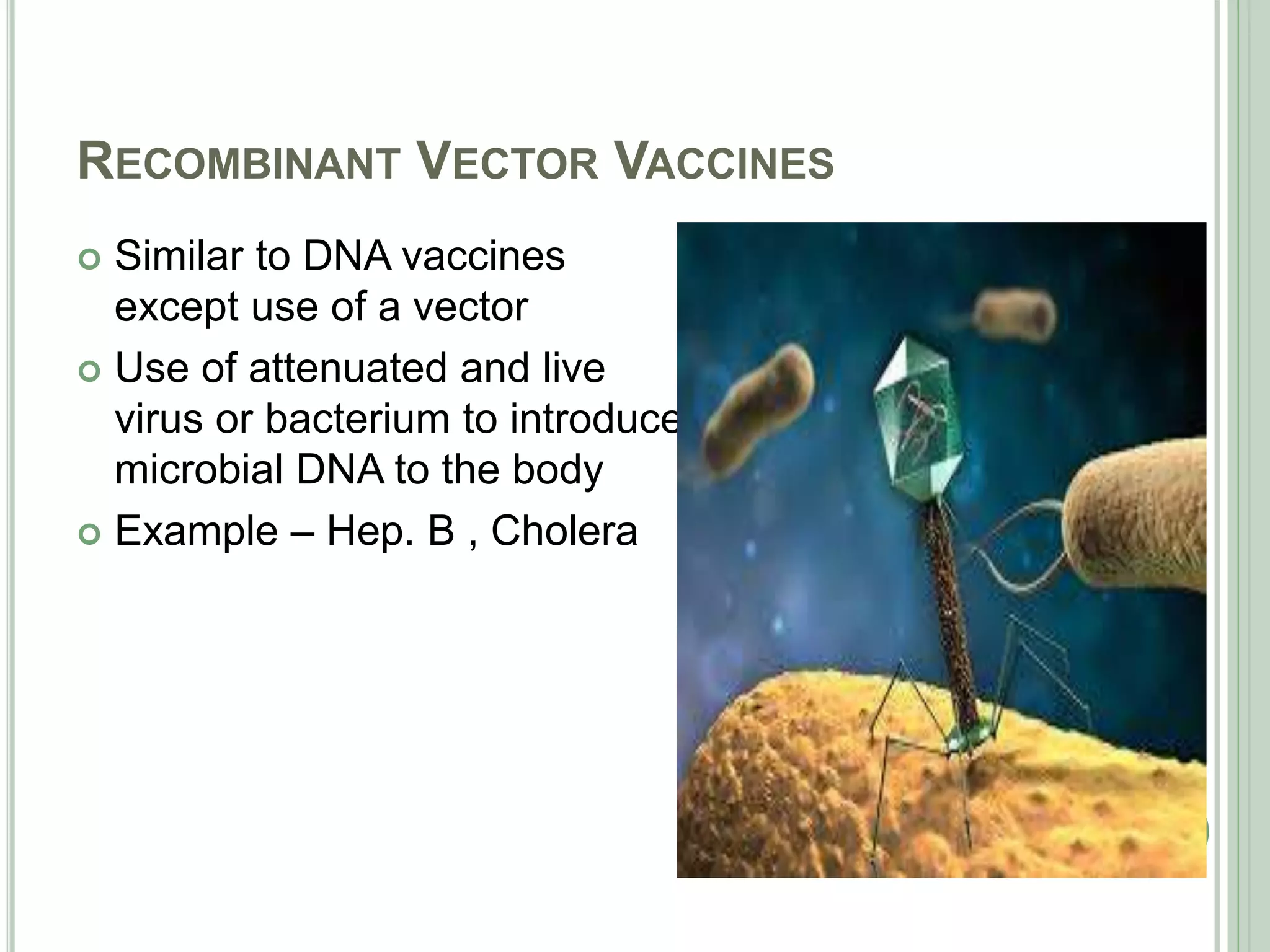
RECOMBINANT VECTOR VACCINES
 Similar to DNA vaccines
except use of a vector
 Use of attenuated and live
virus or bacterium to introduce
microbial DNA to the body
 Example – Hep. B , Cholera
12
COMBINATION VACCINES
 More than one kind of
immunizing agent is
included in the vaccine
 It simplifies
administration and
reduces cost
 Example - DPT, DT,
MMR
13
14
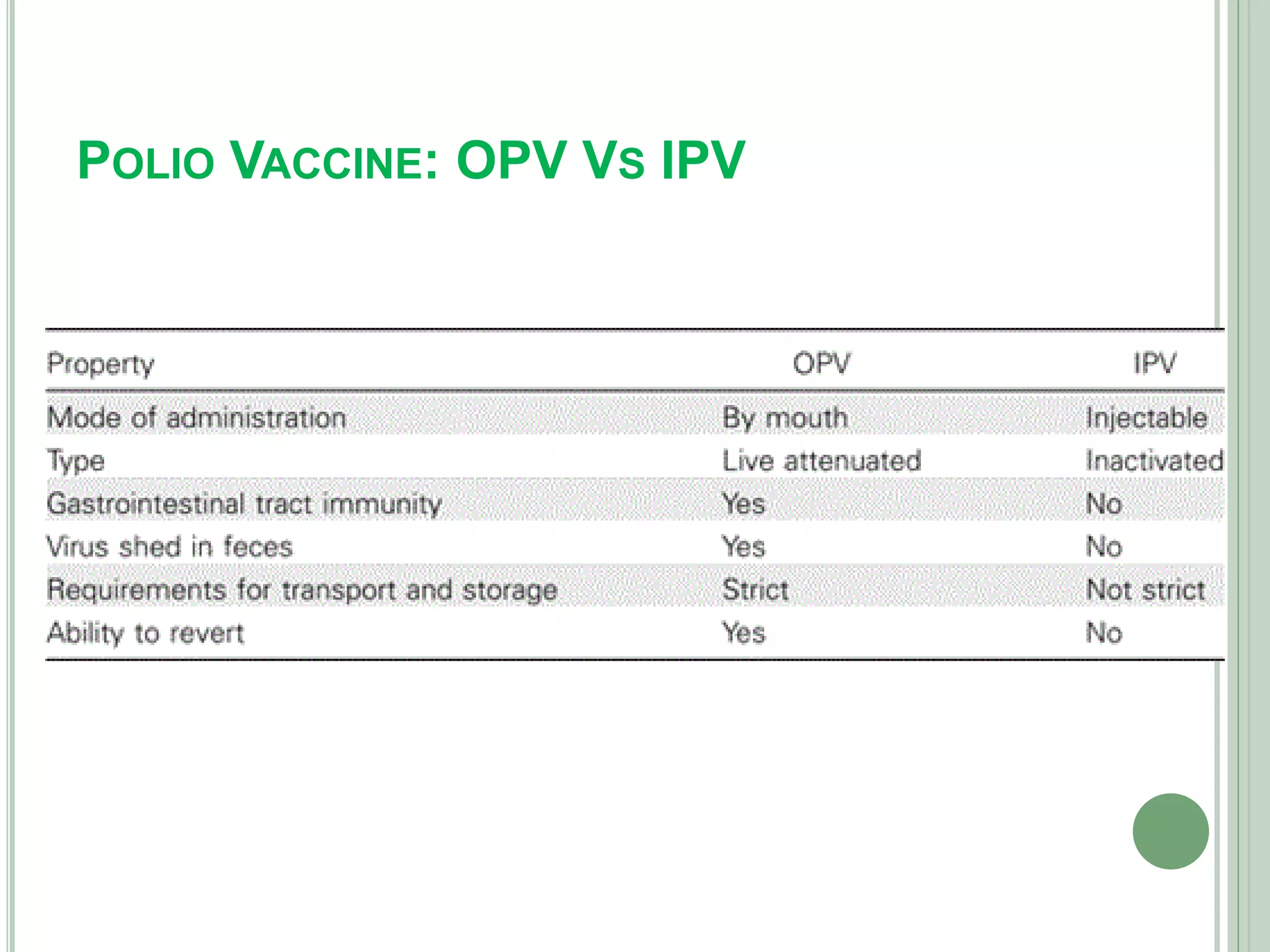
POLIO VACCINE: OPV VS IPV
 Routine immunization with OPV must cease after the
eradication of poliovirus because of the danger of
outbreaks of circulating vaccine-derived poliovirus and
the risk of VAPP (Vaccine Associated Paralytic
Poliomyelitis)
 In the regions of the world in which wild-type poliovirus has
been eliminated, moving to an IPV or IPV/OPV sequential
schedule will reduce or eliminate the risk of VAPP and
outbreaks of circulating vaccine-derived poliovirus, as well as
increase the likelihood of countries agreeing to stop
administering OPV after eradication is achieved.
 IPV could also be used with OPV in routine schedules to
increase immune responses and to decrease the circulation of
wild-type poliovirus in countries in which transmission has not
been stopped.
IPV – RATIONALE
 Type 2 poliovirus mutates into virulent form
 IPV contains killed virus, so IPV mitigates this risk
 IPV in addition to OPV provides better immunity
 All countries switched from tOPV to bOPV (minus type 2) 2016
 Introduction of IPV before this ensure protection against type 2
 Once virus circulation stopped everywhere, OPV withdrawn
17
18

Types of vaccines

  • 1.
    1 Prepared by: AnishDhakal (Aryan) anishdhakal718@gmail.com MBBS Student Patan Academy of Health Sciences
  • 2.
    OBJECTIVES  To definevaccine  To discuss the types of vaccines  To discuss the Expanded Program on Immunization (EPI) schedule of Nepal with OPV and IPV rationale 2
  • 3.
    WHAT IS VACCINE? Vaccine is an immuno biological substance designed to produce specific protection against a give disease  Artificial Active Immunity  Triggers humoral and cell mediated immune response or both mimicking the natural infection 3
  • 4.
    TYPES OF VACCINES Live attenuated vaccines  Inactivated /Killed vaccines  Toxoid vaccines  Cellular fraction / sub unit  Conjugate vaccines  Acellular vaccines  DNA vaccines  Recombinant vaccines  Combination vaccines 4
  • 5.
    LIVE ATTENUATED VACCINE Prepared from live (generally attenuated) organism  Organisms lost pathogenicity but retain immunogenicity due to repeated culturing  More potent than other vaccines because:  Resultant antigenic dose is higher and sustained  Contain all major and minor antigenic components  Engage body tissues causing persistent immune response  Viral live vaccines are provoke excellent immune response  Immunization usually with a single dose 5
  • 6.
    LIVE ATTENUATED VACCINE Example of live vaccines include Measles, Mumps, BCG, Influenza, Rubella and oral polio vaccine  Contraindication  Immunocompromised state (due to therapy or disease)  Pregnancy 6
  • 7.
    INACTIVATED OR KILLEDVACCINE  Organism are killed by heat or chemical and injected into body  Usually safe, requires adjuvants and less efficacious than live vaccine  Requires booster dose  Examples include J.E , Rabies, Hepatitis B, IPV  Contraindication  Severe local or general reaction in previous dose 7
  • 8.
    TOXOID VACCINES  Toxinsproduce by organism are detoxicated and used in preparation of vaccine  Antibodies produced neutralized the toxin rather than act upon the organism  Toxicity is lost but antigenicity is retained  Examples – Diphtheria and Tetanus 8
  • 9.
    CELLULAR FRACTION /SUB UNIT  Conjugate vaccines  Pieces from coats of bacteria are linked to carrier protein which cause immune response  Example – Hib  Acellular vaccines  Vaccine that contain cellular material but not complete cell  Only those antigen/epitopes that evoke best immune response are selected  Example - Pertussis 9
  • 10.
    DNA VACCINES  Genesfor microbe’s antigen are introduced into body, some cells take up the DNA  Microbe’s DNA then instructs cell to synthesize antigens  The person’s own body become vaccine making factories creating antigens required to provoke immune response  DNA vaccines being tested in humans include those against the viruses that cause influenza and herpes 10
  • 11.
  • 12.
    RECOMBINANT VECTOR VACCINES Similar to DNA vaccines except use of a vector  Use of attenuated and live virus or bacterium to introduce microbial DNA to the body  Example – Hep. B , Cholera 12
  • 13.
    COMBINATION VACCINES  Morethan one kind of immunizing agent is included in the vaccine  It simplifies administration and reduces cost  Example - DPT, DT, MMR 13
  • 14.
  • 15.
  • 16.
     Routine immunizationwith OPV must cease after the eradication of poliovirus because of the danger of outbreaks of circulating vaccine-derived poliovirus and the risk of VAPP (Vaccine Associated Paralytic Poliomyelitis)  In the regions of the world in which wild-type poliovirus has been eliminated, moving to an IPV or IPV/OPV sequential schedule will reduce or eliminate the risk of VAPP and outbreaks of circulating vaccine-derived poliovirus, as well as increase the likelihood of countries agreeing to stop administering OPV after eradication is achieved.  IPV could also be used with OPV in routine schedules to increase immune responses and to decrease the circulation of wild-type poliovirus in countries in which transmission has not been stopped.
  • 17.
    IPV – RATIONALE Type 2 poliovirus mutates into virulent form  IPV contains killed virus, so IPV mitigates this risk  IPV in addition to OPV provides better immunity  All countries switched from tOPV to bOPV (minus type 2) 2016  Introduction of IPV before this ensure protection against type 2  Once virus circulation stopped everywhere, OPV withdrawn 17
  • 18.