AUTISM
Brittney Ortega
San Diego Christian College
Ed 300
WHAT IS AUTISM?
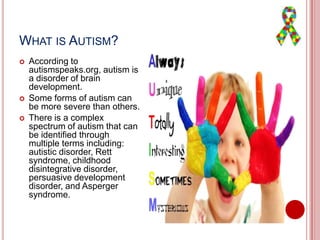
 According to
autismspeaks.org, autism is
a disorder of brain
development.
 Some forms of autism can
be more severe than others.
 There is a complex
spectrum of autism that can
be identified through
multiple terms including:
autistic disorder, Rett
syndrome, childhood
disintegrative disorder,
persuasive development
disorder, and Asperger
syndrome.
WHAT IS AUTISM?
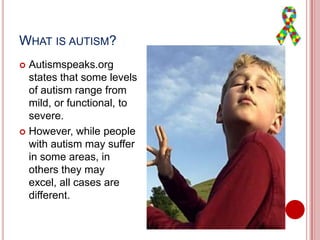
 Autismspeaks.org
states that some levels
of autism range from
mild, or functional, to
severe.
 However, while people
with autism may suffer
in some areas, in
others they may
excel, all cases are
different.
WHAT IS AUTISM?
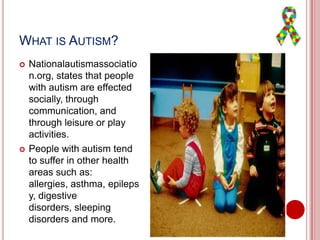
 Nationalautismassociatio
n.org, states that people
with autism are effected
socially, through
communication, and
through leisure or play
activities.
 People with autism tend
to suffer in other health
areas such as:
allergies, asthma, epileps
y, digestive
disorders, sleeping
disorders and more.
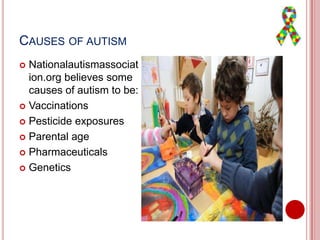
CAUSES OF AUTISM
 Nationalautismassociat
ion.org believes some
causes of autism to be:
 Vaccinations
 Pesticide exposures
 Parental age
 Pharmaceuticals
 Genetics
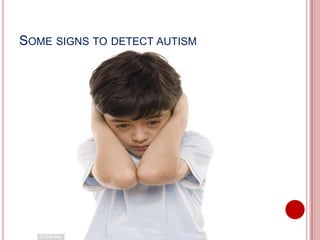
SOME SIGNS TO DETECT AUTISM
SOME SIGNS TO DETECT AUTISM IN BABIES
 Autismspeaks.org
informs us of signs to
look for in child autism:
 No smiles or joyful
expressions by 6 months
 No sharing of sounds,
smiles, or other facial
expressions by 9 months
 No babbling by 12
months
 No pointing, showing,
reaching, or waving by 12
months
 No words by 16 months
 No meaningful 2 word
phrases by 24 months
 Loss of speech, babbling,
or social skills at any age
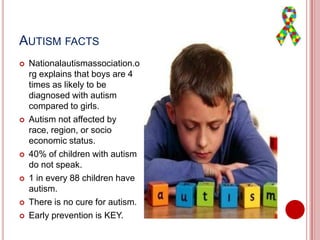
AUTISM FACTS
 Nationalautismassociation.o
rg explains that boys are 4
times as likely to be
diagnosed with autism
compared to girls.
 Autism not affected by
race, region, or socio
economic status.
 40% of children with autism
do not speak.
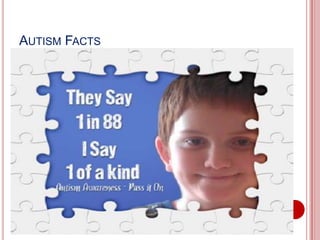
 1 in every 88 children have
autism.
 There is no cure for autism.
 Early prevention is KEY.
AUTISM FACTS
AUTISM TREATMENTS
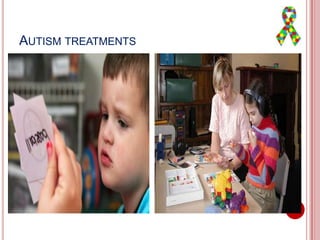
 Autism can best be treated
when early intervention
occurs.
 Nationalautismassociation.o
rg states that multiple
therapies can be used to
treat autism:
 Behavioral, occupational, ph
ysical, speech, vision, music
, and canine therapies all
help people with autism.
 Some specialists state that
diet is important to
prevention. Gluten-
free, casein-free, and
specific carbohydrate diet
according to body
chemistry.
AUTISM TREATMENTS
AUTISM TREATMENTS
 Howcast.com is a website that has hundreds of
how-to videos. Amongst its health section, a video
on “How to Help a Child With Autism” was posted.
The video emphasizes many of the points used in
this power point:
 http://www.howcast.com/videos/218410-How-to-
Help-a-Child-with-Autism
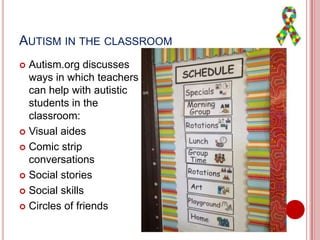
AUTISM IN THE CLASSROOM
 Autism.org discusses
ways in which teachers
can help with autistic
students in the
classroom:
 Visual aides
 Comic strip
conversations
 Social stories
 Social skills
 Circles of friends
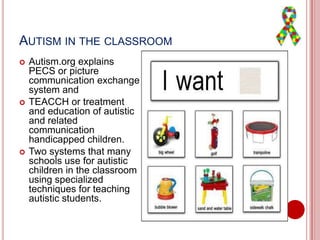
AUTISM IN THE CLASSROOM
 Autism.org explains
PECS or picture
communication exchange
system and
 TEACCH or treatment
and education of autistic
and related
communication
handicapped children.
 Two systems that many
schools use for autistic
children in the classroom
using specialized
techniques for teaching
autistic students.
AUTISM IN THE CLASSROOM
 SPELL is a program designed by the National
Autistic Society’s schools in order to provide the
best form of education to students with autism.
 Autism.org explains how SPELL works with autistic
students:
 Structure
 Positive approaches
 Empathy
 Low arousal environments
 Links from one’s personal life to their therapies in
order to create consistent environments for learning
AUTISM IN THE CLASSROOM
WORKS CITED
 (n.d). "How Can I Help a Child with Autism at My School?" -. National Autistic Society
UK. Retrieved July 12, 2013. From http://www.autism.org.uk/working-
with/education/educational-professionals- in-schools/lessons-and-breaktimes/how-can-i-
help-a-child-with-autism-at-my- school.aspx
 (n.d). "How to Help a Child with Autism." Howcast. Retrieved July 12, 2013. From
http://www.howcast.com/videos/218410-How-to-Help-a-Child-with-Autism
 (n.d). "National Autism Association." National Autism Association RSS. National
Autism Association. Retrieved July 12, 2013. From
http://nationalautismassociation.org/
 (n.d). "What Is Autism?" Autism Speaks. Autism Speaks Inc. Retrieved July 12, 2013.
From http://www.autismspeaks.org/

Autism pp

  • 1.
    AUTISM Brittney Ortega San DiegoChristian College Ed 300
  • 2.
    WHAT IS AUTISM? According to autismspeaks.org, autism is a disorder of brain development.  Some forms of autism can be more severe than others.  There is a complex spectrum of autism that can be identified through multiple terms including: autistic disorder, Rett syndrome, childhood disintegrative disorder, persuasive development disorder, and Asperger syndrome.
  • 3.
    WHAT IS AUTISM? Autismspeaks.org states that some levels of autism range from mild, or functional, to severe.  However, while people with autism may suffer in some areas, in others they may excel, all cases are different.
  • 4.
    WHAT IS AUTISM? Nationalautismassociatio n.org, states that people with autism are effected socially, through communication, and through leisure or play activities.  People with autism tend to suffer in other health areas such as: allergies, asthma, epileps y, digestive disorders, sleeping disorders and more.
  • 5.
    CAUSES OF AUTISM Nationalautismassociat ion.org believes some causes of autism to be:  Vaccinations  Pesticide exposures  Parental age  Pharmaceuticals  Genetics
  • 6.
    SOME SIGNS TODETECT AUTISM
  • 7.
    SOME SIGNS TODETECT AUTISM IN BABIES  Autismspeaks.org informs us of signs to look for in child autism:  No smiles or joyful expressions by 6 months  No sharing of sounds, smiles, or other facial expressions by 9 months  No babbling by 12 months  No pointing, showing, reaching, or waving by 12 months  No words by 16 months  No meaningful 2 word phrases by 24 months  Loss of speech, babbling, or social skills at any age
  • 8.
    AUTISM FACTS  Nationalautismassociation.o rgexplains that boys are 4 times as likely to be diagnosed with autism compared to girls.  Autism not affected by race, region, or socio economic status.  40% of children with autism do not speak.  1 in every 88 children have autism.  There is no cure for autism.  Early prevention is KEY.
  • 9.
  • 10.
    AUTISM TREATMENTS  Autismcan best be treated when early intervention occurs.  Nationalautismassociation.o rg states that multiple therapies can be used to treat autism:  Behavioral, occupational, ph ysical, speech, vision, music , and canine therapies all help people with autism.  Some specialists state that diet is important to prevention. Gluten- free, casein-free, and specific carbohydrate diet according to body chemistry.
  • 11.
  • 12.
    AUTISM TREATMENTS  Howcast.comis a website that has hundreds of how-to videos. Amongst its health section, a video on “How to Help a Child With Autism” was posted. The video emphasizes many of the points used in this power point:  http://www.howcast.com/videos/218410-How-to- Help-a-Child-with-Autism
  • 13.
    AUTISM IN THECLASSROOM  Autism.org discusses ways in which teachers can help with autistic students in the classroom:  Visual aides  Comic strip conversations  Social stories  Social skills  Circles of friends
  • 14.
    AUTISM IN THECLASSROOM  Autism.org explains PECS or picture communication exchange system and  TEACCH or treatment and education of autistic and related communication handicapped children.  Two systems that many schools use for autistic children in the classroom using specialized techniques for teaching autistic students.
  • 15.
    AUTISM IN THECLASSROOM  SPELL is a program designed by the National Autistic Society’s schools in order to provide the best form of education to students with autism.  Autism.org explains how SPELL works with autistic students:  Structure  Positive approaches  Empathy  Low arousal environments  Links from one’s personal life to their therapies in order to create consistent environments for learning
  • 16.
    AUTISM IN THECLASSROOM
  • 17.
    WORKS CITED  (n.d)."How Can I Help a Child with Autism at My School?" -. National Autistic Society UK. Retrieved July 12, 2013. From http://www.autism.org.uk/working- with/education/educational-professionals- in-schools/lessons-and-breaktimes/how-can-i- help-a-child-with-autism-at-my- school.aspx  (n.d). "How to Help a Child with Autism." Howcast. Retrieved July 12, 2013. From http://www.howcast.com/videos/218410-How-to-Help-a-Child-with-Autism  (n.d). "National Autism Association." National Autism Association RSS. National Autism Association. Retrieved July 12, 2013. From http://nationalautismassociation.org/  (n.d). "What Is Autism?" Autism Speaks. Autism Speaks Inc. Retrieved July 12, 2013. From http://www.autismspeaks.org/